

EN 1186-1:2002
(Main)Materials and articles in contact with foodstuffs - Plastics - Part 1: Guide to the selection of conditions and test methods for overall migration
- Abstract
This part of this European Prestandard provides a guide to the selection of the appropriate conditions and methods of test for the determination of overall migration into food simulants from plastics which are intended to come into contact with foodstuffs.
- Status
- Published
- Publication Date
- 16-Apr-2002
- Withdrawal Date
- 30-Oct-2002
- Technical Committee
- CEN/TC 194 - Utensils in contact with food
- Drafting Committee
- CEN/TC 194/SC 1/WG 1 - Overall migration
- Current Stage
- 9093 - Decision to confirm - Review Enquiry
- Start Date
- 17-Jul-2007
- Completion Date
- 17-Jul-2007


Overview
EN 1186-1:2002 is the CEN guide for selecting test conditions and methods for overall migration from plastics intended to be in contact with foodstuffs. It explains how to choose appropriate migration, substitute and alternative test methods using food simulants and test media to determine the mass transferred from plastics into food-like media. The standard supports testing for regulatory compliance and is part of the EN 1186 series covering plastics food contact materials.
Key Topics
- Scope and purpose: Guidance on selecting conditions and methods to determine overall migration into food simulants and test media.
- Types of test:
- Migration tests using defined food simulants under conventional conditions.
- Substitute tests using test media (iso‑octane, 95% ethanol, modified polyphenylene oxide) when fatty simulant tests are not feasible.
- Alternative/Extraction tests using volatile or strongly extracting media where scientific evidence supports their equivalence or conservativeness.
- Food simulants defined:
- Simulant A: distilled water
- Simulant B: 3% acetic acid (w/v)
- Simulant C: 10% ethanol (v/v)
- Simulant D: fatty simulant (reference: rectified olive oil; may be replaced by synthetic triglyceride mixtures, sunflower or corn oil meeting specifications)
- Reduction factors: Conventionally applied numbers (2 to 5) to account for greater extractive power of some simulants for certain fatty foods.
- Selection criteria: When to use substitute tests (e.g., interference, incomplete oil extraction, excessive absorption, instability, or reaction with fat).
- Ancillary requirements: apparatus, sample geometry, precision (repeatability/reproducibility), tolerances on contact times/temperatures, and test reporting.
- Normative and informative annexes: characteristics of fatty simulants, tolerances, supports/cells, and relationship to EU Directives (Annex ZA).
Applications
Who uses EN 1186-1:2002:
- Plastics manufacturers designing food contact materials to demonstrate compliance with migration limits.
- Testing laboratories selecting validated methods and justifying substitute or alternative tests.
- Regulatory and compliance teams assessing conformity with EU legislation and supporting test choices linked to directives.
- Certification bodies and accreditation schemes (laboratory validation, proficiency testing).
Practical uses:
- Defining which simulant and test method to apply for a specific packaging application (films, pouches, containers).
- Choosing substitute media and applying reduction factors when direct fatty simulant testing is impractical.
- Preparing coherent test reports and ensuring traceability to EN 1186 series requirements.
Related Standards
- Other parts of EN 1186 (Parts 2–15) specify specific test methods (e.g., immersion, cell, pouch, high/low temperature, olive oil methods).
- Laboratory accreditation and quality references: EN 45001/EN 45002/EN 45003 (general laboratory and accreditation criteria).
- Annex ZA provides links to relevant EU Directives (e.g., Council Directive 89/109/EEC and Commission Directive 90/128/EEC).
Relations
- Effective Date
- 22-Dec-2008
- Effective Date
- 28-Jan-2026
- Effective Date
- 28-Jan-2026
- Effective Date
- 28-Jan-2026
- Effective Date
- 28-Jan-2026
- Effective Date
- 28-Jan-2026
- Effective Date
- 28-Jan-2026
- Effective Date
- 28-Jan-2026
- Effective Date
- 28-Jan-2026
- Effective Date
- 28-Jan-2026
- Effective Date
- 28-Jan-2026
- Effective Date
- 28-Jan-2026
- Effective Date
- 28-Jan-2026
- Effective Date
- 28-Jan-2026
- Effective Date
- 28-Jan-2026
Get Certified
Connect with accredited certification bodies for this standard

BSI Group
BSI (British Standards Institution) is the business standards company that helps organizations make excellence a habit.

Bureau Veritas
Bureau Veritas is a world leader in laboratory testing, inspection and certification services.

DNV
DNV is an independent assurance and risk management provider.
Sponsored listings
Frequently Asked Questions
EN 1186-1:2002 is a standard published by the European Committee for Standardization (CEN). Its full title is "Materials and articles in contact with foodstuffs - Plastics - Part 1: Guide to the selection of conditions and test methods for overall migration". This standard covers: This part of this European Prestandard provides a guide to the selection of the appropriate conditions and methods of test for the determination of overall migration into food simulants from plastics which are intended to come into contact with foodstuffs.
This part of this European Prestandard provides a guide to the selection of the appropriate conditions and methods of test for the determination of overall migration into food simulants from plastics which are intended to come into contact with foodstuffs.
EN 1186-1:2002 is classified under the following ICS (International Classification for Standards) categories: 67.250 - Materials and articles in contact with foodstuffs. The ICS classification helps identify the subject area and facilitates finding related standards.
EN 1186-1:2002 has the following relationships with other standards: It is inter standard links to ENV 1186-1:1994, EN 1186-4:2002, EN 1186-12:2002, EN 1186-8:2002, EN 1186-3:2002, EN 1186-15:2002, EN 1186-7:2002, EN 1186-11:2002, EN 1186-14:2002, EN 1186-2:2022, EN 1186-3:2022, EN 1186-10:2002, EN 1186-13:2002, EN 1186-6:2002, EN 1186-2:2002. Understanding these relationships helps ensure you are using the most current and applicable version of the standard.
EN 1186-1:2002 is associated with the following European legislation: EU Directives/Regulations: 89/109/EEC; Standardization Mandates: M/052. When a standard is cited in the Official Journal of the European Union, products manufactured in conformity with it benefit from a presumption of conformity with the essential requirements of the corresponding EU directive or regulation.
EN 1186-1:2002 is available in PDF format for immediate download after purchase. The document can be added to your cart and obtained through the secure checkout process. Digital delivery ensures instant access to the complete standard document.
Standards Content (Sample)
2003-01.Slovenski inštitut za standardizacijo. Razmnoževanje celote ali delov tega standarda ni dovoljeno.Materiali in predmeti v stiku z živili - Polimerni materiali - 1. del: Vodilo za izbiro pogojev in preskusnih metod za celotno migracijoWerkstoffe und Gegenstände in Kontakt mit Lebensmitteln - Kunststoffe - Teil 1: Leitfaden für die Auswahl der Prüfbedingungen und Prüfverfahren für die GesamtmigrationMatériaux et objets en contact avec les denrées alimentaires - Matiere plastique - Partie 1: Guide pour le choix des conditions et des méthodes d'essai en matiere de migration globaleMaterials and articles in contact with foodstuffs - Plastics - Part 1: Guide to the selection of conditions and test methods for overall migration67.250Materiali in predmeti v stiku z živiliMaterials and articles in contact with foodstuffsICS:Ta slovenski standard je istoveten z:EN 1186-1:2002SIST EN 1186-1:2002en01-september-2002SIST EN 1186-1:2002SLOVENSKI
STANDARDSIST ENV 1186-1:19971DGRPHãþD
EUROPEAN STANDARDNORME EUROPÉENNEEUROPÄISCHE NORMEN 1186-1April 2002ICS 67.250Supersedes ENV 1186-1:1994English versionMaterials and articles in contact with foodstuffs - Plastics - Part1: Guide to the selection of conditions and test methods foroverall migrationMatériaux et objets en contact avec les denréesalimentaires - Matière plastique - Partie 1: Guide pour lechoix des conditions et des méthodes d'essai en matièrede migration globaleWerkstoffe und Gegenstände in Kontakt mit Lebensmitteln- Kunststoffe - Teil 1: Leitfaden für die Auswahl derPrüfbedingungen und Prüfverfahren für dieGesamtmigrationThis European Standard was approved by CEN on 5 January 2002.CEN members are bound to comply with the CEN/CENELEC Internal Regulations which stipulate the conditions for giving this EuropeanStandard the status of a national standard without any alteration. Up-to-date lists and bibliographical references concerning such nationalstandards may be obtained on application to the Management Centre or to any CEN member.This European Standard exists in three official versions (English, French, German). A version in any other language made by translationunder the responsibility of a CEN member into its own language and notified to the Management Centre has the same status as the officialversions.CEN members are the national standards bodies of Austria, Belgium, Czech Republic, Denmark, Finland, France, Germany, Greece,Iceland, Ireland, Italy, Luxembourg, Malta, Netherlands, Norway, Portugal, Spain, Sweden, Switzerland and United Kingdom.EUROPEAN COMMITTEE FOR STANDARDIZATIONCOMITÉ EUROPÉEN DE NORMALISATIONEUROPÄISCHES KOMITEE FÜR NORMUNGManagement Centre: rue de Stassart, 36
B-1050 Brussels© 2002 CENAll rights of exploitation in any form and by any means reservedworldwide for CEN national Members.Ref. No. EN 1186-1:2002 ESIST EN 1186-1:2002
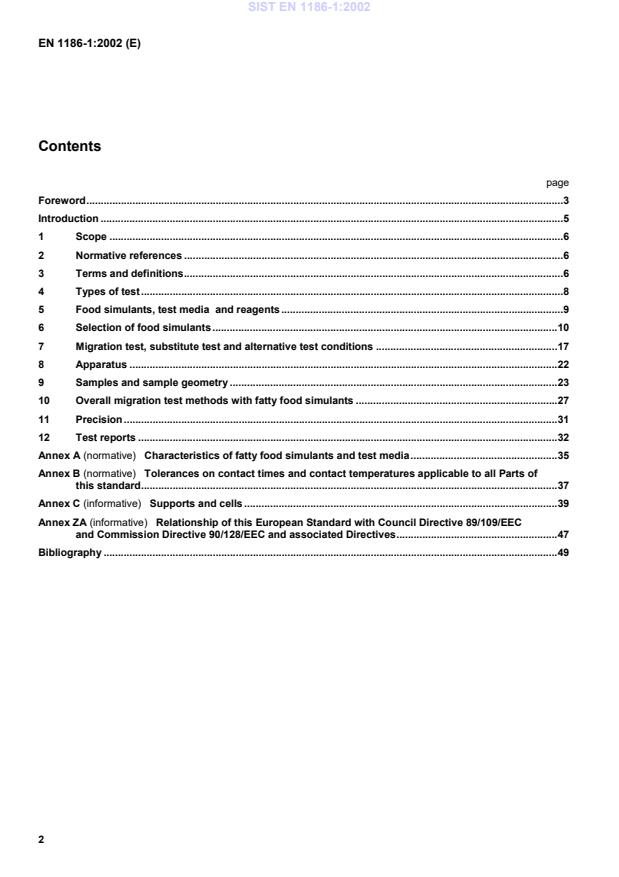
and reagents.96Selection of food simulants.107Migration test, substitute test and alternative test conditions.178Apparatus.229Samples and sample geometry.2310Overall migration test methods with fatty food simulants.2711Precision.3112Test reports.32Annex A (normative)
Characteristics of fatty food simulants and test media.35Annex B (normative)
Tolerances on contact times and contact temperatures applicable to all Parts ofthis standard.37Annex C (informative)
Supports and cells.39Annex ZA (informative)
Relationship of this European Standard with Council Directive 89/109/EECand Commission Directive 90/128/EEC and associated Directives.47Bibliography.49SIST EN 1186-1:2002
Further Directives andamendments to existing Directives are expected which could change the legislative requirements which thisstandard supports.
It is therefore strongly recommended that users of this standard refer to the latest relevantpublished Directive(s) before commencement of any of the test or tests described in this standard.The titles of other parts of this European Standard are as follows:EN 1186 Materials and articles in contact with foodstuffs - Plastics –:Part 2Test methods for overall migration into olive oil by total immersionPart 3Test methods for overall migration into aqueous food simulants by total immersionPart 4Test methods for overall migration into olive oil by cellPart 5Test methods for overall migration into aqueous food simulants by cellPart 6Test methods for overall migration into olive oil using a pouchPart 7Test methods for overall migration into aqueous food simulants using a pouchPart 8Test methods for overall migration into olive oil by article fillingPart 9Test methods for overall migration into aqueous food simulants by article fillingPart 10Test methods for overall migration into olive oil (modified method for use in cases whereincomplete extraction of olive oil occurs)Part 11Test methods for overall migration into mixtures of
14C-labelled synthetic triglyceridesPart 12Test methods for overall migration at low temperaturesPart 13Test methods for overall migration at high temperaturesPart 14Test method for substitute tests for overall migration into iso-octane and 95 % aqueousethanolSIST EN 1186-1:2002
Annex C is for information onlyAccording to the CEN/CENELEC Internal Regulations, the national standards organizations of the followingcountries are bound to implement this European Standard: Austria, Belgium, Czech Republic, Denmark, Finland,France, Germany, Greece, Iceland, Ireland, Italy, Luxembourg, Malta, Netherlands, Norway, Portugal, Spain,Sweden, Switzerland and the United Kingdom.SIST EN 1186-1:2002
Indeed, owing to the practical difficulties inherent in testing with involatile extractants such asfats and the multitude of applications in which plastics articles come into contact with food, there are many methodsand permitted variations to methods in this standard.EN 1186-1 is intended to give advice on the selection of the most appropriate type of test, test conditions and testmethod for a given application of a plastics article and is intended to be read in its entirety before testing protocolsare finalized.
For most plastics articles methods in EN 1186-2 to EN 1186-9 are suitable, according to the form inwhich the article is tested.
Subsequent Parts of this standard are intended to be used in conjunction with themethods in EN 1186-2 to EN 1186-9 for more difficult samples and at other temperatures.The general criteria for the operation and assessment of testing laboratories as well as the general criteria forlaboratory accreditation bodies are set out in EN 45001, EN 45002 and EN 45003.
It is recommended thatlaboratories using this standard validate their procedures by testing certified reference samples and by taking partin a proficiency scheme.
Reference plastics samples with well characterized values for overall migration into thefatty food simulant olive oil have been prepared as part of a programme sponsored by the Standards,Measurement & Testing Programme of the European Commission, DG XII.
Suitable proficiency schemes areoperated in Germany and in the United Kingdom, for example the German Assessment Scheme for Food Testing(GAFT) and the Food Analysis Performance Assessment Scheme (FAPAS) conducted by the Central ScienceLaboratory of the Ministry of Agriculture, Fisheries and Food.SIST EN 1186-1:2002
Thesenormative references are cited at the appropriate places in the text and the publications are listed hereafter. Fordated references, subsequent amendments to and revisions of any of these publications apply to this EuropeanStandard only when incorporated in it by amendment or revision.
For undated references the latest edition of thepublication referred to applies (including amendments).EN 1186:2002, Materials and articles in contact with foodstuffs – Plastics.ENV 1186-10, Materials and articles in contact with foodstuffs – Plastics - Part 10: Test methods for overallmigration into olive oil (modified method for use in cases where incomplete extraction of olive oil occurs).ENV 1186-13, Materials and articles in contact with foodstuffs – Plastics - Part 13: Test methods for overallmigration at high temperatures.ENV 1186-14, Materials and articles in contact with foodstuffs – Plastics - Part 14: Test methods for 'substitutetests' for overall migration from plastics intended to come into contact with fatty foodstuffs using test media iso-octane and 95 % ethanol.3 Terms and definitionsFor the purposes of this European Standard, the following terms and definitions apply.3.1plasticsorganic macromolecular compounds obtained by polymerization, polycondensation, polyaddition or any similarprocess from molecules with a lower molecular weight or by chemical alteration of natural molecules. Othersubstances or matter may be added to such compounds3.2final articlearticle in its ready-for-use state or as sold3.3samplematerial or article under investigation3.4test specimenportion of the sample on which a test is performed3.5test pieceportion of the test specimen3.6conventional ovenoven where the air within the oven is heated and this heat is then transferred to the food through the plastic asopposed to a microwave oven where the food itself is heated directly by microwave irradiationSIST EN 1186-1:2002
Thesubstitute tests involve the use of all of the substitute test media, 95 % ethanol in aqueous solution, iso-octane andmodified polyphenylene oxide under the test conditions corresponding to the test conditions for simulant D, seeTable 4.
A new test specimen is used for each test. The reduction factors, 2 to 5, are applicable to these substitutetests, see clause 6.
To ascertain compliance with the overall migration limit the highest value obtained using all ofthe test media is selected.4.3 Alternative tests4.3.1 "Alternative tests" with volatile mediaThe results of alternative tests, using volatile test media such as iso-octane and 95 % ethanol in aqueous solutionor other volatile solvents or mixtures of solvents may be used to demonstrate compliance with the legislative limit,provided that:a)
the result obtained in a comparison test shows that the value is equal to or greater than those obtainedin the migration test with a fatty food simulant;b)
the migration in the alternative test does not exceed the overall migration limit, after application ofappropriate reduction factors.If either or both conditions are not fulfilled, then the migration tests (4.1) have to be performed.4.3.2 Extraction testsOther tests are permitted which use other test media having very strong extractive power under severe testconditions, if it is generally recognized, on the basis of scientific evidence, that the results obtained using theseextraction tests are equal to or higher than those obtained with simulant D.SIST EN 1186-1:2002
and reagents5.1 Aqueous food simulantsThe aqueous food simulants shall be of the following quality:- distilled water or water of equivalent quality, simulant A;- 3 % acetic acid (w/v) in aqueous solution, simulant B;For the purposes of this standard this means a solution prepared by diluting 30 g of acetic acid with distilledwater to a volume of 1 l;-
10 % ethanol (v/v) in aqueous solution, simulant C.For liquids or beverages with an ethanol content greater than 10 % (v/v) the test is carried out with aqueoussolutions of ethanol of a similar strength.Each of the above food simulants shall give a non-volatile residue of less than 5 mg/l, when evaporated to drynessand dried to constant mass at 105 °C to 110 °C.5.2 Fatty food simulantsThe fatty food simulants are as follows:- rectified olive oil, "reference simulant D".This "reference simulant D" may be replaced by a synthetic mixture of triglycerides or sunflower oil or corn oil withstandardized specifications.
These are known as "other fatty food simulants" and called "simulant D".For the characteristics of olive oil, a synthetic mixture of triglycerides, sunflower oil and corn oil, see annex A.NOTEWhen these fatty food simulants are used to simulate some classes of food, reduction factors can be used, see 6.2and Table 2.5.3 Test media5.3.1 Test media for substitute testsThe test media to be used in substitute tests are iso-octane, 95 % ethanol in aqueous solution and a modifiedpolyphenylene oxide (MPPO).
The characteristics of modified polyphenylene oxide are to be found in annex A.5.3.2 Test media for alternative testsThese are volatile media such as iso-octane and 95 % ethanol in aqueous solution or other volatile solvents ormixtures of solvents.5.4 ReagentsUnless otherwise required, reagents shall be of analytical quality.SIST EN 1186-1:2002
Solid reagents meight not be homogeneous with respect to contaminants not addressed byspecifications, therefore it may be necessary to demonstrate that such reagents are suitable for use.6 Selection of food simulantsNOTECommission Directive 85/572/EEC [6] specifies the use of 15 % ethanol (v/v) in aqueous solution as simulant C.This has been superseded by Commission Directive 97/48/EC [5] the second amendment to Council Directive 82/711/EEC [3]that specifies 10 % ethanol (v/v) in aqueous solution.6.1 Simulating contact with all food typesWhere a plastics article is intended for use in contact with all types of food it shall be tested with 3 % acetic acid(w/v) in aqueous solution, simulant B, 10 % ethanol (v/v) in aqueous solution, simulant C and a fatty food simulant,simulant D, without reduction factors.
If when using any of the other fatty food simulants, see 5.2, the migrationlimit is exceeded, for the judgement of non compliance with the overall migration limit a confirmation of the result byusing olive oil is obligatory, when technically feasible.
If this confirmation is not technically feasible and themigration from the material or article exceeds the limit it shall be deemed not in compliance with the overallmigration limit.6.2 Simulating contact with specific food typesProvision for materials and articles intended to come into contact with specific food types has been made in thefollowing situations:a)
when the material or article is already in contact with a known foodstuff;b)
when the material or article is accompanied, by a specific indication stating with which food types it mayor may not be used, for example "only for aqueous foods";c)
when the material or article is accompanied by a specific indication stating with which foodstuff(s) orgroup(s) of foodstuffs
they may or may not be used.
This indication shall be expressed:1)
at the marketing stage other than retail stage, by using the " reference number" or "descriptionof foodstuffs";2)
at the retail stage using an indication which shall refer to only a few foods or groups of food,preferably with examples which are easy to understand.In situation b) the simulants to be used in the overall migration tests are specified in Table 1.SIST EN 1186-1:2002
Where no 'X' appears, no migration testis required for the heading or subheading concerned.When 'X' is followed by an oblique stroke and a figure, the result of the migration tests should be divided by thenumber indicated.
In the case of certain types of fatty foodstuffs, this figure, known as the 'reduction factor, isconventionally used to take account of the greater extractive capacity of the simulant for such foodstuffs.Where a letter 'a' is shown in brackets after the 'X' only one of the two simulants given should be used:- if the pH value is higher than 4,5, simulant A should be used;- if the pH value is 4,5, or less, simulant B should be used.Where a foodstuff is listed under both a specific heading and a general heading, only the simulant(s) indicatedunder the specific heading is (are) to be used.Where the foodstuff(s) or group(s) of foodstuffs are not included in the Table 2, select the item from the table offood simulants to be selected for testing food contact materials in special cases, which corresponds most closely tothe foodstuff(s) or group of foodstuff(s) under examination.SIST EN 1186-1:2002
alcoholic strength equal to orexceeding 5 % vol.:Beverages shown under heading 01.01 but with analcoholic strength equal to or exceeding 5 % vol.:Wines, spirits and liqueursMiscellaneous: undenatured ethyl alcoholCereals, cereal products, pastry, biscuits, cakes andother bakers' waresStarchesCereals, unprocessed, puffed in flakes, (including popcorn,corn flakes and the like)Cereal flour and mealMacaroni, spaghetti and similar productsPastry, biscuits, cakes, and, other bakers' wares, dry:A.
With fatty substances on the surfaceB.
OtherPastry, cakes, and, other bakers' wares, fresh:A.
With fatty substances on the surfaceB.
OtherChocolate, sugar and products thereof
ConfectioneryproductsChocolate, chocolate-coated products, substitutes andproducts coated with substitutesConfectionery products:A.
In solid form: I.
With fatty substances on the surfaceII.
OtherX(a)XX(a)X(*)X(*)X(**)X(**)X/5X/5X/5X/5(*) This test shall be carried out only in cases where the pH is 4,5 or less.(**) This test may be carried out in the case of liquids or beverages of an alcoholic strength exceeding 10 % vol. with aqueoussolutions of ethanol of a similar strength.
1 The source of the reference number is Commission Directive 85/572/EEC[6]SIST EN 1186-1:2002
In paste form: I.
With fatty substances on the surfaceII.
MoistSugar and sugar productsA.
In solid formB. Honey and the likeC. Molasses and sugar syrupsFruit, vegetables and products thereofWhole fruit, fresh or chilledProcessed fruit:A. Dried or dehydrated fruit, whole or in the form of flour orpowderB. Fruit in the form of chunks, purée or pasteC. Fruit preserves (jams and similar products - whole fruitor chunks or in the form of flour or powder, preserved in
aliquid medium): I.
In an aqueous medium II.
In an oily mediumIII. In an alcoholic medium (³ 5 % vol.)Nuts, (peanuts, chestnuts, almonds, hazelnuts, walnuts,pine kernels and other):A. Shelled, driedB. Shelled and roastedC. In paste or cream formWhole vegetables, fresh or chilledProcessed vegetables:A. Dried, or dehydrated vegetables whole or in the form offlour or powderB. Vegetables, cut, in the form of puréesC. Preserved vegetables; I.
In an aqueous medium II.
In an oily mediumIII. In an alcoholic medium (³ 5 % vol.)Fats and oilsAnimals and vegetable fats and oil, whether natural ortreated (including cocoa butter, lard, resolidified butter)Margarine, butter and other fats and oils made from wateremulsions in oilsXXXX(a)X(a)X(a)XX(a)X(a)X(a)X(a)X(a)X(a)X(*)X(a)X(a)X(a)X(*)XXX/3XX/5(**)X/3(**)XXX/2(*) This test is to be used only where the pH is 4,5 or less.(**) If it can be determined by means of an appropriate test that there is no 'fatty contact' with the plastics, thetest with simulant D may be dispensed with.SIST EN 1186-1:2002
With fatty substances on the surfaceB. OtherX(a)XX(a)X(a)X(a)X(a)X(a)X(a)X(a)XX(a)XX(a)X(a)X(a)X(a)X(a)X(a)X(a)X/5X/4X/4X/5X/3X/3XX/3(*)X/5X/5(*) If it can be determined by means of an appropriate test that there is no 'fatty contact' with the plastics, the test withsimulant D may be dispensed with.SIST EN 1186-1:2002
This list of simulants to be used in the migration test with a particular foodstuff or group of foodstuffs is as specified inCouncil Directive 85/572/EEC [6].6.3 Simulating contact with dry foodsPlastics intended to come into contact with dry food, such as cereals and dried eggs, need not be tested for overallmigration.6.4 Testing for fatty contactThe simulants have been specified according to the type of food the plastic is intended to contact in actual orforeseeable use.
Fatty food simulants, simulant D, are used for testing plastics intended to contact fatty foods.
Forcertain specified food types, testing with simulant D may be dispensed with if it can be demonstrated, by means ofan appropriate test, that there is no 'fatty contact' between the plastic and the food with which it comes into contact.NOTEA method for determining whether a food makes fatty contact is being prepared by a Subcommittee (SC1) of CEN/TC194 'Utensils in contact with food’ under work item 00194077.The principle of the method is that food, of a similar nature to that which will contact the plastic in actual use, isplaced in contact with a polyethylene test film into which has been incorporated a fat-soluble fluorescent dye.
Afterexposure to the film, the dye is extracted from the food and the quantity transferred from the film is determined byhigh performance liquid chromatography with fluorescence detection.
The degree of transfer indicates whether thefood has made fatty contact with the plastic or not and hence determines whether the plastic shall be tested withsimulant D or not.SIST EN 1186-1:2002
For some foods, it could be necessaryto modify the method in order to obtain results which are representative of the food/plastic contact which occurs inactual use.
Examples of such foods include crisps and snack foods where the food/plastic contact area in actualuse can be small and irregular.
In this instance it could be necessary to use a larger food/plastic contact area forthe test.
In situations where in actual use the food can consist of different surfaces and only one surface is tocontact the food, it could be necessary to modify the method.
Suitable modifications may involve altering the foodso that only the surface that will contact the plastic in use is used for the test.7 Migration test, substitute test and alternative test conditions7.1 Test conditions for migration testsNOTE 1The basic rules necessary for testing the overall migration of the constituents of plastics materials and articlesintended to come into contact with foodstuffs are laid down (reference Council Directive 82/711/EEC and its subsequentamendments, [3], [4] and [5]).NOTE 2The test times and temperatures are chosen according to conditions of contact in actual use.
Tolerances on contacttimes and contact temperatures applicable to all Parts of this standard are detailed in Tables B.1 and B.2.7.1.1 GeneralThe migration tests are to be carried out, selecting from the times and temperatures specified in Table 3 thosewhich correspond to the worst foreseeable conditions of contact for the plastics material or article and to anylabelling information on maximum temperature for use.
Therefore, if the final plastics material or article is intendedfor a food contact application covered by a combination of two or more times and temperatures taken from thetable, the migration test shall be carried out subjecting the test specimen successively to all the applicable worstforeseeable conditions appropriate to the sample, using the same portion of food simulant.In some instances, it maybe necessary to measure the temperature of plastics materials and articles at the food-plastic interface during microwave and conventional oven heating.NOTEA method for the determination of temperature of plastics materials and articles at the plastics/food interface is beingprepared by a Subcommittee (SC1) of CEN/TC 194 'Utensils in contact with food’ under work item 00194078.7.1.2 Contact conditions generally recognized as more severeNOTEIn the application of the general criteria that the determination of the migration should be restricted to the testconditions which, in the specific case under examination, are recognized to be the most severe on the basis of scientificevidence, some specific examples for the test conditions are given below.7.1.2.1 Contact with foodstuffs at any condition of time and temperatureMany articles may be used at a variety of temperatures and for varying times, or their conditions of use may not beknown. Where the plastics material or article may in actual use be employed under any conditions of contact time,and no labelling or instructions are given to indicate contact temperature and time expected in actual use,depending on food type(s), simulants(s) A and/or B and/or C shall be used for 4 h at 100 °C or for 4 h at refluxtemperature and/or simulant D shall be used only for 2 h at 175 °C.SIST EN 1186-1:2002
t
£
5 minsee the conditions in 7.1.65 min
<
t
£
0,5 h0,5 h0,5 h
<
t
£
1 h
1 h
1 h
<
t
£
2 h2 h 2 h
<
t
£
4 h4 h
4 h
<
t
£
24 h24 ht > 24 h10 dContact temperatureTest temperature T
£
5 °C5 °C
5 °C
<
T
£
20 °C
20 °C 20 °C
<
T
£
40 °C
40 °C 40 °C
<
T
£
70 °C
70 °C
70 °C
<
T
£
100 °C100 °C or reflux temperature100 °C
<
T
£
121 °C121 °C (*)121 °C
<
T
£
130 °C
130 °C (*)130 °C
<
T
£
150 °C
150 °C (*)T
>
150 °C175 °C (*)(*)
This temperature shall be used only for simulant D.
For simulants A, B, or C the test may bereplaced by a test at 100 °C or at reflux temperature for a duration of four times the time selectedaccording to the general rules of 7.1.1NOTE
These conventional conditions for migration tests with food simulants are specified in Council Directive 82/711/EEC [3]as amended by [4] and [5].7.1.2.2 Contact with foodstuffs at room temperature or below for an unspecified periodWhere the materials and articles are labelled for use at room temperature or below or where the materials andarticles by their nature are clearly intended for use at room temperature and below, the test shall be carried out atSIST EN 1186-1:2002
These conditions of time and temperature are conventionally considered to be the more severe.7.1.3 Contact for less than 15 min at temperatures between 70 °C and 100 °CIf the plastics material or article may in actual use be employed for periods of less than 15 min at temperaturesbetween 70 °C and 100 °C, e.g. hot fill, and is so indicated by appropriate labelling or instructions, only the 2 h testat 70 °C shall be carried out.
However if the material or article is intended to be used also for storage at roomtemperature, the test at 70 °C for 2 h is replaced by a test at 40 °C for 10 d, this being conventionally the moresevere test.7.1.4 Contact in a microwave ovenFor materials and articles intended for use in microwave ovens, migration testing may be carried out in either aconventional oven or a microwave oven provided the appropriate time and temperature conditions are selected.7.1.5 Contact conditions causing changes in physical or other propertiesIf it is found that carrying out the test under the chosen contact conditions causes physical or other changes in thetest specimen which do not occur under worst foreseeable conditions of use of the material or article underexamination, the migration tests shall be carried out under the worst foreseeable conditions of use in which thesephysical or other changes do not take place.7.1.6 Contact not covered by the conventional condition for migration testsIn those instances where the conventional conditions for migration tests do not adequately cover the conditions inactual use, for instance contact at temperatures greater than 175 °C or contact times of less than 5 min, othercontact conditions may be used which are more appropriate to the case under examination, provided that theselected conditions represent the worst foreseeable conditions of contact.7.1.7 Testing at low temperaturesTesting with fats at 5 °C may lead to technical problems if the fat partially solidifies or, in the case of the synthetictriglyceride mixture, totally solidifies.A sunflower oil, which is free of components which solidify at the temperature of test (i.e. a "dewaxed" oil ), may beused.However, with olive oil and sunflower oil the test is usually without this problem at 10 °C.
If the overall migrationdoes not exceed the limit when tested at 10 °C this indicates that it would not have exceeded the limit at 5 °C.Testing by total immersion or in a cell or in a pouch is practicable at low temperatures, although if a cell or pouch isused for the fatty food simulant where a visual check on solidification is difficult, a dewaxed simulant shall be used.The method of test for the determination of overall migration at low temperatures (5 °C and 20 °C) is given in EN1186-12.7.1.8 Testing at high temperatureIn practice, severe difficulties have been found in obtaining consistent and comparable results in interlaboratorytrials with the test conditions for simulating exposure at temperatures of use in excess of 121 °C.
The main sourceof inconsistency appears to be due to variation in the time required to achieve the test temperature with olive oiland other fatty food simulants.
Various options such as exposure of sample tubes in electrically heated cells, etc.are under investigation as possible solutions to the problem.
These have been incorporated into methodsdescribed in Part 13 of this standard.7.1.9 Caps, gaskets, stoppers or similar sealing devices and lidsIn many cases lids and closures may be expected to come into contact with foodstuffs and are tested under similarSIST EN 1186-1:2002
However in some high temperature applications the lid may only be exposedto water vapour and this condensed vapour may be returned to the bulk of the foodstuff.
In such cases the lids andclosures should be tested with simulant A at reflux.7.1.10 Tubing, taps, valves, filtersDefining the time of exposure may be difficult for articles such as tubing, taps, valves, filters etc. as they may be incontact with flowing foodstuff.
However, this exposure may be considered to be repeated brief contact for thepurposes of migration testing. Such articles may be tested by repeated total immersion or by repeated filling.Tubing may be stoppered with an inert stopper. To select the exposure time for tubing, the retention time of thefoodstuff, which is subject to the flow rate of the foodstuff, as well as length and diameter of the tubing, shall betaken into account.7.2 Test conditions for substitute testsCorresponding conventional conditions for the substitute tests have been agreed for examples of the mostimportant conventional migration test conditions, see Table 4.SIST EN 1186-1:2002
MPPO = modified polyphenylene oxide(**)
The volatile test media are used up to a maximum temperature of 60 °C.
A precondition of using thesubstitute tests is that the material or article will withstand the test conditions that would otherwise be used withsimulant D.
Immerse the test specimen in olive oil under the appropriate conditions.
If the physical propertiesare changed (e.g. melting, deformation) then the material is considered unsuitable for use at that temperature.If the physical properties are not changed then proceed with the substitute tests using new specimens.NOTE 1These conventional conditions for substitute tests are specified in Commission Directive 97/48?EC [5] the secondamendment to Council Directive 82/711/EEC [3].NOTE 2Since conducting a 12 h test can pose organizational problems to a laboratory, a prolonged test, for example of amore manageable 16 h, can be applied. This is acceptable as long as the overall migration limit is not exceeded under suchm
...