


EN ISO 10239:2025
(Main)Small craft - Liquefied petroleum gas (LPG) systems (ISO 10239:2025)
Small craft - Liquefied petroleum gas (LPG) systems (ISO 10239:2025)
This document specifies requirements for the installation of permanently installed liquefied petroleum gas (LPG) systems and LPG-burning appliances on small craft.
This document is applicable to portable cooking appliances with internal LPG cartridges, with a capacity of 225 g or less (see Annex D).
This document is applicable to the storage of all LPG cylinders.
NOTE 1 National regulations can apply to the technical requirements of LPG cylinders.
This document does not contain procedures for commissioning new LPG installations or system maintenance or upgrades.
This document does not apply to LPG-fuelled propulsion engines or LPG-driven generators.
NOTE 2 National codes and procedures appropriate to the country concerned can be available.
Kleine Wasserfahrzeuge - Flüssiggas-Anlagen (LPG) (ISO 10239:2025)
Dieses Dokument legt Anforderungen für den Einbau von fest eingebauten Flüssiggas-(LPG)-Anlagen und flüssiggasbetriebenen Geräten auf kleinen Wasserfahrzeugen fest.
Dieses Dokument ist anwendbar auf tragbare Kochgeräte mit integrierten Flüssiggaskartuschen mit einem Fassungsvermögen von 225 g oder weniger (siehe Anhang D).
Dieses Dokument ist anwendbar für die Aufbewahrung aller Flüssiggasflaschen.
ANMERKUNG 1 Für die technischen Anforderungen an Flüssiggasflaschen können nationale Vorschriften gelten.
Dieses Dokument enthält keine Verfahren für die Inbetriebnahme neuer Flüssiggas-Installationen oder Wartung oder Erweiterung von Systemen.
Dieses Dokument ist nicht anwendbar für flüssiggasbetriebene Antriebsmaschinen oder flüssiggasbetriebene Generatoren.
ANMERKUNG 2 Nationale Regeln und in dem entsprechenden Land einschlägige Verfahren können verfügbar sein.
Petits navires - Installations alimentées en gaz de pétrole liquéfiés (GPL) (ISO 10239:2025)
Le présent document spécifie les exigences relatives à l’installation des systèmes alimentés en gaz de pétrole liquéfiés (GPL) installés à demeure et les appareils brûlant du GPL installés sur les petits navires.
Le présent document s’applique aux appareils de cuisson portables comportant des cartouches de GPL internes d’une capacité inférieure ou égale à 225 g (voir Annexe D).
Le présent document s’applique au stockage de toutes les bouteilles de GPL.
NOTE 1 Des réglementations nationales peuvent s’appliquer aux exigences techniques relatives aux bouteilles de GPL.
Le présent document ne contient pas de procédures relatives à la mise en service des nouvelles installations au GPL ou à la maintenance ou l’amélioration des systèmes.
Le présent document ne s’applique pas aux moteurs de propulsion alimentés en GPL ou aux générateurs alimentés en GPL.
NOTE 2 Il peut exister des codes et procédures nationaux en vigueur dans le pays concerné.
Mala plovila - Sistemi za utekočinjeni naftni plin (LPG) (ISO 10239:2025)
Ta dokument določa zahteve za namestitev trajno nameščenih sistemov za utekočinjeni naftni plin (LPG) in aparatov na utekočinjeni naftni plin na malih plovilih. Ta dokument se uporablja za prenosne aparate za pripravo hrane z notranjimi kartušami z utekočinjenim naftnim plinom s prostornino 225 g ali manj (glej dodatek D). Ta dokument se uporablja za shranjevanje jeklenk za utekočinjeni naftni plin. OPOMBA 1: Za tehnične zahteve jeklenk za utekočinjeni naftni plin lahko veljajo tudi nacionalni predpisi. Ta dokument ne vsebuje postopkov za začetek uporabe novih naprav za utekočinjeni naftni plin ali za vzdrževanje oziroma nadgradnje sistemov. Ta dokument se ne uporablja za pogonske motorje na utekočinjeni naftni plin ali generatorje na utekočinjeni naftni plin. OPOMBA 2: Na voljo so lahko nacionalni predpisi in postopki zadevne države.
General Information
- Status
- Published
- Publication Date
- 22-Apr-2025
- Technical Committee
- CEN/TC 464 - Small Craft
- Drafting Committee
- CEN/TC 464 - Small Craft
- Current Stage
- 6060 - Definitive text made available (DAV) - Publishing
- Start Date
- 23-Apr-2025
- Completion Date
- 23-Apr-2025
Relations
- Effective Date
- 18-Jan-2023
- Effective Date
- 25-Feb-2026
- Effective Date
- 25-Feb-2026
- Effective Date
- 25-Feb-2026
- Effective Date
- 25-Feb-2026
- Effective Date
- 25-Feb-2026
- Effective Date
- 25-Feb-2026
- Effective Date
- 25-Feb-2026
- Effective Date
- 28-Jan-2026
- Effective Date
- 28-Jan-2026
- Refers
prEN 15116 - Ventilation in buildings - Chilled beams - Testing and rating of active chilled beams - Effective Date
- 28-Jan-2026
- Effective Date
- 28-Jan-2026
- Effective Date
- 28-Jan-2026
- Effective Date
- 28-Jan-2026
- Effective Date
- 28-Jan-2026
Overview
EN ISO 10239:2025 - Small craft - Liquefied petroleum gas (LPG) systems specifies safety and installation requirements for permanently installed LPG systems and LPG-burning appliances on small craft. Published by CEN and identical to ISO 10239:2025, this edition supersedes EN ISO 10239:2017. It also applies to portable cooking appliances with internal LPG cartridges of 225 g or less (see Annex D) and covers the storage of all LPG cylinders, while noting that national regulations may govern cylinder technical requirements. This standard does not cover commissioning procedures, routine maintenance/upgrades, or LPG-fuelled propulsion engines and generators.
Key Topics
This standard addresses practical, safety-focused elements of marine LPG installations, including:
- Pressure regulating devices and associated performance requirements
- LPG supply lines: piping, hose assemblies, materials and installation practices
- Shut-off valves and system isolation measures
- Appliances: requirements for LPG-burning equipment on board
- Ducts and flues for air intake and exhaust of combustion products
- Location and installation of LPG cylinders, including cylinder lockers and housings
- Ventilation requirements (Annex B) and safe airflow design for lockers/housings
- Tightness testing of LPG installations and system commissioning labels
- Ignition protection for electrical devices near LPG components
- Owner’s manual content requirements and instructions (Annex C)
- Special provisions for portable cooking appliances with integral LPG cartridges ≤225 g (Annex D)
- Informative guidance: pressure-drop design (Annex A) and example layouts (Annex E)
Applications
EN ISO 10239:2025 is intended for stakeholders involved in marine LPG safety and installation, including:
- Marine designers and boatbuilders integrating LPG systems on small craft
- Marine HVAC and gas installation contractors responsible for LPG piping, regulators and cylinder installation
- Safety and compliance officers assessing vessel conformity to European requirements
- Manufacturers of LPG-burning appliances, portable cartridge stoves, and cylinder lockers
- Surveyors and classification societies referencing standards for recreational craft safety
Practical benefits include improved boat safety, standardized installation practices, and a clear basis for design decisions related to LPG cylinders, ventilation, and ignition protection.
Related Standards
EN ISO 10239:2025 references and aligns with a number of standards relevant to marine gas systems, for example:
- ISO 8434-1 / EN ISO 8434-1 (metallic tube connections)
- ISO 8846 / EN ISO 8846 (protection against ignition)
- ISO 9094 / EN ISO 9094 (fire protection)
- EN 1949 (LPG systems installation in vehicles/leisure accommodation)
- ISO 8666 (small craft principal data)
Using EN ISO 10239:2025 helps demonstrate conformity with relevant EU directives (see Annex ZA) and supports consistent, safety-driven LPG installations on small craft.


Get Certified
Connect with accredited certification bodies for this standard

DNV
DNV is an independent assurance and risk management provider.

Lloyd's Register
Lloyd's Register is a global professional services organisation specialising in engineering and technology.

ABS Quality Evaluations Inc.
American Bureau of Shipping quality certification.
Sponsored listings
Frequently Asked Questions
EN ISO 10239:2025 is a standard published by the European Committee for Standardization (CEN). Its full title is "Small craft - Liquefied petroleum gas (LPG) systems (ISO 10239:2025)". This standard covers: This document specifies requirements for the installation of permanently installed liquefied petroleum gas (LPG) systems and LPG-burning appliances on small craft. This document is applicable to portable cooking appliances with internal LPG cartridges, with a capacity of 225 g or less (see Annex D). This document is applicable to the storage of all LPG cylinders. NOTE 1 National regulations can apply to the technical requirements of LPG cylinders. This document does not contain procedures for commissioning new LPG installations or system maintenance or upgrades. This document does not apply to LPG-fuelled propulsion engines or LPG-driven generators. NOTE 2 National codes and procedures appropriate to the country concerned can be available.
This document specifies requirements for the installation of permanently installed liquefied petroleum gas (LPG) systems and LPG-burning appliances on small craft. This document is applicable to portable cooking appliances with internal LPG cartridges, with a capacity of 225 g or less (see Annex D). This document is applicable to the storage of all LPG cylinders. NOTE 1 National regulations can apply to the technical requirements of LPG cylinders. This document does not contain procedures for commissioning new LPG installations or system maintenance or upgrades. This document does not apply to LPG-fuelled propulsion engines or LPG-driven generators. NOTE 2 National codes and procedures appropriate to the country concerned can be available.
EN ISO 10239:2025 is classified under the following ICS (International Classification for Standards) categories: 47.080 - Small craft. The ICS classification helps identify the subject area and facilitates finding related standards.
EN ISO 10239:2025 has the following relationships with other standards: It is inter standard links to EN ISO 10239:2017, ISO 7-1:1994, ISO 11812:2020, ISO 9094:2022, ISO 8434-1:2018, ISO 8666:2020, ISO 565:1990, ISO 8846:1990, EN 12503-2:2001, EN 1949:2021, prEN 15116, EN 2858-3:1994, EN 751-2:1996, EN 16129:2013, EN 15266:2024. Understanding these relationships helps ensure you are using the most current and applicable version of the standard.
EN ISO 10239:2025 is associated with the following European legislation: EU Directives/Regulations: 2013/53/EU; Standardization Mandates: M/542. When a standard is cited in the Official Journal of the European Union, products manufactured in conformity with it benefit from a presumption of conformity with the essential requirements of the corresponding EU directive or regulation.
EN ISO 10239:2025 is available in PDF format for immediate download after purchase. The document can be added to your cart and obtained through the secure checkout process. Digital delivery ensures instant access to the complete standard document.
Standards Content (Sample)
SLOVENSKI STANDARD
01-junij-2025
Mala plovila - Sistemi za utekočinjeni naftni plin (LPG) (ISO 10239:2025)
Small craft - Liquefied petroleum gas (LPG) systems (ISO 10239:2025)
Kleine Wasserfahrzeuge - Flüssiggas-Anlagen (LPG) (ISO 10239:2025)
Petits navires - Installations alimentées en gaz de pétrole liquéfiés (GPL) (ISO
10239:2025)
Ta slovenski standard je istoveten z: EN ISO 10239:2025
ICS:
47.080 Čolni Small craft
75.160.30 Plinska goriva Gaseous fuels
2003-01.Slovenski inštitut za standardizacijo. Razmnoževanje celote ali delov tega standarda ni dovoljeno.
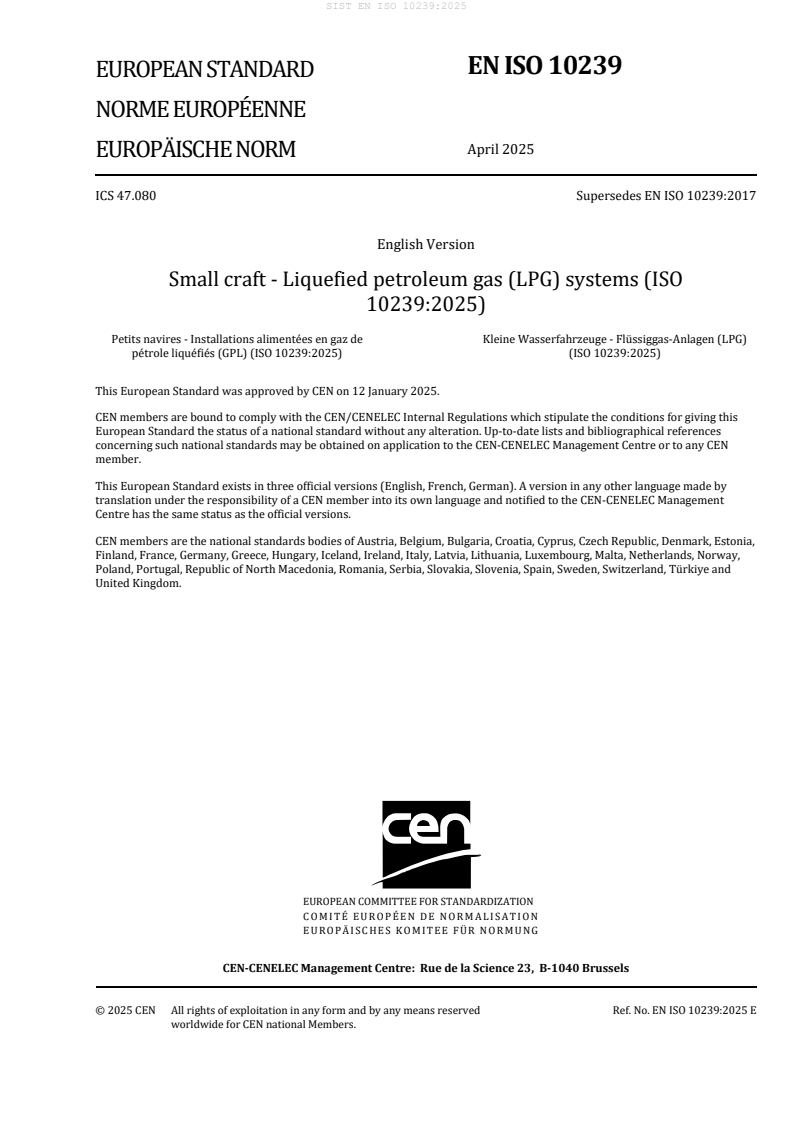
EN ISO 10239
EUROPEAN STANDARD
NORME EUROPÉENNE
April 2025
EUROPÄISCHE NORM
ICS 47.080 Supersedes EN ISO 10239:2017
English Version
Small craft - Liquefied petroleum gas (LPG) systems (ISO
10239:2025)
Petits navires - Installations alimentées en gaz de Kleine Wasserfahrzeuge - Flüssiggas-Anlagen (LPG)
pétrole liquéfiés (GPL) (ISO 10239:2025) (ISO 10239:2025)
This European Standard was approved by CEN on 12 January 2025.
CEN members are bound to comply with the CEN/CENELEC Internal Regulations which stipulate the conditions for giving this
European Standard the status of a national standard without any alteration. Up-to-date lists and bibliographical references
concerning such national standards may be obtained on application to the CEN-CENELEC Management Centre or to any CEN
member.
This European Standard exists in three official versions (English, French, German). A version in any other language made by
translation under the responsibility of a CEN member into its own language and notified to the CEN-CENELEC Management
Centre has the same status as the official versions.
CEN members are the national standards bodies of Austria, Belgium, Bulgaria, Croatia, Cyprus, Czech Republic, Denmark, Estonia,
Finland, France, Germany, Greece, Hungary, Iceland, Ireland, Italy, Latvia, Lithuania, Luxembourg, Malta, Netherlands, Norway,
Poland, Portugal, Republic of North Macedonia, Romania, Serbia, Slovakia, Slovenia, Spain, Sweden, Switzerland, Türkiye and
United Kingdom.
EUROPEAN COMMITTEE FOR STANDARDIZATION
COMITÉ EUROPÉEN DE NORMALISATION
EUROPÄISCHES KOMITEE FÜR NORMUNG
CEN-CENELEC Management Centre: Rue de la Science 23, B-1040 Brussels
© 2025 CEN All rights of exploitation in any form and by any means reserved Ref. No. EN ISO 10239:2025 E
worldwide for CEN national Members.
Contents Page
European foreword . 3
Annex ZA (informative) Relationship between this European Standard and the essential
requirements of EU Directive 2013/53/EU . 4
European foreword
This document (EN ISO 10239:2025) has been prepared by Technical Committee ISO/TC 188 "Small
craft" in collaboration with Technical Committee CEN/TC 464 “Small Craft” the secretariat of which is
held by SIS.
This European Standard shall be given the status of a national standard, either by publication of an
identical text or by endorsement, at the latest by October 2025, and conflicting national standards shall
be withdrawn at the latest by October 2025.
Attention is drawn to the possibility that some of the elements of this document may be the subject of
patent rights. CEN shall not be held responsible for identifying any or all such patent rights.
This document supersedes EN ISO 10239:2017.
This document has been prepared under a standardization request addressed to CEN by the European
Commission. The Standing Committee of the EFTA States subsequently approves these requests for its
Member States.
For the relationship with EU Legislation, see informative Annex ZA, which is an integral part of this
document.
Any feedback and questions on this document should be directed to the users’ national standards
body/national committee. A complete listing of these bodies can be found on the CEN website.
According to the CEN-CENELEC Internal Regulations, the national standards organizations of the
following countries are bound to implement this European Standard: Austria, Belgium, Bulgaria,
Croatia, Cyprus, Czech Republic, Denmark, Estonia, Finland, France, Germany, Greece, Hungary, Iceland,
Ireland, Italy, Latvia, Lithuania, Luxembourg, Malta, Netherlands, Norway, Poland, Portugal, Republic of
North Macedonia, Romania, Serbia, Slovakia, Slovenia, Spain, Sweden, Switzerland, Türkiye and the
United Kingdom.
Endorsement notice
The text of ISO 10239:2025 has been approved by CEN as EN ISO 10239:2025 without any modification.
Annex ZA
(informative)
Relationship between this European Standard and the essential
requirements of EU Directive 2013/53/EU
This European Standard has been prepared under a Commission’s standardization request M/542/C
(2015) 8736 final to provide one voluntary means of conforming to essential requirements of Directive
2013/53/EU.
Once this standard is cited in the Official Journal of the European Union under that Directive,
compliance with the normative clauses of this standard given in Table ZA.1 confers, within the limits of
the scope of this standard, a presumption of conformity with the corresponding essential requirements
of that Directive, and associated EFTA regulations.
Table ZA.1 — Correspondence between this European Standard and Directive 2013/53/EU
Essential Requirements of Clause(s)/sub-clause(s) Remarks/Notes
Directive 2013/53/EU of this EN
I.A.5.5 – Gas System 4, 5, 6, 7, 8, 9, 10, 11, 13, This standard satisfies the legal
requirements of this essential
Annex B,
requirement in respect of Liquid
Annex D
Petroleum Gas systems.
Annex D applies in respect of
cooking appliances with integral
LPG cartridges with a capacity of
225 g or less.
1.A.5.6.1 - Fire protection, Clause 6.5, 7.9, 7.11, Annex D applies in respect of
general cooking appliances with integral
Annex C,
LPG cartridges with a capacity of
Annex D
225 g or less.
1.A.2.5 - Owner’s manual Clause 14, Annex D applies in respect of
cooking appliances with integral
Annex C,
LPG cartridges with a capacity of
Annex D.9
225 g or less.
Table ZA.2 — Applicable Standards to confer presumption of conformity as described in this
Annex ZA
Column 1 Column 2 Column 3 Column 4
Reference in International Title Corresponding European
Clause 2 Standard Edition Standard Edition
ISO 7-1 ISO 7-1:1994 Pipe threads where For applicable standard
pressure-tight joints are edition see Column 2
made on the threads —
Part 1: Dimensions,
tolerances and designation
ISO 565 ISO 565:1990 Test sieves — Metal wire For applicable standard
cloth, perforated metal edition see Column 2
plate and electroformed
sheet — Nominal sizes of
openings
ISO 8434-1:2018 ISO 8434-1:2018 Metallic tube connections EN ISO 8434-1:2018
for fluid power and general
use — Part 1: 24° cone
connectors
ISO 8666 ISO 8666:2020 Small craft — Principal EN ISO 8666:2020
data EN ISO
8666:2020/A11:2021
ISO 8846 ISO 8846:1990 Small craft — Electrical EN ISO 8846:2017
devices — Protection
against ignition of
surrounding flammable
gases
ISO 9094 ISO 9094:2022 Small craft — Fire EN ISO 9094:2017
protection
ISO 11812 ISO 11812:2020 Small craft — Watertight EN ISO 11812:2024
or quick-draining recesses
and cockpits
ISO 11812:2020/ Small craft — Watertight EN ISO
Amd 1:2024 or quick-draining recesses 11812:2024/A1:2024
and cockpits — Amendment
EN 751-2 - Sealing materials for EN 751-2:1996
metallic threaded joints in
contact with 1st, 2nd and
3rd family gases and hot
water — Part 2: Non-
hardening jointing
compounds
EN 751-3 - Sealing materials for EN 751-3:1996
metallic threaded joints in
EN 751-3:1996/AC:1997
contact with 1st, 2nd and
Column 1 Column 2 Column 3 Column 4
Reference in International Title Corresponding European
Clause 2 Standard Edition Standard Edition
3rd family gases and hot
water — Part 3: Unsintered
PTFE tapes
EN 1254-2 - Copper and copper alloys - EN 1254-2:2021
Plumbing fittings - Part 2:
Compression fittings for use
with copper tubes
EN 1949 - Specification for the EN 1949:2021
installation of LPG systems
for habitation purposes in
leisure accommodation
vehicles and
accommodation purposes in
other vehicles
EN 15266 - Stainless steel pliable EN 15266:2007
corrugated tubing kits in
buildings for gas with an
operating pressure up to
0,5 bar
EN 16129:2013 - Pressure regulators, EN 16129:2013
automatic change-over
devices, having a maximum
regulated pressure of 4 bar,
with a maximum capacity
of 150 kg/h, associated
safety devices and adaptors
for butane, propane, and
their mixtures
WARNING 1 — Presumption of conformity stays valid only as long as a reference to this European
Standard is maintained in the list published in the Official Journal of the European Union. Users of this
standard should consult frequently the latest list published in the Official Journal of the European
Union.
WARNING 2 — Other Union legislation may be applicable to the product(s) falling within the scope of
this standard.
International
Standard
ISO 10239
Fourth edition
Small craft — Liquefied petroleum
2025-02
gas (LPG) systems
Petits navires — Installations alimentées en gaz de pétrole
liquéfiés (GPL)
Reference number
ISO 10239:2025(en) © ISO 2025
ISO 10239:2025(en)
© ISO 2025
All rights reserved. Unless otherwise specified, or required in the context of its implementation, no part of this publication may
be reproduced or utilized otherwise in any form or by any means, electronic or mechanical, including photocopying, or posting on
the internet or an intranet, without prior written permission. Permission can be requested from either ISO at the address below
or ISO’s member body in the country of the requester.
ISO copyright office
CP 401 • Ch. de Blandonnet 8
CH-1214 Vernier, Geneva
Phone: +41 22 749 01 11
Email: copyright@iso.org
Website: www.iso.org
Published in Switzerland
ii
ISO 10239:2025(en)
Contents Page
Foreword .iv
1 Scope . 1
2 Normative references . 1
3 Terms and definitions . 2
4 General provisions . 4
5 Pressure regulating device . . 5
6 LPG supply line . . 6
6.1 General .6
6.2 Piping .6
6.3 Hose assemblies .7
6.4 Materials .8
6.5 Installation .8
6.6 Shut-off valves .9
7 Appliances . 10
8 Ducts and flues for air intake and combustion product discharge.11
9 Location and installation of LPG cylinders .12
9.1 General . 12
9.2 Cylinder lockers . 13
9.3 Cylinder housings . 13
10 Ventilation . 14
11 LPG installation tightness test . 14
12 LPG system commissioning label . 14
13 Ignition protection from electrical devices .15
14 Owner’s manual .15
Annex A (informative) Design guidelines for pressure drop due to hose/pipe resistance .16
Annex B (normative) Ventilation . . 17
Annex C (normative) Instructions to be included with the owner’s manual.18
Annex D (normative) Cooking appliances with integral LPG cartridges with a capacity of 225 g
or less .20
Annex E (informative) Examples of cylinder lockers and cylinder housings and their locations .21
Bibliography .24
iii
ISO 10239:2025(en)
Foreword
ISO (the International Organization for Standardization) is a worldwide federation of national standards
bodies (ISO member bodies). The work of preparing International Standards is normally carried out through
ISO technical committees. Each member body interested in a subject for which a technical committee
has been established has the right to be represented on that committee. International organizations,
governmental and non-governmental, in liaison with ISO, also take part in the work. ISO collaborates closely
with the International Electrotechnical Commission (IEC) on all matters of electrotechnical standardization.
The procedures used to develop this document and those intended for its further maintenance are described
in the ISO/IEC Directives, Part 1. In particular, the different approval criteria needed for the different types
of ISO document should be noted. This document was drafted in accordance with the editorial rules of the
ISO/IEC Directives, Part 2 (see www.iso.org/directives).
ISO draws attention to the possibility that the implementation of this document may involve the use of (a)
patent(s). ISO takes no position concerning the evidence, validity or applicability of any claimed patent
rights in respect thereof. As of the date of publication of this document, ISO had not received notice of (a)
patent(s) which may be required to implement this document. However, implementers are cautioned that
this may not represent the latest information, which may be obtained from the patent database available at
www.iso.org/patents. ISO shall not be held responsible for identifying any or all such patent rights.
Any trade name used in this document is information given for the convenience of users and does not
constitute an endorsement.
For an explanation of the voluntary nature of standards, the meaning of ISO specific terms and expressions
related to conformity assessment, as well as information about ISO’s adherence to the World Trade
Organization (WTO) principles in the Technical Barriers to Trade (TBT), see www.iso.org/iso/foreword.html.
This document was prepared by Technical Committee ISO/TC 188, Small craft, in collaboration with
the European Committee for Standardization (CEN) Technical Committee CEN/TC 464, Small Craft, in
accordance with the Agreement on technical cooperation between ISO and CEN (Vienna Agreement).
This fourth edition cancels and replaces the third edition (ISO 10239:2014), which has been technically
revised.
The main changes are as follows:
— the Scope has been clarified;
— new definitions for “room-sealed appliance” and “open-flued appliance” have been added;
— new definitions for “cylinder locker” and “cylinder housing” have been added, including some examples
in a new Annex E;
— Clause 9 on the location and installation of LPG cylinders has been revised;
— a new Clause 12 has been added with details of a commissioning label;
— the location of pressure regulating devices has been clarified;
— Annex C has been revised to update the instructions to be included with the owner’s manual;
— a new Annex E has been added to provide examples of cylinder lockers and cylinder housings.
Any feedback or questions on this document should be directed to the user’s national standards body. A
complete listing of these bodies can be found at www.iso.org/members.html.
iv
International Standard ISO 10239:2025(en)
Small craft — Liquefied petroleum gas (LPG) systems
1 Scope
This document specifies requirements for the installation of permanently installed liquefied petroleum gas
(LPG) systems and LPG-burning appliances on small craft.
This document is applicable to portable cooking appliances with internal LPG cartridges, with a capacity of
225 g or less (see Annex D).
This document is applicable to the storage of all LPG cylinders.
NOTE 1 National regulations can apply to the technical requirements of LPG cylinders.
This document does not contain procedures for commissioning new LPG installations or system maintenance
or upgrades.
This document does not apply to LPG-fuelled propulsion engines or LPG-driven generators.
NOTE 2 National codes and procedures appropriate to the country concerned can be available.
2 Normative references
The following documents are referred to in the text in such a way that some or all of their content constitutes
requirements of this document. For dated references, only the edition cited applies. For undated references,
the latest edition of the referenced document (including any amendments) applies.
ISO 7-1, Pipe threads where pressure-tight joints are made on the threads — Part 1: Dimensions, tolerances and
designation
ISO 565, Test sieves — Metal wire cloth, perforated metal plate and electroformed sheet — Nominal sizes of
openings
ISO 8434-1:2018, Metallic tube connections for fluid power and general use — Part 1: 24° cone connectors
ISO 8666, Small craft — Principal data
ISO 8846, Small craft — Electrical devices — Protection against ignition of surrounding flammable gases
ISO 9094, Small craft — Fire protection
ISO 11812, Small craft — Watertight or quick-draining recesses and cockpits
EN 751-2, Sealing materials for metallic threaded joints in contact with 1st, 2nd and 3rd family gases and hot
water — Part 2: Non-hardening jointing compounds
EN 751-3, Sealing materials for metallic threaded joints in contact with 1st, 2nd and 3rd family gases and hot
water — Part 3: Unsintered PTFE tapes and PTFE strings
EN 1254-2, Copper and copper alloys — Plumbing fittings — Part 2: Compression fittings for use with copper tubes
EN 1949, Specification for the installation of LPG systems for habitation purposes in leisure accommodation
vehicles and accommodation purposes in other vehicles
EN 15266, Stainless steel pliable corrugated tubing kits in buildings for gas with an operating pressure up to 0,5 bar
ISO 10239:2025(en)
EN 16129:2013, Pressure regulators, automatic change-over devices, having a maximum regulated pressure of
4 bar, with a maximum capacity of 150 kg/h, associated safety devices and adaptors for butane, propane, and
their mixtures
3 Terms and definitions
For the purposes of this document, the following terms and definitions apply.
ISO and IEC maintain terminology databases for use in standardization at the following addresses:
— ISO Online browsing platform: available at https:// www .iso .org/ obp
— IEC Electropedia: available at https:// www .electropedia .org/
3.1
craft
small craft
recreational boat, and other watercraft using similar equipment, of up to 24 m length of hull (L )
H
Note 1 to entry: The measurement methodology for the length of hull (L ) is defined in ISO 8666.
H
[SOURCE: ISO 8666:2020, 3.15, modified — Note 1 to entry added.]
3.2
liquefied petroleum gas
LPG
mixture of light hydrocarbons, gaseous under conditions of normal temperature and pressure, and
maintained in the liquid state by increase of pressure or lowering of temperature
Note 1 to entry: The principal components are propane, propene, butanes or butenes.
Note 2 to entry: LPG can be obtained as commercial butane, commercial propane or a mixture of the two.
[SOURCE: EN 624:2011, 3.1.7, modified — Note 2 to entry added.]
3.3
permanently installed
securely fastened so that tools are required for removal
[SOURCE: ISO 10088:2022, 3.3]
3.4
cylinder housing
ventilated enclosure with or without a door which is vapour tight to the interior of the craft (3.1), intended
solely for storage of one or more liquefied petroleum gas (3.2) cylinders, pressure regulating devices (3.12)
and safety devices, and located so that leakage flows overboard unimpeded
3.5
cylinder locker
enclosure which is vapour-tight to at least the height of the cylinder valve and other high-pressure
components and is completely vapour tight to the interior of the craft (3.1), intended solely for storage of
one or more liquefied petroleum gas (3.2) cylinders, pressure regulating devices (3.12) and safety devices, and
fitted with a drain so that leakage flows overboard unimpeded
ISO 10239:2025(en)
3.6
liquefied petroleum gas system
LPG system
system consisting of an arrangement of cylinder(s), safety device(s), pressure regulating device(s) (3.12),
connection(s), valve(s), piping (3.23), hose assembly(ies) (3.20), fitting(s) and devices intended to store,
supply, monitor or control the flow of LPG (3.2) up to and including the appliance
Note 1 to entry: The cylinders are replacement items and are sometimes but not always supplied with the LPG system
in the craft (3.1).
3.7
habitable space
space surrounded by permanent structure in which there is provision for any of the following activities:
sleeping, cooking, eating, washing/toilet, navigation and steering
Note 1 to entry: Spaces intended exclusively for storage, open cockpits with or without canvas enclosures and engine
compartments (3.21) are not included.
[SOURCE: ISO 11105:2020, 3.1, modified — “engine compartments” replaced “engine rooms” in Note 1 to entry.]
3.8
readily accessible
capable of being reached quickly and safely for effective use under emergency conditions without the use of tools
[SOURCE: ISO 9094:2022, 3.2]
3.9
unattended appliance
device intended to function without the constant attention of an operator and which can cycle on and off
automatically
EXAMPLE Water heaters, refrigerators, cabin heaters.
Note 1 to entry: Stoves, ovens and gas lamps are not considered to be unattended appliances.
3.10
high pressure side
part of an installation between the cylinder valve and the inlet of a pressure regulating device (3.12) in a
liquefied petroleum gas system (3.6)
Note 1 to entry: Vapour pressure at 20 °C for propane = 700 kPa and for butane = 175 kPa.
Note 2 to entry: 100 kPa = 1 bar.
3.11
low pressure side
part of an installation exposed to the regulated pressure of the liquefied petroleum gas (LPG) (3.2) pressure
regulating device (3.12) in an LPG system (3.6)
3.12
pressure regulating device
device to reduce, in a controlled manner, the high pressure of the liquefied petroleum gas system (3.6) to the
required operating pressure (3.16) of the appliances
3.13
appliance shut-off valve
device to isolate an appliance from the gas supply
3.14
main shut-off valve
device to isolate the entire liquefied petroleum gas system (3.6) from the high pressure side (3.10) of the supply
ISO 10239:2025(en)
3.15
flame supervision device
device that has a sensing element that causes the inlet of the liquefied petroleum gas (3.2) supply to a burner
to be open in the presence of a flame and closed in the absence of a flame
3.16
operating pressure
inlet pressure of the liquefied petroleum gas (3.2) appliance(s)
3.17
ventilator
device that allows air to pass into and out of habitable spaces (3.7)
3.18
room-sealed appliance
appliance having a combustion system in which incoming combustion air and outgoing products of combustion
pass through ductwork sealed to habitable spaces (3.7) and connected to an enclosed combustion chamber
3.19
open-flued appliance
appliance where combustion air is drawn from the space containing the appliance and the outgoing products
of combustion pass through a flue incorporating a draught diverter
3.20
hose assembly
length of hose equipped with permanently attached fittings on both ends, such as a swaged sleeve or sleeve
and threaded insert
3.21
engine compartment
compartment of the craft (3.1), containing spark or compression ignition internal combustion engine(s)
[SOURCE: ISO 9094:2022, 3.3]
3.22
critical bilge water level
level at which bilge water contacts metallic fuel tanks, couplings, engine pans, non-submersible machinery,
or non-watertight electrical circuits and connections, with the craft (3.1) in the static upright floating
position at maximum load condition (m )
LDC
[SOURCE: ISO 15083:2020, 3.6]
3.23
piping
rigid metallic pipe or semi-rigid, pliable corrugated stainless-steel tubing
4 General provisions
4.1 An LPG system and all its components shall be capable of withstanding storage at −30 °C to +60 °C.
4.2 LPG systems shall be of the vapour withdrawal type, i.e. LPG released only under gas phase conditions.
4.3 All LPG appliances installed on a single LPG system shall be designed for use at the same operating
pressure and the same LPG type, e.g. propane, butane or a mixture of the two. The operating pressure shall
ISO 10239:2025(en)
be labelled in the vicinity of the LPG cylinder enclosure and be clearly visible when the cylinder(s) is/are
installed.
The cylinder(s) selected and other supply equipment shall be of sufficient capacity to ensure safe and
satisfactory operation of all appliances simultaneously. The cylinder enclosure shall be capable of
accommodating the capacity of cylinders needed.
4.4 Where an additional LPG system is installed:
— there shall be no connection between each of the LPG supplies;
— the cylinder(s) for each gas supply may be installed in the same cylinder enclosure.
If an additional cylinder enclosure is used, there shall be a warning sign inside each cylinder enclosure which
indicates that there is an additional LPG supply.
Inside the cylinder enclosure it shall be clearly indicated which appliances are supplied by each LPG supply.
This shall also be stated in the owner’s manual.
4.5 Each LPG system shall be fitted with simple means to test the LPG system for leakage before use of any
appliances (e.g. a pressure gauge, bubble leak detector).
Where a bubble leak detector is fitted in the LPG system, it shall be securely mounted and installed in
accordance with the manufacturer’s instructions in the low pressure side of the LPG system and in the
cylinder enclosure.
If pressure gauges are used, they shall read the cylinder pressure side of the pressure regulating device. The
gauge scale shall have a pressure range from 0 kPa to a maximum of between 1 000 kPa and 1 600 kPa to be
able to show pressure drops during the LPG system check (see Clause C.3).
5 Pressure regulating device
5.1 Each LPG system shall be equipped with, or have provision for the installation of, a pressure regulating
device. This pressure regulating device shall be designed to provide a defined operating pressure suitable
for the consuming appliances, but not more than 5 kPa.
5.2 The pressure regulating device shall have an overpressure unit to prevent uncontrolled pressure
increase in the low pressure side to a value above 15 kPa. Any LPG discharge of the overpressure unit shall
be inside the cylinder enclosure, or shall be separately vented outside the craft. The overpressure unit may
be a pressure relief governor, a pressure relief valve or an automatic safety shut-off valve.
5.3 The operating pressure shall be marked on the pressure regulating device.
5.4 The setting of pressure regulating devices shall be fixed and shall not have external manual output
pressure adjustment.
5.5 The pressure regulating device shall be located within the cylinder enclosure.
5.6 If not rigidly connected to, and supported by, the cylinder connection, the pressure regulating device
shall be separately secured within the cylinder enclosure to protect it from damage and exposure to dirt
and water. Pressure regulating devices not rigidly connected to, and supported by, the cylinder connection
shall be connected to the cylinder by a high-pressure hose assembly as specified in Clause 6.
5.7 Pressure regulating devices shall be located such that the inlet to them is at or above the level of the
cylinder outlet connection.
ISO 10239:2025(en)
5.8 Pressure regulating devices shall be made of corrosion-resistant metallic material or have an effective
coating against external corrosion. Fasteners used shall be of corrosion-resistant material or have a
corrosion-resistant plating or coating.
5.9 First and single stage pressure regulating devices with a cylinder valve connection shall be fitted with
an integral filter.
The filter shall be situated on the regulating devices inlet upstream of the valve pad. The filter mesh shall
not exceed the recommended dimensions for the nominal size of opening 125 (in micrometre) in accordance
with ISO 565, or exceed 0,14 mm diameter in cases of perforated sheet.
NOTE Pressure regulating devices in accordance with EN 16129:2013, Annex M, meet these requirements and are
marked with “Marine.”
6 LPG supply line
6.1 General
6.1.1 The LPG supply line from the cylinder enclosure to the appliance(s) shall be:
— piping in accordance with 6.2, or
— a continuous hose assembly from the cylinder enclosure to each appliance in accordance with 6.3.
The layout of each supply line shall be such that the length of piping and/or hose assemblies are as short as
practicable.
6.1.2 Hose assemblies shall be used to connect:
— gimballed appliances to any LPG supply line piping;
— cylinders to pressure regulating devices (high pressure side of the system) where the pressure regulating
device is not connected directly to the cylinder; in such arrangements, the hose assembly shall be within
the cylinder enclosure;
— cylinder mounted pressure regulating devices to any LPG supply line piping (low pressure side of the
system); in such arrangements, the hose assembly shall be within the cylinder enclosure.
NOTE Hose assemblies can be used to connect appliances that are not gimballed to their LPG supply line piping if
installed in accordance with the appliance manufacturer’s instructions.
6.1.3 Piping and hose assemblies shall be sized so that any pressure drop does not reduce the operating
pressure at any appliance below that required by the appliance manufacturer when all appliances are
operating simultaneously.
NOTE Annex A provides design guidelines for pressure drop due to hose/pipe resistance for various connected
appliance kW ratings.
6.2 Piping
6.2.1 Piping shall be solid drawn copper or drawn stainless steel pipe, or semi-rigid, pliable corrugated
stainless steel tubing.
Wall thickness for copper or stainless steel pipe shall be equal or greater than 0,6 mm for pipe up to 12 mm
outside diameter and a minimum of 0,8 mm for pipe with an outside diameter greater than 12 mm.
Semi-rigid, pliable corrugated stainless steel tubing (PCT) shall conform to EN 15266.
ISO 10239:2025(en)
6.2.2 Fittings for connections and joints in piping shall be metallic and of any of the following types:
— welded, hard soldered and brazed connections;
— cutting ring fittings in accordance with ISO 8434-1:2018, Table 4 (where cutting ring fittings are used in
conjunction with copper pipe, a brass insertion sleeve and brass cutting ring shall be fitted);
— copper rings on copper piping and compression fittings in accordance with EN 1254-2;
— stainless steel rings on stainless steel piping;
— connections in accordance with EN 16129:2013, Annex M;
— PCT fittings in accordance with EN 15266.
All threaded connections required to ensure gas tightness of the LPG system shall be of taper pipe thread
type conforming to ISO 7-1 or fittings conforming to EN 1949, with sealants conforming to EN 751-2 or
EN 751-3. Sealants shall be applied to the male thread only, before assembly.
Jointing compound for flared fittings or flared rings and gas tightness by compression of ductile joints,
except connections in accordance with EN 16129:2013, Annex M, shall not be used.
6.2.3 Piping shall be made up with as few fittings as practicable. Joints and fittings shall be capable of
being reached for inspection, removal or maintenance without removal of any permanent craft structure.
6.3 Hose assemblies
6.3.1 A hose shall only be used when part of a hose assembly. Materials and components of hose assemblies
shall be designed to be suitable for LPG and to withstand the stresses and exposures found in the marine
environment.
Hose assemblies in accordance with one or more of the relevant standards given in Table 1 meet this
requirement.
Table 1 — Hose assembly manufacturing standards
Manufacturing standard Max. operating pressure Application
Hose assembly to EN 16436-2 incorporating Regulated, appliance operating
a
10bar
hose to EN 16436-1 Class 2 pressure only
Unregulated cylinder pressure
Hose assembly to EN 16436-2 incorporating
30 bar and regulated appliance operating
hose to EN 16436-1 Class 3
pressure
Regulated, appliance operating
Hose assembly to EN 14800 0,5 bar
pressure only
Unregulated cylinder pressure
0,5 to 450 bar
and/or regulated appliance
(depending on marked
Hose assembly to ISO 10380 operating pressure (depending
specification on individual hose
on marked specification on
assembly)
individual hose assembly)
a 5 2
1 bar = 0,1 MPa = 10 Pa; 1 MPa = 1 N/mm .
6.3.2 Hose assemblies, including connections, shall be:
— capable of being reached for inspection, removal or maintenance without removal of any permanent
craft structure;
— installed so as to avoid stress or tight radius turns;
— installed so that they are not subject to tension or kinking under any conditions of use.
ISO 10239:2025(en)
6.3.3 Where hose assemblies are used to directly connect appliances to the pressure regulating device,
the assembly shall be:
— of minimum practical length;
— continuous and have no joints or fittings from within the cylinder enclosure to the appliance, or the
readily accessible shut-off valve near the appliance (see 6.6.3).
Where two or more appliances are installed, a suitable manifold shall be located within the cylinder
enclosure to enable the individual appliance supply line hose assemblies to be connected to the pressure
regulating device.
6.3.4 Low pressure hose assemblies used to connect the LPG supply line piping to appliances shall be of
minimum practical length.
Low pressure hoses between pressure regulating devices and the LPG supply line piping shall not exceed
1 m in length.
If a bubble leak detector is installed within a cylinder enclosure, up to 1 m of hose can be used between the
cylinder mounted pressure regulating device and the bubble leak detector, and up to 1 m of hose may be
used within the cylinder enclosure between the bubble leak detector and LPG supply piping.
6.3.5 High-pressure hose assemblies used to connect cylinders to pressure regulating devices shall be of
minimum practical length not exceeding 1 m.
6.4 Materials
6.4.1 Materials used for hard soldered or brazed connections shall not have a melting point less than 450 °C.
6.4.2 Fittings through which LPG flows shall be compatible with LPG and shall be galvanically compatible
with the metallic components to which they are connected.
6.4.3 Hose clamps, if used to secure cylinder locker drain hoses, shall be made of corrosion-resistant
material and shall be reusable.
6.4.4 All fittings shall be of corrosion-resistant material, such as brass or stainless steel, or shall be of
equivalent corrosion resistance in a marine environment.
6.4.5 Where cutting ring fittings are used in conjunction with copper pipe, a brass insertion sleeve and
brass cutting ring shall be fitted.
6.5 Installation
6.5.1 Metallic LPG supply lines and components shall not have direct contact with metallic parts of the
craft structure of higher galvanic nobility.
6.5.2 Metallic LPG supply lines and components shall be routed at least 30 mm away from electrical
conductors unless the LPG supply line and components are run jointless through non-conducting conduit,
or the conductors are sheathed or in non-conducting conduit or trunking. Metallic LPG supply lines and
components shall be at least 100 mm from exposed terminals of electrical devices or accessories.
6.5.3 LPG supply lines and components shall be above the critical bilge water level.
6.5.4 LPG supply lines and components shall be at least 100 mm from engine exhaust components and
appliance flue systems.
ISO 10239:2025(en)
6.5.5 LPG cylinders, pressure regulating devices and other safety devices shall be at least 250 mm from
dry engine exhaust components or other heat sources unless a thermal barrier is provided.
6.5.6 LPG supply lines shall be supported in order to prevent damage from chafing or vibration. For copper
or stainless steel pipe, such supporting devices shall be spaced at intervals not exceeding 0,5 m. For hose
assemblies and PCT, the intervals shall not exceed 1 m. Additional requirements for the securing of piping
passing through engine compartments are given in 6.5.11 and 6.5.12. Fixing devices shall be corrosion-
resistant, non-abrasive, designed to prevent cutting or other damage to the lines and galvanically compatible
with the supply line material. In the case of conduit, it shall be vented and non-metallic.
All joints shall have at least one fixing device per line no more than 150 mm away from the joint.
NOTE Joints secured by specific integral fixings such as mounting plates or bulkhead fittings can be considered
as meeting this requirement.
6.5.7 Connections in piping and hose assemblies shall be installed to prevent undue stress at the
connection.
6.5.8 Piping and hoses passing through bulkheads intended to maintain watertight integrity in the craft
at the level of penetration shall be sealed by materials or fittings capable of maintaining the water tightness.
6.5.9 Piping and hoses shall be protected from abrasion or chafing at the point where they pass through
walls or bulkheads or other material that can cause abrasion or chaff damage.
6.5.10 Hose assemblies shall not be routed through an engine compartment.
6.5.11 There shall be no joints or fittings in piping passing through engine compartments.
6.5.12 Piping passing through engine compartments shall be protected by conduit or trunking, or supported
by non-abrasive attachments which are no more than 300 mm apart.
6.6 Shut-off valves
6.6.1 Each single cylinder LPG system with a pressure regulating device directly connected to the cylinder
shall be equipped with a singular main shut-off valve, either:
— as a readily accessible manually operated valve, or
— a solenoid valve, operated from a readily accessible location. A label shall be located close to the solenoid
command/switch to identify the purpose of th
...
Questions, Comments and Discussion
Ask us and Technical Secretary will try to provide an answer. You can facilitate discussion about the standard in here.
Loading comments...