

EN 13443-2:2005+A1:2007
(Main + Amendment)Water conditioning equipment inside buildings - Mechanical filters - Part 2: Particle rating 1 µm to less than 80 µm - Requirements for performance, safety and testing
- Abstract
This document specifies requirements relating to the construction, performance and methods of testing for mechanical filters for the removal of suspended matter in drinking water installations inside buildings. It applies to filters with a filtration rating from 1 µm up to less than 80 µm and which are intended for use in systems with a minimum pressure rating of PN 6, connections between DN 15 and DN 100 and service temperature of less than 30 °C.
This document is applicable to back-washable filters, integral filters and those designed for replaceable cartridges. It only concerns units that are permanently connected to the mains supply at point of entry or point of use.
Part 1 of this standard (EN 13443-1) is a separate document and deals with filters with a particle rating between
80 µm and 150 µm.
- Status
- Published
- Publication Date
- 12-Jun-2007
- Withdrawal Date
- 30-Dec-2007
- Technical Committee
- CEN/TC 164 - Water supply
- Drafting Committee
- CEN/TC 164/WG 13 - Water conditioning equipment inside buildings
- Current Stage
- 9020 - Submission to 2 Year Review Enquiry - Review Enquiry
- Start Date
- 15-Oct-2026
- Completion Date
- 15-Oct-2026


Overview
EN 13443-2:2005+A1:2007 is the CEN European standard for mechanical filters used inside buildings to remove suspended particulate matter from drinking water. It covers filters with a particle/filtration rating from 1 µm up to less than 80 µm, intended for permanently connected point-of-entry or point-of-use installations (connections DN 15 to DN 100), minimum pressure rating PN 6, and service temperature < 30 °C. The standard specifies requirements for design, performance, safety and test methods for back-washable filters, integral filters and replaceable cartridge filters.
Key topics and technical requirements
- Filtration performance: The filter (cartridge + housing in the manufacturer’s recommended configuration) must demonstrate a high filtration efficiency (notably a ≥ 99.8% efficiency at the declared particle rating when tested as specified).
- Filter types covered: Back-washable filters, integral units and cartridge (replaceable element) systems designed for permanent mains connection.
- Materials and water quality: Materials and coatings must not degrade drinking water quality or cause non‑compliance with Directive 98/83/EC or national regulations.
- Design and usability:
- Cartridges must be replaceable with minimal contamination risk; replacement cartridges should be individually wrapped.
- Back-washable filters must restore rated performance after cleaning, allow in‑situ cleaning without tools, and avoid supply interruption during backwash.
- Housings and cartridge compatibility must be identified by manufacturers.
- Pressure and temperature limits: Minimum system rating PN 6 and continuous operation at design temperature up to 30 °C; manufacturers must state clean and maximum permissible pressure drops and collapse pressure characteristics.
- Testing and inspection: Test methods referenced include particle counting upstream/downstream, use of ISO test dusts (ISO MTD/CTD), porosimetry (average pore diameter), retention capacity measurements, bubble point/integrity checks (Annex C) and standard procedures for differential pressure and clogging tests (Annex B).
Applications and intended users
- Who uses this standard: filter and housing manufacturers, product designers, test laboratories, plumbing and building services engineers, water utilities, procurement officers and compliance/certification bodies.
- Practical applications:
- Specifying mechanical filtration for potable water systems at point-of-entry or point-of-use.
- Designing and testing cartridge and back-washable filters to ensure performance and consumer safety.
- Demonstrating compliance for CE marking, tender specifications, or product documentation.
Related standards
- EN 13443-1 (filters 80 µm to 150 µm)
- EN 1717 (backflow prevention)
- ISO 12103-1 (Arizona / ISO test dusts)
- EN 872 (suspended solids by filtration)
- ISO 4021, ISO 304 (referenced test and analysis standards)
This standard is essential when selecting or certifying mechanical drinking-water filters in European building installations and supports consistent, verifiable filter performance and safety.
Relations
- Effective Date
- 19-Jan-2023
- Effective Date
- 17-Jun-2026
- Refers
ISO 304:1985 - Surface active agents — Determination of surface tension by drawing up liquid films - Effective Date
- 17-Jun-2026
- Refers
ISO 12103-1:1997 - Road vehicles — Test dust for filter evaluation — Part 1: Arizona test dust - Effective Date
- 17-Jun-2026
- Effective Date
- 01-Apr-2026
- Effective Date
- 09-Feb-2026
- Effective Date
- 28-Jan-2026
- Effective Date
- 28-Jan-2026
- Effective Date
- 28-Jan-2026
- Effective Date
- 28-Jan-2026
- Effective Date
- 28-Jan-2026
Get Certified
Connect with accredited certification bodies for this standard

DIBt (Deutsches Institut für Bautechnik)
German Institute for Building Technology.
DIN CERTCO
DIN Group product certification.

Kiwa BDA Testing
Building and construction product certification.
Sponsored listings
Frequently Asked Questions
EN 13443-2:2005+A1:2007 is a standard published by the European Committee for Standardization (CEN). Its full title is "Water conditioning equipment inside buildings - Mechanical filters - Part 2: Particle rating 1 µm to less than 80 µm - Requirements for performance, safety and testing". This standard covers: This document specifies requirements relating to the construction, performance and methods of testing for mechanical filters for the removal of suspended matter in drinking water installations inside buildings. It applies to filters with a filtration rating from 1 µm up to less than 80 µm and which are intended for use in systems with a minimum pressure rating of PN 6, connections between DN 15 and DN 100 and service temperature of less than 30 °C. This document is applicable to back-washable filters, integral filters and those designed for replaceable cartridges. It only concerns units that are permanently connected to the mains supply at point of entry or point of use. Part 1 of this standard (EN 13443-1) is a separate document and deals with filters with a particle rating between 80 µm and 150 µm.
This document specifies requirements relating to the construction, performance and methods of testing for mechanical filters for the removal of suspended matter in drinking water installations inside buildings. It applies to filters with a filtration rating from 1 µm up to less than 80 µm and which are intended for use in systems with a minimum pressure rating of PN 6, connections between DN 15 and DN 100 and service temperature of less than 30 °C. This document is applicable to back-washable filters, integral filters and those designed for replaceable cartridges. It only concerns units that are permanently connected to the mains supply at point of entry or point of use. Part 1 of this standard (EN 13443-1) is a separate document and deals with filters with a particle rating between 80 µm and 150 µm.
EN 13443-2:2005+A1:2007 is classified under the following ICS (International Classification for Standards) categories: 13.060.20 - Drinking water; 91.140.60 - Water supply systems. The ICS classification helps identify the subject area and facilitates finding related standards.
EN 13443-2:2005+A1:2007 has the following relationships with other standards: It is inter standard links to EN 13443-2:2005, ISO 4021:1992, ISO 304:1985, ISO 12103-1:1997, EN 1717:2025+A1:2026, ISO 1219-1:2006, EN 1717:2025, EN 15861:2012, EN 13443-1:2002, EN 1715-4:1997, EN 806-5:2012. Understanding these relationships helps ensure you are using the most current and applicable version of the standard.
EN 13443-2:2005+A1:2007 is associated with the following European legislation: EU Directives/Regulations: 305/2011, 89/106/EEC, 98/83/EC. When a standard is cited in the Official Journal of the European Union, products manufactured in conformity with it benefit from a presumption of conformity with the essential requirements of the corresponding EU directive or regulation.
EN 13443-2:2005+A1:2007 is available in PDF format for immediate download after purchase. The document can be added to your cart and obtained through the secure checkout process. Digital delivery ensures instant access to the complete standard document.
Standards Content (Sample)
2003-01.Slovenski inštitut za standardizacijo. Razmnoževanje celote ali delov tega standarda ni dovoljeno.Water conditioning equipment inside buildings - Mechanical filters - Part 2: Particle rating 1 µm to less than 80 µm - Requirements for performance, safety and testingAppareils de traitement d'eau a l'intérieur des bâtiments - Filtres mécaniques - Partie 2: Particules de taille 1 µm a 80 µm - Exigences de performances, de sécurité et essaisAnlagen zur Behandlung von Trinkwasser innerhalb von Gebäuden - Mechanisch wirkende Filter - Teil 2: Filterfeinheit 1 µm bis 80 µm - Anforderungen an Ausführung, Sicherheit und PrüfungTa slovenski standard je istoveten z:EN 13443-2:2005+A1:2007SIST EN 13443-2:2005+A1:2007en91.140.60Sistemi za oskrbo z vodoWater supply systems13.060.20Pitna vodaDrinking waterICS:SLOVENSKI
STANDARDSIST EN 13443-2:2005+A1:200701-julij-2007
EUROPEAN STANDARD NORME EUROPÉENNE EUROPÄISCHE NORM
EN 13443-2:2005+A1
June 2007 ICS 13.060.20; 91.140.60 Supersedes EN 13443-2:2005English Version
Water conditioning equipment inside buildings - Mechanical filters - Part 2: Particle rating 1 µm to less than 80 µm - Requirements for performance, safety and testing
Appareils de traitement d'eau à l'intérieur des bâtiments - Filtres mécaniques - Partie 2: Particules de taille 1 µm à 80 µm - Exigences de performances, de sécurité et essais
Anlagen zur Behandlung von Trinkwasser innerhalb von Gebäuden - Mechanisch wirkende Filter - Teil 2: Filterfeinheit 1 µm bis 80 µm - Anforderungen an Ausführung, Sicherheit und Prüfung This European Standard was approved by CEN on 24 December 2004 and includes Amendment 1 approved by CEN on 10 May 2007.
CEN members are bound to comply with the CEN/CENELEC Internal Regulations which stipulate the conditions for giving this European Standard the status of a national standard without any alteration. Up-to-date lists and bibliographical references concerning such national standards may be obtained on application to the CEN Management Centre or to any CEN member.
This European Standard exists in three official versions (English, French, German). A version in any other language made by translation under the responsibility of a CEN member into its own language and notified to the CEN Management Centre has the same status as the official versions.
CEN members are the national standards bodies of Austria, Belgium, Bulgaria, Cyprus, Czech Republic, Denmark, Estonia, Finland, France, Germany, Greece, Hungary, Iceland, Ireland, Italy, Latvia, Lithuania, Luxembourg, Malta, Netherlands, Norway, Poland, Portugal, Romania, Slovakia, Slovenia, Spain, Sweden, Switzerland and United Kingdom.
EUROPEAN COMMITTEE FOR STANDARDIZATION
COMITÉ EUROPÉEN DE NORMALISATION EUROPÄISCHES KOMITEE FÜR NORMUNG
Management Centre: rue de Stassart, 36
B-1050 Brussels © 2007 CEN All rights of exploitation in any form and by any means reserved worldwide for CEN national Members. Ref. No. EN 13443-2:2005+A1:2007: E
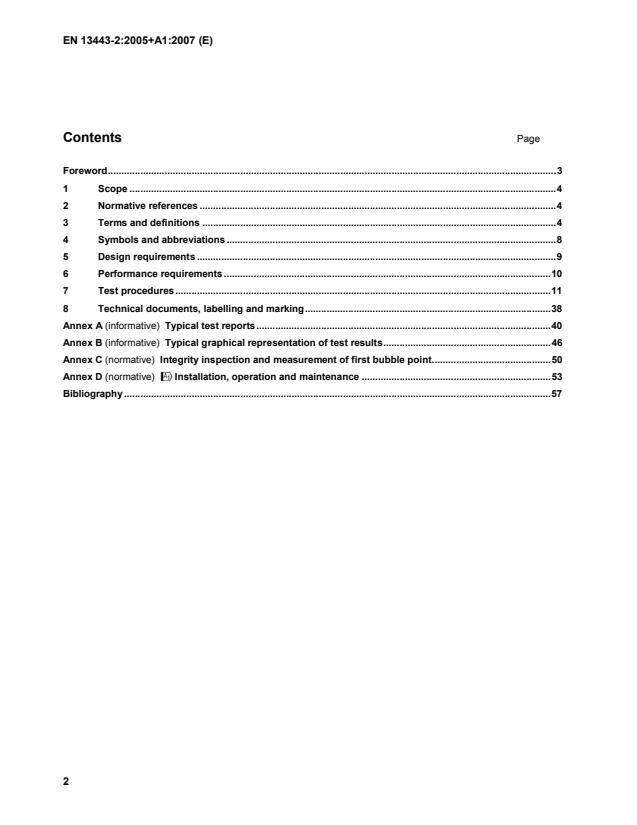
Typical test reports.40 Annex B (informative)
Typical graphical representation of test results.46 Annex C (normative)
Integrity inspection and measurement of first bubble point.50 Annex D (normative)
!Installation, operation and maintenance.53 Bibliography.57
80 µm and 150 µm. 2 Normative references The following referenced documents are indispensable for the application of this document. For dated references, only the edition cited applies. For undated references, the latest edition of the referenced document (including any amendments) applies. EN 872, Water quality — Determination of suspended solids — Method by filtration through glass fibre filters EN 1717, Protection against pollution of potable water in water installations and general requirements of devices to prevent pollution by backflow EN 13443-1:2002, Water conditioning equipment inside buildings — Mechanical filters — Part 1: Particle rating 80 µm to 150 µm — Requirements for performances, safety and testing ISO 304, Surface active agents — Determination of surface tension by drawing up liquid films ISO 1219-1, Fluid power systems and components — Graphic symbols and circuit diagrams — Part 1: Graphic symbols ISO 4021, Hydraulic fluid power — Particulate contamination analysis — Extraction of fluid samples from lines of an operating system ISO 12103-1, Road vehicles — Test dust for filter evaluation — Part 1: Arizona test dust 3 Terms and definitions For the purposes of this document, the following terms and definitions apply. 3.1 average pore diameter (DMP) value, in µm, of the pore diameter which corresponds to the mode of the relative frequency of pore diameter distribution of a filter media determined by air porosimetry 3.2 backwashable filter filter unit which is equipped with facilities, manual or automatic, to enable the periodic, in situ cleaning of the filter element by reversing the flow of water through the element 3.3 bubble point lowest air pressure at which a stream of bubbles appears at a point of the filter media surface when immersed under air pressure in a wetting liquid in accordance with Annex C
integral filter complete filter for which the filter element and housing are inseparable 3.21 ISO Coarse Test Dust (ISO CTD) siliceous test powder having a particle size distribution by convention between 0 µm and 200 µm in accordance with ISO 12103-1 NOTE It may also be referred to as ISO 12103-1 A4 dust. 3.22 ISO Medium Test Dust (ISO MTD) siliceous test powder having a particle size distribution by convention between 0 µm and 80 µm in accordance with ISO 12103-1 NOTE It may also be referred to as ISO 12103-1 A3 dust. 3.23 mechanical filter appliance designed to remove particulate matter from water by passage of the water through a porous medium 3.24 net differential pressure (dPN) difference between the final differential pressure of the clogged filter element and the differential pressure across the clean filter element (see 3.8) 3.25 nominal flow rate flow rate for the filter specified by the manufacturer or, in the absence of this specification, the flow rate through the clean filter element at which the pressure drop across the filter element is 20 kPa 3.26 particle shedding
release of particles of the filter element construction material into the filtered water 3.27 reference filtration rating (S) dimension, in µm , of the ISO MTD or ISO CTD particles at which the overall mean cumulative filtration efficiency of a filtering cartridge tested in accordance with the procedure described in this document, is greater than or equal to 99,8 % 3.28 retention capacity (CR) mass of ISO MTD or ISO CTD effectively retained by the filter element when the final standard differential pressure of 250 kPa is reached (CR250) or a specific one of x kPa (CRx), calculated by subtraction of the mass of contaminant in the filtrate from the injected mass
4 Symbols and abbreviations The generic symbols and abbreviations used in this document are given in Table 1. Table 1 — Symbols and abbreviations Symbol or abbreviation Parameter Unit Ce Test concentration mg/l Ci Injection concentration mg/l CR2 500 Retention capacity at 2 500 kPa g CRx Retention capacity at x kPa g CTD Coarse Test Dust - ∆P Differential pressure kPa ∆PF Final differential pressure kPa d Size of the particle µm dPc Loss of pressure due to the test housing alone kPa dPeo Loss of pressure due to the clean filter alone kPa dPF Loss of pressure at the end of the test kPa dPi Loss of pressure at the point of inflexion kPa dPo Loss of pressure due to the test housing kPa dPs Loss of specific pressure kPa Ed Cumulative filtration efficiency at the size greater than d µm % E[d1 ; d2] Differential filtration efficiency (between the sizes d1 and d2) % M Mass of contaminant necessary for the test g Mi Total mass of injected contaminant g MNR Mass of non retained contaminant g
MTD Medium Test Dust - Nd Number of particles having a dimension greater than or equal to d - N[d1 ; d2] Number of particles having a dimension greater than or equal to d1 and less than d2 - ∆PN Net differential pressure kPa Qe Test flow rate l/min Qi Injection flow rate l/h Qsensors Flow rate through the sensors l/h S Reference filtration rating µm TF End of test time min Vi Injection circuit fluid volume l ViM Injection circuit maximum fluid volume l VF Final fluid volume in test circuit l ∆t100 Time duration of a 100 mg/l period min PT Number of clogging periods (at 100 mg/l)
The graphic symbols used conform to the requirements of ISO 1219-1.
Cartridge cyclic differential pressure resistance When subjected to a cyclic flow of water sufficient to generate a peak pressure drop of 200 kPa, or greater, at a cycle frequency of 0,05 Hz, for 500 cycles (see 7.5): a) the pressure drop at the peak flow rate, shall not fall off during the test, b) there shall be no visible evidence of damage to the filter cartridge and c) the bubble point for the cartridge after the test shall not differ from that measured before the test, by more than 15 %. The bubble point shall be measured in accordance with Annex C. 6.7 Particle shedding When subjected to the manufacturer’s recommended flow rate, a new cartridge, after preconditioning in accordance with the manufacturer’s instructions (see Clause 8), shall show no increase in particle count when compared to the background particle count of the test rig, when tested in accordance with 7.6. 6.8 Housing resistance to static pressure When subjected to a static pressure test as defined in EN 13443-1:2002, 7.2, the filter housing shall show no permanent, visible signs of leakage, permanent deformation, fissures or ruptures.
Key 1 Main reservoir 10 Recirculation pump 2 Main pump 11 Injection pump 3 Temperature sensor regulator 12 Micro-filtered water supply 4 Sampling valve 13 Filter to be tested 5 Differential pressure gauge 14 On line counts 6 Flow meter 15 Main circuit 7 Counter pressure control valve 16 Injection circuit n° 1 8 Decontamination filters 17 Injection circuit n° 2 9 Injection reservoir Figure 1 — Diagram of filtration efficiency and retention capacity test rig 7.1.2.1.1 Filter test circuit The filter test circuit is designed in order to permit the recycling of the fluid being filtered. The return line is equipped with a decontamination filter that retains all of the test particles that have passed through the test filter. The test circuit comprises: a) conical bottom reservoir having a recommended cone angle less than or equal to 90°. It shall have a retention time of 30 s and an aspect ratio of 2 to 3. The recycled water return line penetrates beneath the free face so as to avoid the risk of air entrainment; b) circulation pump which ensures a constant, non pulsed flow rate throughout the test duration, particularly when the filter is clogged. It shall be resistant to the test contaminant and it shall not modify its particle size distribution; c) decontamination filter to restore the level of the test fluid’s particulate contamination to less than 300 particles greater than 5 µm per 100 ml. It shall be fitted with bypass and isolation valves;
7.1.2.3 Test fluid Mains water filtered so as to contain less than 300 particles greater than 5 µm per 100 ml. NOTE To avoid precipitation of calcium carbonate, the test water hardness should preferably be less than
300 mg/l as CaCO3. 7.1.2.4 Test contaminant ISO MTD particulate silica for a cartridge designated between 0 µm and 25 µm and ISO CTD for a cartridge designated between 25 µm and 80 µm (see 3.21 and 3.22). 7.1.2.5 Stop watch 7.1.2.6 Ultra clean bottles Use thoroughly cleaned sample bottles which contain less than 300 particles greater than 5 µm per 100 ml when filled with micro-filtered water. 7.1.2.7 Pigment and paint shaker 7.1.3 Test rig validation 7.1.3.1 General The purpose of the validation is to demonstrate that the test rig complies with the test requirements. The validation shall be carried out regularly at least twice a year, and whenever a component of the installation is modified or changed. 7.1.3.2 Validation of the injection circuits and of the decontamination filter The two injection circuits for attaining test concentrations of 5 mg/l and 100 mg/l shall be successively validated. The validation is conducted with the maximum volume (ViM) in each tank and at the minimum flow rates for the injection circuits. a) Calculate the two injection circuit contamination concentrations so that the concentration in the test circuit Ce = 5 mg/l (injection circuit N° 1) or Ce = 100 mg/l (injection circuit N° 2): )/(ieeiQQCC= (1) where Qe
= 15 l/min; Qi is the minimum value of the injection flow rate, in l/min.
b) Prepare a mass M of test dust ISO MTD or ISO CTD, previously dried at a temperature between 110 °C to 150 °C for at least 1 h and cooled to room temperature in a desiccator, to obtain the previously calculated concentration Ci: iiMCVM×= (2) where M
is the mass of test dust, in mg; ViM
is the maximum volume of each tank, in l; Ci
is the infection circuit contaminant concentration, in mg/l. c) Disperse the contaminant in 200 ml of clean water ensuring complete homogenisation (e.g. by using ultrasonics and then mixing with a non-magnetic stirrer). d) Introduce the fluid volume (ViM = 200 ml) into the injection reservoir, start the recirculation pump (see Figure 1, item 10), introduce the test contaminant prepared in b) and c) above, and allow to circulate for a few minutes. e) Set the injection flow rate at the minimum Qi value, continuously controlling the value displayed by the flow rate meter (see Figure 1, items 6B or 6C) and the height of the fluid in the injection reservoir. Start the injection into the test reservoir. NOTE It is preferable to inject the contaminant by means of a flexible pipe in order to facilitate the sampling operations at the injection point. f) Every 30 min, during a 6 h period, take a 200 ml sample via sampling valve (see Figure 1, item 4D) and at the injection point in the main circuit. Determine suspended solids concentration in accordance with EN 872. g) During the course of the validation of injection circuit N° 2 (to verify Ce = 100 mg) and with a view to validating the decontamination filter, carry out, between two sampling operations, a 15 min phase of on-line counts by connecting a sensor and a counter to take-off (see Figure 1, item 4E). h) The injection circuit is validated if the following conditions are satisfied: average of the flow rates, the measured maximum values and the defined injection flow rate Qi, do not differ by more than 5 %; suspended solids for each of the injection concentrations do not differ by more than 5 %. i) The decontamination filter is validated, if all the counts conducted in g) of this clause are less than 300 particles greater than 5 µm per 100 ml. 7.1.3.3 Validation of the test circuit a) Adjust the volume of the fluid VF in the main circuit to (7,5 ± 0,375) l. b) After fitting a tubular sleeve in place of the filter cartridge to be tested, set up the temperature regulation system and the main pump adjusting the main flow rate Qe to 15 l/min. Operate until the conditions have stabilised and, if necessary, readjust the fluid volume in the circuit to 7,5 l. c) To the upstream and downstream sample valves (see Figure 1, items 4B and 4C), connect on-line automatic counters previously calibrated, regulating the flow rate through the sensors to the values recommended by the manufacturer of the automatic counters.
than 800 particles greater than 2 µm per 100 ml; f) duration of phases: 1) counting phase (Ce = 5 mg/l) : 30 min; 2) clogging phase (Ce = 100 mg/l) : surface cartridge: 60 min; depth cartridge:
15 min (wound, bonded); g) end of test minimum differential pressure: surface cartridge : dPF = 250 kPa;
< 5
1 2 3 4 5 6
]5 to 10 ] 2 3 5 8 10 12
]10 to 15]
3 6 10 12 15 20
]15 to 25 ] 5 8 12 20 30 40
]25 to 35 ] 10 15 20 30 40 50
]35 to 50 ] 15 20 30 40 50 60
]50 to 80 ] 30 40 50 60 80 100 7.1.4.1.2.2 Initial downstream cleanliness level The initial cleanliness level of the test circuit measured via downstream sampling valve (see Figure 1, item 4C) shall be such that the number of particles of a size greater than the reference rating is no more than 10 % of the expected number of particles at this threshold downstream of the filter. This expected number is calculated from the number of the test contaminant particles at 5 mg/l and the filter presumed efficiency at this threshold. 7.1.4.2 Preparation of the contaminant injection circuits 7.1.4.2.1 Calculation of the test conditions for injection circuit N° 1 (5 mg/l test concentration) NOTE 1 The preparation for the test presupposes a prior knowledge of the retention capacity of the filter element to be tested at the specified final differential pressure. If this capacity is not known, a preliminary test is conducted at the flow rate scheduled for the test and with an exceptionally high concentration of test contaminant upstream of the filter (between 100 mg/l and 300 mg/l). a) Taking the concentration Ce = 100 mg/l upstream of the filter under test, calculate the time T’1 in minutes required for clogging the filter element: eeRP'1QCCT×= (3) where
CRP = is the presumed retention capacity, in mg; Ce = 100 mg/l;
(4) NOTE 2 This total volume Vi1 can be prepared as required during the course of testing. e) Calculate the concentration Ci1 in milligram per litre of the contaminant in injection circuit N° 1: i1eei1QQCC×= (5) where Ce = 5 mg/l; Qe = 15 l/min. f) Calculate the quantity M1 in grams of contaminant required to be introduced into the injection water in order to comply with the previously calculated test conditions, according to the following equation: 0001i1i11QCM×= (6) 7.1.4.2.2 Calculation of the test conditions for injection circuit N° 2 (100 mg/l test concentration) a) Select the injection flow rate value (Qi2) as a function of the sampling flow rates upstream and downstream of the filter under test and of a possible additional draw-off flow rate in order to guarantee the stability of the fluid volume in the main circuit throughout the test. The sampling flow rates are set to the flow rates required for the particle counters.
(7) NOTE This total volume Vi2 can be prepared as required during the course of testing. A greater volume can be prepared provided that the contaminant concentration conforms to that calculated in a) of this clause. c) Calculate the concentration Ci2 (mg/l) of the contaminant in injection circuit N° 2: i2eei2QQCC×= (8) where Ce = 100 mg/l; Qe = 15 l/min. d) Calculate the quantity M2 in grams of contaminant required to be introduced into the injection water in order to conform to the previously calculated test conditions, according to the following equation: 000 1i2i22QCM×= (9) 7.1.4.2.3 Setting up injection circuits a) Fill up the injection reservoirs and start the recirculation pumps. b) Set the injection flow rates at the values selected in 7.1.4.2.1 c) and 7.1.4.2.2 a). c) Put the decontamination filters of the injection circuits (see Figure 1, item 8C) into service and operate the systems until they contain less than 6 000 particles greater than 2 µm per 100 ml. d) By-pass the decontamination filters (see Figure 1, item 8C). e) Accurately measure the fluid volumes (Vi) in the injection circuits and add to each reservoir the mass M of contaminant determined in 7.1.4.2.1 f) and 7.1.4.2.2 d) previously dispersed in a small quantity of water sampled from the injection circuits taking care to properly rinse the containers. NOTE Special attention should be paid to the dispersion of the high concentration contaminant. It is recommended to pour the completely dehydrated test dust into a bottle with a screw-cap having a capacity of 80 times the bulk volume of the contaminant, then to introduce a volume of fluid equal to 50 times this same bulk volume. The bottle is immersed in an ultrasonic tank for 1 min, then placed for 10 min in a pigment and paint shaker. f) Operate the injection circuits for 10 min in order to homogenise the suspensions prior to starting to inject the contaminant into the test circuit. 7.1.4.3 Preparation of the test circuit a) Install the filter housing (without filter element) into the main circuit prior to assembly. Make certain that the housing of the filter under test and all the additional piping are clean. b) Adjust the volume of water in the circuit to (7,5 ± 0,375) l.
...