

EN 14439:2006
(Main)Cranes - Safety - Tower cranes
- Abstract
This European Standard specifies safety requirements for tower cranes.
This European Standard applies to tower cranes for construction work, which are either erected by parts or self erecting cranes.
This European Standard is not applicable to mobile cranes, mobile harbour cranes, crawler cranes, slewing jib cranes, bridge and gantry cranes, offshore cranes, floating cranes, loader cranes, hand operated cranes or railway cranes.
This European Standard deals with all significant hazards, hazardous situations and events relevant to tower cranes, when used as intended and under conditions foreseen by the manufacturer. This European Standard specifies the appropriate technical measures to eliminate or reduce risks arising from the significant hazards (see Clause 4).
The significant hazards covered by this European Standard are identified in Clause 4.
This European Standard does not cover hazards related to:
- the lifting of persons by the tower crane itself;
- the climbing system.
The requirements related to Electromagnetic compatibility (EMC), the specific hazards due to external influence on electrical equipment, potentially explosive atmospheres and ionising radiation are not covered by this European Standard.
This European Standard is not applicable to tower cranes which are manufactured before the date of publication by CEN of this European Standard.
- Status
- Withdrawn
- Publication Date
- 05-Dec-2006
- Withdrawal Date
- 12-May-2009
- Technical Committee
- CEN/TC 147 - Cranes - Safety
- Drafting Committee
- CEN/TC 147 - Cranes - Safety
- Current Stage
- 9960 - Withdrawal effective - Withdrawal
- Start Date
- 13-May-2009
- Completion Date
- 13-May-2009
- Directive
- 98/37/EC - MachineryOJ Ref: C, C 104 OJ Date: 08-May-2007

Relations
- Effective Date
- 19-Jan-2023
- Referred By
EN 50014:1992 - Electrical apparatus for potentially explosive atmospheres - General requirements - Effective Date
- 09-Feb-2026
- Effective Date
- 28-Jan-2026
- Effective Date
- 28-Jan-2026
- Effective Date
- 28-Jan-2026
- Referred By
EN 1664:1997 - Prevailing torque type all-metal hexagon nuts with flange (ISO 7044:1997, modified) - Effective Date
- 28-Jan-2026
- Effective Date
- 28-Jan-2026
- Effective Date
- 28-Jan-2026
- Effective Date
- 28-Jan-2026
- Effective Date
- 28-Jan-2026
Frequently Asked Questions
EN 14439:2006 is a standard published by the European Committee for Standardization (CEN). Its full title is "Cranes - Safety - Tower cranes". This standard covers: This European Standard specifies safety requirements for tower cranes. This European Standard applies to tower cranes for construction work, which are either erected by parts or self erecting cranes. This European Standard is not applicable to mobile cranes, mobile harbour cranes, crawler cranes, slewing jib cranes, bridge and gantry cranes, offshore cranes, floating cranes, loader cranes, hand operated cranes or railway cranes. This European Standard deals with all significant hazards, hazardous situations and events relevant to tower cranes, when used as intended and under conditions foreseen by the manufacturer. This European Standard specifies the appropriate technical measures to eliminate or reduce risks arising from the significant hazards (see Clause 4). The significant hazards covered by this European Standard are identified in Clause 4. This European Standard does not cover hazards related to: - the lifting of persons by the tower crane itself; - the climbing system. The requirements related to Electromagnetic compatibility (EMC), the specific hazards due to external influence on electrical equipment, potentially explosive atmospheres and ionising radiation are not covered by this European Standard. This European Standard is not applicable to tower cranes which are manufactured before the date of publication by CEN of this European Standard.
This European Standard specifies safety requirements for tower cranes. This European Standard applies to tower cranes for construction work, which are either erected by parts or self erecting cranes. This European Standard is not applicable to mobile cranes, mobile harbour cranes, crawler cranes, slewing jib cranes, bridge and gantry cranes, offshore cranes, floating cranes, loader cranes, hand operated cranes or railway cranes. This European Standard deals with all significant hazards, hazardous situations and events relevant to tower cranes, when used as intended and under conditions foreseen by the manufacturer. This European Standard specifies the appropriate technical measures to eliminate or reduce risks arising from the significant hazards (see Clause 4). The significant hazards covered by this European Standard are identified in Clause 4. This European Standard does not cover hazards related to: - the lifting of persons by the tower crane itself; - the climbing system. The requirements related to Electromagnetic compatibility (EMC), the specific hazards due to external influence on electrical equipment, potentially explosive atmospheres and ionising radiation are not covered by this European Standard. This European Standard is not applicable to tower cranes which are manufactured before the date of publication by CEN of this European Standard.
EN 14439:2006 is classified under the following ICS (International Classification for Standards) categories: 53.020.20 - Cranes. The ICS classification helps identify the subject area and facilitates finding related standards.
EN 14439:2006 has the following relationships with other standards: It is inter standard links to EN 14439:2006+A2:2009, EN 50014:1992, EN 1667:1997, EN 1663:1997, EN 1666:1997, EN 1664:1997, EN ISO 8733:1997, EN 1661:1997, EN 1662:1997, EN ISO 8735:1997. Understanding these relationships helps ensure you are using the most current and applicable version of the standard.
EN 14439:2006 is associated with the following European legislation: EU Directives/Regulations: 98/37/EC; Standardization Mandates: M/BC/CEN/91/1. When a standard is cited in the Official Journal of the European Union, products manufactured in conformity with it benefit from a presumption of conformity with the essential requirements of the corresponding EU directive or regulation.
EN 14439:2006 is available in PDF format for immediate download after purchase. The document can be added to your cart and obtained through the secure checkout process. Digital delivery ensures instant access to the complete standard document.
Standards Content (Sample)
2003-01.Slovenski inštitut za standardizacijo. Razmnoževanje celote ali delov tega standarda ni dovoljeno.Cranes - Safety - Tower cranesDvigala (žerjavi) – Varnost –
Stolpna dvigalaAppareils de levage a charge suspendue - Sécurité - Grues a tourKrane - Sicherheit - TurmdrehkraneTa slovenski standard je istoveten z:EN 14439:2006SIST EN 14439:2007en53.020.20DvigalaCranesICS:SLOVENSKI
STANDARDSIST EN 14439:200701-marec-2007
EUROPEAN STANDARDNORME EUROPÉENNEEUROPÄISCHE NORMEN 14439December 2006ICS 53.020.20 English VersionCranes - Safety - Tower cranesAppareils de levage à charge suspendue - Sécurité - Gruesà tourKrane - Sicherheit - TurmdrehkraneThis European Standard was approved by CEN on 21 October 2006.CEN members are bound to comply with the CEN/CENELEC Internal Regulations which stipulate the conditions for giving this EuropeanStandard the status of a national standard without any alteration. Up-to-date lists and bibliographical references concerning such nationalstandards may be obtained on application to the Central Secretariat or to any CEN member.This European Standard exists in three official versions (English, French, German). A version in any other language made by translationunder the responsibility of a CEN member into its own language and notified to the Central Secretariat has the same status as the officialversions.CEN members are the national standards bodies of Austria, Belgium, Cyprus, Czech Republic, Denmark, Estonia, Finland, France,Germany, Greece, Hungary, Iceland, Ireland, Italy, Latvia, Lithuania, Luxembourg, Malta, Netherlands, Norway, Poland, Portugal, Romania,Slovakia, Slovenia, Spain, Sweden, Switzerland and United Kingdom.EUROPEAN COMMITTEE FOR STANDARDIZATIONCOMITÉ EUROPÉEN DE NORMALISATIONEUROPÄISCHES KOMITEE FÜR NORMUNGManagement Centre: rue de Stassart, 36
B-1050 Brussels© 2006 CENAll rights of exploitation in any form and by any means reservedworldwide for CEN national Members.Ref. No. EN 14439:2006: E
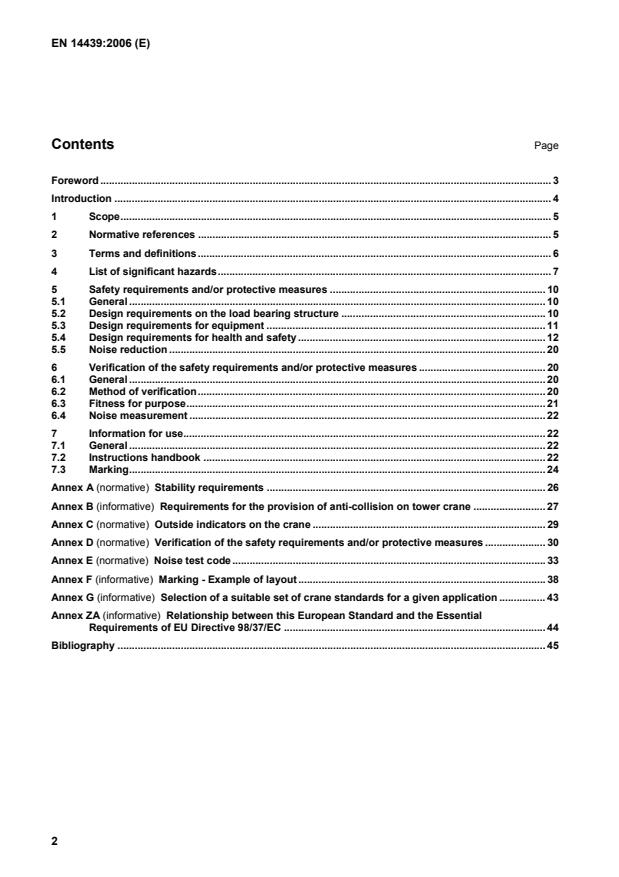
Stability requirements.26 Annex B (informative)
Requirements for the provision of anti-collision on tower crane.27 Annex C (normative)
Outside indicators on the crane.29 Annex D (normative)
Verification of the safety requirements and/or protective measures.30 Annex E (normative)
Noise test code.33 Annex F (informative)
Marking - Example of layout.38 Annex G (informative)
Selection of a suitable set of crane standards for a given application.43 Annex ZA (informative)
Relationship between this European Standard and the Essential Requirements of EU Directive 98/37/EC.44 Bibliography.45
ISO 4306-1:1990 and ISO 4306-3:2003 and the following apply. NOTE Definitions are in alphabetical order for the English version only.
The maximum net load that the crane is designed to lift for a given crane configuration and load location during normal operation. 3.2 tower crane slewing jib crane with the jib located at the top of a tower which stays approximately vertical in the working position. This power-driven appliance is equipped with means for raising and lowering suspended loads and for the movement of such loads by changing the radius, slewing and/or travelling of the complete appliance. NOTE 1 Certain appliances perform several, but not necessarily all of these movements. NOTE 2 The appliance can be installed in a fixed position or equipped with means for displacement or climbing. 4 List of significant hazards Table 1 contains all the significant hazards, hazardous situations and events, as far as they are dealt with in this European Standard, identified by risk assessment as significant for this type of machinery and which require action to eliminate or reduce the risk. It also contains the corresponding cross-references to EN ISO 12100, and the relevant clauses in this European Standard that are necessary to reduce or eliminate the risks associated with those hazards.
Table 1 — List of significant hazards and associated requirements N° Hazards Relevant clause(s) in this European Standard Hazards, hazardous situations and hazardous event 1 Mechanical hazards due to machine parts or workpieces, e.g.
– Shape 5.4.1
– Inadequacy of mechanical strength 5.2, 5.3.2 1.1 Crushing hazard 5.4.3, 5.4.4, 5.4.4.2 1.2 Shearing hazard 5.4.3 1.3 Cutting or severing hazard 5.4.3 1.4 Entanglement hazard 5.4.3, 5.4.3.1 1.5 Drawing-in or trapping hazard 5.4.3 1.6 Impact hazard 5.4.2, 5.4.1.8, 5.4.2.9, 5.4.3 1.9 High pressure fluid injection or ejection hazard (on cranes with hydraulic) 5.3.2 2 Electrical hazards due to:
2.1 Contact of persons with live parts (direct contact) 5.3.1 2.2 Contact of persons with parts which have become live under faulty conditions (indirect contact) 5.3.1
3.1 Burns, scalds and other injuries by a possible contact of persons with objects or materials with an extreme high or low temperature, by flames or explosions and also by the radiation of heat sources 5.4.1 3.2 Damage to health by hot or cold working environment 5.4.1, 5.4.1.8 4 Hazards generated by noise 5.5, 7.2.5, Annex E 4.1 Hearing loss 5.5, 7.2.5, Annex E 4.2 Interference with speech communication 5.5, 7.2.5, Annex E 7 Hazards generated by materials and substances (and their constituent elements) processed or used by the machinery
7.2 Fire or explosion hazard 5.4.1 8 Hazards generated by neglecting ergonomic principles in machinery design as, e.g. hazards from:
8.1 Unhealthy postures or excessive effort 5.4.4.4 8.2 Inadequate consideration of hand-arm foot-leg anatomy
5.4.1, 5.4.1.4 8.3 Neglected use of personal protection equipment 5.4.4, 5.4.4.5.1 8.4 Inadequate local lighting 5.4.1, 5.4.5 8.6 Human error, human behaviour 5.4.1, 5.4.1.2, 5.4.1.3, 5.4.2.5.1, 5.4.2.5.2, 5.4.2.6, 5.4.6 8.7 Inadequate design, location or identification of manual controls 5.4.1, 5.4.1.4 8.8 Inadequate design or location of visual display unit 5.4.1, 5.4.1.2 10 Unexpected start-up, unexpected overrun/overspeed (or any similar malfunction) from:
10.1 Failure/Disorder of the control system 5.4.1, 5.4.1.9, 5.4.2, 5.4.2.2 10.4 Other external influences (gravity, wind, etc) 5.2.1, 5.4.2.6, 5.4.2.10, 7.2.6 10.5 Errors in software 5.3.1 10.6 Errors made by the operator (due to mismatch of machinery with human characteristics and abilities) 5.4.1, 5.4.1.2, 5.4.1.3, 5.4.2.5.1, 5.4.2.5.2, 5.4.2.6, 5.4.6 13 Failure of the power supply 5.3.1 14 Failure of the control circuit 5.3.1 16 Break-up during operation 5.2, 5.3.2, 5.4.2.8, 5.4.3.2 17 Falling or ejected objects or fluids 5.4.3.2 18 Loss of stability/overturning of machinery 5.2, 5.4.2, 5.4.2.3, 5.4.2.4, 5.4.2.7, 5.4.2.8 19 Slip, trip and fall of persons (related to machinery) 5.4.4, 5.4.4.3, 5.4.4.5 Additional hazards, hazardous situations and hazardous event due to mobility 21 Linked to the work position (including driving station) on the machine
5.4.1 21.4 Mechanical hazards at the work position: d) Break-up of parts rotating at high speed
5.4.3.1, 5.4.3.2, 5.4.4.2 21.5 Insufficient visibility from the work positions 5.4.1, 5.4.1.5 21.6 Inadequate lighting 5.4.1 21.7 Inadequate seating 5.4.1 21.8 Noise at the work position 5.5, 7.2.5 21.10 Insufficient means for evacuation/emergency exit 5.4.1, 5.4.4 22 Due to the control system
22.1 Inadequate location of manual controls 5.3.1, 5.4.1, 5.4.1.3 22.2 Inadequate design of
manual controls and their mode of operation 5.3.1, 5.4.1, 5.4.1.2 23 From handling of the Machine (lack of stability) 7.2, 7.2.4 25 From/to third persons
25.2 Drift of part away from its stopping position 5.3.1, 5.3.2, 5.4.2 25.3 Lack or inadequacy of visual or acoustic warning means 7.3.2, 5.4.6 Additional hazards, hazardous situations and hazardous event due to lifting 27 Mechanical hazard and hazardous events
27.1 From load falls, collisions machine tipping caused by:
27.1.1 Lack of stability 5.2 27.1.4 Unexpected/unintended movement of the load 5.3.1, 5.3.2, 5.4.2 27.1.6 Collision of more the one machine 5.4.2.8 27.2 From access of persons to load support 7.2.6 27.3 From derailment 5.3.2 27.4 From insufficient mechanical strength of parts 5.2, 5.3.2 27.5 From inadequate design of pulleys, drums 5.3.2 27.6 From inadequate selection of chains, ropes lifting and accessories and their inadequate integration into the machine 5.3.2.3 27.7 From lowering of load under control of friction brake 5.3.2 27.8 From abnormal conditions of assembly/testing/use/maintenance 6.3 28 Electrical hazards
28.1 From lightning 5.3.1 29 Hazards generated by neglecting ergonomic principles
29.1 Insufficient visibility from the driving position 5.4.1, 5.4.1.5
at least A3; jib
at least E2. When calculation is done using other standards (see 5.2.1), an equivalent classification is required. 5.2.2.4 Wind forces shall be determined with an appropriate and recognised method e.g. F.E.M. 1.001. 5.2.2.5 For travel gears of tower cranes, a verification of the energy absorption capacity of the buffers and of the effect of the buffer forces on the supporting structure may be dispensed with, on condition that the rated travelling speed is less than 40 m/min and that limit switches are installed in addition to buffer stops.
M5; trolley travelling mechanism
M3; travelling gear
M3; NOTE The mechanism used to change occasionally the position of the crane may be defined in group M2. Auxiliary winch only used for mounting and maintenance operations
M1. The mechanisms shall be calculated in accordance with FEM 1.001, booklet 4. 5.3.2.3 Ropes Selection and calculation of running and stationary ropes shall be carried out from the maximum tensile force in the rope in accordance with FEM 1.001, booklet 4. The influences of dynamic effects and friction losses have to be considered. The mechanism group classification in accordance with FEM 1.001, booklet 2 shall be at least: lifting or luffing ropes
M4; trolley travel ropes
M4, and M3 when rope braking is monitored (see 5.4.2.7); erection ropes
M3; stationary ropes
M3. 5.3.2.4 Rail wheels Rail wheels shall be determined with an appropriate and recognised method, e.g. with FEM 1.001, booklets 4 and 9.
No modification
EN 13557:2003 applies 5.2.1.2 Control station dimensions completed by 5.4.1.4 5.2.2.2.6 Means to clear external surfaces of windows completed by 5.4.1.5 5.2.2.3.1.4 Effective door aperture No modification
EN 13557:2003 applies 5.2.2.3.1.5 Effective hatch aperture completed by 5.4.1.6 5.2.2.3.1.6 Dimensions of the hatch in the floorcompleted by 5.4.1.7 5.2.2.6.2 Cabin climate completed by 5.4.1.8 C.3.1 Category according to EN 954-1 for cableless controls No modification (No particular category for tower cranes)
C.3.2 Recommended delay to stop all crane movements, when no valid frame has been correctly received completed by 5.4.1.9
NOTE When EN 13557 requests for specific requirements from particular cranes types standards, the answer is given even there is no modification. 5.4.1.2 For tower cranes the symbols according to FEM 1.003 are recommended. 5.4.1.3 The arrangement of the controls shall be in accordance with ISO 7752-3. 5.4.1.4 Control station dimensions shall conform to ISO 8566-3. 5.4.1.5 On tower cranes, windscreens wiper and washers shall be provided on the front cabin window. 5.4.1.6 The minimum dimensions for effective hatch apertures shall be 0,55 m × 0,55 m. On self erecting cranes the hatch: can be under the driver seat, only if a other solution isn’t possible;
5.4.2.2 For limiters at least the following categories in accordance with EN 954-1:1996, Clause 6 shall be used: a)
For control circuits built with electromechanical components: category 1; b)
For control circuits built with electronic components: category 2. 5.4.2.3 A rated capacity limiter/indicator shall operate according the installed jib length.
Tower cranes assembled from components parts Self erecting tower cranes Tower cranes assembled from components parts Self erecting tower cranes Tower cranes assembled from components parts Self erecting tower cranes Tower cranes assembled from components parts Self erecting tower cranes Indicators for the actual radius and the actual load
X X X X X X X X Plates on the jib The load ratio between two succeeding steps is not more than 1,5 including the value of the maximum load at the maximum authorised radius and the value of the load at the maximum radius X X
Plates on the jib indicating the value of the maximum load at the maximum authorised radius and the value of the load at the maximum radius
X
X
X
5.4.2.6 Motion limiters 5.4.2.6.1 General The motion limiters shall be provided according to Table 5. 5.4.2.6.2 Overriding When it is necessary to override motion limiters in normal operation (e.g. change of the falls number, storage of the trolley) provision may be at the control station. The overriding devices shall be hold-to-run types and the crane components and the crane’s stability shall not be endangered. 5.4.2.7 For trolley drives on horizontal jib using ropes the breakage of a trolley travelling rope shall initiate the stop of the trolley.
d) Slewing limiter No if power supply via slipping assembly e) Travelling limiter YES f) Derricking limiter YES g) Telescoping limiter NO if erection work - YES if working condition h) Control station position limiter YES, if the control station is moved during service i) Working space limiter a Not mandatory, at the request of the user according the risk analysis of the job site j) Anti-collision device Not mandatory, at the request of the user k) Trolleying limiter YES l) A-frame position limiter YES a Working space limiter and crane being interdependent, the power supply shall be such that when the crane is "on", the working space limiter is automatically “on".
5.4.2.8 Requirements for the provision of anti-collision device on tower crane Each tower crane shall be capable of being equipped with anti-collision device. This device shall stop motions to avoid entering in a forbidden area and allow the reverse movement. Crane manufacturer shall determine the connection points necessary for the action of the device on the movement or function of the crane. The choice of these connection points and the given orders shall be such that the device actions are compatible with the normal use of the crane mechanisms (decelerating before stopping high inertia motions, mechanical brakes application). All connection points necessary for the installation of the device on the crane motion, shall be assembled in a specific collector or on a dedicated cable. This specific collector or dedicated cable shall be installed on all cranes except on self erecting cranes. NOTE Annex B provides some guidance for the anti-collision device. 5.4.2.9 Requirements for the provision of working space limiter on tower crane Each tower crane shall be capable of being equipped with working space limiter. This device shall stop motions to avoid entering in a forbidden area and allow the reverse movement. NOTE Annex B can be used also to provide some guidance for working space limiter. 5.4.2.10 Anemometer Tower cranes shall be provided with an anemometer except for self erecting cranes with a height under hook of less than 30 m measured with a horizontal jib.
EN 13586. 5.4.3.2 Prevention of crane components from falling Crane parts such as gears, pulleys, trolley wheels, covers and boxes shall be designed, assembled and fixed in such a way to prevent them from falling during normal operation. Covers, guards and access closures shall be fitted with hinges or other means to restrain them from falling. The trolleys shall be design such as the wheels should not slip out from the railway in case of rupture of the axis; furthermore the falling of the trolley shall not be possible. The output gears of the slewing gears shall be provided with covers or any other device avoiding their falling in case of rupture. 5.4.4 Access 5.4.4.1 General The design requirements for access shall conform to EN 13586 with the changes as shown in Table 6. Means of access can include a passing through the structure of the crane even if the dimension does not comply with EN 13586. Table 6 — Design requirements for access Clause in EN 13586:2004 Topic Change In this European Standard 6.2.8 Crushing hazard between moving parts completed by 5.4.4.2 6.4.1 Rung ladders completed by 5.4.4.3 6.6 Manholes completed by 5.4.4.4
5.4.4.2 Crushing hazard between moving parts Where persons could be present between moving parts a safety distance of at least 0,5 m shall be observed. Where such a distance cannot be obtained, guards (when possible) and warning notices shall be fitted.
Figure 1 5.4.4.5.3 Position of the walkway, handrail and steel wire rope Manufacturers shall take into consideration the dimension of the jib when determining the position of the walkway, hand rail and steel wire rope. 5.4.4.5.4 Basket The minimum dimension of the length/width of the basket shall be 0,5 × 0,35 m. Manufacturers shall take into consideration the weight and the number of persons when determining the basket. The side protection shall comply with EN 13586:2004, Table 7, type 2, walkway. Instructions and markings shall be provided for the use of the basket: how to reach the basket; admissible load and number of persons; warnings concerning residual risks e.g. shearing, entanglement. 5.4.5 Lighting A fixed non-dazzling service lighting shall be provided and so arranged that the necessary illumination of the control is provided. The minimum illumination shall be 50 lux. When the general area lighting does not permit sufficient illumination in a machinery cabinet, supplementary lighting shall be provided. For maintenance, the minimum illumination shall be 200 lux which may be obtained by additional movable lighting.
6 Verification of the safety requirements and/or protective measures 6.1 General Only verifications of additional requirements of the Clause 5 are given in the Table 7, the others are already covered by the particular standard. 6.2 Method of verification It is necessary to verify that the requirements of this European Standard have been incorporated in the design and manufacture of a tower crane. Either one or a combination of the following shall achieve this: a) measurement; b) calculation; c) visual examination; d) functional tests; as described in Table 7 and Annex D, clause D.1. To ensure fitness for purpose every single crane shall be checked individually in accordance with 6.3.
Clause of this European Standard Method of verification 5.2 Calculation, test and analysis 5.3 1 See Clause 6 of EN 13135-1:2003 5.3.2 See Clause 6 of EN 13135-2:2004 5.4.1
See Clause 6 of EN 13557:2003 5.4.1.3 Visual and design verification 5.4.1.4 Visual and design verification 5.4.1.5 Functional test
5.4.1.6 Geometrical verification 5.4.1.7 Geometrical verification 5.4.1.8 Measure and test 5.4.1.9 Functional test
5.4.2
See Clause 6 of EN 12077-2:1998 5.4.2.4 Functional test 5.4.2.5 Functional test 5.4.2.6 Functional test
5.4.2.7 Visual verification 5.4.2.8 Functional test 5.4.2.9 Functional test 5.4.3.1
Visual verification
5.4.3.2
Visual verification 5.4.4
See Clause 6 of EN 13586:2004 5.4.4.2 Geometrical verification 5.4.4.3 Visual and geometrical verification 5.4.4.4 Geometrical verification 5.4.4.5 Visual and geometrical verification 5.4.5 Visual verification 5.4.6 Functional and visual check 5.5 See 6.4 of this Standard
6.3 Fitness for purpose To ensure fitness for purpose, each tower crane shall be checked according to D.2 and D.3. As a general rule, this verification is done after the first erection and includes: visual inspection;
...