

EN 13242:2002+A1:2007
(Main + Amendment)Aggregates for unbound and hydraulically bound materials for use in civil engineering work and road construction
- Abstract
This European Standard specifies the properties of aggregates obtained by processing natural or manufactured or recycled materials for hydraulically bound and unbound materials for civil engineering work and road construction.
It provides for the evaluation of conformity of the products to this European Standard.
NOTE 1 Aggregates used in construction should comply with all the requirements of this European Standard. As well as familiar and traditional natural and manufactured aggregates Mandate M/125 "Aggregates" included recycled aggregates and some materials from new or unfamiliar sources. Recycled aggregates are included in the standards and new test methods for them are at an advanced stage of preparation. For unfamiliar materials from secondary sources, however, the work on standardisation has only started recently and more time is needed to define clearly the origins and characteristics of these materials. In the meantime such unfamiliar materials when placed on the market as aggregates must comply fully with this standard and national regulations for dangerous substances (see Annex ZA of the standard) depending upon their intended use. Additional characteristics and requirements may be specified on a case by case basis depending upon experience of use of the product, and defined in specific contractual documents.
NOTE 2 Properties for lightweight aggregates are specified in EN 13055-2.
- Status
- Published
- Publication Date
- 11-Dec-2007
- Technical Committee
- CEN/TC 154 - Aggregates
- Drafting Committee
- CEN/TC 154/SC 4 - Hydraulic bound and unbound aggregates
- Current Stage
- 9092 - Decision on results of review/2YR ENQ - revise - Review Enquiry
- Start Date
- 29-Sep-2009
- Completion Date
- 29-Sep-2009
- Directive
- 305/2011 - Regulation (eu) No 305/2011 of the European Parliament and of the Council of 9 march 2011 laying down harmonised conditions for the marketing of construction products and repealing council directive 89/106/eecOJ Ref: C, C 259 OJ Date: 08-Aug-2014
89/106/EEC - Construction productsOJ Ref: C, C 321 OJ Date: 16-Dec-2008
Buy Documents






Overview
EN 13242:2002+A1:2007 is a CEN European Standard that specifies the properties and conformity assessment of aggregates for unbound and hydraulically bound materials used in civil engineering work and road construction. It covers aggregates from natural, manufactured and recycled sources, setting out requirements for geometrical, physical, chemical and durability properties, and defines how producers and testing bodies should demonstrate compliance with the standard and applicable EU requirements.
Key Topics
- Scope & applicability: Aggregates for unbound fills, sub-bases, bases and hydraulically bound mixtures used in roads and civil engineering. Recycled and secondary-source materials are included but require adherence to national regulations for dangerous substances.
- Geometrical requirements: Designation by aggregate size (d/D) and grading; particle shape (flakiness/shape index); percentage of crushed/broken particles; fines (fraction <0.063 mm) content and fines quality.
- Physical requirements: Tests for resistance to fragmentation and wear (e.g., EN 1097 series), particle density and water absorption; classification of recycled aggregate constituents.
- Chemical requirements: Assessment of acid-soluble sulfates and total sulfur and other chemical properties using referenced test methods (e.g., EN 1744 series).
- Durability: Resistance to freezing/thawing, magnesium sulfate testing and specific tests for basalt “Sonnenbrand” (thermal sensitivity).
- Conformity & quality control: Initial type testing, factory production control (FPC) procedures and marking/labeling requirements; annexes provide assessment of fines, freezing/thawing guidance, and FPC essentials.
- Regulatory linkage: Supports essential requirements of EU construction product directives (see Annex ZA).
Applications
- Specification and procurement of aggregates for road bases, sub-bases, embankments, drainage layers, and hydraulically bound mixtures.
- Guidance for quarry/mining operators, recycled-aggregate processors, civil engineers, contractors, test laboratories and product certifiers to ensure materials meet performance and safety requirements.
- Basis for contract clauses, product data sheets and compliance documentation used in national and EU regulatory frameworks.
Related standards
- EN 12620 (Aggregates for concrete)
- EN 13043 / EN 13055 (Aggregates for bituminous mixtures and lightweight aggregates)
- EN 13139 (Aggregates for mortar)
- EN 1097 series (mechanical and physical testing)
- EN 933 series (geometrical testing)
- EN 1367 series (durability testing)
EN 13242:2002+A1:2007 is essential for ensuring consistent, safe and durable aggregate materials in civil and road construction projects using both traditional and recycled sources. Keywords: EN 13242:2002+A1:2007, aggregates, unbound, hydraulically bound, road construction, recycled aggregates, grading, conformity assessment.
Relations
- Effective Date
- 19-Jan-2023
- Effective Date
- 19-Jan-2023
- Effective Date
- 22-Dec-2008
- Effective Date
- 25-Aug-2026
- Effective Date
- 28-Jan-2026
- Effective Date
- 28-Jan-2026
- Effective Date
- 28-Jan-2026
- Effective Date
- 28-Jan-2026
- Refers
EN 1744-1:2009+A1:2012 - Tests for chemical properties of aggregates - Part 1: Chemical analysis - Effective Date
- 28-Jan-2026
- Effective Date
- 28-Jan-2026
- Effective Date
- 28-Jan-2026
- Effective Date
- 28-Jan-2026
- Effective Date
- 28-Jan-2026
- Effective Date
- 28-Jan-2026
- Effective Date
- 28-Jan-2026
Buy Documents
Get Certified
Connect with accredited certification bodies for this standard

DIBt (Deutsches Institut für Bautechnik)
German Institute for Building Technology.
DIN CERTCO
DIN Group product certification.

Aboma Certification B.V.
Specialized in construction, metal, and transport sectors.
Sponsored listings
Frequently Asked Questions
EN 13242:2002+A1:2007 is a standard published by the European Committee for Standardization (CEN). Its full title is "Aggregates for unbound and hydraulically bound materials for use in civil engineering work and road construction". This standard covers: This European Standard specifies the properties of aggregates obtained by processing natural or manufactured or recycled materials for hydraulically bound and unbound materials for civil engineering work and road construction. It provides for the evaluation of conformity of the products to this European Standard. NOTE 1 Aggregates used in construction should comply with all the requirements of this European Standard. As well as familiar and traditional natural and manufactured aggregates Mandate M/125 "Aggregates" included recycled aggregates and some materials from new or unfamiliar sources. Recycled aggregates are included in the standards and new test methods for them are at an advanced stage of preparation. For unfamiliar materials from secondary sources, however, the work on standardisation has only started recently and more time is needed to define clearly the origins and characteristics of these materials. In the meantime such unfamiliar materials when placed on the market as aggregates must comply fully with this standard and national regulations for dangerous substances (see Annex ZA of the standard) depending upon their intended use. Additional characteristics and requirements may be specified on a case by case basis depending upon experience of use of the product, and defined in specific contractual documents. NOTE 2 Properties for lightweight aggregates are specified in EN 13055-2.
This European Standard specifies the properties of aggregates obtained by processing natural or manufactured or recycled materials for hydraulically bound and unbound materials for civil engineering work and road construction. It provides for the evaluation of conformity of the products to this European Standard. NOTE 1 Aggregates used in construction should comply with all the requirements of this European Standard. As well as familiar and traditional natural and manufactured aggregates Mandate M/125 "Aggregates" included recycled aggregates and some materials from new or unfamiliar sources. Recycled aggregates are included in the standards and new test methods for them are at an advanced stage of preparation. For unfamiliar materials from secondary sources, however, the work on standardisation has only started recently and more time is needed to define clearly the origins and characteristics of these materials. In the meantime such unfamiliar materials when placed on the market as aggregates must comply fully with this standard and national regulations for dangerous substances (see Annex ZA of the standard) depending upon their intended use. Additional characteristics and requirements may be specified on a case by case basis depending upon experience of use of the product, and defined in specific contractual documents. NOTE 2 Properties for lightweight aggregates are specified in EN 13055-2.
EN 13242:2002+A1:2007 is classified under the following ICS (International Classification for Standards) categories: 91.100.15 - Mineral materials and products. The ICS classification helps identify the subject area and facilitates finding related standards.
EN 13242:2002+A1:2007 has the following relationships with other standards: It is inter standard links to EN 13242:2002/prA1, EN 13242:2002/AC:2004, EN 13242:2002, ISO 565:1990, EN 932-3:2022, EN 933-3:2012, EN 1097-2:1998, EN 1744-3:2002, EN 1744-1:2009+A1:2012, EN 1367-1:2007, EN 933-4:2008, EN 1367-3:2001, EN 1097-1:2023, EN 933-5:2022, EN 196-2:2025. Understanding these relationships helps ensure you are using the most current and applicable version of the standard.
EN 13242:2002+A1:2007 is associated with the following European legislation: EU Directives/Regulations: 305/2011, 89/106/EEC; Standardization Mandates: M/125. When a standard is cited in the Official Journal of the European Union, products manufactured in conformity with it benefit from a presumption of conformity with the essential requirements of the corresponding EU directive or regulation.
EN 13242:2002+A1:2007 is available in PDF format for immediate download after purchase. The document can be added to your cart and obtained through the secure checkout process. Digital delivery ensures instant access to the complete standard document.
Standards Content (Sample)
2003-01.Slovenski inštitut za standardizacijo. Razmnoževanje celote ali delov tega standarda ni dovoljeno.Aggregates for unbound and hydraulically bound materials for use in civil engineering work and road constructionGranulats pour matériaux traités aux liants hydrauliques et matériaux non traités utilisés pour les travaux de génie civil et pour la construction des chausséesGesteinskörnungen für ungebundene und hydraulisch gebundene Gemische für den Ingenieur- und StraßenbauTa slovenski standard je istoveten z:EN 13242:2002+A1:2007SIST EN 13242:2003+A1:2008en,fr,de91.100.15ICS:SLOVENSKI
STANDARDSIST EN 13242:2003+A1:200801-april-2008
EUROPEAN STANDARD NORME EUROPÉENNE EUROPÄISCHE NORM
EN 13242:2002+A1
December 2007 ICS 91.100.15 Supersedes EN 13242:2002 English Version
Aggregates for unbound and hydraulically bound materials for use in civil engineering work and road construction
Granulats pour matériaux traités aux liants hydrauliques et matériaux non traités utilisés pour les travaux de génie civil et pour la construction des chaussées
Gesteinskörnungen für ungebundene und hydraulisch gebundene Gemische für den Ingenieur- und Straßenbau This European Standard was approved by CEN on 23 September 2002 and includes Corrigendum 1 issued by CEN on 26 May 2004 and Amendment 1 approved by CEN on 3 November 2007.
CEN members are bound to comply with the CEN/CENELEC Internal Regulations which stipulate the conditions for giving this European Standard the status of a national standard without any alteration. Up-to-date lists and bibliographical references concerning such national standards may be obtained on application to the CEN Management Centre or to any CEN member.
This European Standard exists in three official versions (English, French, German). A version in any other language made by translation under the responsibility of a CEN member into its own language and notified to the CEN Management Centre has the same status as the official versions.
CEN members are the national standards bodies of Austria, Belgium, Bulgaria, Cyprus, Czech Republic, Denmark, Estonia, Finland, France, Germany, Greece, Hungary, Iceland, Ireland, Italy, Latvia, Lithuania, Luxembourg, Malta, Netherlands, Norway, Poland, Portugal, Romania, Slovakia, Slovenia, Spain, Sweden, Switzerland and United Kingdom.
EUROPEAN COMMITTEE FOR STANDARDIZATION
COMITÉ EUROPÉEN DE NORMALISATION EUROPÄISCHES KOMITEE FÜR NORMUNG
Management Centre: rue de Stassart, 36
B-1050 Brussels © 2007 CEN All rights of exploitation in any form and by any means reserved worldwide for CEN national Members. Ref. No. EN 13242:2002+A1:2007: E
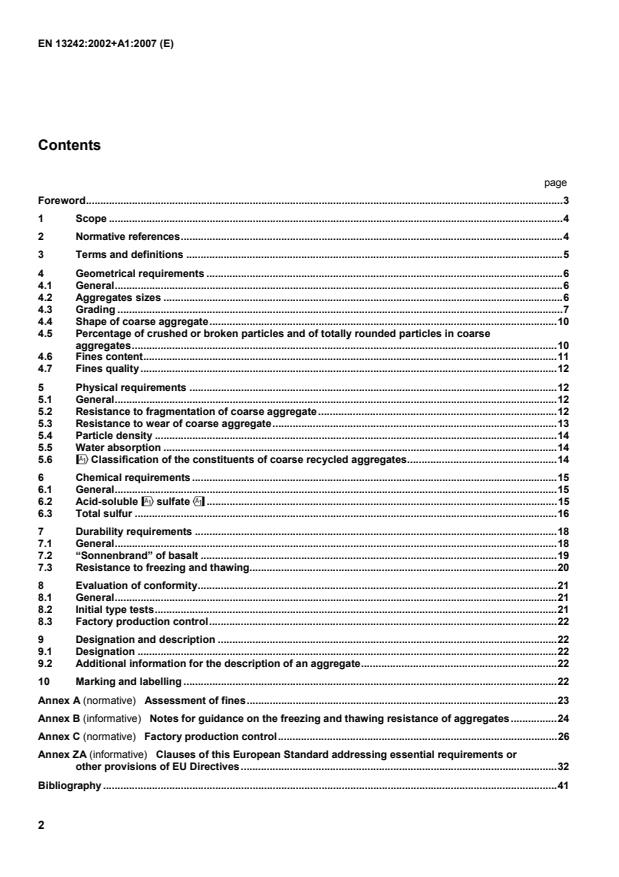
Assessment of fines.23 Annex B (informative)
Notes for guidance on the freezing and thawing resistance of aggregates.24 Annex C (normative)
Factory production control.26 Annex ZA (informative)
Clauses of this European Standard addressing essential requirements or other provisions of EU Directives.32 Bibliography.41
Aggregates for concrete EN 13043
Aggregates for bituminous mixtures and surface treatments for roads, airfields and
other trafficked areas EN 13055-1
Lightweight aggregates - Part 1: lightweight aggregates for concrete, mortar and grout !EN 13055-2 Lightweight aggregates - Part 2: Lightweight aggregates for bituminous mixtures and surface treatments and for unbound and bound applications" EN 13139
Aggregates for mortar EN 13383-1
Armourstone - Part 1: Specification !EN 13450" Aggregates for railway ballast According to the CEN/CENELEC Internal Regulations, the national standards organizations of the following countries are bound to implement this European Standard: Austria, Belgium, Bulgaria, Cyprus, Czech Republic, Denmark, Estonia, Finland, France, Germany, Greece, Hungary, Iceland, Ireland, Italy, Latvia, Lithuania, Luxembourg, Malta, Netherlands, Norway, Poland, Portugal, Romania, Slovakia, Slovenia, Spain, Sweden, Switzerland and United Kingdom.
Aggregates used in construction should comply with all the requirements of this European Standard. As well as familiar and traditional natural and manufactured aggregates Mandate M/125 “Aggregates” included recycled aggregates and some materials from new or unfamiliar sources. Recycled aggregates are included in the standards and new test methods for them are at an advanced stage of preparation. For unfamiliar materials from secondary sources, however, the work on standardisation has only started recently and more time is needed to define clearly the origins and characteristics of these materials. In the meantime such unfamiliar materials when placed on the market as aggregates must comply fully with this standard and national regulations for dangerous substances (see Annex ZA of the standard) depending upon their intended use. Additional characteristics and requirements may be specified on a case by case basis depending upon experience of use of the product, and defined in specific contractual documents.™ NOTE 2 Properties for lightweight aggregates are specified in EN 13055-2. 2 Normative references This European Standard incorporates by dated or undated reference, provisions from other publications. These normative references are cited at the appropriate places in the text and the publications are listed hereafter. For dated references, subsequent amendments to or revisions of any of these publications apply to this European Standard only when incorporated in it by amendment or revision.
For undated references the latest edition of the publication referred to applies (including amendments). EN 196-2, Methods of testing cement — Part 2: Chemical analysis of cement. EN 932-3, Tests for general properties of aggregates — Part 3: Procedure and terminology for simplified
petrographic description. EN 932-5, Tests for general properties of aggregates — Part 5: Common equipment and calibration. EN 933-1, Tests for geometrical properties of aggregates — Part 1: Determination of particle size distribution — Sieving method. EN 933-3, Tests for geometrical properties of aggregates — Part 3: Determination of particle shape — Flakiness index. EN 933-4, Tests for geometrical properties of aggregates — Part 4: Determination of particle shape — Shape index. EN 933-5, Tests for geometrical properties of aggregates — Part 5: Determination of percentage of crushed and broken surfaces in coarse aggregates particles EN 933-8, Tests for geometrical properties of aggregates — Part 8: Assessment of fines — Sand equivalent test. EN 933-9, Tests for geometrical properties of aggregates — Part 9: Assessment of fines — Methylene blue test. !prEN 933-11, Tests for geometrical properties of aggregates — Part 11: Classification test for the constituents of coarse recycled aggregates" EN 1097-1, Tests for mechanical and physical properties of aggregates — Part 1: Determination of the resistance to wear (micro-Deval). EN 1097-2:1998, Tests for mechanical and physical properties of aggregates — Part 2: Methods for the determination of the resistance to fragmentation.
3.2 natural aggregate aggregate from mineral sources which have been subjected to nothing more than mechanical processing
3.3 manufactured aggregate aggregate of mineral origin resulting from an industrial process involving thermal or other modification
3.4 recycled aggregate aggregate resulting from the processing of inorganic material previously used in construction
3.5 normal weight aggregate aggregate of mineral origin having a particle density not less than 2,00 Mg/m3 (2 000 kg/m3) but less than 3,00 Mg/m3 (3 000 kg/m3)
3.6 aggregate size designation of aggregate in terms of lower (d) and upper (D) sieve sizes expressed in terms as d/D
NOTE This designation accepts the presence of some particles which will be retained on the upper sieve (oversize) and some which will pass the lower sieve (undersize). The lower sieve size (d) can be zero. 3.7 fine aggregate designation given to size aggregates with d equal to 0 and D less than or equal to 6,3 mm (see Table 2)
NOTE Fine aggregate can be produced from natural disintegration of rock or gravel and/or by the crushing of rock or gravel !or processing of manufactured aggregates".
3.9 all-in aggregate aggregate consisting of a mixture of coarse and fine aggregates with D greater than 6,3 mm
NOTE It can be produced without separating into coarse and fine fractions or it can be produced by combining coarse and fine aggregate.
3.10 fines particle size fraction of an aggregate which passes the 0,063 mm sieve 3.11 category level of a property of an aggregate expressed as a range of values or a limiting value
NOTE There is no relationship between the categories of different properties. 3.12 grading particle size distribution expressed as the percentage by mass passing a specified number of sieves
3.13 undersize part of the aggregate passing the smaller of the limiting sieves used in the aggregate size description
3.14 oversize part of the aggregate retained on the larger of the limiting sieves used in the aggregate size description 4 Geometrical requirements 4.1 General The necessity for testing and declaring all properties in this clause shall be limited according to the particular application or end use or origin of the aggregate.
When required, the tests specified in clause 4 shall be carried out to determine appropriate geometrical properties.
NOTE 1 When the value of a property is required but not defined by specified limits the value should be declared by the manufacturer as an XXDeclared category, e.g., in Table 5 a flakiness index of say 60 corresponds to FI60 (Declared value).
NOTE 2 When a property is not required, a “No requirement” category can be used. NOTE 3 Guidance on selection of appropriate categories for specific applications can be found in national provisions in the place of use of the aggregate. NOTE 4 When specified, the requirements for the end-use product should supersede the requirements in this European Standard (e.g., grading and/or fines content for all-in aggregates). 4.2 Aggregates sizes All aggregates shall be described in terms of aggregate sizes using the designations d/D and shall comply with the grading requirements specified in 4.3. Aggregate sizes shall be specified using the nominal sizes given in the Table 1 comprising the basic set or the basic set plus set 1 or the basic set plus set 2. A combination of sieve sizes from set 1 and set 2 is not allowed.
4.3 Grading 4.3.1 General The grading of aggregate sizes when determined in accordance with EN 933-1 shall comply with the requirements of 4.3.2 and 4.3.3 as appropriate to its aggregate size d/D. Combinations of two or more than two adjacent aggregate sizes or all-in aggregates are permitted. NOTE Aggregate supplied as a mixture of different sizes or types should be uniformly blended. When aggregates of significantly different density are blended caution is necessary to avoid segregation. When assessing production within a system of factory production control at least 90 % of gradings, taken on different batches within a maximum period of 6 months, shall fall within the limits specified in 4.3.2 and 4.3.3 for tolerances on manufacturers' declared typical gradings.
Table 2 — General grading requirements Percentage passing by mass Aggregate Size mm 2 D a 1,4 D b c D d d c e d/2 b c Category G Coarse
d ≥ 1 100 98 to 100 85 to 99 0 to 15 0 to 5 GC 85-15
and D > 2 100 98 to 100 80 to 99 0 to 20 0 to 5 GC 80-20 Fine
d = 0 100 98 to 100 85 to 99 – – GF 85
and D ≤ 6,3 100 98 to 100 80 to 99 – – GF 80
d = 0 - 100 85 to 99 – – GA 85 All-in
100 98 to 100 80 to 99 – – GA 80
and D > 6,3 100 – 75 to 99 – – GA 75 a
For aggregate sizes where D is greater than 63 mm (e.g. 80 mm and 90 mm) only the oversize
requirements related to the 1,4 D sieve apply since there is no ISO 565/R20 series sieve above 125 mm.
b
Where the sieves calculated as 1,4 D and d/2 are not exact sieve sizes in the ISO 565/R20 series then
the next higher or lower sieve size respectively shall be adopted.
c
For special uses additional requirements may be specified.
d
The percentage passing D may be greater than 99 % but in such cases the manufacturer shall document and
declare the typical grading including the sieves D, d, d/2 and sieves in the basic set plus set 1 or basic
set plus set 2 intermediate between d and D. Sieves with a ratio less than 1,4 times the next lower sieve
may be excluded.
e
Limits for the percentage passing d can be modified to 1 to 15 for GC 85-15 and 1 to 20 for GC 80-20
where necessary to ensure a well graded aggregate.
4.3.2 Coarse aggregate All coarse aggregates shall comply with the general grading requirements specified in Table 2 appropriate to their size d/D. When required, for graded coarse aggregate where D/d ≥ 2, the following additional requirements shall apply for the percentage passing the mid-size sieve:
all gradings shall comply with the overall limits given in Table 3;
the manufacturer shall document and, on request, declare the typical grading passing the mid-size sieve.
The
limit deviations shall comply with the requirements of the categories selected in Table 3 according to the particular
application or end use. For single coarse aggregate where D/d <2, there shall be no requirement additional to those specified in Table 2.
≥ 2 D/d Mid-size sieve
mm Overall limits Limit deviations on manufacturer's declared typical grading Category
GT <4 D/1,4 25 to
80 ± 15 GTC25/15
20 to 70 ± 15 GTC20/15 ≥4 D/2 20 to 70 ± 17,5 GTC20/17,5
No requirement GTNR When the mid-size sieves calculated in the above is not an exact sieve size in the ISO 565/R20 series then the nearest sieve in the series shall be used.
4.3.3 Fine aggregate and all-in aggregate Fine aggregates and all-in aggregates shall comply with the general grading requirements specified in Table 2. When required, the manufacturer shall document, and on request declare, the typical grading for each fine aggregate and all-in aggregate size produced.
The limit deviations shall comply with the requirements of the categories selected in Table 4 according to the particular application or end use. Table 4 — Categories of tolerances on manufacturer’s declared typical grading of fine aggregate and all-in aggregate Limit deviations
Percentage passing by mass Category
D sieve D/2 sieve
0,063 mm sieve
Fine aggregate GTF All-in aggregate GTA ± 5 ± 5 ± 7,5 ± 10 ± 20 ± 25 ± 3 a ± 4 b ± 5 c GTF10 GTF20 GTF25 GTA10 GTA20 GTA25 No requirement GTFNR GTANR When the mid-size sieve calculated as above is not an exact sieve size in the ISO 565/R20 series, then the nearest sieve in the series shall be used.
NOTE
Limit deviations of D sieves are further limited by the requirements of Table 2.
a
Except for category f 3
(see Table 8).
b
Except for categories f 3 and f 7 for fine aggregates and f 3 , f 5 and f 7 for all-in aggregates (see Table 8).
c
Except for categories f 3 and f 7 for fine aggregates and f 3 , f 5 , f 7 and f 9 for all-in aggregates (see Table 8).
The flakiness index shall be the reference test for the determination of the shape of coarse aggregates.
The flakiness index shall be declared in accordance with the relevant category specified in Table 5 according to the particular application or end use. Table 5 — Categories for maximum values of flakiness index Flakiness index Category FI ≤ 20 ≤ 35 ≤ 50 > 50 FI20 FI35 FI50
FIDeclared No requirement FINR
Where required, the shape index, determined in accordance with EN 933-4, shall be declared in accordance with the relevant category specified in Table 6 according to the particular application or end use. Table 6 — Categories for maximum values of shape index
Shape index Category SI ≤ 20 ≤ 40 ≤ 55 > 55 SI20 SI40 SI55
SIDeclared No requirement SINR
4.5 Percentage of crushed or broken particles and of totally rounded particles in coarse aggregates When required, the percentage of crushed or broken and of totally rounded particles in coarse aggregates, determined in accordance with EN 933-5, shall be declared in accordance with the relevant category specified in Table 7. Aggregates obtained from crushing rock shall be assumed to be category C90/3 and do not require further testing.
% Mass fraction of totally rounded particles
% Category C 90 to 100 0 to 3
C90/3 50 to 100 0 to 10
C50/10 50 to 100 0 to 30
C50/30 - 0 to 50
CNR/50 - 0 to 70
CNR/70 Declared value Declared value
CDeclared No requirement No requirement CNR
4.6 Fines content When required, the fines content for coarse aggregate, fine aggregate and all-in aggregate, shall be declared in accordance with the relevant category specified in Table 8. Table 8 — Categories for maximum values of fines content Aggregate Mass fraction of passing 0,063 mm sieve,
% Category f ≤ 2 f 2 ≤ 4 f 4 > 4
f Declared
Coarse No requirement f NR ≤ 3 f 3 ≤ 7 f 7 ≤ 10 f 10 ≤ 16 f 16 ≤ 22 f 22 > 22
f Declared
Fine No requirement f NR ≤ 3 f 3 ≤ 5 f 5 ≤ 7 f 7 ≤ 9 f 9 ≤ 12 f 12 ≤ 15 f 15 > 15
f Declared
All-in No requirement f NR
4.7 Fines quality When the fines content in the fine aggregate exceeds a mass fraction of 3 % and there is documented evidence of satisfactory use, further testing may not be necessary.
When required, aggregates shall be assessed for harmful fines in accordance with annex A. 5 Physical requirements 5.1 General The necessity for testing and declaring all properties in this clause shall be limited according to the particular application or end use or origin of the aggregate.
When required, the tests specified in clause 5 shall be carried out to determine appropriate physical properties. NOTE 1 When the value of a property is required but not defined by specified limits the value should be declared by the manufacturer as an XXDeclared category, e.g., in Table 9 a Los Angeles coefficient of say 65 corresponds to LA65 (Declared value).
NOTE 2 When a property is not required, a “No requirement” category can be used. NOTE 3 Guidance on selection of appropriate categories for specific applications can be found in national provisions in the place of use of the aggregate. 5.2 Resistance to fragmentation of coarse aggregate When required, the resistance to fragmentation shall be determined in terms of the Los Angeles coefficient, as specified in EN 1097-2:1998, clause 5.
The Los Angeles test method shall be the reference test for the determination of resistance of fragmentation.
The Los Angeles coefficient shall be declared in accordance with the relevant category specified in Table 9 according to the particular application or end use. Table 9 — Categories for maximum values of Los Angeles coefficients Los Angeles coefficient Category LA ≤ 20 LA20 ≤ 25 LA25 ≤ 30 LA30 ≤ 35 LA35 ≤ 40 LA40 !≤ 45 LA45" ≤ 50 LA50 ≤ 60 LA60 > 60
LADeclared No requirement LANR
Where required, the impact value, determined in accordance with EN 1097-2:1998, clause 6 shall be declared in accordance with the relevant category specified in Table 10 according to the particular application or end use.
SZDeclared No requirement SZNR 5.3 Resistance to wear of coarse aggregate When required, the resistance to wear of coarse aggregate (micro-Deval coefficient, MDE) determined in accordance with EN 1097-1, shall be declared in accordance with the relevant category specified in Table 11 according to the particular application or end use. Table 11 — Categories for maximum values of resistance to wear ! micro-Deval coefficient Category MDE ≤ 15 ≤ 20 ≤ 25 ≤ 30 ≤ 35 ≤ 40 ≤ 45 ≤ 50 > 50 MDE15 MDE20 MDE25 MDE30 MDE35 MDE40 MDE45 MDE50
MDEDeclared No requirement MDENR "
percentage by mass
Rc ≥ 90 ≥ 80 ≥ 70 ≥ 50 < 50 no requirement Rc 90 Rc 80 Rc 70 Rc 50 Rc Declared Rc NR Rc + Ru + Rg ≥ 90 ≥ 70 ≥ 50 < 50 no requirement Rcug 90 Rcug 70 Rcug 50 Rcug Declared Rcug NR Rb ≤ 10 ≤ 30 ≤ 50 > 50 no requirement Rb 10- Rb 30- Rb 50- Rb Declared Rb NR Ra ≥ 95 ≥ 80 ≥ 50 ≥ 40 > 30 ≤ 30 ≤ 20 ≤ 10 ≤ 5 ≤ 1 no requirement Ra 95 Ra 80 Ra 50 Ra 40 Ra 30 Ra 30- Ra 20- Ra 10- Ra 5- Ra 1- Ra NR Rg ≤ 2 ≤ 5 ≤ 25 no requirement Rg 2- Rg 5- Rg 25- Rg NR X ≤ 1 X1-
Content
cm3/kg Categories FL ≤ 5 ≤ 10 FL5- FL10-
NOTE 1 When the value of a property is required but not defined by specified limits the value should be declared by the manufacturer as an XXDeclared category, e.g., in !Table 13" a value of say with a mass fraction of 1,4 % for the acid-soluble !sulfate" content of air-cooled blastfurnace slag corresponds to AS1,4 (Declared value). NOTE 2 When a property is not required, a “No requirement” category can be used. NOTE 3 Guidance on selection of appropriate categories for specific applications can be found in national provisions in the place of use of the aggregate. 6.2 Acid-soluble !sulfate" When required, the acid soluble !sulfate" content of combined aggregates for hydraulically bound materials, determined in accordance with !EN 1744-1", shall be declared in accordance with the relevant category specified in !Table 13".
ASDeclared
Aggregates other than air-cooled blastfurnace slag No requirement ASNR ≤ 1,0 AS1,0 > 1,0
ASDeclared
Air-cooled blastfurnace slag No requirement ASNR
6.3 Total sulfur When required, the total sulfur content of the aggregate, determined in accordance with !EN 1744-1", shall be declared in accordance with the relevant category specified in !Table 14". !Table 14" — Categories for maximum values of total sulfur content Aggregate Total sulfur content % Category S ≤ 1 S1 > 1
SDeclared
Aggregates other than air-cooled blastfurnace slag No requirement
SNR ≤ 2 S2 > 2
SDeclared
Air-cooled blastfurnace slag No requirement
SNR
NOTE
Special precautions are necessary if pyrrhotite, an unstable form of iron sulphide (FeS), is present in the aggregate. If this mineral is known to be present, a maximum total sulphur content of 0,4 % as S should apply. 6.4 !Water-soluble sulfate When required, the water-soluble sulfate content of the recycled aggregates, determined in accordance with
EN 1744-1, shall be declared in accordance with the relevant category specified in Table 15.
NOTE Water-soluble sulfates determined according to EN 1744-1, are essentially potentially active sulfates (e.g. gypsum plaster) sources of destruction of civil engineering works and roads." 6.5 Other constituents 6.5.1 Constituents which alter the rate of setting and hardening of hydraulically bound mixtures Aggregates !deleted text" that contain organic or other substances in proportions that alter the rate of setting and hardening of hydraulically bound mixtures shall be assessed for the effect on stiffening time and compressive strength in accordance with !EN 1744-1". The proportions of such materials shall be such that they do not: a) increase the stiffening time of mortar test specimens by more than 120 min; b) decrease the compressive strength of mortar test specimens by more than 20 % at 28 days. The presence of organic matter shall be determined in accordance with !EN 1744-1" (sodium hydroxide test).
If the results indicate the presence of humic acid, the presence of fulvo acids shall be determined in accordance with !EN 1744-1".
If the supernatant liquid in these tests is lighter than the standard colours the aggregates shall be considered to be free from organic matter. NOTE 1 Some inorganic compounds which discolour the supernatant liquid in the sodium hydroxide test do not adversely affect the setting and hardening of hydraulically bound mixtures. NOTE 2 Sugars do not affect the colour of the supernatant liquid in the sodium hydroxide test or the fulvo acid test.
If it is suspected that sugars or sugar type materials are present, the aggregate should be tested using the mortar specimen test (see !EN 1744-1". The stiffening time and compressive strength requirements shown above should apply. 6.5.2 Constituents which affect volume stability of blastfurnace and steel slag for unbound aggregates 6.5.2.1 Volume stability of steel slags When required the volume stability of steel slag aggregate shall be determined in accordance with !EN 1744-1".
Steel slag aggregate shall be considered to be volumetrically stable if the expansion is not greater than the specified maximum value declared in accordance with the category specified in !Table 16" according to the particular application or end use. For determination of the magnesium oxide (MgO) content the test specified in EN 196-2 shall be used.
≤ 7,5
V7,5
≤ 10
V10
> 10
VDeclared
BOF-slag a /EAF-slag b No requirement
VNR NOTE 1
When the MgO content determined in accordance with EN 196-2 is not greater than or equal to 5 %, the testing time should be 24 h.
When the MgO content is more than 5 %, the testing time should be 168 h.
NOTE 2
The total MgO content is used as a measure of free MgO, in the absence, at present of a reliable method of determining the content of free MgO. In the event of a reliable method being developed, the types should be redefined in terms of free MgO content. MgO values declared by steel manufacturers are acceptable for use in determining testing time for steel slag. a BOF-slag: Basic oxygen furnace slag. b EAF-slag: Electric arc furnace slag.
6.5.2.2 Dicalcium silicate disintegration of air-cooled blastfurnace slags When required, air-cooled blastfurnace slag aggregate shall be tested in accordance with !EN 1744-1", and shall be free from dicalcium silicate disintegration. 6.5.2.3 Iron disintegration of air-cooled blast furnace slags When required, air-cooled blastfurnace slag aggregate shall be tested in accordance with !EN 1744-1", and shall be free from iron disintegration. 6.5.3 Water soluble constituents When a determination of water soluble constituent is required, the preparation of an eluate shall be made in accordance with EN 1744-3. 6.5.4 Impurities When required, aggregates shall not contain any foreign matters such as wood, glass and plastic that will cause damage to the end use product. 7 Durability requirements 7.1 General The necessity for testing and declaring all properties in this clause shall be limited according to the particular application or end use or origin of the aggregate.
When required, the tests specified in clause 7 shall be carried out to determine appropriate durability properties. NOTE 1 When the value of a property is required but not defined by specified limits the value should be declared by the manufacturer as an XXDeclared category, !e.g. in Table 21 a magnesium sulfate value of 45 percentage loss of mass corresponds to MS45(Declared value)".
Usually hairline cracks are generated radiating out from the spots and interconnecting them.
This reduces the strength of the mineral fabric, and as a result the rock decays to small particles.
Depending on the source this process can take place within months of extraction or extend over several decades. In exceptional cases a rapid decay results in the formation of large cracks and the breaking of aggregate particles. On completion of the boiling test, the loss of mass and the resistance to fragmentation (SBSZ or SBLA) shall be declared in accordance with the relevant category specified in !Table 17" according to the particular application or end use. !Table 17" — Categories for maximum values of resistance to ‘’Sonnenbrand’’ Test method Result % Category SB Boiling test
and
a) Impact test
or
b) Los Angeles test !Loss of mass after boiling
Increase of impact value after boiling
Increase of Los Angeles coefficient after boiling" ≤ 1
≤ 5
≤ 8
SBSZ
SBLA Boiling test
and
a) Impact test
or
b) Los Angeles test !Loss of mass after boiling
Increase of impact value after boiling
Increase of Los Angeles coefficient after boiling" > 1
> 5
> 8
SBSZ Declared
SBLA Declared
No requirement SBNR
NOTE
Selection of the water absorption test specified in !EN 1097-6:2000, Clause 7 or Clause 8" or annex B is dependent upon the size of the aggregate. If the water absorption, determined in accordance with !EN 1097-6:2000, Clause 7 or Clause 8", is not greater than the value selected as one of the categories specified in !Table 18", the aggregate shall be assumed to be freeze-thaw resistant. !Table 18" — Categories for maximum values of water absorption (!EN 1097-6:2000, Clause 7 or Clause 8") Water absorption Percentage by mass % Category WA24 ≤ 1 ≤ 2 WA24 1 WA24 2 NOTE
The water absorption test as a screening test is not applicable for blastfurnace slag.
If the water absorption, determined in accordance with EN 1097-6:2000, annex B, is not greater than the maximum a value of 0,5 %, the aggregate shall be assumed to be freeze-thaw resistant (see !Table 19").
!Table 19" — Categories for maximum values of water absorption (EN 1097-6:2000, annex B) Water absorption Percentage by mass % Category !Wcm" ≤ 0,5 > 0,5 !Wcm0,5"
!Wcm Declared" No requirement !WcmNR" NOTE
The water absorption test as a screening test is not applicable for blastfurnace slag.
!Table 21". !Table 20" — Categories for maximum freeze-thaw resistance Freeze-thaw Percentage by mass a % Category F < 1 < 2 < 4 > 4 F1 F2 F4
FDeclared No requirement
FNR a In extreme situations of cold weather and/or salt or de-icing salt saturation, then tests using a salt solution or urea described in EN1367-1:1999, annex B, may be more appropriate. The limits in this table would not apply.
!Table 21" — Categories for maximum magnesium !sulfate" soundness Magnesium !sulfate value" Percentage loss of mass % Category MS < 18 < 25 < 35 > 35 MS18 MS25 MS35
MSDeclared No requirement MSNR
8 Evaluation of conformity 8.1 General The manufacturer shall undertake initial type tests (see 8.2) and Factory Production Control (see annex C) to ensure that the product conforms to this European Standard and to declared values as appropriate. 8.2 Initial type tests Initial type tests relevant to the intended end use shall be carried out to check compliance with specified requirements in the following circumstances: a) A new source of aggregates is to be used;
the properties of the aggregates. The results of the initial tests shall be documented as the starting point of the factory production control for that material.
This shall particularly include the identification of any components likely to emit radiation above normal background levels, any components likely to release polyaromatic carbons or other dangerous substances.
If the content of any of these components exceeds the limits in force according to the provisions valid in the place of use of the aggregate, the results of the initial tests shall be declared. 8.3 Factory production control The manufacturer shall have in place a system of factory production control that complies with the requirements of annex C. The records held by
...
SLOVENSKI SIST EN 13242:2003+A1
STANDARD april 2008
Agregati za nevezane in hidravlično vezane materiale za uporabo v
inženirskih objektih in za gradnjo cest
Aggregates for unbound and hydraulically bound materials for use in civil
engineering work and road construction
Granulats pour matériaux traités aux liants hydrauliques et matériaux non traités
utilisés pour les travaux de génie civil et pour la construction des chaussés
Gesteinskörnungen für ungebundene und hydraulisch gebundene Gemische für
Ingenieur- und Strassenbau
Referenčna oznaka
ICS 91.100.15 SIST EN 13242:2003+A1:2008 (sl)
Nadaljevanje na straneh II in III ter od 1 do 39
© 2011-09. Slovenski inštitut za standardizacijo. Razmnoževanje celote ali delov tega standarda ni dovoljeno.
SIST EN 13242:2003+A1 : 2008
NACIONALNI UVOD
Standard SIST EN 13242:2003+A1 (sl), Agregati za nevezane in hidravlično vezane materiale za
uporabo v inženirskih objektih in za gradnjo cest, 2008, ima status slovenskega standarda in je
istoveten evropskemu standardu EN 13242:2002+A1 (en, de, fr), Aggregates for unbound and
hydraulically bound materials for use in civil engineering work and road construction, 2007.
Standard SIST EN 13242:2003+A1:2008 nadomešča SIST EN 13242:2003.
NACIONALNI PREDGOVOR
Evropski standard EN 13242:2002+A1:2007 je pripravil tehnični odbor Evropskega komiteja za
standardizacijo CEN/TC 154 Agregati. Slovenski standard SIST EN 13242:2003+A1:2008 je prevod
evropskega standarda EN 13242:2002+A1:2007. V primeru spora glede besedila slovenskega
prevoda v tem standardu je odločilen izvirni evropski standard v enem izmed treh uradnih jezikov
CEN. Slovensko izdajo standarda je pripravil tehnični odbor SIST/TC AGR Agregati.
Odločitev za izdajo tega standarda je dne 20. marca 2008 sprejel SIST/TC AGR Agregati.
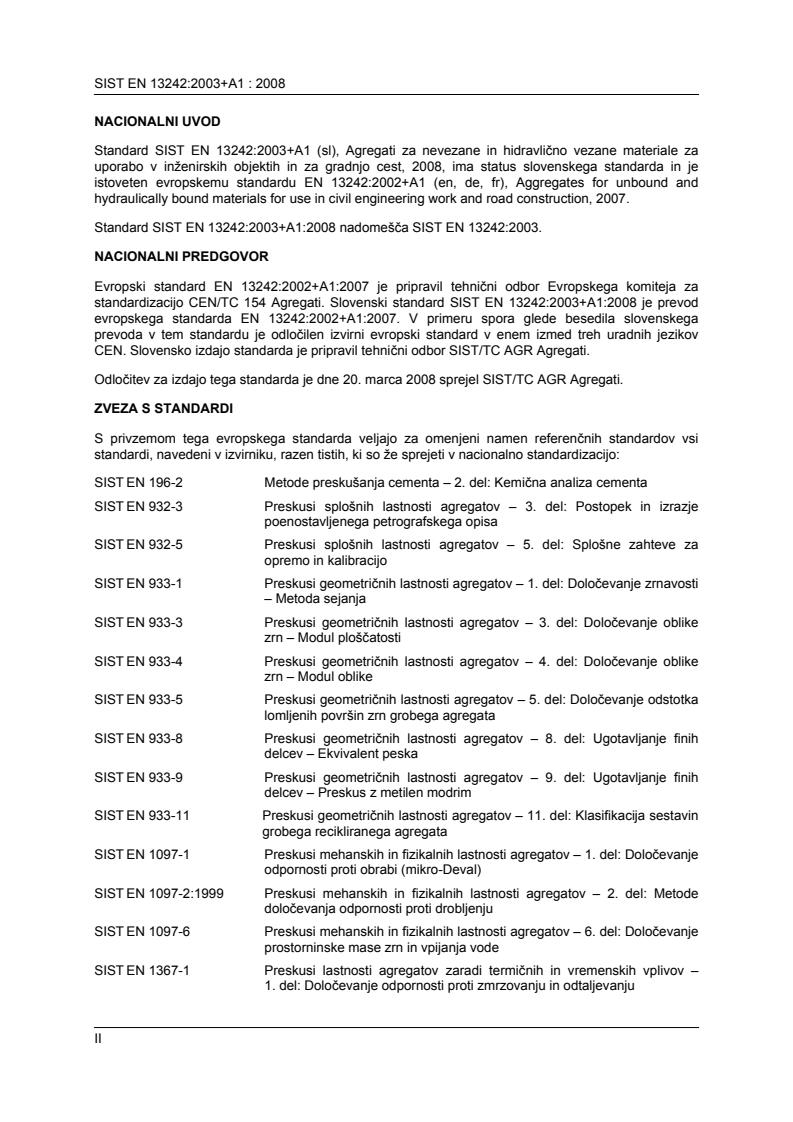
ZVEZA S STANDARDI
S privzemom tega evropskega standarda veljajo za omenjeni namen referenčnih standardov vsi
standardi, navedeni v izvirniku, razen tistih, ki so že sprejeti v nacionalno standardizacijo:
SIST EN 196-2 Metode preskušanja cementa – 2. del: Kemična analiza cementa
SISTEN 932-3 Preskusi splošnih lastnosti agregatov – 3. del: Postopek in izrazje
poenostavljenega petrografskega opisa
SISTEN 932-5 Preskusi splošnih lastnosti agregatov – 5. del: Splošne zahteve za
opremo in kalibracijo
SIST EN 933-1 Preskusi geometričnih lastnosti agregatov – 1. del: Določevanje zrnavosti
– Metoda sejanja
SIST EN 933-3 Preskusi geometričnih lastnosti agregatov – 3. del: Določevanje oblike
zrn – Modul ploščatosti
SIST EN 933-4 Preskusi geometričnih lastnosti agregatov – 4. del: Določevanje oblike
zrn – Modul oblike
SIST EN 933-5 Preskusi geometričnih lastnosti agregatov – 5. del: Določevanje odstotka
lomljenih površin zrn grobega agregata
SIST EN 933-8 Preskusi geometričnih lastnosti agregatov – 8. del: Ugotavljanje finih
delcev – Ekvivalent peska
SIST EN 933-9 Preskusi geometričnih lastnosti agregatov – 9. del: Ugotavljanje finih
delcev – Preskus z metilen modrim
SIST EN 933-11 Preskusi geometričnih lastnosti agregatov – 11. del: Klasifikacija sestavin
grobega recikliranega agregata
SIST EN 1097-1 Preskusi mehanskih in fizikalnih lastnosti agregatov – 1. del: Določevanje
odpornosti proti obrabi (mikro-Deval)
SISTEN 1097-2:1999 Preskusi mehanskih in fizikalnih lastnosti agregatov – 2. del: Metode
določevanja odpornosti proti drobljenju
SIST EN 1097-6 Preskusi mehanskih in fizikalnih lastnosti agregatov – 6. del: Določevanje
prostorninske mase zrn in vpijanja vode
SISTEN 1367-1 Preskusi lastnosti agregatov zaradi termičnih in vremenskih vplivov –
1. del: Določevanje odpornosti proti zmrzovanju in odtaljevanju
II
SIST EN 13242:2003+A1 : 2008
SISTEN 1367-2 Preskusi lastnosti agregatov zaradi termičnih in vremenskih vplivov –
2. del: Preskus z magnezijevim sulfatom
SISTEN 1367-3 Preskusi lastnosti agregatov zaradi termičnih in vremenskih vplivov –
3. del: Preskus s kuhanjem zaradi vpliva sonca na bazald, metoda
"Sonnenbrand bazalt"
SIST EN 1744-1 Preskusi kemičnih lastnosti agregatov – 1. del: Kemijska analiza
SIST EN 1744-3 Preskusi kemičnih lastnosti agregatov – 3. del: Priprava izlužkov
agregatov
SIST ISO 565 Preskusna sita – Kovinsko pletivo, kovinske perforirane plošče in
električno oblikovane folije - Imenske mere odprtin
OSNOVA ZA IZDAJO STANDARDA
– privzem standarda EN 13242:2002+A1:2007
PREDHODNA IZDAJA
– SIST EN 13242:2003, Agregati za nevezane in hidravlično vezane materiale za uporabo v
inženirskih objektih in za gradnjo cest
OPOMBE
– Povsod, kjer se v besedilu standarda uporablja izraz “evropski standard”, v SIST EN
13242:2003+A1:2008 to pomeni “slovenski standard”.
– Uvod in nacionalni predgovor nista sestavni del standarda.
– Ta nacionalni dokument je istoveten EN 13242:2002+A1:2007 in je objavljen z dovoljenjem
CEN
Management Centre
Avenue Marnix 17
B-1000 Bruselj
– This national document is identical with EN 13242:2002+A1:2007 and is published with the
permission of
CEN
Management Centre
Avenue Marnix 17
B-1000 Bruselj
III
EVROPSKI STANDARD EN 13242:2002+A1
EUROPEAN STANDARD
EUROPÄISCHE NORM
NORME EUROPÉENNE december 2007
ICS: 91.100.15 Nadomešča EN 13242:2002
Slovenska izdaja
Agregati za nevezane in hidravlično vezane materiale za uporabo v
inženirskih objektih in za gradnjo cest
Aggregates for unbound and Granulats pour matériaux traités aux Gesteinskörnungen für
hydraulically bound materials liants hydrauliques et matériaux non ungebundene und hydraulisch
for use in civil engineering traités utilisés pour les travaux de gebundene Gemische für
work and road construction génie civil et pour la construction Ingenieur- und Strassenbau
des chaussés
Ta evropski standard je CEN sprejel 23. septembra 2002 in vključuje popravek 1, ki ga je CEN izdal
26. maja 2004, in dopolnilo 1, ki ga je CEN sprejel 3. novembra 2007.
Člani CEN morajo izpolnjevati notranje predpise CEN/CENELEC, ki določajo pogoje, pod katerimi
dobi ta standard status nacionalnega standarda brez kakršnih koli sprememb. Seznami najnovejših
izdaj teh nacionalnih standardov in njihovi bibliografski podatki so na voljo pri Upravnem centru ali
članih CEN.
Ta evropski standard obstaja v treh uradnih izdajah (angleški, francoski in nemški). Izdaje v drugih
jezikih, ki jih člani CEN na lastno odgovornost prevedejo in izdajo ter prijavijo pri Centralnem
sekretariatu CEN, veljajo kot uradne izdaje.
Člani CEN so nacionalni organi za standarde Avstrije, Belgije, Bolgarije, Cipra, Češke republike,
Danske, Estonije, Finske, Francije, Grčije, Irske, Islandije, Italije, Latvije, Litve, Luksemburga,
Madžarske, Malte, Nizozemske, Nemčije, Norveške, Poljske, Portugalske, Romunije, Slovaške,
Slovenije, Španije, Švedske, Švice in Združenega kraljestva.
CEN
Evropski komite za standardizacijo
European Committee for Standardization
Comité Européen de Normalisation
Europäisches Komitee für Normung
Upravni center CEN: Rue de Stassart 36, B-1050 Bruselj
© 2007 CEN Imetniki avtorskih pravic so nacionalni člani CEN Referenčna oznaka EN 13242:2002+A1:2007
SIST EN 13242:2003+A1 : 2008
Vsebina Stran
Predgovor .4
1 Področje uporabe .5
2 Zveze s standardi .5
3 Izrazi in definicije .6
4 Geometrične zahteve .7
4.1 Splošno.7
4.2 Velikosti agregata.7
4.3 Zrnavost.8
4.4 Oblika grobega agregata.10
4.5 Delež drobljenih ali lomljenih in popolnoma zaobljenih zrn v grobih agregatih .10
4.6 Vsebnost finih delcev .11
4.7 Kakovost finih delcev.12
5 Fizikalne zahteve.12
5.1 Splošno.12
5.2 Odpornost grobega agregata proti drobljenju .12
5.3 Odpornost grobega agregata proti obrabi.13
5.4 Prostorninska masa zrn.14
5.5 Vpijanje vode.14
5.6 1 Klasifikacija sestavin grobih recikliranih agregatov .14
6 Kemijske zahteve .15
6.1 Splošno.15
6.2 1 Sulfat 1 , topen v kislini .15
6.3 Celotno žveplo.16
6.4 V vodi topni sulfat .16
6.5 Druge sestavine.16
7 Zahteve glede obstojnosti .18
7.1 Splošno.18
7.2 Sončna pegavost ("Sonnenbrand") bazalta .18
7.3 Odpornost proti zmrzovanju in tajanju.18
8 Vrednotenje skladnosti .20
8.1 Splošno.20
8.2 Začetni tipski preskusi.20
8.3 Kontrola proizvodnje v obratu.20
9 Opredelitev in opis.20
9.1 Opredelitev .20
9.2 Dodatne informacije za opis agregata.21
10 Označevanje.21
Dodatek A (normativni): Ocenjevanje finih delcev .22
Dodatek B (informativni): Opombe glede odpornosti agregata proti zmrzovanju in tajanju.23
SIST EN 13242:2003+A1 : 2008
B.1 Splošno .23
B.2 Preskušanje .23
B.3 Izbira kategorije.24
Dodatek C (normativni): Kontrola proizvodnje v obratu .25
C.1 Uvod.25
C.2 Organizacija.25
C.3 Kontrolni postopki .25
C.4 Vodenje proizvodnje .26
C.5 Pregledi in preskusi .26
C.6 Zapisi .27
C.7 Obvladovanje neskladnih proizvodov.27
C.8 Ravnanje, skladiščenje in ukrepanje na območjih proizvodnje .28
C.9 Transport in pakiranje .28
C.10 Usposabljanje osebja.28
Dodatek ZA (informativni).31
SIST EN 13242:2003+A1 : 2008
Predgovor
Ta dokument (EN 13242:2002+A1:2007) je pripravil tehnični odbor CEN/TC 154 Agregati, katerega
sekretariat vodi BSI.
Ta evropski standard mora dobiti status nacionalnega standarda z objavo istovetnega besedila ali z
razglasitvijo najpozneje do junija 2008, nasprotujoče nacionalne standarde pa je treba razveljaviti
najpozneje do septembra 2009.
Ta dokument vključuje dopolnilo 1, ki ga je CEN sprejel 3. novembra 2007, in popravek, izdan leta
2004.
Ta dokument nadomešča EN 13242:2002.
Začetek in konec besedila, ki je dodano z dopolnilom ali je z njim spremenjeno, je označeno z 1 1 .
Spremembe iz popravka CEN so vključene na ustreznih mestih v besedilu in označene z
Ta dokument je bil pripravljen na podlagi mandata, ki sta ga Evropska komisija in EFTA (Evropsko
združenje za prosto trgovino) podelili CEN, in podpira bistvene zahteve direktive EU 89/106/EGS.
Zveza z direktivo(-ami) EU je razvidna iz informativnega dodatka ZA, ki je sestavni del tega
dokumenta.
V tem evropskem standardu sta dodatka A in C normativna, dodatek B pa je informativen.
Zahteve za druge končne uporabe agregatov bodo predpisane v naslednjih evropskih standardih:
EN 12620 Agregati za beton
EN 13043 Agregat za bitumenske zmesi in površinske prevleke za ceste, letališča in
druge prometne površine
EN 13055-1 Lahki agregati – 1. del: Lahki agregati za beton, malto in injekcijsko malto
1 EN 13055-2 Lahki agregati – 2. del: Lahki agregati za bitumenske zmesi in površinske
prevleke ter za uporabo v nevezanih in vezanih mešanicah
EN 13139 Agregati za malto
EN 13383-1 Kamen za obloge pri vodnih zgradbah in drugih gradbenih delih, – 1. del:
Specifikacija
1 EN 13450 Agregati za grede železniških prog
Skladno z notranjimi predpisi CEN/CENELEC morajo ta evropski standard obvezno uvesti nacionalne
organizacije za standarde naslednjih držav: Avstrije, Belgije, Bolgarije, Cipra, Češke republike,
Danske, Estonije, Finske, Francije, Grčije, Irske, Islandije, Italije, Latvije, Litve, Luksemburga,
Madžarske, Malte, Nemčije, Nizozemske, Norveške, Poljske, Portugalske, Romunije, Slovaške,
Slovenije, Španije, Švedske, Švice in Združenega kraljestva.
SIST EN 13242:2003+A1 : 2008
1 Področje uporabe
Ta evropski standard določa lastnosti agregatov, pridobljenih s predelavo naravnih ali umetnih ali
recikliranih materialov, za hidravlično vezane ali nevezane materiale, namenjene za inženirske
objekte in gradnjo cest.
Standard vsebuje določila za vrednotenje skladnosti proizvodov s tem evropskim standardom.
OPOMBA 1: Agregati, ki se uporabljajo pri gradnji, naj ustrezajo vsem zahtevam tega evropskega standarda. Mandat
M/125 "Agregati" je poleg znanih in tradicionalnih naravnih in umetnih agregatov vključil tudi reciklirane
agregate ter nekatere materiale iz novih in neobičajnih virov. Reciklirani agregati so vključeni v standarde in
priprava novih metod preskušanja zanje je v zaključni fazi. Za neobičajne materiale iz sekundarnih virov pa
se je delo pri standardiziranju začelo šele pred kratkim in bo potrebnega več časa, da se jasno opredelijo
viri in lastnosti teh materialov. V tem času morajo takšni neobičajni materiali pri dajanju na trg glede na
njihovo predvideno uporabo v celoti ustrezati temu standardu in nacionalnim predpisom za nevarne snovi
(glej dodatek ZA standarda). Od primera do primera in odvisno od izkušenj pri uporabi proizvoda se lahko
predpišejo dodatne lastnosti in zahteve ter se opredelijo v posebnih pogodbenih dokumentih.
OPOMBA 2: Lastnosti lahkih agregatov so predpisane v EN 13055-2.
2 Zveze s standardi
Ta standard vključuje z datiranim ali nedatiranim sklicevanjem določila iz drugih publikacij. Sklicevanja
na standarde so navedena na ustreznih mestih v besedilu, publikacije pa so naštete spodaj. Pri
datiranih sklicevanjih se pri uporabi tega standarda upoštevajo poznejša dopolnila ali spremembe
katerekoli od navedenih publikacij le, če so z dopolnilom ali spremembo vključene vanj. Pri
nedatiranih sklicevanjih se uporablja zadnja izdaja publikacije (vključno z dopolnili).
EN 196-2 Metode preskušanja cementa – 2. del: Kemična analiza cementa
EN 932-3 Preskusi splošnih lastnosti agregatov – 3. del: Postopki in izrazje
poenostavljenega petrografskega opisa
EN 932-5 Preskusi splošnih lastnosti agregatov – 5. del: Splošne zahteve za
opremo in kalibracijo
EN 933-1 Preskusi geometričnih lastnosti agregatov – 1.del: Določevanje zrnavosti
– Metoda sejanja
EN 933-3 Preskusi geometričnih lastnosti agregatov – 3. del: Določevanje oblike
zrn – Modul ploščatosti
EN 933-4 Preskusi geometričnih lastnosti agregatov – 4. del: Določevanje oblike
zrn − Modul oblike
EN 933-5 Preskusi geometričnih lastnosti agregatov – 5. del: Določevanje odstotka
lomljenih površin zrn grobega agregata
EN 933-8 Preskusi geometričnih lastnosti agregatov – 8. del: Ugotavljanje finih
delcev – Ekvivalent peska
EN 933-9 Preskusi geometričnih lastnosti agregatov – 9. del: Ugotavljanje finih
delcev – Preskus z metilen modrim
1 prEN 933-11 Preskusi geometričnih lastnosti agregatov – 11. del: Klasifikacija sestavin
grobega recikliranega agregata 1
EN 1097-1 Preskusi mehanskih in fizikalnih lastnosti agregatov – 1. del: Določevanje
odpornosti proti obrabi (mikro-Deval)
EN 1097-2:1998 Preskusi mehanskih in fizikalnih lastnosti agregatov – 2. del: Metode
določevanja odpornosti proti drobljenju
EN 1097-6:2000 Preskusi mehanskih in fizikalnih lastnosti agregatov – 6. del: Določevanje
prostorninske mase zrn in vpijanja vode
SIST EN 13242:2003+A1 : 2008
EN 1367-1:1997 Preskusi lastnosti agregatov zaradi termičnih in vremenskih vplivov –
1. del: Določevanje odpornosti proti zmrzovanju in tajanju
EN 1367-2 Preskusi lastnosti agregatov zaradi termičnih in vremenskih vplivov –
2. del: Preskus z magnezijevim sulfatom
EN 1367-3 Preskusi lastnosti agregatov zaradi termičnih in vremenskih vplivov –
3. del: Preskus s kuhanjem zaradi vpliva sonca na bazalt, metoda
"Sonnenbrand bazalt"
1 1
EN 1744-1 Preskusi kemičnih lastnosti agregatov – 1. del: Kemijska analiza
EN 1744-3 Preskusi kemičnih lastnosti agregatov – 3. del: Priprava izlužkov agregatov
ISO 565 Preskusna sita – Kovinsko pletivo, kovinska perforirana plošča in elektro
pločevina – Nazivne velikosti odprtin
3 Izrazi in definicije
V tem standardu veljajo naslednji izrazi in definicije:
3.1
agregat
zrnat material, ki se uporablja pri gradnji. Agregati so lahko naravni, umetni ali reciklirani
3.2
naravni agregat
agregat mineralnega izvora, ki je bil le mehansko predelan
3.3
umetni agregat
agregat mineralnega izvora, pripravljen v industrijskem procesu pod vplivom toplotnih ali drugačnih
sprememb
3.4
reciklirani agregat
agregat, ki nastane s predelavo neorganskega materiala, ki je bil pred tem že vgrajen
3.5
normalno težek agregat
3 3
agregat mineralnega izvora, katerega prostorninska masa zrn ni manjša od 2,00 Mg/m (2 000 kg/m ),
3 3
vendar je manjša od 3,00 Mg/m (3 000 kg/m )
3.6
velikost agregata
oznaka agregata glede na spodnjo (d) in zgornjo (D) velikost sita, izražena z d/D
OPOMBA: Pri tej oznaki se razume, da nekatera zrna ostanejo na zgornjem situ (nadmerna zrna), nekatera pa gredo skozi
spodnje sito (podmerna zrna). Velikost spodnjega sita (d) je lahko nič.
3.7
drobni agregat
oznaka za velikost agregatov, katerih d je enak 0, D pa je manjši ali enak 6,3 mm (glej preglednico 2)
OPOMBA: Drobni agregat (pesek) lahko nastane pri naravnem razpadanju kamnine (hribine) ali proda in/ali z drobljenjem
kamnine (hribine) ali proda ali z industrijsko predelavo umetnega agregata 1 ali s predelavo izdelanih
agregatov 1
.
3.8
grobi agregat
oznaka za velikost agregatov, katerih d je enak ali večji od 1 mm, D pa je večji od 2 mm
SIST EN 13242:2003+A1 : 2008
3.9
mešani agregat
agregat iz mešanice grobih in drobnih agregatov z D, večjim od 6,3 mm
OPOMBA: Proizvede se lahko brez ločevanja na grobe in fine frakcije ali pa s sestavljanjem grobega in drobnega agregata.
3.10
fini delci
delež zrn v neki velikosti agregata, ki gredo skozi sito 0,063 mm
3.11
kategorija
raven določene lastnosti nekega agregata, izražena z območjem vrednosti ali z mejno vrednostjo
OPOMBA: Med kategorijami različnih lastnosti ni medsebojne povezave.
3.12
zrnavost
porazdelitev velikosti zrn, izražena z masnimi odstotki presevkov skozi predpisani stavek sit
3.13
podmerni agregat
del agregata, ki gre skozi manjše od mejnih sit, s katerimi je opisana velikost agregata
3.14
nadmerni agregat
del agregata, ki ostane na večjem od mejnih sit, s katerimi je opisana velikost agregata
4 Geometrijske zahteve
4.1 Splošno
Katere od lastnosti, navedenih v tej točki, je treba preskusiti in deklarirati, je odvisno od predvidenega
načina končne uporabe ali izvora agregata. Kadar se zahteva, je treba za določitev ustreznih
geometričnih lastnosti izvesti preskuse, predpisane v točki 4.
OPOMBA 1: Kadar je vrednost neke lastnosti zahtevana, ni pa opredeljena s predpisanimi mejnimi vrednostmi, naj
proizvajalec to vrednost deklarira kot kategorijo XX ; npr. modul ploščatosti 60 v preglednici 5 ustreza
deklarirana
Fl (deklarirana vrednost).
OPOMBA 2: Kadar lastnost ni zahtevana, se lahko uporabi kategorija “ni zahteve”.
OPOMBA 3: Navodilo za izbiro ustreznih kategorij za določeno uporabo je mogoče najti v nacionalnih predpisih, veljavnih v
kraju uporabe agregata.
OPOMBA 4: Če so zahteve za končno uporabo proizvoda predpisane, naj nadomestijo zahteve tega evropskega standarda
(na primer zrnavost ali vsebnost finih delcev pri mešanem agregatu).
4.2 Velikosti agregata
Vse agregate je treba označiti z velikostjo agregata, za kar se uporablja oznaka d/D. Izpolnjevati
morajo zahteve za zrnavost, predpisane v 4.3.
Velikosti agregata je treba predpisati s pomočjo nazivnih velikosti (sit) iz preglednice 1, kjer je
naveden osnovni stavek ali osnovni in 1. stavek ali osnovni in 2. stavek. Kombinacija velikosti sit iz 1.
in 2. stavka ni dovoljena.
Pri določeni velikosti agregata razmerje med zgornjo velikostjo sita D in spodnjo velikostjo sita d ne
sme biti manjše od 1,4.
SIST EN 13242:2003+A1 : 2008
Preglednica 1: Velikosti sit za določanje velikosti agregata
Osnovni stavek sit Osnovni in Osnovni in
1. stavek sit 2. stavek sit
mm mm mm
0 0 0
1 1 1
2 2 2
4 4 4
– 5,6 (5) –
– – 6,3 (6)
8 8 8
– – 10
– 11,2 (11) –
– – 12,5 (12)
– – 14
16 16 16
– – 20
– 22,4 (22) –
31.5 (32) 31,5 (32) 31,5 (32)
– – 40
– 45 –
– 56 –
63 63 63
– – 80
– 90 –
OPOMBA 1: Za posebne namene se lahko uporabijo velikosti sit, večje od 90 mm.
OPOMBA 2: Zaokrožene številke v oklepajih se lahko uporabljajo za enostavnejše
označevanje velikosti agregata.
4.3 Zrnavost
4.3.1 Splošno
Zrnavost posameznih velikosti agregata, določena po EN 933-1, mora glede na velikost agregata d/D
ustrezati zahtevam iz 4.3.2 in 4.3.3.
Dovoljene so kombinacije dveh ali več kot dveh sosednjih velikosti agregata ali mešani agregati.
OPOMBA: Agregati, ki se dobavljajo kot mešanica različnih velikosti ali vrst, naj bodo enakomerno premešani. Kadar se
mešajo agregati z izrazito različno prostorninsko maso, je treba paziti, da ne pride do segregacije.
Pri ocenjevanju proizvodnje v okviru sistema kontrole proizvodnje v obratu mora biti najmanj 90 %
zrnavosti, ugotovljenih za različne šarže v obdobju največ 6 mesecev, v mejah, predpisanih v 4.3.2 in
4.3.3 za dovoljena odstopanja od proizvajalčevih deklariranih tipičnih zrnavosti.
SIST EN 13242:2003+A1 : 2008
Preglednica 2: Splošne zahteve za zrnavost
Presevek v masnih odstotkih
Velikost Kategorija
Agregat
a b, c d c, e b, e
mm G
2 D 1,4 D D d d/2
100 98 do 100 85 do 99 0 do 15 0 do 5 G 85–15
d ≥ 1 c
Grobi
in D > 2 100 98 do 100 80 do 99 0 do 20 0 do 5 G 80–20
c
d = 0 100 98 do 100 85 do 99 – – G 85
F
Drobni
in D ≤ 6,3 100 98 do 100 80 do 99 – – G 80
F
D = 0 – 100 85 do 99 – – G 85
A
Mešani 100 98 do 100 80 do 99 – – G 80
A
in D > 6,3
100 – 75 do 99 – – G 75
A
a
Pri velikostih agregata, ki imajo D večji od 63 mm (na primer 80 in 90 mm), veljajo le zahteve za nadmerni del na situ
1,4 D, ker v seriji ISO 565/R 20 ni sita nad 125 mm.
b
Kadar izračunani siti 1,4 D in d/2 nista točno enaki številkam sit iz serije ISO 565/R 20, je treba upoštevati naslednjo
najbližjo velikost sita.
c
Za posebne uporabe so lahko predpisane dodatne zahteve.
d
Presevek na situ D je lahko večji od 99 %, vendar mora proizvajalec v takih primerih za dokumentiranje in deklariranje
tipične zrnavosti vključiti sita D, d, d/2 ter sita iz osnovnega in 1. stavka ali iz osnovnega in 2. stavka, ki se nahajajo med d
in D. Sita, pri katerih znaša razmerje do najbližjega manjšega sita manj kot 1,4, se lahko izključijo.
e
Za zagotovitev dobre zvezne zrnavosti agregata se lahko, če je potrebno, meje presevka na situ d spremenijo, in sicer za
G 85–15 na 1 do 15 in za G 80–20 na 1 do 20.
c c
4.3.2 Grobi agregati
Vsi grobi agregati morajo izpolnjevati splošne zahteve za zrnavost, predpisane v preglednici 2, ki
ustreza njihovi velikosti d/D.
Kadar se zahteva, morata biti za grobi agregat d/D z zvezno zrnavostjo, kjer je d/D ≥ 2, izpolnjeni
naslednji dodatni zahtevi za presevek na sredinskem situ:
– vse zrnavosti morajo ustrezati absolutnim mejnim vrednostim, navedenim v preglednici 3;
– proizvajalec mora dokumentirati in na zahtevo deklarirati tipični presevek na sredinskem situ;
mejna odstopanja morajo ustrezati zahtevam iz preglednice 3 za izbrane kategorije in glede na
način končne uporabe.
Za enozrnati grobi agregat, kjer je d/D < 2, ne smejo biti k zahtevam iz preglednice 2 postavljene
nobene dodatne zahteve.
Preglednica 3: Kategorije mejnih vrednosti in dovoljenih odstopanj za presevek grobega
agregata na sredinskem situ
Absolutne mejne vrednosti in dovoljena odstopanja na
sredinskih sitih
Sredinsko
(presevek v masnih odstotkih),
Kategorija
sito
D/d
kjer je d/D ≥ 2
GT
mm
Absolutne mejne Dovoljena odstopanja od tipičnega
vrednosti presevka, ki ga deklarira proizvajalec
D/1,4 25 do 80 GT 25/15
<4 ±15 C
20 do 70 GT 20/15
±15
C
D/2 20 do 70 GT 20/17,5
≥4 ±17,5 C
Ni zahteve GT
NR
Če sredinsko sito, izračunano na gornji način, ni točno sito iz serije ISO 565/R 20, je treba uporabiti najbližje sito v stavku.
SIST EN 13242:2003+A1 : 2008
4.3.3 Drobni in mešani agregat
Drobni in mešani agregati morajo izpolnjevati splošne zahteve za zrnavost, predpisane v preglednici 2.
Kadar se zahteva, mora proizvajalec dokumentirati in na zahtevo deklarirati tipično zrnavost za vsako
proizvedeno velikost drobnega ali mešanega agregata. Dovoljena odstopanja morajo ustrezati
zahtevam iz preglednice 4 za izbrane kategorije in glede na način končne uporabe.
Preglednica 4: Kategorije dovoljenih odstopanj od tipične zrnavosti, ki jo deklarira proizvajalec,
za drobne in mešane agregate
Dovoljena odstopanja
Kategorija
Presevek v masnih odstotkih
Drobni agregat Mešani agregat
Sito D Sito D/2 Sito 0,063 mm
GT GT
F A
a
GT 10 GT 10
±5 ±10 ±3
F A
b
GT 20 GT 20
±5 ±20 ±4 F A
c
GT 25 GT 25
F A
±7,5 ±25 ±5
Ni zahteve GT NR GT NR
F A
Če sredinsko sito, izračunano na gornji način, ni točno sito iz serije ISO 565/R 20, je treba uporabiti najbližje sito v stavku.
OPOMBA: Dovoljena odstopanja sit D so dodatno omejena z zahtevami iz preglednice 2.
a
Razen za kategorijo f (glej preglednico 8).
b
Razen za kategorije f in f za drobne agregate ter f , f in f za mešane agregate (glej preglednico 8).
3 7 3 5 7
c
Razen za kategorije f in f za drobni agregat ter f , f , f in f za mešane agregate (glej preglednico 8).
3 7 3 5 7 9
4.4 Oblika grobega agregata
Kadar se zahteva, je treba obliko grobih agregatov določiti z modulom ploščatosti, kot je predpisano v
EN 933-3. Modul ploščatosti velja kot referenčni preskus za določitev oblike grobih agregatov.
Deklarirati ga je treba glede na način končne uporabe v skladu z ustrezno kategorijo, predpisano v
preglednici 5.
Preglednica 5: Kategorije za največje vrednosti modula ploščatosti
Kategorija
Modul ploščatosti
FI
FI
≤20 20
FI
≤35 35
FI
≤50
Fl
deklarirani
>50
Ni zahteve FI
NR
Kadar se zahteva, je treba modul oblike, določen po EN 933-4, deklarirati glede na način končne
uporabe v skladu z ustrezno kategorijo, predpisano v preglednici 6.
SIST EN 13242:2003+A1 : 2008
Preglednica 6: Kategorije za največje vrednosti modula oblike
Kategorija
Modul oblike
SI
SI
≤20
SI
≤40 40
SI
≤55
SI
>55 deklariran
Ni zahteve SI
NR
4.5 Delež drobljenih ali lomljenih in popolnoma zaobljenih zrn v grobih agregatih
Kadar se zahteva, je treba delež drobljenih ali lomljenih in popolnoma zdrobljenih zrn v grobih
agregatih, določen po EN 933-5, deklarirati v skladu z ustrezno kategorijo, predpisano v preglednici 7.
Za agregate, dobljene z drobljenjem kamnine, je treba predpostaviti kategorijo C in zanje ne
90/3
zahtevati nadaljnjega preskušanja.
Preglednica 7: Kategorije za delež drobljenih ali lomljenih in popolnoma zaobljenih zrn v grobih
agregatih
Masni delež zdrobljenih ali Masni delež popolnoma
Kategorija
zlomljenih zrn zaobljenih zrn
C
% %
90 do 100 0 do 3 C
90/3
50 do 100 0 do 10 C
50/10
50 do 100 0 do 30 C
50/30
– 0 do 50 C
NR/50
– 0 do 70 C
NR/70
Deklarirana vrednost Deklarirana vrednost C
deklarirana
Ni zahteve Ni zahteve C
NR
4.6 Vsebnost finih delcev
Kadar se zahteva, je treba vsebnost finih delcev v grobem, drobnem in mešanem agregatu izraziti v
skladu z ustrezno kategorijo, ki je predpisana v preglednici 8.
SIST EN 13242:2003+A1 : 2008
Preglednica 8: Kategorije za največje vrednosti vsebnosti finih delcev
Kategorija
Presevek skozi sito 0,063 mm
Agregat
masni odstotek
f
≤2 f
f
≤4
Grobi
f
>4
deklarirana
Ni zahteve f
NR
f
≤3 3
f
≤7 7
f
≤10 10
f
Drobni
≤16 16
f
≤22 22
f
>22 deklarirana
Ni zahteve f
NR
f
≤3
f
≤5 5
f
≤7 7
f
≤9 9
Mešani
f
≤12 12
f
≤15 15
f
>15 deklarirana
Ni zahteve f
NR
4.7 Kakovost finih delcev
Kadar vsebnost finih delcev v drobnem agregatu preseže 3 % mase in obstajajo dokumentirana
dokazila o zadovoljivi uporabi, lahko nadaljnje preskušanje ni potrebno. Kadar se zahteva, je treba v
skladu z dodatkom A oceniti škodljive fine delce v agregatu.
5 Fizikalne zahteve
5.1 Splošno
Katere od lastnosti, navedenih v tej točki, je treba preskusiti in deklarirati, je odvisno od predvidenega
načina končne uporabe ali izvora agregata. Kadar se zahteva, je treba za določitev ustreznih fizikalnih
lastnosti izvesti preskuse, predpisane v točki 5.
OPOMBA 1: Kadar je vrednost neke lastnosti zahtevana, ni pa opredeljena s predpisanimi mejnimi vrednostmi, naj
proizvajalec to vrednost deklarira kot kategorijo XX ; npr. v preglednici 9 ustreza vrednost 65 za koeficient
deklarirana
Los Angeles kategoriji LA (deklarirana vrednost).
OPOMBA 2: Kadar neka lastnost ni zahtevana, se lahko uporabi kategorija “ni zahteve”.
OPOMBA 3: Navodilo za izbiro ustreznih kategorij za posamezne načine uporabe je mogoče najti v nacionalnih predpisih, ki
veljajo v kraju uporabe agregata.
5.2 Odpornost grobega agregata proti drobljenju
Kadar se zahteva, je treba odpornost proti drobljenju določiti s koeficientom Los Angeles, kot je
predpisano v EN 1097-2:1998, točka 5. Preskusna metoda Los Angeles velja za referenčni preskus
za določitev odpornosti proti drobljenju. Koeficient Los Angeles je treba deklarirati v skladu z ustrezno
kategorijo iz preglednice 9 glede na način končne uporabe.
SIST EN 13242:2003+A1 : 2008
Preglednica 9: Kategorije za največje vrednosti koeficientov Los Angeles
Kategorija
Koeficient Los Angeles
LA
≤20 LA
≤25 LA
≤30 LA
≤35 LA
≤40 LA
1 ≤45 LA
≤50 LA
≤60 LA
>60 LA
deklarirana
Ni zahteve LA
NR
Kadar se zahteva, je treba udarno vrednost, določeno po EN 1097-2:1998, 6. točka, deklarirati v
skladu z ustrezno kategorijo iz preglednice 10 glede na način končne uporabe.
Preglednica 10: Kategorije za največje vrednosti odpornosti proti udarcem
Udarna vrednost Kategorija
% SZ
≤18 SZ
≤22 SZ
≤26 SZ
≤32 SZ
≤35 SZ
≤38 SZ
>38 SZ
deklarirana
Ni zahteve SZ
NR
5.3 Odpornost grobega agregata proti obrabi
Kadar se zahteva, je treba odpornost grobega agregata proti obrabi (koeficient mikro Deval – M ),
DE
določeno po EN 1097-1, deklarirati v skladu z ustrezno kategorijo, predpisano v preglednici 11, glede
na način končne uporabe.
Preglednica 11: Kategorije za največje vrednosti odpornosti proti obrabi
Koeficient mikro-Deval Kategorija
M
DE
≤15 M 15
DE
≤20 M 20
DE
≤25 M 25
DE
≤30 M 30
DE
≤35 M 35
DE
≤40 M 40
DE
≤45 M 45
DE
≤50 M 50
DE
>50 M deklarirana
DE
Ni zahteve M NR
DE
SIST EN 13242:2003+A1 : 2008
5.4 Prostorninska masa zrn
Kadar se zahteva, je odvisno od velikosti agregata treba prostorninsko maso zrn določiti po EN 1097-
6:2000, točke 7, 8 ali 9, in deklarirati rezultate.
5.5 Vpijanje vode
Kadar se zahteva, je odvisno od velikosti agregata treba vpijanje vode določiti po EN 1097-6:2000,
točke 7, 8 ali 9, in deklarirati rezultate.
5.6 1 Klasifikacija sestavin grobih recikliranih agregatov
Delež sestavin materialov v grobih recikliranih agregatih je treba določiti po prEN 933-11 in deklarirati
v skladu z ustrezno kategorijo, predpisano v preglednici 12.
Preglednica 12: Kategorije sestavin grobih recikliranih agregatov
Vsebnost
Sestavine Kategorije
masni odstotek
≥90 Rc
≥80 Rc
≥70 Rc
Rc
≥50 Rc
<50 Rc
deklarirana
Ni zahteve Rc
NR
≥90 Rcug
≥70 Rcug
Rc + Ru + Rg ≥50 Rcug
<50 Rcug
deklarirana
Ni zahteve Rcug
NR
≤10 Rb
10-
≤30 Rb
30-
Rb ≤50 Rb
50-
>50 Rb
deklarirana
Ni zahteve Rb
NR
≥95 Ra
≥80 Ra
≥50 Ra
≥40 Ra
>30 Ra
Ra ≤30 Ra
30-
≤20 Ra
20-
≤10 Ra
10-
≤5 Ra
5-
≤1 Ra
1-
Ni zahteve Ra
NR
≤2 Rg
2-
≤5 Rg
5-
Rg
≤25 Rg
25-
Ni zahteve Rg
NR
X ≤1 X
1-
Vsebnost
Kategorija
cm /kg
≤5 FL
5-
FL
≤10 FL
10-
SIST EN 13242:2003+A1 : 2008
kjer so po prEN 933-11:
Rc = beton, betonski proizvodi, malta;
betonski zidaki
Ru = nevezani agregat, naravni kamen;
hidravlično vezani agregat
Rb = opečni zidaki (npr. opeka in ploščice);
apneno-peščeni zidaki;
celični beton gostote nad 1
Ra = bitumenski materiali
Rg = steklo
FL = plavajoč (lahek) material v prostornini
X = drugo;
kohezivni materiali (npr. glina in zemlja);
mešano: kovine (železne in neželezne);
neplavajoč les, plastika in guma;
mavčni omet.
6 Kemijske zahteve
6.1 Splošno
Katere od lastnosti, navedenih v tej točki, je treba preskusiti in deklarirati, je odvisno od predvidenega
načina končne uporabe ali izvora agregata. Kadar se zahteva, je treba za določitev ustreznih
kemijskih lastnosti opraviti preskuse, predpisane v točki 6.
OPOMBA 1: Kadar je vrednost neke lastnosti zahtevana, ni pa opredeljena s predpisanimi mejnimi vrednostmi, naj proizvajalec
1 1
to vrednost deklarira kot kategorijo XX . Na primer: v preglednici 13 ustreza vrednost 1,4 % za
deklarirana
masni delež v kislini topnega 1 sulfata v zračno hlajeni žlindri deklarirani kategoriji AS (deklarirana
1,4
kategorija).
OPOMBA 2: Kadar neka lastnost ni zahtevana, se lahko uporabi kategorija “ni zahteve”.
OPOMBA 3: Navodilo za izbiro ustreznih kategorij za posebne načine uporabe je mogoče najti v nacionalnih predpisih, ki
veljajo v kraju uporabe agregata.
6.2 1 Sulfat , topen v kislini
Kadar se zahteva, je treba vsebnost 1 sulfata , topnega v kislini, v sestavljenih agregatih za
hidravlično vezane materiale, določeno po 1 EN 1744-1 1 , deklarirati v skladu z ustrezno
kategorijo iz 1 preglednice 13 .
1 Preglednica 13 1 : Kategorije za največje vrednosti 1 sulfata 1 , topnega v kislini
Vsebnost sulfata, topnega v kislini
Kategorija
Agregat
% AS
≤0,2 AS
0,2
≤0,8 AS
Vsi agregati, razen zračno hlajene 0,8
plavžne žlindre
>0,8 AS
deklarirano
Ni zahteve AS
NR
≤1,0 AS
1,0
Zračno hlajena plavžna žlindra AS
>1,0
deklarirano
Ni zahteve AS
NR
SIST EN 13242:2003+A1 : 2008
6.3 Celotno žveplo
Kadar se zahteva, je treba celotno žveplo v agregatu, določeno po 1 EN 1744-1 1 deklarirati v
,
1 1
skladu z ustrezno kategorijo iz preglednice 14 .
1 Preglednica 14 : Kategorije za največje vrednosti celotnega žvepla
Celotno žveplo Kategorija
Agregat
% S
≤1 S
Vsi agregati, razen zračno hlajene
>1 S
deklarirano
plavžne žlindre
Ni zahteve S
NR
≤2 S
Zračno hlajena plavžna žlindra >2 S
deklarirano
Ni zahteve S
NR
OPOMBA: Posebej je treba biti previden, če je v agregatu prisoten pirotin, ki je nestabilna oblika železovega sulfida (FeS).
Če se ugotovi, da je ta mineral prisoten, sme celotna vsebnost žvepla znašati največ 0,4 %.
6.4 1 V vodi topni sulfat
Kadar se zahteva, je treba vsebnost v vodi topnega sulfata v recikliranih agregatih, določeno po
EN 1744-1, deklarirati z ustrezno kategorijo iz preglednice 15.
Preglednica 15: Kategorije za največje vrednosti v vodi topnega sulfata za reciklirane agregate
Vsebnost v vodi topnega sulfata Kategorija
≤0,2 SS
0,2
≤0,7 SS
0,7
≤1,3 SS
1,3
Ni zahteve SS
NR
OPOMBA: V vodi topni sulfati, določeni po EN 1744-1, so v bistvu potencialno aktivni sulfati (kot je sadrin omet) in
uničujejo konstrukcije nizkih gradenj in cest.
6.5 Druge sestavine
6.5.1 Sestavine, ki spremenijo hitrost vezanja in strjevanja hidravlično vezanih mešanic
Pri agregatih, 1 izbrisano 1 ki vsebujejo organske ali druge snovi v deležih, ki spreminjajo
dinamiko vezanja in strjevanja hidravlično vezanih mešanic, je treba skladno z 1 EN 1744-1
oceniti njihov vpliv na čas otrjevanja in na tlačno trdnost.
Deleži takšnih materialov morajo biti le tolikšni, da se:
a) čas otrjevanja preskušancev malte ne podaljša za več kot 120 min;
b) tlačna trdnost preskušancev malte po 28 dneh ne zmanjša za več kot 20 %.
Prisotnost organskih snovi je treba določiti po 1 EN 1744-1 1 (preskus z natrijevim hidroksidom).
Če rezultati kažejo prisotnost humusne kisline, je treba v skladu z 1 EN 1744-1 1 določiti prisotnost
fulvo kislin. Če je pri teh preskusih tekočina nad vzorcem svetlejša od standardiziranih barv, se šteje,
da agregat ne vsebuje organskih snovi.
OPOMBA 1: Nekatere neorganske sestavine, ki pri preskusu z natrijevim hidroksidom spremenijo barvo tekočine nad
vzorcem, ne vplivajo škodljivo na vezanje in strjevanje hidravlično vezanih mešanic.
SIST EN 13242:2003+A1 : 2008
OPOMBA 2: Sladkorji ne vplivajo na barvo tekočine nad vzorcem pri preskusu z natrijevim hidroksidom ali preskusu s fulvo
kislino. Če se sumi, da so prisotni sladkorji ali sladkorju podobni materiali, naj se za agregat opravi preskus na
preskušancih iz malte (glej 1 EN 1744-1) 1 . Pri tem veljajo gornje zahteve glede časa otrjevanja in tlačne
trdnosti.
6.5.2 Sestavine, ki vplivajo na prostorninsko stabilnost plavžne in jeklarske žlindre pri nevezanih
agregatih
6.5.2.1 Prostorninska stabilnost jeklarskih žlinder
Kadar se zahteva, je treba prostorninsko stabilnost agregata iz jeklarske žlindre določiti po
1 EN 1744-1 1 . Agregat iz jeklarske žlindre šteje za prostorninsko stabilnega, če povečanje
prostornine ni večje od predpisane največje vrednosti, ki glede na način končne uporabe ustreza
kategoriji iz 1 preglednice 16 1 . Za določevanje magnezijevega oksida (MgO) je treba uporabiti
preskus, predpisan v EN 196-2.
1 Preglednica 16 : Kategorije za največje vrednosti povečanja prostornine pri nevezanih
agregatih iz jeklarske žlindre
Povečanje prostornine Kategorija
Vrsta jeklarske žlindre
% prostornine V
≤5 V
≤7,5 V
7,5
a b
Žlindra BOF /žlindra EAF ≤10 V
>10 V
deklarirana
Ni zahteve V
NR
OPOMBA 1: Če je vsebnost MgO, določena po EN 196-2, manjša ali enaka 5 %, mora preskus trajati 24 ur. Če je
vsebnost MgO večja od 5 %, mora preskus trajati 168 ur.
OPOMBA 2: Kot merilo prostega MgO se uporablja celotna vsebnost MgO, ker trenutno ni zanesljive metode za
določevanje prostega MgO. Ko bo razvita zanesljiva metoda, naj se žlindre ponovno opredelijo glede na
vsebnost prostega MgO. Vrednosti MgO, ki jih deklarirajo proizvajalci jekla, so sprejemljive za določitev
trajanja preskusa
...