

EN 13852-2:2004
(Main)Cranes - Offshore cranes - Part 2: Floating cranes
- Abstract
This document specifies the safety requirements for floating cranes including their supporting pedestals or structures.
This document applies to cranes manufactured after the date of issue of this document.
This document does not cover:
a) fabrication, assembly, dismantling or changing the configuration of the crane;
b) lifting accessories, i.e. any item between the hook and the load;
c) design temperature below -20 °C;
d) operations at an ambient temperature above 50 °C;
e) cranes covered by the Machinery Directive.
The significant hazards covered by this document are identified in clause 4.
This document includes requirements for lifting of persons. The use of cranes for lifting of persons may be subject to specific national regulations. Where National Authorities permit the use of a floating crane for the lifting of persons, the crane would at least need to fulfil the requirements of this standard and be adopted in accordance with the relevant National regulations for the lifting of persons.
- Status
- Published
- Publication Date
- 26-Oct-2004
- Withdrawal Date
- 29-Apr-2005
- Technical Committee
- CEN/TC 147 - Cranes - Safety
- Drafting Committee
- CEN/TC 147 - Cranes - Safety
- Current Stage
- 9092 - Decision on results of review/2YR ENQ - revise - Review Enquiry
- Start Date
- 12-Jan-2023
- Completion Date
- 21-Oct-2026

Overview
EN 13852-2:2004 - "Cranes - Offshore cranes - Part 2: Floating cranes" (CEN) is a European safety standard that specifies safety requirements for floating offshore cranes, including their supporting pedestals and structures. It applies to cranes manufactured after the document’s issue date and covers significant hazards, verification, testing, documentation and in-service procedures. The standard excludes fabrication/assembly changes, lifting accessories (between hook and load), designs for temperatures below −20 °C, operations above 50 °C, and cranes already covered by the Machinery Directive. It also includes requirements for the lifting of persons where national regulations permit.
Key topics and technical requirements
EN 13852-2:2004 organizes safety and technical guidance across design, components, systems and operational verification. Major topics include:
- Structure and mechanisms: in-service/out-of-service loads, failure mode analysis, and load combinations.
- Equipment and components: requirements for wire ropes, wire rope terminations and anchorage, winches, brakes, slewing bearings and fasteners, hydraulic cylinders, motion compensators and shock absorbers.
- Drive systems: electrical, hydraulic and pneumatic system requirements and power considerations.
- Heave compensation and rope-tensioning systems: guidance for dynamic offshore motions and operational control.
- Controls, indicators and limiting devices: operator controls, indicators, limiters, and emergency stop/operation provisions.
- Protection systems: Emergency Load Release System (ELRS), emergency operation modes and emergency stop.
- Health & safety and ergonomics: control stations, cabins, communications, access, guards and noise reduction.
- Lifting of personnel: minimum requirements and special provisions (subject to national regulations).
- Verification and testing: functional tests, installation tests, test acceptance criteria and test loads.
- Information for use: documentation, operation checks, maintenance, inspections and marking.
- Normative and informative annexes: dynamic coefficients, environmental influences (wind, ice, corrosion, lightning), failure mode analysis, material selection, wire rope safety factors, slewing systems and brake requirements.
Applications and who uses this standard
EN 13852-2:2004 is used by:
- Crane manufacturers and OEMs for design and compliance of floating cranes
- Naval architects and marine engineers integrating cranes into vessels and platforms
- Shipyards and contractors during installation, commissioning and testing
- Classification societies and notified bodies for conformity assessments and certification
- Maintenance teams, operators and safety managers for safe operation, inspections and procedures
- Procurement and regulatory authorities specifying safety and performance requirements
Practical applications include design verification, selection of components (wire ropes, slewing bearings, brakes), acceptance testing, on-board procedures for personnel lifts, and lifecycle maintenance planning.
Related standards
- European Machinery Directive (as an exclusion reference)
- Other parts of EN 13852 series and relevant crane and marine standards (see Annex A for selection guidance).
Relations
- Effective Date
- 25-Aug-2026
- Effective Date
- 25-Aug-2026
- Effective Date
- 25-Aug-2026
- Effective Date
- 25-Aug-2026
- Effective Date
- 25-Aug-2026
- Effective Date
- 29-Jul-2026
- Effective Date
- 29-Jul-2026
- Effective Date
- 09-Feb-2026
- Refers
EN IEC 60079-18:2025 - Explosive atmospheres - Part 18: Equipment protection by encapsulation "m" - Effective Date
- 09-Feb-2026
- Effective Date
- 09-Feb-2026
- Effective Date
- 09-Feb-2026
- Refers
EN IEC 60079-11:2024 - Explosive atmospheres - Part 11: Equipment protection by intrinsic safety "i" - Effective Date
- 09-Feb-2026
- Effective Date
- 09-Feb-2026
- Effective Date
- 09-Feb-2026
- Refers
EN 60079-6:2015 - Explosive atmospheres - Part 6: Equipment protection by liquid immersion "o" - Effective Date
- 09-Feb-2026
Get Certified
Connect with accredited certification bodies for this standard

DNV
DNV is an independent assurance and risk management provider.

Lloyd's Register
Lloyd's Register is a global professional services organisation specialising in engineering and technology.

FSC International
Forest Stewardship Council certification.
Sponsored listings
Frequently Asked Questions
EN 13852-2:2004 is a standard published by the European Committee for Standardization (CEN). Its full title is "Cranes - Offshore cranes - Part 2: Floating cranes". This standard covers: This document specifies the safety requirements for floating cranes including their supporting pedestals or structures. This document applies to cranes manufactured after the date of issue of this document. This document does not cover: a) fabrication, assembly, dismantling or changing the configuration of the crane; b) lifting accessories, i.e. any item between the hook and the load; c) design temperature below -20 °C; d) operations at an ambient temperature above 50 °C; e) cranes covered by the Machinery Directive. The significant hazards covered by this document are identified in clause 4. This document includes requirements for lifting of persons. The use of cranes for lifting of persons may be subject to specific national regulations. Where National Authorities permit the use of a floating crane for the lifting of persons, the crane would at least need to fulfil the requirements of this standard and be adopted in accordance with the relevant National regulations for the lifting of persons.
This document specifies the safety requirements for floating cranes including their supporting pedestals or structures. This document applies to cranes manufactured after the date of issue of this document. This document does not cover: a) fabrication, assembly, dismantling or changing the configuration of the crane; b) lifting accessories, i.e. any item between the hook and the load; c) design temperature below -20 °C; d) operations at an ambient temperature above 50 °C; e) cranes covered by the Machinery Directive. The significant hazards covered by this document are identified in clause 4. This document includes requirements for lifting of persons. The use of cranes for lifting of persons may be subject to specific national regulations. Where National Authorities permit the use of a floating crane for the lifting of persons, the crane would at least need to fulfil the requirements of this standard and be adopted in accordance with the relevant National regulations for the lifting of persons.
EN 13852-2:2004 is classified under the following ICS (International Classification for Standards) categories: 47.020.01 - General standards related to shipbuilding and marine structures; 53.020.20 - Cranes. The ICS classification helps identify the subject area and facilitates finding related standards.
EN 13852-2:2004 has the following relationships with other standards: It is inter standard links to ISO 12482-1:1995, ISO 4308-1:2003, ISO 12480-1:1997, ISO 8566-1:1992, ISO 9927-1:1994, EN 13586:2026, EN 13135:2026, EN 61131-3:1993, EN IEC 60079-18:2025, ISO 12478-1:1997, EN IEC 61000-6-4:2019, EN IEC 60079-11:2024, EN IEC 60079-14:2024, EN IEC 60079-25:2022, EN 60079-6:2015. Understanding these relationships helps ensure you are using the most current and applicable version of the standard.
EN 13852-2:2004 is associated with the following European legislation: Standardization Mandates: M/BC/CEN/91/1. When a standard is cited in the Official Journal of the European Union, products manufactured in conformity with it benefit from a presumption of conformity with the essential requirements of the corresponding EU directive or regulation.
EN 13852-2:2004 is available in PDF format for immediate download after purchase. The document can be added to your cart and obtained through the secure checkout process. Digital delivery ensures instant access to the complete standard document.
Standards Content (Sample)
2003-01.Slovenski inštitut za standardizacijo. Razmnoževanje celote ali delov tega standarda ni dovoljeno.Dvigala (žerjavi) – Priobalna dvigala - 2. del: Plovna dvigalaKrane - Offshore-Krane - Teil 2: Schwimmende KraneAppareils de levage a charge suspendue - Grues offshore - Partie 2 : Grues flottantesCranes - Offshore cranes - Part 2: Floating cranes53.020.20DvigalaCranes47.020.40Dvigalna oprema in oprema za pretovorLifting and cargo handling equipmentICS:Ta slovenski standard je istoveten z:EN 13852-2:2004SIST EN 13852-2:2005en01-januar-2005SIST EN 13852-2:2005SLOVENSKI
STANDARD
EUROPEAN STANDARDNORME EUROPÉENNEEUROPÄISCHE NORMEN 13852-2October 2004ICS 47.020.01; 53.020.20 English versionCranes - Offshore cranes - Part 2: Floating cranesAppareils de levage à charge suspendue - Grues offshore -Partie 2 : Grues flottantesKrane - Offshore-Krane - Teil 2: Schwimmende KraneThis European Standard was approved by CEN on 23 August 2004.CEN members are bound to comply with the CEN/CENELEC Internal Regulations which stipulate the conditions for giving this EuropeanStandard the status of a national standard without any alteration. Up-to-date lists and bibliographical references concerning such nationalstandards may be obtained on application to the Central Secretariat or to any CEN member.This European Standard exists in three official versions (English, French, German). A version in any other language made by translationunder the responsibility of a CEN member into its own language and notified to the Central Secretariat has the same status as the officialversions.CEN members are the national standards bodies of Austria, Belgium, Cyprus, Czech Republic, Denmark, Estonia, Finland, France,Germany, Greece, Hungary, Iceland, Ireland, Italy, Latvia, Lithuania, Luxembourg, Malta, Netherlands, Norway, Poland, Portugal, Slovakia,Slovenia, Spain, Sweden, Switzerland and United Kingdom.EUROPEAN COMMITTEE FOR STANDARDIZATIONCOMITÉ EUROPÉEN DE NORMALISATIONEUROPÄISCHES KOMITEE FÜR NORMUNGManagement Centre: rue de Stassart, 36
B-1050 Brussels© 2004 CENAll rights of exploitation in any form and by any means reservedworldwide for CEN national Members.Ref. No. EN 13852-2:2004: ESIST EN 13852-2:2005
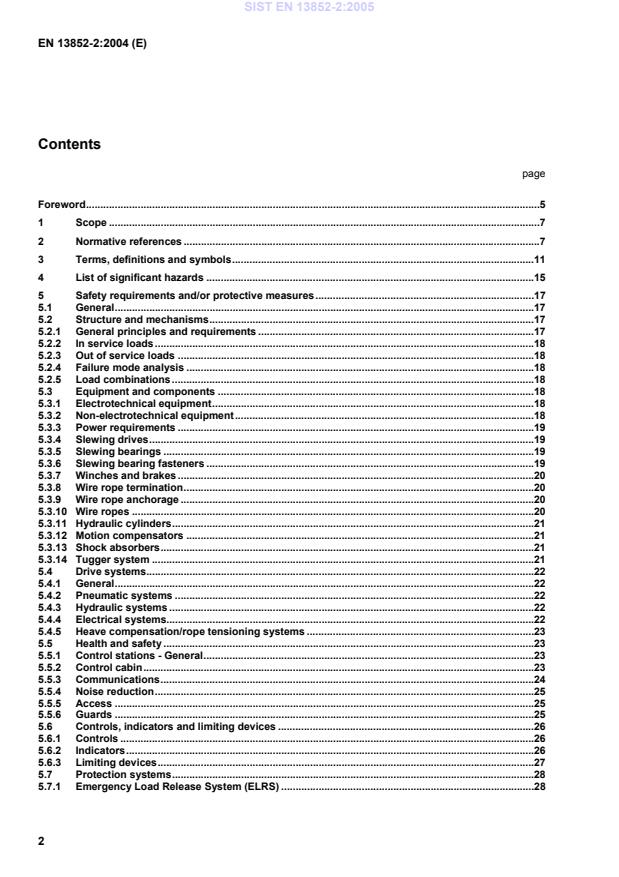
Selection of a suitable set of crane standards for a given application.39 Annex B (normative)
Determination of factors.40 B.1 Calculation of the dynamic coefficient ΦΦΦΦn by the simplified method.40 B.2 Calculation of dynamic coefficient ΦΦΦΦn by motion response analysis.41 B.3 Out of plane influences.42 B.4 Hook velocity.43 B.5 Load combinations.43 Annex C (normative)
Environmental influences.45 C.1 General.45 C.2 Wind.45 C.2.1 Mean wind velocities.45 C.2.2 Boom stalling.45 C.3 Ice.45 C.4 Stowage and transportation.46 C.5 Corrosion protection.46 C.6 Lightning protection.46 C.7 High temperatures.46 Annex D (normative)
Failure mode analysis.47 D.1 General.47 D.2 Failure mode charts.47 Annex E (normative)
Material selection.49 E.1 General.49 E.2 Verification of material quality.49 E.3 Forged rings for slewing bearings.49 SIST EN 13852-2:2005
Control station instrumentation.53 Annex G (normative)
Wire rope safety factors.54 G.1 General.54 G.2 Static safety factors.54 G.2.1 Running rigging.54 G.2.2 Standing rigging.54 G.3 Dynamic safety factors.54 G.3.1 Running rigging.54 G.3.2 Standing rigging.54 Annex H (normative)
Slewing systems.55 H.1 Systems incorporating slewing rings.55 H.2 Systems incorporating house rollers and pintle type design.55 Annex I (normative)
Requirements for brakes.56 Annex J (normative)
Ranking of safety systems.57 Annex K (normative)
Winches.58 Annex L (informative)
Typical floating cranes.59 Annex M (informative)
Excursion envelope for offlead and sidelead.61 Annex N (normative)
Equipment for use in a hazardous area.62 N.1 General.62 N.2 Avoidance or reduction of ignition sources.62 N.3 Electrotechnical equipment.62 N.4 Non-electrotechnical equipment.62 N.5 Electrostatic discharge.62 Bibliography.63
This standard is one part of EN 13852.
The other part is: Part 1: General - purpose offshore cranes According to the CEN/CENELEC Internal Regulations, the national standards organizations of the following countries are bound to implement this European Standard: Austria, Belgium, Cyprus, Czech Republic, Denmark, Estonia, Finland, France, Germany, Greece, Hungary, Iceland, Ireland, Italy, Latvia, Lithuania, Luxembourg, Malta, Netherlands, Norway, Poland, Portugal, Slovakia, Slovenia, Spain, Sweden, Switzerland and United Kingdom.
EN 418:1992, Safety of machinery – Emergency stop equipment, functional aspects – Principles for design. EN 457, Safety of machinery – Auditory danger signals – General requirements, design and testing (ISO 7731:1986, modified). EN 614-1, Safety of machinery – Ergonomic design principles – Part 1: Terminology and general principles. EN 842, Safety of machinery – Visual danger signals – General requirements, design and testing. EN 894-3, Safety of machinery – Ergonomics requirements for the design of displays and control actuators – Part 3: Control actuators. EN 954-1, Safety of machinery – Safety related parts of control systems – Part 1: General principles for design. EN 982, Safety of machinery – Safety requirements for fluid power systems and their components – Hydraulics. EN 983, Safety of machinery – Safety requirements for fluid power systems and their components – Pneumatics. EN 1005-3, Safety of machinery – Human physical performance – Part 3: Recommended force limits for machinery operation. SIST EN 13852-2:2005
explosive gas atmospheres -
Part 0: General requirements
(IEC 60079-0:2004) / Note:
Reprint includes the
Corrigendum of 2004-04 and
replaces the corrigendum March
EN 60079-1, Electrical apparatus for potentially explosive atmospheres – Part 1:
Flameproof enclosure "d" (IEC
60079-1:2003) / Note: Reprint
includes the corrigendum
2004-03 EN 60079-7, Electrical apparatus for explosive gas atmospheres – Part 7: Increased safety «e» (IEC 60079-7:2001). EN 60079-14, Electrical apparatus for explosive gas atmospheres – Part 14: Electrical installations in hazardous areas (other than mines) (IEC 60079-14:2002). EN 60079-15, Electrical apparatus for explosive gas atmospheres – Type of protection «n» (IEC 60079-15:2001, modified). EN 60079-18, Electrical apparatus for
explosive gas atmospheres -
Part 18: Construction, test and
marking of type of protection
encapsulation "m" electrical
apparatus (IEC 60079-18:2004) EN 61000-6-2, Electromagnetic compatibility (EMC) – Part 6-2: Generic standards – Immunity for industrial environments (IEC 60079-6-2:1999, modified). EN 61000-6-4, Electromagnetic compatibility (EMC) – Part 6-4: Generic standards – Emission standard for industrial environments (IEC 61000-6-4:1997, modified). EN 61131-3:1993, Programmable Controllers – Part 3: Programming languages (IEC 61131-3:2003) / Note:
Endorsement notice. EN 61310-1, Safety of machinery – Indication, marking and actuation – Part 1: Requirements for visual, auditory and tactile signals (IEC 61310-1:1995). EN 61310-2, Safety of machinery – Indication, marking and actuation – Part 2: Requirements for marking (IEC 61310-2:1995). EN 61310-3, Safety of machinery – Indication, marking and actuation – Part 3: Requirements for location and operation of actuators (IEC 61310-3:1999). SIST EN 13852-2:2005
R0 × Φ0 ≥
Rn × Φn + "Loss" (1) Key X Radius/outreach Y Load 1 Design load R0 x Φ0 2 Operational design load Rn x Φn 3 Still water lift (H1/3 = 0 m) R0 4 Sea lift Rn “Loss” Effects due to environmental conditions and out of-plane influences Figure 1 – Design load 3.7 design moment maximum moment caused by the design load multiplied by radius
3.8 design temperature (Td) reference temperature for the area in which the crane is operated, used as a criterion for the selection of materials. The design temperature shall be taken as the lowest mean daily air temperature with an annual probability of exceedance of 10-2 3.9 dynamic coefficient (Φn) ratio between the maximum dynamic load at the hook and the actual hook load for any given configuration or operating condition 3.10 emergency load release system (ELRS) system activated by the crane operator, that protects the crane against overload and over-moment by allowing the hoisting wire to be pulled away from the crane, thus reducing the load carrying capacity SIST EN 13852-2:2005
Key
X Radius/outreach Y Rated capacity 1 Aux. hoist rated capacity Ra0 for still water lifts with wave height H1/3 = 0 m 2 Main hoist rated capacity R2 for sea lifts with wave height H1/3 = 2 m 3 Main hoist rated capacity R1 for sea lifts with wave height H1/3 = 1 m 4 Main hoist rated capacity R0 for still water lifts with wave height H1/3 = 0 m Figure 2 – Load chart SIST EN 13852-2:2005
passive rope tensioning system
(PRT) system, which maintains the tension of the hoisting rope between predefined values, using stored energy 3.21 sidelead load lateral load at the boom tip 3.22
significant damage condition that represents 80 % of the calculated limit state (see annex D) of the weakest load carrying structural or mechanical component 3.23 significant wave height (H1/3) average height of the highest one third of the individual wave heights in a short term constant state of sea, typically 3 h 3.24 radius horizontal distance between the crane axis of slewing/boom foot pin and a vertical line through the hook when the axis of slewing is vertical and there is no offlead NOTE The term outreach is used instead of radius to account for the effect of the inclined vessel. 3.25 rated capacity (R0 or Rn) actual hook load that the crane is designed to lift for a given operating condition n (e.g. boom configuration, reeving arrangement, offlead/sidelead, heel/trim, radius, wave height etc) NOTE Rated capacity R0 equates to SWL as found in ILO conventions. 3.26 running rigging all wire ropes passing over sheaves or guide rollers, or wound on winches, irrespective of whether or not the ropes are moved under load 3.27 standing rigging ropes that are not turned round or wound on to winches (e.g. guided wires, pendants, stays) 3.28 tugger system system to reduce the swinging and/or control the orientation of the load SIST EN 13852-2:2005
1.1 Generated by machine parts or work pieces caused, e.g. by:
1.1.5 Inadequacy of mechanical strength 5.2, 5.3.2, 5.3.4, 5.3.5, 5.3.6, 5.3.7, 5.3.8, 5.3.9, 5.3.10, 5.3.11, 5.3.14, 5.8.3, 5.8.4 1.2 Accumulation of energy inside the machinery caused, e.g. by:
1.2.2 Liquids and gases under pressure 5.3.2, 5.3.3, 5.3.11. 5.3.12, 5.3.13, 5.4.2, 5.4.3, 5.4.5 2 Electrical hazards 5.1, 5.3.1, 5.4.4 3 Thermal hazards 5.2.1, 5.2.2 4 Hazards generated by noise 5.5.4, 8 Hazards generated by neglecting ergonomic principles in machinery design 5.5, 5.5.2, 5.5.2.3, 5.5.5, 5.5.6, 5.6 10 Unexpected start-up, unexpected overrun/overspeed (or any similar malfunction) 5.3.1, 5.3.2, 5.3.3, 5.3.11, 5.3.12, 5.3.13, 5.4.5, 5.5.1, 5.6.1, 5.6.2, 5.6.3 11 Impossibility of stopping the machine in the best possible conditions 5.6.3, 5.7 13 Failure of the power supply 5.3.3, 5.6.2 14 Failure of the control circuit 5.3.1, 5.4.1, 5.4.2, 5.4.3, 5.4.4, 5.4.5, 5.5.1, 5.5.2, 5.5.33, 5.6.1, 5.6.2, 5.6.3, 5.7, 5.8.5 16 Break-up during operation 5.2.4, 5.3.4, 5.8.6 17 Falling or ejected objects 5.5.2 18 Loss of stability/overturning of machinery 5.2, 5.3.4, 5.3.5, 5.3.6, 5.8.2, 5.3.11, 5.6.2, 5.6.3 SIST EN 13852-2:2005
27.1 from load falls, collisions, machine tipping caused by :
27.1.2 uncontrolled loading – overloading – overturning moments exceeded 5.2, 5.3, 5.4, 5.6, 5.7 27.1.3 uncontrolled amplitude of movements 5.4.5, 5.6.2, 5.7.3 27.1.4 unexpected/unintended movement of loads 5.4.5, 5.6.1 27.4 from insufficient mechanical strength of parts 5.2, 5.3.2 27.5 from inadequate design of pulleys, drums 5.3.2 27.6 from inadequate selection/integration into the machine of chains, ropes, lifting equipment 5.3.2, 5.3.8, 5.3.9, 5.3.10 27.7 from lowering of the load by friction brake 5.7.2 27.8 from abnormal conditions of assembly/testing/use/ maintenance 5.5.3, 5.5.5, 6 and 7 29 Hazards generated by neglecting ergonomic principles:
29.1 insufficient visibility from the driving position 5.5.1, 5.5.2, 5.5.3 34-37 Hazards due to the lifting or moving of personnel 5.8, 7.2.5 SIST EN 13852-2:2005
as defined in FEM shall not be less than 1,3 for
R0 < 250 tonnes and not less than 1,1 for R0
> 500 tonnes.
Linear interpolation shall be used for intermediate values of R0 . In this standard the symbol Φ equates to ψ. Rope drives shall comply with ISO 4308-1. The wire rope safety factors shall comply with annex G instead of FEM Booklet 4. The general principles and requirements shall also be considered for the maintenance, taking into account the environmental conditions prevailing. Materials shall be selected in accordance with annex E. SIST EN 13852-2:2005
However, in the absence of the required input for such a detailed analysis the simplified method described in B.1 gives an indication for the determination of factors. The crane shall be provided with, a load chart, see 3.13. The load chart shall be displayed at the control station. The information from the load chart shall be programmed into the rated capacity indicator as described in 5.6.2.2. The crane shall withstand the environmental influences in annex C. 5.2.3 Out of service loads The crane shall withstand the environmental influences in annex C. 5.2.4 Failure mode analysis The failure mode analysis shall be carried out in accordance with annex D. 5.2.5 Load combinations Load combinations shall be in accordance with B.5. 5.3 Equipment and components 5.3.1 Electrotechnical equipment Electrotechnical equipment shall be in accordance with EN 13135-1. Safety related parts of control systems shall comply with the specified categories of performance as given by EN 954-1, minimum category 2. Electrotechnical equipment operating in a hazardous area shall be in accordance with EN 60079-14 and annex N. Enclosures for electrotechnical equipment operating in a hazardous area shall be in accordance with series EN
...