

EN 1034-27:2012
(Main)Safety of machinery - Safety requirements for the design and construction of paper making and finishing machines - Part 27: Roll handling systems
- Abstract
This European Standard applies to roll handling systems for use in paper finishing and applies together with
EN 1034-1:2000+A1:2010. It deals with all significant hazards, hazardous situations and hazardous events relevant to roll handling systems, when they are used as intended and under conditions of misuse which are reasonably foreseeable by the manufacturer (see Clause 4).
This document does not apply to:
- machine reel handling systems;
- stacker trucks, industrial trucks and driverless industrial trucks;
- separate storage systems with cranes and high bay storage systems;
- portable devices for moving rolls.
This document is not applicable to roll handling systems which are manufactured before the date of publication of this document by CEN.
- Status
- Published
- Publication Date
- 28-Aug-2012
- Technical Committee
- CEN/TC 198 - Printing and paper machinery - Safety
- Drafting Committee
- CEN/TC 198/WG 2 - Paper Machinery
- Current Stage
- 9060 - Closure of 2 Year Review Enquiry - Review Enquiry
- Start Date
- 03-Mar-2024
- Completion Date
- 03-Mar-2024
- Directive
- 2006/42/EC - Directive 2006/42/EC of the European Parliament and of the Council of 17 May 2006 on machinery, and amending Directive 95/16/EC (recast)OJ Ref: C, C 350 OJ Date: 15-Nov-2012



Overview - EN 1034-27:2012 (Roll handling systems)
EN 1034-27:2012 is a CEN European Standard that specifies safety requirements for the design and construction of roll handling systems used in paper finishing. Published in 2012, it is intended to be used together with EN 1034-1:2000+A1:2010 (common requirements) and addresses all significant hazards, hazardous situations and events relevant to roll handling systems when used as intended or under reasonably foreseeable misuse. It is a Type C machine safety standard and takes precedence where it differs from Type A/B standards.
This standard applies to integrated systems such as conveyors, transfer carriages, upenders, vertical conveyors, rotating carrying rolls and related devices used to transport, turn, tilt and transfer paper rolls. It explicitly excludes machine reel handling systems, stacker/industrial trucks (including driverless trucks), separate crane/high-bay storage systems and portable roll-moving devices. Systems manufactured before publication are not covered.
Key topics and technical requirements
- Hazard identification and risk reduction for rolling rolls, collisions, crushing, entrapment and unexpected start-up.
- Safety functions and control performance: references to functional safety standards (e.g., EN ISO 13849-1 / EN 62061) for safety-related parts of control systems.
- Electrical and EMC requirements: conformity with EN 60204-1 and EN 61000-6-2 for electrical safety and immunity.
- Electro-sensitive protective equipment (ESPE) guidance (muting, partial blanking) for roll loading/unloading zones - informative Annex B.
- Mechanical guards and distances: alignment with EN 349, EN ISO 13855 and EN 953 for guarding and safe distances.
- Emergency stop, make‑ready and maintenance requirements and human-machine interface ergonomics (EN 614‑1/2, EN 894).
- Conveying specifics: requirements for conveyors, transfer points, crossing of passageways, conveyors through fire doors and transfer points interfacing with adjacent machines or industrial trucks.
- Verification, marking and documentation: provisions for verification of compliance, instruction handbook content and marking requirements.
Practical applications and users
Who uses EN 1034-27:2012:
- Machine designers and OEMs of paper finishing and converting equipment
- Safety engineers and CE/conformity assessors
- System integrators and automation specialists implementing transfer and conveyor systems
- Maintenance teams, plant safety managers and procurement professionals specifying compliant equipment
Practical benefits:
- Helps reduce roll‑handling risks (crushing, impact, uncontrolled roll movement)
- Provides normative references for control-system safety and ESPE deployment
- Supports compliance with EU Machinery Directive requirements (informative Annex ZA)
Related standards
- EN 1034-1:2000+A1:2010 (Common requirements for paper machinery)
- EN ISO 13849-1 / EN 62061 (functional safety)
- EN 60204-1 (electrical equipment of machines)
- EN 61496 (electro-sensitive protective equipment)
- Other referenced ergonomic, guarding and noise standards within the EN 1034-27 normative list
Keywords: EN 1034-27:2012, roll handling systems, paper finishing, safety of machinery, CEN, conveyors, ESPE, functional safety.
Relations
- Effective Date
- 25-Aug-2026
- Effective Date
- 09-Feb-2026
- Effective Date
- 09-Feb-2026
- Effective Date
- 09-Feb-2026
- Effective Date
- 28-Jan-2026
- Effective Date
- 28-Jan-2026
- Effective Date
- 28-Jan-2026
- Effective Date
- 28-Jan-2026
- Effective Date
- 28-Jan-2026
- Effective Date
- 28-Jan-2026
- Effective Date
- 28-Jan-2026
- Effective Date
- 28-Jan-2026
- Effective Date
- 28-Jan-2026
- Effective Date
- 28-Jan-2026
- Effective Date
- 28-Jan-2026
Get Certified
Connect with accredited certification bodies for this standard

Control Union Certifications
Global certification for agriculture and sustainability.

Gozdarski inštitut Slovenije
Slovenian Forestry Institute. Forest management certification support, timber testing.
Sponsored listings
Frequently Asked Questions
EN 1034-27:2012 is a standard published by the European Committee for Standardization (CEN). Its full title is "Safety of machinery - Safety requirements for the design and construction of paper making and finishing machines - Part 27: Roll handling systems". This standard covers: This European Standard applies to roll handling systems for use in paper finishing and applies together with EN 1034-1:2000+A1:2010. It deals with all significant hazards, hazardous situations and hazardous events relevant to roll handling systems, when they are used as intended and under conditions of misuse which are reasonably foreseeable by the manufacturer (see Clause 4). This document does not apply to: - machine reel handling systems; - stacker trucks, industrial trucks and driverless industrial trucks; - separate storage systems with cranes and high bay storage systems; - portable devices for moving rolls. This document is not applicable to roll handling systems which are manufactured before the date of publication of this document by CEN.
This European Standard applies to roll handling systems for use in paper finishing and applies together with EN 1034-1:2000+A1:2010. It deals with all significant hazards, hazardous situations and hazardous events relevant to roll handling systems, when they are used as intended and under conditions of misuse which are reasonably foreseeable by the manufacturer (see Clause 4). This document does not apply to: - machine reel handling systems; - stacker trucks, industrial trucks and driverless industrial trucks; - separate storage systems with cranes and high bay storage systems; - portable devices for moving rolls. This document is not applicable to roll handling systems which are manufactured before the date of publication of this document by CEN.
EN 1034-27:2012 is classified under the following ICS (International Classification for Standards) categories: 85.100 - Equipment for the paper industry. The ICS classification helps identify the subject area and facilitates finding related standards.
EN 1034-27:2012 has the following relationships with other standards: It is inter standard links to ISO 8598:1996, EN 62061:2005, EN 61496-1:2004, EN 61000-6-2:2005, EN 1760-3:2004+A1:2009, EN 13023:2003+A1:2010, EN 1034-1:2000+A1:2010, EN 1088:1995+A2:2008, EN ISO 13855:2010, EN ISO 13849-2:2008, EN ISO 13732-1:2008, EN ISO 14122-2:2001, EN 2286:1989, EN ISO 13849-1:2008, EN 349:1993+A1:2008. Understanding these relationships helps ensure you are using the most current and applicable version of the standard.
EN 1034-27:2012 is associated with the following European legislation: EU Directives/Regulations: 2006/42/EC. When a standard is cited in the Official Journal of the European Union, products manufactured in conformity with it benefit from a presumption of conformity with the essential requirements of the corresponding EU directive or regulation.
EN 1034-27:2012 is available in PDF format for immediate download after purchase. The document can be added to your cart and obtained through the secure checkout process. Digital delivery ensures instant access to the complete standard document.
Standards Content (Sample)
2003-01.Slovenski inštitut za standardizacijo. Razmnoževanje celote ali delov tega standarda ni dovoljeno.LSicherheit von Maschinen - Sicherheitstechnische Anforderungen an Konstruktion und Bau von Maschinen der Papierherstellung und Ausrüstung - Teil 27: RollentransportsystemeSécurité des machines - Prescriptions de sécurité pour la conception et la construction de machines de fabrication et de finition du papier - Partie 27: Installations pour manutention des bobinesSafety of machinery - Safety requirements for the design and construction of paper making and finishing machines - Part 27: Roll handling systems85.100Oprema za papirno industrijoEquipment for the paper industry21.020Characteristics and design of machines, apparatus, equipment13.110Varnost strojevSafety of machineryICS:Ta slovenski standard je istoveten z:EN 1034-27:2012SIST EN 1034-27:2012en01-november-2012SIST EN 1034-27:2012SLOVENSKI
STANDARD
EUROPEAN STANDARD NORME EUROPÉENNE EUROPÄISCHE NORM
EN 1034-27
August 2012 ICS 85.100 English Version
Safety of machinery - Safety requirements for the design and construction of paper making and finishing machines - Part 27: Roll handling systems
Sécurité de machines - Exigences techniques de sécurité pour la conception et la construction de machines de fabrication et de finition du papier - Partie 27: Installations pour manutention de bobines
Sicherheit von Maschinen - Sicherheitstechnische Anforderungen an Konstruktion und Bau von Maschinen der Papierherstellung und Ausrüstung - Teil 27: Rollentransportsysteme This European Standard was approved by CEN on 13 July 2012.
CEN members are bound to comply with the CEN/CENELEC Internal Regulations which stipulate the conditions for giving this European Standard the status of a national standard without any alteration. Up-to-date lists and bibliographical references concerning such national standards may be obtained on application to the CEN-CENELEC Management Centre or to any CEN member.
This European Standard exists in three official versions (English, French, German). A version in any other language made by translation under the responsibility of a CEN member into its own language and notified to the CEN-CENELEC Management Centre has the same status as the official versions.
CEN members are the national standards bodies of Austria, Belgium, Bulgaria, Croatia, Cyprus, Czech Republic, Denmark, Estonia, Finland, Former Yugoslav Republic of Macedonia, France, Germany, Greece, Hungary, Iceland, Ireland, Italy, Latvia, Lithuania, Luxembourg, Malta, Netherlands, Norway, Poland, Portugal, Romania, Slovakia, Slovenia, Spain, Sweden, Switzerland, Turkey and United Kingdom.
EUROPEAN COMMITTEE FOR STANDARDIZATION
COMITÉ EUROPÉEN DE NORMALISATION EUROPÄISCHES KOMITEE FÜR NORMUNG
Management Centre:
Avenue Marnix 17,
B-1000 Brussels © 2012 CEN All rights of exploitation in any form and by any means reserved worldwide for CEN national Members. Ref. No. EN 1034-27:2012: ESIST EN 1034-27:2012
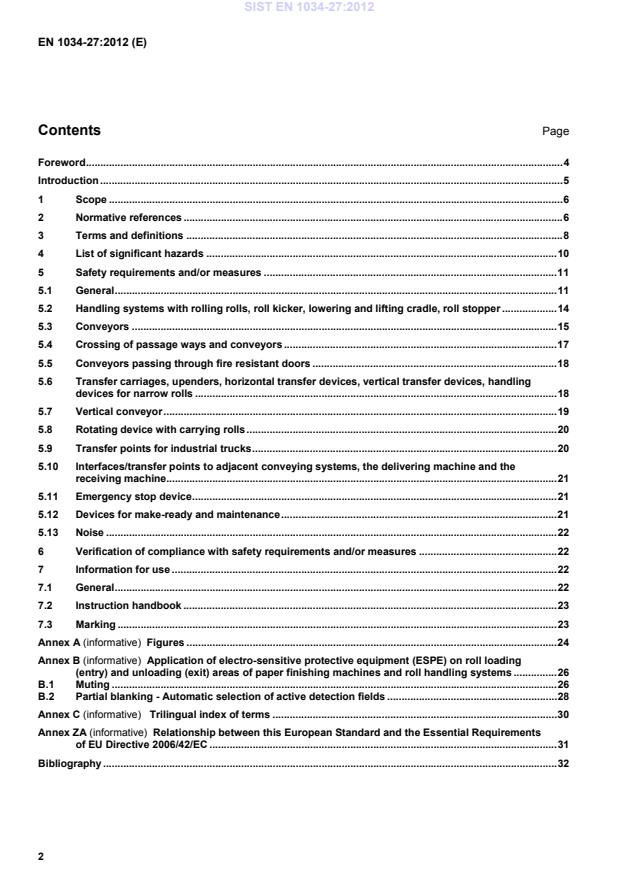
Figures . 24Annex B (informative)
Application of electro-sensitive protective equipment (ESPE) on roll loading (entry) and unloading (exit) areas of paper finishing machines and roll handling systems . 26B.1Muting . 26B.2Partial blanking - Automatic selection of active detection fields . 28Annex C (informative)
Trilingual index of terms . 30Annex ZA (informative)
Relationship between this European Standard and the Essential Requirements of EU Directive 2006/42/EC . 31Bibliography . 32SIST EN 1034-27:2012
Verification of compliance with safety requirements and/or measures. 22Figure A.1 — Example of a reel and roll handling system (picture provided by Metso) . 24 Figure A.2 — Example of a reel and roll handling system (picture provided by Metso) . 25
1 Scope This European Standard applies to roll handling systems for use in paper finishing and applies together with
EN 1034-1:2000+A1:2010. It deals with all significant hazards, hazardous situations and hazardous events relevant to roll handling systems, when they are used as intended and under conditions of misuse which are reasonably foreseeable by the manufacturer (see Clause 4).
This European Standard does not apply to: machine reel handling systems; stacker trucks, industrial trucks and driverless industrial trucks; separate storage systems with cranes and high bay storage systems; portable devices for moving rolls. This European Standard is not applicable to roll handling systems which are manufactured before the date of publication of this document by CEN. 2 Normative references The following documents, in whole or in part, are normatively referenced in this document and are indispensable for its application. For dated references, only the edition cited applies. For undated references, the latest edition of the referenced document (including any amendments) applies. EN 349:1993+A1:2008, Safety of machinery — Minimum gaps to avoid crushing of parts of the human body EN 614-1:2006+A1:2009, Safety of machinery — Ergonomic design principles — Part 1: Terminology and general principles EN 614-2:2000+A1:2008, Safety of machinery — Ergonomic design principles — Part 2: Interaction between the design of machinery and work tasks EN 619:2002+A1:2010, Continuous handling equipment and systems — Safety and EMC requirements for equipment for mechanical handling of unit loads EN 894-1:1997+A1:2008, Safety of machinery — Ergonomic requirements for the design of displays and control actuators — Part 1: General principles for human interactions with displays and control actuators EN 894-2:1997+A1:2008, Safety of machinery — Ergonomic requirements for the design of displays and control actuators — Part 2: Displays EN 953:1997+A1:2009, Safety of machinery — Guards — General requirements for the design and construction of fixed and movable guards EN 1034-1:2000+A1:2010, Safety of machinery — Safety requirements for the design and construction of paper making and finishing machines — Part 1: Common requirements EN 1037:1995+A1:2008, Safety of machinery — Prevention of unexpected start-up EN 1088:1995+A2:2008, Safety of machinery — Interlocking devices associated with guards — Principles for design and selection EN 1525:1997, Safety of industrial trucks — Driverless trucks and their systems SIST EN 1034-27:2012
(IEC 60204-1:2005, modified) EN 61000-6-2:2005, Electromagnetic compatibility (EMC) — Part 6-2: Generic standards — Immunity for industrial environments (IEC 61000-6-2:2005) EN 61496-1:2004, Safety of machinery — Electrosensitive protective equipment — Part 1: General requirements and tests (IEC 61496-1:2004, mod) EN 62061:2005, Safety of machinery — Functional safety of safety-related electrical, electronic and programmable electronic control systems (IEC 62061:2005) EN ISO 4413:2010, Hydraulic fluid power — General rules and safety requirements for systems and their components (ISO 4413:2010) EN ISO 4414:2010, Pneumatic fluid power — General rules and safety requirements for systems and their components (ISO 4414:2010) EN ISO 12100:2010, Safety of machinery — General principles for design — Risk assessment and risk reduction (ISO 12100:2010) EN ISO 13732-1:2008, Ergonomics of the thermal environment — Methods for the assessment of human responses to contact with surfaces — Part 1: Hot surfaces (ISO 13732-1:2006) EN ISO 13849-1:2008, Safety of machinery — Safety-related parts of control systems — Part 1: General principles for design (ISO 13849-1:2006) EN ISO 13849-2:2008, Safety of machinery — Safety-related parts of control systems — Part 2: Validation
(ISO 13849-2:2003) EN ISO 13850:2008, Safety of machinery — Emergency stop — Principles for design (ISO 13850:2006) EN ISO 13855:2010, Safety of machinery — Positioning of safeguards with respect to the approach speeds of parts of the human body (ISO 13855:2010) EN ISO 13857:2008, Safety of machinery — Safety distances to prevent hazard zones being reached by upper and lower limbs (ISO 13857:2008) EN ISO 14122-2:2001, Safety of machinery — Permanent means of access to machinery — Part 2: Working platforms and walkways (ISO 14122-2:2001) EN ISO 14122-3:2001, Safety of machinery — Permanent means of access to machinery — Part 3: Stairs, stepladders and guard-rails (ISO 14122-3:2001) SIST EN 1034-27:2012
EN ISO 12100:2010 and the following apply:
3.1 roll paper roll, made in the wind up section of a winder, by winding up the paper webs onto cores or onto a winding shaft or by winding up the paper web in the wind up section of a rereeler onto a reel spool 3.2 roll handling system system for handling rolls which consists of one or more devices intended to transport and/or turn and tilt rolls for further processing, and which is controlled by a joint control system Note 1 to entry: Devices can include the following: conveyor, roll kicker, roll stopper, lowering and lifting cradle, transfer carriage, horizontal transfer device, vertical transfer device, vertical conveyor, upender, handling device for narrow rolls, rotating device. Note 2 to entry: The transporting might involve for example rolls being taken from winders to sheeters, roll packaging machines, intermediate storage or dispatching. 3.2.1 conveyor equipment provided with movable carrying elements for transporting the rolls on the carrying elements such as slat, belt, carousel cart or roller conveyors 3.2.2 carrying element movable parts of the conveyor carrying the roll 3.2.3 roll kicker device for pushing the rolls to make them roll 3.2.4 roll stopper device for stopping rolling rolls 3.2.5 lowering and lifting cradle device for rolling-in the roll, stopping it and subsequently releasing it for further rolling
Note 1 to entry: The lowering and lifting cradle can be integrated as part of a plane surface or an inclined surface. 3.2.6 rolling roll roll rolling on a plane, kicked off by a roll kicker or moved by gravity 3.2.7 rolling distance distance a paper roll is rolling freely from a sending device (e.g. roll kicker) to a receiving device (e.g. a roll stopper) 3.2.8 area of rolling area where rolls roll, either by being pushed or by gravity
Note 1 to entry: The area of rolling rolls can comprise one or more rolling distances. SIST EN 1034-27:2012
EXAMPLE Scissor lifting table. 3.2.12 vertical conveyor device with integrated conveying elements and a lifting/lowering device for transferring rolls onto a different conveying level 3.2.13 upender device with integrated conveying element(s) and upending device for tipping rolls up to 90° changing the conveying level not more than 1,50 m 3.2.14 downender device with integrated conveying element(s) and downending device for tipping rolls up to 90° changing the conveying level more than 1,50 m 3.2.15 rotating device device with two carrying rolls for rotating paper rolls around their own axis into predetermined positions Note 1 to entry: For example, a rotating device might be used for reading labels or attaching the paper web. 3.2.16 handling device for narrow rolls device handling short rolls 3.3 delivering machine machine which delivers rolls to the roll handling system
EXAMPLE Winders, coating machines, storage systems. 3.4 receiving machine the machine which receives the rolls
EXAMPLE Sheeters, roll packaging machines, palletizers, labelling robots, strapping machines, automatic cranes. 3.5 transfer point
area in or at a roll handling system where rolls are
transferred from a delivering machine to a conveying system,
transferred from a conveying system to a receiving machine,
Table 1 — List of significant hazards No Hazard subclause of this standard EN 1034-1:2000+A1:2010
Origin (source) Potential consequences
Mechanical hazards
1 Inadequate design of workplaces, means of access, walkways, passageways Slipping, tripping, falling off and falling, fractures of arms and legs, injury of head by impact 5.1; 5.3.7; 5.7.1 5.5; 5.5.9 2 Drawing-in points on conveyors, rotating rolls and rollers
Wrapping points on transmissions elements Drawing-in or trapping, crushing, amputation
5.3.1; 5.3.2; 5.8.1; 5.8.2; 5.11 5.1; 5.4; 5.7 3 Linear movements of machinery or machinery parts Crushing, shearing, impact injuries, contusion 5.2.1; 5.2.4; 5.4.2; 5.4.3; 5.6.1; 5.6.2; 5.7.4; 5.11 5.1; 5.3; 5.7 4 Swivelling machinery parts Shearing, crushing injuries 5.2.4; 5.9.1; 5.11 5.1; 5.7 5 Sharp edges of machinery frame Cutting injuries
5.1; 5.11; 5.12 6 Movement of
rolls
Crushing, impact injuries
5.2.2; 5.2.3; 5.2.4; 5.3.3; 5.3.4; 5.3.5; 5.3.6; 5.4.1; 5.4.2; 5.6.1; 5.11 5.1 7 Hydraulic and pneumatic equipment Injuries by ejection of high-pressure fluids
5.24; 5.25 8 Ejection and falling of rolls Crushing, impact of injuries 5.3.8; 5.3.9; 5.3.10; 5.7.2; 5.7.3; 5.9.2; 5.9.3 5.2
Electrical Hazards
9 Electrical equipment Electric shock, death, fire, burning and blinding by electric arc 5.1 5.23 10 Electrical equipment Outside effects on electrical equipment 5.1 5.23 SIST EN 1034-27:2012
(continued)
Thermal hazards
11 Hot surfaces of machinery parts Burning by contact of persons 5.1 5.17
Noise hazards
12 Hydraulic aggregate
Hearing loss, stress, interference with speech communication and acoustic signals 5.13 5.15
Hazards generated by material and substances
13 Paper, leakage of hydraulic and lubrication oil, material of electrical equipment Fire 5.1 5.19; 5.23
Hazards generated by neglecting ergonomic principles
14 Neglect of ergonomic principles Discomfort, fatigue, stress, overload 5.9.3 5.22 15 Inadequate lighting of the workplace Blinding, falling, stress
5.18
Hazards caused by failure of energy supply, control system and other functional disorders
16 Unexpected start-up Crushing, shearing, impact 5.2.4; 5.3.2; 5.3.4; 5.3.5; 5.3.6; 5.3.8; 5.3.9; 5.4.1; 5.6.1; 5.6.2; 5.7.2; 5.7.4; 5.8.2; 5.9; 5.11.4; 5.12.2 5.6; 5.8 17 Malfunction in the control system Crushing, shearing, impact 5.2.4; 5.3.2; 5.3.4; 5.3.5; 5.3.6; 5.3.8; 5.3.9; 5.4.1; 5.6.1; 5.6.2; 5.7.2; 5.7.4; 5.8.2; 5.9; 5.11.4; 5.12.2 5.14
Combination of hazards
18 Combination of hazards Drawing-in, crushing, shearing, impact 5.10.1; 5.10.2; 5.12 5.7 19 Fire hazards Spread of fire 5.5
5 Safety requirements and/or measures 5.1 General The machine shall comply with the safety requirements and/or protective measures of Clause 5 and
EN 1034-1:2000+A1:2010, Table 2. For guidance in connection with risk reduction, see EN ISO 12100:2010, 6.2 and for safeguarding measures see EN ISO 12100-2:2010, 6.3. In addition, the machine shall be designed in accordance with the principles of EN ISO 12100:2010 for hazards relevant but not significant, which are not dealt with by this document (e.g. sharp edges of the machine frame). Table 2 — Requirements from EN 1034-1:2000+A1:2010 and related B standards Requirements and/or measures from Clause 5 ofEN 1034-1:2000+A1:2010 RelatedB standards Working platforms, means of access, walkways
5.5 EN ISO 14122-2:2001
EN ISO 14122-3:2001
5.1 EN 953:1997+A1:2009 EN ISO 13857:2008 EN 1088:1995+A2:2008
EN 61496-1:2004 EN 1760-1:1997+A1:2009 EN 1760-2:2001+A1:2009 EN 1760-3:2004+A1:2009 Energy isolation and dissipation, protection against unexpected start-up 5.8
EN 1037:1995+A1:2008 EN 60204-1:2006 Integrated lighting 5.18 EN 1837:1999+A1:2009 Electrical equipment 5.23 EN 60204-1:2006 EN 61000-6-2:2005 Hydraulic equipment 5.24 EN ISO 4413:2010 Pneumatic equipment 5.24 EN ISO 4414:2010 Power transmission elements 5.2 EN 953:1997+A1:2009 Table 4 of EN ISO 13857:2008 Ergonomic principles 5.22 EN 614-1:2006+A1:2009 EN 614-2:2000+A1:2008 EN 894-1:1997+A1:2008 EN 894-2:1997+A1:2008 Hot surfaces 5.17 EN ISO 13732-1:2008 Control systems 5.14 EN 60204-1:2006 EN ISO 13849-1:2008
EN ISO 13849-2:2008
EN 62061:2005 Emergency stop device 5.7 EN ISO 13850:2008 Fire hazard 5.19 EN 13478:2001+A1:2008
Table 3 lists the requirements for safety related control systems which are specified in this standard. SIST EN 1034-27:2012
Safety function Clause of this standard Performance Level, minimum
Safety Integrity Level, minimumInterlocking and stop function of safety device for systems with rolling rolls, roll kickers, lowering and lifting cradle and roll stopper 5.2.4 PL b SIL 1 Stop function of safety device for drawing-in points on conveyor 5.3.2 PL b SIL 1 Stop function of safety device for crushing and shearing points between rolls and surrounding parts 5.3.4 PL b SIL 1 Stop function of safety device for crushing and shearing points between rolls and conveyor 5.3.5 PL b SIL 1 Protection against collision of rolls on conveyor 5.3.6 PL b SIL 1 Protection against falling down of rolls at the transfer points of conveyor and transfer carriage, horizontal and vertical transfer and upenders 5.3.8 PL b SIL 1 Stop function of above-floor conveyors, to prevent falling down of the rolls
5.3.9 Pl b SIL 1 Protection against impact of persons by paper rolls 5.4.1 PL b SIL 1 Protection against crushing or shearing points between the rolls or their carrying elements and parts of the passage way 5.4.2 PL c SIL 1 Interlocking and stop function of safety devices for crushing and shearing points for transfer carriages, upenders, horizontal transfer devices, vertical transfer devices, transfer devices for narrow rolls
5.6.1 PL c SIL 1 Interlocking and stop function of safety devices in order to avoid or reduce the risk of collision with transfer carriages 5.6.2 PL b SIL 1 Interlocking against falling down of rolls on vertical conveyors 5.7.2 PL c SIL 2 Stop function of safety devices for crushing and shearing points on vertical conveyors 5.7.4 PL c SIL 2 Stop function of safety devices on drawing-in points on rollers 5.8.2 PL c SIL 1 Protection against automatic start-up of the conveyor at the transfer points for industrial trucks 5.9.1 PL b SIL 1 Emergency stop function 5.11.4 PL c SIL 1 Hold-to-run control devices used for make-ready and maintenance and repair 5.12.2 PL b SIL 1
gaps according to EN 349:1993+A1:2008,
filling/covering the openings between moveable machinery parts and machine frame or floor,
or they shall be safeguarded in accordance with 5.2.4.
5.2.2 Roll stoppers shall maintain their position in the event of power loss and/or emergency stopping. 5.2.3 On operator-controlled systems where rolls are pushed by roll kickers, roll out of a lowering and lifting cradle or roll under gravity, safeguarding shall be provided by
measures according to 5.2.4, or by 1) locating the actuator for releasing the pushing of the rolls in such a way that the danger zone is well within the operator’s view; and
2) limiting the rolling distance up to the nearest roll stopper to 5 m maximum: and 3) providing perimeter fencing with a height of 1,40 m minimum on the sides of the rolling area extending as far as possible; and
4) marking the area as danger zone. 5.2.4 On automated roll handling systems where rolls are pushed by roll kickers, roll out of lowering and lifting cradles or roll under gravity, safeguarding shall be provided by one of the following safety devices and measures or a combination thereof: protective structures in accordance with EN ISO 13857:2008, Tables 1 and 4; fixed guards in accordance with EN 953:1997+A1:2009 and in accordance with EN ISO 13857:2008, Tables 1 and 4; fencing with a height of 1,40 m minimum and in accordance with EN 1034-1:2000+A1:2010, 5.1.3 taking into account the safety distances of EN ISO 13857:2008, Tables 1 and 4;
pressure-sensitive safety devices in accordance with EN 1760-1:1997+A1:2009,
EN 1760-2:2001+A1:2009 and EN 1760-3:2004+A1:2009; electro-sensitive protective equipment type 2 in accordance with EN 61496-1:2004 at the entrance and outlet areas where these areas can be accessed to reach the danger zone. Also see
EN 619:2002+A1:2010, Annex F;
an interlocked moveable guard e.g. roll gate arrangement at the entrance and outlet points; locating the in-feeding or out-feeding conveyor(s) at a height of at least 1,00 m above level of access.
EN ISO 13855:2010 shall be complied with. The related control system shall comply with at least EN ISO 13849-1:2008, Performance Level PL b or EN 62061:2005, Safety Integrity Level SIL 1.
When designing the safety system, special consideration shall be given to the fact that electro-sensitive protective equipment and pressure-sensitive devices will prevent the automatic start-up of rolls but that roll rolling will continue up to the next roll stopper. SIST EN 1034-27:2012
fixed plates for covering the inrunning nips mounted in such a way that the gap between the plate and the moving elements is not more than 8 mm; fixed guards in accordance with EN 953:1997+A1:2009 taking into account the safety distances of EN ISO 13857:2008, Tables 1 and 4;
pressure-sensitive safety devices in accordance with EN 1760-1:1997+A1:2009; electro-sensitive protective equipment type 2 in accordance with EN 61496-1:2004.
The related control system shall comply with at least EN ISO 13849-1:2008, Performance Level PL b or EN 62061:2005, Safety Integrity Level SIL 1.
5.3.3 Crushing points which can occur during conveying between the rolls moving up and stationary rolls shall either be avoided or safeguarded by: control measures ensuring that the distance between the rolls is 500 mm minimum where there is a risk of whole-body access; or
safety devices and measures in accordance with 5.3.4.
5.3.4 Crushing and shearing points occurring between the rolls on the conveyor and parts of the building, pillars, gates, fences etc. shall be avoided and/or, where this is not possible, be safeguarded by one or a combination of the following safety devices and measures:
minimum distances in accordance with EN 349:1993+A1:2008 and safety distances in accordance with EN ISO 13857:2008, Table 1;
protective structures taking into account the safety distances of EN ISO 13857:2008, Tables 1 and 4; fixed guards in accordance with EN 953:1997+A1:2009 taking into account the safety distances of EN ISO 13857:2008, Tables 1 and 4 ;
pressure-sensitive safety devices in accordance with EN 1760-1:1997+A1:2009, EN 1760-2:2001+A1:2009 or/and EN 1760-3:2004+A1:2009; electro-sensitive protective equipment type 2 if access is possible to the danger area or electro-sensitive protective equipment type 4 if access is necessary in accordance with EN 61496-1:2004; a moveable guard, e.g. roll gate arrangement, at the entrance and outlet points.
EN ISO 13855:2010 shall be complied with. The related control system shall comply with at least EN ISO 13849-1:2008, Performance Level PL b or EN 62061:2005, Safety Integrity Level SIL 1.
EN ISO 13855:2010 shall be complied with. The related control system shall comply with at least EN ISO 13849-1:2008, Performance Level PL b or EN 62061:2005, Safety Integrity Level SIL 1.
5.3.6 In order to prevent or reduce hazards from collision of conveyed rolls and persons, one of the following measures or safety devices shall be applied:
limiting the conveying speed of conveyors which can be accessed to 0,60 m/s and limiting the start-up-acceleration of conveyors which can be accessed to 0,4 m/s2. The conveyor floor area beside the conveyor shall be provided with clearly visible and indelible markings with the width of the maximum roll radius plus 500 mm on both sides; reducing the possibilities of access by fencing; the height of fencing shall be at least 1,40 m;
fixed guards in accordance with EN 953:1997+A1:2009 and/or protective structures taking into account the safety distances of EN ISO 13857:2008, Tables 1 and 4; a moveable guard, e.g. roll gate arrangement, at the entrance and outlet points. The control system of the interlocking device shall comply with at least
EN ISO 13849-1:2008, Performance Level PL b or EN 62061:2005, Safety Integrity Level SIL 1.
5.3.7 To prevent hazards for persons stepping on conveyors inadvertently or tripping and falling, conveyors with carrying elements that are arranged at a height of up to 0,30 m above access level and which can be accessed easily, shall be provided with clearly noticeable marking, for example marking on the floor or on the frame. 5.3.8 At the points where rolls are handed over from conveyors onto transfer carriages, to horizontal and vertical transfer devices, devices shall be provided which prevent falling of the rolls and allow transfer only if the transfer device is in correct position. The control system shall comply with at least EN ISO 13849-1:2008, Performance Level PL b or EN 62061:2005, Safety Integrity Level SIL 1. 5.3.9 At the end of above-floor conveyors, measures shall be provided to prevent falling down of the rolls, e.g. mechanical limit stops or moveable limit stops or sensors for stopping the conveyor movement. The control system of the interlocking device shall comply with at least EN ISO 13849-1:2008, Performance Level PL b or EN 62061:2005, Safety Integrity Level SIL 1.
5.3.10 Conveyors and their carrying elements shall be so designed that the rolls cannot roll down to the sides or tip over. Measure taken to comply with this requirement include: conveying rolls on trough-type carrying elements, use of trough-type pallets for horizontal transport of rolls,
interlocking guards with guard locking;
interlocking doors with guard locking; barriers;
safety device with approach reaction; actuators for stopping the conveyor; signal lights.
The related control system shall comply with at least EN ISO 13849-1:2008, Performance Level PL b or EN 62061:2005, Safety Integrity Level SIL 1. EN ISO 13855:2010 shall be complied with. 5.4.2 If crushing or shearing hazards between the rolls or their carrying elements and parts of the passage way, e.g. steps, are not avoided by design, one of the following devices shall be provided: interlocking guards; an interlocking device in accordance with EN 1088:1995+A2:2008; interlocking doors; safety device with approach reaction. The related control system shall comply with at least EN ISO 13849-1:2008, Performance Level PL c or EN 62061:2005, Safety Integrity Level SIL 1. EN ISO 13855:2010 shall be complied with. 5.4.3 Where passage ways of industrial trucks cross accessible conveyors with automatic start-up, one or a combination of the following devices shall be provided: interlocking doors;
barriers;
induction loops for industrial trucks; safety devices with approach reaction; actuators for stopping the conveyor;
traffic lights. SIST EN 1034-27:2012
Where conveyors pass through fire resistant doors, it shall be prevented that rolls stop under the fire doors in normal drive mode. 5.6 Transfer carriages, upenders, horizontal transfer devices, vertical transfer devices, handling devices for narrow rolls 5.6.1 Crushing and shearing points created by the moving elements of
transfer carriages, upenders, horizontal transfer devices, vertical transfer devices, handling devices for narrow rolls, and/or rolls handled by these devices shall be safeguarded by one or a combination of the following safety devices and measures: designing out crushing and shearing risks; minimum distances in accordance with EN 349:1993+A1:2008 and safety distances in accordance with EN ISO 13857:2008, Table 1; protective structures taking into account the safety distances of EN ISO 13857:2008, Tables 1 and 4; fixed guards and interlocking guards in accordance with EN 953:1997+A1:2009 and the safety distances of EN ISO 13857:2008, Tables 1 and 4; fencing shall have a minimum height of 1,40 m and comply with EN 1034-1:2000+A1:2010, 5.1.3; pressure-sensitive safety devices in accordance with EN 1760-1:1997+A1:2009, EN 1760-2:2001+A1:2009 and EN 1760-3:2004+A1:2009; electro-sensitive protective equipment type 4 in accordance with EN 61496-1:2004, where frequent access is required;
electro-sensitive protective equipment type 2 in accordance with EN 61496-1:2004 at the entrance and outlet areas where these areas can be accessed to reach the danger zone. Where on automated systems the stopping function is muted for ingoing and outgoing rolls, provisions shall be made to detect persons present at the side of the roll (for examples, see Annex B and EN 619:2002+A1:2010, Annex F); a moveable guard, e.g. roll gate arrangement, at the entrance and outlet points; locating the in- or out-feeding conveyor(s) at a height of at least 1,00 m above level of access. EN ISO 13855:2010 shall be complied with. The related control system shall comply with at least EN ISO 13849-1:2008, Performance Level PL c or EN 62061:2005, Safety Integrity Level SIL 1.
It is recommended to refer to CLC /TS 62046:2008 for further information on Application of protective equipment to detect the presence of persons.
Depending on the configuration of the specific system, it is possible to safeguard various danger zones and devices by the same safety devices.
EN ISO 13857:2008, Tables 1 and 4; fencing shall have a minimum height of 1,40 m. Electro-sensitive protective equipment type 2 or type 4 in accordance with EN 61496-1:2004. EN ISO 13855:2010 shall be complied with. The related control system shall satisfy the requirements of at least EN ISO 13849-1:2008, Performance Level PL b or EN 62061:2005, Safety Integrity Level SIL 1. Pressure-sensitive devices such as pressure-sensitive mats shall comply with EN 1760-1:1997+A1:2009. The requirements of EN ISO 13855:2010 shall be satisfied. The related control system shall satisfy the requirements of at least EN ISO 13849-1:2008, Performance Level PL b or EN 62061:2005, Safety Integrity Level SIL 1. Where this requirement cannot be fulfilled and access to the area where the transfer carriage is moving or ready to start moving is possible, the following measures shall be provided: a) Provide scanning devices on the transfer carriage allowing non-contact detection of the presence of persons in the danger zone and stopping of the transfer carriage drive so that the transfer carriage will come to a stop before the collision occurs. The related control system shall satisfy the requirements of at least EN ISO 13849-1:2008, Performance Level PL b or EN 62061:2005, Safety Integrity Level SIL 1. b) As an alternative to a): on transfer carriages with speeds below 0,5 m/s, it is permitted to provide pressure-sensitive devices such as bumpers in accordance with EN 1760-3:2004+A1:2009 or trip devices in accordance with EN 1760-2:2001+A1:2009. The related control system shall satisfy the requirements of at least EN ISO 13849-1:2008, Performance Level PL b or EN 62061:2005, Safety Integrity Level SIL 1. c) The sides of the transfer carriage shall be smooth and without gaps or protruding parts in order to prevent entanglement of parts of the body. d) The castors of transfer carriages shall be covered, (also see EN 619:2002+A1:2010). It is recommended to refer to Annex D and Annex E of CLC /TS 62046:2008 for further information on Application of protective equipment to detect the presence of persons.
5.7 Vertical conveyor 5.7.1 On the upper transfer points where rolls are handed over from conveyors to vertical conveyors, special precautions are required to prevent falling of persons, for example: locating the conveyor at a height of at least 1,00 m above level of access, fall-off protection with a height of 1,10 m minimum, acces
...