

EN ISO 8655-9:2022
(Main)Piston-operated volumetric apparatus - Part 9: Manually operated precision laboratory syringes (ISO 8655-9:2022)
General Information
- Abstract
This document specifies
— metrological requirements,
— maximum permissible errors,
— requirements for marking and
— information to be provided for users,
for manually operated precision laboratory syringes made of glass or glass and metal designed to deliver their selected volume (Ex).
Manually operated precision laboratory syringes are instruments used for delivering liquids and gases. The barrel is typically made of glass and the plunger and the needle are typically made of metal.
- Status
- Published
- Publication Date
- 10-May-2022
- Withdrawal Date
- 29-Nov-2022
- Technical Committee
- CEN/TC 332 - Laboratory equipment
- Current Stage
- 6060 - Definitive text made available (DAV) - Publishing
- Start Date
- 11-May-2022
- Completion Date
- 11-May-2022


Overview
EN ISO 8655-9:2022 - "Piston-operated volumetric apparatus - Part 9: Manually operated precision laboratory syringes" is the CEN-endorsed European adoption of ISO 8655-9:2022. The standard sets the metrological and design requirements for manually operated precision laboratory syringes (glass or glass-and-metal) intended to deliver a selected volume (Ex). It covers maximum permissible errors, marking, user information and basic construction and material expectations for syringes used to deliver liquids and gases, including micro‑syringes graduated in microlitres.
Key topics and technical requirements
- Scope: Requirements for glass or glass-and-metal manually operated precision syringes used in laboratory dispensing and sampling.
- Metrological requirements: Defines accuracy, repeatability and maximum permissible errors for delivered volumes and references gravimetric, photometric, and alternative measurement procedures in the ISO 8655 series.
- Design & materials:
- Syringes shall consist of barrel, plunger (piston) and nozzle/needle holder; barrel flanges (finger grips) for ergonomic handling.
- Materials must allow cleaning; glass must meet hydrolytic resistance requirements (see ISO 719).
- Scale marking must be permanent, uniform and readable; the zero must be visible if marked.
- Construction requirements: The system must be leak‑tight; graduation lines must be uniform in thickness and spacing; fiduciary/zero alignment rules are defined.
- User information & marking: Manufacturers must provide user guidance, declared nominal volume, calibration and adjustment basis, and clear marking on instruments.
- Reference measurement methods: The standard refers to ISO 8655-6 (gravimetric), ISO 8655-8 (photometric) and ISO 8655-7 (alternative procedures) for volume determination.
Practical applications and intended users
- Manufacturers use EN ISO 8655-9:2022 to design, test and declare compliance of precision laboratory syringes.
- Calibration laboratories and test houses apply the metrological requirements and referenced measurement procedures for independent calibration and verification.
- Laboratory quality managers and users rely on the standard for procurement specifications, routine checks and safe handling practices to ensure accurate liquid and gas delivery in analytical, synthetic and dosing workflows.
- Applicable across clinical, research, environmental and industrial laboratories where precise volumetric delivery (including micro‑volume dispensing) is required.
Related standards
- ISO 8655-1:2022 - Terminology, general requirements and user recommendations
- ISO 8655-6 - Gravimetric reference measurement procedure
- ISO 8655-7 - Alternative measurement procedures
- ISO 8655-8 - Photometric reference measurement procedure
- ISO 719 - Glass hydrolytic resistance test
- ISO 3696 - Water for analytical laboratory use
- ISO 4787 & ISO 7886-1 - Related material and syringe terminology
Keywords: EN ISO 8655-9:2022, manually operated precision laboratory syringes, piston-operated volumetric apparatus, syringe calibration, metrological requirements, laboratory syringe standards.
Relations
- Effective Date
- 25-Aug-2026
- Effective Date
- 25-Aug-2026
- Effective Date
- 09-Feb-2026
- Effective Date
- 09-Feb-2026
- Effective Date
- 09-Feb-2026
- Effective Date
- 09-Feb-2026
- Consolidated By
ISO 8655-9:2022 - Piston-operated volumetric apparatus — Part 9: Manually operated precision laboratory syringes - Effective Date
- 12-Feb-2026
Get Certified
Connect with accredited certification bodies for this standard

ECOCERT
Organic and sustainability certification.

BSMI (Bureau of Standards, Metrology and Inspection)
Taiwan's standards and inspection authority.

Eurofins Food Testing Global
Global leader in food, environment, and pharmaceutical product testing.
Sponsored listings
Frequently Asked Questions
EN ISO 8655-9:2022 is a standard published by the European Committee for Standardization (CEN). Its full title is "Piston-operated volumetric apparatus - Part 9: Manually operated precision laboratory syringes (ISO 8655-9:2022)". This standard covers: This document specifies — metrological requirements, — maximum permissible errors, — requirements for marking and — information to be provided for users, for manually operated precision laboratory syringes made of glass or glass and metal designed to deliver their selected volume (Ex). Manually operated precision laboratory syringes are instruments used for delivering liquids and gases. The barrel is typically made of glass and the plunger and the needle are typically made of metal.
This document specifies — metrological requirements, — maximum permissible errors, — requirements for marking and — information to be provided for users, for manually operated precision laboratory syringes made of glass or glass and metal designed to deliver their selected volume (Ex). Manually operated precision laboratory syringes are instruments used for delivering liquids and gases. The barrel is typically made of glass and the plunger and the needle are typically made of metal.
EN ISO 8655-9:2022 is classified under the following ICS (International Classification for Standards) categories: 17.060 - Measurement of volume, mass, density, viscosity; 71.040.20 - Laboratory ware and related apparatus. The ICS classification helps identify the subject area and facilitates finding related standards.
EN ISO 8655-9:2022 has the following relationships with other standards: It is inter standard links to ISO 8655-8:2022, ISO 8655-6:2022, ISO 8655-7:2022, ISO 3696:1987, ISO 719:2020, ISO 8655-1:2022, ISO 8655-9:2022. Understanding these relationships helps ensure you are using the most current and applicable version of the standard.
EN ISO 8655-9:2022 is available in PDF format for immediate download after purchase. The document can be added to your cart and obtained through the secure checkout process. Digital delivery ensures instant access to the complete standard document.
Standards Content (Sample)
SLOVENSKI STANDARD
01-julij-2022
Volumetrične naprave, delujoče na bat - 9. del: Ročno upravljanje natančne
laboratorijske brizgalke (ISO 8655-9:2022)
Piston-operated volumetric apparatus - Part 9: Manually operated precision laboratory
syringes (ISO 8655-9:2022)
Volumenmessgeräte mit Hubkolben - Teil 9: Manuell betätigte Präzisionslaborspritzen
(ISO 8655-9:2022)
Appareils volumétriques à piston - Partie 9: Seringues de laboratoire haute précision
pour utilisation manuelle (ISO 8655-9:2022)
Ta slovenski standard je istoveten z: EN ISO 8655-9:2022
ICS:
17.060 Merjenje prostornine, mase, Measurement of volume,
gostote, viskoznosti mass, density, viscosity
71.040.20 Laboratorijska posoda in Laboratory ware and related
aparati apparatus
2003-01.Slovenski inštitut za standardizacijo. Razmnoževanje celote ali delov tega standarda ni dovoljeno.
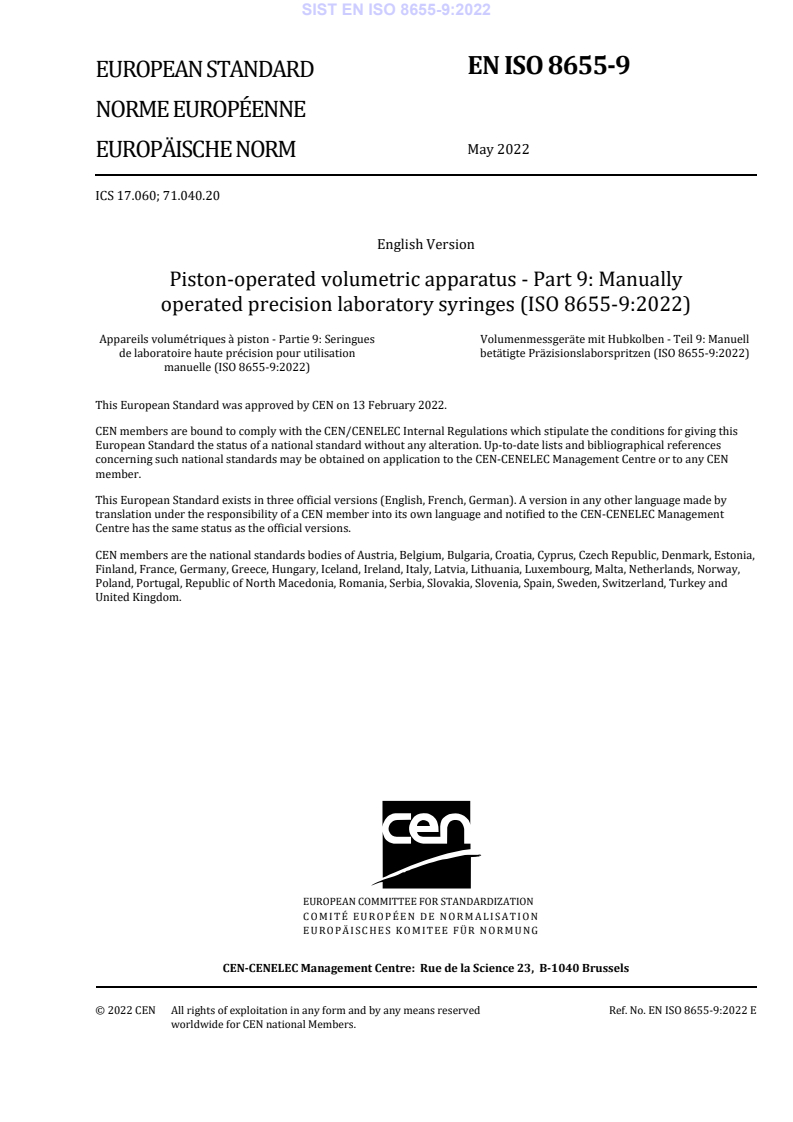
EN ISO 8655-9
EUROPEAN STANDARD
NORME EUROPÉENNE
May 2022
EUROPÄISCHE NORM
ICS 17.060; 71.040.20
English Version
Piston-operated volumetric apparatus - Part 9: Manually
operated precision laboratory syringes (ISO 8655-9:2022)
Appareils volumétriques à piston - Partie 9: Seringues Volumenmessgeräte mit Hubkolben - Teil 9: Manuell
de laboratoire haute précision pour utilisation betätigte Präzisionslaborspritzen (ISO 8655-9:2022)
manuelle (ISO 8655-9:2022)
This European Standard was approved by CEN on 13 February 2022.
CEN members are bound to comply with the CEN/CENELEC Internal Regulations which stipulate the conditions for giving this
European Standard the status of a national standard without any alteration. Up-to-date lists and bibliographical references
concerning such national standards may be obtained on application to the CEN-CENELEC Management Centre or to any CEN
member.
This European Standard exists in three official versions (English, French, German). A version in any other language made by
translation under the responsibility of a CEN member into its own language and notified to the CEN-CENELEC Management
Centre has the same status as the official versions.
CEN members are the national standards bodies of Austria, Belgium, Bulgaria, Croatia, Cyprus, Czech Republic, Denmark, Estonia,
Finland, France, Germany, Greece, Hungary, Iceland, Ireland, Italy, Latvia, Lithuania, Luxembourg, Malta, Netherlands, Norway,
Poland, Portugal, Republic of North Macedonia, Romania, Serbia, Slovakia, Slovenia, Spain, Sweden, Switzerland, Turkey and
United Kingdom.
EUROPEAN COMMITTEE FOR STANDARDIZATION
COMITÉ EUROPÉEN DE NORMALISATION
EUROPÄISCHES KOMITEE FÜR NORMUNG
CEN-CENELEC Management Centre: Rue de la Science 23, B-1040 Brussels
© 2022 CEN All rights of exploitation in any form and by any means reserved Ref. No. EN ISO 8655-9:2022 E
worldwide for CEN national Members.
Contents Page
European foreword . 3
European foreword
This document (EN ISO 8655-9:2022) has been prepared by Technical Committee ISO/TC 48
"Laboratory equipment" in collaboration with Technical Committee CEN/TC 332 “Laboratory
equipment” the secretariat of which is held by DIN.
This European Standard shall be given the status of a national standard, either by publication of an
identical text or by endorsement, at the latest by November 2022, and conflicting national standards
shall be withdrawn at the latest by November 2022.
Attention is drawn to the possibility that some of the elements of this document may be the subject of
patent rights. CEN shall not be held responsible for identifying any or all such patent rights.
Any feedback and questions on this document should be directed to the users’ national standards
body/national committee. A complete listing of these bodies can be found on the CEN website.
According to the CEN-CENELEC Internal Regulations, the national standards organizations of the
following countries are bound to implement this European Standard: Austria, Belgium, Bulgaria,
Croatia, Cyprus, Czech Republic, Denmark, Estonia, Finland, France, Germany, Greece, Hungary, Iceland,
Ireland, Italy, Latvia, Lithuania, Luxembourg, Malta, Netherlands, Norway, Poland, Portugal, Republic of
North Macedonia, Romania, Serbia, Slovakia, Slovenia, Spain, Sweden, Switzerland, Turkey and the
United Kingdom.
Endorsement notice
The text of ISO 8655-9:2022 has been approved by CEN as EN ISO 8655-9:2022 without any
modification.
INTERNATIONAL ISO
STANDARD 8655-9
First edition
2022-04
Piston-operated volumetric
apparatus —
Part 9:
Manually operated precision
laboratory syringes
Appareils volumétriques à piston —
Partie 9: Seringues de laboratoire haute précision pour utilisation
manuelle
Reference number
ISO 8655-9:2022(E)
ISO 8655-9:2022(E)
© ISO 2022
All rights reserved. Unless otherwise specified, or required in the context of its implementation, no part of this publication may
be reproduced or utilized otherwise in any form or by any means, electronic or mechanical, including photocopying, or posting on
the internet or an intranet, without prior written permission. Permission can be requested from either ISO at the address below
or ISO’s member body in the country of the requester.
ISO copyright office
CP 401 • Ch. de Blandonnet 8
CH-1214 Vernier, Geneva
Phone: +41 22 749 01 11
Email: copyright@iso.org
Website: www.iso.org
Published in Switzerland
ii
ISO 8655-9:2022(E)
Contents Page
Foreword .iv
Introduction .v
1 Scope . 1
2 Normative references . 1
3 Terms and definitions . 1
4 Principle of operation . 2
5 Design and adjustment .3
5.1 Materials . 3
5.2 Construction requirements. 3
5.3 Reading of the scale . . 4
5.4 Basis of adjustment . 4
5.5 Initial adjustment . 4
6 Metrological performance requirements . 4
6.1 General . 4
6.2 Calculation of maximum permissible errors not given in Table 2 . 5
7 User information . 5
8 Marking . . 6
Bibliography . 7
iii
ISO 8655-9:2022(E)
Foreword
ISO (the International Organization for Standardization) is a worldwide federation of national standards
bodies (ISO member bodies). The work of preparing International Standards is normally carried out
through ISO technical committees. Each member body interested in a subject for which a technical
committee has been established has the right to be represented on that committee. International
organizations, governmental and non-governmental, in liaison with ISO, also take part in the work.
ISO collaborates closely with the International Electrotechnical Commission (IEC) on all matters of
electrotechnical standardization.
The procedures used to develop this document and those intended for its further maintenance are
described in the ISO/IEC Directives, Part 1. In particular, the different approval criteria needed for the
different types of ISO documents should be noted. This document was drafted in accordance with the
editorial rules of the ISO/IEC Directives, Part 2 (see www.iso.org/directives).
Attention is drawn to the possibility that some of the elements of this document may be the subject of
patent rights. ISO shall not be held responsible for identifying any or all such patent rights. Details of
any patent rights identified during the development of the document will be in the Introduction and/or
on the ISO list of patent declarations received (see www.iso.org/patents).
Any trade name used in this document is information given for the convenience of users and does not
constitute an endorsement.
For an explanation of the voluntary nature of standards, the meaning of ISO specific terms and
expressions related to conformity assessment, as well as information about ISO's adherence to
the World Trade Organization (WTO) principles in the Technical Barriers to Trade (TBT), see
www.iso.org/iso/foreword.html.
This document was prepared by Technical Committee ISO/TC 48, Laboratory equipment, in collaboration
with the European Committee for Standardization (CEN) Technical Committee CEN/TC 332, Laboratory
equipment, in accordance with the Agreement on technical cooperation between ISO and CEN (Vienna
Agreement).
A list of all parts in the ISO 8655 series can be found on the ISO website.
Any feedback or questions on this document should be directed to the user’s national standards body. A
complete listing of these bodies can be found at www.iso.org/members.html.
iv
ISO 8655-9:2022(E)
Introduction
The ISO 8655 series addresses the needs of:
— manufacturers, as a basis for quality control including, where
...