

EN 10298:2005
(Main)Steel tubes and fittings for on shore and offshore pipelines - Internal lining with cement mortar
- Abstract
This European Standard specifies requirements for cement mortar linings for protecting the internal surface of steel tubes and pipeline components. It also specifies requirements for their application. It is applicable to the linings of tubes that have been welded longitudinally or spirally, seamless tubes and non-alloy steel components used for fluid transportation. This European Standard does not cover in situ applied or rehabilitation linings.
This type of lining is used in particular in the transport and distribution, under pressure or by gravity, of water intended for human consumption and industrial use, and also in fire extinguishing and waste water systems. The temperature of the water transported should not exceed 50 °C. Higher working temperature can be used by agreement of the parties.
The constituent materials of cement mortar lining, when used under the conditions for which they are designed, in permanent or temporary contact with water intended for human consumption, shall not change the quality of that water to such an extent that it fails to comply with the requirements of European regulations. For this purpose, reference shall be made to the relevant national standards transposing EN standards when available, dealing with the influence of materials on water quality.
- Status
- Published
- Publication Date
- 04-Oct-2005
- Withdrawal Date
- 29-Apr-2006
- Technical Committee
- ECISS/TC 110 - Steel tubes, and iron and steel fittings
- Drafting Committee
- ECISS/TC 29/SC 4/WG 10 - Internal lining with cement mortar
- Current Stage
- 9093 - Decision to confirm - Review Enquiry
- Start Date
- 05-Jun-2025
- Completion Date
- 07-Oct-2026



Overview
EN 10298:2005 - "Steel tubes and fittings for on shore and offshore pipelines - Internal lining with cement mortar" (CEN) specifies requirements for cement‑mortar internal linings used to protect steel tubes and pipeline components. The standard covers composition, application, inspection and performance requirements for factory‑applied linings on welded (longitudinal or spiral), seamless and non‑alloy steel components used for fluid transportation. It does not cover in‑situ or rehabilitation linings.
Keywords: EN 10298:2005, cement mortar lining, steel tubes, pipeline linings, onshore offshore pipelines, drinking water distribution
Key topics and technical requirements
- Scope & limits
- Intended for transport/distribution of water (drinking and industrial), fire‑fighting and wastewater systems; normal water temperature ≤ 50 °C (higher by agreement).
- Material constituents in contact with drinking water must not cause water to fail applicable European/national water quality rules.
- Materials
- Cement per EN 197‑1 (CEM types shown in the standard); additives allowed (pozzolanic ≤ 10% of cement; non‑pozzolanic ≤ 3%).
- Sand: controlled particle distribution; fine fraction (<0.125 mm) ≤ 10%; clay/fines ≤ 2%; chloride content ≤ 0.02%; max coarse particle ≤ half minimum lining thickness or 3 mm.
- Water for mixing: for drinking‑water systems use potable water; for other uses conductivity < 2000 µS/cm and KMnO4 demand < 10 mg/L (or national equivalent).
- Organic additives must meet saponification resistance (Annex D).
- Application methods
- Centrifugation (spin casting), spinning‑head, or manual trowelling (repairs/fittings).
- Surface prep: remove loose rust, scale, oil, debris; light adhesive rust acceptable.
- Curing and handling requirements to avoid damage and ensure proper strength development.
- Performance metrics
- Fresh mortar S/C ratio (sand/cement) between 1.0 and 2.5.
- W/C ratio (water/cement): centrifugation ≤ 0.42; spinning‑head values linked to S/C (e.g., S/C 1.0 → W/C < 0.37).
- Mechanical: compressive strength ≥ 50 N/mm² and flexural strength ≥ 5 N/mm² after 28 days.
- Purchaser information
- Orders should specify reference to EN 10298, water type, cut‑back type, pressure/gravity application; optional: cement/additives/method/service temperature/pore sealer.
Applications and practical value
- Used by manufacturers and coaters of internal linings to protect pipelines against corrosion, improve hydraulic performance and ensure potable water safety.
- Common in municipal water distribution, industrial water systems, fire‑fighting mains and gravity or pressurized wastewater lines (factory‑lined pipes and fittings).
- Provides procurement and QA guidance for specifiers, purchasers and inspectors when sourcing lined steel tube systems.
Who uses this standard
- Pipeline designers and engineers, pipe manufacturers, lining contractors (coaters), procurement/specification teams, water utilities, inspection and testing laboratories.
Related standards
- EN 197‑1 (cement composition/specification), EN 196‑1 (cement testing), EN 1744‑1 (aggregate chemical tests), ISO 565 / ISO 2591 / ISO 3310 (test sieves) - all referenced by EN 10298:2005.
Relations
- Effective Date
- 25-Aug-2026
- Effective Date
- 25-Aug-2026
- Effective Date
- 25-Aug-2026
- Effective Date
- 28-Jan-2026
- Effective Date
- 28-Jan-2026
- Effective Date
- 28-Jan-2026
- Effective Date
- 28-Jan-2026
- Refers
EN 1744-1:2009+A1:2012 - Tests for chemical properties of aggregates - Part 1: Chemical analysis - Effective Date
- 28-Jan-2026
- Effective Date
- 28-Jan-2026
Get Certified
Connect with accredited certification bodies for this standard

DVS-ZERT GmbH
German welding certification society.
Institut za varilstvo d.o.o. (Welding Institute)
Slovenia's leading welding institute since 1952. ISO 3834, EN 1090, pressure equipment certification, NDT personnel, welder qualification. Only IIW Au
CARES (UK Certification Authority for Reinforcing Steels)
UK certification for reinforcing steels and construction.
Sponsored listings
Frequently Asked Questions
EN 10298:2005 is a standard published by the European Committee for Standardization (CEN). Its full title is "Steel tubes and fittings for on shore and offshore pipelines - Internal lining with cement mortar". This standard covers: This European Standard specifies requirements for cement mortar linings for protecting the internal surface of steel tubes and pipeline components. It also specifies requirements for their application. It is applicable to the linings of tubes that have been welded longitudinally or spirally, seamless tubes and non-alloy steel components used for fluid transportation. This European Standard does not cover in situ applied or rehabilitation linings. This type of lining is used in particular in the transport and distribution, under pressure or by gravity, of water intended for human consumption and industrial use, and also in fire extinguishing and waste water systems. The temperature of the water transported should not exceed 50 °C. Higher working temperature can be used by agreement of the parties. The constituent materials of cement mortar lining, when used under the conditions for which they are designed, in permanent or temporary contact with water intended for human consumption, shall not change the quality of that water to such an extent that it fails to comply with the requirements of European regulations. For this purpose, reference shall be made to the relevant national standards transposing EN standards when available, dealing with the influence of materials on water quality.
This European Standard specifies requirements for cement mortar linings for protecting the internal surface of steel tubes and pipeline components. It also specifies requirements for their application. It is applicable to the linings of tubes that have been welded longitudinally or spirally, seamless tubes and non-alloy steel components used for fluid transportation. This European Standard does not cover in situ applied or rehabilitation linings. This type of lining is used in particular in the transport and distribution, under pressure or by gravity, of water intended for human consumption and industrial use, and also in fire extinguishing and waste water systems. The temperature of the water transported should not exceed 50 °C. Higher working temperature can be used by agreement of the parties. The constituent materials of cement mortar lining, when used under the conditions for which they are designed, in permanent or temporary contact with water intended for human consumption, shall not change the quality of that water to such an extent that it fails to comply with the requirements of European regulations. For this purpose, reference shall be made to the relevant national standards transposing EN standards when available, dealing with the influence of materials on water quality.
EN 10298:2005 is classified under the following ICS (International Classification for Standards) categories: 23.040.10 - Iron and steel pipes; 23.040.40 - Metal fittings; 25.220.99 - Other treatments and coatings. The ICS classification helps identify the subject area and facilitates finding related standards.
EN 10298:2005 has the following relationships with other standards: It is inter standard links to ISO 2591-1:1988, ISO 3310-1:2000, ISO 565:1990, EN 196-1:2016, EN 197-1:2011, EN 15316-4-5:2007, EN 12503-2:2001, EN 1744-1:2009+A1:2012, EN ISO 13230:1999. Understanding these relationships helps ensure you are using the most current and applicable version of the standard.
EN 10298:2005 is associated with the following European legislation: Standardization Mandates: M/005. When a standard is cited in the Official Journal of the European Union, products manufactured in conformity with it benefit from a presumption of conformity with the essential requirements of the corresponding EU directive or regulation.
EN 10298:2005 is available in PDF format for immediate download after purchase. The document can be added to your cart and obtained through the secure checkout process. Digital delivery ensures instant access to the complete standard document.
Standards Content (Sample)
2003-01.Slovenski inštitut za standardizacijo. Razmnoževanje celote ali delov tega standarda ni dovoljeno.Jeklene cevi in fitingi za obalne in priobalne (morske) cevovode – Notranja obloga s cementno maltoStahlrohre und Formstücke für erd- und wasserverlegte Rohrleitungen Zementmörtel-AuskleidungTubes en acier et raccords pour canalisations enterrées et immergées - Revetement interne au moyen de mortier de cimentSteel tubes and fittings for on shore and offshore pipelines - Internal lining with cement mortar77.140.75Jeklene cevi in cevni profili za posebne nameneSteel pipes and tubes for specific use47.020.30Sistemi ceviPiping systemsICS:Ta slovenski standard je istoveten z:EN 10298:2005SIST EN 10298:2005en01-december-2005SIST EN 10298:2005SLOVENSKI
STANDARD
EUROPEAN STANDARDNORME EUROPÉENNEEUROPÄISCHE NORMEN 10298October 2005ICS 23.040.10; 23.040.40; 25.220.99 English VersionSteel tubes and fittings for on shore and offshore pipelines -Internal lining with cement mortarTubes en acier et raccords pour canalisations enterrées etimmergées - Revêtement interne au moyen de mortier decimentStahlrohre und Formstücke für erd- und wasserverlegteRohrleitungen Zementmörtel-AuskleidungThis European Standard was approved by CEN on 26 August 2005.CEN members are bound to comply with the CEN/CENELEC Internal Regulations which stipulate the conditions for giving this EuropeanStandard the status of a national standard without any alteration. Up-to-date lists and bibliographical references concerning such nationalstandards may be obtained on application to the Central Secretariat or to any CEN member.This European Standard exists in three official versions (English, French, German). A version in any other language made by translationunder the responsibility of a CEN member into its own language and notified to the Central Secretariat has the same status as the officialversions.CEN members are the national standards bodies of Austria, Belgium, Cyprus, Czech Republic, Denmark, Estonia, Finland, France,Germany, Greece, Hungary, Iceland, Ireland, Italy, Latvia, Lithuania, Luxembourg, Malta, Netherlands, Norway, Poland, Portugal, Slovakia,Slovenia, Spain, Sweden, Switzerland and United Kingdom.EUROPEAN COMMITTEE FOR STANDARDIZATIONCOMITÉ EUROPÉEN DE NORMALISATIONEUROPÄISCHES KOMITEE FÜR NORMUNGManagement Centre: rue de Stassart, 36
B-1050 Brussels© 2005 CENAll rights of exploitation in any form and by any means reservedworldwide for CEN national Members.Ref. No. EN 10298:2005: ESIST EN 10298:2005
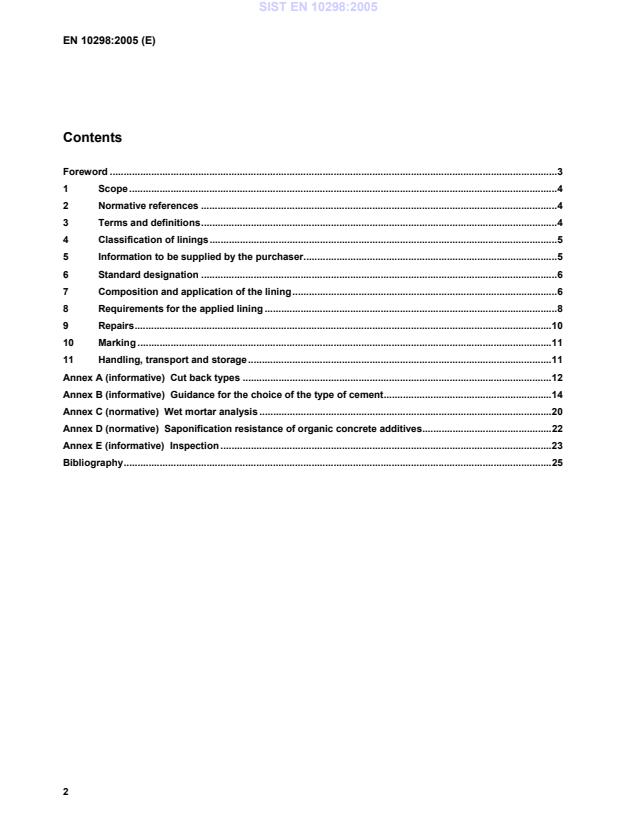
Cut back types.12 Annex B (informative)
Guidance for the choice of the type of cement.14 Annex C (normative)
Wet mortar analysis.20 Annex D (normative)
Saponification resistance of organic concrete additives.22 Annex E (informative)
Inspection.23 Bibliography.25
EN 196-1, Methods of testing cement — Part 1: Determination of strength. EN 197-1, Cement — Part 1: Composition, specifications and conformity criteria for common cements. EN 1744-1, Tests for chemical properties of aggregates — Part 1: Chemical analysis. ISO 565, Test sieves — Metal wire cloth, perforated metal plate and electroformed sheet — Nominal sizes of openings. ISO 2591-1, Test sieving — Part 1: Methods using test sieves of woven wire cloth and perforated metal plate. ISO 3310-1, Test sieves — Technical requirements and testing — Part 1: Test sieves of metal wire cloth. 3 Terms and definitions For the purposes of this European Standard, the following terms and definitions apply. 3.1 product manufacturer manufacturer of lining material 3.2 coater organisation responsible for lining of tubes and components 3.3 purchaser buyer of the lined products 3.4 drinking water water intended for human consumption SIST EN 10298:2005
Symbol CEM III Aa, CEM I a CEM IIIB a, CEM I-HS bCEM CAC b
Additives No additive Liquefying additives Resin dispersion Mineral additives Symbol N L R M Spinning method Spraying method Manual method
Application sign I II III
a Abbreviation according to EN 197-1. b For cement CEM I HS (Sulphate Resistance) and CEM CAC (High Aluminium Cement) reference shall be made to European standards when available or to the relevant national standards. 5 Information to be supplied by the purchaser 5.1 Mandatory information to be supplied by the purchaser The purchaser shall state in his enquiry and order the following minimum information: reference to this European standard EN 10298; type of water to be transported in the pipeline; type of cut-back (see annex A); transportation under pressure or by gravity for waste water application. 5.2 Options to be indicated by the purchaser The purchaser may add the following optional information: type of cement; type of additives; method of application; service temperature; application of a pore sealer. SIST EN 10298:2005
mechanical properties of the mortar; appearance and continuity; thickness of the lining system. Other properties can be specified at the time of enquiry and order. 8.2 S/C and W/C ratios NOTE 1 determination of the sand cement ratio (S/C ratio) according to Annex C; NOTE 2 determination of the water cement ratio (W/C ratio) according to Annex C; 8.2.1 The S/C and W/C ratios of the wet mortar are determined since they have a major influence on the final properties of the cured mortar. SIST EN 10298:2005
273 < D ≤ 610 6 4
610 < D ≤ 914 8 6 c
914 < D ≤ 1 220 10 8 c 1 220 < D 14 12 c a For acidic chalk dissolving water and for saline water (see Annex B), a minimum thickness of 6 mm shall be applicable. b For fittings,
...