


prEN ISO/IEC 15408-2
(Main)Information security, cybersecurity and privacy protection - Evaluation criteria for IT security - Part 2: Security functional components (ISO/IEC DIS 15408-2:2024)
Information security, cybersecurity and privacy protection - Evaluation criteria for IT security - Part 2: Security functional components (ISO/IEC DIS 15408-2:2024)
This document defines the required structure and content of security functional components for the purpose of security evaluation. It includes a catalogue of functional components that meets the common security functionality requirements of many IT products.
Informationssicherheit, Cybersicherheit und Schutz der Privatsphäre - Evaluationskriterien für IT-Sicherheit - Teil 2: Sicherheitsfunktionskomponenten (ISO/IEC DIS 15408-2:2024)
Sécurité de l'information, cybersécurité et protection de la vie privée - Critères d'évaluation pour la sécurité des technologies de l'information - Partie 2: Composants fonctionnels de sécurité (ISO/IEC DIS 15408-2:2024)
Informacijska varnost, kibernetska varnost in varovanje zasebnosti - Merila za vrednotenje varnosti IT - 2. del: Funkcionalne varnostne komponente (ISO/IEC DIS 15408-2:2024)
General Information
- Status
- Not Published
- Publication Date
- 29-Jun-2026
- Technical Committee
- CEN/CLC/TC 13 - Cybersecurity and Data Protection
- Current Stage
- 4599 - Dispatch of FV draft to CMC - Finalization for Vote
- Start Date
- 04-Nov-2025
- Completion Date
- 04-Nov-2025
Relations
- Effective Date
- 22-May-2024
Overview
The prEN ISO/IEC 15408-2:2024 standard, published by CEN, addresses critical aspects of information security, cybersecurity, and privacy protection. Titled "Evaluation criteria for IT security - Part 2: Security functional components," this document specifies the required structure and content for security functional components to facilitate robust security evaluations of IT products. Serving as a comprehensive catalogue, it meets common security functionality requirements across a wide range of information technology systems and products.
Designed to support the development, assessment, and validation of IT security measures, this standard forms part of the broader ISO/IEC 15408 series, often referred to as the Common Criteria. By defining a structured and uniform framework of security functional components, it enables consistent evaluation and strengthens trust in cybersecurity solutions worldwide.
Key Topics
- Security Functional Components Framework: The standard outlines an organized framework detailing security functional classes, families, and individual components, explaining their roles, behaviors, and management.
- Functional Requirements Paradigm: It establishes a paradigm for defining security functionality requirements, ensuring IT products meet defined security objectives.
- Component Classification and Structure:
- Functional classes group related security functions.
- Functional families detail specific areas within these classes.
- Functional components describe concrete security features and their implementation guidelines.
- Audit and Monitoring Components: Detailed guidance is given for security audit functions, including data generation, analysis, review, event selection, and storage, critical for cybersecurity monitoring and incident response.
- Application and Evaluator Notes: The standard includes notes to assist both developers and evaluators in understanding and applying components effectively in various IT environments.
- Component Levelling and Relationships: Providing a hierarchical structure, it helps in defining component priorities and dependencies for security evaluation rigor.
Applications
prEN ISO/IEC 15408-2:2024 is indispensable for organizations involved in:
- Security Evaluation and Certification: Assisting certification bodies and security evaluators in assessing IT products against standardized security criteria.
- Product Development: Guiding IT developers and manufacturers in implementing standardized security functions that meet international benchmarks.
- Risk Management: Supporting security architects and risk managers in identifying necessary security functionalities aligned with identified threats.
- Compliance and Regulatory Requirements: Facilitating compliance with national and international regulations referencing ISO/IEC evaluation criteria.
- Cybersecurity Strategy: Helping enterprises to build secure systems and infrastructure using a trusted set of functional security components.
This standard aids in achieving higher assurance and interoperability by standardizing the security functions critical to protecting digital assets and privacy.
Related Standards
- ISO/IEC 15408-1: General overview and general model-defines the overall framework for IT security evaluation criteria.
- ISO/IEC 15408-3: Security assurance components-focuses on the assurance requirements for IT security evaluation.
- ISO/IEC 27001: Information security management systems requirements.
- ISO/IEC 27002: Code of practice for information security controls.
- ISO/IEC 29100: Privacy framework guidelines.
Together, these standards provide a comprehensive system for establishing, evaluating, and managing information security and privacy protection across diverse technological environments.
By adopting and implementing prEN ISO/IEC 15408-2:2024, organizations can bolster their cybersecurity posture, ensure privacy protection, streamline security product evaluation, and maintain alignment with global security best practices. This standard is foundational for advancing trustworthy IT security solutions and safeguarding information assets in an increasingly complex digital world.

Get Certified
Connect with accredited certification bodies for this standard

BSI Group
BSI (British Standards Institution) is the business standards company that helps organizations make excellence a habit.

Bureau Veritas
Bureau Veritas is a world leader in laboratory testing, inspection and certification services.

DNV
DNV is an independent assurance and risk management provider.
Sponsored listings
Frequently Asked Questions
prEN ISO/IEC 15408-2 is a draft published by the European Committee for Standardization (CEN). Its full title is "Information security, cybersecurity and privacy protection - Evaluation criteria for IT security - Part 2: Security functional components (ISO/IEC DIS 15408-2:2024)". This standard covers: This document defines the required structure and content of security functional components for the purpose of security evaluation. It includes a catalogue of functional components that meets the common security functionality requirements of many IT products.
This document defines the required structure and content of security functional components for the purpose of security evaluation. It includes a catalogue of functional components that meets the common security functionality requirements of many IT products.
prEN ISO/IEC 15408-2 is classified under the following ICS (International Classification for Standards) categories: 35.030 - IT Security. The ICS classification helps identify the subject area and facilitates finding related standards.
prEN ISO/IEC 15408-2 has the following relationships with other standards: It is inter standard links to EN ISO/IEC 15408-2:2023. Understanding these relationships helps ensure you are using the most current and applicable version of the standard.
prEN ISO/IEC 15408-2 is available in PDF format for immediate download after purchase. The document can be added to your cart and obtained through the secure checkout process. Digital delivery ensures instant access to the complete standard document.
Standards Content (Sample)
SLOVENSKI STANDARD
01-november-2024
Informacijska varnost, kibernetska varnost in varovanje zasebnosti - Merila za
vrednotenje varnosti IT - 2. del: Funkcionalne varnostne komponente (ISO/IEC DIS
15408-2:2024)
Information security, cybersecurity and privacy protection - Evaluation criteria for IT
security - Part 2: Security functional components (ISO/IEC DIS 15408-2:2024)
Informationssicherheit, Cybersicherheit und Schutz der Privatsphäre -
Evaluationskriterien für IT-Sicherheit - Teil 2: Sicherheitsfunktionskomponenten (ISO/IEC
DIS 15408-2:2024)
Sécurité de l'information, cybersécurité et protection de la vie privée - Critères
d'évaluation pour la sécurité des technologies de l'information - Partie 2: Composants
fonctionnels de sécurité (ISO/IEC DIS 15408-2:2024)
Ta slovenski standard je istoveten z: prEN ISO/IEC 15408-2
ICS:
35.030 Informacijska varnost IT Security
2003-01.Slovenski inštitut za standardizacijo. Razmnoževanje celote ali delov tega standarda ni dovoljeno.
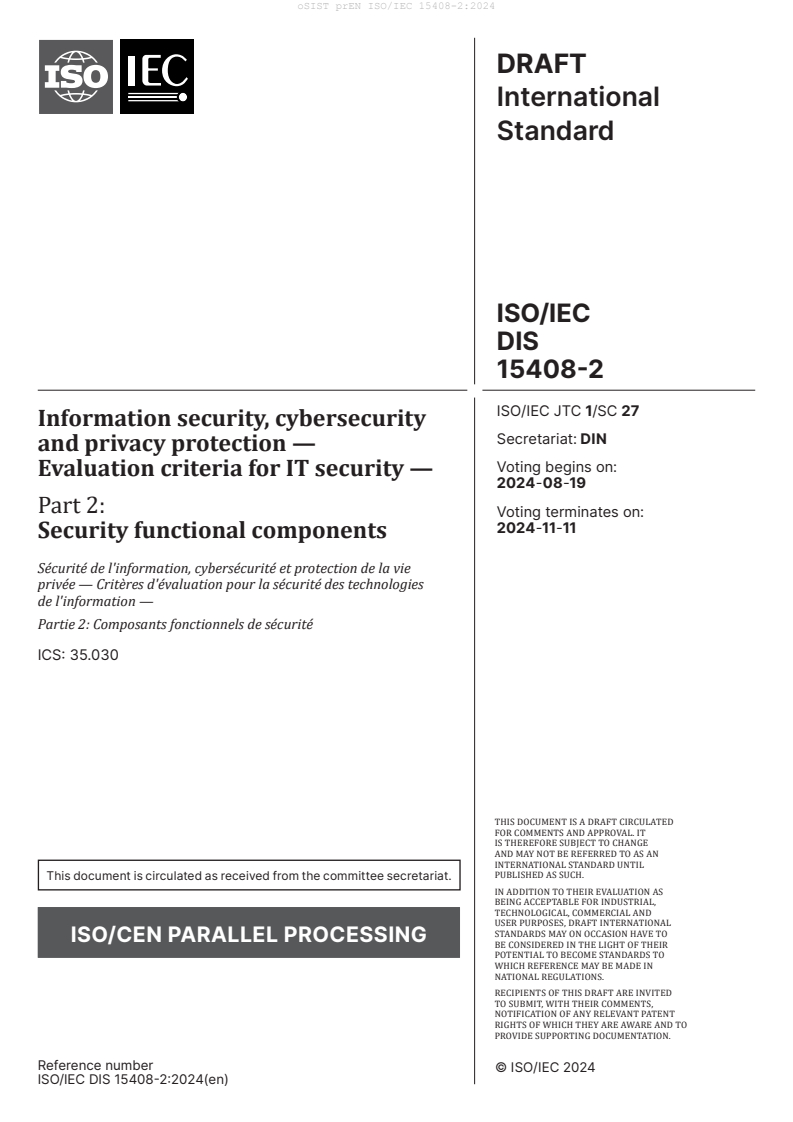
DRAFT
International
Standard
ISO/IEC
DIS
15408-2
ISO/IEC JTC 1/SC 27
Information security, cybersecurity
Secretariat: DIN
and privacy protection —
Voting begins on:
Evaluation criteria for IT security —
2024-08-19
Part 2:
Voting terminates on:
2024-11-11
Security functional components
Sécurité de l'information, cybersécurité et protection de la vie
privée — Critères d'évaluation pour la sécurité des technologies
de l'information —
Partie 2: Composants fonctionnels de sécurité
ICS: 35.030
THIS DOCUMENT IS A DRAFT CIRCULATED
FOR COMMENTS AND APPROVAL. IT
IS THEREFORE SUBJECT TO CHANGE
AND MAY NOT BE REFERRED TO AS AN
INTERNATIONAL STANDARD UNTIL
PUBLISHED AS SUCH.
This document is circulated as received from the committee secretariat.
IN ADDITION TO THEIR EVALUATION AS
BEING ACCEPTABLE FOR INDUSTRIAL,
TECHNOLOGICAL, COMMERCIAL AND
USER PURPOSES, DRAFT INTERNATIONAL
STANDARDS MAY ON OCCASION HAVE TO
ISO/CEN PARALLEL PROCESSING
BE CONSIDERED IN THE LIGHT OF THEIR
POTENTIAL TO BECOME STANDARDS TO
WHICH REFERENCE MAY BE MADE IN
NATIONAL REGULATIONS.
RECIPIENTS OF THIS DRAFT ARE INVITED
TO SUBMIT, WITH THEIR COMMENTS,
NOTIFICATION OF ANY RELEVANT PATENT
RIGHTS OF WHICH THEY ARE AWARE AND TO
PROVIDE SUPPORTING DOCUMENTATION.
Reference number
© ISO/IEC 2024
ISO/IEC DIS 15408-2:2024(en)
DRAFT
ISO/IEC DIS 15408-2:2024(en)
International
Standard
ISO/IEC
DIS
15408-2
ISO/IEC JTC 1/SC 27
Information security, cybersecurity
Secretariat: DIN
and privacy protection —
Voting begins on:
Evaluation criteria for IT security —
Part 2:
Voting terminates on:
Security functional components
Sécurité de l'information, cybersécurité et protection de la vie
privée — Critères d'évaluation pour la sécurité des technologies
de l'information —
Partie 2: Composants fonctionnels de sécurité
ICS: 35.030
THIS DOCUMENT IS A DRAFT CIRCULATED
FOR COMMENTS AND APPROVAL. IT
IS THEREFORE SUBJECT TO CHANGE
AND MAY NOT BE REFERRED TO AS AN
INTERNATIONAL STANDARD UNTIL
PUBLISHED AS SUCH.
This document is circulated as received from the committee secretariat.
IN ADDITION TO THEIR EVALUATION AS
BEING ACCEPTABLE FOR INDUSTRIAL,
© ISO/IEC 2024
TECHNOLOGICAL, COMMERCIAL AND
USER PURPOSES, DRAFT INTERNATIONAL
All rights reserved. Unless otherwise specified, or required in the context of its implementation, no part of this publication may
STANDARDS MAY ON OCCASION HAVE TO
ISO/CEN PARALLEL PROCESSING
be reproduced or utilized otherwise in any form or by any means, electronic or mechanical, including photocopying, or posting on
BE CONSIDERED IN THE LIGHT OF THEIR
the internet or an intranet, without prior written permission. Permission can be requested from either ISO at the address below
POTENTIAL TO BECOME STANDARDS TO
WHICH REFERENCE MAY BE MADE IN
or ISO’s member body in the country of the requester.
NATIONAL REGULATIONS.
ISO copyright office
RECIPIENTS OF THIS DRAFT ARE INVITED
CP 401 • Ch. de Blandonnet 8
TO SUBMIT, WITH THEIR COMMENTS,
CH-1214 Vernier, Geneva
NOTIFICATION OF ANY RELEVANT PATENT
Phone: +41 22 749 01 11
RIGHTS OF WHICH THEY ARE AWARE AND TO
PROVIDE SUPPORTING DOCUMENTATION.
Email: copyright@iso.org
Website: www.iso.org
Published in Switzerland Reference number
© ISO/IEC 2024
ISO/IEC DIS 15408-2:2024(en)
© ISO/IEC 2024 – All rights reserved
ii
ISO/IEC DIS 15408-2:2024(en)
DIS ISO/IEC 15408-2(E)
Contents
Foreword . xxi
Legal notice . xxii
Introduction . xxiii
1 Scope . 1
2 Normative references . 1
3 Terms and definitions . 1
4 Abbreviated terms . 3
5 Overview . 4
5.1 General . 4
5.2 Organization of this document . 4
6 Functional requirements paradigm . 5
7 Security functional components . 9
7.1 Overview . 9
7.2 Functional class structure . 9
7.2.1 General . 9
7.2.2 Class name . 9
7.2.3 Class introduction . 9
7.2.4 Class informative notes . 9
7.2.5 Functional families . 10
7.3 Functional family structure . 10
7.3.1 General . 10
7.3.2 Family name . 10
7.3.3 Family behaviour. 10
7.3.4 Component levelling and description . 10
7.3.5 Component management . 11
7.3.6 Component audit . 11
7.3.7 Family application notes . 11
7.3.8 Family evaluator notes . 12
7.3.9 Functional components . 12
7.4 Functional component structure . 12
7.4.1 General . 12
7.4.2 Component name . 12
7.4.3 Component relationships . 12
7.4.4 Component rationale . 13
7.4.5 Functional elements . 13
7.5 Functional elements . 13
7.6 Component catalogue . 14
7.6.1 Highlighting of component changes . 15
8 Class FAU Security audit . 15
8.1 Introduction . 15
8.2 Notes on class FAU . 17
8.2.1 General information about audit requirements . 17
8.2.2 Audit requirements in a distributed environment . 17
8.3 Security audit automatic response (FAU_ARP) . 18
8.3.1 Family Behaviour . 18
8.3.2 Component levelling and description . 18
© ISO/IEC 2024 – All rights reserved
© ISO/IEC 2024 – All rights reserved
iii
iii
ISO/IEC DIS 15408-2:2024(en)
DIS ISO/IEC 15408-2(E)
8.3.3 Management of FAU_ARP.1 . 18
8.3.4 Audit of FAU_ARP.1 . 18
8.3.5 Application notes. 18
8.3.6 FAU_ARP.1 Security alarms . 19
8.4 Security audit data generation (FAU_GEN) . 19
8.4.1 Family Behaviour . 19
8.4.2 Component levelling and description . 19
8.4.3 Management of FAU_GEN.1, FAU_GEN.2 . 19
8.4.4 Audit of FAU_GEN.1, FAU_GEN.2 . 19
8.4.5 Application notes. 20
8.4.6 Evaluator notes . 21
8.4.7 FAU_GEN.1 Audit data generation . 21
8.4.8 FAU_GEN.2 User identity association . 22
8.5 Security audit analysis (FAU_SAA) . 23
8.5.1 Family Behaviour . 23
8.5.2 Component levelling and description . 23
8.5.3 Management of FAU_SAA.1 . 23
8.5.4 Management of FAU_SAA.2 . 24
8.5.5 Management of FAU_SAA.3 . 24
8.5.6 Management of FAU_SAA.4 . 24
8.5.7 Audit of FAU_SAA.1, FAU_SAA.2, FAU_SAA.3, FAU_SAA.4 . 24
8.5.8 Application notes. 24
8.5.9 FAU_SAA.1 Potential violation analysis . 24
8.5.10 FAU_SAA.2 Profile based anomaly detection . 25
8.5.11 FAU_SAA.3 Simple attack heuristics . 26
8.5.12 FAU_SAA.4 Complex attack heuristics . 28
8.6 Security audit review (FAU_SAR) . 29
8.6.1 Family Behaviour . 29
8.6.2 Component levelling and description . 29
8.6.3 Management of FAU_SAR.1. 30
8.6.4 Management of FAU_SAR.2, FAU_SAR.3 . 30
8.6.5 Audit of FAU_SAR.1. 30
8.6.6 Audit of FAU_SAR.2. 30
8.6.7 Audit of FAU_SAR.3. 30
8.6.8 Application notes. 30
8.6.9 FAU_SAR.1 Audit review . 31
8.6.10 FAU_SAR.2 Restricted audit review . 31
8.6.11 FAU_SAR.3 Selectable audit review . 31
8.7 Security audit event selection (FAU_SEL) . 32
8.7.1 Family Behaviour . 32
8.7.2 Component levelling and description . 32
8.7.3 Management of FAU_SEL.1 . 32
8.7.4 Audit of FAU_SEL.1 . 32
8.7.5 Application notes. 32
8.7.6 FAU_SEL.1 Selective audit . 33
8.8 Security audit data storage (FAU_STG) . 33
8.8.1 Family Behaviour . 33
8.8.2 Component levelling and description . 34
8.8.3 Management of FAU_STG.1 . 34
8.8.4 Management of FAU_STG.2 . 34
8.8.5 Management of FAU_STG.3 . 34
8.8.6 Management of FAU_STG.4 . 34
8.8.7 Management of FAU_STG.5 . 35
© ISO/IEC 2024 – All rights reserved
iv
ISO/IEC DIS 15408-2:2024(en)
DIS ISO/IEC 15408-2(E)
8.8.8 Audit of FAU_STG.1 . 35
8.8.9 Audit of FAU_STG.2, FAU_STG.3 . 35
8.8.10 Audit of FAU_STG.4 . 35
8.8.11 Audit of FAU_STG.5 . 35
8.8.12 Application notes. 35
8.8.13 FAU_STG.1 Audit data storage location . 35
8.8.14 FAU_STG.2 Protected audit data storage . 36
8.8.15 FAU_STG.3 Guarantees of audit data availability . 36
8.8.16 FAU_STG.4 Action in case of possible audit data loss . 37
8.8.17 FAU_STG.5 Prevention of audit data loss . 38
9 Class FCO Communication . 38
9.1 Introduction . 38
9.2 Notes on class FCO . 39
9.3 Non-repudiation of origin (FCO_NRO) . 39
9.3.1 Family Behaviour . 39
9.3.2 Component levelling and description . 39
9.3.3 Management of FCO_NRO.1, FCO_NRO.2 . 40
9.3.4 Audit of FCO_NRO.1 . 40
9.3.5 Audit of FCO_NRO.2 . 40
9.3.6 Application notes. 40
9.3.7 FCO_NRO.1 Selective proof of origin . 41
9.3.8 FCO_NRO.2 Enforced proof of origin . 42
9.4 Non-repudiation of receipt (FCO_NRR) . 43
9.4.1 Family Behaviour . 43
9.4.2 Component levelling and description . 43
9.4.3 Management of FCO_NRR.1, FCO_NRR.2 . 43
9.4.4 Audit of FCO_NRR.1 . 43
9.4.5 Audit of FCO_NRR.2 . 43
9.4.6 Application notes. 44
9.4.7 FCO_NRR.1 Selective proof of receipt . 44
9.4.8 FCO_NRR.2 Enforced proof of receipt . 45
10 Class FCS Cryptographic support . 46
10.1 Introduction . 46
10.2 Notes on class FCS. 48
10.3 Cryptographic key management (FCS_CKM) . 49
10.3.1 Family Behaviour . 49
10.3.2 Component levelling and description . 50
10.3.3 Management of FCS_CKM.1, FCS_CKM.2, FCS_CKM.3, FCS_CKM.5, FCS_CKM.6 . 50
10.3.4 Audit of FCS_CKM.1, FCS_CKM.2, FCS_CKM.3, FCS_CKM.5, FCS_CKM.6 . 50
10.3.5 Application notes. 51
10.3.6 Evaluator notes . 51
10.3.7 FCS_CKM.1 Cryptographic key generation . 52
10.3.8 FCS_CKM.2 Cryptographic key distribution . 52
10.3.9 FCS_CKM.3 Cryptographic key access . 53
10.3.10 FCS_CKM.5 Cryptographic key derivation . 53
10.3.11 FCS_CKM.6 Timing and event of cryptographic key destruction . 54
10.4 Cryptographic operation (FCS_COP) . 55
10.4.1 Family Behaviour . 55
10.4.2 Component levelling and description . 55
10.4.3 Management of FCS_COP.1 . 56
10.4.4 Audit of FCS_COP.1 . 56
10.4.5 Application notes. 56
© ISO/IEC 2024 – All rights reserved
v
v
ISO/IEC DIS 15408-2:2024(en)
DIS ISO/IEC 15408-2(E)
10.4.6 FCS_COP.1 Cryptographic operation . 57
10.5 Random bit generation (FCS_RBG) . 58
10.5.1 Family Behaviour . 58
10.5.2 Component levelling and description . 58
10.5.3 Management of FCS_RBG.1, FCS_RBG.2, FCS_RBG.3, FCS_RBG.4, FCS_RBG.5,
FCS_RBG.6 . 58
10.5.4 Audit of FCS_RBG.1, FCS_RBG.2 . 59
10.5.5 Audit of FCS_RBG.3, FCS_RBG.4, FCS_RBG.5, FCS_RBG.6 . 59
10.5.6 Application notes. 59
10.5.7 FCS_RBG.1 Random bit generation (RBG). 59
10.5.8 FCS_RBG.2 Random bit generation (external seeding) . 60
10.5.9 FCS_RBG.3 Random bit generation (internal seeding - single source) . 61
10.5.10 FCS_RBG.4 Random bit generation (internal seeding - multiple sources) . 62
10.5.11 FCS_RBG.5 Random bit generation (combining entropy sources) . 62
10.5.12 FCS_RBG.6 Random bit generation service . 63
10.6 Generation of random numbers (FCS_RNG) . 63
10.6.1 Family Behaviour . 63
10.6.2 Component levelling and description . 63
10.6.3 Management of FCS_RNG.1 . 63
10.6.4 Audit of FCS_RNG.1 . 63
10.6.5 Application notes. 64
10.6.6 FCS_RNG.1 Random number generation . 64
11 Class FDP User data protection. 66
11.1 Introduction . 66
11.2 Notes on class FDP . 69
11.3 Access control policy (FDP_ACC) . 72
11.3.1 Family Behaviour . 72
11.3.2 Component levelling and description . 72
11.3.3 Management of FDP_ACC.1, FDP_ACC.2 . 72
11.3.4 Audit of FDP_ACC.1, FDP_ACC.2 . 72
11.3.5 Application notes. 72
11.3.6 FDP_ACC.1 Subset access control . 73
11.3.7 FDP_ACC.2 Complete access control . 74
11.4 Access control functions (FDP_ACF) . 74
11.4.1 Family Behaviour . 74
11.4.2 Component levelling and description . 74
11.4.3 Management of FDP_ACF.1 . 74
11.4.4 Audit of FDP_ACF.1 . 75
11.4.5 Application notes. 75
11.4.6 FDP_ACF.1 Security attribute-based access control . 75
11.5 Data authentication (FDP_DAU) . 77
11.5.1 Family Behaviour . 77
11.5.2 Component levelling and description . 77
11.5.3 Management of FDP_DAU.1, FDP_DAU.2 . 77
11.5.4 Audit of FDP_DAU.1 . 77
11.5.5 Audit of FDP_DAU.2 . 77
11.5.6 Application notes. 78
11.5.7 FDP_DAU.1 Basic Data Authentication . 78
11.5.8 FDP_DAU.2 Data Authentication with Identity of Guarantor . 78
11.6 Export from the TOE (FDP_ETC) . 79
11.6.1 Family Behaviour . 79
11.6.2 Component levelling and description . 79
11.6.3 Management of FDP_ETC.1 . 79
© ISO/IEC 2024 – All rights reserved
vi
vi
ISO/IEC DIS 15408-2:2024(en)
DIS ISO/IEC 15408-2(E)
11.6.4 Management of FDP_ETC.2 . 79
11.6.5 Audit of FDP_ETC.1, FDP_ETC.2. 80
11.6.6 Application notes. 80
11.6.7 FDP_ETC.1 Export of user data without security attributes . 80
11.6.8 FDP_ETC.2 Export of user data with security attributes . 80
11.7 Information flow control policy (FDP_IFC) . 81
11.7.1 Family Behaviour . 81
11.7.2 Component levelling and description . 82
11.7.3 Management of FDP_IFC.1, FDP_IFC.2 . 82
11.7.4 Audit of FDP_IFC.1, FDP_IFC.2 . 82
11.7.5 Application notes. 82
11.7.6 FDP_IFC.1 Subset information flow control . 83
11.7.7 FDP_IFC.2 Complete information flow control . 84
11.8 Information flow control functions (FDP_IFF) . 84
11.8.1 Family Behaviour . 84
11.8.2 Component levelling and description . 85
11.8.3 Management of FDP_IFF.1, FDP_IFF.2. 85
11.8.4 Management of FDP_IFF.3, FDP_IFF.4, FDP_IFF.5 . 85
11.8.5 Management of FDP_IFF.6 . 85
11.8.6 Audit of FDP_IFF.1, FDP_IFF.2, FDP_IFF.5 . 86
11.8.7 Audit of FDP_IFF.3, FDP_IFF.4, FDP_IFF.6 . 86
11.8.8 Application notes. 86
11.8.9 FDP_IFF.1 Simple security attributes . 87
11.8.10 FDP_IFF.2 Hierarchical security attributes . 88
11.8.11 FDP_IFF.3 Limited illicit information flows . 90
11.8.12 FDP_IFF.4 Partial elimination of illicit information flows . 90
11.8.13 FDP_IFF.5 No illicit information flows . 91
11.8.14 FDP_IFF.6 Illicit information flow monitoring . 91
11.9 Information retention control (FDP_IRC) . 92
11.9.1 Family Behaviour . 92
11.9.2 Component levelling and description . 93
11.9.3 Management of FDP_IRC.1 . 93
11.9.4 Audit of FDP_IRC.1 . 93
11.9.5 Application notes. 93
11.9.6 FDP_IRC.1 Information retention control . 93
11.10 Import from outside of the TOE (FDP_ITC) . 94
11.10.1 Family Behaviour . 94
11.10.2 Component levelling and description . 94
11.10.3 Management of FDP_ITC.1, FDP_ITC.2 . 95
11.10.4 Audit of FDP_ITC.1, FDP_ITC.2 . 95
11.10.5 Application notes . 95
11.10.6 FDP_ITC.1 Import of user data without security attributes . 96
11.10.7 FDP_ITC.2 Import of user data with security attributes . 97
11.11 Internal TOE transfer (FDP_ITT) . 97
11.11.1 Family Behaviour . 97
11.11.2 Component levelling and description . 98
11.11.3 Management of FDP_ITT.1, FDP_ITT.2 . 98
11.11.4 Management of FDP_ITT.3, FDP_ITT.4 . 98
11.11.5 Audit of FDP_ITT.1, FDP_ITT.2 . 98
11.11.6 Audit of FDP_ITT.3, FDP_ITT.4 . 98
11.11.7 Application notes . 99
11.11.8 FDP_ITT.1 Basic internal transfer protection . 99
11.11.9 FDP_ITT.2 Transmission separation by attribute . 99
© ISO/IEC 2024 – All rights reserved
vii
ISO/IEC DIS 15408-2:2024(en)
DIS ISO/IEC 15408-2(E)
11.11.10 FDP_ITT.3 Integrity monitoring .100
11.11.11 FDP_ITT.4 Attribute-based integrity monitoring .101
11.12 Residual information protection (FDP_RIP) .102
11.12.1 Family Behaviour .102
11.12.2 Component levelling and description .102
11.12.3 Management of FDP_RIP.1, FDP_RIP.2 .102
11.12.4 Audit of FDP_RIP.1, FDP_RIP.2 .103
11.12.5 Application notes .103
11.12.6 FDP_RIP.1 Subset residual information protection .104
11.12.7 FDP_RIP.2 Full residual information protection .104
11.13 Rollback (FDP_ROL).105
11.13.1 Family Behaviour .105
11.13.2 Component levelling and description .105
11.13.3 Management of FDP_ROL.1, FDP_ROL.2 .105
11.13.4 Audit of FDP_ROL.1, FDP_ROL.2 .105
11.13.5 Application notes .105
11.13.6 FDP_ROL.1 Basic rollback .106
11.13.7 FDP_ROL.2 Advanced rollback .106
11.14 Stored data confidentiality (FDP_SDC) .107
11.14.1 Family Behaviour .107
11.14.2 Component levelling and description .107
11.14.3 Management of FDP_SDC.1, FDP_SDC.2 .
...
Questions, Comments and Discussion
Ask us and Technical Secretary will try to provide an answer. You can facilitate discussion about the standard in here.
Loading comments...