

EN 1885:2018+A1:2025
(Main + Amendment)Feather and down - Terms and definitions
- Abstract
This document defines the principal terms used in the field of feather and down.
- Status
- Published
- Publication Date
- 25-Feb-2025
- Technical Committee
- CEN/TC 443 - Feather and down
- Drafting Committee
- CEN/TC 443/WG 3 - Feather and down testing, identification and labelling
- Current Stage
- 6060 - Definitive text made available (DAV) - Publishing
- Start Date
- 26-Feb-2025
- Due Date
- 18-Nov-2024
- Completion Date
- 26-Feb-2025

Overview
EN 1885:2018+A1:2025 - "Feather and down - Terms and definitions" is a CEN standard that defines the principal vocabulary used across the feather and down sector. Prepared by CEN/TC 443 (secretariat DIN) and updated with Amendment 1 (January 2025), the document standardizes terms for plumage structure, animal types (waterfowl/landfowl), processing states (raw, finished, new, recycled) and damage/defect classifications. The standard exists in English, French and German and is intended for adoption by national standards bodies across Europe.
Key topics and technical requirements
- Structural terminology: clear definitions for quill, quill shaft, quill point, vane, barb, barbule, prong, node, internode, down core, down barb, plumule, nestling down, filoplumes and related elements, illustrated with figures.
- Classification by species/type: terms for waterfowl feathers, goose, duck, eiderdown, and landfowl (chicken, turkey) are defined to ensure consistent labelling and identification.
- Processing and material status: definitions for raw plumage, finished plumage, new plumage, and recycled plumage (note: the standard references EU Directive 2008/98/EC for recycling context).
- Defect and processing terms: milled, broken (quill >40% missing), fractured, stripped, damaged (feather surface >25% missing), residual matter, and foreign matter are specified to support quality control thresholds.
- Identification methods (Annex A): qualitative identification by visual examination and microscopy - distinguishing down, plumules and nestling down by morphological traits (nodes, prongs, sheath, three-dimensional structure).
- No normative references: the standard itself contains terminological content only.
Applications
EN 1885 is a foundational vocabulary standard used to:
- Draft product specifications and procurement contracts for bedding, garments and insulation using feather and down filling.
- Harmonize labelling and marketing claims (e.g., “goose down”, “eiderdown”, “recycled down”).
- Support quality control, sorting and acceptance criteria in processing plants and cleaning/washing facilities.
- Guide laboratory analysts and microscopists for consistent identification and reporting.
- Inform regulatory compliance and supply‑chain traceability efforts.
Who should use this standard
- Feather and down manufacturers, processors and recyclers
- Textile, bedding and outerwear product designers and specifiers
- Quality assurance and testing laboratories
- Certification bodies, product control and procurement teams
- Standards developers and technical committees working on related test methods
Related standards
EN 1885 provides the terminology foundation for the sector; it is typically used together with CEN/ISO standards that define test methods, hygiene procedures, labelling and performance requirements for feather and down products.
Relations
- Effective Date
- 25-Dec-2024
- Effective Date
- 25-Dec-2024
- Effective Date
- 12-Aug-2026
- Effective Date
- 28-Jan-2026
- Effective Date
- 28-Jan-2026
Get Certified
Connect with accredited certification bodies for this standard

Control Union Certifications
Global certification for agriculture and sustainability.

Hohenstein Institut
Textile testing and certification.

Bureau Veritas Bangladesh
Bureau Veritas certification services in Bangladesh.
Sponsored listings
Frequently Asked Questions
EN 1885:2018+A1:2025 is a standard published by the European Committee for Standardization (CEN). Its full title is "Feather and down - Terms and definitions". This standard covers: This document defines the principal terms used in the field of feather and down.
This document defines the principal terms used in the field of feather and down.
EN 1885:2018+A1:2025 is classified under the following ICS (International Classification for Standards) categories: 01.040.59 - Textile and leather technology (Vocabularies); 59.040 - Textile auxiliary materials. The ICS classification helps identify the subject area and facilitates finding related standards.
EN 1885:2018+A1:2025 has the following relationships with other standards: It is inter standard links to EN 1885:2018, EN 1885:2018/FprA1, EN 12131:2026, EN 12131:1998, EN 12131:2018. Understanding these relationships helps ensure you are using the most current and applicable version of the standard.
EN 1885:2018+A1:2025 is available in PDF format for immediate download after purchase. The document can be added to your cart and obtained through the secure checkout process. Digital delivery ensures instant access to the complete standard document.
Standards Content (Sample)
SLOVENSKI STANDARD
01-maj-2025
Perje in puh - Izrazi in definicije (vključno z dopolnilom A1)
Feather and down - Terms and definitions
Federn und Daunen - Begriffe
Plumes et duvets - Termes et définitions
Ta slovenski standard je istoveten z: EN 1885:2018+A1:2025
ICS:
01.040.59 Tekstilna in usnjarska Textile and leather
tehnologija (Slovarji) technology (Vocabularies)
59.040 Pomožni materiali za tekstilije Textile auxiliary materials
2003-01.Slovenski inštitut za standardizacijo. Razmnoževanje celote ali delov tega standarda ni dovoljeno.
EN 1885:2018+A1
EUROPEAN STANDARD
NORME EUROPÉENNE
February 2025
EUROPÄISCHE NORM
ICS 01.040.59; 59.040 Supersedes EN 1885:2018
English Version
Feather and down - Terms and definitions
Plumes et duvets - Termes et définitions Federn und Daunen - Begriffe
This European Standard was approved by CEN on 7 May 2018 and includes Amendment 1 approved by CEN on 13 January 2025.
CEN members are bound to comply with the CEN/CENELEC Internal Regulations which stipulate the conditions for giving this
European Standard the status of a national standard without any alteration. Up-to-date lists and bibliographical references
concerning such national standards may be obtained on application to the CEN-CENELEC Management Centre or to any CEN
member.
This European Standard exists in three official versions (English, French, German). A version in any other language made by
translation under the responsibility of a CEN member into its own language and notified to the CEN-CENELEC Management
Centre has the same status as the official versions.
CEN members are the national standards bodies of Austria, Belgium, Bulgaria, Croatia, Cyprus, Czech Republic, Denmark, Estonia,
Finland, France, Germany, Greece, Hungary, Iceland, Ireland, Italy, Latvia, Lithuania, Luxembourg, Malta, Netherlands, Norway,
Poland, Portugal, Republic of North Macedonia, Romania, Serbia, Slovakia, Slovenia, Spain, Sweden, Switzerland, Türkiye and
United Kingdom.
EUROPEAN COMMITTEE FOR STANDARDIZATION
COMITÉ EUROPÉEN DE NORMALISATION
EUROPÄISCHES KOMITEE FÜR NORMUNG
CEN-CENELEC Management Centre: Rue de la Science 23, B-1040 Brussels
© 2025 CEN All rights of exploitation in any form and by any means reserved Ref. No. EN 1885:2018+A1:2025 E
worldwide for CEN national Members.
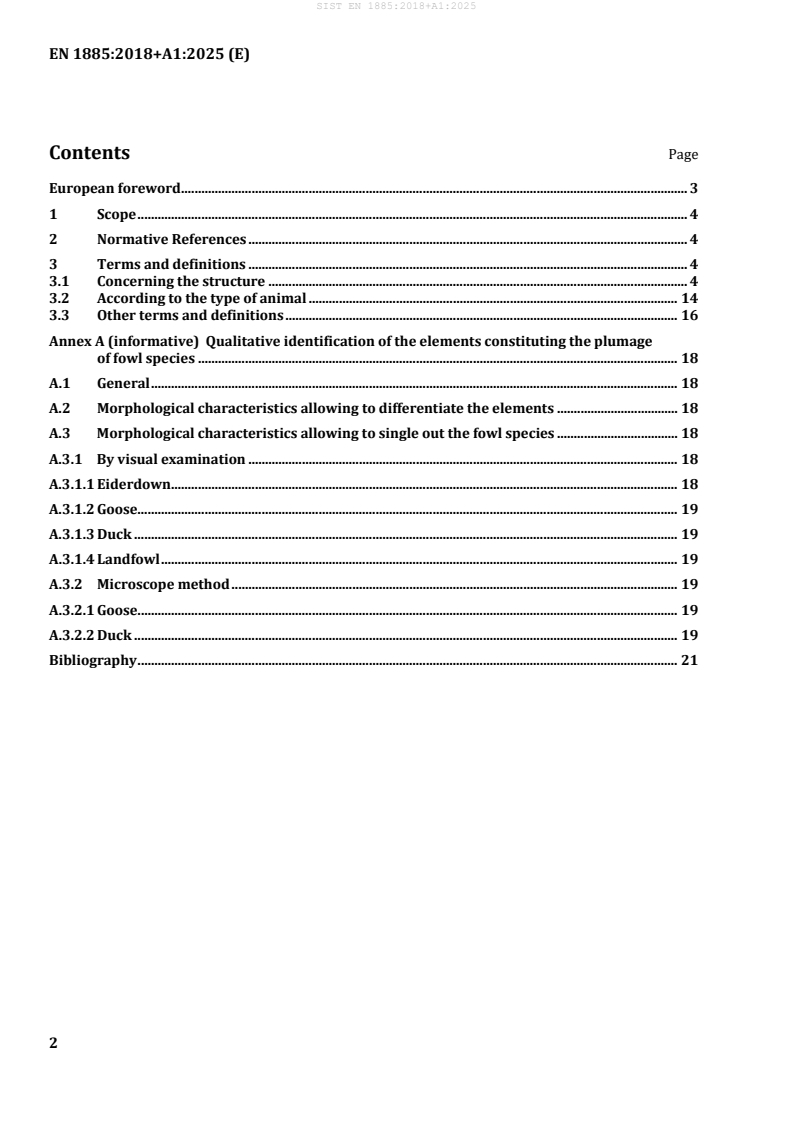
Contents Page
European foreword . 3
1 Scope . 4
2 Normative References . 4
3 Terms and definitions . 4
3.1 Concerning the structure . 4
3.2 According to the type of animal . 14
3.3 Other terms and definitions . 16
Annex A (informative) Qualitative identification of the elements constituting the plumage
of fowl species . 18
A.1 General . 18
A.2 Morphological characteristics allowing to differentiate the elements . 18
A.3 Morphological characteristics allowing to single out the fowl species . 18
A.3.1 By visual examination . 18
A.3.1.1 Eiderdown . 18
A.3.1.2 Goose. 19
A.3.1.3 Duck . 19
A.3.1.4 Landfowl . 19
A.3.2 Microscope method . 19
A.3.2.1 Goose. 19
A.3.2.2 Duck . 19
Bibliography . 21
European foreword
This document (EN 1885:2018+A1:2025) has been prepared by Technical Committee CEN/TC 443
“Feather and down”, the secretariat of which is held by DIN.
This European Standard shall be given the status of a national standard, either by publication of an
identical text or by endorsement, at the latest by September 2025, and conflicting national standards
shall be withdrawn at the latest by September 2025.
This document includes Amendment 1 approved by CEN on 13 January 2025.
Attention is drawn to the possibility that some of the elements of this document may be the subject of
patent rights. CEN shall not be held responsible for identifying any or all such patent rights.
This document supersedes !EN 1885:2018."
The start and finish of text introduced or altered by amendment is indicated in the text by tags !".
According to the CEN-CENELEC Internal Regulations, the national standards organisations of the
following countries are bound to implement this European Standard: Austria, Belgium, Bulgaria,
Croatia, Cyprus, Czech Republic, Denmark, Estonia, Finland, Former Yugoslav Republic of Macedonia,
France, Germany, Greece, Hungary, Iceland, Ireland, Italy, Latvia, Lithuania, Luxembourg, Malta,
Netherlands, Norway, Poland, Portugal, Romania, Serbia, Slovakia, Slovenia, Spain, Sweden, Switzerland,
Turkey and the United Kingdom.
1 Scope
This documentdefines the principal terms used in the field of feather and down.
2 Normative References
There are no normative references in this document.
3 Terms and definitions
For the purposes of this document, the following terms and definitions apply.
ISO and IEC maintain terminological databases for use in standardization at the following addresses:
• IEC Electropedia: available at http://www.electropedia.org/
• ISO Online browsing platform: available at http://www.iso.org/obp
3.1 Concerning the structure
3.1.1
plumage
all elements (quill feathers, feathers, down, plumule) of the covering of different kinds of waterfowl and
landfowl
3.1.2
quill feather
stiff, coarse, wing and tail plumage. It has a longer and stiffer vane (3.1.12) than a feather (3.1.3.1)
3.1.3
Feather
3.1.3.1
feather (general)
plumage (3.1.1) without quill feathers (3.1.2)
Key
A quill point (3.1.10) C quill (3.1.8)
B quill shaft (3.1.9) D upper quill (see damaged feather 3.3.7)
Figure 1 — Feather
3.1.3.2
feather (specific)
horny integument of fowls, with shorter and softer vane (3.1.12) than quill feather (3.1.2) and, unlike
plumules (3.1.17), a well-developed quill (3.1.8)
3.1.4
neck feather
smallest feathers from the neck and head area
Figure 2 — Neck feathers
3.1.5
nestling feather
pin feather
feather (3.1.3.1) not fully developed, having no distinguishable quill (3.1.8) but with relatively short
coarse barbs (3.1.20)
Figure 3 — Nestling feather
3.1.6
filoplumes
feathers with a bare quill without vane but with a brushed tip
3.1.7
flat feather
feather (3.1.3.1) with straight vane (3.1.12)
3.1.8
quill
axial part of quill feather (3.1.2) and feathers (3.1.3.1). It is formed by the quill point (3.1.10) and the
quill shaft (3.1.9)
Note 1 to entry: See Figure 1.
3.1.9
quill shaft
part of the quill (3.1.8) which carries the vane (3.1.12)
Note 1 to entry: See Figure 1 and Figure 2.
3.1.10
quill point
part of the quill (3.1.8) inserted in the skin and partially protruding from it
Note 1 to entry: See Figure 1 and Figure 2.
3.1.11
after shaft
feather (3.1.3.1) that branches off from the same quill point (3.1.10) of a normal feather and that is
smaller than this one; it is typical for chickens and turkeys
Note 1 to entry: See Figure 13.
3.1.12
vane
the whole of feather barbs (3.1.20) intimately connected among them by means of barbules (3.1.22); it
branches off from the quill shaft (3.1.9)
Note 1 to entry: Present in quill feather (3.1.2) and feathers (3.1.3.1) but absent in down (3.1.13).
Note 2 to entry: See Figure 2.
Key
1 prong (3.1.23) 3 barb (3.1.20) 5 quill point (3.1.10)
2 barbule (3.1.22) 4 quill shaft (3.1.9)
Figure 4 — Feather with magnification of the vane (3.1.12)
a) outer face of the quill
b) Sketch of upper barbules with prongs
c) Sketch of lower barbules with thorns and clamp teeth
Key
1 prongs (3.1.23) 4 lower barbules (3.1.22)
2 barb (3.1.20) 5 thorns (3.1.24)
3 upper barbules (3.1.22) 6 clamp teeth (3.1.25)
Figure 5 — Feather vane (3.1.12) with details of upper and lower barbules (3.1.22)
3.1.13
down
plumage forming the undercoating of waterfowl, consisting of clusters of light, fluffy filaments (e.g.
down barbs 3.1.21) growing from one scantly sketched down core (3.1.14) but without any quill shaft
(3.1.9) or vane (3.1.12)
Note 1 to entry: Conventionally at least two barbs connected at one point are considered as down.
Figure 6 — Down
3.1.14
down core
centre growth point in a cluster of down
3.1.15
nestling down
down (3.1.13) not fully developed, with barbules (3.1.22) emanating from the basal end covered with a
sheath (3.1.16) and without any quill (3.1.8)
Key
1 sheath
Figure 7 — Nestling down
3.1.16
sheat
...