

EN 14683:2025
(Main)Medical face masks - Requirements and test methods
- Abstract
This document specifies construction, design, performance requirements and test methods for medical face masks intended to limit the transmission of infective agents from staff to patients during surgical procedures and other medical settings with similar requirements. A medical face mask with an appropriate microbial barrier can also be effective in reducing the emission of infective agents from the nose and mouth of an asymptomatic carrier or a patient with clinical symptoms.
This document is not applicable to face masks intended exclusively for the personal protection of staff. Compliance with this standard does not demonstrate compliance with the requirements of the relevant PPE regulations.
- Status
- Published
- Publication Date
- 28-Jan-2025
- Technical Committee
- CEN/TC 205 - Non-active medical devices
- Current Stage
- 6060 - Definitive text made available (DAV) - Publishing
- Start Date
- 29-Jan-2025
- Due Date
- 03-May-2024
- Completion Date
- 29-Jan-2025
- Directive
- 2017/745 - Regulation (EU) 2017/745 of the European Parliament and of the Council of 5 April 2017 on medical devices, amending Directive 2001/83/EC, Regulation (EC) No 178/2002 and Regulation (EC) No 1223/2009 and repealing Council Directives 90/385/EEC and 93/42/EECOJ Ref: OJ, OJ L 2025/2078 OJ Date: 20-Oct-2025

Overview
EN 14683:2025 - Medical face masks: Requirements and test methods is the updated CEN (European Committee for Standardization) standard that specifies design, construction, performance requirements and laboratory test methods for medical face masks (surgical masks). Published January 2025 and superseding EN 14683:2019+AC:2019, this standard is intended to limit transmission of infective agents from clinical staff to patients in surgical and comparable medical settings. It is not intended for face masks used exclusively as personal respiratory protective equipment (PPE) and compliance with EN 14683:2025 does not demonstrate compliance with PPE regulations.
Key Topics and Requirements
EN 14683:2025 defines classification, mandatory performance tests and manufacturing documentation. Major technical topics include:
- Bacterial Filtration Efficiency (BFE) - in vitro method specified (Annex B) using cascade impactor options to measure microbial barrier performance.
- Breathability / Differential Pressure - method and calculation updated; unit changed to Pa (Annex C) to assess wearer comfort and airflow resistance.
- Splash resistance - evaluation of resistance to liquid penetration for protection against splashes.
- Microbial cleanliness (Bioburden) - clarified and expanded test procedures (Annex D).
- Biocompatibility - requirements for materials in contact with skin and mucous membranes.
- Design and sizing - including guidance for leakages around the mask and optional features such as transparent medical face masks (Annex F).
- Manufacturing, processing and documentation - new Clause 6 on production controls, traceability and required technical documentation.
- Informative annexes - rationales, user information (donning/doffing), environmental impact (Annex G) and alignment with EU regulatory requirements.
Practical Applications and Users
EN 14683:2025 is essential for:
- Mask manufacturers - product design, testing, quality control and technical documentation.
- Independent testing laboratories - implementing BFE, differential pressure, splash and bioburden test methods.
- Healthcare procurement and clinical engineering - selecting compliant surgical masks for hospitals and clinics.
- Regulators and conformity assessors - evaluating medical device conformity and alignment with Regulation (EU) 2017/745 (Annex ZA).
- Quality and regulatory affairs teams - maintaining records, declarations and labeling per the standard.
Practical benefits include improved patient protection, consistent lab test methods for product comparison, and guidance on new mask types (e.g., transparent masks) and environmental considerations.
Related Standards
- EN 149:2001+A1:2009 (respiratory protective devices - filtering half masks) - for PPE applications distinct from EN 14683.
- Regulation (EU) 2017/745 (MDR) - relationships clarified in Annex ZA of EN 14683:2025.
Keywords: EN 14683:2025, medical face masks, surgical mask standard, bacterial filtration efficiency, breathability, mask test methods.
Relations
- Effective Date
- 18-Jan-2023
- Effective Date
- 25-Aug-2026
- Effective Date
- 28-Jan-2026
- Effective Date
- 28-Jan-2026
- Effective Date
- 28-Jan-2026
- Effective Date
- 28-Jan-2026
- Effective Date
- 19-Jan-2023
- Effective Date
- 09-Feb-2022
Get Certified
Connect with accredited certification bodies for this standard

BSI Group
BSI (British Standards Institution) is the business standards company that helps organizations make excellence a habit.

TÜV Rheinland
TÜV Rheinland is a leading international provider of technical services.

TÜV SÜD
TÜV SÜD is a trusted partner of choice for safety, security and sustainability solutions.
Sponsored listings
Frequently Asked Questions
EN 14683:2025 is a standard published by the European Committee for Standardization (CEN). Its full title is "Medical face masks - Requirements and test methods". This standard covers: This document specifies construction, design, performance requirements and test methods for medical face masks intended to limit the transmission of infective agents from staff to patients during surgical procedures and other medical settings with similar requirements. A medical face mask with an appropriate microbial barrier can also be effective in reducing the emission of infective agents from the nose and mouth of an asymptomatic carrier or a patient with clinical symptoms. This document is not applicable to face masks intended exclusively for the personal protection of staff. Compliance with this standard does not demonstrate compliance with the requirements of the relevant PPE regulations.
This document specifies construction, design, performance requirements and test methods for medical face masks intended to limit the transmission of infective agents from staff to patients during surgical procedures and other medical settings with similar requirements. A medical face mask with an appropriate microbial barrier can also be effective in reducing the emission of infective agents from the nose and mouth of an asymptomatic carrier or a patient with clinical symptoms. This document is not applicable to face masks intended exclusively for the personal protection of staff. Compliance with this standard does not demonstrate compliance with the requirements of the relevant PPE regulations.
EN 14683:2025 is classified under the following ICS (International Classification for Standards) categories: 11.140 - Hospital equipment. The ICS classification helps identify the subject area and facilitates finding related standards.
EN 14683:2025 has the following relationships with other standards: It is inter standard links to EN 14683:2019+AC:2019, ISO 22609:2004, EN ISO 10993-1:2020, EN ISO 9936:2006/A1:2011, EN ISO 11737-1:2018/A1:2021, EN ISO 11737-1:2018, EN 13795-2:2019, EN 13795-1:2019. Understanding these relationships helps ensure you are using the most current and applicable version of the standard.
EN 14683:2025 is associated with the following European legislation: EU Directives/Regulations: 2017/745; Standardization Mandates: M/575, M/575 Amd 2. When a standard is cited in the Official Journal of the European Union, products manufactured in conformity with it benefit from a presumption of conformity with the essential requirements of the corresponding EU directive or regulation.
EN 14683:2025 is available in PDF format for immediate download after purchase. The document can be added to your cart and obtained through the secure checkout process. Digital delivery ensures instant access to the complete standard document.
Standards Content (Sample)
SLOVENSKI STANDARD
01-marec-2025
Nadomešča:
SIST EN 14683:2019+AC:2019
Medicinske maske za obraz - Zahteve in preskusne metode
Medical face masks - Requirements and test methods
Medizinische Gesichtsmasken - Anforderungen und Prüfverfahren
Masques à usage médical - Exigences et méthodes d'essai
Ta slovenski standard je istoveten z: EN 14683:2025
ICS:
11.140 Oprema bolnišnic Hospital equipment
2003-01.Slovenski inštitut za standardizacijo. Razmnoževanje celote ali delov tega standarda ni dovoljeno.
EN 14683
EUROPEAN STANDARD
NORME EUROPÉENNE
January 2025
EUROPÄISCHE NORM
ICS 11.140 Supersedes EN 14683:2019+AC:2019
English Version
Medical face masks - Requirements and test methods
Masques à usage médical - Exigences et méthodes Medizinische Gesichtsmasken - Anforderungen und
d'essai Prüfverfahren
This European Standard was approved by CEN on 29 December 2024.
CEN members are bound to comply with the CEN/CENELEC Internal Regulations which stipulate the conditions for giving this
European Standard the status of a national standard without any alteration. Up-to-date lists and bibliographical references
concerning such national standards may be obtained on application to the CEN-CENELEC Management Centre or to any CEN
member.
This European Standard exists in three official versions (English, French, German). A version in any other language made by
translation under the responsibility of a CEN member into its own language and notified to the CEN-CENELEC Management
Centre has the same status as the official versions.
CEN members are the national standards bodies of Austria, Belgium, Bulgaria, Croatia, Cyprus, Czech Republic, Denmark, Estonia,
Finland, France, Germany, Greece, Hungary, Iceland, Ireland, Italy, Latvia, Lithuania, Luxembourg, Malta, Netherlands, Norway,
Poland, Portugal, Republic of North Macedonia, Romania, Serbia, Slovakia, Slovenia, Spain, Sweden, Switzerland, Türkiye and
United Kingdom.
EUROPEAN COMMITTEE FOR STANDARDIZATION
COMITÉ EUROPÉEN DE NORMALISATION
EUROPÄISCHES KOMITEE FÜR NORMUNG
CEN-CENELEC Management Centre: Rue de la Science 23, B-1040 Brussels
© 2025 CEN All rights of exploitation in any form and by any means reserved Ref. No. EN 14683:2025 E
worldwide for CEN national Members.
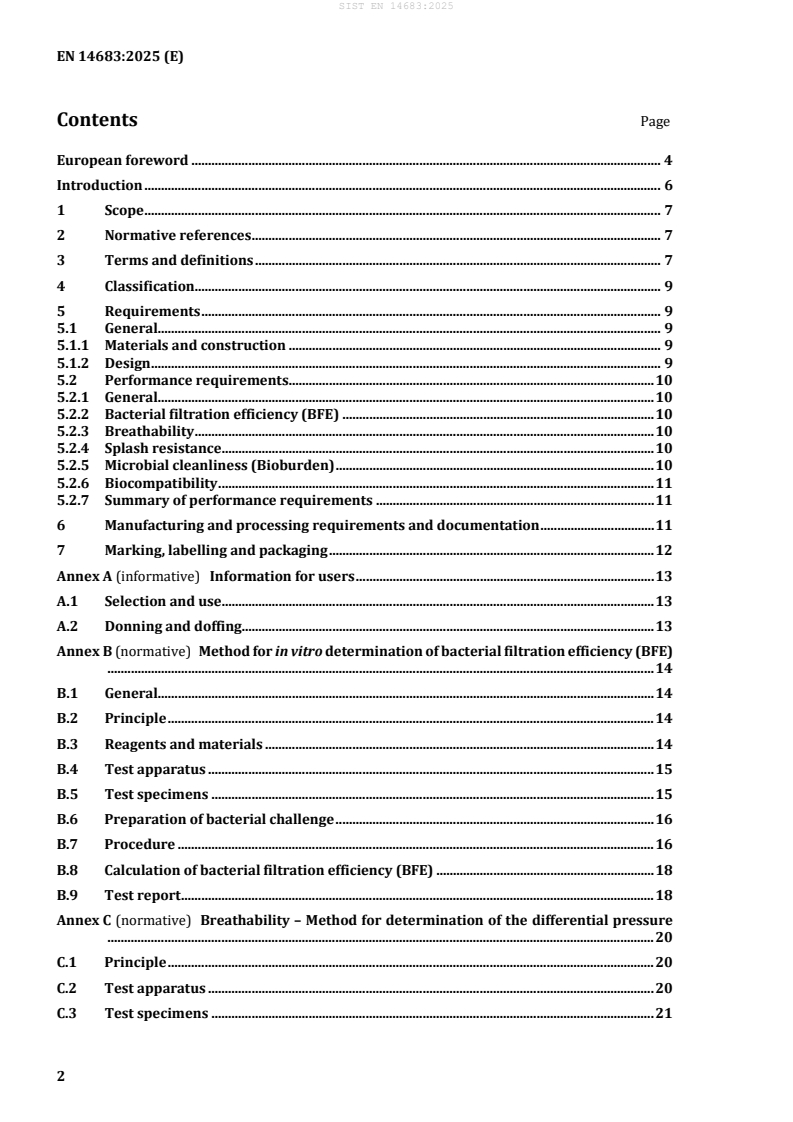
Contents Page
European foreword . 4
Introduction . 6
1 Scope . 7
2 Normative references . 7
3 Terms and definitions . 7
4 Classification. 9
5 Requirements . 9
5.1 General. 9
5.1.1 Materials and construction . 9
5.1.2 Design . 9
5.2 Performance requirements . 10
5.2.1 General. 10
5.2.2 Bacterial filtration efficiency (BFE) . 10
5.2.3 Breathability . 10
5.2.4 Splash resistance . 10
5.2.5 Microbial cleanliness (Bioburden) . 10
5.2.6 Biocompatibility . 11
5.2.7 Summary of performance requirements . 11
6 Manufacturing and processing requirements and documentation . 11
7 Marking, labelling and packaging . 12
Annex A (informative) Information for users . 13
A.1 Selection and use . 13
A.2 Donning and doffing. 13
Annex B (normative) Method for in vitro determination of bacterial filtration efficiency (BFE)
................................................................................................................................................................... 14
B.1 General. 14
B.2 Principle . 14
B.3 Reagents and materials . 14
B.4 Test apparatus . 15
B.5 Test specimens . 15
B.6 Preparation of bacterial challenge . 16
B.7 Procedure . 16
B.8 Calculation of bacterial filtration efficiency (BFE) . 18
B.9 Test report . 18
Annex C (normative) Breathability – Method for determination of the differential pressure
................................................................................................................................................................... 20
C.1 Principle . 20
C.2 Test apparatus . 20
C.3 Test specimens . 21
C.4 Procedure . 21
C.5 Calculation of differential pressure . 22
C.6 Test report . 23
Annex D (informative) Test procedure for microbial cleanliness . 24
Annex E (informative) Rationales . 25
E.1 General . 25
E.2 Sizing of medical face masks. 25
E.3 Leakage around the medical face mask . 25
E.4 Shelf life determination . 25
E.5 Why does the document only test the filter using bacteria rather than viruses? . 25
E.6 Breathability as determined by the differential pressure . 26
E.7 Where did the limits in this document come from? . 26
E.8 Bypass leakage. 26
E.9 Design . 27
E.10 Proposed withdrawal of Type I medical face masks . 27
E.11 Removal of AQLs in Annex B and Annex C . 28
Annex F (informative) Transparent medical face masks . 29
F.1 General . 29
F.2 Breathability . 29
F.3 Differential pressure measurement of TMFM . 29
F.4 Particle attenuation . 30
F.5 Filtration measurement of TMFM . 30
F.6 Fit . 30
F.7 Function . 30
F.8 Condensation . 30
F.9 Acoustics . 30
F.10 Durability . 31
F.11 Visibility . 31
F.12 References . 31
Annex G (informative) Environmental impact . 32
Annex ZA (informative) Relationship between this European Standard and General Safety
and Performance Requirements of Regulation (EU) 2017/745 aimed to be covered
................................................................................................................................................................... 34
Bibliography . 36
European foreword
This document (EN 14683:2025) has been prepared by Technical Committee CEN/TC 205 “Non-active
medical devices”, the secretariat of which is held by DIN.
This European Standard shall be given the status of a national standard, either by publication of an
identical text or by endorsement, at the latest by July 2025, and conflicting national standards shall be
withdrawn at the latest by July 2025.
Attention is drawn to the possibility that some of the elements of this document may be the subject of
patent rights. CEN shall not be held responsible for identifying any or all such patent rights.
This document supersedes EN 14683:2019+AC:2019.
EN 14683:2019+AC:2019:
a) the terms “processor”, “reusable product”, “single-use product” and “transparent medical face mask”
have been added to Clause 3;
b) the Clause “Design” has been amended, first to clarify that requirements for additional features to
medical face masks are not specified in this document and secondly to include transparent medical
face masks;
c) the requirements on microbial cleanliness (bioburden) have been specified in more detail;
d) the unit of differential pressure has been changed to Pa;
e) A new Clause 6 on “Manufacturing and processing requirements and documentation” has been
added;
f) Annex A “Information for users” has been completely revised;
g) Annex B “Method for in vitro determination of bacterial filtration efficiency (BFE)” has been further
specified in regard to the use of the six-stage cascade impactor;
h) Annex C “Breathability – Method for determination of the differential pressure” has been completed
with a formula for the calculation of the airflow, when a different test area is used than the circular
test area of 25 mm in diameter (C.4.5);
i) the option to use AQL for sample numbers in Annex B and Annex C has been removed;
j) Annex D “Test procedure for microbial cleanliness” has been completely revised;
k) a new informative Annex E “Rationales” has been added to provide a concise rationale for the
important requirements of this document. It includes information on the proposed removal of Type I
products in the next revision;
l) a new informative Annex F “Transparent medical face masks” has been added;
m) a new informative Annex G “Environmental impact” has been added;
n) alignment with Regulation (EU) 2017/745 (including updated Annex ZA);
o) update of normative references and bibliography.
This document has been prepared under a standardization request addressed to CEN by the European
Commission. The Standing Committee of the EFTA States subsequently approves these requests for its
Member States.
For the relationship with EU Legislation, see informative Annex ZA, which is an integral part of this
document.
Any feedback and questions on this document should be directed to the users’ national standards body.
A complete listing of these bodies can be found on the CEN website.
According to the CEN-CENELEC Internal Regulations, the national standards organisations of the
following countries are bound to implement this European Standard: Austria, Belgium, Bulgaria, Croatia,
Cyprus, Czech Republic, Denmark, Estonia, Finland, France, Germany, Greece, Hungary, Iceland, Ireland,
Italy, Latvia, Lithuania, Luxembourg, Malta, Netherlands, Norway, Poland, Portugal, Republic of North
Macedonia, Romania, Serbia, Slovakia, Slovenia, Spain, Sweden, Switzerland, Türkiye and the United
Kingdom.
Introduction
Medical face masks can be used as part of an infection control chain. The main intended use of medical
face masks is to protect patients by attenuating the spread of larger particles from the wearer’s mouth
and, additionally, in certain circumstances to protect the wearer against splashes of potentially
contaminated liquids. Medical face masks may also be intended to be worn by patients and other persons
to reduce the risk of spread of infections, particularly in epidemic or pandemic situations.
Bypass leakage around the medical face mask can affect the particle attenuation ability of medical face
masks, especially for smaller particles.
Besides the normative annexes, the following informative annexes are included:
— Annex A provides information for the users of medical face masks;
— Annex D provides a test procedure for microbial cleanliness;
— Annex E provides a concise rationale for the important requirements of this document and is
intended for use by those who are familiar with the subject of this document but who have not
participated in its development;
— Annex F provides some recommendations on transparent medical face masks (TMFM);
— Annex G provides some information to enable the transformation to a circular economy. This
included material efficiency – the conservation of materials by making products more durable,
resource-efficient and which facilitates the reuse or recycling of parts and/or materials at the end of
life.
Standards for face masks for use as respiratory personal protective equipment are available (e.g.
EN 149:2001+A1:2009).
Technical Committee CEN/TC 205 “Non-active medical devices” proposes to remove the specification for
Type I medical face masks at the next revision of this document. The reasons for doing this are
documented in Annex E. Therefore, CEN/TC 205 encourages healthcare organizations and agencies to
consider the potential impact on their guidance of this change.
1 Scope
This document specifies construction, design, performance requirements and test methods for medical
face masks intended to limit the transmission of infective agents from staff to patients during surgical
procedures and other medical settings with similar requirements. A medical face mask with an
appropriate microbial barrier can also be effective in reducing the emission of infective agents from the
nose and mouth of an asymptomatic carrier or a patient with clinical symptoms.
This document is not applicable to face masks intended exclusively for the personal protection of staff.
Compliance with this standard does not demonstrate compliance with the requirements of the relevant
PPE regulations.
2 Normative references
The following documents are referred to in the text in such a way that some or all of their content
constitutes requirements of this document. For dated references, only the edition cited applies. For
undated references, the latest edition of the referenced document (including any amendments) applies.
EN ISO 10993-1:2020, Biological evaluation of medical devices — Part 1: Evaluation and testing within a
risk management process (ISO 10993-1:2018, including corrected version 2018-10)
EN ISO 11737-1:2018, Sterilization of health care products — Microbiological methods — Part 1:
Determination of a population of microorganisms on products (ISO 11737-1:2018)
ISO 22609:2004, Clothing for protection against infectious agents — Medical face masks — Test method
for resistance against penetration by synthetic blood (fixed volume, horizontally projected)
3 Terms and definitions
For the purposes of this document, the following terms and definitions apply.
ISO and IEC maintain terminology databases for use in standardization at the following addresses:
— ISO Online browsing platform: available at https://www.iso.org/obp/
— IEC Electropedia: available at https://www.electropedia.org/
3.1
aerosol
gaseous suspension of solid and/or liquid particles
3.2
bacterial filtration efficiency
BFE
efficiency of the medical face mask material(s) as a barrier to bacterial penetration
Note 1 to entry: The BFE test method is used to measure the bacterial filtration efficiency (BFE) of medical face
mask materials.
3.3
biocompatibility
quality of being accepted in a specific living environment without adverse or unwanted side effects
As impacted by EN ISO 11737-1:2018/A1:2021.
3.4
colony forming unit
CFU
unit by which the culturable number of microorganisms is expressed
Note 1 to entry: The culturable number is the number of microorganisms, single cells or aggregates, able to form
colonies on a solid nutrient medium.
3.5
differential pressure
air permeability of the medical face mask, measured by determining the difference of pressure across the
medical face mask under specific conditions of air flow, temperature and humidity
Note 1 to entry: The differential pressure is an indicator of the “breathability” of the medical face mask.
3.6
filter
material used for mechanical and physical separation or deposition of aerosol particles (liquid or solid)
from the inhaled and exhaled air
3.7
infective agent
microorganism that has been shown to cause surgical wound infections or that might cause infection in
the patient, members of staff or other persons
3.8
medical face mask
surgical mask
medical device covering the mouth and nose providing a barrier to minimize the direct transmission of
infective agents between staff and patient
Note 1 to entry: Transmission of fluid-borne agents from patients to staff can occur via splashes.
3.9
microbial cleanliness
freedom from population of viable micro-organisms on a product and/or a package
Note 1 to entry: In practical use, microbial cleanliness is often referred to as “bioburden”.
3.10
processor
natural or legal person who processes products so that their performance complies with the
requirements of this document
Note 1 to entry: A processor who places a product on the market is a manufacturer in the sense of this document.
Note 2 to entry: A processor of reusable products is often referred to as a ‘reprocessor’ and processing reusable
products is often referred to as ‘reprocessing’ (as e.g. in Medical Device Regulation (EU) 2017/745).
3.11
reusable product
product intended by the manufacturer to be reprocessed and reused
3.12
single-use product
product that is intended to be used on one individual during a single procedure
3.13
splash resistance
ability of a medical face mask to withstand penetration of synthetic blood projected at a given pressure
3.14
transparent medical face mask
TMFM
medical face mask with a transparent section that allows the mouth and some facial expressions to be
seen
Note 1 to entry: The design of a transparent medical face mask can facilitate communication not only to those
dependent on lip reading but also individuals with cognitive impairments. Audio-visual cues can also improve
speech intelligibility in people with no hearing impairment.
Note 2 to entry: A medical face mask with a visor attachment covering the eyes only is not regarded as a transparent
medical face mask.
4 Classification
Medical face masks specified in this document are classified into two types (Type I and Type II) according
to bacterial filtration efficiency whereby Type II is further divided according to whether or not the
medical face mask is splash resistant. The 'R' signifies splash resistance and the Type is marked “IIR”.
5 Requirements
5.1 General
5.1.1 Materials and construction
The medical face mask is a medical device, generally composed of a filter layer that is placed, bonded or
moulded between layers of material. The medical face mask shall not disintegrate, split or tear during
intended use. In the selection of the filter and layer materials, attention shall be paid to cleanliness and
safety with regards to the release of potentially hazardous substances or particulates.
To comply with this document, products shall meet all the requirements specified in this document
throughout their useful life.
5.1.2 Design
The medical face mask shall have a means by which it can be fitted closely over the nose, mouth and chin
of the wearer when in use and which ensures that the medical face mask fits closely at the sides.
Medical face masks may have different shapes and constructions as well as additional features such as a
face shield (to protect the wearer against splashes and droplets) with or without anti-fog function, or a
nose bridge (to enhance fit by conforming to the nose contours). The requirements for such additional
features are not specified in this document.
The function of transparent medical face masks and their performance requirements are set out in
Annex F.
NOTE Medical face masks designed in accordance with this document are not expected to seal tightly to the
face. In the absence of a quantitative bypass leakage assessment, the total leakage is not well defined.
5.2 Performance requirements
5.2.1 General
All tests shall be carried out on finished products or samples cut from finished products.
5.2.2 Bacterial filtration efficiency (BFE)
When tested in accordance with Annex B, the BFE of the medical face mask shall conform to the minimum
value given for the relevant type in Table 1.
For thick and rigid medical face masks such as rigid duckbill or cup masks the test method might not be
suitable as an effective seal cannot be maintained in the cascade impactor. In these cases, another valid
equivalent method shall be used to determine the BFE.
When a medical face mask consists of two or more areas with different characteristics or different layer-
composition, each panel or area shall be tested individually. The lowest performing panel or area shall
determine the BFE value of the complete medical face mask.
5.2.3 Breathability
When tested in accordance with Annex C, the differential pressure of the medical face mask shall conform
to the value given for the relevant type in Table 1.
If the use of a respiratory protective device as face mask is required in an operating theatre and/or other
medical settings, it might not fulfil the performance requirements with regard to differential pressure as
defined in this document. In such case, the device should fulfil the requirement as specified in the relevant
Personal Protective Equipment (PPE) standard(s).
5.2.4 Splash resistance
When tested in accordance with ISO 22609:2004 the resistance of the medical face mask to penetration
of splashes of liquid shall conform to the minimum value given for Type IIR in Table 1.
All tests shall be undertaken with the targeting plate.
5.2.5 Microbial cleanliness (Bioburden)
When tested according to EN ISO 11737-1:2018 the bioburden of the medical face mask shall
be ≤ 30 CFU/g tested (see Table 1).
NOTE EN ISO 11737-1:2018 specifies requirements and provides guidance for the enumeration and microbial
characterization of the population of viable microorganisms on or in a medical device, component, raw material or
package.
To determine the medical face mask’s bioburden according to EN ISO 11737-1:2018, the test procedure
as described in Annex D can be used.
The number of medical face masks that shall be tested is minimum 5 of the same batch/lot. Medical face
mask samples for testing should be provided in the original primary packaging (dispenser box or
equivalent) as offered to the end user. When 5 samples are selected take the top, bottom and 3 randomly
chosen medical face masks. If the medical face mask contains a visor or other accessories, it should be
included in the testing.
Other test conditions (extraction procedure) as described in EN ISO 11737-1:2018 may be applied, but
to be in line with the limits given in Table 1, the media and incubation time should be as follows:
— Tryptic Soy Agar (TSA) for total viable aerobic microbial count – Incubation for 3 days at (30 ± 2) °C;
— Sabouraud Dextrose Agar (SDA) with chloramphenicol for fungi – Incubation for 7 days at
(20 to 25) °C.
Extraction efficiency shall be checked and the correction factor shall be applied to the final count.
The extraction procedure shall be documented in the test report.
The microbial cleanliness (bioburden) expressed in CFU/g is obtained by addition of the total TSA count
and total SDA count, divided by the total mass of the medical face mask.
In the test report, indicate the total bioburden per individual medical face mask and based on the mass
of the medical face mask, the total bioburden per gram.
5.2.6 Biocompatibility
The medical face mask shall be evaluated according to EN ISO 10993-1:2020. The applicable toxicology
testing regime shall be determined, if necessary. Both direct (skin and mucosa) and indirect (through the
inhaled air) contact should be considered. The results of testing should be documented according to the
applicable parts of the EN ISO 10993 series. The biocompatibility evaluation shall be available upon
request.
5.2.7 Summary of performance requirements
Each test specimen’s result shall meet the performance requirements of Table 1 except for splash
resistance pressure where a minimum of 29 specimens out of 32 shall pass the test.
Table 1 — Performance requirements for medical face masks
a
Test Type I Type II Type IIR
Bacterial filtration efficiency
≥ 95 ≥ 98 ≥ 98
(BFE), (%)
Differential pressure
≤ 200 ≤ 200 ≤ 300
b
(Pa)
Splash resistance
Not required Not required ≥ 16,0
pressure (kPa)
Microbial cleanliness
≤ 30 ≤ 30 ≤ 30
(CFU/g)
a
Type I medical face masks should only be used for patients and other persons to reduce
the risk of spread of infections particularly in epidemic or pandemic situations. Type I
medical face masks are not intended for use by healthcare professionals in an operating
room or in other medical settings with similar requirements.
b
The unit for differential pressure has changed in this revision. Further details can be
found in E.5.
6 Manufacturing and processing requirements and documentation
6.1 It shall be documented that the requirements of this document are met and that the fitness for the
intended purpose has been established for each use, both for single-use and reusable medical devices.
Reprocessing of reusable medical face masks shall be undertaken under an appropriate quality
management system, which includes requirements for processing and life-cycle control. A quality system
such as EN ISO 13485:2016 is recommended, and EN 14065:2016 may also be considered.
As impacted by EN ISO 13485:2016/AC:2018 and EN ISO 13485:2016/A11:2021.
6.2 For reusable products, the processor shall be provided with validated information on the number
of reuses and reprocessing cycles based on standardized processes, together with information on
measures for maintaining the technical and functional safety of the medical device and packaging.
7 Marking, labelling and packaging
The following information shall be included on the packaging in which the medical face mask is supplied:
a) the standard number of this document;
b) the type of medical face mask (as indicated in Table 1);
c) an indication of which side of the mask shall be in contact with the face.
NOTE Annex I, section 23 of the Medical Device Regulation (EU) 2017/745 gives additional information to
include on the packaging. This information is considered mandatory by the Regulation.
The manufacturer can also indicate the size of the medical face mask on the packaging.
EN ISO 15223-1:2021 and EN ISO 20417:2021 should be considered.
Annex A
(informative)
Information for users
A.1 Selection and use
Medical face masks, commonly referred to as surgical masks, are designed to attenuate the emission of
larger droplets from the wearer. However, they are less effective at attenuating the emission of smaller
aerosols, due to the fit and facial seal. In a workplace setting, where a risk assessment identifies a risk of
respiratory exposure due to an airborne hazard, personal protective equipment [CE marked to
Regulation (EU) 2016/425] such as a respirator may be required. A medical face mask is not a respirator.
This document does not specify leakage performance requirements on the inward direction. Total inward
leakage is often larger than total outward leakage for two reasons: the high velocity jet of the outward
breath, leading to more impaction of particles than for the diffuse inward breath, and the rapid
evaporation of particles after exhalation, making them smaller and harder to filter.
This document describes two types of medical face masks with associated performance levels. Type I is
the most basic performance level. Type II and type IIR medical face masks are principally intended for
use by healthcare professionals in an operating room or other medical settings with similar
requirements, and Type IIR medical face masks are also intended to protect the wearer against splashes
of potentially contaminated fluids.
A.2 Donning and doffing
Due to the fact that medical face masks are considered highly contaminated from use, it is essential that:
— the body of the medical face mask is not touched by the fingers/hands of the wearer;
— hands are disinfected (full hand disinfection) before donning and after removal of the medical face
mask;
— the nose clip, if present, is fitted on and around the nose to improve the contact between the medical
face mask and the face to reduce outward leakage;
— a medical face mask is worn covering the nose and mouth of the wearer;
— a used medical face mask should be disposed of or placed into suitable collection containers when no
longer needed. Medical face masks should be changed between procedures.
Annex B
(normative)
Method for in vitro determination of bacterial filtration efficiency (BFE)
B.1 General
WARNING — Staphylococcus aureus is a pathogen. The relevant national provisions by law and hygienic
instructions when dealing with pathogens shall be complied with.
B.2 Principle
A specimen of the medical face mask material is clamped between a six-stage cascade impactor and an
aerosol chamber. An aerosol of Staphylococcus aureus is introduced into the aerosol chamber and drawn
through the medical face mask material and the impactor under vacuum. The bacterial filtration
efficiency (BFE) of the medical face mask is given by the number of colony forming units prevented from
passing through the medical face mask material expressed as a percentage of the number of colony
forming units present in the challenge aerosol. For test apparatus, see Figure B.3.
B.3 Reagents and materials
B.3.1 General
B.3.2 and B.3.3 describe commercially available solutions of tryptic soy agar and tryptic soy broth. Other
variants may be suitable.
B.3.2 Tryptic soy agar
Formula/litre
Enzymatic digest of casein 15 g
Enzymatic digest of soybean meal 5 g
Sodium chloride
5 g
Agar 15 g
Final pH 7,3 ± 0,2 at 25 °C
B.3.3 Tryptic soy broth
Formula/litre
Enzymatic digest of casein 17 g
Enzymatic digest of soybean meal 3 g
Sodium chloride 5 g
Dipotassium phosphate 2,5 g
Dextrose 2,5 g
Final pH 7,3 ± 0,2 at 25 °C
B.3.4 Peptone water
Formula/litre
Peptone 10 g
Sodium chloride 5 g
Final pH 7,2 ± 0,2 at 25 °C
B.3.5 Culture of Staphylococcus aureus ATCC 6538, growing on tryptic soy agar slants.
B.4 Test apparatus
B.4.1 Six-stage cascade impactor, the arrangement is specified in Table B.1. The use of plastic Petri
dishes is permitted but their dimensions should be as close as possible to the dimensions of the glass
dishes for which the impactor is designed [14]. The agar-to-grid distance for each stage of the impactor
is also very important. The volume of agar should be determined according to the type of Petri dishes
selected. A volume of 27 ml is generally recommended for the glass dishes offered with the Andersen
impactor. The volume used with the selected Petri dishes should give an agar-to-grid distance compara-
ble to that obtained with a reference glass dish filled with 27 ml of agar or the volume mentioned by the
supplier.
B.4.2 Nebulizer, capable of delivering particles with a mean size of (3,0 ± 0,3) μm when in contact with
the cascade impactor.
B.4.3 Aerosol chamber, glass, (600 ± 5) mm long and (80 ± 5) mm in internal diameter.
B.4.4 Flow meters, capable of measuring a flow rate of 28,3 l/min.
B.4.5 Pressure gauge, capable of measuring a pressure of 35 kPa to a tolerance of ±1 kPa.
B.4.6 Erlenmeyer flasks, 250 ml and 500 ml capacity.
B.4.7 Peristaltic or syringe pump, capable of delivering 0,01 ml/min.
B.4.8 Vacuum pump, capable of maintaining a flow rate of 57 l/min.
B.5 Test specimens
Test specimens shall be cut from complete medical face masks. A complete medical face mask may be
used in place of a cut specimen, as long as the extremities are removed, the medical face mask is laid flat
and all layers are incorporated (in case of folded medical face masks unfold the mask in order to test a
surface as flat as possible). Each specimen shall be minimum 100 mm × 100 mm and shall include all
layers of the medical face mask in the order in which they are placed in the complete medical face mask.
The number of specimens that shall be tested is minimum 5.
All specimens tested shall be taken from representative areas to incorporate all/any variation in
construction. Unless otherwise specified, the testing shall be performed with the inside of the medical
face mask in contact with the bacterial challenge.
Each test specimen shall be conditioned at (21 ± 5) °C and (85 ± 5) % relative humidity for a minimum of
4 h to bring them into equilibrium with atmosphere prior to testing.
B.6 Preparation of bacterial challenge
Staphylococcus aureus (see B.3.5) shall be inoculated into an appropriate volume of tryptic soy broth
(TSB) (e.g. in 30 ml TSB in an Erlenmeyer flask) and incubated with mild shaking at a temperature of
(37 ± 2) °C for (24 ± 2) h. The culture shall then be diluted in peptone water to give a concentration of
approximately 5 × 10 CFU/ml.
3 3
The bacterial challenge shall be maintained at 1,2 × 10 to 3,5 × 10 CFU per test. The bacterial challenge
shall be determined on the basis of experience and previous positive control plates (see B.7.3) and the
dilution of the challenge suspension adjusted accordingly. The mean particle size (MPS) in the bacterial
challenge shall be maintained at (3,0 ± 0,3) μm (see B.7.9).
Table B.1 — Cascade impactor stage arrangement
Stage number 1 2 3 4 5 6
Size of particle P1 P2 P3 P4 P5 P6
Viable “particle” plate count C1 C2 C3 C4 C5 C6
where
P1 = 7,00 μm
P2 = 4,70 μm
P3 = 3,30 μm
P4 = 2,10 μm
P5 = 1,10 μm
P6 = 0,65 μm
P1 × C1 + P2 × C2 + P3 × C3 + P4 × C4 + P5 × C5 + P6 × C6
( ) ( ) ( ) ( ) ( ) ( )
MPS = (B.1)
C1 + C2 + C3 + C4 + C5 + C6
The viable “particles” plate count values used for MPS calculations are the converted “probable hit”
counts calculated using the positive hole conversion chart from the cascade impactor manual.
The MPS value above is the 50 % effective cut-off diameter calculated for each stage using the formula
and information from the cascade impactor manual.
B.7 Procedure
B.7.1 Assemble the test apparatus in accordance with the flow chart shown in Figure B.1 or Figure B.3.
Figure B.1 — Principle of BFE test apparatus
B.7.2 Deliver the bacterial challenge to the nebulizer using the peristaltic or syringe pump.
B.7.3 Perform a positive control run without a test specimen. Initiate the bacterial challenge by turning
on the vacuum pump and adjust the flow rate through the cascade impactor to 28,3 l/min. Deliver the
bacterial challenge for 1 min. Maintain the airflow through the cascade impactor one additional minute
(total test time is 2 min). Then remove the plates from the cascade impactor. Ensure that each plate is
numbered to indicate its position in the cascade impactor.
B.7.4 Place fresh plates in the cascade impactor, clamp the test specimen in place between the first
stage of the cascade impactor and the inlet cone (see Figure B.2) and repeat the procedure described in
B.7.3. The test area is determined by the inner diameter of the impactor lid (~40 cm ). Alternative means
to position the sample may be appropriate, but, if deviated from the procedure, this shall be documented
in the test report.
Key
1 inlet cone
2 o'ring inlet cone
3 cloth / medical face mask
Figure B.2 — Placement of test specimen on the cascade impactor
B.7.5 Repeat this procedure for each test specimen.
B.7.6 After the last test specimen has been tested, perform a further positive control run.
B.7.7 Perform a negative control run by passing air, without addition of the bacterial challenge, through
the cascade impactor for 2 min.
B.7.8 Incubate all the plates at (37 ± 2) °C for (20 to 52) h.
B.7.9 For each specimen and control run, count the number of colonies on each plate and add up the
counts to give the total number of CFU collected by the cascade impactor. Use the “positive hole” conver-
sion table in accordance with the instructions of the cascade impactor manufacturer for stages 3 to 6.
For the two positive control runs, take the mean of the two totals. From the positive control plates calcu-
late the mean particle size (MPS) of bacterial challenge aerosol using the formula given in B.6.
Some aggregates emanating from the same hole of the grid shall be counted as a single colony. If not, the
count of the colonies can be overestimated, which could lead to a total count of colonies higher than 400
which is the number of holes of the grid.
B.8 Calculation of bacterial filtration efficiency (BFE)
For each test specimen calculate the bacterial filtration efficiency B, as a percentage, using the following
formula:
B=C−×T 100/ C (B.2)
( )
where
B is the bacterial filtration efficiency in percent;
C is the mean of the total plate counts for the two positive control runs;
T is the total plate count for the test specimen.
B.9 Test report
The following information shall be given at least in the test report:
a) standard number and date of this document;
b) information on the sample (incl. the lot number or batch code and the descr
...