

EN 4906:2023
(Main)Aerospace series - Embedded tags - Choice of fixation for installation, removal and replacement of embedded tags
- Abstract
This document is applicable in the aeronautical domain to on-board parts and to equipment intended to be embedded or positioned on any civil or military airborne vehicle with a type certificate.
The purpose of this document is to guide design, manufacturing, maintenance and operations organizations in the installation, removal and replacement of RFID tags (UHF and HF) and Contact Memory Buttons (CMB), according to the environments defined in RTCA DO-160/EUROCAE ED-14 and according to the type of support and the expected fixation performances. This guide will provide help in the specification of the tag installation/removal functions and/or will enable the solutions on offer from tag suppliers to be enhanced.
The term "tag" used in this document covers all the tags used to store electronic data, including RFID tags and CMB tags. As a reminder, the tags can also contain information that can be read by devices other than RFID or CMB readers (e.g. bar codes - Data Matrix, QR codes, etc., and/or alphanumerical characters) and information that can be read by the naked eye without any tools (human-readable).
- Status
- Published
- Publication Date
- 24-Oct-2023
- Technical Committee
- ASD-STAN - Aerospace
- Drafting Committee
- ASD-STAN/D 7/WG 2 - RFID Radio Frequency IDentification
- Current Stage
- 6060 - Definitive text made available (DAV) - Publishing
- Start Date
- 25-Oct-2023
- Completion Date
- 25-Oct-2023

Overview
EN 4906:2023 - "Aerospace series - Embedded tags - Choice of fixation for installation, removal and replacement of embedded tags" is a CEN European Standard that guides the selection and implementation of fixation methods for on‑board tags in civil and military aircraft. It covers RFID (UHF and HF) and Contact Memory Buttons (CMB) and applies to parts and equipment intended to be embedded or positioned on any airborne vehicle with a type certificate. The standard helps design, manufacturing, maintenance and operations organizations specify reliable tag installation, removal and replacement solutions in line with airborne environmental categories (RTCA DO‑160 / EUROCAE ED‑14).
Key topics and technical requirements
- Tag types and scope: UHF/HF RFID and CMB tags; tag data may also be human‑readable or encoded as barcodes (DataMatrix, QR).
- Fixation methods: comprehensive review of bonding and mechanical options including adhesive bonding, screwing, riveting, stapling, crimping, pinching, collars, clips, welding, magnets, pouches, textile fixations, braiding/weaving and integrated/container‑incorporated tags.
- Environmental considerations: selection guidance tied to RTCA DO‑160/EUROCAE ED‑14 environments - temperature, vibration/shock, humidity, fluids, salt spray, icing, dust, UV/light, and immersion.
- Support characteristics: influence of support shape, size, orientation and surface nature on fixation choice and tag performance.
- Lifecycle and safety: guidance on integrity, lifespan, replacement strategy, risks such as projection during operation, resistance to cleaning/maintenance, flammability, degassing/toxicity and non‑reuse of tags.
- Selection method and performance: structured approach to match fixation types to expected mechanical loads and operational environments (see sections on bonding, screwing/riveting, crimping, etc.).
Applications and who should use it
EN 4906:2023 is practical for:
- Aircraft OEMs and systems designers specifying embedded identification and tracking tags for avionics, structures and components.
- Suppliers and manufacturers of RFID/CMB tags who need to propose certified fixation solutions.
- MRO (maintenance, repair and overhaul) providers and airline engineering teams planning safe tag removal and replacement processes.
- Certification and airworthiness specialists ensuring tag installations meet environmental and safety requirements.
- IT and asset‑management teams implementing on‑board tracking, maintenance logs and lifecycle tracing using embedded tags.
Keywords: EN 4906:2023, embedded tags, RFID HF UHF, Contact Memory Button, fixation methods, aerospace tag installation, tag removal replacement, RTCA DO‑160, EUROCAE ED‑14.
Related standards
- RTCA DO‑160 / EUROCAE ED‑14 (environmental testing categories referenced by EN 4906:2023)
For implementation, EN 4906:2023 should be used alongside supplier technical data and aircraft‑specific maintenance procedures to define validated fixation designs and operational practices.
Relations
- Effective Date
- 25-Aug-2026
- Effective Date
- 28-Jan-2026
- Effective Date
- 28-Jan-2026
- Effective Date
- 28-Jan-2026
- Effective Date
- 28-Jan-2026
- Effective Date
- 28-Jan-2026
- Effective Date
- 28-Jan-2026
Get Certified
Connect with accredited certification bodies for this standard

BSI Group
BSI (British Standards Institution) is the business standards company that helps organizations make excellence a habit.

BUREAU VERITAS Certification Germany
Bureau Veritas certification in Germany.

Element Materials Technology
Materials testing and product certification.
Sponsored listings
Frequently Asked Questions
EN 4906:2023 is a standard published by the European Committee for Standardization (CEN). Its full title is "Aerospace series - Embedded tags - Choice of fixation for installation, removal and replacement of embedded tags". This standard covers: This document is applicable in the aeronautical domain to on-board parts and to equipment intended to be embedded or positioned on any civil or military airborne vehicle with a type certificate. The purpose of this document is to guide design, manufacturing, maintenance and operations organizations in the installation, removal and replacement of RFID tags (UHF and HF) and Contact Memory Buttons (CMB), according to the environments defined in RTCA DO-160/EUROCAE ED-14 and according to the type of support and the expected fixation performances. This guide will provide help in the specification of the tag installation/removal functions and/or will enable the solutions on offer from tag suppliers to be enhanced. The term "tag" used in this document covers all the tags used to store electronic data, including RFID tags and CMB tags. As a reminder, the tags can also contain information that can be read by devices other than RFID or CMB readers (e.g. bar codes - Data Matrix, QR codes, etc., and/or alphanumerical characters) and information that can be read by the naked eye without any tools (human-readable).
This document is applicable in the aeronautical domain to on-board parts and to equipment intended to be embedded or positioned on any civil or military airborne vehicle with a type certificate. The purpose of this document is to guide design, manufacturing, maintenance and operations organizations in the installation, removal and replacement of RFID tags (UHF and HF) and Contact Memory Buttons (CMB), according to the environments defined in RTCA DO-160/EUROCAE ED-14 and according to the type of support and the expected fixation performances. This guide will provide help in the specification of the tag installation/removal functions and/or will enable the solutions on offer from tag suppliers to be enhanced. The term "tag" used in this document covers all the tags used to store electronic data, including RFID tags and CMB tags. As a reminder, the tags can also contain information that can be read by devices other than RFID or CMB readers (e.g. bar codes - Data Matrix, QR codes, etc., and/or alphanumerical characters) and information that can be read by the naked eye without any tools (human-readable).
EN 4906:2023 is classified under the following ICS (International Classification for Standards) categories: 35.240.60 - IT applications in transport; 49.035 - Components for aerospace construction. The ICS classification helps identify the subject area and facilitates finding related standards.
EN 4906:2023 has the following relationships with other standards: It is inter standard links to ISO 4578:1997, EN 4818:2012, EN ISO 11343:2019, EN 4819:2012, EN 1464:2010, EN 4905:2023, EN 1465:2009. Understanding these relationships helps ensure you are using the most current and applicable version of the standard.
EN 4906:2023 is available in PDF format for immediate download after purchase. The document can be added to your cart and obtained through the secure checkout process. Digital delivery ensures instant access to the complete standard document.
Standards Content (Sample)
SLOVENSKI STANDARD
01-december-2023
Aeronavtika - Vgrajene oznake - Možnost izbire pritrditve za namestitev,
odstranitev in zamenjavo vgrajenih oznak
Aerospace series - Embedded tags - Choice of fixation for installation, removal and
replacement of embedded tags
Luft- und Raumfahrt - On-Board-Etiketten - Auswahl der Befestigung zum Anbringen,
Entfernen und Ersetzen von On-Board-Etiketten
Série aérospatiale - Étiquettes embarquées - Choix de fixation pour pose, dépose et
remplacement d’étiquettes embarquées
Ta slovenski standard je istoveten z: EN 4906:2023
ICS:
35.240.60 Uporabniške rešitve IT v IT applications in transport
prometu
49.035 Sestavni deli za letalsko in Components for aerospace
vesoljsko gradnjo construction
2003-01.Slovenski inštitut za standardizacijo. Razmnoževanje celote ali delov tega standarda ni dovoljeno.
EN 4906
EUROPEAN STANDARD
NORME EUROPÉENNE
October 2023
EUROPÄISCHE NORM
ICS 35.240.60; 49.035
English Version
Aerospace series - Embedded tags - Choice of fixation for
installation, removal and replacement of embedded tags
Série aérospatiale - Étiquettes embarquées - Choix de Luft- und Raumfahrt - On-Board-Etiketten - Auswahl
fixation pour pose, dépose et remplacement der Befestigung zum Anbringen, Entfernen und
d'étiquettes embarquées Ersetzen von On-Board-Etiketten
This European Standard was approved by CEN on 30 July 2023.
CEN members are bound to comply with the CEN/CENELEC Internal Regulations which stipulate the conditions for giving this
European Standard the status of a national standard without any alteration. Up-to-date lists and bibliographical references
concerning such national standards may be obtained on application to the CEN-CENELEC Management Centre or to any CEN
member.
This European Standard exists in three official versions (English, French, German). A version in any other language made by
translation under the responsibility of a CEN member into its own language and notified to the CEN-CENELEC Management
Centre has the same status as the official versions.
CEN members are the national standards bodies of Austria, Belgium, Bulgaria, Croatia, Cyprus, Czech Republic, Denmark, Estonia,
Finland, France, Germany, Greece, Hungary, Iceland, Ireland, Italy, Latvia, Lithuania, Luxembourg, Malta, Netherlands, Norway,
Poland, Portugal, Republic of North Macedonia, Romania, Serbia, Slovakia, Slovenia, Spain, Sweden, Switzerland, Türkiye and
United Kingdom.
EUROPEAN COMMITTEE FOR STANDARDIZATION
COMITÉ EUROPÉEN DE NORMALISATION
EUROPÄISCHES KOMITEE FÜR NORMUNG
CEN-CENELEC Management Centre: Rue de la Science 23, B-1040 Brussels
© 2023 CEN All rights of exploitation in any form and by any means reserved Ref. No. EN 4906:2023 E
worldwide for CEN national Members.
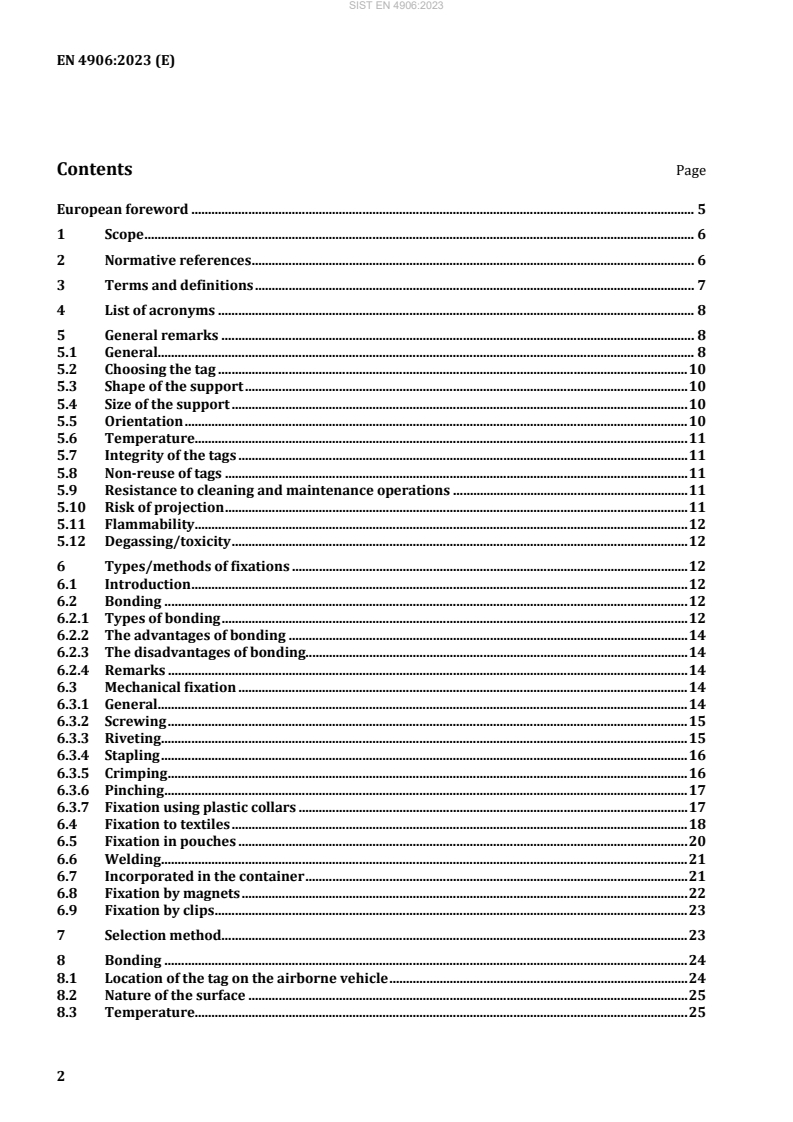
Contents Page
European foreword . 5
1 Scope . 6
2 Normative references . 6
3 Terms and definitions . 7
4 List of acronyms . 8
5 General remarks . 8
5.1 General. 8
5.2 Choosing the tag . 10
5.3 Shape of the support . 10
5.4 Size of the support . 10
5.5 Orientation . 10
5.6 Temperature. 11
5.7 Integrity of the tags . 11
5.8 Non-reuse of tags . 11
5.9 Resistance to cleaning and maintenance operations . 11
5.10 Risk of projection . 11
5.11 Flammability . 12
5.12 Degassing/toxicity . 12
6 Types/methods of fixations . 12
6.1 Introduction . 12
6.2 Bonding . 12
6.2.1 Types of bonding . 12
6.2.2 The advantages of bonding . 14
6.2.3 The disadvantages of bonding. 14
6.2.4 Remarks . 14
6.3 Mechanical fixation . 14
6.3.1 General. 14
6.3.2 Screwing . 15
6.3.3 Riveting . 15
6.3.4 Stapling . 16
6.3.5 Crimping . 16
6.3.6 Pinching . 17
6.3.7 Fixation using plastic collars . 17
6.4 Fixation to textiles . 18
6.5 Fixation in pouches . 20
6.6 Welding . 21
6.7 Incorporated in the container . 21
6.8 Fixation by magnets . 22
6.9 Fixation by clips . 23
7 Selection method. 23
8 Bonding . 24
8.1 Location of the tag on the airborne vehicle . 24
8.2 Nature of the surface . 25
8.3 Temperature. 25
8.4 Vibrations/shocks/constant acceleration . 25
8.5 Sensitivity to fluids, fungus, salt spray, humidity, immersion, icing, sand and dust . 25
8.6 Tearing-off (aerodynamic air flows, maintenance operations, etc.) . 26
8.7 UV/Light . 27
8.8 Lifespan . 27
8.9 Replacement . 27
9 Screwing, riveting and nailing . 27
9.1 Location of the tag . 27
9.2 Nature of the surface . 27
9.3 Temperature . 27
9.4 Vibrations/shocks/constant acceleration . 27
9.5 Sensitivity to fluids, fungus, salt spray, humidity, icing, sand and dust . 28
9.6 Tearing-off (aerodynamic air flows, handling, etc.). 28
9.7 UV/Light . 28
9.8 Lifespan . 28
9.9 Replacement . 28
10 Crimping/Pinching . 28
10.1 Location of the tag . 28
10.2 Nature of the surface . 28
10.3 Temperature . 28
10.4 Vibrations/shocks/constant acceleration . 28
10.5 Sensitivity to fluids, fungus, salt spray, humidity, icing, sand and dust . 29
10.6 Tearing-off (aerodynamic air flows, handling, etc.). 29
10.7 UV/Light . 29
10.8 Lifespan . 29
10.9 Replacement . 29
11 Wrapping and fixation with collars. 29
11.1 Location of the tag on the airborne vehicle . 29
11.2 Nature of the surface . 29
11.3 Temperature . 29
11.4 Vibrations/shocks/constant acceleration . 29
11.5 Sensitivity to fluids, fungus, salt spray, humidity, icing, sand and dust . 29
11.6 Tearing-off (aerodynamic air flows, handling, etc.). 30
11.7 UV/Light . 30
11.8 Lifespan . 30
11.9 Replacement . 30
12 Braiding/weaving . 30
12.1 Location of the tag on the airborne vehicle . 30
12.2 Nature of the surface . 30
12.3 Temperature . 30
12.4 Vibrations/shocks/constant acceleration . 30
12.5 Sensitivity to fluids, fungus, salt spray, humidity, icing, sand and dust . 30
12.6 Tearing-off (aerodynamic air flows, handling, etc.). 30
12.7 UV/Light . 30
12.8 Lifespan . 30
12.9 Replacement . 31
13 Welding . 31
13.1 Location of the tag on the airborne vehicle . 31
13.2 Nature of the surface . 31
13.3 Temperature . 31
13.4 Vibrations/shocks/constant acceleration . 31
13.5 Sensitivity to fluids, fungus, salt spray, humidity, icing, sand and dust . 31
13.6 Tearing-off (aerodynamic air flows, handling, etc.) . 31
13.7 UV/Light . 31
13.8 Lifespan . 31
13.9 Replacement . 31
14 Coated bonding . 31
14.1 Location of the tag on the airborne vehicle . 31
14.2 Nature of the surface . 31
14.3 Temperature. 32
14.4 Vibrations/shocks/constant acceleration . 32
14.5 Sensitivity to fluids, fungus, salt spray, humidity, icing, sand and dust . 32
14.6 Tearing-off (aerodynamic air flows, handling, etc.) . 32
14.7 UV/Light . 32
14.8 Lifespan . 32
14.9 Replacement . 32
Bibliography . 33
European foreword
This document (EN 4906:2023) has been prepared by the Aerospace and Defence Industries
Association of Europe — Standardization (ASD-STAN).
After enquiries and votes carried out in accordance with the rules of this Association, this
document has received the approval of the National Associations and the Official Services of the
member countries of ASD-STAN, prior to its presentation to CEN.
This document shall be given the status of a national standard, either by publication of an identical
text or by endorsement, at the latest by April 2024, and conflicting national standards shall be
withdrawn at the latest by April 2024.
Attention is drawn to the possibility that some of the elements of this document may be the subject
of patent rights. CEN shall not be held responsible for identifying any or all such patent rights.
According to the CEN-CENELEC Internal Regulations, the national standards organizations of the
following countries are bound to implement this document: Austria, Belgium, Bulgaria, Croatia,
Cyprus, Czech Republic, Denmark, Estonia, Finland, France, Germany, Greece, Hungary, Iceland,
Ireland, Italy, Latvia, Lithuania, Luxembourg, Malta, Netherlands, Norway, Poland, Portugal,
Republic of North Macedonia, Romania, Serbia, Slovakia, Slovenia, Spain, Sweden, Switzerland,
Türkiye and the United Kingdom.
1 Scope
This document is applicable in the aeronautical domain to on-board parts and to equipment intended to
be embedded or positioned on any civil or military airborne vehicle with a type certificate.
The purpose of this document is to guide design, manufacturing, maintenance and operations
organizations in the installation, removal and replacement of RFID tags (UHF and HF) and Contact
Memory Buttons (CMB), according to the environments defined in RTCA DO-160/EUROCAE ED-14 and
according to the type of support and the expected fixation performances. This guide will provide help in
the specification of the tag installation/removal functions and/or will enable the solutions on offer from
tag suppliers to be enhanced.
The term “tag” used in this document covers all the tags used to store electronic data, including RFID
tags and CMB tags. As a reminder, the tags can also contain information that can be read by devices
other than RFID or CMB readers (e.g., bar codes - Data Matrix, QR codes, etc., and/or alphanumerical
characters) and information that can be read by the naked eye without any tools (human-readable).
2 Normative references
The following documents are referred to in the text in such a way that some or all of their content
constitutes requirements of this document. For dated references, only the edition cited applies. For
undated references, the latest edition of the referenced document (including any amendments) applies.
EN 1464, Adhesives — Determination of peel resistance of adhesive bonds — Floating roller method
EN 1465, Adhesives — Determination of tensile lap-shear strength of bonded assemblies
EN 4818, Aerospace series — Passive HF RFID tags intended for aircraft use
EN 4819, Aerospace series — Contact Memory Button (CMB) tags intended for aircraft use
EN 4905, Aerospace series — Passive UHF RFID for airborne use
EN ISO 11343, Adhesives — Determination of dynamic resistance to cleavage of high-strength adhesive
bonds under impact wedge conditions — Wedge impact method (ISO 11343)
ISO 4578, Adhesives — Determination of peel resistance of high-strength adhesive bonds — Floating-
roller method
RTCA DO-160/EUROCAE ED-14, Environmental Conditions and Test Procedures for Airborne Equipment
SAE AS 5678B, Passive RFID Tags Intended for Airborne Equipment Use
SAE AS 6023, Active and Battery Assisted Passive Tags Intended for Aircraft Use
Published by: ISO International Organization for Standardization http://www.iso.ch/.
Published by: SAE International (US), https://www.sae.org/.
3 Terms and definitions
For the purposes of this document, the following terms and definitions.
ISO and IEC maintain terminology databases for use in standardization at the following addresses:
— ISO Online browsing platform: available at https://www.iso.org/obp/
— IEC Electropedia: available at https://www.electropedia.org/
3.1
airborne vehicle
any machine capable of taking off and flying in the air
3.2
surface tension
physical-chemical phenomenon related to the molecular interactions of a fluid
Note 1 to entry: It results from the increase in the energy at the interface between two fluids.
Note 2 to entry: The system tends towards an equilibrium corresponding to the lowest-energy configuration
and therefore modifies its geometry to reduce the surface area of this interface.
Note 3 to entry: The force that maintains the system in this configuration is the surface tension.
3.3
primer
material added to make smooth coatings more adhesive to facilitate the application of the second coat
(glue, paint, etc.)
3.4
orientation
relative position of an item of equipment
EXAMPLE Upright, on its side, upside down.
Note 1 to entry: The orientation can affect the reading of tags.
3.5
certification
any form of recognition in accordance with a regulation or a standard based on an appropriate
assessment, certifying that a person or organization, a product, a part, or non-fixed equipment meets
the applicable requirements of this regulation or this document, as well as the delegated acts and the
implementing acts adopted on the basis thereof, through the issue of a certificate testifying this
conformity
3.6
equipment
any instrument, mechanism, machine, auxiliary device, software or accessory transported onboard an
airborne vehicle by the airborne vehicle operator, which is not a part, and which is used, or intended to
be used, to operate or control the airborne vehicle, that contributes to the survivability of the persons
onboard or that has on influence on the operation of the airborne vehicle in complete safety
3.7
counterboring
machining operation consisting of counterboring a part, in particular to produce the bearing surface of
a nut, washer, etc
3.8
peeling
action consisting of detaching a coating from its support
3.9
part
any element of an item of equipment, as defined by the type design of the product
3.10
product
airborne vehicle, engine, propeller; or one of these components
3.11
support
physical part of an item of equipment or a part on which the tag is positioned
4 List of acronyms
For the purposes of this document, the following acronyms apply.
APU Auxiliary Power Unit
CMB Contact Memory Button
HF High Frequency
RFID Radio Frequency IDentification
RTCA Radio Technical Commission for Aeronautics
UHF Ultra-High Frequency
UV UltraViolet
5 General remarks
5.1 General
The fixation of the tag to a product, item of equipment or part shall ensure that the tag remains affixed
to the product, item of equipment or part for a given duration that is consistent with the lifespan of the
product, item of equipment or part, while the tag remains operational (i.e. the tag remains readable/re-
writeable) or up to its replacement if failed.
The methods used to install tags vary according to the shape, size, type of material and texture of the
equipment, and to the environmental conditions under which the equipment will be monitored.
The tags shall be compatible with the intended type of fixation. The technical documentation provided
by the manufacturer usually contains this type of information.
The main criteria to be taken into consideration are as follows:
— the shape of the surface to which the tag will be affixed (flat, cylindrical, etc.), which shall meet the
manufacturer’s recommendations in terms of the flatness or the curvature of the surface;
— the size of the equipment to be identified and the area available to install the tag;
— the material of the surface of the equipment to be tagged, such as metal, plastic or textile fabric, etc.;
— the length of time for which the equipment shall be tagged (short or long term, permanent or
temporary);
— the length of time for which the equipment will be exposed to environmental conditions such as
extreme temperatures, humidity, chemicals, abrasion, dust, human contact, pressure, salt water,
outdoor exposure to ultraviolet rays and weather conditions, industrial treatments, thermal shocks
(from hot to cold and vice versa), instantaneous freezing (dry ice) and laboratory tests;
— the temperature of the equipment when the tag is installed, for example hot injection-moulded
products or parts that have just been removed from the mould, or frozen products or parts;
— the position of the tag on the equipment, product or part;
— the lifespan of the tag;
— the reading distance, the orientation of the tag relative to the reader, the type of reader used to
collect the data, the time required to read or write on the tag, the number of tags to be read
simultaneously, the reading speed;
— the time required to install the tag on the equipment, product or part;
— the human and technical resources required to install the tag (welding machines, surface
preparation, etc.).
The fixation of the tags to new equipment, products or parts is qualified at the same time as the
equipment, product or part in the different environments using the standard RTCA DO-160.
When tags are affixed to equipment already in use, the fixation is validated as per the standard
RTCA DO-160 in an environment that is representative of the equipment in question.
As a general rule:
— sensitive fixation processes shall be qualified;
— the fixation process shall be suited to the lifespan of the equipment and of the tag;
— the fixation process shall be compatible with the environmental conditions that the tag can
withstand.
After choosing the fixation process, it is necessary to proceed with performance tests of the tag
(reading, writing).
5.2 Choosing the tag
It is necessary to make sure that the type of tag selected is appropriate for the application in question
by considering its environmental limits and performing tests on the affixed tags to make sure that the
read/write performances meet the expectations with regard to the materials involved.
The tag manufacturer’s information on accelerated life cycle tests and the limits of the tag’s ease of
maintenance shall be taken into consideration when choosing the tags for each application.
Operators shall take account of the life cycle of the equipment on which the tags will be affixed when
choosing the tags. If any condition, such as the maintenance, servicing or repair of the equipment, could
destroy or damage the tag or its fixation, the operators should take appropriate preventive measures to
keep the tag intact. These actions could include a mechanical system to remove the tag, or the use of
protective materials to protect the tag, etc. Embedded tags shall be qualified in advance according to the
standards SAE AS 5678B, SAE AS 6023, EN 4818, EN 4819 or EN 4905. Additional requirements may
apply, depending on the certification specifications (CS-25, CS-E, etc.).
Operators shall consider the implications of the location, position and installation method of the tags.
The tag shall be installed so that it does not interfere with the adaptation, the shape or the operation in
complete safety or the assembly of the airborne vehicle equipment.
The airborne vehicle operator shall draw up instructions for the installation and replacement of the tags
using materials, finishes and surface shapes that are acceptable for the equipment to which the tag is
affixed.
5.3 Shape of the support
The shape of the support impacts the mode of fixation and the behaviour of the tag.
5.4 Size of the support
The area where the tag is to be affixed shall be at least as large as the size of the tag. The tag shall not
extend beyond the edges of the support to minimize the risks of tearing-off.
5.5 Orientation
To produce the ideal conditions for reading, most RFID tags are oriented in a specific direction relative
to the antenna of the reader. If the RFID tag is poorly oriented, its reading range can be reduced
radically, or the tag cannot be read at all.
The tag manufacturer’s technical documentation can contain information on the recommended
orientation.
Tests should also be performed to find the best orientation for a specific tag/reader combination in the
real-life environment, and to make sure that the tag can be read, once affixed, without having to remove
any nearby equipment.
In the case of a tag located in an air flow, it is recommended to orient the tag in such a way as to
minimize the wind resistance to avoid the risk of tearing-off. The position of the tag takes the different
use cases of the tagged equipment into consideration. Some compromises can be necessary.
NOTE This subclause is not applicable to CMB tags, which are not sensitive to the orientation of the reader.
5.6 Temperature
The temperature of the fixation process shall be lower than the maximum temperature that the tag can
withstand.
If the fixation process involves high temperatures, functional tests shall be carried out to confirm the
integrity of the tag.
5.7 Integrity of the tags
The electronic chips connected to the antennas of RFID tags are sensitive. In particular, bending, folding
or twisting certain RFID tags can break the connections between the antenna and the chip, resulting in a
failure.
Folding, bending, twisting or applying tension to RFID tags in excess of the permissible values indicated
in the manufacturer’s technical documentation should be avoided.
The performances of the RFID tag shall be validated under the reading and writing conditions.
NOTE This subclause is not applicable to CMB tags, which do not have antennas.
5.8 Non-reuse of tags
Removing a tag can cause internal damage, especially to tags affixed with an adhesive. Certain tags are
specifically designed to break the connection between the antenna of the RFID tag and the chip when
they are removed from the equipment to which they are affixed (anti-sabotage RFID tags).
It is forbidden to reuse a tag that has been removed for any purposes other than the use intended
initially.
5.9 Resistance to cleaning and maintenance operations
The affixed tag shall be able to withstand all the types of cleaning and maintenance operations
performed on the equipment to which the tag is affixed, according to EN 4905, for example:
— machine-washing, if affixed to a textile;
— washing with a high-pressure jet;
— washing with degreasing products;
— use of de-icing products.
This resistance shall be demonstrated under real-life conditions.
5.10 Risk of projection
If the tag is torn off or detached, it shall not become a projectile that is a hazard to its human or material
environment. In addition, it is recommended not to position a tag on a high-speed rotating part.
In more general terms, the choice of tag and its mode of fixation shall not impact the safety of persons
transported on board the airborne vehicle, nor that of persons in the vicinity of the airborne vehicle.
The choice of tag and its mode of fixation shall not impact the safety of the airborne vehicle.
This point shall be verified by a risk analysis, tests, etc.
5.11 Flammability
The tag fixations shall meet the requirements of the fire tests as described in RTCA DO-160 –
Section 26 – category C. The tests shall be carried out on the tag affixed to its support in order to
validate the means of fixation (adhesive, weaving, etc.).
5.12 Degassing/toxicity
The tag fixation shall not emit any toxic substances up to the maximum operating temperature of the
tag (fire test).
6 Types/methods of fixations
6.1 Introduction
Even if several methods of fixation are available for most tags (see Figure 1), certain methods can
produce better results for specific applications.
When choosing a method to affix the tag, users shall make sure that the method produces a strong
fixation and keeps the tag visible before implementing it.
Figure 1 — Examples of RFID tags
The means of affixing the tags and sensors shall not produce any corrosive effects.
6.2 Bonding
6.2.1 Types of bonding
Permanent, high-strength bonds can be formed between tags and parts, equipment or products using
different types of adhesives, depending on the application and the user’s preferences:
— peel-off adhesive film (see Figure 2) can be used for most standard tags and applications.
The initial application of the two-sided strip to surfaces at temperatures below 10 °C (50 °F) is not
recommended, because the adhesive becomes too firm to adhere easily;
Figure 2 — Example of a two-sided adhesive
— cyanoacrylate adhesives set very quickly in just a few seconds, but their mechanical strength is
limited over time;
— silicone- or acrylic-based adhesives:
— are generally used with more robust tags,
— in applications that demand a stronger adhesive method,
Silicone-based mastics shall be used for fixation in accordance with the supplier’s documentation;
— structural acrylic adhesives are another popular choice, because they set relatively quickly and are
highly resistant to peeling and the environment;
— epoxy adhesives (see Figure 3):
— highly resistant to water, chemicals and high temperatures (they can withstand autoclaving),
— they are used to cover built-in tags or tags that require an ultra-strong adhesive.
Figure 3 — Glue of resin used to affix a CMB tag
6.2.2 The advantages of bonding
Bonding offers the following advantages:
— quick and easy to prepare and use;
— if an appropriate glue is chosen, bonding is compatible with composite materials.
6.2.3 The disadvantages of bonding
Bonding has the following disadvantages:
— replacements can sometimes be difficult and require repainting;
— a broad range of drying times (e.g. 2 h at 80 °C or 7 days at 20 °C).
6.2.4 Remarks
To be noted:
— variable sensitivity to the environment (temperature, UV rays, mechanical stress, etc.);
— sensitivity of the bonding to ageing;
— refer to the maintenance or repair manual of the equipment for specific instructions on the choice
of an acceptable adhesive for use on this type of equipment;
— handling the adhesives: most adhesives and finishing products are at least potentially toxic to
users. Contact with the skin or eyes, inhalation or accidental ingestion can cause injury. Users shall
be familiar with the manufacturer’s instructions and the safety data sheet;
— the nature of the glue and the thickness of the film of glue can influence the reading distance of an
RFID tag;
— it is important to determine the lifespan of the bonding of the tag. In certain cases, such as in the
cabin, it is easy to use adhesives that can be removed relatively easily, while in other cases, such as
in an unpressurised hold, permanently stronger bonding is required to achieve better adherence.
6.3 Mechanical fixation
6.3.1 General
This method is recommended for applications incurring a high risk of mechanical stress or ageing, or
applications in which the temperature is not conducive to the formation of strong adherence using the
adhesive method. Mechanical fixation can be achieved by using screws or rivets adapted to the surface
material on which the tag is installed.
Users shall pay attention to the use of screws or rivets with metal heads, which can “detune” the RFID
tag and reduce its read range. Likewise, the use of metal disks or washers with circular RFID tags can
render the tag almost unreadable.
It is important to tighten the fixation to the correct torque so that it is neither loose nor over-tight and,
therefore, likely to be deformed.
6.3.2 Screwing
Figure 4 and Figure 5 show examples of tags installed using screws.
Figure 4 — Example of a screw with self-locking inserts
Figure 5 — Screw-mounted tag
Screwing offers the following advantages:
— easy installation and replacement;
— low sensitivity to chemical attacks and variations in temperature.
The disadvantages of screwing:
— requires a support that is thick enough to accommodate the thread;
— requires the locking of the screws.
NOTE It is possible to affix CMB tags with an adapter using screws.
6.3.3 Riveting
Figure 6 and Figure 7 show examples of tags installed using rivets.
Figure 6 — Example of fixation by rivets
Figure 7 — Rivet-mounted tag
Riveting offers the following advantages:
— easy installation and replacement;
— low sensitivity to chemical attacks and variations in temperature.
The disadvantage of riveting is that it requires a sufficient support thickness to accommodate the rivet.
NOTE It is possible to use rivets to affix CMB tags with an adapter.
6.3.4 Stapling
Staples can be used on wooden or plastic surfaces for applications of limited durations.
NOTE 1 This document does not develop this type of fixation, because it is rarely used in aeronautics on stressed
parts or it is only used for ground logistics (or in cabins).
NOTE 2 It is possible to use stapling to affix CMB tags with an adapter.
6.3.5 Crimping
Crimping is a simple operation used to assemble two parts by deformation. One of the two parts of the
assembly is deformed without crushing the material.
The advantage of crimping is that it is relatively insensitive to chemical attacks and variations in temperature.
The disadvantage of crimping is that replacements are difficult without special tools.
NOTE It is possible to use crimping to affix CMB tags with an adapter.
6.3.6 Pinching
Pinching consists of sandwiching the tag (the round bronze part in the example in Figure 8) between a
surface of the equipment and a plate, which may be an identification plate or not.
Figure 8 — Example of pinching by a plate
Pinching offers the following advantages:
— easy replacement;
— low sensitivity to chemical attacks and variations in temperature.
The disadvantage of pinching is that screws with a positive locking system or rivets are used.
6.3.7 Fixation using plastic collars
Figure 9 and Figure 10 show examples of tags affixed using collars.
Figure 9 — Example of a fixation by collar
Figure 10 — Example of fixation by collar
Fixation using plastic collars offers the following advantages:
— easy installation and replacement;
— retrofitting is possible;
— it is well suited to small cylindrical items of equipment that are difficult to tag (e.g. cables, pipes, etc.).
Fixation
...