

EN 12086:2013
(Main)Thermal insulating products for building applications - Determination of water vapour transmission properties
- Abstract
This European Standard specifies the equipment and procedures for determining the water vapour transmission rate, water vapour permeance and water vapour permeability of test specimens in the steady state under different sets of specified test conditions. It is applicable to thermal insulating products.
It is intended to be used for homogeneous materials and for products which may contain integral skins or facings of different material(s).
A material is considered to be homogeneous, with regard to mass distribution, if its density is approximately the same throughout, i.e. if the measured density values are close to its mean density.
This test method is not normally used for determining the water vapour transmission properties of single, separate vapour barriers (of high diffusion resistance), such as prefabricated films, foils, membranes or sheets, due to the long duration of the test. For products with a vapour retarder or barrier with a water vapour diffusion equivalent air layer thickness sd 1 000 m (see 3.6) other test methods e.g. IR-detection can be used for measuring the single separate vapour retarder or barrier, provided that the results obtained are in the same range as the values measured in accordance with this standard.
The water vapour transmission rate and permeance values are specific to the test specimen (i.e. the product) thickness tested. For homogeneous products, the water vapour permeability is a property of the material.
- Status
- Published
- Publication Date
- 12-Mar-2013
- Withdrawal Date
- 29-Sep-2013
- Technical Committee
- CEN/TC 88 - Thermal insulating materials and products
- Drafting Committee
- CEN/TC 88/WG 1 - Common general test methods
- Current Stage
- 9093 - Decision to confirm - Review Enquiry
- Start Date
- 07-Apr-2025
- Completion Date
- 07-Oct-2026

Overview
EN 12086:2013 - published by CEN - defines a European test method for determining water vapour transmission properties of thermal insulating products used in buildings. The standard covers procedures and equipment to measure the water vapour transmission rate (g), water vapour permeance (W) and water vapour permeability (δ) in the steady state under specified temperature and relative humidity conditions. It applies to homogeneous insulation materials and to products with integral skins or facings, and clarifies when alternative methods should be used for high-resistance vapour barriers.
Key topics and technical requirements
- Test principle: A specimen is sealed to a dish containing a desiccant or a saturated salt solution; vapor flow through the specimen is monitored by periodic weighing until steady state is reached.
- Measured quantities:
- Water vapour transmission rate (g) - mass flux per area and time
- Water vapour permeance (W) - transmission rate divided by vapour pressure difference
- Water vapour permeability (δ) - permeance × specimen thickness (material property for homogeneous products)
- Specimen rules:
- Include natural surface skins/facings unless testing core only (core specimens ≥ 20 mm thick).
- Exposed area ≥ 50 cm²; diameter at least twice specimen thickness.
- Minimum number of specimens: five (three if area > 500 cm²).
- Conditioning: store specimens at (23 ± 5) °C (or 23 ± 2 °C and 50 ± 5 % RH in disputes) for ≥ 6 hours.
- Test conditions: three standard atmospheres at 23 °C - e.g., “dry” vs humid states such as 0/50 %, 0/85 % and 50/93 % RH. Desiccants or saturated salt solutions are used to establish interior assembly humidity.
- Apparatus & accuracy: corrosion-resistant test dishes, template, analytical balance (±1 mg), and a humidity chamber (±1 °C, ±3 % RH). Edge effects and assembly fit are controlled; examples and corrections are in normative annexes.
- Limitations: Not normally used for separate high-resistance vapour barriers (sd ≥ 1 000 m). For such materials, alternative methods (e.g., IR detection) may be used if results are comparable.
Applications and users
EN 12086:2013 is used by:
- Insulation manufacturers for product characterization and product standards compliance
- Accredited test laboratories performing water vapour transmission testing
- Specifiers, architects and building physicists evaluating hygrothermal performance of building envelopes
- Certification bodies and regulators who require standardized vapour transmission data for compliance and labeling
Typical applications include hygrothermal design, moisture risk assessment, specification of faced or unfaced insulating boards, and selection of materials where vapour diffusion affects condensation risk.
Related standards
EN 12086 forms part of a CEN/TC 88 series of thermal insulation test methods. Related documents include EN 822, EN 823, EN 824, EN 825, EN 1602 and EN 12085 (dimensions and specimen preparation). These standards together support consistent assessment of thermal insulating products.
Relations
- Effective Date
- 20-Mar-2013
- Effective Date
- 28-Jan-2026
- Effective Date
- 28-Jan-2026
- Effective Date
- 28-Jan-2026
- Effective Date
- 28-Jan-2026
- Effective Date
- 28-Jan-2026
- Effective Date
- 28-Jan-2026
- Effective Date
- 28-Jan-2026
- Effective Date
- 28-Jan-2026
- Effective Date
- 28-Jan-2026
- Effective Date
- 28-Jan-2026
- Effective Date
- 28-Jan-2026
- Effective Date
- 28-Jan-2026
- Effective Date
- 28-Jan-2026
- Effective Date
- 28-Jan-2026
Get Certified
Connect with accredited certification bodies for this standard

DIBt (Deutsches Institut für Bautechnik)
German Institute for Building Technology.
DIN CERTCO
DIN Group product certification.

Aboma Certification B.V.
Specialized in construction, metal, and transport sectors.
Sponsored listings
Frequently Asked Questions
EN 12086:2013 is a standard published by the European Committee for Standardization (CEN). Its full title is "Thermal insulating products for building applications - Determination of water vapour transmission properties". This standard covers: This European Standard specifies the equipment and procedures for determining the water vapour transmission rate, water vapour permeance and water vapour permeability of test specimens in the steady state under different sets of specified test conditions. It is applicable to thermal insulating products. It is intended to be used for homogeneous materials and for products which may contain integral skins or facings of different material(s). A material is considered to be homogeneous, with regard to mass distribution, if its density is approximately the same throughout, i.e. if the measured density values are close to its mean density. This test method is not normally used for determining the water vapour transmission properties of single, separate vapour barriers (of high diffusion resistance), such as prefabricated films, foils, membranes or sheets, due to the long duration of the test. For products with a vapour retarder or barrier with a water vapour diffusion equivalent air layer thickness sd 1 000 m (see 3.6) other test methods e.g. IR-detection can be used for measuring the single separate vapour retarder or barrier, provided that the results obtained are in the same range as the values measured in accordance with this standard. The water vapour transmission rate and permeance values are specific to the test specimen (i.e. the product) thickness tested. For homogeneous products, the water vapour permeability is a property of the material.
This European Standard specifies the equipment and procedures for determining the water vapour transmission rate, water vapour permeance and water vapour permeability of test specimens in the steady state under different sets of specified test conditions. It is applicable to thermal insulating products. It is intended to be used for homogeneous materials and for products which may contain integral skins or facings of different material(s). A material is considered to be homogeneous, with regard to mass distribution, if its density is approximately the same throughout, i.e. if the measured density values are close to its mean density. This test method is not normally used for determining the water vapour transmission properties of single, separate vapour barriers (of high diffusion resistance), such as prefabricated films, foils, membranes or sheets, due to the long duration of the test. For products with a vapour retarder or barrier with a water vapour diffusion equivalent air layer thickness sd 1 000 m (see 3.6) other test methods e.g. IR-detection can be used for measuring the single separate vapour retarder or barrier, provided that the results obtained are in the same range as the values measured in accordance with this standard. The water vapour transmission rate and permeance values are specific to the test specimen (i.e. the product) thickness tested. For homogeneous products, the water vapour permeability is a property of the material.
EN 12086:2013 is classified under the following ICS (International Classification for Standards) categories: 91.100.60 - Thermal and sound insulating materials; 91.100.99 - Other construction materials. The ICS classification helps identify the subject area and facilitates finding related standards.
EN 12086:2013 has the following relationships with other standards: It is inter standard links to EN 12086:1997, EN ISO 29768:2022, EN 14620-4:2006, EN 13469:2012, EN 14305:2015, EN 14307:2015, EN 14308:2009+A1:2013, EN 14314:2009, EN 14308:2015, EN 14314:2009+A1:2013, CEN/TS 16354:2013, EN 14305:2009, EN 16855-2:2018, EN 14304:2009, EN 14315-1:2013. Understanding these relationships helps ensure you are using the most current and applicable version of the standard.
EN 12086:2013 is associated with the following European legislation: EU Directives/Regulations: 305/2011, 89/106/EEC. When a standard is cited in the Official Journal of the European Union, products manufactured in conformity with it benefit from a presumption of conformity with the essential requirements of the corresponding EU directive or regulation.
EN 12086:2013 is available in PDF format for immediate download after purchase. The document can be added to your cart and obtained through the secure checkout process. Digital delivery ensures instant access to the complete standard document.
Standards Content (Sample)
2003-01.Slovenski inštitut za standardizacijo. Razmnoževanje celote ali delov tega standarda ni dovoljeno.Wärmedämmstoffe für das Bauwesen - Bestimmung der WasserdampfdurchlässigkeitProduits isolants thermiques destinés aux applications du bâtiment - Détermination des propriétés de transmission de la vapeur d'eauThermal insulating products for building applications - Determination of water vapour transmission properties91.100.60Thermal and sound insulating materialsICS:Ta slovenski standard je istoveten z:EN 12086:2013SIST EN 12086:2013en,fr,de01-julij-2013SIST EN 12086:2013SLOVENSKI
STANDARDSIST EN 12086:19991DGRPHãþD
EUROPEAN STANDARD NORME EUROPÉENNE EUROPÄISCHE NORM
EN 12086
March 2013 ICS 91.100.60 Supersedes EN 12086:1997English Version
Thermal insulating products for building applications - Determination of water vapour transmission properties
Produits isolants thermiques destinés aux applications du bâtiment - Détermination des propriétés de transmission de la vapeur d'eau
Wärmedämmstoffe für das Bauwesen - Bestimmung der Wasserdampfdurchlässigkeit This European Standard was approved by CEN on 15 December 2012.
CEN members are bound to comply with the CEN/CENELEC Internal Regulations which stipulate the conditions for giving this European Standard the status of a national standard without any alteration. Up-to-date lists and bibliographical references concerning such national standards may be obtained on application to the CEN-CENELEC Management Centre or to any CEN member.
This European Standard exists in three official versions (English, French, German). A version in any other language made by translation under the responsibility of a CEN member into its own language and notified to the CEN-CENELEC Management Centre has the same status as the official versions.
CEN members are the national standards bodies of Austria, Belgium, Bulgaria, Croatia, Cyprus, Czech Republic, Denmark, Estonia, Finland, Former Yugoslav Republic of Macedonia, France, Germany, Greece, Hungary, Iceland, Ireland, Italy, Latvia, Lithuania, Luxembourg, Malta, Netherlands, Norway, Poland, Portugal, Romania, Slovakia, Slovenia, Spain, Sweden, Switzerland, Turkey and United Kingdom.
EUROPEAN COMMITTEE FOR STANDARDIZATION
COMITÉ EUROPÉEN DE NORMALISATION EUROPÄISCHES KOMITEE FÜR NORMUNG
Management Centre:
Avenue Marnix 17,
B-1000 Brussels © 2013 CEN All rights of exploitation in any form and by any means reserved worldwide for CEN national Members. Ref. No. EN 12086:2013: ESIST EN 12086:2013
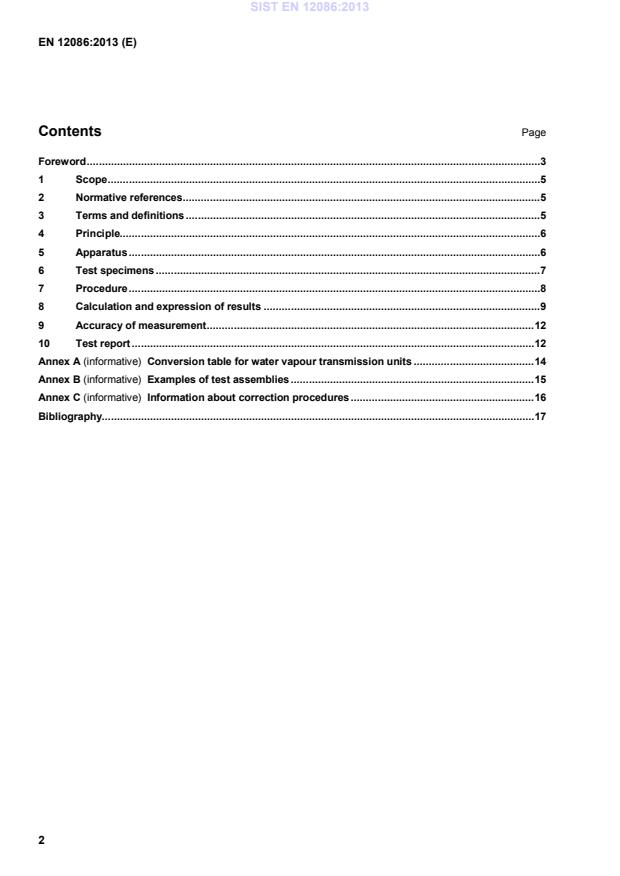
Conversion table for water vapour transmission units . 14 Annex B (informative)
Examples of test assemblies . 15 Annex C (informative)
Information about correction procedures . 16 Bibliography. 17
The revision of this standard contains no major changes, only minor corrections and clarifications of an editorial nature. This European Standard is one of a series of standards which specify test methods for determining dimensions and properties of thermal insulating materials and products. It supports a series of product standards for thermal insulating materials and products which derive from the Council Directive of 21 December 1988 on the approximation of laws, regulations and administrative provisions of the Member States relating to construction products (Directive 89/106/EEC) through the consideration of the essential requirements. This European Standard has been drafted for applications in buildings but it may also be used in other areas where it is relevant. This European test standard is one of the following group of inter-related standards on test methods for determining dimensions and properties of thermal insulation materials and products, all of which fall within the scope of CEN/TC 88: EN 822, Thermal insulating products for building applications — Determination of length and width EN 823, Thermal insulating products for building applications — Determination of thickness EN 824, Thermal insulating products for building applications — Determination of squareness EN 825, Thermal insulating products for building applications — Determination of flatness EN 826, Thermal insulating products for building applications — Determination of compression behaviour EN 1602, Thermal insulating products for building applications — Determination of the apparent density EN 1603, Thermal insulating products for building applications — Determination of dimensional stability under constant normal laboratory conditions (23 °C/50 % relative humidity) EN 1604, Thermal insulating products for building applications — Determination of dimensional stability under specified temperature and humidity conditions EN 1605, Thermal insulating products for building applications — Determination of deformation under specified compressive load and temperature conditions EN 1606, Thermal insulating products for building applications — Determination of compressive creep SIST EN 12086:2013
These dishes are typically made of glass or metal. The size of the dishes depends on the size of the test specimen to be tested. The difference in size between the upper exposed area (A1) and the lower exposed area (A2) of the test specimen shall be less than 3 % (see examples in Annex B). Some types of test dish are unsuitable for use with certain materials. This should be stated in the relevant product standard or any other European Technical Specification. 5.2 Measuring instruments, capable of determining linear dimensions in accordance with EN 12085. 5.3 Template (with edge tapered to facilitate removal after use) with a shape and size corresponding to that of the test dish to duplicate the exposed area of the specimen.
The template shall have an area that is at least 90 % of the test specimen's surface in order to limit the edge effect due to non-linear vapour flow (see Annex C). 5.4 Analytical balance, capable of weighing the test assembly to an accuracy of ± 1 mg or better.
If larger test assemblies are used, the weighing accuracy may be determined with respect to the total weight and the required accuracy of the test results. 5.5 Chamber, capable of being maintained within ± 3 % of the required relative humidity and within ± 1 °C of the required temperature. In order to
...