

EN 460:2023
(Main)Durability of wood and wood-based products - Guidance on performance
- Abstract
This document gives guidance on the selection of wood and wood-based products for use in situations where they can be subject to degradation by fungi, wood destroying insects or marine borers. This guidance includes information on factors that can influence the service life of a wood or wood-based product when considering biological degradation. In many end uses, design, workmanship and maintenance will also influence the service life of the wood or wood-based product.
This document is a step toward the evaluation of the service life of a wood product.
This document does not consider:
1) the durability characteristics of the glue used in wood-based products;
2) the aesthetic function of wood products (discoloration, surface weathering, mould).
- Status
- Published
- Publication Date
- 14-Feb-2023
- Technical Committee
- CEN/TC 38 - Durability of wood and derived materials
- Drafting Committee
- CEN/TC 38/WG 28 - Performance classification
- Current Stage
- 6060 - Definitive text made available (DAV) - Publishing
- Start Date
- 15-Feb-2023
- Due Date
- 21-Dec-2022
- Completion Date
- 15-Feb-2023
Buy Documents


Overview
EN 460:2023 - Durability of wood and wood-based products - Guidance on performance (CEN) provides guidance for selecting wood and wood-based products where biological degradation (fungi, wood‑destroying insects, marine borers) is a risk. The standard frames decisions about material selection, treatment and design by linking exposure, design life, and consequence of failure (COF) to help specify appropriate biological durability. EN 460:2023 is a practical step toward evaluating the service life of wood components in construction and related uses.
Key topics and requirements
- Scope and exclusions
- Applies to biological durability of wood and wood-based products; excludes glue durability and aesthetic issues (discoloration, surface weathering, mould).
- Decision framework
- Performance specification based on: (i) materials and exposure, (ii) stated design life, and (iii) COF (safety, economic or environmental impact).
- Exposure factors
- Climate, use class, micro‑climate, design, quality of installation, maintenance and usage all influence deterioration and service life.
- Materials and durability
- Differentiates natural durability (species inherent resistance) and conferred durability (preservative treatments, wood modification).
- Addresses material resistance and moisture dynamics as key determinants of biological performance.
- Service life concepts
- Defines design life, service life, limit state and likelihood of failure; links them to performance requirements rather than prescribing numerical service-life values.
- Biological hazards
- Guidance on durability needs versus fungi, beetles, termites, marine borers and combined hazards.
- Informative annexes
- Consequence of Failure (COF), guidance on durability classes by use class, and key factors relating expected service life to biological durability.
Practical applications and users
EN 460:2023 is targeted at professionals who must specify or assess wood performance against biological degradation, including:
- Architects, structural and façade designers
- Product manufacturers and preservative treatment providers
- Timber suppliers and specifiers (choice of species, heartwood selection)
- Building owners, facility managers and maintenance planners
- Certification bodies, testing laboratories and building regulators
Typical applications:
- Selecting timber species or treated products for exterior cladding, decking, structural members, marine structures and termite‑risk areas
- Integrating design measures (moisture control, detailing) with material selection to meet target service life
- Preparing performance specifications for procurement, compliance with Construction Products Regulation (CPR) and lifecycle planning
Related standards
- EN 1001-2 (Terminology)
- EN 1990 / EN 1995-1-1 (service life and structural design guidance)
- EN 15026 (hygrothermal simulations)
- CEN/TC 38 (technical committee responsible for durability of wood)
Keywords: EN 460:2023, durability of wood, biological durability, service life, use class, wood preservative, wood modification, moisture dynamics, CEN.
Relations
- Effective Date
- 19-Jan-2023
- Refers
EN 1001-2:2005 - Durability of wood and wood based products - Terminology - Part 2: Vocabulary - Effective Date
- 28-Jan-2026
- Effective Date
- 28-Jan-2026
- Effective Date
- 28-Jan-2026
- Effective Date
- 28-Jan-2026
- Effective Date
- 28-Jan-2026
- Effective Date
- 28-Jan-2026
- Effective Date
- 28-Jan-2026
- Effective Date
- 28-Jan-2026
- Effective Date
- 28-Jan-2026
- Effective Date
- 28-Jan-2026
- Effective Date
- 28-Jan-2026
- Effective Date
- 28-Jan-2026
- Referred By
EN 16927:2017 - Mini-pools - Specific requirements including safety and test methods for mini-pools - Effective Date
- 28-Jan-2026
Buy Documents
Get Certified
Connect with accredited certification bodies for this standard

Gozdarski inštitut Slovenije
Slovenian Forestry Institute. Forest management certification support, timber testing.
Sponsored listings
Frequently Asked Questions
EN 460:2023 is a standard published by the European Committee for Standardization (CEN). Its full title is "Durability of wood and wood-based products - Guidance on performance". This standard covers: This document gives guidance on the selection of wood and wood-based products for use in situations where they can be subject to degradation by fungi, wood destroying insects or marine borers. This guidance includes information on factors that can influence the service life of a wood or wood-based product when considering biological degradation. In many end uses, design, workmanship and maintenance will also influence the service life of the wood or wood-based product. This document is a step toward the evaluation of the service life of a wood product. This document does not consider: 1) the durability characteristics of the glue used in wood-based products; 2) the aesthetic function of wood products (discoloration, surface weathering, mould).
This document gives guidance on the selection of wood and wood-based products for use in situations where they can be subject to degradation by fungi, wood destroying insects or marine borers. This guidance includes information on factors that can influence the service life of a wood or wood-based product when considering biological degradation. In many end uses, design, workmanship and maintenance will also influence the service life of the wood or wood-based product. This document is a step toward the evaluation of the service life of a wood product. This document does not consider: 1) the durability characteristics of the glue used in wood-based products; 2) the aesthetic function of wood products (discoloration, surface weathering, mould).
EN 460:2023 is classified under the following ICS (International Classification for Standards) categories: 79.040 - Wood, sawlogs and sawn timber. The ICS classification helps identify the subject area and facilitates finding related standards.
EN 460:2023 has the following relationships with other standards: It is inter standard links to EN 460:1994, EN 1001-2:2005, EN 13964:2004, EN 16582-1:2015+A1:2021, EN 13629:2020, EN 14951:2006, EN 14220:2006, EN 16582-1:2015, EN 1995-1-1:2004, EN 13964:2014, EN 13629:2012, CEN/TR 16239:2011, CEN/TS 15679:2007, EN 16927:2017. Understanding these relationships helps ensure you are using the most current and applicable version of the standard.
EN 460:2023 is associated with the following European legislation: EU Directives/Regulations: 305/2011; Standardization Mandates: M/112. When a standard is cited in the Official Journal of the European Union, products manufactured in conformity with it benefit from a presumption of conformity with the essential requirements of the corresponding EU directive or regulation.
EN 460:2023 is available in PDF format for immediate download after purchase. The document can be added to your cart and obtained through the secure checkout process. Digital delivery ensures instant access to the complete standard document.
Standards Content (Sample)
SLOVENSKI STANDARD
01-junij-2023
Nadomešča:
SIST EN 460:1995
Odpornost lesa in lesnih proizvodov - Navodilo za učinkovitost
Durability of wood and wood-based products - Guidance on performance
Dauerhaftigkeit von Holz und Holzprodukten - Leitfaden zur Bestimmung der
Leistungsfähigkeit
Durabilité du bois et des matériaux à base de bois - Guide pour déterminer la
performance
Ta slovenski standard je istoveten z: EN 460:2023
ICS:
79.040 Les, hlodovina in žagan les Wood, sawlogs and sawn
timber
2003-01.Slovenski inštitut za standardizacijo. Razmnoževanje celote ali delov tega standarda ni dovoljeno.
EN 460
EUROPEAN STANDARD
NORME EUROPÉENNE
February 2023
EUROPÄISCHE NORM
ICS 79.040 Supersedes EN 460:1994
English Version
Durability of wood and wood-based products - Guidance
on performance
Durabilité du bois et des matériaux à base de bois - Dauerhaftigkeit von Holz und Holzprodukten -
Guide pour déterminer la performance Leitfaden zur Bestimmung der Leistungsfähigkeit
This European Standard was approved by CEN on 2 January 2023.
CEN members are bound to comply with the CEN/CENELEC Internal Regulations which stipulate the conditions for giving this
European Standard the status of a national standard without any alteration. Up-to-date lists and bibliographical references
concerning such national standards may be obtained on application to the CEN-CENELEC Management Centre or to any CEN
member.
This European Standard exists in three official versions (English, French, German). A version in any other language made by
translation under the responsibility of a CEN member into its own language and notified to the CEN-CENELEC Management
Centre has the same status as the official versions.
CEN members are the national standards bodies of Austria, Belgium, Bulgaria, Croatia, Cyprus, Czech Republic, Denmark, Estonia,
Finland, France, Germany, Greece, Hungary, Iceland, Ireland, Italy, Latvia, Lithuania, Luxembourg, Malta, Netherlands, Norway,
Poland, Portugal, Republic of North Macedonia, Romania, Serbia, Slovakia, Slovenia, Spain, Sweden, Switzerland, Türkiye and
United Kingdom.
EUROPEAN COMMITTEE FOR STANDARDIZATION
COMITÉ EUROPÉEN DE NORMALISATION
EUROPÄISCHES KOMITEE FÜR NORMUNG
CEN-CENELEC Management Centre: Rue de la Science 23, B-1040 Brussels
© 2023 CEN All rights of exploitation in any form and by any means reserved Ref. No. EN 460:2023 E
worldwide for CEN national Members.
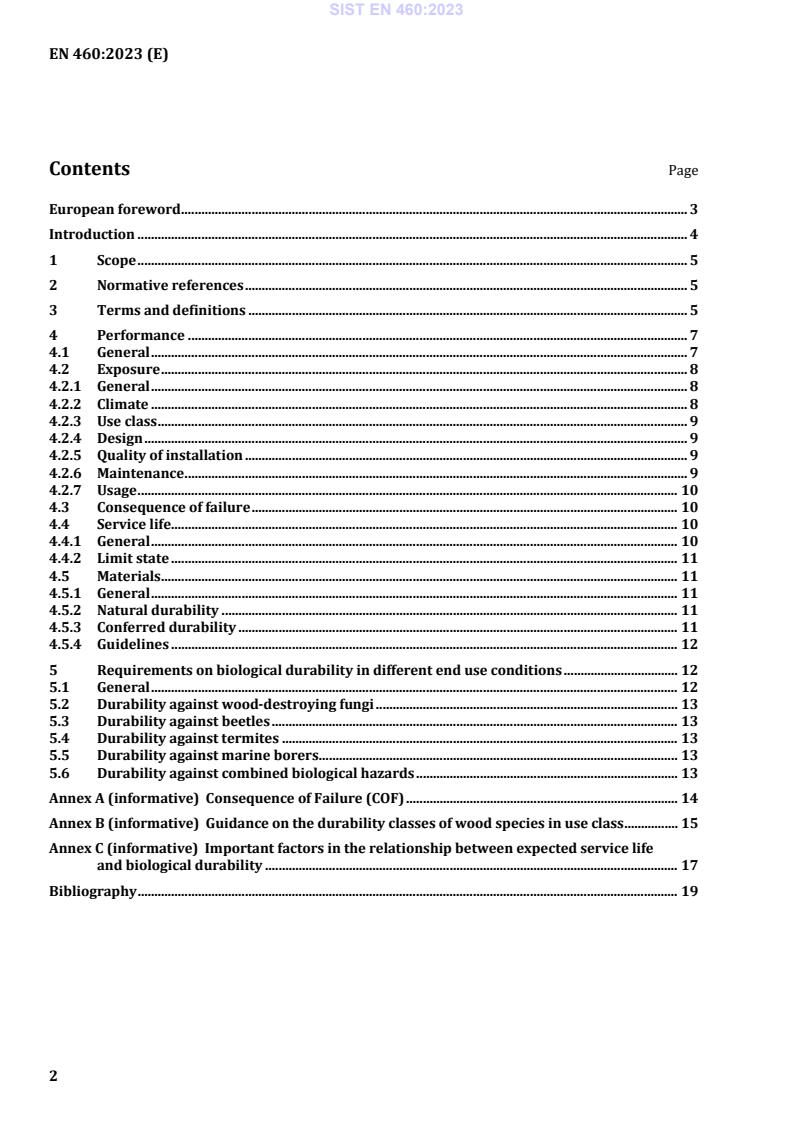
Contents Page
European foreword . 3
Introduction . 4
1 Scope . 5
2 Normative references . 5
3 Terms and definitions . 5
4 Performance . 7
4.1 General . 7
4.2 Exposure . 8
4.2.1 General . 8
4.2.2 Climate . 8
4.2.3 Use class . 9
4.2.4 Design . 9
4.2.5 Quality of installation . 9
4.2.6 Maintenance . 9
4.2.7 Usage . 10
4.3 Consequence of failure . 10
4.4 Service life . 10
4.4.1 General . 10
4.4.2 Limit state . 11
4.5 Materials . 11
4.5.1 General . 11
4.5.2 Natural durability . 11
4.5.3 Conferred durability . 11
4.5.4 Guidelines . 12
5 Requirements on biological durability in different end use conditions . 12
5.1 General . 12
5.2 Durability against wood-destroying fungi . 13
5.3 Durability against beetles . 13
5.4 Durability against termites . 13
5.5 Durability against marine borers . 13
5.6 Durability against combined biological hazards . 13
Annex A (informative) Consequence of Failure (COF) . 14
Annex B (informative) Guidance on the durability classes of wood species in use class . 15
Annex C (informative) Important factors in the relationship between expected service life
and biological durability . 17
Bibliography . 19
European foreword
This document (EN 460:2023) has been prepared by Technical Committee CEN/TC 38 “Durability of
wood and wood-based products”, the secretariat of which is held by SIS.
This European Standard shall be given the status of a national standard, either by publication of an
identical text or by endorsement, at the latest by August 2023, and conflicting national standards shall be
withdrawn at the latest by August 2023.
Attention is drawn to the possibility that some of the elements of this document may be the subject of
patent rights. CEN shall not be held responsible for identifying any or all such patent rights.
This document supersedes EN 460:1994.
— title change;
— the introduction of a decision process for performance specification of wood and wood-based
products based on (i) materials and exposure, (ii) presentation of design life and (iii) articulation of
consequence of failure.
This document has been prepared under a Standardization Request given to CEN by the European
Commission and the European Free Trade Association.
Any feedback and questions on this document should be directed to the users’ national standards body.
A complete listing of these bodies can be found on the CEN website.
According to the CEN-CENELEC Internal Regulations, the national standards organisations of the
following countries are bound to implement this European Standard: Austria, Belgium, Bulgaria, Croatia,
Cyprus, Czech Republic, Denmark, Estonia, Finland, France, Germany, Greece, Hungary, Iceland, Ireland,
Italy, Latvia, Lithuania, Luxembourg, Malta, Netherlands, Norway, Poland, Portugal, Republic of North
Macedonia, Romania, Serbia, Slovakia, Slovenia, Spain, Sweden, Switzerland, Türkiye and the United
Kingdom.
Introduction
There is increasing need to understand the service life of wood products, especially in construction.
Service life in the Construction Products Regulation (Regulation (EU) No 305/2011 (CPR) and its
equivalent in non-EU countries) can be understood as performance within an economically acceptable
period, under typical exposure and maintenance scenarios.
This document is concerned with the service life of wood materials and wood products, especially in
construction. The purpose of this document is to provide guidance to help the user to select a wood or
wood-based material based of appropriate biological durability based on information about the end use
environment and the target service life.
For the service life of structures, refer to EN 1990 and EN 1995-1-1.
1 Scope
This document gives guidance on the selection of wood and wood-based products for use in situations
where they can be subject to degradation by fungi, wood destroying insects or marine borers. This
guidance includes information on factors that can influence the service life of a wood or wood-based
product when considering biological degradation. In many end uses, design, workmanship and
maintenance will also influence the service life of the wood or wood-based product.
This document is a step toward the evaluation of the service life of a wood product.
This document does not consider:
1) the durability characteristics of the glue used in wood-based products;
2) the aesthetic function of wood products (discoloration, surface weathering, mould).
2 Normative references
The following documents are referred to in the text in such a way that some or all of their content
constitutes requirements of this document. For dated references, only the edition cited applies. For
undated references, the latest edition of the referenced document (including any amendments) applies.
EN 1001-2, Durability of wood and wood based products — Terminology — Part 2: Vocabulary
3 Terms and definitions
For the purposes of this document, the terms and definitions given in EN 1001-2 and the following apply.
ISO and IEC maintain terminology databases for use in standardization at the following addresses:
• ISO Online browsing platform: available at https://www.iso.org/obp
• IEC Electropedia: available at https://www.electropedia.org/
3.1
biological durability
inherent resistance of a wood species or a wood-based material against wood-destroying organisms
Note 1 to entry: This can be a natural or a conferred durability.
3.2
coating
product, normally applied in a liquid form to a surface, that forms a film possessing protective properties
3.3
component
product manufactured as a distinct unit to serve a specific function or functions
3.4
conferred durability
improved resistance of a wood species to biological degradants provided by a treatment process
(chemical, physical, etc.) such as wood preservation or wood modification
3.5
consequence of failure (COF)
significance of product failure in service determined by the outcome of a failure expressed in terms of
personnel safety, economic loss, and/or damage to the environment
3.6
critical biological hazard
biological hazard (or hazards) most significant in the end use application and its geographical location
3.7
design life
service life intended by the designer
3.8
likelihood of failure
probability that a wood component will reach its limit state within the design life
3.9
limit state
state beyond which the structure (or product) no longer satisfies the relevant design criteria
[SOURCE : EN 1990:2002, Clause 3.1.2.14 (CEN/TC250/SC10 N 523)]
Note 1 to entry: The limit state is commonly reached before loss of function is complete.
3.10
material resistance
inherent ability of a material to endure a specific biological hazard through a combination of natural
and/or conferred durability and moisture dynamic behaviour relevant for the different biological agents
3.11
moisture dynamics
physical characteristic of a wood material or wood product to respond to changing environmental
conditions and take up and release moisture (vapour or liquid)
Note 1 to entry: The moisture dynamics of a wood species or a wood-based material can be tested using the
method described in CEN/TS 16818.
3.12
natural durability
inherent resistance of a wood species to attack by wood-destroying organisms
3.13
overlay
one or more sheets or films, for example impregnated paper, plastics, resin film, metal that protect a wood
surface
3.14
performance
ability of a wood species or a wood-based material to withstand deterioration over time and fulfil
essential functions
3.15
permeability to water
ease with which water penetrates a wood-based matrix (wood of a particular species, wood-based
material)
3.16
service life
period of time after installation during which a building, structure or component parts meet or exceed
the performance requirements
Note 1 to entry: This standard does not consider the service life of entire structures, it is limited to the properties
of the material and service life of components.
3.17
serviceability
ability of a structure or structural member to satisfy, with planned maintenance, its design performance
requirements over the design service life
[SOURCE : EN 1990:2002, Clause 3.1.2.3 (CEN/TC 250/SC 10 N 523)]
3.18
wood modification
non-biocidal process of a chemical, biological, or physical alteration of the cell wall substance of wood,
resulting in a permanent desired property enhancement to primarily enhance biological durability and
dimensional stability
Note 1 to entry: This includes thermal modification and chemical modification.
3.19
wood preservative treatment
application of wood preservative products in liquid form for the preventive treatment of wood resulting
in a desired improvement of their properties in order to protect them from degradation by wood
destroying fungi, wood-destroying insects (termites and beetles) or marine borers
Note 1 to entry: The usual processes are superficial (soaking or spraying) or penetrating treatment (double
vacuum autoclave or vacuum autoclave and pressure).
4 Performance
4.1 General
When wood-destroying organisms are likely to degrade wood in service, a suitable approach for meeting
service life needs to be selected. There are two principal approaches:
1) by design - changing the habitat conditions e.g. with wood destroying fungi minimizing the moisture
risk to which the wooden component is exposed or e.g. with insects by denying the access through
construction measures;
2) by durability - either select the heartwood of a wood species of sufficient natural durability or ensure
sufficient conferred durability by treatment with a wood preservative, wood modification or non-
biocidal treatment to manage the challenge presented in the use environment.
Typically, it is a combination of both.
This standard provides information to aid the user in the choice of a wood or wood-based material for a
product, knowing its use class with the corresponding end use environment and the envisioned target
service life. No attempt has been made to quantify the service life that could be expected from a particular
combination. This is considered in national interpretation documents e.g. standards, guidelines, technical
reports and service life prediction tools.
A schematic diagram to illustrate a decision-making process for determining the performance of a wood
product is shown in Figure 1. The features defining the exposure of a material or product are
multifaceted. Considered together, the exposure and the service life requirement for the product is the
framework for identifying suitable wood and wood-based materials to meet these requirements.
Figure 1 — Schematic illustration of a decision process for performance specification linked to
clauses in this document
4.2 Exposure
4.2.1 General
The exposure is the challenge presented to the wood material or product and comprises many features.
The performance of each component will deteriorate or improve at a rate depending on climate, use class,
design, quality of installation, maintenance and usage.
4.2.2 Climate
The geographical location indicates the local climate and most significantly for wood products in UC 3
(e.g. exterior wood cladding) the moisture availability, as well as solar UV radiation, which can impact on
the rate of deterioration. The geographical location also determines whether biological hazards are likely
to be present or not (e.g. termites).
Furthermore, consideration should be given to the micro-climate in service (e.g. accumulation of
condensation under a waterproof roof covering). The possibility to estimate the moisture situation (e.g.
hygrothermal simulations) should follow EN 15026.
4.2.3 Use class
The service situations in which wood is exposed to different environments and the corresponding
likelihood of susceptibility to biological degradation have been divided into use classes which are defined
in EN 335. Guidance on the application of these use classes to solid wood is given in EN 335. (See
ISO 15686-8:2008, Annex A, Clauses A.1.5 Factor D – Factor category – indoor environment and A.1.6
Factor E — Factor category: outdoor environment).
4.2.4 Design
The design detailing and workmanship of the wood material in a component has a significant impact on
the performance of the component. Poor design features that enable water trapping increase exposure
and can accelerate degradation whilst good design that excludes moisture ingress and/or easily allows
redrying during the service life of the component can reduce exposure and avoid degradation. National
guidelines for product categories should be referred to for best practice design features. (See
ISO 15686-8:2008, Annex A, Clause A.1.3 Factor B — Factor category: design level).
Enhancing performance by design means taking planning, constructive, building physics and
organizational measures which prevent or limit a reduction in the functionality of wood and wood-based
materials, especially by fungi, insects or marine borers during their service life, and also prevent damage
from excessive swelling and shrinkage of the wood and wood-based materials.
Some of these measures are enshrined in national building guidelines. These measures include restricton
or limitation of access of humidity, insects or marine borers to wood and wood-based materials e.g. by
covering or coating, calculations or simulations of moisture subject to climate conditions and protection
against undesirable changes in the moisture content of the materials during storage, transport, assembly
and installation.
In many cases, the desired performance of any measures adopted can only be ensured if the measures
and the wood component are maintained to an appropriate level (4.2.6).
4.2.5 Quality of installation
The activity of installing a wood product into service is known to have an impact on performance and
national best practice construction site guidance should be available. (See ISO 15686-8:2008, Annex A,
Clause A.1.4 Factor C — Factor category: work execution level).
4.2.6 Maintenance
Maintenance is the combination of technical, administrative and organizational measures during the
service life of an object, which serve to maintain or restore its functional condition so that it can fulfil the
required function. In many end uses, maintenance can significantly extend service life. Statements
concerning service life or requirements of durability for wood materials and wood products can only be
based on maintained buildings.
Basic measures of maintenance are regular servicing (e.g. cleaning of surfaces and gutters), inspection,
repair and improvement. A typical maintenance schedule, depending on the exposure and the actual
component, could be:
— servicing and cleaning in specific intervals depending on 4.2.2, 4.2.3, 4.2.4, 4.2.7 and Annex A;
— inspection by the user or owner when servicing and cleaning;
— professional inspection in specific intervals depending on 4.2.2, 4.2.3, 4.2.4, 4.2.7 and Annex A;
— repair following inspection, e.g. for an exterior wood coating this might be a 5 year (2-7 years
depending on exposure) redecoration cycle;
— improvement whenever necessary.
Regular inspection of wooden components can lead to the early detection of any detrimental changes,
damage or consequential damage. The earlier changes or damage are detected, the lower the effort
required to repair consequential damage and the lower the cost of repairs or other conservation
measures.
Servicing includes maintaining the functionality of system parts, built-in parts and components, such as
coatings, drainage devices, ventilation, covers and enclosures. Servicing also includes the removal of dirt
deposits, growth of plants, moss and algae that can cause detrimental wetting of the wooden component.
Products in exterior use that are coated require coatings to be maintained to continue to provide a
protective effect to the wood material used in the product. The coating reduces the exposure of the wood
material and delays or avoids degradation. Poorly maintained coatings can exacerbate moisture risk
through water trapping. (See ISO 15686-8:2008, Annex A, Clause A.1.8 Factor G — Factor category:
maintenance level).
4.2.7 Usage
The operation of the building or asset can impact on performance (e.g. a vacant, unheated house can have
moisture and maintenance issues). (See ISO 15686-8:2008, Annex A, Clause A.1.7 Factor F — Factor
category: usage conditions).
4.3 Consequence of failure
Consequence of failure (COF) i
...
SLOVENSKI STANDARD
01-junij-2023
Nadomešča:
SIST EN 460:1995
Trajnost lesa in lesnih proizvodov - Navodilo za učinkovitost
Durability of wood and wood-based products - Guidance on performance
Dauerhaftigkeit von Holz und Holzprodukten - Leitfaden zur Bestimmung der
Leistungsfähigkeit
Durabilité du bois et des matériaux à base de bois - Guide pour déterminer la
performance
Ta slovenski standard je istoveten z: EN 460:2023
ICS:
79.040 Les, hlodovina in žagan les Wood, sawlogs and sawn
timber
2003-01.Slovenski inštitut za standardizacijo. Razmnoževanje celote ali delov tega standarda ni dovoljeno.
EN 460
EUROPEAN STANDARD
NORME EUROPÉENNE
February 2023
EUROPÄISCHE NORM
ICS 79.040 Supersedes EN 460:1994
English Version
Durability of wood and wood-based products - Guidance
on performance
Durabilité du bois et des matériaux à base de bois - Dauerhaftigkeit von Holz und Holzprodukten -
Guide pour déterminer la performance Leitfaden zur Bestimmung der Leistungsfähigkeit
This European Standard was approved by CEN on 2 January 2023.
CEN members are bound to comply with the CEN/CENELEC Internal Regulations which stipulate the conditions for giving this
European Standard the status of a national standard without any alteration. Up-to-date lists and bibliographical references
concerning such national standards may be obtained on application to the CEN-CENELEC Management Centre or to any CEN
member.
This European Standard exists in three official versions (English, French, German). A version in any other language made by
translation under the responsibility of a CEN member into its own language and notified to the CEN-CENELEC Management
Centre has the same status as the official versions.
CEN members are the national standards bodies of Austria, Belgium, Bulgaria, Croatia, Cyprus, Czech Republic, Denmark, Estonia,
Finland, France, Germany, Greece, Hungary, Iceland, Ireland, Italy, Latvia, Lithuania, Luxembourg, Malta, Netherlands, Norway,
Poland, Portugal, Republic of North Macedonia, Romania, Serbia, Slovakia, Slovenia, Spain, Sweden, Switzerland, Türkiye and
United Kingdom.
EUROPEAN COMMITTEE FOR STANDARDIZATION
COMITÉ EUROPÉEN DE NORMALISATION
EUROPÄISCHES KOMITEE FÜR NORMUNG
CEN-CENELEC Management Centre: Rue de la Science 23, B-1040 Brussels
© 2023 CEN All rights of exploitation in any form and by any means reserved Ref. No. EN 460:2023 E
worldwide for CEN national Members.
Contents Page
European foreword . 3
Introduction . 4
1 Scope . 5
2 Normative references . 5
3 Terms and definitions . 5
4 Performance . 7
4.1 General . 7
4.2 Exposure . 8
4.2.1 General . 8
4.2.2 Climate . 8
4.2.3 Use class . 9
4.2.4 Design . 9
4.2.5 Quality of installation . 9
4.2.6 Maintenance . 9
4.2.7 Usage . 10
4.3 Consequence of failure . 10
4.4 Service life . 10
4.4.1 General . 10
4.4.2 Limit state . 11
4.5 Materials . 11
4.5.1 General . 11
4.5.2 Natural durability . 11
4.5.3 Conferred durability . 11
4.5.4 Guidelines . 12
5 Requirements on biological durability in different end use conditions . 12
5.1 General . 12
5.2 Durability against wood-destroying fungi . 13
5.3 Durability against beetles . 13
5.4 Durability against termites . 13
5.5 Durability against marine borers . 13
5.6 Durability against combined biological hazards . 13
Annex A (informative) Consequence of Failure (COF) . 14
Annex B (informative) Guidance on the durability classes of wood species in use class . 15
Annex C (informative) Important factors in the relationship between expected service life
and biological durability . 17
Bibliography . 19
European foreword
This document (EN 460:2023) has been prepared by Technical Committee CEN/TC 38 “Durability of
wood and wood-based products”, the secretariat of which is held by SIS.
This European Standard shall be given the status of a national standard, either by publication of an
identical text or by endorsement, at the latest by August 2023, and conflicting national standards shall be
withdrawn at the latest by August 2023.
Attention is drawn to the possibility that some of the elements of this document may be the subject of
patent rights. CEN shall not be held responsible for identifying any or all such patent rights.
This document supersedes EN 460:1994.
— title change;
— the introduction of a decision process for performance specification of wood and wood-based
products based on (i) materials and exposure, (ii) presentation of design life and (iii) articulation of
consequence of failure.
This document has been prepared under a Standardization Request given to CEN by the European
Commission and the European Free Trade Association.
Any feedback and questions on this document should be directed to the users’ national standards body.
A complete listing of these bodies can be found on the CEN website.
According to the CEN-CENELEC Internal Regulations, the national standards organisations of the
following countries are bound to implement this European Standard: Austria, Belgium, Bulgaria, Croatia,
Cyprus, Czech Republic, Denmark, Estonia, Finland, France, Germany, Greece, Hungary, Iceland, Ireland,
Italy, Latvia, Lithuania, Luxembourg, Malta, Netherlands, Norway, Poland, Portugal, Republic of North
Macedonia, Romania, Serbia, Slovakia, Slovenia, Spain, Sweden, Switzerland, Türkiye and the United
Kingdom.
Introduction
There is increasing need to understand the service life of wood products, especially in construction.
Service life in the Construction Products Regulation (Regulation (EU) No 305/2011 (CPR) and its
equivalent in non-EU countries) can be understood as performance within an economically acceptable
period, under typical exposure and maintenance scenarios.
This document is concerned with the service life of wood materials and wood products, especially in
construction. The purpose of this document is to provide guidance to help the user to select a wood or
wood-based material based of appropriate biological durability based on information about the end use
environment and the target service life.
For the service life of structures, refer to EN 1990 and EN 1995-1-1.
1 Scope
This document gives guidance on the selection of wood and wood-based products for use in situations
where they can be subject to degradation by fungi, wood destroying insects or marine borers. This
guidance includes information on factors that can influence the service life of a wood or wood-based
product when considering biological degradation. In many end uses, design, workmanship and
maintenance will also influence the service life of the wood or wood-based product.
This document is a step toward the evaluation of the service life of a wood product.
This document does not consider:
1) the durability characteristics of the glue used in wood-based products;
2) the aesthetic function of wood products (discoloration, surface weathering, mould).
2 Normative references
The following documents are referred to in the text in such a way that some or all of their content
constitutes requirements of this document. For dated references, only the edition cited applies. For
undated references, the latest edition of the referenced document (including any amendments) applies.
EN 1001-2, Durability of wood and wood based products — Terminology — Part 2: Vocabulary
3 Terms and definitions
For the purposes of this document, the terms and definitions given in EN 1001-2 and the following apply.
ISO and IEC maintain terminology databases for use in standardization at the following addresses:
• ISO Online browsing platform: available at https://www.iso.org/obp
• IEC Electropedia: available at https://www.electropedia.org/
3.1
biological durability
inherent resistance of a wood species or a wood-based material against wood-destroying organisms
Note 1 to entry: This can be a natural or a conferred durability.
3.2
coating
product, normally applied in a liquid form to a surface, that forms a film possessing protective properties
3.3
component
product manufactured as a distinct unit to serve a specific function or functions
3.4
conferred durability
improved resistance of a wood species to biological degradants provided by a treatment process
(chemical, physical, etc.) such as wood preservation or wood modification
3.5
consequence of failure (COF)
significance of product failure in service determined by the outcome of a failure expressed in terms of
personnel safety, economic loss, and/or damage to the environment
3.6
critical biological hazard
biological hazard (or hazards) most significant in the end use application and its geographical location
3.7
design life
service life intended by the designer
3.8
likelihood of failure
probability that a wood component will reach its limit state within the design life
3.9
limit state
state beyond which the structure (or product) no longer satisfies the relevant design criteria
[SOURCE : EN 1990:2002, Clause 3.1.2.14 (CEN/TC250/SC10 N 523)]
Note 1 to entry: The limit state is commonly reached before loss of function is complete.
3.10
material resistance
inherent ability of a material to endure a specific biological hazard through a combination of natural
and/or conferred durability and moisture dynamic behaviour relevant for the different biological agents
3.11
moisture dynamics
physical characteristic of a wood material or wood product to respond to changing environmental
conditions and take up and release moisture (vapour or liquid)
Note 1 to entry: The moisture dynamics of a wood species or a wood-based material can be tested using the
method described in CEN/TS 16818.
3.12
natural durability
inherent resistance of a wood species to attack by wood-destroying organisms
3.13
overlay
one or more sheets or films, for example impregnated paper, plastics, resin film, metal that protect a wood
surface
3.14
performance
ability of a wood species or a wood-based material to withstand deterioration over time and fulfil
essential functions
3.15
permeability to water
ease with which water penetrates a wood-based matrix (wood of a particular species, wood-based
material)
3.16
service life
period of time after installation during which a building, structure or component parts meet or exceed
the performance requirements
Note 1 to entry: This standard does not consider the service life of entire structures, it is limited to the properties
of the material and service life of components.
3.17
serviceability
ability of a structure or structural member to satisfy, with planned maintenance, its design performance
requirements over the design service life
[SOURCE : EN 1990:2002, Clause 3.1.2.3 (CEN/TC 250/SC 10 N 523)]
3.18
wood modification
non-biocidal process of a chemical, biological, or physical alteration of the cell wall substance of wood,
resulting in a permanent desired property enhancement to primarily enhance biological durability and
dimensional stability
Note 1 to entry: This includes thermal modification and chemical modification.
3.19
wood preservative treatment
application of wood preservative products in liquid form for the preventive treatment of wood resulting
in a desired improvement of their properties in order to protect them from degradation by wood
destroying fungi, wood-destroying insects (termites and beetles) or marine borers
Note 1 to entry: The usual processes are superficial (soaking or spraying) or penetrating treatment (double
vacuum autoclave or vacuum autoclave and pressure).
4 Performance
4.1 General
When wood-destroying organisms are likely to degrade wood in service, a suitable approach for meeting
service life needs to be selected. There are two principal approaches:
1) by design - changing the habitat conditions e.g. with wood destroying fungi minimizing the moisture
risk to which the wooden component is exposed or e.g. with insects by denying the access through
construction measures;
2) by durability - either select the heartwood of a wood species of sufficient natural durability or ensure
sufficient conferred durability by treatment with a wood preservative, wood modification or non-
biocidal treatment to manage the challenge presented in the use environment.
Typically, it is a combination of both.
This standard provides information to aid the user in the choice of a wood or wood-based material for a
product, knowing its use class with the corresponding end use environment and the envisioned target
service life. No attempt has been made to quantify the service life that could be expected from a particular
combination. This is considered in national interpretation documents e.g. standards, guidelines, technical
reports and service life prediction tools.
A schematic diagram to illustrate a decision-making process for determining the performance of a wood
product is shown in Figure 1. The features defining the exposure of a material or product are
multifaceted. Considered together, the exposure and the service life requirement for the product is the
framework for identifying suitable wood and wood-based materials to meet these requirements.
Figure 1 — Schematic illustration of a decision process for performance specification linked to
clauses in this document
4.2 Exposure
4.2.1 General
The exposure is the challenge presented to the wood material or product and comprises many features.
The performance of each component will deteriorate or improve at a rate depending on climate, use class,
design, quality of installation, maintenance and usage.
4.2.2 Climate
The geographical location indicates the local climate and most significantly for wood products in UC 3
(e.g. exterior wood cladding) the moisture availability, as well as solar UV radiation, which can impact on
the rate of deterioration. The geographical location also determines whether biological hazards are likely
to be present or not (e.g. termites).
Furthermore, consideration should be given to the micro-climate in service (e.g. accumulation of
condensation under a waterproof roof covering). The possibility to estimate the moisture situation (e.g.
hygrothermal simulations) should follow EN 15026.
4.2.3 Use class
The service situations in which wood is exposed to different environments and the corresponding
likelihood of susceptibility to biological degradation have been divided into use classes which are defined
in EN 335. Guidance on the application of these use classes to solid wood is given in EN 335. (See
ISO 15686-8:2008, Annex A, Clauses A.1.5 Factor D – Factor category – indoor environment and A.1.6
Factor E — Factor category: outdoor environment).
4.2.4 Design
The design detailing and workmanship of the wood material in a component has a significant impact on
the performance of the component. Poor design features that enable water trapping increase exposure
and can accelerate degradation whilst good design that excludes moisture ingress and/or easily allows
redrying during the service life of the component can reduce exposure and avoid degradation. National
guidelines for product categories should be referred to for best practice design features. (See
ISO 15686-8:2008, Annex A, Clause A.1.3 Factor B — Factor category: design level).
Enhancing performance by design means taking planning, constructive, building physics and
organizational measures which prevent or limit a reduction in the functionality of wood and wood-based
materials, especially by fungi, insects or marine borers during their service life, and also prevent damage
from excessive swelling and shrinkage of the wood and wood-based materials.
Some of these measures are enshrined in national building guidelines. These measures include restricton
or limitation of access of humidity, insects or marine borers to wood and wood-based materials e.g. by
covering or coating, calculations or simulations of moisture subject to climate conditions and protection
against undesirable changes in the moisture content of the materials during storage, transport, assembly
and installation.
In many cases, the desired performance of any measures adopted can only be ensured if the measures
and the wood component are maintained to an appropriate level (4.2.6).
4.2.5 Quality of installation
The activity of installing a wood product into service is known to have an impact on performance and
national best practice construction site guidance should be available. (See ISO 15686-8:2008, Annex A,
Clause A.1.4 Factor C — Factor category: work execution level).
4.2.6 Maintenance
Maintenance is the combination of technical, administrative and organizational measures during the
service life of an object, which serve to maintain or restore its functional condition so that it can fulfil the
required function. In many end uses, maintenance can significantly extend service life. Statements
concerning service life or requirements of durability for wood materials and wood products can only be
based on maintained buildings.
Basic measures of maintenance are regular servicing (e.g. cleaning of surfaces and gutters), inspection,
repair and improvement. A typical maintenance schedule, depending on the exposure and the actual
component, could be:
— servicing and cleaning in specific intervals depending on 4.2.2, 4.2.3, 4.2.4, 4.2.7 and Annex A;
— inspection by the user or owner when servicing and cleaning;
— professional inspection in specific intervals depending on 4.2.2, 4.2.3, 4.2.4, 4.2.7 and Annex A;
— repair following inspection, e.g. for an exterior wood coating this might be a 5 year (2-7 years
depending on exposure) redecoration cycle;
— improvement whenever necessary.
Regular inspection of wooden components can lead to the early detection of any detrimental changes,
damage or consequential damage. The earlier changes or damage are detected, the lower the effort
required to repair consequential damage and the lower the cost of repairs or other conservation
measures.
Servicing includes maintaining the functionality of system parts, built-in parts and components, such as
coatings, drainage devices, ventilation, covers and enclosures. Servicing also includes the removal of dirt
deposits, growth of plants, moss and algae that can cause detrimental wetting of the wooden component.
Products in exterior use that are coated require coatings to be maintained to continue to provide a
protective effect to the wood material used in the product. The coating reduces the exposure of the wood
material and delays or avoids degradation. Poorly maintained coatings can exacerbate moisture risk
through water trapping. (See ISO 15686-8:2008, Annex A, Clause A.1.8 Factor G — Factor category:
maintenance level).
4.2.7 Usage
The operation of the building or asset can impact on performance (e.g. a vacant, unheated house can have
moisture and maintenance issues). (See ISO 15686-8:2008, Annex A, Clause A.1.7 Factor F — Factor
category: usage conditions).
4.3 Consequence of failure
Consequence of failure (COF) is
...