

EN 13631-16:2004
(Main)Explosives for civil uses - High explosives - Part 16: Detection and measurement of toxic gases
General Information
- Abstract
This document specifies a method for determination of the quantity of nitrogen oxides and carbon oxides produced by the detonation of explosives for use in underground works.
- Status
- Published
- Publication Date
- 17-Aug-2004
- Withdrawal Date
- 27-Feb-2005
- Technical Committee
- CEN/TC 321 - Explosives for civil uses
- Drafting Committee
- CEN/TC 321/WG 2 - High Explosives
- Current Stage
- 9093 - Decision to confirm - Review Enquiry
- Start Date
- 30-Jul-2015
- Completion Date
- 30-Sep-2026
- Directive
- 2014/28/EU - Directive 2014/28/EU of the European Parliament and of the Council of 26 February 2014 on the harmonisation of the laws of the Member States relating to the making available on the market and supervision of explosives for civil usesOJ Ref: C 118, C 118/2 OJ Date: 12-Apr-2017
93/15/EEC - Explosives for civil usesOJ Ref: C 219, C 70, C 90 OJ Date: 22-Mar-2005



Overview
EN 13631-16:2004 is a European standard developed by CEN, titled Explosives for civil uses – High explosives – Part 16: Detection and measurement of toxic gases. This standard outlines a precise and reproducible methodology for determining the quantities of nitrogen oxides (NO, NO₂) and carbon oxides (CO, CO₂) generated by detonating high explosives in underground environments. It plays a significant role in ensuring the safety of workers, environmental protection, and regulatory compliance within civil engineering and mining operations that utilize high explosives.
Key Topics
- Measurement of Toxic Gases: EN 13631-16:2004 specifies procedures to detect and quantify toxic gases, focusing on nitrous and carbon oxides released during detonation.
- Testing Apparatus Requirements:
- Detailed design criteria for blast chambers, including minimum volume and safety measures.
- Specifications for analysis equipment capable of real-time toxic gas monitoring.
- Guidelines for gas extraction and sampling equipment to ensure reliable data.
- Test Methods:
- Steps for sample preparation, detonation, and gas measurement.
- Requirements for test piece dimensions and placement.
- Procedures for calculating the amount of generated toxic gases in terms of liters per kilogram of explosive.
- Test Reporting: Instructions for documenting results, including referencing the standard, recording explosive charges, gas concentrations, apparatus used, and data on each test run.
Applications
EN 13631-16:2004 is applied in several areas associated with the civil use of explosives, particularly where underground work is involved:
- Civil Engineering and Mining: Assists operators in assessing and controlling toxic gas emissions during tunneling, shaft sinking, and similar works, promoting the health and safety of personnel.
- Explosives Manufacturing: Enables manufacturers to provide verified data on the toxic gas emissions of their products, aiding compliance with EU regulations and industry best practices.
- Regulatory Compliance: Supports adherence to health, safety, and environmental protection regulations, specifically aligning with requirements of EU Directive 93/15 EEC.
- Testing and Certification: Serves as a basis for laboratory analysis and certification of explosives, ensuring a standardized approach to safety assessments.
Related Standards
EN 13631-16:2004 is part of the comprehensive EN 13631 series concerning civil use of high explosives. Closely related standards include:
- EN 13631-1: Requirements for high explosives.
- EN 13631-10: Verification of means of initiation.
- EN ISO/IEC 17025: Quality and competence requirements for testing and calibration laboratories.
- EN 13857-1: Terminology relevant to explosives for civil use.
Together, these standards provide a complete framework for the safe, responsible, and effective deployment of high explosives within civil and mining sectors.
Keywords: EN 13631-16, explosives for civil uses, high explosives, toxic gas measurement, nitrogen oxides, carbon oxides, underground works, CEN standard, EU Directive 93/15 EEC, occupational safety, explosive testing, gas emission monitoring, environmental compliance.
Relations
- Effective Date
- 28-Jan-2026
- Effective Date
- 28-Jan-2026
- Effective Date
- 28-Jan-2026
- Effective Date
- 28-Jan-2026
Get Certified
Connect with accredited certification bodies for this standard

ECOCERT
Organic and sustainability certification.

Eurofins Food Testing Global
Global leader in food, environment, and pharmaceutical product testing.

Intertek Bangladesh
Intertek certification and testing services in Bangladesh.
Sponsored listings
Frequently Asked Questions
EN 13631-16:2004 is a standard published by the European Committee for Standardization (CEN). Its full title is "Explosives for civil uses - High explosives - Part 16: Detection and measurement of toxic gases". This standard covers: This document specifies a method for determination of the quantity of nitrogen oxides and carbon oxides produced by the detonation of explosives for use in underground works.
This document specifies a method for determination of the quantity of nitrogen oxides and carbon oxides produced by the detonation of explosives for use in underground works.
EN 13631-16:2004 is classified under the following ICS (International Classification for Standards) categories: 71.100.30 - Explosives. Pyrotechnics and fireworks. The ICS classification helps identify the subject area and facilitates finding related standards.
EN 13631-16:2004 has the following relationships with other standards: It is inter standard links to EN ISO/IEC 17025:2017, EN 13857-1:2003, EN 13631-10:2025, EN 13631-1:2005. Understanding these relationships helps ensure you are using the most current and applicable version of the standard.
EN 13631-16:2004 is associated with the following European legislation: EU Directives/Regulations: 2014/28/EU, 93/15/EEC; Standardization Mandates: M/055. When a standard is cited in the Official Journal of the European Union, products manufactured in conformity with it benefit from a presumption of conformity with the essential requirements of the corresponding EU directive or regulation.
EN 13631-16:2004 is available in PDF format for immediate download after purchase. The document can be added to your cart and obtained through the secure checkout process. Digital delivery ensures instant access to the complete standard document.
Standards Content (Sample)
2003-01.Slovenski inštitut za standardizacijo. Razmnoževanje celote ali delov tega standarda ni dovoljeno.Explosives for civil uses - High explosives - Part 16: Detection and measurement of toxic gasesEksplozivi za civilno uporabo – Razstreliva – 16. del: Odkrivanje in merjenje strupenih plinovExplosifs a usage civil - Explosifs - Partie 16: Détection et mesurage des gaz toxiquesExplosivstoffe für zivile Zwecke - Sprengstoffe - Teil 16: Nachweis und Messung von toxischen SchwadenbestandteilenTa slovenski standard je istoveten z:EN 13631-16:2004SIST EN 13631-16:2004en71.100.30ICS:SLOVENSKI
STANDARDSIST EN 13631-16:200401-november-2004
EUROPEAN STANDARDNORME EUROPÉENNEEUROPÄISCHE NORMEN 13631-16August 2004ICS 71.100.30English versionExplosives for civil uses - High explosives - Part 16: Detectionand measurement of toxic gasesExplosifs à usage civil - Explosifs - Partie 16: Détection etmesure des gaz toxiques az toxiquesExplosivstoffe für zivile Zwecke - Sprengstoffe - Teil 16:Nachweis und Messung von toxischenSchwadenbestandteilenThis European Standard was approved by CEN on 21 June 2004.CEN members are bound to comply with the CEN/CENELEC Internal Regulations which stipulate the conditions for giving this EuropeanStandard the status of a national standard without any alteration. Up-to-date lists and bibliographical references concerning such nationalstandards may be obtained on application to the Central Secretariat or to any CEN member.This European Standard exists in three official versions (English, French, German). A version in any other language made by translationunder the responsibility of a CEN member into its own language and notified to the Central Secretariat has the same status as the officialversions.CEN members are the national standards bodies of Austria, Belgium, Cyprus, Czech Republic, Denmark, Estonia, Finland, France,Germany, Greece, Hungary, Iceland, Ireland, Italy, Latvia, Lithuania, Luxembourg, Malta, Netherlands, Norway, Poland, Portugal, Slovakia,Slovenia, Spain, Sweden, Switzerland and United Kingdom.EUROPEAN COMMITTEE FOR STANDARDIZATIONCOMITÉ EUROPÉEN DE NORMALISATIONEUROPÄISCHES KOMITEE FÜR NORMUNGManagement Centre: rue de Stassart, 36
B-1050 Brussels© 2004 CENAll rights of exploitation in any form and by any means reservedworldwide for CEN national Members.Ref. No. EN 13631-16:2004: E
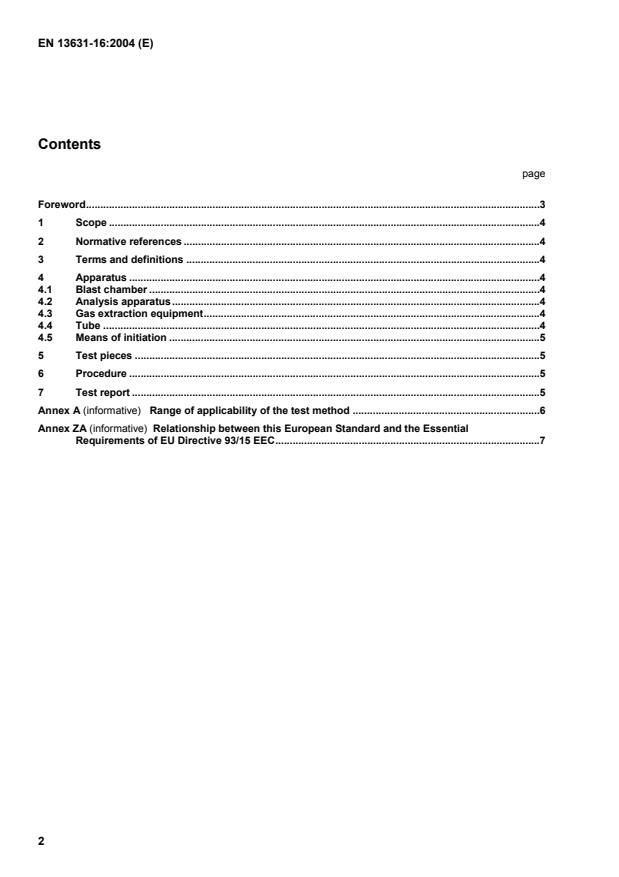
Range of applicability of the test method.6 Annex ZA (informative)
Relationship between this European Standard and the Essential Requirements of EU Directive 93/15 EEC.7
Part 1: Requirements EN 13631-2
Part 2: Determination of thermal stability of explosives EN 13631-3
Part 3: Determination of sensitiveness to friction of explosives EN 13631-4
Part 4: Determination of sensitiveness to impact of explosives EN 13631-5
Part 5: Determination of resistance to water EN 13631-6
Part 6: Determination of resistance to hydrostatic pressure EN 13631-7
Part 7: Determination of safety and reliability at extreme temperatures EN 13631-10
Part 10: Verification of the means of initiation EN 13631-11
Part 11: Determination of transmission of detonation prEN 13631-12 Part 12: Specification of boosters with different initiating capability EN 13631-13
Part 13: Determination of density EN 13631-14
Part 14: Determination of velocity of detonation prEN 13631-15
Part 15: Calculation of
...