

EN 16085:2012
(Main)Conservation of Cultural property - Methodology for sampling from materials of cultural property - General rules
- Abstract
This European Standard provides a methodology and criteria for sampling cultural property materials for their scientific investigation. It covers, for example, how to characterize the material(s), assess the condition, determine the deterioration causes and/or mechanism(s) and decide on and/or evaluate the conservation treatment(s). Apart from sampling, this document also provides requirements for documentation, and handling of sample(s).
This European Standard does not deal with the decision making process for taking a sample nor how the sample is to be used.
- Status
- Published
- Publication Date
- 31-Jul-2012
- Withdrawal Date
- 27-Feb-2013
- Technical Committee
- CEN/TC 346 - Conservation of cultural property
- Current Stage
- 9093 - Decision to confirm - Review Enquiry
- Start Date
- 22-May-2024
- Completion Date
- 21-Oct-2026

Overview
EN 16085:2012 is a European standard developed by CEN that establishes a comprehensive methodology for sampling materials from cultural property. Designed specifically for conservation professionals, this standard outlines general rules and criteria for taking scientifically useful samples from items of cultural heritage. The goal is to enable accurate characterization, condition assessment, and evaluation of deterioration mechanisms to support informed conservation treatments. Although sampling is inherently invasive, EN 16085 emphasizes minimizing damage and ensuring proper documentation, handling, and storage of samples.
Key highlights of EN 16085:2012 include detailed requirements for sampling planning, operation, recording, and packaging, making it a valuable reference for heritage conservators, researchers, and institutions managing cultural assets.
Key Topics
Scope of Sampling
The standard defines sampling as the removal of a representative portion of cultural property material for scientific investigation. It covers characterization, condition assessment, and investigation of deterioration causes but does not address the decision-making process on whether to sample or how samples are used after collection.Sampling Criteria and Justification
Sampling should only occur with clear justification and in close consultation with responsible authorities. It must comply with legal and institutional conservation policies and aim to minimize visible damage. Sample size and number must be sufficient yet minimal.Sampling Plan Development
A robust sampling plan is essential, formulated after a preliminary survey. This plan specifies:- Research questions and objectives
- Locations, number, size, and nature of samples
- Authorized personnel and sampling methods
- Protocols for remaining sample disposition
- Archiving of sampling documentation
Comprehensive Sample Documentation
Accurate and detailed recording during sampling ensures traceability and future reference. Information includes:- Unique sample identification codes
- Sampling aims and planned scientific investigations
- Cultural property identification and condition reports
- Sampling date, personnel, and precise sampling locations with photographic evidence and scale references
- Sample description (type, physical state, color, stratigraphy)
- Sampling method and tools used
- Environmental and handling conditions before analysis
Handling and Storage
Samples must be correctly packaged to prevent contamination, physical damage, or alteration. Storage conditions should reflect the sample’s nature to preserve integrity until scientific investigation.
Applications
Conservation Science
EN 16085 provides the framework to obtain scientifically valuable samples from cultural objects, facilitating material analysis that is critical for diagnosing deterioration and planning sustainable conservation treatment.Museum and Heritage Management
Professionals can use this standard to develop ethical and reproducible sampling protocols, ensuring that invasive procedures are justified and documented thoroughly, complying with institutional policies and legislation.Research and Analytical Laboratories
The standard’s emphasis on detailed sampling records and handling ensures that laboratories receive high-quality, traceable samples suitable for reliable examination and testing.Condition Assessment and Restoration Projects
Enables conservators to strategically take samples that assist in detailed condition surveys and to validate or design conservation interventions based on scientific evidence.
Related Standards
- EN 15898:2011 – Conservation of cultural property – Main general terms and definitions
- EN 16095:2012 – Conservation of cultural property – Condition recording for movable cultural heritage
- EN 16096:2012 – Conservation of cultural property – Condition survey and report of built cultural heritage
These standards complement EN 16085 by providing a structured vocabulary, condition assessment protocols, and comprehensive procedures for documenting cultural property condition, forming an integrated framework for conservation activities.
By adhering to EN 16085:2012, conservation professionals ensure that sampling of precious cultural materials is performed responsibly, systematically, and with a strong scientific basis-maximizing the value of investigations while preserving heritage for future generations.
Relations
- Effective Date
- 28-Jan-2026
- Effective Date
- 28-Jan-2026
- Effective Date
- 28-Jan-2026
- Effective Date
- 28-Jan-2026
- Effective Date
- 28-Jan-2026
- Effective Date
- 28-Jan-2026
- Effective Date
- 28-Jan-2026
- Effective Date
- 28-Jan-2026
- Effective Date
- 28-Jan-2026
- Effective Date
- 28-Jan-2026
- Effective Date
- 28-Jan-2026
- Effective Date
- 28-Jan-2026
- Effective Date
- 28-Jan-2026
- Effective Date
- 28-Jan-2026
- Effective Date
- 28-Jan-2026
Frequently Asked Questions
EN 16085:2012 is a standard published by the European Committee for Standardization (CEN). Its full title is "Conservation of Cultural property - Methodology for sampling from materials of cultural property - General rules". This standard covers: This European Standard provides a methodology and criteria for sampling cultural property materials for their scientific investigation. It covers, for example, how to characterize the material(s), assess the condition, determine the deterioration causes and/or mechanism(s) and decide on and/or evaluate the conservation treatment(s). Apart from sampling, this document also provides requirements for documentation, and handling of sample(s). This European Standard does not deal with the decision making process for taking a sample nor how the sample is to be used.
This European Standard provides a methodology and criteria for sampling cultural property materials for their scientific investigation. It covers, for example, how to characterize the material(s), assess the condition, determine the deterioration causes and/or mechanism(s) and decide on and/or evaluate the conservation treatment(s). Apart from sampling, this document also provides requirements for documentation, and handling of sample(s). This European Standard does not deal with the decision making process for taking a sample nor how the sample is to be used.
EN 16085:2012 is classified under the following ICS (International Classification for Standards) categories: 97.195 - Items of art and handicrafts. Cultural property and heritage. The ICS classification helps identify the subject area and facilitates finding related standards.
EN 16085:2012 has the following relationships with other standards: It is inter standard links to EN 15898:2019, EN 16096:2012, EN 16095:2012, EN 16455:2014, EN 12184:2009, EN 17187:2020, EN 18056:2025, EN 16682:2017, EN 17891:2023, EN 17543:2021, EN 17036:2018, EN 17121:2019, EN 12183:2009, EN 16581:2014, EN 16515:2015. Understanding these relationships helps ensure you are using the most current and applicable version of the standard.
EN 16085:2012 is available in PDF format for immediate download after purchase. The document can be added to your cart and obtained through the secure checkout process. Digital delivery ensures instant access to the complete standard document.
Standards Content (Sample)
2003-01.Slovenski inštitut za standardizacijo. Razmnoževanje celote ali delov tega standarda ni dovoljeno.Erhaltung des kulturellen Erbes - Methodologie der Probenahme von Materialien des kulturellen Erbes - Allgemeine RegelnConservation des biens culturels - Méthodologie d'échantillonnage des matériaux - Règles généralesConservation of Cultural property - Methodology for sampling from materials of cultural property - General rules97.195Umetniški in obrtniški izdelkiItems of art and handicraftsICS:Ta slovenski standard je istoveten z:EN 16085:2012SIST EN 16085:2012en,fr,de01-oktober-2012SIST EN 16085:2012SLOVENSKI
STANDARD
EUROPEAN STANDARD NORME EUROPÉENNE EUROPÄISCHE NORM
EN 16085
August 2012 ICS 97.195 English Version
Conservation of Cultural property - Methodology for sampling from materials of cultural property - General rules
Conservation des biens culturels - Méthodologie d'échantillonnage des matériaux - Règles générales
Erhaltung des kulturellen Erbes - Verfahren der Probenahme an Materialien des kulturellen Erbes - Allgemeine Regeln This European Standard was approved by CEN on 23 June 2012.
CEN members are bound to comply with the CEN/CENELEC Internal Regulations which stipulate the conditions for giving this European Standard the status of a national standard without any alteration. Up-to-date lists and bibliographical references concerning such national standards may be obtained on application to the CEN-CENELEC Management Centre or to any CEN member.
This European Standard exists in three official versions (English, French, German). A version in any other language made by translation under the responsibility of a CEN member into its own language and notified to the CEN-CENELEC Management Centre has the same status as the official versions.
CEN members are the national standards bodies of Austria, Belgium, Bulgaria, Croatia, Cyprus, Czech Republic, Denmark, Estonia, Finland, Former Yugoslav Republic of Macedonia, France, Germany, Greece, Hungary, Iceland, Ireland, Italy, Latvia, Lithuania, Luxembourg, Malta, Netherlands, Norway, Poland, Portugal, Romania, Slovakia, Slovenia, Spain, Sweden, Switzerland, Turkey and United Kingdom.
EUROPEAN COMMITTEE FOR STANDARDIZATION
COMITÉ EUROPÉEN DE NORMALISATION EUROPÄISCHES KOMITEE FÜR NORMUNG
Management Centre:
Avenue Marnix 17,
B-1000 Brussels © 2012 CEN All rights of exploitation in any form and by any means reserved worldwide for CEN national Members. Ref. No. EN 16085:2012: ESIST EN 16085:2012
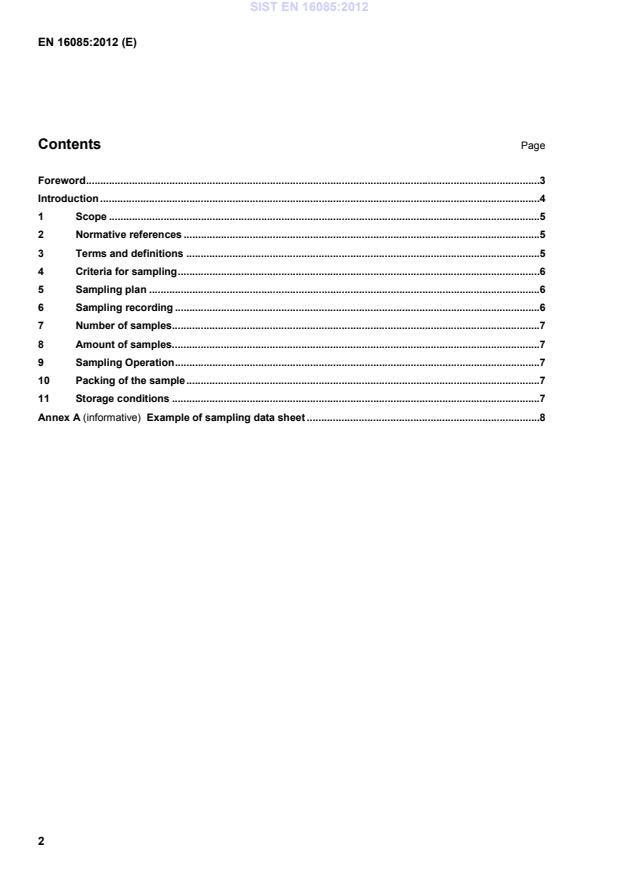
Example of sampling data sheet .8 SIST EN 16085:2012
...