

EN 13687-3:2002
(Main)Products and systems for the protection and repair of concrete structures - Test methods - Determination of thermal compatibility - Part 3: Thermal cycling without de-icing salt impact
- Abstract
This standard is the third in a series of five parts to assess the thermal compatibility of repair products and systems, comprising grouts, mortars and concretes and surface protection systems, used for the repair and protection of concrete structures. The method measures the effect of thermal cycling, including wetting and drying but without de-icing salt immersion, upon surface protection and injection systems used as part of a repair product or system.
- Status
- Published
- Publication Date
- 26-Feb-2002
- Technical Committee
- CEN/TC 104 - Concrete ( performance, production, placing and compliance criteria )
- Drafting Committee
- CEN/TC 104/SC 8/WG 1 - Surface protection systems
- Current Stage
- 9060 - Closure of 2 Year Review Enquiry - Review Enquiry
- Start Date
- 04-Mar-2019
- Completion Date
- 04-Mar-2019

Overview
EN 13687-3:2002 is a European standard developed by CEN that specifies test methods for assessing the thermal compatibility of products and systems used for the protection and repair of concrete structures. This part 3 of a five-part series focuses on thermal cycling without de-icing salt impact, evaluating how surface protection and injection systems react to temperature changes combined with wetting and drying, but excluding immersion in de-icing salt solutions.
This standard plays a crucial role in ensuring that repair products-including grouts, mortars, concretes, and surface protection systems-can withstand the stresses caused by temperature fluctuations in environments without de-icing salts. Its practical application safeguards the durability and integrity of concrete repairs and protections against thermal-induced damage.
Key Topics
- Thermal Compatibility Testing: The method involves exposing concrete specimens treated with repair materials to thermal cycles between 60 °C and -15 °C, combined with periods of wetting and drying but without de-icing salt immersion.
- Test Specimens: Concrete slabs sized 300 mm x 300 mm x 100 mm, prepared as per EN 1766, are coated with surface protection systems and subjected to the thermal cycling to simulate real-life environmental stress.
- Testing Procedure: Two main methods are described:
- Manual thermal cycling using climate cabinets in sequence
- Automated cycling in a programmable climatic cabinet ensuring precise and controlled temperature and moisture conditions.
- Evaluation Criteria:
- Visual inspection for surface defects such as cracking, blistering, delamination, or peeling after cycles.
- Pull-off adhesion strength measurement following EN 1542 to quantify bonding performance between repair product and substrate.
- Curing and Conditioning: Specifies standardized curing and conditioning regimes for test specimens to ensure consistent and comparable results.
Applications
- Concrete Repair and Protection Validation: EN 13687-3:2002 is used to validate the durability and thermal resilience of repair mortars, grouts, and protective coatings on concrete infrastructure such as bridges, parking decks, tunnels, and building facades.
- Quality Control and Specification Compliance: Manufacturers and contractors utilize this standard to demonstrate compliance with performance requirements for thermal compatibility as part of product certification and quality assurance.
- Design of Repair Systems: Engineers and architects rely on the test results guided by this standard to select materials and systems optimized for environments where temperature cycling occurs without de-icing salts.
- Research and Development: Facilitates innovation in repair materials by providing a consistent testing framework to compare new formulations’ performance against established benchmarks.
- Regulatory and Contractual Reference: Often referenced in technical specifications, procurement documents, and regulatory compliance for construction and repair of concrete structures.
Related Standards
EN 13687-3:2002 is part of a broader suite of test standards covering thermal compatibility of concrete repair products:
- EN 13687-1: Freeze-thaw cycling with de-icing salt immersion - assesses performance under harsh winter conditions involving salt contamination.
- EN 13687-2: Thunder-shower cycling (thermal shock) - focuses on rapid and extreme temperature changes simulating outdoor exposure.
- EN 13687-4: Dry thermal cycling - evaluates thermal compatibility under dry heat and cooling cycles.
- EN 13687-5: Resistance to temperature shock - measures product performance under sudden and severe temperature changes.
Complementary standards for repair product definitions, bond strength testing, and concrete preparation include:
- EN 1504-1: Definitions, requirements, and quality control for concrete repair products.
- EN 1542: Pull-off test method for bond strength measurement.
- EN 1766: Specifications for reference concrete used in testing.
By providing a comprehensive and reproducible method to assess thermal compatibility without de-icing salt exposure, EN 13687-3:2002 supports the development and deployment of durable, reliable concrete repair systems optimized for diverse environmental conditions. This standard helps ensure the long-term performance and structural safety of concrete infrastructure subjected to thermal stress cycles.
Relations
- Effective Date
- 28-Jan-2026
- Effective Date
- 28-Jan-2026
- Effective Date
- 28-Jan-2026
- Effective Date
- 28-Jan-2026
- Effective Date
- 28-Jan-2026
- Effective Date
- 28-Jan-2026
- Referred By
EN 15824:2009 - Specifications for external renders and internal plasters based on organic binders - Effective Date
- 28-Jan-2026
- Effective Date
- 28-Jan-2026
- Referred By
EN 15824:2017 - Specifications for external renders and internal plasters based on organic binders - Effective Date
- 28-Jan-2026
- Effective Date
- 28-Jan-2026
- Effective Date
- 28-Jan-2026
- Effective Date
- 28-Jan-2026
- Effective Date
- 22-Dec-2008
Get Certified
Connect with accredited certification bodies for this standard

DIBt (Deutsches Institut für Bautechnik)
German Institute for Building Technology.
DIN CERTCO
DIN Group product certification.

Aboma Certification B.V.
Specialized in construction, metal, and transport sectors.
Sponsored listings
Frequently Asked Questions
EN 13687-3:2002 is a standard published by the European Committee for Standardization (CEN). Its full title is "Products and systems for the protection and repair of concrete structures - Test methods - Determination of thermal compatibility - Part 3: Thermal cycling without de-icing salt impact". This standard covers: This standard is the third in a series of five parts to assess the thermal compatibility of repair products and systems, comprising grouts, mortars and concretes and surface protection systems, used for the repair and protection of concrete structures. The method measures the effect of thermal cycling, including wetting and drying but without de-icing salt immersion, upon surface protection and injection systems used as part of a repair product or system.
This standard is the third in a series of five parts to assess the thermal compatibility of repair products and systems, comprising grouts, mortars and concretes and surface protection systems, used for the repair and protection of concrete structures. The method measures the effect of thermal cycling, including wetting and drying but without de-icing salt immersion, upon surface protection and injection systems used as part of a repair product or system.
EN 13687-3:2002 is classified under the following ICS (International Classification for Standards) categories: 91.080.40 - Concrete structures. The ICS classification helps identify the subject area and facilitates finding related standards.
EN 13687-3:2002 has the following relationships with other standards: It is inter standard links to EN 1766:2017, EN 1542:1999, EN 1504-1:2005, EN 196-1:2016, EN 16566:2014, EN 12618-2:2004, EN 15824:2009, EN 1504-2:2004, EN 15824:2017, EN 1504-5:2004, EN 14879-2:2006, EN 14879-3:2006; is excused to EN 13687-1:2002. Understanding these relationships helps ensure you are using the most current and applicable version of the standard.
EN 13687-3:2002 is associated with the following European legislation: EU Directives/Regulations: 305/2011, 89/106/EEC; Standardization Mandates: M/128. When a standard is cited in the Official Journal of the European Union, products manufactured in conformity with it benefit from a presumption of conformity with the essential requirements of the corresponding EU directive or regulation.
EN 13687-3:2002 is available in PDF format for immediate download after purchase. The document can be added to your cart and obtained through the secure checkout process. Digital delivery ensures instant access to the complete standard document.
Standards Content (Sample)
2003-01.Slovenski inštitut za standardizacijo. Razmnoževanje celote ali delov tega standarda ni dovoljeno.Produkte und Systeme für den Schutz und die Instandsetzung von Betontragwerken - Prüfverfahren - Bestimmung der Temperaturwechselverträglichkeit - Teil 3: Temperaturwechselbeanspruchung ohne TausalzangriffProduits et systemes pour la protection et la réparation des structures en béton - Méthodes d'essai - Détermination de la compatibilité thermique - Partie 3: Cycles thermiques sans immersion dans des sels de déverglaçageProducts and systems for the protection and repair of concrete structures - Test methods - Determination of thermal compatibility - Part 3: Thermal cycling without de-icing salt impact91.080.40Betonske konstrukcijeConcrete structuresICS:Ta slovenski standard je istoveten z:EN 13687-3:2002SIST EN 13687-3:2002en01-september-2002SIST EN 13687-3:2002SLOVENSKI
STANDARD
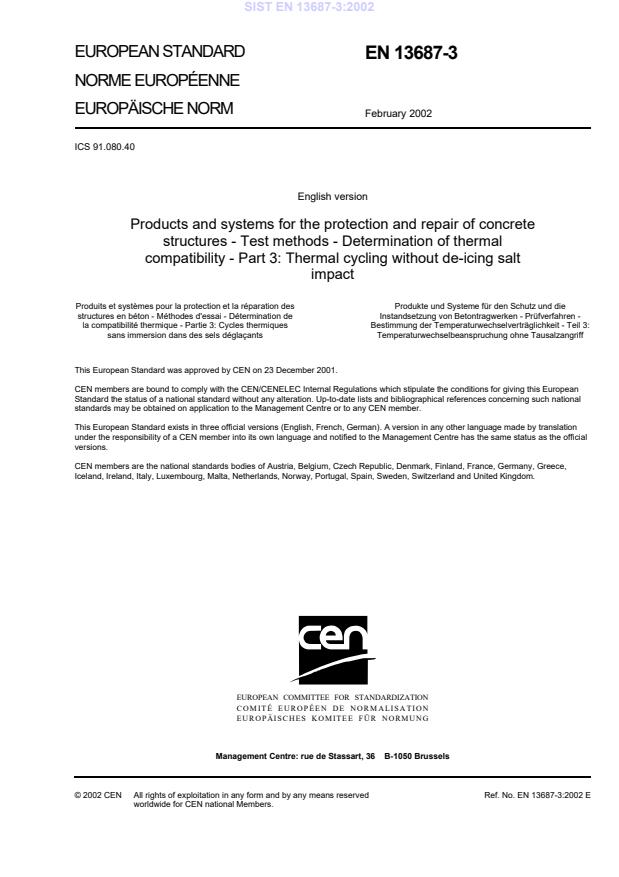
EUROPEAN STANDARDNORME EUROPÉENNEEUROPÄISCHE NORMEN 13687-3February 2002ICS 91.080.40English versionProducts and systems for the protection and repair of concretestructures - Test methods - Determination of thermalcompatibility - Part 3: Thermal cycling without de-icing saltimpactProduits et systèmes pour la protection et la réparation desstructures en béton - Méthodes d'essai - Détermination dela compatibilité thermique - Partie 3: Cycles thermiquessans immersion dans des sels déglaçantsProdukte und Systeme für den Schutz und dieInstandsetzung von Betontragwerken - Prüfverfahren -Bestimmung der Temperaturwechselverträglichkeit - Teil 3:Temperaturwechselbeanspruchung ohne TausalzangriffThis European Standard was approved by CEN on 23 December 2001.CEN members are bound to comply with the CEN/CENELEC Internal Regulations which stipulate the conditions for giving this EuropeanStandard the status of a national standard without any alteration. Up-to-date lists and bibliographical references concerning such nationalstandards may be obtained on application to the Management Centre or to any CEN member.This European Standard exists in three official versions (English, French, German). A version in any other language made by translationunder the responsibility of a CEN member into its own language and notified to the Management Centre has the same status as the officialversions.CEN members are the national standards bodies of Austria, Belgium, Czech Republic, Denmark, Finland, France, Germany, Greece,Iceland, Ireland, Italy, Luxembourg, Malta, Netherlands, Norway, Portugal, Spain, Sweden, Switzerland and United Kingdom.EUROPEAN COMMITTEE FOR STANDARDIZATIONCOMITÉ EUROPÉEN DE NORMALISATIONEUROPÄISCHES KOMITEE FÜR NORMUNGManagement Centre: rue de Stassart, 36
B-1050 Brussels© 2002 CENAll rights of exploitation in any form and by any means reservedworldwide for CEN national Members.Ref. No. EN 13687-3:2002 ESIST EN 13687-3:2002
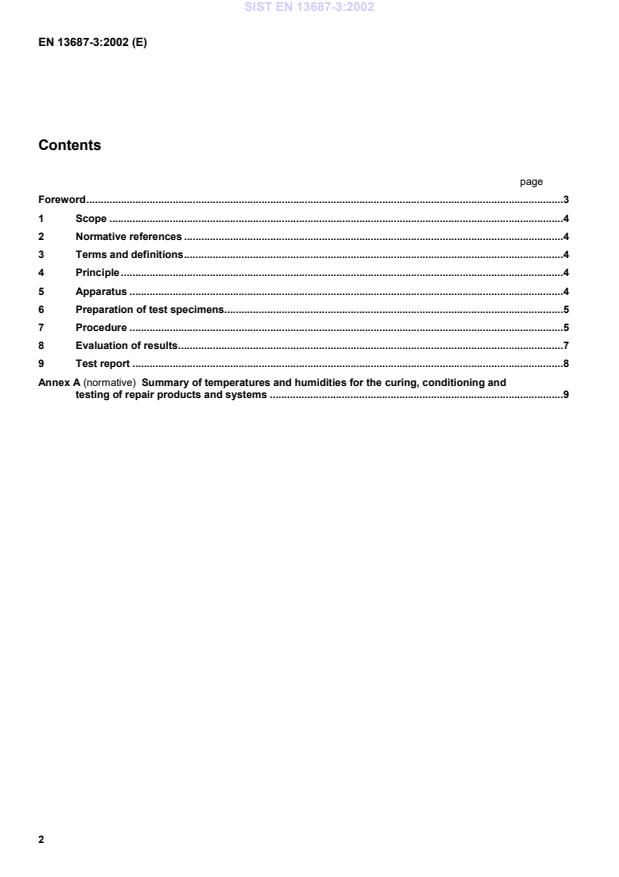
Summary of temperatures and humidities for the curing, conditioning andtesting of repair products and systems.9SIST EN 13687-3:2002
...