

EN 15644:2008
(Main)Traditionally designed prefabricated stairs made of solid wood - Specifications and requirements
- Abstract
This European Standard gives specifications and requirements for prefabricated stairs made of solid wood, i.e. where the components contributing to the fulfilment of mechanical resistance and stability characteristics are made of solid wood. These stairs are traditionally designed.
NOTE 1 If the filling of the guarding does not contribute to the mechanical stability and resistance, the used material is not relevant.
NOTE 2 Examples of traditionally made/designed stairs are given in Annex E.
This European Standard covers: stairs either pre-assembled, partly pre-assembled or in component form including balustrades and handrails for internal or external use.
This European Standard does not consider the contribution of these elements to the overall structure design. The ability of a stair to contribute to the overall stability of the works or to the strength of the structure is not covered by this standard.
Carpets on stairs are not covered by this Standard.
The surfaces of the wooden elements may be exposed or covered by finishes.
Where stairs are supplied with a finish or covering, aesthetic or visual characteristics will not be covered by this Standard and references shall be made to the appropriate product standard (e.g. colour fastness of carpet finishes).
- Status
- Published
- Publication Date
- 09-Dec-2008
- Withdrawal Date
- 29-Jun-2009
- Technical Committee
- CEN/TC 175 - Round and sawn timber
- Drafting Committee
- CEN/TC 175/WG 37 - Specific user requirements - Timber in stairs
- Current Stage
- 9093 - Decision to confirm - Review Enquiry
- Start Date
- 20-May-2025
- Completion Date
- 07-Oct-2026



Overview
EN 15644:2008 - Traditionally designed prefabricated stairs made of solid wood is a European Standard published by CEN that specifies requirements and verification methods for prefabricated stairs whose structural components are made of solid wood. The standard covers traditionally designed stairs supplied as pre‑assembled, partly pre‑assembled or as components, including balustrades and handrails, for internal and external use. It explicitly excludes carpets and does not address a stair’s contribution to the overall structural stability of a building. Aesthetic characteristics of finishes are outside its scope.
Key topics and requirements
- Scope and classification: Defines classes based on climatic location, traffic frequency and comfort for intended use (heated, unheated, external).
- Performance characteristics: Requirements and verification methods for mechanical resistance and stability, safety in use, reaction and resistance to fire, hygiene/ dangerous substances and durability.
- Geometry and safety: Prescribes geometric considerations (tread/riser dimensions, landings), slipperiness criteria, handrail/grip requirements, safe breakage and impact resistance.
- Materials and finishes: Covers solid wood product characteristics, permitted other materials (where they don’t contribute to structural resistance), finish behaviour, and limits for dangerous substances (e.g., formaldehyde, treated wood preservatives).
- Durability and biological resistance: Addresses performance under climatic conditions, resistance to chemical and biological agents and use‑class guidance for treated wood.
- Verification and testing: Specifies methods for load/displacement behaviour, fixings resistance, vibration, fire testing and acoustic/thermal considerations.
- Factory production control and labelling: Guidance on production quality control, testing, handling, installation, maintenance and product identification.
Applications and users
EN 15644:2008 is intended for:
- Stair manufacturers and timber processors producing prefabricated solid wood stairs
- Architects, specifiers and façade/building consultants selecting compliant stair systems
- Installers and contractors responsible for correct handling and on‑site assembly
- Testing laboratories and certification bodies performing conformity assessment
- Regulatory authorities and building control referencing performance criteria for stairs
Practical uses include specifying compliance for internal and external wooden stairs, designing balustrade and handrail details for safety, and defining factory quality control and labelling requirements.
Related standards
- EN 13501‑1 (reaction to fire classifications) - referenced for fire performance classes
- EN 335 (use classes and biological durability guidance) - referenced for wood durability
- Product‑specific standards for finishes (e.g., carpet or surface coverings) for aesthetic characteristics
Keywords: EN 15644:2008, prefabricated stairs, solid wood stairs, mechanical resistance, handrails, balustrades, fire safety, durability, CEN.
Relations
- Effective Date
- 28-Jan-2026
- Effective Date
- 28-Jan-2026
- Effective Date
- 28-Jan-2026
- Effective Date
- 28-Jan-2026
- Effective Date
- 28-Jan-2026
- Effective Date
- 28-Jan-2026
- Effective Date
- 28-Jan-2026
- Refers
EN 1534:2020 - Wood flooring and parquet - Determination of resistance to indentation - Test method - Effective Date
- 28-Jan-2026
- Effective Date
- 28-Jan-2026
- Effective Date
- 28-Jan-2026
- Effective Date
- 28-Jan-2026
- Effective Date
- 28-Jan-2026
- Effective Date
- 28-Jan-2026
- Effective Date
- 28-Jan-2026
- Effective Date
- 28-Jan-2026
Get Certified
Connect with accredited certification bodies for this standard

DIBt (Deutsches Institut für Bautechnik)
German Institute for Building Technology.
DIN CERTCO
DIN Group product certification.

Aboma Certification B.V.
Specialized in construction, metal, and transport sectors.
Sponsored listings
Frequently Asked Questions
EN 15644:2008 is a standard published by the European Committee for Standardization (CEN). Its full title is "Traditionally designed prefabricated stairs made of solid wood - Specifications and requirements". This standard covers: This European Standard gives specifications and requirements for prefabricated stairs made of solid wood, i.e. where the components contributing to the fulfilment of mechanical resistance and stability characteristics are made of solid wood. These stairs are traditionally designed. NOTE 1 If the filling of the guarding does not contribute to the mechanical stability and resistance, the used material is not relevant. NOTE 2 Examples of traditionally made/designed stairs are given in Annex E. This European Standard covers: stairs either pre-assembled, partly pre-assembled or in component form including balustrades and handrails for internal or external use. This European Standard does not consider the contribution of these elements to the overall structure design. The ability of a stair to contribute to the overall stability of the works or to the strength of the structure is not covered by this standard. Carpets on stairs are not covered by this Standard. The surfaces of the wooden elements may be exposed or covered by finishes. Where stairs are supplied with a finish or covering, aesthetic or visual characteristics will not be covered by this Standard and references shall be made to the appropriate product standard (e.g. colour fastness of carpet finishes).
This European Standard gives specifications and requirements for prefabricated stairs made of solid wood, i.e. where the components contributing to the fulfilment of mechanical resistance and stability characteristics are made of solid wood. These stairs are traditionally designed. NOTE 1 If the filling of the guarding does not contribute to the mechanical stability and resistance, the used material is not relevant. NOTE 2 Examples of traditionally made/designed stairs are given in Annex E. This European Standard covers: stairs either pre-assembled, partly pre-assembled or in component form including balustrades and handrails for internal or external use. This European Standard does not consider the contribution of these elements to the overall structure design. The ability of a stair to contribute to the overall stability of the works or to the strength of the structure is not covered by this standard. Carpets on stairs are not covered by this Standard. The surfaces of the wooden elements may be exposed or covered by finishes. Where stairs are supplied with a finish or covering, aesthetic or visual characteristics will not be covered by this Standard and references shall be made to the appropriate product standard (e.g. colour fastness of carpet finishes).
EN 15644:2008 is classified under the following ICS (International Classification for Standards) categories: 91.060.30 - Ceilings. Floors. Stairs. The ICS classification helps identify the subject area and facilitates finding related standards.
EN 15644:2008 has the following relationships with other standards: It is inter standard links to EN 599-1:2009+A1:2013, ENV 1998-1-2:1994, CEN/TS 15680:2007, EN 1294:2000, EN 335-2:2006, EN 13647:2021, EN 599-2:2016, EN 1534:2020, EN 12600:2002, EN 1365-6:2004, EN 351-1:2023, EN 13501-1:2018, EN 13696:2008, EN 1995-1-1:2025, EN 14076:2013. Understanding these relationships helps ensure you are using the most current and applicable version of the standard.
EN 15644:2008 is associated with the following European legislation: EU Directives/Regulations: 305/2011, 89/106/EEC. When a standard is cited in the Official Journal of the European Union, products manufactured in conformity with it benefit from a presumption of conformity with the essential requirements of the corresponding EU directive or regulation.
EN 15644:2008 is available in PDF format for immediate download after purchase. The document can be added to your cart and obtained through the secure checkout process. Digital delivery ensures instant access to the complete standard document.
Standards Content (Sample)
2003-01.Slovenski inštitut za standardizacijo. Razmnoževanje celote ali delov tega standarda ni dovoljeno.Tradicionalno oblikovane predizdelane stopnice iz masivnega lesa - Specifikacije in zahteveTraditionell geplante, vorgefertigte Treppen aus Massivholz — Spezifikationen und AnforderungenEscaliers préfabriqués de conception traditionnelle en bois massif - Spécifications et exigencesTraditionally designed prefabricated stairs made of solid wood - Specifications and requirements91.060.30Stropi. Tla. StopniceCeilings. Floors. StairsICS:Ta slovenski standard je istoveten z:EN 15644:2008SIST EN 15644:2009en,fr,de01-april-2009SIST EN 15644:2009SLOVENSKI
STANDARD
EUROPEAN STANDARDNORME EUROPÉENNEEUROPÄISCHE NORMEN 15644December 2008ICS 91.060.30 English VersionTraditionally designed prefabricated stairs made of solid wood -Specifications and requirementsEscaliers préfabriqués de conception traditionnelle en boismassif - Spécifications et exigencesTraditionell konstruierte, vorgefertigte Treppen ausMassivholz - Spezifikationen und AnforderungenThis European Standard was approved by CEN on 8 November 2008.CEN members are bound to comply with the CEN/CENELEC Internal Regulations which stipulate the conditions for giving this EuropeanStandard the status of a national standard without any alteration. Up-to-date lists and bibliographical references concerning such nationalstandards may be obtained on application to the CEN Management Centre or to any CEN member.This European Standard exists in three official versions (English, French, German). A version in any other language made by translationunder the responsibility of a CEN member into its own language and notified to the CEN Management Centre has the same status as theofficial versions.CEN members are the national standards bodies of Austria, Belgium, Bulgaria, Cyprus, Czech Republic, Denmark, Estonia, Finland,France, Germany, Greece, Hungary, Iceland, Ireland, Italy, Latvia, Lithuania, Luxembourg, Malta, Netherlands, Norway, Poland, Portugal,Romania, Slovakia, Slovenia, Spain, Sweden, Switzerland and United Kingdom.EUROPEAN COMMITTEE FOR STANDARDIZATIONCOMITÉ EUROPÉEN DE NORMALISATIONEUROPÄISCHES KOMITEE FÜR NORMUNGManagement Centre: rue de Stassart, 36
B-1050 Brussels© 2008 CENAll rights of exploitation in any form and by any means reservedworldwide for CEN national Members.Ref. No. EN 15644:2008: ESIST EN 15644:2009
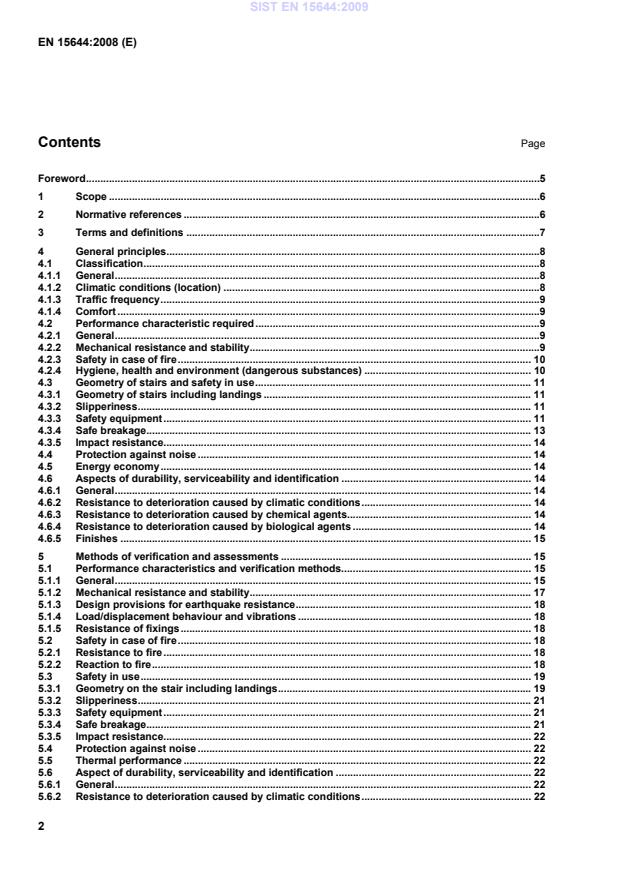
Dimensional and performance characteristics of balustrades, handrails and flights of stairs in connection with the classification given in 4.1 . 35 A.1 Handrails and/or balustrades . 35 SIST EN 15644:2009
General considerations regarding biological durability . 37 B.1 General precautions (extract from EN 335-2:2006, Annex 3) . 37 B.2 Natural or conferred durability of sound wood (extract from EN 335-2:2006, Annex 4) . 37 Annex C (normative)
Formaldehyde classes . 38 C.1 Product to be tested . 38 C.2 Materials to be tested . 38 Annex D (informative)
Remind of classes of reaction to fire performance for construction products for flooring including their surface coverings (OJEC 150/18 - 23.2.2000) (Extract from EN 13501-1:2007) . 40 Annex E (informative)
Examples of traditional and non traditional timber stairs . 41 E.1 Examples of traditional timber stairs. 41 E.2 Examples of non traditional timber stairs . 43 Bibliography . 46
- Clauses 4 and 5: General questions; - Clauses 6 to 11: Applications to stairs made of solid wood. If a general standard on stairs is developed and adopted, Clauses 4 and 5 of this document will be reconsidered to be aligned with the general standard, if needed. According to the CEN/CENELEC Internal Regulations, the national standards organizations of the following countries are bound to implement this European Standard: Austria, Belgium, Bulgaria, Cyprus, Czech Republic, Denmark, Estonia, Finland, France, Germany, Greece, Hungary, Iceland, Ireland, Italy, Latvia, Lithuania, Luxembourg, Malta, Netherlands, Norway, Poland, Portugal, Romania, Slovakia, Slovenia, Spain, Sweden, Switzerland and the United Kingdom. SIST EN 15644:2009
NOTE 2 Examples of traditionally made/designed stairs are given in Annex E. This European Standard covers: stairs either pre-assembled, partly pre-assembled or in component form including balustrades and handrails for internal or external use. This European Standard does not consider the contribution of these elements to the overall structure design. The ability of a stair to contribute to the overall stability of the works or to the strength of the structure is not covered by this standard. Carpets on stairs are not covered by this Standard. The surfaces of the wooden elements may be exposed or covered by finishes. Where stairs are supplied with a finish or covering, aesthetic or visual characteristics will not be covered by this Standard and references shall be made to the appropriate product standard (e.g. colour fastness of carpet finishes). 2 Normative references The following referenced documents are indispensable for the application of this document. For dated references, only the edition cited applies. For undated references, the latest edition of the referenced document (including any amendments) applies. EN 335-2:2006, Durability of wood and wood–based products — Definition of use classes — Part 2: Application to solid wood EN 350-1, Durability of wood and wood-based products – Natural durability of solid wood – Part 1: Guide to the principles of testing and classification of the natural durability of wood EN 350-2, Durability of wood and wood-based products – Natural durability of solid wood – Part 2: Guide to natural durability and treatability of selected wood species of importance in Europe EN 351-1, Durability of wood and wood–based products — Preservative–treated solid wood — Part 1: Classification of preservative penetration and retention EN 599-1, Durability of wood and wood–based products — Efficacy of preventive wood preservatives as determined by biological tests — Part 1: Specification according to use class EN 599-2, Durability of wood and wood–based products — Performance of preventive wood preservatives as determined by biological tests — Part 2: Classification and labelling EN 1121, Doors - Behaviour between two different climates - Test method EN 1294, Door leaves - Determination of the behaviour under humidity variations in successive uniform climates EN 1365-6, Fire resistance tests for loadbearing elements - Part 6: Stairs EN 1534, Wood and parquet flooring – Determination of resistance to indentation (Brinell) – Test method EN 1990, Eurocode – Basis of structural design SIST EN 15644:2009
3.2
calculation
assessment of characteristics (for example mechanical resistance, stability, etc.) using formulae of appropriate design models for the structural behaviour of stairs and components including the use of tabulated values (for some characteristics, Eurocodes are relevant) 3.3 traditionally-designed prefabricated stair stair made of solid wood with steps with or without riser, housed on both ends into strings, either close string(s) and/or cut string(s)
NOTE Fixing of steps on both ends in/on strings indicates a design of steps as single-span beam (examples given in Annex E).
3.4 solid wood wood sawn or otherwise machined which may include finger jointed and/or laminated wood (as defined in
EN 335-2) NOTE
A decorative veneer may be used if the hidden parts are made of solid wood.
complying with this technical specification (see Guidance Paper M:May 2005) 3.6 stair made of solid wood components (steps, strings, guarding/railing, etc.) which contribute to the fulfilment of mechanical resistance and stability characteristics (vertical and horizontal) are of solid wood 3.7 classified without the need further testing CWFT procedure by which the level of performance of a product is initially demonstrated by testing, in such a way that manufacturers may refer to that performance without the need of further tests (see Guidance Paper M:May 2005) 3.8 conventional accepted performance CAP provisions presented or referred to in the technical specification that allows manufacturers to declare product performances without the need to perform initial type tests, calculations, etc. such as tabulated values, descriptive solutions and alike (see Guidance Paper M :May 2005) 3.9 balustrade safety barrier that shall prevent a person falling from the stair or being trapped. 3.10 walking line theorical line indicating the average path of the user of the stair 4 General principles 4.1 Classification 4.1.1 General For the purpose of this standard, 3 systems are considered: climatic conditions, traffic frequency and comfort. For each performance given in the clauses below, a verification method is given in Clause 5. 4.1.2 Climatic conditions (location) The intended use (location) is defined in the following Table 1: Table 1 — Climatic conditions Internal - for space with room temperature below
12 °C - for space with room temperature included between 12 °C and 21 °C - for space with room temperature over
21 °C External No subclasses NOTE
Border values are given in 5.6.2. SIST EN 15644:2009
Specific climatic conditions relevant for wooden stairs are given in Clause 6. 4.1.3 Traffic frequency The material used in the stairs shall take into account the intended use (frequency: Fx): F1 (low traffic): typical use: domestic: 1 – 10 persons using the stair in the building; F2 (moderate traffic): typical use: domestic and/or commercial: 10 - 20 persons; F3 (high traffic): typical use: public and industrial: more than 20 persons. 4.1.4 Comfort There are different aspects of the comfort, for example: number of steps, the clear width, the pitch. Classifications exist concerning comfort. These classifications can rely on the relation between rise and going. Following this relation, the stairs can be tight, ordinary or comfortable. Another way to classify the comfort is the modulus given by the relation g (going) + 2 r (rise). If no national regulation exists, this relation shall be between 580 mm and 660 mm. 4.2 Performance characteristic required 4.2.1 General NOTE 1 This clause is necessary mostly to take into account the existing laws or regulations or administrative provisions enforced for some buildings and or for some European countries or for particular cases. The following aspect(s) of performance(s) are relevant. NOTE 2 Methods for verification and assessment can be found in Clause 5.
4.2.2 Mechanical resistance and stability 4.2.2.1 Load bearing capacity The prefabricated stair shall have sufficient mechanical resistance and stability to withstand static or dynamic loads from the actions (permanent, variable and accidental) without reaching its serviceability limit state. The actions shall be in accordance with the laws, regulations and administrative provisions, applicable for the location where the product is incorporated in the works. 4.2.2.2 Design provisions for earthquake resistance In seismic zones, the product, together with the fixing, may be able to resist to seismic actions, when relevant. 4.2.2.3 Stability and stiffness Stability and stiffness are expressed as load-displacement behaviour and vibrations. The stair as a whole and its parts, such as steps and barriers, shall be designed to limit the deflection and vibrations under working conditions. SIST EN 15644:2009
http://europa.eu.int/comm/enterprise/construction/internal/dangsub/dangmain.htm 4.2.4.2 Release of formaldehyde The components shall be made of concerned materials and the concerned surface treatments shall be made, in order that release of formaldehyde is in accordance with laws, regulations and administrative provisions, applicable for the location where the product is incorporated in the works. 4.2.4.3 Content of pentachlorophenol (PCP) The components shall be made of such materials and the surface treatments shall be made, in order that the content of pentachlorophenol is in accordance with laws, regulations and administrative provisions, applicable for the location where the product is incorporated in the works. 4.2.4.4 Content of asbestos The components shall be made of such materials that the content of asbestos is in accordance with laws, regulations and administrative provisions applicable for the location where the product is incorporated in the works. NOTE See Council Directive 91/382/EEC of 25 June 1991 amending Directive 83/477/EEC and Council Directive 87/217/EEC of 19 March. SIST EN 15644:2009
Key a openings b height of handrail c height of balustrade Figure 1 — Balustrade and handrail 4.3.3.2 Handrails 4.3.3.2.1 Height of the handrail The height of the handrail and additional handrail for children shall ensure that the user can firmly grasp and use the handrail in all cases in an appropriate way (Figure 1). The heights of the handrails shall comply with the different requirements set out in the relevant laws, regulations and administrative provisions, applicable for the location where the product is incorporated in the works, to allow users to go up and down safely. 4.3.3.2.2 Geometry of the handrail The performance of the handrail and its end shall be such that the user can firmly grasp and use the handrail in an appropriate way. The gap between the wall and the handrail (a) shall be sufficient to enable the safe use of the handrail (Figure 2). Additional handrails shall be provided if demanded. SIST EN 15644:2009
Figure 2 — Examples of handrails The free side distance (a) shall be clear for the full length of the handrail (fixings shall not interrupt normal finger contact (c). See Annex A, Clause A.1.2. The handrails shall be smooth without sharp or cutting or projections for areas in normal hand contact. 4.3.3.3 Balustrades 4.3.3.3.1 Height of balustrade and minimum and maximum height of the part of the balustrade without ladder effects (e.g. openings, decorative elements) The height of the balustrade and the height of the part of the balustrade without ladder effect shall comply with different requirements set out in the relevant laws, regulations and administrative provisions, applicable for the location where the product is incorporated in the works to allow users to go up and down safely. 4.3.3.3.2 Climbability for infants
Depending on the intended use and the local regulations where the product is incorporated in the works, there may be a requirement to prohibit the ladder effect. The ladder effect means that some components of the balustrade make it possible for infants to climb up (ladder effect) the balustrade. To minimise the ladder effect, for example, the maximum diameter of openings of the balustrade in-fill and of the in-fill elements of the associated parts of the balustrade shall comply with the different requirements set out in the relevant laws, regulations and administrative provisions, applicable for the location where the product is incorporated in the works. 4.3.3.4 Tactility and visibility For some applications, there may be a need of specific safety equipment to enable disabled people, children or elderly people to use the stairs. Tactility for blind people as well as the visibility for all users of the stairs shall be considered. The safety equipment shall be such that the beginning and the end of the stairs and the handrail can be observed clearly. The edge of the steps and landings shall be marked clearly, this marking shall not increase the slipperiness of the stairs. 4.3.4 Safe breakage In normal use, regardless of whether the parts contribute to the mechanical resistance and stability of the stairs as a whole or not (e.g. infilling component of a balustrade or guard-rail), the stairs shall be designed and installed with due consideration to passive safety to prevent occupants from being injured by the stairs or part of the stairs. In the case of a person falling against the stairs or balustrade, the possible injuries shall be limited. Also, in the case of an accident, the injury caused to persons below or in the neighbourhood of the stairs shall be limited. SIST EN 15644:2009
To retain their properties during the working life, the components of the stairs and surfaces may need regular maintenance. The maintenance of applied coatings and finishes shall be specified in accompanying documents. This may be especially important for outdoor stairs and stairs in public buildings. 4.6.2 Resistance to deterioration caused by climatic conditions The stairs and the parts of them, especially joints, shall not be adversely affected (deteriorated, distorted or deformed) by the following conditions: variations of temperature of the environment; variations of relative humidity of the environment; radiation of the sun, if necessary. 4.6.3 Resistance to deterioration caused by chemical agents The stairs and the parts of them, especially joints, shall not be adversely affected by the following chemical agents: cleaning agents; water, and
naturally occurring corrosives. 4.6.4 Resistance to deterioration caused by biological agents The stairs and the parts of them, especially joints, shall not be adversely affected by the following biological agents: fungi; insects. SIST EN 15644:2009
The finishes of the stairs shall protect against deterioration caused by climatic conditions, chemical or biological agents, when relevant. The finishes shall not increase the slipperiness of the stairs beyond safe limits. NOTE Safe limits can be given in national regulations for several end uses. If other functions of surface finishes are claimed, they shall be proven. 5 Methods of verification and assessments 5.1 Performance characteristics and verification methods 5.1.1 General The relevant requirements to product performances (as given in Clause 4) are assessed and tested as given in the following Table 2 in accordance with conventionally accepted performance (provisions presented or referenced in technical specifications) or by calculation or by testing. Table 3 gives information regarding additional performance characteristics. SIST EN 15644:2009
Class of release Level or content
For timber: 7.5.1 Release of formaldehyde (wood: 7.5.2) 4 4.3.1 Geometry of stair including landings Definition of geometry 5.3.1 Geometry of the stair including landings 4.3.2 Slipperiness Slipperiness of the surface materials of the steps and landings 5.3.2 Slipperiness (wood: 7.6.2) 4.3.3 Safety equipment Adequate function 5.3.3 Safety equipment 4.3.4 Safe breakage Geometry and shattering properties of glass and other materials 5.3.4 Safe breakage (wood: 7.11) 4.3.5 Impact resistance Resistance to structural damage from soft body, hard body and angular body impact load 5.3.5 Impact resistance a
ER: Essential requirements
durability
serviceability and identification
4.6.2 Resistance to deterioration caused by climatic conditions 5.6.2 Resistance to deterioration caused by physical agents
4.6.3 Resistance to deterioration caused by chemical agents 5.6.3 Resistance to deterioration caused by chemical agents (wood: 7.9.3) 4.6.4 Resistance to deterioration caused by biological agents 5.6.4 Resistance to deterioration caused by biological agents (wood: 7.8.3) 4.6.5 Finishes and surface layers 5.6.5 Finishes and surface layers Resistance to deterioration caused by physical, chemical or biological agents Specific functions
5.1.2 Mechanical resistance and stability The mechanical load bearing capacity of the stairs is a matter of safety so that the stairs will not be damaged in use.
The load bearing capacity and the load-displacement behaviour and vibrations of the stair as a whole or of its parts (in
...