

EN 13063-2:2005+A1:2007
(Main + Amendment)Chimneys - System chimneys with clay/ceramic flue liners - Part 2: Requirements and test methods under wet conditions
- Abstract
This European Standard specifies the requirements and test methods for multiwall system chimneys working under wet conditions (in the following expressed as wet chimney) with pressure
type N1, N2 or P1 according to EN 1443 and a working temperature below or equal T600 according to !EN 13063-1:2005+A1", in which the products of combustion are conveyed to the atmosphere through clay/ceramic flue liners. Marking and inspection are also covered by this document.
This European Standard does not apply to structurally independent (free standing or self supporting) system chimneys.
The wet chimney may comprise the following appropriate components:
clay/ceramic flue liners;
insulation layer;
outer walls;
acid resistant mortar for jointing flue liners or elastomeric sealant;
mortar for jointing outer walls;
terminal;
chimney base;
condensate collector;
condensate outlet;
cladding;
opening section;
cleaning and inspection door;
distance piece;
reinforcement.
The wet system chimney covers a combination of compatible chimney components, obtained or specified from one manufacturing source with product responsibility for the whole system chimney.
NOTE This document does not cover soot fire resistance chimneys.
- Status
- Published
- Publication Date
- 17-Jul-2007
- Technical Committee
- CEN/TC 166 - Chimneys
- Drafting Committee
- CEN/TC 166/WG 6 - Clay/Ceramic and Concrete chimneys components
- Current Stage
- 9020 - Submission to 2 Year Review Enquiry - Review Enquiry
- Start Date
- 15-Jul-2026
- Completion Date
- 15-Jul-2026
- Directive
- 305/2011 - Regulation (eu) No 305/2011 of the European Parliament and of the Council of 9 march 2011 laying down harmonised conditions for the marketing of construction products and repealing council directive 89/106/eecOJ Ref: C, C 259 OJ Date: 08-Aug-2014
89/106/EEC - Construction productsOJ Ref: C, C 290 OJ Date: 04-Dec-2007
Buy Documents






Overview
EN 13063-2:2005+A1:2007 is a CEN European Standard for system chimneys with clay/ceramic flue liners designed to operate under wet conditions. It specifies requirements, sampling and test methods for multiwall system chimneys of pressure types N1, N2 or P1 (per EN 1443) and working temperatures up to T600. The standard covers complete system responsibility (compatible components from one manufacturer), marking, inspection and conformity assessment. It does not apply to free‑standing/self‑supporting chimneys and excludes soot‑fire‑resistant chimneys.
Key topics and technical requirements
- Scope & components: clay/ceramic flue liners, insulation layer, outer walls, acid‑resistant mortar or elastomeric sealants, condensate collector/outlet, terminals, cleaning doors, reinforcement, etc.
- Dimensions & tolerances: flue liner external diameter tolerance ±3% of nominal; component dimensions per referenced EN standards.
- Material requirements:
- Flue liners: meet EN 1457 requirements; W (wet) or D (dry) designation conditional on system test.
- Acid‑resistant mortar: compressive strength ≥ 10 N/mm² (after 24 h water preconditioning); density ±10% of declared; mass loss limits for water resistance ≤ 3% and acid resistance ≤ 2%.
- Elastomeric seals: comply with EN 14241-1.
- Insulation: prefabricated, dimensionally stable; durability under heat cycles with defined test temperatures for each T‑class (e.g., T400 test 500 °C, T600 test 700 °C).
- Performance tests:
- Thermal shock and heat stress (per EN 13216-1).
- Gas‑tightness: maximum leakage rates specified by pressure type (examples: N1 at 40 Pa → 2×10‑3 m³/s·m²).
- Condensate resistance and vapour saturation checks (system test per EN 13216-1).
- Distance to combustibles: tested under normal operating conditions; adjacent combustible surface ≤ 85 °C (ambient 20 °C).
- Relative movement: flue liner position after thermal cycle must be within ±5 mm of original.
- Wind load: freestanding portion above last support must withstand 1.5 kN/m².
- Thermal resistance: declared as Ryy (e.g., R22 = 0.22 m²K/W) verified by test or calculation.
- Mechanical safety: opening sections tested to withstand at least five times the declared design load.
Applications and users
- Chimney system manufacturers and component suppliers - for design, manufacturing, testing and declaration of system chimneys.
- Product and third‑party test laboratories - to perform required performance and durability tests.
- Specifiers, architects and HVAC engineers - to select compliant chimney systems for wet‑operating applications (condensing appliances, low flue gas temperatures).
- Installers and building control authorities - for inspection, marking verification and conformity assessment.
Related standards
- EN 13063-1 (Part 1 - sootfire resistance)
- EN 13063-3 (system air flue chimneys, related part)
- EN 1443, EN 1457, EN 13216-1, EN 12446, EN 14241-1, EN 13162 (referenced normative documents)
Keywords: EN 13063-2, system chimneys, clay/ceramic flue liners, wet conditions, test methods, gas tightness, condensate resistance, thermal resistance, chimney standards, CEN.
Relations
- Effective Date
- 18-Jan-2023
- Effective Date
- 22-Jul-2026
- Effective Date
- 28-Jan-2026
- Effective Date
- 28-Jan-2026
- Effective Date
- 28-Jan-2026
- Effective Date
- 28-Jan-2026
- Effective Date
- 28-Jan-2026
- Effective Date
- 28-Jan-2026
- Effective Date
- 28-Jan-2026
- Effective Date
- 28-Jan-2026
- Effective Date
- 28-Jan-2026
- Effective Date
- 28-Jan-2026
- Refers
EN 1366-8:2004 - Fire resistance tests for service installations - Part 8: Smoke extraction ducts - Effective Date
- 28-Jan-2026
- Effective Date
- 28-Jan-2026
- Effective Date
- 28-Jan-2026
Buy Documents
Get Certified
Connect with accredited certification bodies for this standard

DIBt (Deutsches Institut für Bautechnik)
German Institute for Building Technology.
DIN CERTCO
DIN Group product certification.

Aboma Certification B.V.
Specialized in construction, metal, and transport sectors.
Sponsored listings
Frequently Asked Questions
EN 13063-2:2005+A1:2007 is a standard published by the European Committee for Standardization (CEN). Its full title is "Chimneys - System chimneys with clay/ceramic flue liners - Part 2: Requirements and test methods under wet conditions". This standard covers: This European Standard specifies the requirements and test methods for multiwall system chimneys working under wet conditions (in the following expressed as wet chimney) with pressure type N1, N2 or P1 according to EN 1443 and a working temperature below or equal T600 according to !EN 13063-1:2005+A1", in which the products of combustion are conveyed to the atmosphere through clay/ceramic flue liners. Marking and inspection are also covered by this document. This European Standard does not apply to structurally independent (free standing or self supporting) system chimneys. The wet chimney may comprise the following appropriate components: clay/ceramic flue liners; insulation layer; outer walls; acid resistant mortar for jointing flue liners or elastomeric sealant; mortar for jointing outer walls; terminal; chimney base; condensate collector; condensate outlet; cladding; opening section; cleaning and inspection door; distance piece; reinforcement. The wet system chimney covers a combination of compatible chimney components, obtained or specified from one manufacturing source with product responsibility for the whole system chimney. NOTE This document does not cover soot fire resistance chimneys.
This European Standard specifies the requirements and test methods for multiwall system chimneys working under wet conditions (in the following expressed as wet chimney) with pressure type N1, N2 or P1 according to EN 1443 and a working temperature below or equal T600 according to !EN 13063-1:2005+A1", in which the products of combustion are conveyed to the atmosphere through clay/ceramic flue liners. Marking and inspection are also covered by this document. This European Standard does not apply to structurally independent (free standing or self supporting) system chimneys. The wet chimney may comprise the following appropriate components: clay/ceramic flue liners; insulation layer; outer walls; acid resistant mortar for jointing flue liners or elastomeric sealant; mortar for jointing outer walls; terminal; chimney base; condensate collector; condensate outlet; cladding; opening section; cleaning and inspection door; distance piece; reinforcement. The wet system chimney covers a combination of compatible chimney components, obtained or specified from one manufacturing source with product responsibility for the whole system chimney. NOTE This document does not cover soot fire resistance chimneys.
EN 13063-2:2005+A1:2007 is classified under the following ICS (International Classification for Standards) categories: 91.060.40 - Chimneys, shafts, ducts. The ICS classification helps identify the subject area and facilitates finding related standards.
EN 13063-2:2005+A1:2007 has the following relationships with other standards: It is inter standard links to EN 13063-2:2005, ISO 2859-1:1999, EN 12446:2003, EN 14241-1:2013, EN 14297:2004, EN 13162:2001, EN 1457:1999, EN 1443:2003, EN 998-2:2003, EN 13216-1:2004, EN 13069:2005, EN 13384-1:2015+A1:2019, EN 1366-8:2004, EN 196-1:1994, EN 13063-1:2005+A1:2007. Understanding these relationships helps ensure you are using the most current and applicable version of the standard.
EN 13063-2:2005+A1:2007 is associated with the following European legislation: EU Directives/Regulations: 305/2011, 89/106/EEC; Standardization Mandates: M/105. When a standard is cited in the Official Journal of the European Union, products manufactured in conformity with it benefit from a presumption of conformity with the essential requirements of the corresponding EU directive or regulation.
EN 13063-2:2005+A1:2007 is available in PDF format for immediate download after purchase. The document can be added to your cart and obtained through the secure checkout process. Digital delivery ensures instant access to the complete standard document.
Standards Content (Sample)
SLOVENSKI STANDARD
01-september-2007
Dimovodne naprave – Sistemski dimniki s keramičnimi tuljavami – 2. del: Zahteve
in preskusne metode za obratovanje v vlažnih pogojih
Chimneys - System chimneys with clay/ceramic flue liners - Part 2: Requirements and
test methods under wet conditions
Abgasanlagen - System-Abgasanlagen mit Keramik-Innenrohren - Teil 2: Anforderungen
und Prüfungen für feuchte Betriebsweise
Conduits de cheminées - Conduits de cheminées résistant aux feux de cheminées a
paroi intérieure en terre cuite/céramique - Partie 2: Exigences et méthodes d'essai en
conditions humides
Ta slovenski standard je istoveten z: EN 13063-2:2005+A1:2007
ICS:
91.060.40 Dimniki, jaški, kanali Chimneys, shafts, ducts
2003-01.Slovenski inštitut za standardizacijo. Razmnoževanje celote ali delov tega standarda ni dovoljeno.
EUROPEAN STANDARD
EN 13063-2:2005+A1
NORME EUROPÉENNE
EUROPÄISCHE NORM
July 2007
ICS 91.060.40 Supersedes EN 13063-2:2005
English Version
Chimneys - System chimneys with clay/ceramic flue liners - Part
2: Requirements and test methods under wet conditions
Conduits de cheminées - Conduits de cheminées résistant Abgasanlagen - System-Abgasanlagen mit Keramik-
aux feux de cheminées à paroi intérieure en terre Innenrohren - Teil 2: Anforderungen und Prüfungen für
cuite/céramique - Partie 2: Exigences et méthodes d'essai feuchte Betriebsweise
en conditions humides
This European Standard was approved by CEN on 1 April 2005 and includes Amendment 1 approved by CEN on 14 June 2007.
CEN members are bound to comply with the CEN/CENELEC Internal Regulations which stipulate the conditions for giving this European
Standard the status of a national standard without any alteration. Up-to-date lists and bibliographical references concerning such national
standards may be obtained on application to the CEN Management Centre or to any CEN member.
This European Standard exists in three official versions (English, French, German). A version in any other language made by translation
under the responsibility of a CEN member into its own language and notified to the CEN Management Centre has the same status as the
official versions.
CEN members are the national standards bodies of Austria, Belgium, Bulgaria, Cyprus, Czech Republic, Denmark, Estonia, Finland,
France, Germany, Greece, Hungary, Iceland, Ireland, Italy, Latvia, Lithuania, Luxembourg, Malta, Netherlands, Norway, Poland, Portugal,
Romania, Slovakia, Slovenia, Spain, Sweden, Switzerland and United Kingdom.
EUROPEAN COMMITTEE FOR STANDARDIZATION
COMITÉ EUROPÉEN DE NORMALISATION
EUROPÄISCHES KOMITEE FÜR NORMUNG
Management Centre: rue de Stassart, 36 B-1050 Brussels
© 2007 CEN All rights of exploitation in any form and by any means reserved Ref. No. EN 13063-2:2005+A1:2007: E
worldwide for CEN national Members.
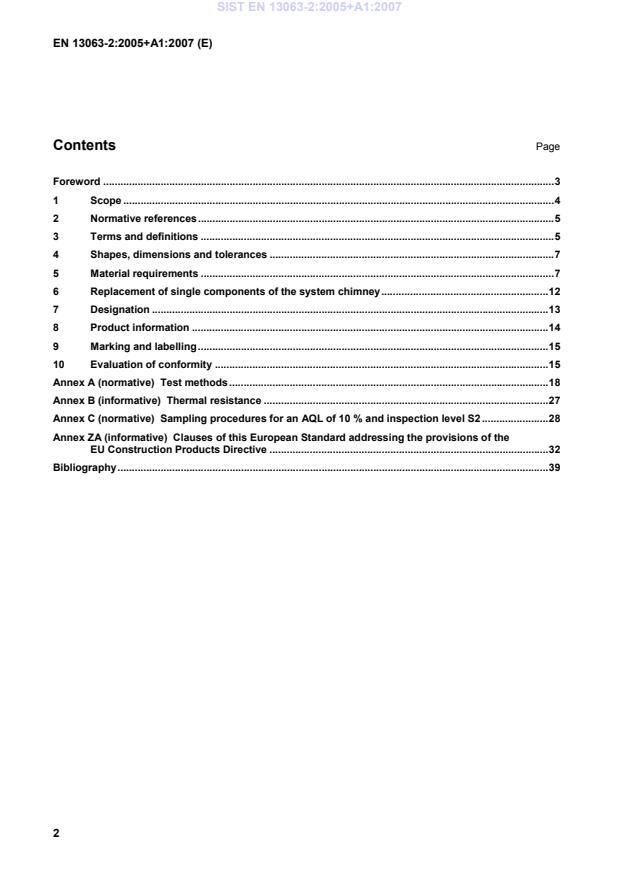
Contents Page
Foreword .3
1 Scope .4
2 Normative references.5
3 Terms and definitions .5
4 Shapes, dimensions and tolerances .7
5 Material requirements .7
6 Replacement of single components of the system chimney.12
7 Designation .13
8 Product information .14
9 Marking and labelling.15
10 Evaluation of conformity .15
Annex A (normative) Test methods.18
Annex B (informative) Thermal resistance .27
Annex C (normative) Sampling procedures for an AQL of 10 % and inspection level S2 .28
Annex ZA (informative) Clauses of this European Standard addressing the provisions of the
EU Construction Products Directive .32
Bibliography.39
Foreword
This document (EN 13063-2:2005+A1:2007) has been prepared by Technical Committee CEN/TC 166
“Chimneys”, the secretariat of which is held by UNI.
This document shall be given the status of a national standard, either by publication of an identical text or
by endorsement, at the latest by January 2008 and conflicting national standards shall be withdrawn at the
latest by April 2009.
This document includes Amendment 1 approved by CEN on 2007-06-14.
This document supersedes EN 13063-2:2005.
The start and finish of text introduced or altered by amendment is indicated in the text by tags ! ".
This document has been prepared under a mandate given to CEN by the European Commission and the
European Free Trade Association, and supports essential requirements of EU Directive(s).
For relationship with EU Directive(s), see informative Annex ZA, which is an integral part of this document.
This document is part 2 of a series of standards for system chimneys with clay/ceramic flue liners.
Part 1 is for chimneys with sootfire resistance and part 3 is for system air flue chimneys.
According to the CEN/CENELEC Internal Regulations, the national standards organizations of the following
countries are bound to implement this European Standard: Austria, Belgium, Bulgaria, Cyprus, Czech
Republic, Denmark, Estonia, Finland, France, Germany, Greece, Hungary, Iceland, Ireland, Italy, Latvia,
Lithuania, Luxembourg, Malta, Netherlands, Norway, Poland, Portugal, Romania, Slovakia, Slovenia,
Spain, Sweden, Switzerland and United Kingdom.
1 Scope
This European Standard specifies the requirements and test methods for multiwall system chimneys
working under wet conditions (in the following expressed as “wet chimney”) with pressure
type N1, N2 or P1 according to EN 1443 and a working temperature below or equal T600 according
to !EN 13063-1:2005+A1", in which the products of combustion are conveyed to the atmosphere
through clay/ceramic flue liners. Marking and inspection are also covered by this document.
This European Standard does not apply to structurally independent (free standing or self-supporting)
system chimneys.
The wet chimney may comprise the following appropriate components:
clay/ceramic flue liners;
insulation layer;
outer walls;
acid resistant mortar for jointing flue liners or elastomeric sealant;
mortar for jointing outer walls;
terminal;
chimney base;
condensate collector;
condensate outlet;
cladding;
opening section;
cleaning and inspection door;
distance piece;
reinforcement.
The wet system chimney covers a combination of compatible chimney components, obtained or specified
from one manufacturing source with product responsibility for the whole system chimney.
NOTE This document does not cover soot fire resistance chimneys.
2 Normative references
The following referenced documents are indispensable for the application of this document. For dated
references, only the edition cited applies. For undated references, the latest edition of the referenced
document (including any amendments) applies.
EN 998-2:2003,!Specification for mortar for masonry – Part 2: Masonry mortar"
EN 1366-8,!Fire resistance tests for service installations – Part 8: Smoke extraction ducts"
EN 1443:2003, Chimneys – General requirements
EN 1457:1999, Chimneys – Clay/ceramic flue liners – Requirements and test methods
EN 12446:2003, Chimneys – Components – Concrete outer wall elements
!EN 13063-1:2005+A1:2007", Chimneys – System chimneys with clay/ceramic flue liners – Part 1:
Requirements and test methods for sootfire resistance
!EN 13069:2005", Chimneys – Clay/ceramic outer walls for system chimneys – Requirements and
test methods
EN 13162:2001, Thermal insulation products for buildings – Factory made mineral wool (MW) products –
Specification
EN 13216-1:2004, Chimneys - Test methods for system chimneys – Part 1: General test methods
EN 13384-1, Chimneys – Thermal and fluid dynamic calculation methods – Part 1: Chimneys serving
one appliance
!EN 14241-1", Chimneys – Elastomeric seals and elastomeric sealants – Material requirements and
test methods - Part 1: Seals in flue liners
EN 14297:2004, Chimneys – Freeze-thaw resistance test method for chimney products
!ISO 2859-1, Sampling procedures for inspection by attributes – Part 1: Sampling schemes indexed by
acceptance quality limit (AQL) for lot-by-lot inspection"
3 Terms and definitions
For the purposes of this European Standard, the terms and definitions given in EN 1443:2003,
EN 13216-1:2004, !EN 13063-1:2005+A1:2007" and the following apply.
3.1
system chimney under wet conditions
system chimney is a multiwall construction, consisting mainly of an outer wall, an insulation layer and the
inner clay/ceramic flue liner that can work under wet conditions (see Figure 1)
Key
1 flue liner
2 insulation layer
3 outer wall
4 back ventilation
5 cavities for structural reinforcement
6 non ventilated air gap
Figure 1 — Examples of construction of a chimney for wet conditions
3.2
wet operating conditions
conditions when the chimney is designed to operate normally with the temperature of the inner surface of
the flue liner at and below the water dew point
3.3
condensate collector
flue liner base unit for collecting the condensates with an opening for discharging the condensates
3.4
condensate outlet
drain to ensure the discharge of the condensates from the condensates collector
3.5
jointing materials for flue liners
3.5.1
prefabricated elastomeric seals
prefabricated element made of elastomeric material, which ensures a gastight seal in a joint
3.5.2
on site applied elastomeric sealant
sealing material which is applied on site to ensure the gas tightness
3.5.3
acid resistant mortar
jointing material made with acid resistant mortar
4 Shapes, dimensions and tolerances
4.1 Flue liners
4.1.1 General
Flue liners shall meet the requirements on size and tolerance of dimensions given in EN 1457:1999, 7.1,
7.2, 7.3, 7.4, 7.5, 7.6 and 7.7.
4.1.2 External diameter of flue liner
When tested in accordance with A.2.6, the external diameter of circular flue liners measured on any
diameter shall not deviate more than ± 3 % of the manufacturer’s stated nominal external diameter.
4.2 Insulation
The insulation layer shall meet the requirements on tolerances of dimension given in EN 13162:2001,
4.2.2 (length and width) and 4.2.3 (thickness class T3).
4.3 Outer wall elements
Outer wall elements shall fulfil the requirements on shapes and tolerances on dimensions given in:
concrete outer wall elements: EN 12446:2003, Clause 7;
clay/ceramic outer walls: !EN 13069:2005", Clause 6;
metal outer walls: !EN 13063-1:2005+A1:2007", Annex B.
4.4 Cleaning and inspection doors
Dimensions and tolerances shall be declared by the manufacturers.
5 Material requirements
5.1 General requirements for components
5.1.1 Flue liners
Flue liners shall meet the requirements of EN 14571999, 8.1, 9.1, 9.2, Clauses 10, 11, 12 and 13. If the
requirement of EN 1457:1999, 13.1 "Water vapour permeability" is not fulfilled, the flue liner may be used
for wet chimneys, if the system test for system chimneys under wet conditions according to
!EN 13216-1:2004, 5.6, is passed according to the requirements in 5.3.2.1."
5.1.2 Maximum load for opening sections
When tested as described in A.2.3, components shall withstand a load (F) of at least five times the
manufacturer's declared design load (H × G).
χ ×H ×G
F = (1)
where
F is the minimum load, expressed in kilonewton (kN);
χ is the safety factor equal to 5;
H is the height of the chimney, is expressed in meter (m);
G is expressed in kilogram per meter (kg/m).
NOTE The limiting factor of the maximum height of system chimneys is the compressive strength of the
opening section.
5.1.3 Jointing material for flue liners
5.1.3.1 Acid resistant mortar
5.1.3.1.1 Density
The density of jointing material shall not vary more than ± 10 % of the manufacturer's declared value
when tested in accordance with A.2.2.2.
5.1.3.1.2 Compressive strength
The compressive strength shall be tested after a 24 h preconditioning under water in accordance with
A.2.2.3.The compressive strength shall be at least 10 N/mm².
5.1.3.1.3 Water resistance
Acid resistant mortar for jointing the components in system chimneys stated for use in wet conditions
shall be tested in accordance with A.2.2.4 and the mass loss from any sample shall not exceed 3 %.
5.1.3.1.4 Acid resistance
When tested in accordance with A.2.2.5, the mass loss from any sample shall not exceed 2 %.
5.1.3.2 Prefabricated elastomeric seals
The elastomeric seals shall comply with !EN 14241-1".
5.1.4 Insulation
5.1.4.1 General
The insulation shall be to the manufacturer’s specifications and shall be prefabricated and have an
independent, permanent shape before and after being exposed to heat (e.g. blocks or bonded loose
material).
5.1.4.2 Durability under normal operating conditions
When tested in accordance with A.2.1 at test temperature related to the temperature class (see Table 1),
the change in the outside surface temperature of the test sample after the fourth cycle of heating shall
not exceed 10 % of the maximum outside surface temperature of the sample of the first cycle.
Table 1 — Test temperatures
Temperature class T 80 T 100 T 120 T 140 T 160 T 200 T 250 T 300 T 400 T 450 T 600
Test temperature (°C) 100 120 150 170 190 250 300 350 500 550 700
5.1.5 Outer wall elements
Outer wall elements shall fulfil EN 12446 for concrete outer wall elements, !EN 13069" for
clay/ceramic outer wall or Annex B of !EN 13063-1:2005+A1:2007" for metal outer walls.
5.1.6 Jointing material for outer wall elements
Jointing materials used for jointing outer walls according to EN 12446 for concrete outer wall elements
and !EN 13069" for clay/ceramic outer walls, where supplied with the system chimney, shall comply
with the system chimney manufacturer's declared specification and shall be at least M2,5 according to
EN 998-2:2003, 5.3.1, Table 1.
5.1.7 Wind load
The freestanding part of the chimney above the last lateral support of the system chimney shall withstand
a wind load of 1,5 kN/m . The maximum permissible height of a chimney outside the building of a system
chimney shall be calculated according to calculation methods applicable in the place of use of the
chimney, taking into account the tilt momentum of the outer wall element. Alternatively the tilt momentum
of the complete construction can be taken into account. A test method to evaluate the tilt momentum is
given in A.2.4.
5.2 Safety in use
5.2.1 Thermal shock resistance
The wet chimney shall be tested at the normal operating conditions in accordance with the heat stress
test method described in !EN 13216-1:2004, 5.7", for the required temperature types according to
Table 1.
5.2.2 Distance to combustible materials
5.2.2.1 General
The distance to combustible materials shall be tested at the normal operating condition in accordance
with !EN 13216-1:2004, 5.7", the test assembly shall be the corner installation. The distance
between the outer surface of the chimney and the adjacent combustible material shall be declared as
O(xx), where (xx) is the minimum distance in mm.
5.2.2.2 Normal operating conditions
The wet chimney shall be tested in accordance with the heat stress test method described in
!EN 13216-1:2004, 5.7" for the required temperature types according to Table 1. The maximum
surface temperature of combustible materials adjacent to the test wet chimney shall not be greater than
85 °C, when related to an ambient temperature of 20 °C.
NOTE 1 This requirement is declared fulfilled when chimneys, where combustibles are at least 50 mm from the
outer walls and the space ventilated, are tested in a free standing open room test assembly at the test-temperatures
500 °C (for T400) or 700 °C (for T600) and the temperature of the outer wall does not exceed 100 °C at an ambient
temperature of 20 °C. For this case the distance is designated as O50.
NOTE 2 If the wet chimney has already been tested according to !EN 13063-1:2005+A1:2007", 5.2.1.1, the
results can be used.
5.2.3 Relative movement between flue liner and outer wall
After thermal testing (normal operating conditions) in accordance with !EN 13216-1:2004, 5.7", the
final position after cooling down to room temperature of the upper flue liner shall be ± 5 mm to the
original position when tested according to !EN 13216-1:2004, 5.3".
5.2.4 Thermal resistance
The thermal resistance value of the system chimney declared by the manufacturer shall be verified by
testing according to the test method of EN 13216-1:2004, 5.8 (as the reference test method) or
calculation in accordance with Annex B, both with inner surface temperature of the flue liner at 200 °C.
The designation of the thermal resistance shall be given as Ryy, where yy is the value in square metres
Kelvin per Watt multiplied by 100, rounded to the nearest integer (e.g.: R22 is R=0,22 m K/W).
5.2.5 Resistance to fire external to external
!Until a European test method is available the resistance to fire, external to external, shall be
evaluated and declared according to national regulations.
Examples of European classification are given in Table 2."
!!!!Table 2 — Examples of European fire resistance performance classes""""
Fire resistance performance classes Duration in min
EI 000 0 ≤ EI 000 < 30
EI 030
30 ≤ EI 030 < 60
EI 060 60 ≤ EI 060 < 90
EI 090 90 ≤ EI 090 < 120
EI 120
120 ≤ EI 120
5.3 Hygiene, health and environment
5.3.1 Gas tightness
When a chimney is tested according to the test methods described in !EN 13216-1:2004, 5.4", the
leakage rate shall not be greater than that given in Table 3, both before and after the thermal
performance test.
Table 3 — Leakage rate
Leakage rate/
Test pressure
Pressure type flue surface area
(Pa)
3 ²
(m /s/ m )
-3
N1 40 2 ×⋅10
-3
N2 20
3 ×⋅10
-3
P1 200 0,006 × 10
5.3.2 Durability
5.3.2.1 Condensate resistance
Wet chimneys shall have either clay/ceramic flue liners which are designated W according
to !EN 1457:1999, Clause 13 and EN 1457:1999/A1:2002, Clause 13", or clay/ceramic flue liners
which are designated D according to !EN 1457:1999 and EN 1457:1999/A1:2002" if the chimney,
when tested according to !EN 13216-1:2004, 5.6", shows no water vapour saturation in any part of
the system chimney.
Prefabricated elastomeric seals and on site applied elastomeric sealant shall comply with !EN 14241-
1" condensate class W at the designated temperature class of the wet chimney
5.3.2.2 Corrosion resistance of flue liners and jointing material
The mass loss of clay/ceramic flue liners shall not exceed 2 % when tested according to EN 1457:1999,
16.9. Prefabricated elastomeric seals and on site applied elastomeric sealant shall comply with !EN
14241-1" corrosion class 1 or 2 at the designated temperature class of the wet chimney.
5.3.3 Flow resistance of flue liners and fittings
!The manufacturer shall declare either:
1) The flow resistance measured according to EN 13216-1:2004, 5.11; or
2) The friction coefficient ζ and the mean roughness r calculated according to EN 13216-1:2004,
5.11; or
3) The default roughness value for clay/ceramic inner liners of r = 0,0015 m and/or the default
friction coefficient ζ for fittings taken from EN 13384-1."
5.4 Cleaning and inspection doors
The increase of the surface temperature of the outer surface of the cleaning and inspection doors shall
not exceed 140 K during thermal testing, the test shall be carried out in accordance with !EN 13216-
1:2004, 5.7".
NOTE It is recommended that the distance to combustible materials should not be less than 400 mm from
cleaning and inspection doors.
When tested in accordance with !EN 13216-1:2004, 5.4", the complete system with cleaning and
inspection doors shall not have a leakage rate greater than the values given in Table 3.
The inspection opening shall not hinder the relative movement of the flue liner and no water shall occur
at the outside of the cleaning and inspection doors.
5.5 Cladding and accessory exposed to freeze/thaw
!For particular climatic conditions and where subject to national regulations, the freeze/thaw resistance
of the flue liner and/or the outer wall of the system chimney shall be tested according to EN 14297. The
product shall not present any damage of type 7, 8, 9 and 10 in accordance with EN 14297:2004, Table
1."
6 Replacement of single components of the system chimney
6.1 General
If the manufacturer changes a part of the system, it is possible to replace single components as
described below. If the manufacturing process or material of a single component changes, it shall also be
tested like a replacement.
6.2 Change of flue liner
To change the type of flue liner, the new values of each characteristic shall be compared to the original
flue liner and shall not deviate more than the values given in Table 4.
Table 4 — Requirements of flue liners for exchange
Test method for comparison
Requirement compared to
Characteristic of flue liner
originally used flue liner
EN 1457:1999
Tolerances on dimensions Equal or tighter Clause 7
Density Equal or denser Clause 11
Temperature Equal or higher 16.8
Compressive strength Equal or higher 8.1
Acid resistance (mass loss) Equal or less Clause 10
Condensate resistance Equal or tighter 13.1
6.3 Change of opening sections
The opening sections shall be tested as described in A.2.3. The minimum load shall be equal or more
than the original value.
6.4 Change of insulation
To change the type of insulation, the new values of each characteristic shall be compared to the original
flue liner and shall not deviate more than the values given in Table 5.
Table 5 — Requirements of insulation for exchange
Requirement compared to
Characteristic of insulation Test method for comparison
originally used insulation flue liner
Thermal conductivity Equal or lower EN 13162:2001, 4.2.1
Layer thickness Equal or greater EN 13162 :2001, 4.2.3
Durability At least equal A.2.1
6.5 Change of jointing materials for flue liners
To change the jointing materials for flue liners, the new values of each characteristic shall be compared
to the original flue liner and shall not deviate more than the values given in Table 6.
Table 6 — Requirements of jointing materials for flue liners for exchange
Requirement compared to
Characteristic of jointing materials Test method for comparison
originally used jointing materials
Compressive strength of mortar Equal or higher A.2.2.3
Water resistance of mortar (mass
Equal or less A.2.2.4
loss)
Acid resistance of mortar (mass loss) Equal or less A.2.2.5
Prefabricated elastomeric seals Equal or higher !EN 14241-1"
Elastomeric sealant applied on site Equal or higher !EN 14241-1"
6.6 Change of outer wall elements
If concrete outer wall elements have to be changed they shall be according to EN 12446 and the flue
liner shall be designated W. Otherwise the system test for system chimneys under wet conditions
according to !EN 13216-1:2004, 5.6", shall be applied.
6.7 Change of cleaning and inspection doors
If a cleaning and inspection door shall be tested separately from the initial type test of the system
chimney (e.g. for exchange of component or use in more than one system), the doors shall be tested
according to A.2.5.
The increase of surface temperature before and after thermal testing shall be !less than 140 K". The
gas tightness before and after thermal testing shall be within the leakage rate given in Table 3. The door
shall not hinder the movement of the flue liner. No condensate shall occur at the outside of the door
when tested.
7 Designation
The following shall be used for the designation of system chimneys with clay/ceramic flue liners under
wet conditions:
denomination;
standard number;
temperature class (see Table 1);
resistance to condensate class (see 5.3.2.1);
corrosion condensate class (see 5.3.2.2);
soot fire resistance class followed by the distance to combustible materials (see 5.2.2);
NOTE The CE marking the distance to combustible material should not be indicated.
pressure class (see 5.3.1).
Typical example
System EN 13063 –2 T400 N1 W 2 O50
chimney
Denomination
Standard number
Temperature class
Pressure class
Resistance to
condensate class
Corrosion resistance
class
Soot fire resistance
class followed by the
distance to combustible
materials
8 Product information
The installation instructions shall be available in the language of the country in which the product is
placed on the market and shall meet the criteria, if stated, in the national building regulations.
The following information shall be included:
manufacturer identification;
product designation with explanation;
installation drawing typical of the application;
method of jointing the components;
method of installing sections or fittings and accessories;
minimum distance to combustibles;
limitations of height and location of exposed section of the chimney;
location of the inspection doors;
resistance to fire external to external;
values for performance calculation according to EN 13384-1:
nominal temperature of the chimney;
gas tightness of the chimney;
internal size of the flue liner (diameter or length and width);
external size of the chimney (length and width or diameter);
thermal resistance of the chimney;
roughness of the flue liner;
coefficient of flow resistance due to a directional change in the flue.
9 Marking and labelling
The manufacturer shall make available a chimney plate made of a durable material that shall include the
following information:
a) name or trademark of the manufacturer, engraved or indelibly marked;
b) nominal size;
c) date of manufacturing or batch number;
d) first installer;
e) date of installation.
NOTE For CE marking and labelling, see ZA.3.
10 Evaluation of conformity
10.1 General
The conformity of the system chimneys working under wet conditions to the requirements of this
document and with the stated values (including classes) shall be demonstrated by:
initial type testing;
factory production control by the manufacturer, including product assessment.
For the purposes of testing, the system chimneys working under wet conditions may be grouped into
families, where it is considered that the selected property/properties is/are common to all the system
chimneys working under wet conditions within that family.
10.2 Components
Wet chimneys are made of components that have been already evaluated for conformity according to
their relevant product standards:
clay/ceramic flue liners EN 1457;
insulation EN 13162;
clay/ceramic outer wall elements !EN 13069";
concrete outer wall elements EN 12446;
metal outer wall elements Annex B.
10.3 Initial type testing
Type tests for the required characteristics given in Table 7 shall be performed initially together with
factory production control tests.
The test sequence according to A.1 shall be carried out on one size of flue liner for each geometrical
configuration (e.g. circular, square, rectangular). For circular flue liners the size to be tested shall be
(200 ± 50) mm internal diameter. For other geometrical configurations the flue liner shall have an
equivalent cross-sectional area range.
All other tests of Table 7, which are not included in the test sequence of A.1, are carried out separately.
10.4 Exchange of components
A new component in the system chimney shall comply with the relevant requirement clauses given in
Table 7.
Table 7 — Factory production control and type tests
Relevant requirement clauses
Item
Factory production Exchange of
initial type tests 10.3
control 10.5 components 10.4
Wind load 5.1.7
Thermal shock
5.2.1
conditions
Thermal
5.2.4
resistance
Wet chimney
Gas tightness 5.3.1
Flow resistance
of inner liners 5.3.3
and fittings
Freeze/thaw
5.5 5.5
resistance
flue liners 4.1 5.1.1 6.2
Insulation 4.2 5.1.4 6.4
opening section - 5.1.2 6.3
jointing material 5.1.3.1.1 5.1.6 6.5
outer wall elements:
- 5.1.5 6.6
clay/ceramic
outer wall elements:
- 5.1.5 6.6
concrete
!EN 13063- !EN 13063-
outer wall elements:
1:2005+A1:2007", 1:2005+A1:2007", not possible
metal
B.2 B.3
cleaning and inspection doors 4.4 5.4 6.7
10.5 Factory production control
To achieve compliance with this document the manufacturer shall establish and maintain an effective
documented quality system.
Factory production control tests are carried out by the manufacturer to monitor the quality of product.
(see Table 7).
Sampling and testing of any batch shall be completed prior to removal from the works and shall be in
accordance with ISO 2859-1 at an AQL of 10 % and inspection level S2. Isolated batches of units shall
be assessed in accordance with tightened inspection procedures, with a maximum batch size of
1 200 (see Annex C).
Batch
...
ba
SLOVENSKI SIST EN 13063-2:2005+A1
STANDARD
september 2007
Dimovodne naprave – Sistemske dimovodne naprave s keramičnimi
dimovodnimi tuljavami – 2. del: Zahteve in preskusne metode za
obratovanje v vlažnih pogojih
Chimneys – System chimneys with clay/ceramic flue liners –
Part 2: Requirements and test methods under wet conditions
Abgasanlagen – System-Abgasanlagen mit Keramik-Innenrohren –
Teil 2: Anforderungen und Prüfungen für feuchte Betriebsweise
Conduits de cheminées – Conduits de cheminées résistant aux feux de
cheminées a paroi intérieure en terre cuite/céramique – Partie 2: Exigences et
méthodes d'essai en conditions humides
Referenčna oznaka
ICS 91.060.40 SIST EN 13063-2:2005+A1:2007 (sl)
Nadaljevanje na straneh II do III in od 1 do 37
© 2020-03. Slovenski inštitut za standardizacijo. Razmnoževanje celote ali delov tega standarda ni dovoljeno.
SIST EN 13063-2:2005+A1 : 2007
NACIONALNI UVOD
Standard SIST EN 13063-2:2005+A1 (sl), Dimovodne naprave – Sistemske dimovodne naprave s
keramičnimi dimovodnimi tuljavami – 2. del: Zahteve in preskusne metode za obratovanje v vlažnih
pogojih, 2007, ima status slovenskega standarda in je istoveten evropskemu standardu EN 13063-
2:2005+A1 (en, de, fr), Chimneys – System chimneys with clay/ceramic flue liners – Part 2:
Requirements and test methods under wet conditions, 2007.
Ta standard nadomešča SIST EN 13063-2:2005.
NACIONALNI PREDGOVOR
Evropski standard EN 13063-2:2005+A1:2007 je pripravil tehnični odbor Evropskega komiteja za
standardizacijo CEN/TC 166 Dimovodne naprave. Slovenski standard SIST EN 13063-2:2005+A1:2007
je prevod evropskega standarda EN 13063-2:2005+A1:2007 v angleškem jeziku. V primeru spora glede
besedila slovenskega prevoda v tem standardu je odločilen izvirni evropski standard v enem izmed treh
uradnih jezikov CEN. Slovensko izdajo standarda je pripravil tehnični odbor SIST/TC POZ Požarna
varnost.
Odločitev za privzem tega standarda je julija 2007 sprejel SIST/TC POZ Požarna varnost.
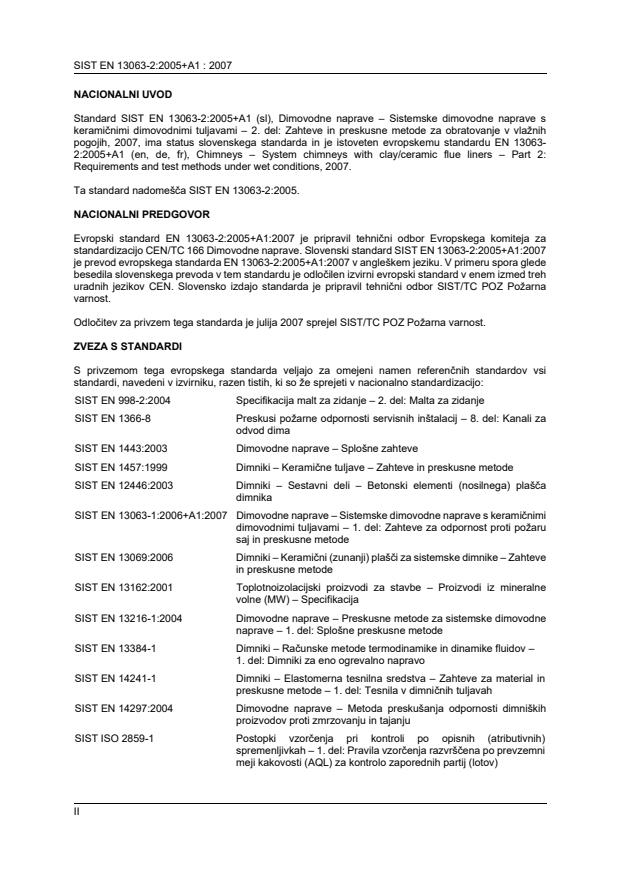
ZVEZA S STANDARDI
S privzemom tega evropskega standarda veljajo za omejeni namen referenčnih standardov vsi
standardi, navedeni v izvirniku, razen tistih, ki so že sprejeti v nacionalno standardizacijo:
SIST EN 998-2:2004 Specifikacija malt za zidanje – 2. del: Malta za zidanje
SIST EN 1366-8 Preskusi požarne odpornosti servisnih inštalacij – 8. del: Kanali za
odvod dima
SIST EN 1443:2003 Dimovodne naprave – Splošne zahteve
SIST EN 1457:1999 Dimniki – Keramične tuljave – Zahteve in preskusne metode
SIST EN 12446:2003 Dimniki – Sestavni deli – Betonski elementi (nosilnega) plašča
dimnika
SIST EN 13063-1:2006+A1:2007 Dimovodne naprave – Sistemske dimovodne naprave s keramičnimi
dimovodnimi tuljavami – 1. del: Zahteve za odpornost proti požaru
saj in preskusne metode
SIST EN 13069:2006 Dimniki – Keramični (zunanji) plašči za sistemske dimnike – Zahteve
in preskusne metode
SIST EN 13162:2001 Toplotnoizolacijski proizvodi za stavbe – Proizvodi iz mineralne
volne (MW) – Specifikacija
SIST EN 13216-1:2004 Dimovodne naprave – Preskusne metode za sistemske dimovodne
naprave – 1. del: Splošne preskusne metode
SIST EN 13384-1 Dimniki – Računske metode termodinamike in dinamike fluidov –
1. del: Dimniki za eno ogrevalno napravo
SIST EN 14241-1 Dimniki – Elastomerna tesnilna sredstva – Zahteve za material in
preskusne metode – 1. del: Tesnila v dimničnih tuljavah
SIST EN 14297:2004 Dimovodne naprave – Metoda preskušanja odpornosti dimniških
proizvodov proti zmrzovanju in tajanju
SIST ISO 2859-1 Postopki vzorčenja pri kontroli po opisnih (atributivnih)
spremenljivkah – 1. del: Pravila vzorčenja razvrščena po prevzemni
meji kakovosti (AQL) za kontrolo zaporednih partij (lotov)
II
SIST EN 13063-2:2005+A1 : 2007
OSNOVA ZA IZDAJO STANDARDA
– privzem standarda EN 13063-2:2005+A1:2007
PREDHODNA IZDAJA
– SIST EN 13063-2:2005, Dimniki – Sistemski dimniki s keramičnimi tuljavami – 2. del: Zahteve in
preskusne metode za delovanje v vlažnih razmerah
OPOMBE
– Povsod, kjer se v besedilu standarda uporablja izraz "evropski standard", v SIST EN 13063-
2:2005+A1:2007 to pomeni "slovenski standard".
– Nacionalni uvod in nacionalni predgovor nista sestavni del standarda.
– Ta nacionalni dokument je istoveten EN 13063-2:2005+A1:2007 in je objavljen z dovoljenjem
CEN-CENELEC
Upravni center
Rue de Stassart 36
B-1050 Bruselj
This national document is identical with EN 13063-2:2005+A1:2007 and is published with the
permission of
CEN-CENELEC
Management Centre
Rue de Stassart, 36
B-1050 Brussels
III
SIST EN 13063-2:2005+A1 : 2007
(prazna stran)
IV
EVROPSKI STANDARD EN 13063-2:2005+A1
EUROPEAN STANDARD
NORME EUROPÉENNE
julij 2007
EUROPÄISCHE NORM
ICS 91.060.40 Nadomešča EN 13063-2:2005
Slovenska izdaja
Dimovodne naprave – Sistemske dimovodne naprave s keramičnimi
dimovodnimi tuljavami – 2. del: Zahteve in preskusne metode za
obratovanje v vlažnih pogojih
Chimneys – System chimneys Conduits de cheminées – Abgasanlagen – System-
with clay/ceramic flue liners – Conduits de cheminées Abgasanlagen mit Keramik-
Part 2: Requirements and test résistant aux feux de cheminées Innenrohren – Teil 2:
methods under wet conditi a paroi intérieure en terre Anforderungen und Prüfungen
cuite/céramique – Partie 2: für feuchte Betriebsweise
Exigences et méthodes d'essai
en conditions humides
Ta evropski standard je CEN sprejel 1. aprila 2005 in vključuje dopolnilo 1, ki ga je CEN sprejel 14. junija
2007.
Člani CEN morajo izpolnjevati določila notranjih predpisov CEN/CENELEC, s katerimi je predpisano,
da mora biti ta evropski standard brez kakršnihkoli sprememb sprejet kot nacionalni standard. Seznami
najnovejših izdaj teh nacionalnih standardov in njihovi bibliografski podatki so na voljo pri Upravnem
centru CEN ali članih CEN.
Ta evropski standard obstaja v treh uradnih izdajah (angleški, francoski in nemški). Izdaje v drugih jezikih,
ki jih člani CEN na lastno odgovornost prevedejo in izdajo ter prijavijo pri Upravnem centru CEN, veljajo
kot uradne izdaje.
Člani CEN so nacionalni organi za standarde Avstrije, Belgije, Bolgarije, Cipra, Češke republike, Danske,
Estonije, Finske, Francije, Grčije, Irske, Islandije, Italije, Latvije, Litve, Luksemburga, Madžarske, Malte,
Nemčije, Nizozemske, Norveške, Poljske, Portugalske, Romunije, Slovaške, Slovenije, Španije,
Švedske, Švice in Združenega kraljestva.
CEN
Evropski komite za standardizacijo
European Committee for Standardization
Comité Européen de Normalisation
Europäisches Komitee für Normung
Upravni center: rue de Stassart, 36, B-1050 Brussels
© 2007 CEN. Lastnice avtorskih pravic so vse države članice CEN. Ref. oznaka: EN 13063-2:2005+A1:2007 E
SIST EN 13063-2:2005+A1 : 2007
VSEBINA Stran
Predgovor . 3
1 Področje uporabe . 4
2 Zveze s standardi . 4
3 Izrazi in definicije . 5
4 Oblike, mere in tolerance . 7
5 Zahteve za material . 7
6 Zamenjava posameznih sestavnih delov sistemske dimovodne naprave . 12
7 Oznaka . 13
8 Informacije o proizvodu . 14
9 Označevanje in etiketiranje . 15
10 Vrednotenje skladnosti . 15
Dodatek A (normativni): Preskusne metode . 18
Dodatek B (informativni): Toplotna upornost . 27
Dodatek C (normativni): Postopki vzorčenja za raven prevzemne kakovosti 10 % (AQL) in
raven pregleda S2 . 28
Dodatek ZA (informativni): Točke tega evropskega standarda, v katerih so obravnavane
določbe Direktive EU o gradbenih proizvodih . 32
Literatura . 37
SIST EN 13063-2:2005+A1 : 2007
Predgovor
Ta dokument (EN 13063-2:2005+A1:2007) je pripravil tehnični odbor CEN/TC 166 "Dimovodne
naprave", katerega sekretariat vodi UNI.
Ta dokument mora dobiti status nacionalnega standarda bodisi z objavo istovetnega besedila ali z
razglasitvijo najpozneje januarja 2008, nasprotujoče nacionalne standarde pa je treba razveljaviti
najpozneje aprila 2009.
Ta dokument vključuje dopolnilo 1, ki ga je CEN sprejel 14. junija 2007.
Ta dokument nadomešča standard EN 13063-2:2005.
Začetek in konec besedila, dodanega ali spremenjenega z dopolnilom, sta označena z oznakama .
Ta dokument je bil pripravljen na podlagi mandata, ki sta ga Evropska komisija in Evropsko združenje
za prosto trgovino podelila CEN, in podpira bistvene zahteve direktiv EU.
Za povezavo z direktivo(-ami) Evropske unije glej dodatek ZA, ki je sestavni del tega dokumenta.
Ta dokument je 2. del skupine standardov za sistemske dimovodne naprave s keramičnimi dimovodnimi
tuljavami.
Prvi del obravnava dimovodne naprave, odporne proti požaru saj, in tretji del sistemske dimovodne
naprave z zračnimi dimovodi.
V skladu z notranjimi predpisi CEN/CENELEC morajo ta evropski standard obvezno uvesti nacionalne
organizacije za standardizacijo naslednjih držav: Avstrije, Belgije, Bolgarije, Cipra, Češke republike,
Danske, Estonije, Finske, Francije, Grčije, Irske, Islandije, Italije, Latvije, Litve, Madžarske,
Luksemburga, Malte, Nemčije, Nizozemske, Norveške, Poljske, Portugalske, Romunije, Slovaške,
Slovenije, Španije, Švedske, Švice in Združenega kraljestva.
SIST EN 13063-2:2005+A1 : 2007
1 Področje uporabe
Ta evropski standard določa zahteve in preskusne metode za večslojne sistemske dimovodne naprave,
ki obratujejo v vlažnih pogojih (v nadaljevanju: dimovodna naprava za obratovanje v vlažnem), s tlakom
tipa N1, N2 ali P1 v skladu s standardom EN 1443 in delovno temperaturo, nižjo ali enako T600 v skladu
s standardom EN 13063-1:2005+A1 , pri katerih se produkti zgorevanja odvajajo v ozračje prek
keramičnih dimovodnih tuljav. Ta dokument zajema tudi označevanje in pregledovanje.
Ta evropski standard se ne uporablja za konstrukcijsko neodvisne (samostoječe ali samonosilne)
sistemske dimovodne naprave.
Dimovodno napravo za obratovanje v vlažnem lahko sestavljajo naslednji ustrezni sestavni deli:
– keramične dimovodne tuljave,
– izolacijski sloj,
– zunanji plašči,
– malta, odporna proti kislinam, za spajanje dimovodnih tuljav ali elastomerna tesnilna masa,
– malta za spajanje zunanjih plaščev,
– zaključni element,
– temelj dimovodne naprave,
– zbiralnik kondenzata,
– odvod kondenzata,
– obloga dimovodne naprave,
– element z odprtino,
– vratca za čiščenje in pregledovanje,
– distančnik,
– ojačitev.
Sistemska dimovodna naprava za obratovanje v vlažnem je kombinacija med seboj združljivih sestavnih
delov, ki jih je dobavil ali določil en sam proizvajalec, ki prevzema odgovornost za celotno dimovodno
napravo.
OPOMBA: Ta dokument ne zajema dimovodnih naprav, odpornih proti požaru saj.
2 Zveze s standardi
Za uporabo tega dokumenta so nujni naslednji referenčni dokumenti. Pri datiranih sklicevanjih se
uporablja samo navedena izdaja. Pri nedatiranih sklicevanjih se uporablja zadnja izdaja referenčnega
dokumenta (vključno z morebitnimi dopolnili).
EN 998-2:2003 Specifikacija malt za zidanje – 2. del: Malta za zidanje
EN 1366-8 Preskusi požarne odpornosti servisnih inštalacij – 8. del: Kanali
za odvod dima
EN 1443:2003 Dimovodne naprave – Splošne zahteve
EN 1457:1999 Dimniki – Keramične tuljave – Zahteve in preskusne metode
EN 12446:2003 Dimniki – Sestavni deli – Betonski elementi (nosilnega) plašča
dimnika
SIST EN 13063-2:2005+A1 : 2007
EN 13063-1:2005+A1:2007 Dimovodne naprave – Sistemske dimovodne naprave s keramičnimi
dimovodnimi tuljavami – 1. del: Zahteve za odpornost proti požaru
saj in preskusne metode
EN 13069:2006 Dimniki – Keramični (zunanji) plašči za sistemske dimnike – Zahteve
in preskusne metode
EN 13162:2001 Toplotnoizolacijski proizvodi za stavbe – Proizvodi iz mineralne
volne (MW) – Specifikacija
EN 13216-1:2004 Dimovodne naprave – Preskusne metode za sistemske dimovodne
naprave – 1. del: Splošne preskusne metode
EN 13384-1 Dimniki – Računske metode termodinamike in dinamike fluidov –
1. del: Dimniki za eno ogrevalno napravo
EN 14241-1 Dimniki – Elastomerna tesnilna sredstva – Zahteve za material in
preskusne metode – 1. del: Tesnila v dimničnih tuljavah
EN 14297:2004 Dimovodne naprave – Metoda preskušanja odpornosti dimniških
proizvodov proti zmrzovanju in tajanju
ISO 2859-1 Postopki vzorčenja pri kontroli po opisnih (atributivnih)
spremenljivkah – 1. del: Pravila vzorčenja razvrščena po prevzemni
meji kakovosti (AQL) za kontrolo zaporednih partij (lotov)
3 Izrazi in definicije
V tem evropskem standardu se uporabljajo izrazi in definicije, navedeni v standardih EN 1443:2003,
EN 13216-1:2004, EN 13063-1:2005+A1:2007 , ter naslednji izrazi in definicije:
3.1
sistemska dimovodna naprava za obratovanje v vlažnih pogojih
sistemska dimovodna naprava je večslojna konstrukcija, najpogosteje sestavljena iz zunanjega plašča,
izolacijskega sloja in notranje keramične dimovodne tuljave, ki lahko deluje v vlažnih pogojih (glej sliko
1)
SIST EN 13063-2:2005+A1 : 2007
Legenda:
1 dimovodna tuljava
2 izolacijski sloj
3 zunanji plašč
4 povratno prezračevanje
5 odprtine za konstrukcijsko ojačitev
6 zračna reža brez prezračevanja
Slika 1: Primeri konstrukcije dimovodne naprave za obratovanje v vlažnih pogojih
3.2
vlažni pogoji obratovanja
pogoji, pri katerih je dimovodna naprava načrtovana, da obratuje normalno, kadar je temperatura
notranje površine dimovodne tuljave enaka ali nižja od temperature rosišča
3.3
zbiralnik kondenzata
osnovni element dimovodne tuljave za zbiranje kondenzata z odprtino za odvajanje kondenzata
3.4
odvod kondenzata
odtok za odvajanje kondenzata iz zbiralnika kondenzata
3.5
vezivni materiali za tuljave
3.5.1
predizdelana elastomerna tesnila
predizdelan element iz elastomernega materiala, ki zagotavlja, da je spoj plinotesen
SIST EN 13063-2:2005+A1 : 2007
3.5.2
elastomerna tesnilna masa, ki se nanese na kraju samem
tesnilni material, ki se nanese na kraju samem, da se zagotovi plinotesnost
3.5.3
malta, odporna proti kislinam
vezivni material, izdelan z malto, odporno proti kislinam
4 Oblike, mere in tolerance
4.1 Dimovodne tuljave
4.1.1 Splošno
Dimovodne tuljave morajo izpolnjevati zahteve glede velikosti in tolerance mer, podane v točkah 7.1,
7.2, 7.3, 7.4, 7.5, 7.6 in 7.7 standarda EN 1457:1999
4.1.2 Zunanji premer dimovodne tuljave
Kadar se preskuša v skladu z A.2.6, zunanji premer okroglih dimovodnih tuljav, izmerjen pri kateremkoli
premeru, ne sme odstopati za več kot ± 3 % od nazivnega zunanjega premera, ki ga je navedel
proizvajalec.
4.2 Izolacija
Izolacijski sloj mora izpolnjevati zahteve glede tolerance mer, podane v točkah 4.2.2 (dolžina in širina)
in 4.2.3 (razred debeline T3) standarda EN 13162:2001.
4.3 Elementi zunanjega plašča
Elementi zunanjega plašča morajo izpolnjevati zahteve glede oblik in toleranc mer, podanih v:
betonski elementi zunanjega plašča: EN 12446:2003, točka 7
keramični zunanji plašči: EN 13069:2005 , točka 6
kovinski zunanji plašči: EN 13063-1:2005+A1:2007 , dodatek B.
4.4 Čistilna in revizijska vratca
Mere in tolerance morajo navesti proizvajalci.
5 Zahteve za material
5.1 Splošne zahteve za sestavne dele
5.1.1 Dimovodne tuljave
Dimovodne tuljave morajo izpolnjevati zahteve iz točk 8.1, 9.1, 9.2, 10, 11, 12 in 13 standarda EN
1457:1999. Če zahteva iz točke 13.1 "Prepustnost za vodno paro" standarda EN 1457:1999 ni
izpolnjena, se dimovodna tuljava lahko uporabi za dimovodne naprave za obratovanje v vlažnem, če je
sistemski preskus za sistemske dimovodne naprave za obratovanje v vlažnih pogojih v skladu s točko
5.6 standarda EN 13216-1:2004 opravljen v skladu z zahtevami iz točke 5.3.2.1.
5.1.2 Največja obtežba elementov z odprtino
Pri preskušanju, kot je opisano v točki A.2.3, morajo sestavni deli zdržati obtežbo (F), ki je najmanj petkrat
večja od projektne obtežbe, ki jo je navedel proizvajalec (H G).
SIST EN 13063-2:2005+A1 : 2007
(1)
kjer so:
F najmanjša obtežba, izražena v kilonewtonih (kN)
χ varnostni faktor = 5
H višina dimnika, izražena v metrih (m)
G izražen v kilogramih na meter (kg/m)
OPOMBA: Omejitveni faktor največje višine sistemskih dimovodnih naprav je tlačna trdnost elementa z odprtino.
5.1.2 Vezivni material za dimovodne tuljave
5.1.3.1 Malta, odporna proti kislinam
5.1.3.1.1 Gostota
Pri preskušanju, kot je opisano v točki A.2.2.2, se gostota vezivnega materiala ne sme razlikovati za več
kot ± 10 % od vrednosti, ki jo je navedel proizvajalec.
5.1.3.1.2 Tlačna trdnost
Tlačno trdnost je treba preskusiti po 24 h predkondicioniranja v vodi v skladu s točko A.2.2.3. Tlačna
trdnost mora biti vsaj 10 N/mm .
5.1.3.1.3 Odpornost proti vodi
Proti kislinam odporno malto za spajanje sestavnih delov sistemskih dimovodnih naprav, za katero je
navedeno, da se uporablja v vlažnih pogojih, je treba preskusiti v skladu s točko A.2.2.4 in izguba mase
pri nobenem vzorcu ne sme presegati 3 %.
5.1.3.1.4 Odpornost proti kislinam
Pri preskušanju v skladu s točko A.2.2.5 izguba mase pri nobenem vzorcu ne sme presegati 2 %.
5.1.3.2 Predizdelana elastomerna tesnila
Elastomerna tesnila morajo biti skladna s standardom EN 14241-1 .
5.1.4 Izolacija
5.1.4.1 Splošno
Izolacija mora biti v skladu s proizvajalčevimi specifikacijami in mora biti predizdelana ter mora pred
izpostavljenostjo toploti in po njej imeti samostojno, trajno obliko (npr. plošče ali kosmiči).
5.1.4.2 Trajnost v normalnih obratovalnih pogojih
Pri preskušanju v skladu s točko A.2.1 pri preskusni temperaturi, povezani s temperaturnim razredom
(glej preglednico 1), sprememba v temperaturi zunanje površine preskusnega vzorca po četrtem ciklu
segrevanja ne sme presegati 10 % najvišje temperature zunanje površine vzorca v prvem ciklu.
SIST EN 13063-2:2005+A1 : 2007
Preglednica 1: Preskusne temperature
Temperaturni razred T 80 T 100 T 120 T 140 T 160 T 200 T 250 T 300 T 400 T 450 T 600
Preskusna temperatura
100 120 150 170 190 250 300 350 500 550 700
(°C)
5.1.5 Elementi zunanjega plašča
Elementi zunanjega plašča morajo izpolnjevati zahteve standarda EN 12446 za betonske elemente
zunanjega plašča, standarda EN 13069 za keramični zunanji plašč ali dodatka B standarda
EN 13063-1:2005+A1:2007 za kovinski zunanji plašč.
5.1.6 Vezivni material za elemente zunanjega plašča
Vezivni materiali, ki se uporabljajo za spajanje zunanjih plaščev v skladu s standardom EN 12446 za
betonske elemente zunanjega plašča in standardom EN 13069 za keramični zunanji plašč ter so
dobavljeni s sistemsko dimovodno napravo, morajo biti skladni s specifikacijo, ki jo je navedel
proizvajalec sistemske dimovodne naprave in morajo biti najmanj razreda M2,5 v skladu s standardom
EN 998-2:2003, točka 5.3.1, preglednica 1.
5.1.7 Obtežba vetra
Prostostoječi del dimovodne naprave nad zadnjo bočno oporo sistemske dimovodne naprave mora
vzdržati obtežbo vetra 1,5 kN/m . Največjo dovoljeno višino dimovodne naprave zunaj zgradbe je za
sistemsko dimovodno napravo treba izračunati v skladu z računskimi metodami, ki se uporabljajo na
kraju uporabe dimovodne naprave, pri tem pa je treba upoštevati moment nagiba elementa zunanjega
plašča. Alternativno se lahko upošteva tudi moment nagiba celotne konstrukcije. Preskusna metoda za
vrednotenje momenta nagiba je podana v A.2.4.
5.2 Varnost pri uporabi
5.2.1 Odpornost proti toplotnemu šoku
Dimovodno napravo za obratovanje v vlažnem je treba preskušati pri normalnih obratovalnih pogojih v
skladu s preskusno metodo toplotne obremenitve, opisano v standardu EN 13216-1:2004, točka 5.7
, za zahtevane temperaturne tipe v skladu s preglednico 1.
5.2.2 Odmik od gorljivih materialov
5.2.2.1 Splošno
Odmik od gorljivih materialov je treba preskušati v normalnih obratovalnih pogojih v skladu s standardom
EN 13216-1:2004, točka 5.7 , pri čemer mora biti preskusni sestav nameščen v kotu. Odmik zunanje
površine dimovodne naprave od gorljivega materiala v neposredni bližini je treba navesti kot O(xx), pri
čemer je (xx) najmanjši odmik v mm.
5.2.2.2 Normalni obratovalni pogoji
Dimovodno napravo za obratovanje v vlažnem je treba preskušati po preskusni metodi s toplotno
obremenitvijo, opisani v standardu EN 13216-1:2004, točka 5.7, za zahtevane temperaturne tipe v
skladu s preglednico 1. Najvišja temperatura površine gorljivih materialov v bližini preskusne dimovodne
naprave za obratovanje v vlažnem ne sme biti višja od 85 °C v povezavi s temperaturo okolice 20 °C.
OPOMBA 1: Ta zahteva se šteje za izpolnjeno, kadar so dimovodne naprave, pri katerih so gorljivi materiali oddaljeni od
zunanjih plaščev vsaj 50 mm in je prostor prezračevan, preskušene v prostostoječem preskusnem sestavu v
odprtem prostoru pri preskusnih temperaturah 500 °C (za T400) ali 700 °C (za T600) in temperatura zunanjega
plašča ne presega 100 °C pri temperaturi okolice 20 °C. V tem primeru je oddaljenost označena kot O50.
SIST EN 13063-2:2005+A1 : 2007
OPOMBA 2: Če je bila dimovodna naprava za obratovanje v vlažnem že preskušena v skladu s standardom EN 13063-
1:2005+A1:2007 , točka 5.2.1.1, je rezultate mogoče uporabiti.
5.2.3 Relativno gibanje med dimovodno tuljavo in zunanjim plaščem
Po preskušanju s toploto (normalni obratovalni pogoji) v skladu s standardom EN 13216-1:2004,
točka 5.7 , sme končni položaj zgornje dimovodne tuljave po ohladitvi zgornje tuljave na sobno
temperaturo znašati ± 5 mm glede na prvotni položaj pri preskusu v skladu s standardom EN 13216-
1:2004, točka 5.3 .
5.2.4 Toplotna upornost
Vrednost toplotne upornosti sistemske dimovodne naprave, ki jo je navedel proizvajalec, je treba
preveriti s preskušanjem po preskusni metodi iz standarda EN 13216-1:2004, točka 5.8 (kot referenčna
preskusna metoda), ali z izračunom v skladu z dodatkom B, pri čemer mora pri obeh metodah
temperatura notranje površine dimovodne tuljave znašati 200 °C.
Toplotno upornost je treba označiti kot Ryy, pri čemer je yy vrednost v kvadratnih metrih kelvina na vat,
pomnožena s 100, zaokrožena na najbližje celo število (npr. R22 je R = 0,22 m K/W).
5.2.5 Odpornost proti požaru od zunaj navzven
Dokler ni na voljo evropska preskusna metoda, je treba odpornost proti požaru od zunaj navzven
vrednotiti in navajati v skladu z nacionalnimi predpisi.
Primeri evropske klasifikacije so podani v preglednici 2.
Preglednica 2: Primeri evropskih razredov odpornosti proti požaru
Razredi odpornosti proti požaru Trajanje v minutah
EI 000 0 ≤ EI 000 < 30
EI 030 30 ≤ EI 030 < 60
EI 060 60 ≤ EI 060 < 90
EI 090 90 ≤ EI 090 < 120
EI 120 120 ≤ EI 120
5.3 Higiena, zdravje in okolje
5.3.1 Plinotesnost
Pri preskušanju dimovodne naprave po preskusnih metodah, opisanih v standardu EN 13216-1:2004,
točka 5.4 , stopnja prepustnosti ne sme biti večja od vrednosti v preglednici 2, tako pred preskusom s
toplotnimi obremenitvami kot po njem.
Preglednica 3: Stopnja prepustnosti
Stopnja prepustnosti/površina
Vrsta tlaka Preskusni tlak (Pa)
3 2
dimovodne tuljave (m /s/ m )
–3
N1 40 2 × 10
–3
N2 20 3 × 10
–3
P1 200 0,006 × 10
SIST EN 13063-2:2005+A1 : 2007
5.3.2 Trajnost
5.3.2.1 Odpornost proti kondenzatu
Dimovodne naprave za obratovanje v vlažnem morajo imeti keramične dimovodne tuljave z oznako W
v skladu s standardom EN 1457:1999, točka 13, in standardom EN 1457:1999/A1:2002, točka 13 ,
ali keramične dimovodne tuljave z oznako D v skladu s standardoma EN 1457:1999 in EN
1457:1999/A1:2002 , če dimovodna naprava, preskušena v skladu s standardom EN 13216-1:2004,
točka 5.6 , v nobenem delu sistemske dimovodne naprave ne kaže nasičenosti z vodno paro.
Predizdelana elastomerna tesnila in elastomerna tesnilna masa, ki se nanese na kraju samem, morajo
ustrezati razredu kondenzata W iz standarda EN 14241-1 ob navedenem temperaturnem razredu
dimovodne naprave za obratovanje v vlažnem.
5.3.2.2 Odpornost dimovodnih tuljav in vezivnega materiala proti koroziji
Pri preskušanju v skladu s standardom EN 1457:1999, točka 16.9, izguba mase keramičnih dimovodnih
tuljav ne sme presegati 2 %. Predizdelana elastomerna tesnila in elastomerna tesnilna masa, ki se
nanese na kraju samem, morajo ustrezati razredu korozijske odpornosti 1 ali 2 iz standarda EN
14241-1 ob navedenem temperaturnem razredu dimovodne naprave za obratovanje v vlažnem.
5.3.3 Pretočna upornost notranjih tuljav in fazonskih elementov
Proizvajalec mora navesti ali:
1) pretočno upornost, izmerjeno po standardu EN 13216-1:2004, točka 5.11, ali
2) koeficient trenja ζ in povprečno hrapavost r, izračunano po standardu EN 13216-1:2004, točka
5.11, ali
3) privzeto vrednost hrapavosti za keramične tuljave r = 0,0015 m in/ali privzeti koeficient trenja ζ za
fazonske elemente iz standarda EN 13384-1.
5.4 Čistilna in revizijska vrata
Temperatura zunanje površine čistilnih in revizijskih vratc med toplotnim preskušanjem ne sme presegati
140 K; preskus je treba opraviti v skladu s standardom EN 13216-1:2004, točka 5.7 5.7 .
OPOMBA: Priporočljivo je, da odmik čistilnih in revizijskih vratc od gorljivih materialov ni manjši od 400 mm.
Pri preskušanju v skladu s standardom EN 13216-1:2004, točka 5.4 , stopnja prepustnosti,
izmerjena v celotnem sistemu s čistilnimi in revizijskimi vratci, ne sme biti višja od vrednosti, podanih v
preglednici 3.
Revizijska vratca ne smejo ovirati relativnega gibanja notranje tuljave in na zunanji strani čistilnih in
revizijskih vratc se ne sme pojaviti voda.
5.5 Obloga in oprema dimovodne naprave, izpostavljeni zmrzovanju-tajanju
V posebnih podnebnih razmerah in kadar je to predmet nacionalnih predpisov, je treba preskusiti
odpornost dimovodne tuljave in/ali zunanjega plašča sistemske dimovodne naprave proti zmrzovanju-
tajanju v skladu s standardom EN 14297. Izdelek ne sme izkazovati nobenih poškodb tipov 7, 8, 9 in 10
v skladu s standardom EN 14297:2004, preglednica 1.
SIST EN 13063-2:2005+A1 : 2007
6 Zamenjava posameznih sestavnih delov sistemske dimovodne naprave
6.1 Splošno
Če proizvajalec menja del sistema, je posamezne sestavne dele mogoče zamenjati, kot je opisano spodaj.
Kot pri zamenjavi je treba opraviti preskus tudi, če se menjata proizvodni proces ali material posameznega
sestavnega dela.
6.2 Menjava dimovodne tuljave
Pri menjavi vrste dimovodne tuljave je treba nove vrednosti vsake lastnosti primerjati z vrednostmi
prvotne dimovodne tuljave, pri čemer ne smejo odstopati od podanih vrednosti v preglednici 4.
Preglednica 4: Zahteve pri menjavi dimovodnih tuljav
Zahteva v primerjavi s prvotno Preskusna metoda za primerjavo
Lastnosti dimovodne tuljave
uporabljeno dimovodno tuljavo EN 1457:1999
Tolerance mer Enake ali ožje Točka 7
Gostota Enaka ali gostejša Točka 11
Temperatura Enaka ali višja 16.8
Tlačna trdnost Enaka ali večja 8.1
Odpornost proti kislinam
Enaka ali manjša Točka 10
(izguba mase)
Odpornost proti kondenzatu Enaka ali manjša 13.1
6.3 Menjava elementov z odprtino
Elemente z odprtino je treba preskusiti, kot je opisano v točki A.2.3. Najmanjša obtežba mora biti enaka
ali večja od prvotne vrednosti.
6.4 Menjava izolacije
Pri menjavi vrste izolacije je treba nove vrednosti vsake lastnosti primerjati z vrednostmi prvotne
dimovodne tuljave, pri čemer ne smejo odstopati od podanih vrednosti v preglednici 5.
Preglednica 5: Zahteve pri menjavi izolacije
Zahteva v primerjavi s prvotno
Lastnosti izolacije Preskusna metoda za primerjavo
uporabljeno izolacijo
Toplotna prevodnost Enaka ali manjša EN 13162:2001, 4.2.1
Debelina sloja Enaka ali večja EN 13162:2001, 4.2.3
Trajnost Vsaj enaka A.2.1
6.5 Menjava vezivnih materialov za dimovodne tuljave
Pri menjavi vrste vezivnih materialov za dimovodne tuljave je treba nove vrednosti vsake lastnosti
primerjati z vrednostmi prvotne dimovodne tuljave, pri čemer ne smejo odstopati od podanih vrednosti
v preglednici 6.
SIST EN 13063-2:2005+A1 : 2007
Preglednica 6: Zahteve pri menjavi vezivnih materialov za dimovodne tuljave
Zahteva v primerjavi s prvotno
Lastnost vezivnih materialov Preskusna metoda za primerjavo
uporabljenimi vezivnimi materiali
Tlačna trdnost malte Enaka ali večja A.2.2.3
Odpornost malte proti vlagi
Enaka ali manjša A.2.2.4
(izguba mase)
Odpornost malte proti kislinam
Enaka ali manjša A.2.2.5
(izguba mase)
Predizdelana elastomerna tesnila Enaka ali višja EN 14241-1
Elastomerna tesnilna masa, ki se
Enaka ali višja EN 14241-1
nanese na kraju samem
6.6 Menjava elementov zunanjega plašča
Če je treba menjati betonske elemente plašča, morajo biti novi v skladu s standardom EN 12446,
dimovodna tuljava pa mora imeti oznako W. V nasprotnem je treba opraviti sistemski preskus za
sistemske dimovodne naprave za obratovanje v vlažnih pogojih v skladu s standardom EN 13216-
1:2004, točka 5.6 .
6.7 Menjava čistilnih in revizijskih vratc
Če je treba čistilna in revizijska vratca preskusiti ločeno od začetnega tipskega preskusa sistemske
dimovodne naprave (npr. za menjavo sestavnega dela ali uporabo v več kot enem sistemu), jih je treba
preskusiti v skladu s točko A.2.5.
Dvig temperature površine pred toplotnim preskušanjem in po njem mora biti manjši od 140 K .
Plinotesnost pred toplotnim preskušanjem in po njem mora biti znotraj stopnje prepustnosti, podane v
preglednici 3. Vratca ne smejo ovirati gibanja dimovodne tuljave. Pri preskusu se na zunanji strani vratc
ne sme pojaviti kondenzat.
7 Oznaka
Oznaka sistemskih dimovodnih naprav s keramičnimi dimovodnimi tuljavami, ki obratujejo v vlažnih
pogojih, mora vsebovati naslednje navedbe:
naziv,
številka standarda,
temperaturni razred (glej preglednico 1),
razred odpornosti proti kondenzatu (glej 5.3.2.1),
razred odpornosti proti koroziji (glej 5.3.2.2),
razred odpornosti proti požaru saj, ki mu sledi odmik od gorljivih materialov (glej 5.2.2),
OPOMBA: Oznaka CE naj ne bi vsebovala odmika od gorljivih materialov.
tlačni razred (glej 5.3.1).
SIST EN 13063-2:2005+A1 : 2007
Sistemska dimovodna EN 13063-2
naprava
Tlačni razred
požaru saj, ki mu sledi
odmik od gorljivih materialov
8 Informacije o proizvodu
Navodila za vgradnjo morajo biti na voljo v jeziku države, v kateri je proizvod dan na trg, in morajo
izpolnjevati merila nacionalnih gradbenih predpisov, če obstajajo.
Vključiti je treba naslednje informacije:
– identifikacija proizvajalca,
– oznaka proizvoda s pojasnilom,
– shema vgradnje, običajna za uporabo,
– metoda spajanja sestavnih delov,
– metoda vgradnje delov ali fazonskih elementov in opreme,
– najmanjši odmik od gorljivih materialov,
– omejitve glede višine in lokacije izpostavljenega dela dimovodne naprave,
– lokacija revizijskih vratc,
– odpornost proti požaru od zunaj navzven,
– vrednosti za izračun lastnosti po standardu EN 13384-1:
– nazivna temperatura dimovodne naprave,
– plinotesnost dimovodne naprave,
– notranja mera dimovodne tuljave (premer ali dolžina in širina),
– zunanja mera dimovodne naprave (dolžina in višina ali premer),
– toplotna upornost dimovodne naprave,
SIST EN 13063-2:2005+A1 : 2007
– hrapavost dimovodne tuljave,
– koeficient pretočne upornosti zaradi spremembe smeri v tuljavi.
9 Označevanje in etiketiranje
Proizvajalec mora zagotoviti napisno ploščico dimovodne naprave iz obstojnega materiala, ki mora
vključevati naslednje informacije:
a) naziv ali blagovna znamka proizvajalca, gravirana ali označena na vidnem mestu,
b) nazivna velikost,
c) datum proizvodnje ali številka serije,
d) prva vgradnja,
e) datum vgradnje.
OPOMBA: Za CE-označevanje in etiketiranje glej ZA.3.
10 Vrednotenje skladnosti
10.1 Splošno
Skladnost sistemskih dimovodnih naprav, ki obratujejo v vlažnih pogojih, z zahtevami tega dokumenta
in z navedenimi vrednostmi (vključno z razredi) je treba prikazati:
– z začetnim tipskim preskušanjem;
– s kontrolo proizvodnje v obratu, ki jo opravi proizvajalec, vključno z oceno proizvoda.
Za namene preskušanja se sistemske dimovodne naprave, ki obratujejo v vlažnih pogojih, lahko
razvrstijo v skupine, kadar se meni, da je (so) izbrana(-e) lastnost(-i) skupna(-e) vsem sistemskim
dimovodnim napravam, ki obratujejo v vlažnih pogojih, znotraj posamezne skupine.
10.2 Sestavni deli
Dimovodne naprave za obratovanje v vlažnem so izdelane iz sestavnih delov, katerih skladnost je že
bila ovrednotena v skladu z njihovimi ustreznimi standardi za proizvode.
– keramične dimovodne tuljave EN 1457
– izolacija EN 13162
– keramični elementi zunanjega plašča EN 13069
– betonski elementi zunanjega plašča EN 12446
– kovinski elementi zunanjega plašča Dodatek B
10.3 Začetno tipsko preskušanje
Tipske preskuse zahtevanih značilnosti, podanih v preglednici 7, je treba opraviti na začetku skupaj s
preskusi kontrole proizvodnje v obratu.
Preskusno zaporedje v skladu s točko A.1 je treba opraviti pri določeni velikosti dimovodne tuljave za
vsako geometrijsko konfiguracijo (npr. okroglo, kvadratno, pravokotno). Pri okroglih dimovodnih tuljavah
je treba preskusiti tiste z notranjim premerom (200 ± 50) mm. Pri drugih geometrijskih konfiguracijah
mora imeti dimovodna tuljava enakovredno površino prečnega prereza.
Vsi ostali preskusi iz preglednice 7, ki niso vključeni v preskusno zaporedje iz točke A.1, se opravijo
ločeno.
SIST EN 13063-2:2005+A1 : 2007
10.4 Menjava sestavnih delov
Nov sestavni del v sistemski dimovodni napravi mora biti v skladu z ustreznimi točkami z zahtevami,
podanimi v preglednici 7.
Preglednica 7: Preskusi kontrole proizvodnje v obratu in tipski preskusi
Ustrezne točke z zahtevami
Element
Kontrola proizvodnje Začetni tipski preskusi Menjava sestavnih
v obratu 10.5 10.3 delov 10.4
Obtežba vetra 5.1.7
Pogoji toplotnega 5.2.1
šoka
Toplotna upornost 5.2.4
Dimovodna
Plinotesnost 5.3.1
naprava za
obratovanje
Pretočna upornost 5.3.3
v vlažnem
notranjih tuljav in
fazonskih
elementov
Odpornost proti 5.5 5.5
zmrzovanju-tajanju
Dimovodne tuljave 4.1 5.1.1 6.2
Izolacija 4.2 5.1.4 6.4
Element z odprtino - 5.1.2 6.3
Vezni material 5.1.3.1.1 5.1.6 6.5
Elementi zunanjega plašča:
- 5.1.5 6.6
keramični
Elementi zunanjega plašča:
- 5.1.5 6.6
betonski
Elementi zunanjega plašča: EN 13063- EN 13063-
Ni mogoča
kovinski 1:2005+A1:2007 , B.2 1:2005+A1:2007 , B.3
Čistilna in revizijska vratca 4.4 5.4 6.7
10.5 Kontrola proizvodnje v obratu
Za doseganje skladnosti s tem dokumentom mora proizvajalec vzpostaviti in vzdrževati uspešen
dokumentiran sistem kakovosti.
Preskuse kontrole proizvodnje v obratu opravlja proizvajalec, da spremlja kakovost proizvoda (glej
preglednico 7).
Vzorčenje in preskušanje vsake serije je treba izvesti pred sprostitvijo iz proizvodnje in morata biti
skladni s standardom ISO 2859-1 pri ravni prevzemne kakovosti 10 % in ravni pregleda S2. Posamezne
serije enot je treba oceniti v skladu s postopki strožje kontrole, pri čemer je največja velikost serije 1 200
(glej dodatek C).
SIST EN 13063-2:2005+A1 : 2007
Serije, ki so v postopku kontrole proizvodnje v obratu zavrnjene, je mogoče znova preskusiti po
odstranitvi enot s predhodno neodkritimi vidnimi napakami v skladu s postopki strožje kontrole, in sicer
samo za napako, zaradi katere je prišlo do prvotne zavrnitve.
OPOMBA: Sistem kontrole proizvodnje v obratu, ki je skladen z gornjimi zahtevami iz ustreznih delov standarda EN ISO
9001 in prilagojen specifičnim zahtevam tega dokumenta, predvidoma izpolnjuje zgoraj navedene zahteve.
SIST EN 13063-2:2005+A1 : 2007
Dodatek A
(normativni)
Preskusne metode
A.1 Preskusno zaporedje za dimovodne naprave, ki obratujejo v vlažnem
Preskušanje dimovodnih naprav za obratovanje v vlažnem v skladu s standardom EN 13216-1 je treba
opraviti v naslednjem preskusnem zaporedju:
a) plinotesnost,
b) toplotni preskus v obratovalnih pogojih,
c) plinotesnost,
d) relativno gibanje
izbrisano besedilo
e) odpornost proti kondenzatu
izbrisano besedilo
f) odpornost proti obrabi
g) pretočna upornost,
h) toplotna upornost.
A.2 Dodatne preskusne metode
A.2.1 Preskusna metoda toplotne obstojnosti izolacije proti vročini (trajanje)
Preskusni vzorec izolacije je treba namestiti v preskusni okvir (0,4 × 0,4) m tako, da med preskusom
ostane stabilen. Preskusni okvir je treba namestiti na odprtino na eni strani peči, ki jo je mogoče segreti
tako, da temperatura na notranji površini notranje strani preskusnega vzorca sledi krivulji segrevanja,
prikazani na sliki A.1, dokler ne doseže preskusne temperature v skladu s preglednico 1.
SIST EN 13063-2:2005+A1 : 2007
Legenda:
X čas v min
Y temperatura v K
Slika A.1: Krivulja segrevanja
Na sredino zunanje in notranje površine preskusnega vzorca je treba namestiti termočlene. Meriti in
beležiti je treba obe temperaturi.
Ko se doseže zahtevana preskusna temperatura, je treba peč ohlajati eno uro. Cikel segrevanja in
ohlajanja se ponovi štirikrat.
A.2.2 Preskusi malte, odporne proti kislinam
A.2.2.1 Priprava vzorcev
Vzorce je treba pripraviti kot valje ter jih predkondicionirati pri temperaturi okolice in relativni vlažnosti
65 % 7 dni ali kot je navedel proizvajalec. Najmanjši premer vzorcev mora znašati 26 mm, njihova višina
pa mora biti od 1- do 1,5-krat večja od premera. Imeti morajo ravno zgornjo in spodnjo ploskev, ki bo v
stiku s stiskalnimi valji preskusne naprave.
SIST EN 13063-2:2005+A1 : 2007
A.2.2.2 Gostota
Kot je opisano v standardu EN 1457:1999, točke 16.11.2, 16.11.3 in 16.11.4.
A.2.2.3 Preskus tlačne trdnosti
Preskusne vzorce je treba hraniti v vodi 24 h po preteku sedmih dni sušenja ali po preteku časa sušenja,
ki ga je navedel proizvajalec.
A.2.2.3.1 Preskusna naprava
Kot je opisano v standardu EN 1457:1999, točka 16.7.2, brez vezanih plošč.
A.2.2.3.2 Preskusni postopek
Kot je opisano v standardu EN 1457:1999, točka 16.7.3.
A.2.2.3.3 Obtežba
–2 –1
Uporabi se enakomerna obtežba in se s primerno vrednostjo, ki ne presega 5,0 Nm min , povečuje in
vzdržuje do odpovedi, tj. ko kazalec kazalnika pade nazaj kljub progresivnemu prilagajanju krmilnikov
naprave ali dokler se primerek eksplozivno ne zruši.
Zabeleži se največja obtežba (v N), ki jo med preskusom prenese vzorec.
Na podlagi največje obtežbe, ki jo prenese vzorec, in površine vzorca, ki je v stiku s stiskalnimi valji, se
izračuna tlačna trdnost vzorca v N/mm . Stična površina se določi kot izmerjena srednja vrednost dveh
nasprotnih ploskev.
A.2.2.3.4 Izračun tlačne trdnosti
Tlačno trdnost malte, odporne proti kislinam, je treba izračunati iz srednje tlačne trdnosti vsaj treh
vzorcev.
A.2.2.4 Preskus odpornosti proti vlagi
Vzorce je treba pripraviti v skladu s točko A.2.2.1.
Vzorce je treba očistiti v vodi in sušiti pri temperaturi, ki ni nižja od 110 °C, dokler pri zaporednem
tehtanju v 24-urnih intervalih ni zaznati nobene dodatne izgube mase (do 0,01 g natančno).
Točnost tehtnice mora biti do 0,01 g, kadar je obremenjena z 200 g.
Vzorci se položijo v ustrezno vodno kopel in prekrijejo z vsaj 30 mm vode za (24 ± 0,5) h pri temperaturi
okolice.
Vzorce je treba sušiti pri temperaturi, ki ni nižja od 110 °C, dokler pri zaporednem tehtanju v 24-urnih
intervalih ni zaznati nobene dodatne izgube mase. Izgubo topnih snovi v preskusnem vzorcu je treba
izračunati kot odstotek suhe mase, kot sledi:
Odstotna izguba v suhi masi = (A.1)
kjer sta:
M masa preskusnega vzorca pred potopitvijo, izražena v gramih (g)
M masa preskusnega vzorca po potopitvi, izražena v gramih (g)
SIST EN 13063-2:2005+A1 : 2007
A.2.2.5 Preskus odpornosti proti kislinam
Vzorce je treba pripraviti v skladu s točko A.2.2.1.
Vzorce je treba očistiti v vodi in sušiti pri temperaturi, ki ni nižja od 110 °C, dokler pri zaporednem
tehtanju v 24-urnih intervalih ni zaznati nobene dodatne izgube mase (na 0,01 g natančno).
Točnost tehtnice mora biti do 0,01 g, kadar je obremenjena z 200 g.
Vzorce je treba položiti v ustrezno posodo in prekriti z vsaj 30 mm kisline za (24 ± 0,5) h pri temperaturi
okolice.
Raztopina žveplove kisline, c (H2SO4) = 70 % glede na maso (gostota pri 20 °C = 1,610 kg/m ).
Po odstranitvi iz raztopine je treba vzorec sprati v vreli destilirani/deionizirani vodi, dokler voda ne
postane več motna, ko se doda nekaj kapljic barijevega klorida, ali največ 50 h (100 ciklov).
Koncentracija barijevega klorida mora biti 50 g na liter.
Preskusni vzorec je treba sušiti pri temperaturi, ki ni nižja od 110 °C, dokler pri zaporednem tehtanju v
24-urnih intervalih ni zaznati nobene dodatne izgube mase. Izgubo topnih snovi v preskusnem vzorcu
je treba izračunati kot odstotek suhe mase, kot sledi:
Odstotna izguba v suhi masi = (A.2)
kjer sta:
M masa preskusnega vzorca pred potopitvijo, izražena v gramih (g)
M masa preskusnega vzorca po potopitvi, izražena v gramih (g)
A.2.3 Tlačna trdnost elementov z odprtino
A.2.3.1 Preskusni vzorec
Preskusiti je treba najmanj tri dimovodne povezave ali dimovodne tul
...