

EN 30-1-1:2008+A2:2010
(Main + Amendment)Domestic cooking appliances burning gas - Part 1-1: Safety - General
- Abstract
This European Standard specifies the construction and performance characteristics as well as the requirements and methods of test for the safety and marking of freestanding and built-in domestic cooking appliances burning the combustible gases given in 4.1 according to the categories specified in 4.2, referred to in the text as "appliances".
This European Standard covers the following types of domestic cooking appliances, as defined in Clause 3, and belonging to the classes defined in 4.3 (see Table 1):
- independent freestanding hotplates;
- independent built-in hotplates;
- independent hotplates and grills;
- table cookers;-
- freestanding ovens;
- built-in ovens;
- freestanding or built-in grills;
- griddles;
- freestanding cookers;
- built-in cookers.
Unless specifically excluded hereafter, this European Standard applies to these appliances or their component parts, whether or not the component parts are independent or incorporated into a single appliance, even if the other heating components of the appliance use electrical energy (e.g. combined gas-electric cookers).
This European Standard includes requirements covering the electrical safety of equipment incorporated in the appliance that is associated with the use of gas. It does not include requirements covering the electrical safety of electrically heated component parts or their associated equipment ).
This European Standard does not apply to:
a) outdoor appliances;
b) appliances connected to a combustion products evacuation duct;
c) appliances having a pyrolitic gas oven;
d) appliances having covered burners which are not in conformity with the constructional requirements of 5.2.8.2.2;
e) appliances incorporating flame supervision devices and having an automatic ignition device for which the duration of the ignition attempt is limited by design;
f) appliances equipped with a burner that is periodically ignited and extinguished under the control of an automatic on/off device;
- Status
- Withdrawn
- Publication Date
- 09-Nov-2010
- Withdrawal Date
- 12-Feb-2013
- Technical Committee
- CEN/TC 49 - Gas cooking appliances
- Drafting Committee
- CEN/TC 49/WG 1 - Revision of EN 30
- Current Stage
- 9960 - Withdrawal effective - Withdrawal
- Start Date
- 13-Feb-2013
- Completion Date
- 13-Feb-2013
- Directive
- 2009/142/EC - Appliances burning gaseous fuelsOJ Ref: C, C 349 OJ Date: 22-Dec-2010


Relations
- Merged Into
EN 30-1-1:2008+A3:2013 - Domestic cooking appliances burning gas - Part 1-1: Safety - General - Effective Date
- 19-Jan-2023
- Merged From
EN 30-1-1:2008+A1:2010 - Domestic cooking appliances burning gas - Part 1-1: Safety - General - Effective Date
- 13-Sep-2010
- Effective Date
- 25-Aug-2026
- Effective Date
- 25-Aug-2026
- Effective Date
- 09-Feb-2026
- Effective Date
- 09-Feb-2026
- Effective Date
- 09-Feb-2026
- Effective Date
- 09-Feb-2026
- Effective Date
- 09-Feb-2026
- Effective Date
- 09-Feb-2026
- Effective Date
- 28-Jan-2026
- Effective Date
- 28-Jan-2026
- Effective Date
- 28-Jan-2026
- Effective Date
- 28-Jan-2026
- Effective Date
- 28-Jan-2026
Frequently Asked Questions
EN 30-1-1:2008+A2:2010 is a standard published by the European Committee for Standardization (CEN). Its full title is "Domestic cooking appliances burning gas - Part 1-1: Safety - General". This standard covers: This European Standard specifies the construction and performance characteristics as well as the requirements and methods of test for the safety and marking of freestanding and built-in domestic cooking appliances burning the combustible gases given in 4.1 according to the categories specified in 4.2, referred to in the text as "appliances". This European Standard covers the following types of domestic cooking appliances, as defined in Clause 3, and belonging to the classes defined in 4.3 (see Table 1): - independent freestanding hotplates; - independent built-in hotplates; - independent hotplates and grills; - table cookers;- - freestanding ovens; - built-in ovens; - freestanding or built-in grills; - griddles; - freestanding cookers; - built-in cookers. Unless specifically excluded hereafter, this European Standard applies to these appliances or their component parts, whether or not the component parts are independent or incorporated into a single appliance, even if the other heating components of the appliance use electrical energy (e.g. combined gas-electric cookers). This European Standard includes requirements covering the electrical safety of equipment incorporated in the appliance that is associated with the use of gas. It does not include requirements covering the electrical safety of electrically heated component parts or their associated equipment ). This European Standard does not apply to: a) outdoor appliances; b) appliances connected to a combustion products evacuation duct; c) appliances having a pyrolitic gas oven; d) appliances having covered burners which are not in conformity with the constructional requirements of 5.2.8.2.2; e) appliances incorporating flame supervision devices and having an automatic ignition device for which the duration of the ignition attempt is limited by design; f) appliances equipped with a burner that is periodically ignited and extinguished under the control of an automatic on/off device;
This European Standard specifies the construction and performance characteristics as well as the requirements and methods of test for the safety and marking of freestanding and built-in domestic cooking appliances burning the combustible gases given in 4.1 according to the categories specified in 4.2, referred to in the text as "appliances". This European Standard covers the following types of domestic cooking appliances, as defined in Clause 3, and belonging to the classes defined in 4.3 (see Table 1): - independent freestanding hotplates; - independent built-in hotplates; - independent hotplates and grills; - table cookers;- - freestanding ovens; - built-in ovens; - freestanding or built-in grills; - griddles; - freestanding cookers; - built-in cookers. Unless specifically excluded hereafter, this European Standard applies to these appliances or their component parts, whether or not the component parts are independent or incorporated into a single appliance, even if the other heating components of the appliance use electrical energy (e.g. combined gas-electric cookers). This European Standard includes requirements covering the electrical safety of equipment incorporated in the appliance that is associated with the use of gas. It does not include requirements covering the electrical safety of electrically heated component parts or their associated equipment ). This European Standard does not apply to: a) outdoor appliances; b) appliances connected to a combustion products evacuation duct; c) appliances having a pyrolitic gas oven; d) appliances having covered burners which are not in conformity with the constructional requirements of 5.2.8.2.2; e) appliances incorporating flame supervision devices and having an automatic ignition device for which the duration of the ignition attempt is limited by design; f) appliances equipped with a burner that is periodically ignited and extinguished under the control of an automatic on/off device;
EN 30-1-1:2008+A2:2010 is classified under the following ICS (International Classification for Standards) categories: 97.040.20 - Cooking ranges, working tables, ovens and similar appliances. The ICS classification helps identify the subject area and facilitates finding related standards.
EN 30-1-1:2008+A2:2010 has the following relationships with other standards: It is inter standard links to EN 30-1-1:2008+A3:2013, EN 30-1-1:2008+A1:2010, ISO 5732:1978, ISO 15717:1998, EN 60335-1:2002, EN 60335-2-102:2006, EN 60068-2-75:1997, EN 60584-1:1995, EN 60335-2-6:2003, EN 60730-2-1:1997, EN 1106:2010, EN 549:1994, EN ISO 3166-1:2006, EN 10226-1:2004, EN 88-1:2007. Understanding these relationships helps ensure you are using the most current and applicable version of the standard.
EN 30-1-1:2008+A2:2010 is associated with the following European legislation: EU Directives/Regulations: 2009/142/EC; Standardization Mandates: M/BC/CEN/89/6. When a standard is cited in the Official Journal of the European Union, products manufactured in conformity with it benefit from a presumption of conformity with the essential requirements of the corresponding EU directive or regulation.
EN 30-1-1:2008+A2:2010 is available in PDF format for immediate download after purchase. The document can be added to your cart and obtained through the secure checkout process. Digital delivery ensures instant access to the complete standard document.
Standards Content (Sample)
2003-01.Slovenski inštitut za standardizacijo. Razmnoževanje celote ali delov tega standarda ni dovoljeno.Haushalt-Kochgeräte für gasförmige Brennstoffe - Teil 1-1: Sicherheit - AllgemeinesAppareils de cuisson domestiques utilisant les combustibles gazeux - Partie 1-1: Sécurité - GénéralitésDomestic cooking appliances burning gas - Part 1-1: Safety - General97.040.20Cooking ranges, working tables, ovens and similar appliancesICS:Ta slovenski standard je istoveten z:EN 30-1-1:2008+A2:2010SIST EN 30-1-1:2009+A2:2011en,fr,de01-januar-2011SIST EN 30-1-1:2009+A2:2011SLOVENSKI
STANDARDSIST EN 30-1-1:2009+A1:20101DGRPHãþD
EUROPEAN STANDARD NORME EUROPÉENNE EUROPÄISCHE NORM
EN 30-1-1:2008+A2
November 2010 ICS 97.040.20 Supersedes EN 30-1-1:2008+A1:2010English Version
Domestic cooking appliances burning gas - Part 1-1: Safety - General
Appareils de cuisson domestiques utilisant les combustibles gazeux - Partie 1-1: Sécurité - Généralités
Haushalt-Kochgeräte für gasförmige Brennstoffe - Teil 1-1: Sicherheit - Allgemeines This European Standard was approved by CEN on 11 July 2008 and includes Amendment 1 approved by CEN on 29 May 2010 and Amendment 2 approved by CEN on 4 October 2010.
CEN members are bound to comply with the CEN/CENELEC Internal Regulations which stipulate the conditions for giving this European Standard the status of a national standard without any alteration. Up-to-date lists and bibliographical references concerning such national standards may be obtained on application to the CEN Management Centre or to any CEN member.
This European Standard exists in three official versions (English, French, German). A version in any other language made by translation under the responsibility of a CEN member into its own language and notified to the CEN Management Centre has the same status as the official versions.
CEN members are the national standards bodies of Austria, Belgium, Bulgaria, Croatia, Cyprus, Czech Republic, Denmark, Estonia, Finland, France, Germany, Greece, Hungary, Iceland, Ireland, Italy, Latvia, Lithuania, Luxembourg, Malta, Netherlands, Norway, Poland, Portugal, Romania, Slovakia, Slovenia, Spain, Sweden, Switzerland and United Kingdom.
EUROPEAN COMMITTEE FOR STANDARDIZATION
COMITÉ EUROPÉEN DE NORMALISATION EUROPÄISCHES KOMITEE FÜR NORMUNG
Management Centre:
Avenue Marnix 17,
B-1000 Brussels © 2010 CEN All rights of exploitation in any form and by any means reserved worldwide for CEN national Members. Ref. No. EN 30-1-1:2008+A2:2010: ESIST EN 30-1-1:2009+A2:2011
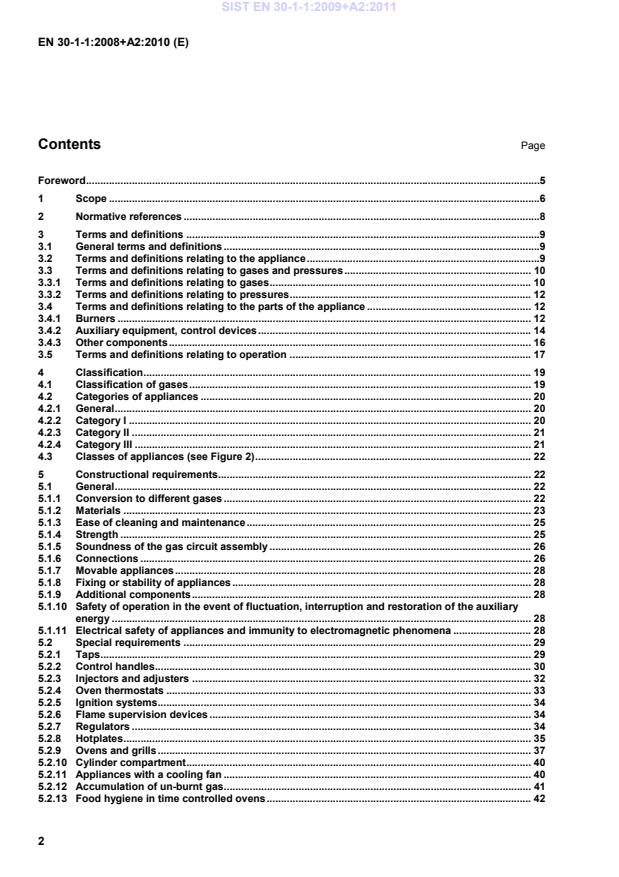
National situations . 121A.1 General . 121A.2 Marketing in different countries of the categories listed in the text of the standard . 121A.3 Supply pressures for the appliances (see 7.1.2) . 125A.4 Particular categories marketed nationally or locally . 127A.4.1 National distribution . 127SIST EN 30-1-1:2009+A2:2011
Guidelines for extension to other categories . 134Annex C (normative)
Characteristics of the pans required . 135C.1 Pans required for testing on gas burners . 135C.2 Characteristics of pans for testing on electric cooking plates . 137Annex D (normative)
Surface temperature probe (7.3.1.5.3.2) . 138D.1 Design . 138D.2 Validation test . 138D.2.1 Principle . 138D.2.2 Procedure . 138D.2.3 Validation . 139Annex E (normative)
Use of symbols on the appliance and packaging . 140E.1 Information having to appear on the appliance and packaging, in accordance with Clause 8 . 140E.1.1 Electricity supply . 140E.1.2 Type of gas . 140E.1.3 Pressure . 141E.1.4 Country . 141E.1.5 Category . 141E.2 Other optional information . 141E.2.1 General . 141E.2.2 Nominal heat input of a burner Qn. 142E.2.3 Nominal heat input of all appliance burners Qn∑ . 142E.3 Information having to appear on the appliance and its packaging, in accordance with 8.1 and 8.2 . 142Annex F (normative)
Symbol “Do not shut lid when burner alight” . 145Annex ZA (informative)
Relationship between this European Standard and the Essential Requirements of EU Directive 90/396/EEC . 146Bibliography . 149 SIST EN 30-1-1:2009+A2:2011
# $. This document has been prepared under a mandate given to CEN by the European Commission and the European Free Trade Association, and supports essential requirements of EU Directive(s). For relationship with EU Directive(s), see informative Annex ZA, which is an integral part of this document. EN 30 Domestic cooking appliances burning gas consists of the following parts: Part 1-1: Safety — General; Part 1-2: Safety — Appliances having forced-convection ovens and/or grills; Part 1-3: Safety — Appliances having a glass ceramic hotplate; Part 1-4: Safety — Appliances having one or more burners with an automatic burner control system; Part 2-1: Rational use of energy — General; Part 2-2: Rational use of energy — Appliances having forced-convection ovens and/or grills. According to the CEN/CENELEC Internal Regulations, the national standards organizations of the following countries are bound to implement this European Standard: Austria, Belgium, Bulgaria, Croatia, Cyprus, Czech Republic, Denmark, Estonia, Finland, France, Germany, Greece, Hungary, Iceland, Ireland, Italy, Latvia, Lithuania, Luxembourg, Malta, Netherlands, Norway, Poland, Portugal, Romania, Slovakia, Slovenia, Spain, Sweden, Switzerland and the United Kingdom.
1) Refer to the electrical safety rules. SIST EN 30-1-1:2009+A2:2011
à encastrer - Eingebaute Strahlungsgrilleinrichtungen - Grills - built-in - Grilloirs par contact - Kontaktgrilleinrichtungen - Griddles - Cuisinières isolées - Freistehende Herde - Cookers - freestanding - Cuisinières encastrées - Eingebaute Herde - Cookers - built-in
(IEC 60068-2-75:1997) EN 60335-1:2002, Household and similar electrical appliances — Safety — Part 1: General requirements
(IEC 60335-1:2001, modified) EN 60335-2-6:2003, Household and similar electrical appliances — Safety — Part 2-6: Particular requirements for stationary cooking ranges, hobs, ovens and similar appliances (IEC 60335-2-6:2002, modified) EN 60335-2-102:2006, Household and similar electrical appliances — Safety — Part 2-102: Particular requirements for gas, oil and solid-fuel burning appliances having electrical connections
(IEC 60335-2-102:2004, modified) EN 60584-1:1995, Thermocouples — Part 1: Reference tables (IEC 60584-1:1995) EN 60730-2-1:1997, Automatic electrical controls for household and similar use — Part 2: Particular requirements for electrical controls for electrical household appliances (IEC 60730-2-1:1989, modified) EN ISO 228-1:2003, Pipe threads where pressure-tight joints are not made on the threads — Part 1: Dimensions, tolerances and designation (ISO 228-1:2000) EN ISO 3166-1:2006, Codes for the representation of names of countries and their subdivisions — Part 1: Country codes (ISO 3166-1:2006) SIST EN 30-1-1:2009+A2:2011
NOTE When installed, the appliance may only be in contact with a single furniture unit. 3.2.4 appliance for building into a furniture unit appliance intended to be installed in a kitchen cabinet or unit or in a housing located in a wall or under similar conditions NOTE For this reason, the appliance may not necessarily have a casing on all sides. 3.2.5 domestic cooking appliance appliance to be used by private individuals in a domestic dwelling
NOTE This is indicated in the instructions for use and maintenance as well as in the technical instructions. 3.2.6 cooker cooking appliance comprising: a hotplate; one or more ovens with or without a thermostat, having possibly a grill; possibly a grill 3.2.7 table cooker cooking appliance intended to rest on a raised support or stand comprising: a hotplate; an oven; possibly a grill 3.2.8 independent hotplate cooking appliance consisting only of a hotplate 3.2.9 independent hotplate and grill cooking appliance consisting of hotplate and a grill 3.3 Terms and definitions relating to gases and pressures 3.3.1 Terms and definitions relating to gases 3.3.1.1 test gases gases intended for the verification of the operational characteristics of appliances using combustible gases; they consist of reference gases and limit gases SIST EN 30-1-1:2009+A2:2011
NOTE Table 7 gives the characteristics of reference gases and limit gases. 3.3.1.2 reference gases test gases with which appliances operate under nominal conditions when they are supplied at the corresponding normal pressure 3.3.1.3 limit gases test gases representative of the extreme variations in characteristics of the gases for which the appliances have been designed 3.3.1.4 relative density d ratio of the masses of equal volumes of dry gas and dry air under the same conditions of temperature and pressure: 15 °C or 0 °C and 1 013,25 mbar 3.3.1.5 calorific value quantity of heat produced by complete combustion at a constant pressure of 1 013,25 mbar, of a unit volume or mass of gas, the constituents of the combustible mixture being taken at reference A distinction is made between: - the gross calorific value Hs: the water produced by combustion is assumed to be condensed; -the net calorific value Hi: the water produced by combustion is assumed to be in the vapour state. NOTE 1 The calorific value is expressed: − either in megajoules per cubic metre (MJ/m3) of dry gas under the reference conditions; - or in megajoules per kilogram (MJ/kg) of dry gas. NOTE 2 In this European Standard only the gross calorific value is used 3.3.1.6 Wobbe index gross Wobbe index Ws; net Wobbe index Wi ratio of the calorific value of a gas per unit volume and the square root of its relative density under the same reference conditions. The Wobbe index is said to be gross or net according to whether the calorific value used is the gross or net calorific value
NOTE The Wobbe indices are expressed - - either in megajoules per cubic metre (MJ/m3) of dry gas under the reference conditions; - or in megajoules per kilogram (MJ/kg) of dry gas. 3.3.1.7 theoretical air volume of air necessary for the stoichiometric combustion of a unit volume of gas SIST EN 30-1-1:2009+A2:2011
difference between the static pressure measured at the inlet connection of the appliance in operation and the atmospheric pressure NOTE
The gas supply pressure is expressed in millibar (mbar): 1 mbar = 102 Pa. 3.3.2.2 test pressures gas pressures used to verify the operational characteristics of appliances using combustible gases. They consist of normal and limit pressures NOTE 1
The gas pressures used are expressed in millibars (mbar): 1 mbar = 102 Pa. NOTE 2 The test pressures are given in Table 9. 3.3.2.3 normal pressure pn
pressure under which the appliances operate in nominal conditions, when they are supplied with the corresponding reference gas 3.3.2.4 limit pressures maximum pressure: pmax; minimum pressure: pmin pressures representative of the extreme variations in the supply conditions 3.3.2.5 pressure couple combination of two distinct gas distribution pressures applied by reason of the significant difference existing between the Wobbe indices within a single family or group in which: the higher pressure corresponds only to gases of low Wobbe index; the lower pressure corresponds to gases of high Wobbe index. 3.4 Terms and definitions relating to the parts of the appliance 3.4.1 Burners 3.4.1.1 burners component devices that allow the gas to burn NOTE 1 They may be one of two types: non-aerated burners in which the air for combustion is entrained entirely at the burner outlet; aerated burners in which part of the air for combustion termed "primary air", is entrained by the gas flow and is mixed with gas before the burner outlet. The remainder of the air, termed "secondary air" is entrained after the burner outlet. NOTE 2 These burners consist of: a gas injector; SIST EN 30-1-1:2009+A2:2011
NOTE The burner may be so enclosed that flames may not be visible during normal operation. 3.4.1.6 uncovered burners hotplate burners for which the pans being heated are in direct contact with the flames 3.4.1.7 injector component part that admits the gas into an aerated burner NOTE There are two types of injectors: calibrated injector in which the section of the outlet orifice is fixed; adjustable injector in which the section of the outlet orifice is variable. SIST EN 30-1-1:2009+A2:2011
NOTE The operation of changing the setting of this device is termed the "adjustment of primary air". 3.4.2.7 gas rate adjuster device allowing the gas rate to a burner to be set at a pre-determined value according to the supply conditions NOTE 1 The adjustment may be continuous (adjustment screw) or discontinuous (change of calibrated orifices, etc.). NOTE 2 The operation of changing the setting of this device is termed the "adjustment of the gas rate". 3.4.2.8 locking of an adjuster immobilization, by the manufacturer or installer, of an adjuster in its adjustment position by some means (screw, etc.) 3.4.2.9 sealing of an adjuster any arrangement relating to the adjuster whereby any change to the adjustment causes breaking of the sealing device and makes interference with the adjuster apparent; the adjuster is then said to be sealed in the adjusted position. NOTE A factory-sealed adjuster is regarded as non-existent. 3.4.2.10 calibrated orifice device with one or more orifices which is placed in the gas circuit to create
...