


prEN 17968
(Main)Rough-terrain variable-reach tractors - Safety requirements and verification for permanently mounted equipment
Rough-terrain variable-reach tractors - Safety requirements and verification for permanently mounted equipment
This document specifies the safety requirements relevant to load-handling functions for rough-terrain variable reach tractors (RTVR tractors). This includes the safety requirements for their permanently mounted equipment (PME).
Fork arms are considered to be part of the PME. RTVR tractors can also be equipped with a variety of attachments (e.g. bale spikes, mowers, sweepers).
This document deals with all the significant hazards, hazardous situations and events relevant to the operation of the PME of RTVR tractors when they are used as intended and under conditions of misuse which are reasonably foreseeable by the manufacturer (see Annex A).
This document does not apply to:
- rough-terrain variable-reach trucks covered by EN 1459-1:2025;
- slewing rough-terrain variable-reach trucks covered by EN 1459-2:2015+A1:2018;
- industrial variable reach trucks covered by EN ISO 3691-2:2023;
- lorry-mounted variable-reach trucks covered by ISO 20297-1:2017;
- variable-reach trucks fitted with tilting or elevating operator position;
- mobile cranes covered by EN 13000:2010+A1:2014;
- machines designed primarily for earth moving, even if their buckets and blades are replaced with forks (see EN 474 series);
- trucks designed primarily with variable length load suspension elements (e.g. chain, ropes) from which the load can swing freely in all directions;
- trucks designed primarily for container handling;
- trucks on tracks;
- trucks with articulated chassis;
- front loaders covered by EN 12525:2000+A2:2010;
- attachments.
Determination and declaration of sound power level is not addressed by this document.
This document does not cover sales literature.
This document does not address hazards linked to:
- operation of the RTVR tractor from a position other than the normal operating position or the remote control;
- hybrid power systems;
- gas power systems;
- gasoline engine systems;
- battery power systems.
This document does not address hazards which can occur:
a) when handling suspended loads which can swing freely (additional requirements are given in EN 1459-4:2024+A1:2025);
b) when using RTVR tractors on public roads;
c) when operating in potentially explosive atmospheres (additional requirements are given in EN 1755:2024);
d) when operating underground;
e) when towing trailers;
f) when fitted with a personnel work platform (additional requirements are given in EN 1459-3:2015 and EN 1459-9:2021);
g) when using system capable of controlling the speed of the RTVR tractor as set by the operator (cruise-control).
This document does not provide a method of calculation for fatigue and strength of material.
This document is not applicable to RTVR tractors manufactured before the date of its publication.
Geländegängige Traktoren mit veränderlicher Reichweite - Sicherheitstechnische Anforderungen und Verifizierung für permanent montierte Ausrüstung
Dieses Dokument legt die Sicherheitsanforderungen fest, die für Funktionen zur Handhabung der Last für geländegängige Traktoren mit veränderlicher Reichweite (RTVR Traktoren) relevant sind. Dabei sind die Sicherheitsanforderungen an die entsprechende permanent montierte Ausrüstung (PME) eingeschlossen.
Gabelzinken werden als Teil der PME betrachtet. RTVR Traktoren können auch mit einer Vielzahl von Zusatzeinrichtungen (z. B. Ballenspießen, Mähern, Räumgeräten) ausgestattet sein.
Dieses Dokument behandelt die für den Betrieb der PME des RTVR Traktors zutreffenden signifikanten Gefährdungen, Gefährdungssituationen und ereignisse, wenn die Maschine bestimmungsgemäß genutzt wird und unter Bedingungen der fehlerhaften Nutzung, die vom Hersteller vernünftigerweise vorhersehbar sind (siehe Anhang A).
Dieses Dokument gilt nicht für:
geländegängige Stapler mit veränderlicher Reichweite, die in EN 1459-1:2025 behandelt werden;
geländegängige schwenkbare Stapler mit veränderlicher Reichweite, die in EN 1459-2:2015+A1:2018 behandelt werden;
motorkraftbetriebene Flurförderzeuge mit veränderlicher Reichweite, die in EN ISO 3691-2:2023 behandelt werden;
Mitnahmestapler mit veränderlicher Reichweite, die in ISO 20297-1:2017 behandelt werden;
Flurförderzeuge mit veränderlicher Reichweite, die mit neigbarem oder hebbarem Bedienerplatz ausgestattet sind;
Fahrzeugkrane, die in EN 13000:2010+A1:2014 behandelt werden;
primär für Erdarbeiten entwickelte Maschinen, selbst wenn deren Ladeschaufeln und Schilde durch Gabeln ersetzt werden (siehe Normenreihe EN 474);
Flurförderzeuge, die in erster Linie mit Lastaufnahmeelementen veränderlicher Länge (z. B. Ketten, Seilen) ausgestattet sind, bei denen die Last in alle Richtungen frei pendeln kann;
Flurförderzeuge, die in erster Linie für die Handhabung von Containern ausgelegt sind;
schienengebundene Stapler;
Stapler mit Knicklenkung;
Frontlader, die in EN 12525:2000+A2:2010 behandelt werden;
Zusatzeinrichtungen.
Die Bestimmung und Angabe von Schallleistungspegeln werden in diesem Dokument nicht behandelt.
Dieses Dokument gilt nicht für Verkaufsunterlagen.
Dieses Dokument behandelt keine Gefährdungen in Verbindung mit Folgendem:
Betrieb des RTVR Traktors aus einer anderen Position als der normalen Fahrposition oder durch Fernsteuerung;
hybridbetriebenen Systemen;
gasbetriebenen Systemen;
benzinbetriebenen Systemen;
batteriebetriebenen Systemen.
Dieses Dokument behandelt keine Gefahren, die in folgenden Situationen auftreten können:
a) beim Befördern hängender Lasten, die frei pendeln können (zusätzliche Anforderungen sind in EN 1459-4:2024+A1:2025 angegeben);
b) beim Einsatz der RTVR Traktoren auf öffentlichen Straßen;
c) beim Betrieb in möglicherweise explosionsfähigen Atmosphären (weitere Anforderungen sind in EN 1755:2024 angegeben);
d) beim Betrieb unter Tage;
e) beim Schleppen von Anhängern;
f) beim Anbringen einer Arbeitsbühne (zusätzliche Anforderungen sind in EN 1459-3:2015 und EN 1459-9:2021 angegeben);
g) bei Verwendung eines Systems, das in der Lage ist, die Geschwindigkeit des RTVR Traktors nach den Vorgaben des Bedieners zu steuern (Geschwindigkeitsregelung).
Dieses Dokument enthält kein Verfahren zur Berechnung von Ermüdung und Festigkeit von Material.
Dieses Dokument gilt nicht für RTVR Traktoren, die vor dem Veröffentlichungsdatum dieses Dokuments hergestellt wurden.
Tracteurs tout-terrain à portée-variable - Exigences de sécurité et vérification pour les équipements montés en permanence
Le présent document spécifie les exigences de sécurité relatives aux fonctions de manutention de la charge pour les tracteurs tout-terrain à portée variable (tracteurs RTVR). Cela inclut les exigences de sécurité pour leurs équipements montés en permanence (PME).
Les bras de fourche sont considérés comme partie des PME. Les tracteurs RTVR peuvent être également équipés d'une grande variété d'accessoires (par exemple, fourche à ballots, faucheuse, balayeuse).
Le présent document traite de tous les phénomènes dangereux significatifs, des situations et évènements dangereux pertinents pour le fonctionnement des PME des tracteurs RTVR lorsqu'ils sont utilisés comme prévu et dans les conditions de mauvaise utilisation qui sont raisonnablement prévisibles par le fabricant (voir Annexe A).
Le présent document ne s’applique pas aux :
— chariots tout-terrain à portée variable couverts par l’EN 1459-1:2025 ;
— chariots tout-terrain rotatifs à portée variable couverts par l’EN 1459-2:2015+A1:2018 ;
— aux chariots industriels à portée variable traités dans l’EN ISO 3691-2:2023 ;
— chariots à portée variable embarqués sur porteurs routiers par l’EN 1459-1:2025 ;
— aux chariots à portée variable avec poste de conduite inclinable ou élevable ;
— aux grues mobiles couvertes par l’EN 13000:2010+A1:2014 ;
— aux machines conçues principalement pour le terrassement, même si leurs godets et leurs lames sont remplacés par des fourches (voir la série EN 474) ;
— aux chariots conçus principalement avec des éléments de suspension de la charge à longueur variable (tels que chaînes, câbles) et permettant à la charge d'osciller librement dans toutes les directions ;
— aux chariots conçus principalement pour la manutention de conteneurs ;
— aux chariots sur chenilles ;
— aux chariots à châssis articulé ;
— chargeurs frontaux couverts par l’EN 12525:2000+A2:2010 ;
— aux accessoires.
La détermination et la déclaration du niveau de puissance acoustique ne sont pas abordées dans le présent document.
Le présent document ne couvre pas la documentation commerciale :
Le présent document ne traite pas des phénomènes dangereux liés aux :
— fonctionnement du tracteur RTVR à partir d’une position autre que la position normale de conduite ou à distance ;
— systèmes à source d'énergie hybride ;
— systèmes à source d’énergie gaz ;
— systèmes à moteur à essence ;
— systèmes alimentés par batteries ;
Le présent document ne traite pas des phénomènes dangereux qui peuvent apparaître :
a) lors de la manutention de charges suspendues qui peuvent se balancer librement (les exigences supplémentaires sont données dans l’EN 1459-4:2024+A1:2025) ;
b) lors de l'utilisation des tracteurs RTVR sur les voies publiques ;
c) en cas de fonctionnement dans des atmosphères potentiellement explosives (des exigences supplémentaires sont données dans l’EN 1755:2024) ;
d) lors de travaux souterrains ;
d) lors de la traction de remorques ;
f) lorsqu’ils sont équipés d’une plate-forme de personnel/travail (des exigences supplémentaires sont données dans les EN 1459-3:2015 et EN 1459-9:2021) ;
g) en cas d'utilisation d'un système capable de contrôler la vitesse du tracteur RTVR telle qu'elle a été réglée par l'opérateur (régulateur de vitesse).
Le présent document ne fournit pas de méthode de calcul de la fatigue et de la résistance du matériau.
Le présent document n'est pas applicable aux tracteurs RTVR fabriqués avant la date de sa publication.
Traktorji za zahtevne terene z mehanizmom za dviganje - Terenska vozila - Varnostne zahteve in preverjanje trajno nameščene opreme
General Information
- Status
- Not Published
- Publication Date
- 30-Sep-2026
- Technical Committee
- CEN/TC 150 - Industrial trucks - Safety
- Drafting Committee
- CEN/TC 150/WG 2 - Variable reach trucks
- Current Stage
- 4599 - Dispatch of FV draft to CMC - Finalization for Vote
- Start Date
- 03-Apr-2026
- Due Date
- 30-Sep-2024
- Completion Date
- 03-Apr-2026
Relations
- Effective Date
- 28-Dec-2022
Overview
The prEN 17968:2025 standard, developed by the European Committee for Standardization (CEN), specifies the safety requirements and verification procedures for the permanently mounted equipment (PME) of rough-terrain variable-reach (RTVR) tractors. These tractors are designed to operate on challenging terrains with variable reach capabilities, equipped with integral equipment such as fork arms, bale spikes, mowers, or sweepers.
This standard addresses all significant hazards, hazardous situations, and events related to the operation of RTVR tractors’ PME under normal use and reasonably foreseeable misuse as anticipated by manufacturers. It excludes several vehicle types and equipment configurations, focusing exclusively on rough-terrain tractors and their permanently installed load-handling components.
Key Topics
1. Scope and Application
- Applies to RTVR tractors with permanently mounted equipment including fork arms.
- Excludes related vehicles such as rough-terrain variable-reach trucks (covered by EN 1459 series), mobile cranes (EN 13000), and front loaders (EN 12525).
- Does not cover hybrid, gas, gasoline, or battery power systems, nor hazards related to operation from non-standard positions or remote controls.
2. Safety Requirements
- Prevention of unauthorized starting and unintended movement.
- Effective braking systems including energy supply failure resilience.
- Protection against electrical hazards in control systems with proper wiring identification and shock protection.
- Controls ergonomically designed for normal operator positions, including steering, load handling, stabilizing devices, and remote control functionality.
- Design considerations for maintenance access and safe handling of hydraulic and lifting systems.
- Structural safety including stability, load-holding verification, and protection against crushing, shearing, and trapping.
- Integration of operator protection devices such as ROPS (Roll Over Protective Structures) and FOPS (Falling Object Protective Structures).
- Visibility, lighting, audible warnings, and fire protection measures are also specified.
3. Verification Procedures
- Functional tests to ensure safety systems operate correctly.
- Structural verification through static and dynamic tests using specified test loads.
- Load holding performance to prevent uncontrolled lowering or release of loads.
- Verification of protective devices and operators’ station safety features.
4. Information and Labeling
- Requirements for operator manuals, storage, and accessibility.
- Use of graphical symbols and safety signs for critical functions such as lift points, tie-down, and retrieval.
Applications
This standard is crucial for manufacturers, designers, and safety engineers involved in the development, production, and maintenance of RTVR tractors used in industries such as:
- Agriculture – Handling bales, equipment fork lifting, and terrain maneuvering.
- Forestry – Equipped with permanent tools like sweepers.
- Construction and Infrastructure – Moving materials and operating in rough terrains.
- Material Handling – Load manipulation with permanently mounted forks or attachments.
Ensuring compliance with this standard improves operational safety, reducing accidents due to mechanical failures or operator error on rough terrains. It supports safer maintenance procedures and provides a framework for ergonomic control design.
Related Standards
- EN 1459 series – Covering rough-terrain variable-reach trucks with non-permanently mounted equipment.
- EN ISO 3691-2:2023 – Industrial variable reach trucks safety requirements.
- EN 13000 – Mobile cranes safety standard.
- EN 474 series – Earth-moving machinery safety.
- EN 12525:2000+A2:2010 – Front loaders safety requirements.
- EN 1755:2024 – Use in potentially explosive atmospheres with RTVR tractors.
- EN 1459-3:2015 and EN 1459-9:2021 – Safety requirements for RTVR tractors fitted with personnel work platforms.
- ISO 20297-1:2017 – Lorry-mounted variable-reach trucks.
Compliance with prEN 17968 ensures a harmonized approach to safety across Europe and supports manufacturers in meeting regulatory requirements while facilitating market access.
This standard is essential reading for professionals engaged with rough-terrain variable-reach tractors, emphasizing safety in handling equipment permanently mounted on these machines to enhance operational reliability and reduce hazards in demanding working environments.

Get Certified
Connect with accredited certification bodies for this standard

Control Union Certifications
Global certification for agriculture and sustainability.

ECOCERT
Organic and sustainability certification.

FSC International
Forest Stewardship Council certification.
Sponsored listings
Frequently Asked Questions
prEN 17968 is a draft published by the European Committee for Standardization (CEN). Its full title is "Rough-terrain variable-reach tractors - Safety requirements and verification for permanently mounted equipment". This standard covers: This document specifies the safety requirements relevant to load-handling functions for rough-terrain variable reach tractors (RTVR tractors). This includes the safety requirements for their permanently mounted equipment (PME). Fork arms are considered to be part of the PME. RTVR tractors can also be equipped with a variety of attachments (e.g. bale spikes, mowers, sweepers). This document deals with all the significant hazards, hazardous situations and events relevant to the operation of the PME of RTVR tractors when they are used as intended and under conditions of misuse which are reasonably foreseeable by the manufacturer (see Annex A). This document does not apply to: - rough-terrain variable-reach trucks covered by EN 1459-1:2025; - slewing rough-terrain variable-reach trucks covered by EN 1459-2:2015+A1:2018; - industrial variable reach trucks covered by EN ISO 3691-2:2023; - lorry-mounted variable-reach trucks covered by ISO 20297-1:2017; - variable-reach trucks fitted with tilting or elevating operator position; - mobile cranes covered by EN 13000:2010+A1:2014; - machines designed primarily for earth moving, even if their buckets and blades are replaced with forks (see EN 474 series); - trucks designed primarily with variable length load suspension elements (e.g. chain, ropes) from which the load can swing freely in all directions; - trucks designed primarily for container handling; - trucks on tracks; - trucks with articulated chassis; - front loaders covered by EN 12525:2000+A2:2010; - attachments. Determination and declaration of sound power level is not addressed by this document. This document does not cover sales literature. This document does not address hazards linked to: - operation of the RTVR tractor from a position other than the normal operating position or the remote control; - hybrid power systems; - gas power systems; - gasoline engine systems; - battery power systems. This document does not address hazards which can occur: a) when handling suspended loads which can swing freely (additional requirements are given in EN 1459-4:2024+A1:2025); b) when using RTVR tractors on public roads; c) when operating in potentially explosive atmospheres (additional requirements are given in EN 1755:2024); d) when operating underground; e) when towing trailers; f) when fitted with a personnel work platform (additional requirements are given in EN 1459-3:2015 and EN 1459-9:2021); g) when using system capable of controlling the speed of the RTVR tractor as set by the operator (cruise-control). This document does not provide a method of calculation for fatigue and strength of material. This document is not applicable to RTVR tractors manufactured before the date of its publication.
This document specifies the safety requirements relevant to load-handling functions for rough-terrain variable reach tractors (RTVR tractors). This includes the safety requirements for their permanently mounted equipment (PME). Fork arms are considered to be part of the PME. RTVR tractors can also be equipped with a variety of attachments (e.g. bale spikes, mowers, sweepers). This document deals with all the significant hazards, hazardous situations and events relevant to the operation of the PME of RTVR tractors when they are used as intended and under conditions of misuse which are reasonably foreseeable by the manufacturer (see Annex A). This document does not apply to: - rough-terrain variable-reach trucks covered by EN 1459-1:2025; - slewing rough-terrain variable-reach trucks covered by EN 1459-2:2015+A1:2018; - industrial variable reach trucks covered by EN ISO 3691-2:2023; - lorry-mounted variable-reach trucks covered by ISO 20297-1:2017; - variable-reach trucks fitted with tilting or elevating operator position; - mobile cranes covered by EN 13000:2010+A1:2014; - machines designed primarily for earth moving, even if their buckets and blades are replaced with forks (see EN 474 series); - trucks designed primarily with variable length load suspension elements (e.g. chain, ropes) from which the load can swing freely in all directions; - trucks designed primarily for container handling; - trucks on tracks; - trucks with articulated chassis; - front loaders covered by EN 12525:2000+A2:2010; - attachments. Determination and declaration of sound power level is not addressed by this document. This document does not cover sales literature. This document does not address hazards linked to: - operation of the RTVR tractor from a position other than the normal operating position or the remote control; - hybrid power systems; - gas power systems; - gasoline engine systems; - battery power systems. This document does not address hazards which can occur: a) when handling suspended loads which can swing freely (additional requirements are given in EN 1459-4:2024+A1:2025); b) when using RTVR tractors on public roads; c) when operating in potentially explosive atmospheres (additional requirements are given in EN 1755:2024); d) when operating underground; e) when towing trailers; f) when fitted with a personnel work platform (additional requirements are given in EN 1459-3:2015 and EN 1459-9:2021); g) when using system capable of controlling the speed of the RTVR tractor as set by the operator (cruise-control). This document does not provide a method of calculation for fatigue and strength of material. This document is not applicable to RTVR tractors manufactured before the date of its publication.
prEN 17968 is classified under the following ICS (International Classification for Standards) categories: 53.060 - Industrial trucks; 65.060.10 - Agricultural tractors and trailed vehicles. The ICS classification helps identify the subject area and facilitates finding related standards.
prEN 17968 has the following relationships with other standards: It is inter standard links to CEN/TS 1459-8:2018. Understanding these relationships helps ensure you are using the most current and applicable version of the standard.
prEN 17968 is associated with the following European legislation: EU Directives/Regulations: 2006/42/EC. When a standard is cited in the Official Journal of the European Union, products manufactured in conformity with it benefit from a presumption of conformity with the essential requirements of the corresponding EU directive or regulation.
prEN 17968 is available in PDF format for immediate download after purchase. The document can be added to your cart and obtained through the secure checkout process. Digital delivery ensures instant access to the complete standard document.
Standards Content (Sample)
SLOVENSKI STANDARD
01-julij-2025
Traktorji z mehanizmom s spremenljivim dosegom- Terenska vozila - Varnostne
zahteve in preverjanje za trajno nameščeno opremo
Rough-terrain variable-reach tractors - Safety requirements and verification for
permanently mounted equipment
Geländegängige Traktoren mit veränderlicher Reichweite - Sicherheitstechnische
Anforderungen und Verifizierung für permanent montierte Ausrüstung
Tracteurs tout-terrain à portée-variable - Exigences de sécurité et vérification pour les
équipements montés en permanence
Ta slovenski standard je istoveten z: prEN 17968
ICS:
53.060 Industrijski tovornjaki Industrial trucks
2003-01.Slovenski inštitut za standardizacijo. Razmnoževanje celote ali delov tega standarda ni dovoljeno.
DRAFT
EUROPEAN STANDARD
NORME EUROPÉENNE
EUROPÄISCHE NORM
June 2025
ICS 53.060 Will supersede CEN/TS 1459-8:2018
English Version
Rough-terrain variable-reach tractors - Safety
requirements and verification for permanently mounted
equipment
Tracteurs tout-terrain à portée-variable - Prescriptions Geländegängige Traktor mit veränderlicher Reichweite
de sécurité et vérification - Sicherheitstechnische Anforderungen und
Verifizierung
This draft European Standard is submitted to CEN members for enquiry. It has been drawn up by the Technical Committee
CEN/TC 150.
If this draft becomes a European Standard, CEN members are bound to comply with the CEN/CENELEC Internal Regulations
which stipulate the conditions for giving this European Standard the status of a national standard without any alteration.
This draft European Standard was established by CEN in three official versions (English, French, German). A version in any other
language made by translation under the responsibility of a CEN member into its own language and notified to the CEN-CENELEC
Management Centre has the same status as the official versions.
CEN members are the national standards bodies of Austria, Belgium, Bulgaria, Croatia, Cyprus, Czech Republic, Denmark, Estonia,
Finland, France, Germany, Greece, Hungary, Iceland, Ireland, Italy, Latvia, Lithuania, Luxembourg, Malta, Netherlands, Norway,
Poland, Portugal, Republic of North Macedonia, Romania, Serbia, Slovakia, Slovenia, Spain, Sweden, Switzerland, Türkiye and
United Kingdom.
Recipients of this draft are invited to submit, with their comments, notification of any relevant patent rights of which they are
aware and to provide supporting documentation.
Warning : This document is not a European Standard. It is distributed for review and comments. It is subject to change without
notice and shall not be referred to as a European Standard.
EUROPEAN COMMITTEE FOR STANDARDIZATION
COMITÉ EUROPÉEN DE NORMALISATION
EUROPÄISCHES KOMITEE FÜR NORMUNG
CEN-CENELEC Management Centre: Rue de la Science 23, B-1040 Brussels
© 2025 CEN All rights of exploitation in any form and by any means reserved Ref. No. prEN 17968:2025 E
worldwide for CEN national Members.
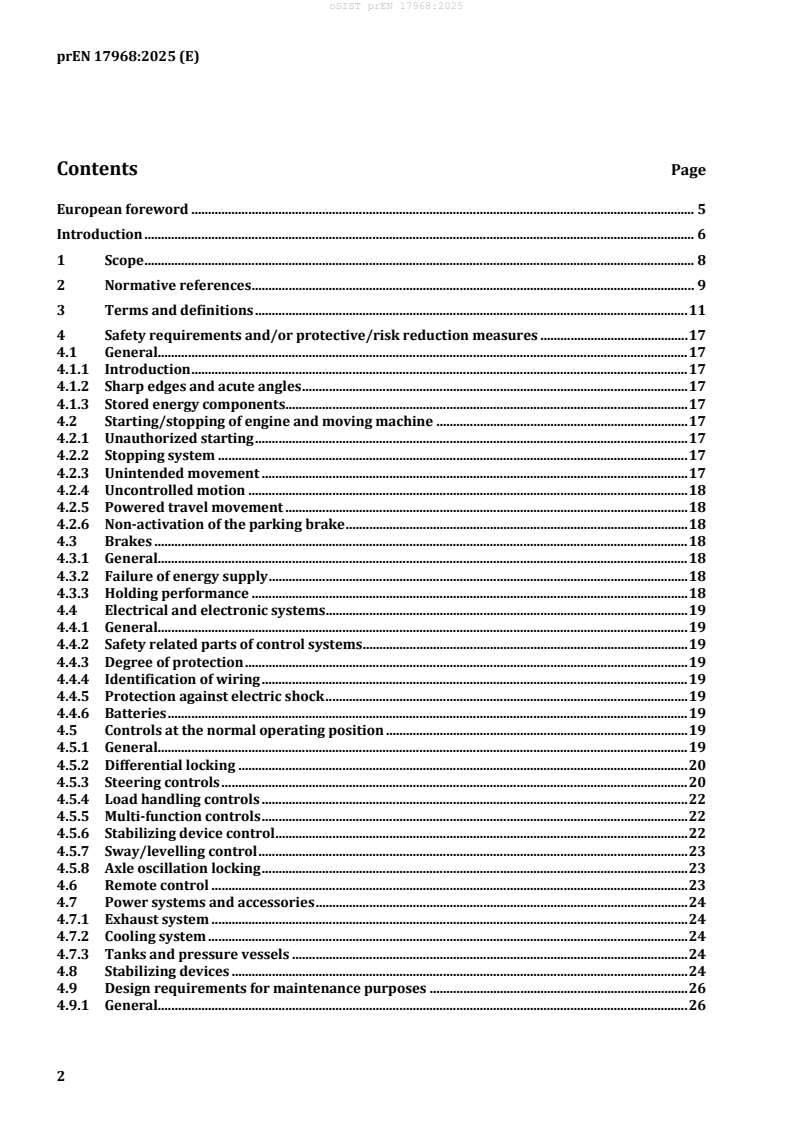
Contents Page
European foreword . 5
Introduction . 6
1 Scope . 8
2 Normative references . 9
3 Terms and definitions . 11
4 Safety requirements and/or protective/risk reduction measures . 17
4.1 General. 17
4.1.1 Introduction . 17
4.1.2 Sharp edges and acute angles . 17
4.1.3 Stored energy components . 17
4.2 Starting/stopping of engine and moving machine . 17
4.2.1 Unauthorized starting . 17
4.2.2 Stopping system . 17
4.2.3 Unintended movement . 17
4.2.4 Uncontrolled motion . 18
4.2.5 Powered travel movement . 18
4.2.6 Non-activation of the parking brake . 18
4.3 Brakes . 18
4.3.1 General. 18
4.3.2 Failure of energy supply . 18
4.3.3 Holding performance . 18
4.4 Electrical and electronic systems . 19
4.4.1 General. 19
4.4.2 Safety related parts of control systems . 19
4.4.3 Degree of protection . 19
4.4.4 Identification of wiring . 19
4.4.5 Protection against electric shock . 19
4.4.6 Batteries . 19
4.5 Controls at the normal operating position . 19
4.5.1 General. 19
4.5.2 Differential locking . 20
4.5.3 Steering controls . 20
4.5.4 Load handling controls . 22
4.5.5 Multi-function controls . 22
4.5.6 Stabilizing device control . 22
4.5.7 Sway/levelling control . 23
4.5.8 Axle oscillation locking . 23
4.6 Remote control . 23
4.7 Power systems and accessories . 24
4.7.1 Exhaust system . 24
4.7.2 Cooling system . 24
4.7.3 Tanks and pressure vessels . 24
4.8 Stabilizing devices . 24
4.9 Design requirements for maintenance purposes . 26
4.9.1 General. 26
4.9.2 Boom support device . 26
4.9.3 Tiltable cab support device . 27
4.10 Systems for lifting, tilting and reaching . 27
4.10.1 Chains and wire ropes . 27
4.10.2 Hydraulic system . 28
4.10.3 Maximum load lowering speed . 29
4.10.4 Limitation of stroke . 29
4.10.5 Fork arms . 29
4.10.6 Attachment interface . 30
4.11 Operator’s station . 30
4.11.1 General requirements . 30
4.11.2 Operator’s manual storage . 30
4.11.3 Pipes and hoses . 30
4.11.4 Operator's station . 30
4.11.5 Operator's seat . 32
4.11.6 Control panels, and symbols on displays . 33
4.12 Operator access . 33
4.12.1 General requirements . 33
4.12.2 Operator’s station openings . 33
4.13 Protective measures and devices . 33
4.13.1 Hot parts . 33
4.13.2 Protection against crushing, shearing and trapping . 33
4.13.3 Guards . 34
4.13.4 Engine compartment . 34
4.13.5 Fenders . 34
4.13.6 ROPS and FOPS . 34
4.13.7 Audible warning devices . 34
4.14 Stability requirements . 34
4.15 Visibility . 35
4.16 Lighting . 35
4.17 Fire protection . 35
4.17.1 Fire resistance . 35
4.17.2 Fire extinguisher . 35
4.18 Retrieval, transportation and lifting . 35
4.18.1 General . 35
4.18.2 Retrieval . 35
4.18.3 Tying-down . 35
4.18.4 Lifting . 36
4.19 Noise . 36
4.19.1 Noise emission reduction . 36
4.19.2 Emission sound pressure level at the operator's station . 37
4.20 Electromagnetic radiation . 37
5 Verification of safety requirements and/or protective/risk reduction measures . 37
5.1 General . 37
5.2 Functional verification . 37
5.3 Structural verification . 37
5.3.1 Test loads . 37
5.3.2 Static test . 38
5.3.3 Dynamic tests . 38
5.4 Load holding verification . 39
6 Information for use . 39
6.1 General . 39
6.2 Graphical symbols and warning . 39
6.2.1 Safety signs and graphical symbols . 39
6.2.2 Graphical symbol of lift points . 39
6.2.3 Graphical symbol of tie-down points . 40
6.2.4 Graphical symbol of retrieval points . 40
6.2.5 Graphical symbol for pneumatic tyre inflation pressures . 41
6.2.6 Graphical symbol for fuel filling points . 41
6.2.7 Graphical symbol for hydraulic fluid filling points . 42
6.2.8 Graphical symbols for stored energy components . 42
6.2.9 Graphical symbol for brake fluid filling points . 43
6.2.10 Graphical symbol for battery disconnection . 44
6.2.11 Warnings . 44
6.3 Instruction handbook. 44
6.3.1 General. 44
6.3.2 Operating and maintenance instructions . 45
6.4 Marking of PME . 48
6.5 Load chart . 49
Annex A (informative) List of significant hazards . 51
Annex B (informative) Consistency of motions . 57
Annex C (normative) Rules for the construction and layout of pedals . 59
C.1 Definitions . 59
C.1.1 pedal . 59
C.1.2 service brake pedal . 59
C.1.3 clutch pedal . 59
C.1.4 inching pedal . 59
C.1.5 accelerator pedal . 59
C.2 Requirements . 59
C.2.1 General. 59
C.2.2 Service brake pedal . 59
C.2.3 Clutch pedal . 60
C.2.4 Accelerator pedal . 60
C.2.5 Inching pedal . 60
C.3 Design and manufacture . 60
Bibliography . 62
European foreword
This document (prEN 17968:2025) has been prepared by Technical Committee CEN/TC 150 “Industrial
trucks - Safety”, the secretariat of which is held by BSI.
This document will supersede CEN/TS 1459-8:2018.
In comparison with the previous edition CEN/TS 1459-8:2018, the following technical modifications
have been made:
— alignment to requirements of EN 1459-1:2025;
— update of normative references;
— other minor changes, mainly editorial clarifications of existing requirements.
This document has been prepared under a standardization request given to CEN by the European
Commission. The Standing Committee of the EFTA States subsequently approves these requests for its
Member States.
Introduction
This document covers general safety requirements and the means for verification of these requirements
for rough-terrain variable-reach tractors (RTVR tractors).
All quantities are in SI units, and this includes metric units.
This document is a type C standard as stated in EN ISO 12100:2010.
This document is of relevance, in particular, for the following stakeholder groups representing the market
players with regard to machinery safety:
— machine manufacturers (small, medium and large enterprises);
— health and safety bodies (regulators, accident prevention organizations, market surveillance etc.).
Others can be affected by the level of machinery safety achieved with the means of the document by the
above-mentioned stakeholder groups:
— machine users/employers (small, medium and large enterprises);
— machine users/employees (e.g. trade unions, organizations for people with special needs);
— service providers, e.g. for maintenance (small, medium and large enterprises);
— consumers (in case of machinery intended for use by consumers).
The above-mentioned stakeholder groups have been given the possibility to participate at the drafting
process of this document.
The machinery concerned and the extent to which hazards, hazardous situations or hazardous events are
covered are indicated in the scope of this document.
When provisions of this type C standard are different from those which are stated in type A or B
standards, the provisions of this type C standard take precedence over the provisions of the other
standards, for machines that have been designed and built according to the provisions of this type C
standard.
Two legislative frameworks involve RTVR tractors:
— Regulation (EU) No 167/2013 providing requirements for the type-approval of agricultural and
forestry vehicles, also known as Tractor Mother Regulation (TMR), which trucks are homologated
according to. A number of additional Regulations supplements this one, such as:
— Delegated Regulation (EU) No 1322/2014 with regard to construction and general requirements
of agricultural and forestry vehicles;
— Delegated Regulation (EU) 2015/208 with regard to functional safety requirements of
agricultural and forestry vehicles;
— Delegated Regulation (EU) 2015/68 with regard to braking systems of agricultural and forestry
vehicles;
— Delegated Regulation (EU) 2018/985 as regards environmental and propulsion unit
performance requirements for agricultural and forestry vehicles and their engines;
— Implementing Regulation (EU) 2015/504 with regard to the administrative requirements of
agricultural and forestry vehicles.
— Directive 2006/42/EC as the permanently mounted equipment (PME), that RTVR tractors are
equipped with, falls under the definition of machinery in Article 2 (a) third indent as "an assembly
referred to in the first and second indents, ready to be installed and able to function as it stands only
if mounted on a means of transport".
A CEN/TR “Mapping between the clauses in EN 17968 and the European frameworks involving rough-
terrain variable-reach tractors” is under development.
This document is based on requirements of EN 1459-1:2025.
1 Scope
This document specifies the safety requirements relevant to load-handling functions for rough-terrain
variable reach tractors (RTVR tractors). This includes the safety requirements for their permanently
mounted equipment (PME).
Fork arms are considered to be part of the PME. RTVR tractors can also be equipped with a variety of
attachments (e.g. bale spikes, mowers, sweepers).
This document deals with all the significant hazards, hazardous situations and events relevant to the
operation of the PME of RTVR tractors when they are used as intended and under conditions of misuse
which are reasonably foreseeable by the manufacturer (see Annex A).
This document does not apply to:
— rough-terrain variable-reach trucks covered by EN 1459-1:2025;
— slewing rough-terrain variable-reach trucks covered by EN 1459-2:2015+A1:2018;
— industrial variable reach trucks covered by EN ISO 3691-2:2023;
— lorry-mounted variable-reach trucks covered by ISO 20297-1:2017;
— variable-reach trucks fitted with tilting or elevating operator position;
— mobile cranes covered by EN 13000:2010+A1:2014;
— machines designed primarily for earth moving, even if their buckets and blades are replaced with
forks (see EN 474 series);
— trucks designed primarily with variable length load suspension elements (e.g. chain, ropes) from
which the load can swing freely in all directions;
— trucks designed primarily for container handling;
— trucks on tracks;
— trucks with articulated chassis;
— front loaders covered by EN 12525:2000+A2:2010;
— attachments.
Determination and declaration of sound power level is not addressed by this document.
This document does not cover sales literature.
This document does not address hazards linked to:
— operation of the RTVR tractor from a position other than the normal operating position or the remote
control;
— hybrid power systems;
— gas power systems;
— gasoline engine systems;
— battery power systems.
This document does not address hazards which can occur:
a) when handling suspended loads which can swing freely (additional requirements are given in
EN 1459-4:2024+A1:2025);
b) when using RTVR tractors on public roads;
c) when operating in potentially explosive atmospheres (additional requirements are given in
EN 1755:2024);
d) when operating underground;
e) when towing trailers;
f) when fitted with a personnel work platform (additional requirements are given in EN 1459-3:2015
and EN 1459-9:2021);
g) when using system capable of controlling the speed of the RTVR tractor as set by the operator
(cruise-control).
This document does not provide a method of calculation for fatigue and strength of material.
This document is not applicable to RTVR tractors manufactured before the date of its publication.
2 Normative references
The following documents are referred to in the text in such a way that some or all of their content
constitutes requirements of this document. For dated references, only the edition cited applies. For
undated references, the latest edition of the referenced document (including any amendments) applies.
EN 1459-5:2020, Rough-terrain trucks — Safety requirements and verification — Part 5: Attachment
interface
EN 12053:2001+A1:2008, Safety of industrial trucks — Test methods for measuring noise emissions
EN 13059:2002+A1:2008, Safety of industrial trucks — Test methods for measuring vibration
EN 15000:2008, Safety of industrial trucks — Self-propelled variable reach trucks — Specification,
performance and test requirements for longitudinal load moment indicators and longitudinal load moment
limiters
EN 15830:2012, Rough-terrain variable reach trucks — Visibility — Test methods and verification
EN 17314:2020, Industrial trucks — Specifications and test methods — Operator restraint systems other
than lap-type seat belts
EN 60529:1991, Degrees of protection provided by enclosures (IP Code) (IEC 60529:1989)
EN IEC 62061:2021, Safety of machinery — Functional safety of safety-related electrical, electronic and
programmable electronic control systems (IEC 62061:2021)
This document is impacted by EN 1459-5:2020/prA1:202x.
This document is impacted by the amendments EN 60529:1991/A1:2000 and EN 60529:1991/A2:2013.
EN ISO 3449:2008, Earth-moving machinery — Falling-object protective structures — Laboratory tests
and performance requirements (ISO 3449:2005)
EN ISO 3457:2008, Earth-moving machinery — Guards — Definitions and requirements (ISO 3457:2003)
EN ISO 3471:2008, Earth-moving machinery — Roll-over protective structures — Laboratory tests and
performance requirements (ISO 3471:2008)
EN ISO 4413:2010, Hydraulic fluid power — General rules and safety requirements for systems and their
components (ISO 4413:2010)
EN ISO 6683:2008, Earth-moving machinery — Seat belts and seat belt anchorages — Performance
requirements and tests (ISO 6683:2005)
EN ISO 11688-1:2009, Acoustics — Recommended practice for the design of low-noise machinery and
equipment — Part 1: Planning (ISO/TR 11688-1:1995)
EN ISO 12100:2010, Safety of machinery — General principles for design — Risk assessment and risk
reduction (ISO 12100:2010)
EN ISO 13849-1:2023, Safety of machinery — Safety-related parts of control systems — Part 1: General
principles for design (ISO 13849-1:2023)
EN ISO 13850:2015, Safety of machinery — Emergency stop function — Principles for design
(ISO 13850:2015)
EN ISO 13857:2019, Safety of machinery — Safety distances to prevent hazard zones being reached by
upper and lower limbs (ISO 13857:2019)
ISO 2328:2011, Fork-lift trucks — Hook-on type fork arms and fork arm carriages — Mounting dimensions
ISO 2330:2002, Fork-lift trucks — Fork arms — Technical characteristics and testing
ISO 3864-1:2011, Graphical symbols — Safety colours and safety sign — Part 1: Design principles for safety
signs and safety markings
ISO 3864-2:2016, Graphical symbols — Safety colours and safety sign — Part 2: Design principles for
product safety labels
ISO 3864-3:2024, Graphical symbols — Safety colours and safety sign — Part 3: Design principles for
graphical symbols for use in safety signs
ISO 3864-4:2011, Graphical symbols — Safety colours and safety sign — Part 4: Colorimetric and
photometric properties of safety sign materials
ISO 5053-1:2020, Industrial trucks — Vocabulary — Part 1: Types of industrial trucks
ISO 6011:2003, Earth-moving machinery — Visual display of machine operation
ISO 7000:2019, Graphical symbols for use on equipment — Registered symbols
ISO 9244:2008 , Graphical symbols for use on equipment — Registered symbols
ISO 10263-2:2009, Earth-moving machinery — Operator enclosure environment — Part 2: Air filter
element test method
ISO 10263-4:2009, Earth-moving machinery — Operator enclosure environment — Part 4: Heating,
ventilating and air conditioning (HVAC) test method and performance
ISO 12509:2023, Earth-moving machinery and rough-terrain trucks — Lighting, signalling and marking
lights, and reflex reflectors
ISO 13333:1994, Earth-moving machinery — Dumper body support and operator's cab tilt support devices
ISO 15817:2012, Earth-moving machinery — Safety requirements for remote operator control systems
ISO 15818:2017, Earth-moving machinery — Lifting and tying-down attachment points — Performance
requirements
ISO 15870:2000, Powered industrial trucks — Safety signs and hazard pictorials — General principles
ISO 16528-1:2007, Boilers and pressure vessels — Part 1: Performance requirements
ISO 16528-2:2007, Boilers and pressure vessels — Part 2: Procedures for fulfilling the requirements of
ISO 16528-1
ISO 21507:2010, Earth-moving machinery — Performance requirements for non-metallic fuel tanks
ISO 22915-10:2023, Industrial trucks — Verification of stability — Part 10: Additional stability test for
trucks operating in the special condition of stacking with load laterally displaced by powered devices
ISO 22915-14:2010, Industrial trucks — Verification of stability — Part 14: Rough-terrain variable-reach
trucks
ISO 22915-20:2023, Industrial trucks — Verification of stability — Part 20: Additional stability test for
trucks operating in the special condition of offset load, offset by utilization
3 Terms and definitions
For the purposes of this document, the terms and definitions given in EN ISO 12100:2010, ISO 5053-
1:2020 and the following apply.
ISO and IEC maintain terminology databases for use in standardization at the following addresses:
— ISO Online browsing platform: available at https://www.iso.org/obp
— IEC Electropedia: available at https://www.electropedia.org/
3.1
tractor
motorised, wheeled agricultural or forestry vehicle having two axles and a maximum design speed of not
less than 6 km/h, the main function of which lies in its tractive power and which has been especially
As impacted by ISO 9244:2008/Amd 1:2016.
designed to pull, push, carry and actuate certain interchangeable equipment designed to perform
agricultural or forestry work, or to tow agricultural or forestry trailers or equipment
[SOURCE: Regulation (EU) No 167/2013, Article 3(8), modified]
3.2
rough-terrain variable-reach tractor
RTVR tractor
tractor having one telescopic articulated arm, non-slewing or having a slewing movement of not more
than 5° either side of the longitudinal axis of the RTVR tractor used for stacking loads
Note 1 to entry: See Figure 1.
Figure 1 — RTVR tractor
3.3
compact rough-terrain variable-reach tractor
RTVR tractor having a maximum height in normal travel mode of 2 150 mm and at least one of the
following conditions:
— a maximum operating mass of 7 000 kg;
— a maximum width in normal travel mode of 2 000 mm
Note 1 to entry: These dimensions do not include equipment such as working lights, mirrors, etc.
3.4
actual capacity
Q
maximum load, established by the manufacturer based on components strength and RTVR tractor
stability, that the RTVR tractor can carry, lift and stack to a specified height, at a specified standard load
centre distance and reach, in normal operating conditions
Note 1 to entry: The actual capacity depends on the configuration of the RTVR tractor in terms of such variables as:
— lift height;
— reach of the boom;
— standard load centre distance;
— load handling device (fork arms or attachment fitted);
— stabilizing devices.
Note 2 to entry: This actual capacity defines the load handling ability of the particular RTVR tractor as equipped.
Additional actual capacity ratings with removable attachments may also be established where permitted by the
appropriate stability test or by calculation verified by empirical data.
3.5
rated capacity
Q1
maximum load permitted by the manufacturer at the standard load centre distance (D) that the RTVR
tractor is capable of lifting and transporting on fork arms in normal conditions with the boom fully
retracted
3.6
reach
d
distance between two vertical parallel planes, one plane tangent to the front of the outside diameter of
the front tyres, the other plane described by the vertical projection of the centre-of-gravity of the load to
the ground
Note 1 to entry: The centre-of-gravity of the load (G) is defined in Table 1.
Note 2 to entry: See Figure 2 for examples of reach.
Note 3 to entry: For practical matters, d can be measured referring to point g, being g the vertical projection of the
centre-of-gravity (G) of the load onto the plane of the top surface of the fork arms.
Key
d reach
D standard load centre distance
G centre of gravity of the load
g the vertical projection of the centre-of-gravity (G) of the load onto the plane of the top surface of the fork
arms
H height of the load
Q actual capacity
Q1 rated capacity
Q2 actual capacity at maximum height or elevation
Q3 actual capacity at maximum reach
Figure 2 — Parameters for the designation of the actual capacity of the RTVR tractor with fork
3.7
lift height
H
vertical distance between the upper face of the fork arms and the ground
Note to entry: See Figure 2.
3.8
standard load centre distance
D
distance from the centre of gravity (G) of the load measured horizontally back to the front of the fork
shanks and vertically down to the upper faces of the fork arms, as specified in Table 1
Note 1 to entry: See Figure 2, for example.
Note 2 to entry: Typical standard load centre distances are given in Table 1. Trucks may be rated for special
applications with load centres related to those applications which may be different from those listed in Table 1.
Table 1 — Typical standard load centre distance
Rated capacity Q in kg Standard load centre distance D in mm
400 500 600 900 1 200
0 < 1 000 X
≥ 1 000 < 5 000 X
≥ 5 000 ≤ 10 000 X
> 10 000 < 20 000 X X X
≥ 20 000 < 25 000 X X
≥ 25 000 X
3.9
axle oscillation lock
mechanism designed to prevent oscillation of an axle to improve RTVR tractor stability
3.10
stabilising devices
extendable and/or pivoting mechanical supports used to improve stability of a RTVR tractor when
stationary
3.11
lateral levelling
changing the lateral inclination angle between the chassis and the ground to ensure the boom operates
in a vertical plane even when the RTVR tractor is positioned on a side slope
3.12
forks
device comprising two or more solid fork arms, each consisting of a shank (vertical portion) and blade,
which is hook- or shaft-mounted, fitted on the carriage and usually adjusted manually
3.13
boom
pivoting support member that permits horizontal and vertical positioning of the load or attachment
3.14
crab steering mode
steering mode where all wheels of the RTVR tractor steer in the same direction
3.15
normal operating position
position specified by the manufacturer in which the operator is able to control the RTVR tractor
operations, including load handling functions
3.16
attachment bracket
device fitted at the end of the boom to mount interchangeable attachments to facilitate quick interchange
of attachment
3.17
boom float
operating mode that uses gravity to allow an attachment at the end of the boom to follow a contour (e.g.
the ground)
3.18
maximum working pressure
maximum pressure in the hydraulic circuit during normal operation
Note to entry: This definition is derived from ISO 10972-3:2003, 3.2.
3.19
level ground
ground with a gradient of (0 ± 2) %
3.20
operating mass
mass of the RTVR tractor equipped with forks, unladen, and with the operator (75 kg), full fuel tank and
all fluid systems (i.e. hydraulic oil, transmission oil, engine oil, engine coolant) at the levels specified by
the manufacturer
3.21
technically permissible maximum operating mass
operating mass without the forks and including the heaviest permitted attachment without load
3.22
operator’s station
part of the machine which surrounds the normal operating position
3.23
enclosed cab
cab where door(s) or window
...
Questions, Comments and Discussion
Ask us and Technical Secretary will try to provide an answer. You can facilitate discussion about the standard in here.
Loading comments...