EN 12259-3:2000/A2:2005
(Amendment)Fixed firefighting systems - Components for sprinkler and water spray systems - Part 3: Dry alarm valve assemblies
Fixed firefighting systems - Components for sprinkler and water spray systems - Part 3: Dry alarm valve assemblies
Modification to tolerances to allow alarm valves not in conformance to EN 12259-3 to come within the requirements of the standard.
Ortsfeste Löschanlagen - Bauteile für Sprinkler- und Sprühwasseranlagen - Teil 3: Trockenalarmventile mit Zubehör
Installations fixes de lutte contre l'incendie - Composants des systèmes d'extinction du type sprinkleur et à pulvérisation d'eau - Partie 3 : Systèmes de clapet d'alarme sous air
Vgrajene naprave za gašenje – Sestavni deli sprinklerskih sistemov in sistemov s pršečo vodo – 3. del: Suhi alarmni ventili
General Information
- Status
- Published
- Publication Date
- 22-Nov-2005
- Withdrawal Date
- 30-Aug-2007
- Technical Committee
- CEN/TC 191 - Fixed firefighting systems
- Drafting Committee
- CEN/TC 191/WG 5 - Sprinkler systems
- Current Stage
- 6060 - Definitive text made available (DAV) - Publishing
- Start Date
- 23-Nov-2005
- Due Date
- 28-Sep-2006
- Completion Date
- 23-Nov-2005
- Directive
- 89/106/EEC - Construction products
Relations
- Effective Date
- 22-Dec-2008
Overview
EN 12259-3:2000/A2:2005 is a European standard developed by CEN focusing on fixed firefighting systems, specifically the components used in sprinkler and water spray systems. This part of the standard covers dry alarm valve assemblies, which play a critical role in fire protection by controlling the flow and signaling in dry pipe sprinkler systems.
The amendment A2:2005 introduces important modifications to the standard’s construction and performance tolerances, allowing certain alarm valves that previously did not fully conform to EN 12259-3 to now meet the standard’s requirements. These updates enhance product consistency and safety across European markets.
Key Topics
Valve Body and Cover Materials:
Bodies and covers must be constructed from durable materials such as cast iron, bronze, brass, monel metal, stainless steel, titanium, or their equivalents. Fasteners must have compatible physical and mechanical properties to ensure robustness and corrosion resistance.Tolerance Adjustments:
The amendment refines clearances and tolerances within the alarm valve assemblies, including:- Radial clearances between sealing assemblies and valve bodies
- Diametrical clearances between seat rings and sealing components
- Axial clearances for hinge mechanisms
These precise adjustments guarantee reliable valve operation under various conditions.
Quick Opening Device Requirements:
Strength and leak resistance of fasteners under specific pressure loads are defined, with pressure gauge connection mandates for quick opening devices. This ensures prompt activation and effective water delivery during fire events.Marking Standards:
Minimum dimensions and specifications for marking characters on valves and devices are detailed to facilitate identification, traceability, and compliance verification.Salt Mist Corrosion Testing (Annex M):
A rigorous salt mist corrosion test simulates harsh environmental exposures to verify material resistance. Valves must maintain functional integrity after exposure, followed by operational testing to uphold safety standards.
Applications
EN 12259-3:2000/A2:2005 is relevant for manufacturers, installers, and inspectors involved with fixed firefighting systems, especially dry pipe sprinkler systems that utilize dry alarm valve assemblies. The standard supports the following:
Fire Protection System Design
Ensures components meet mechanical, performance, and durability criteria essential for reliable fire suppression.Quality Control and Manufacturing
Guidance on materials, clearances, and performance tests assists manufacturers in producing compliant dry alarm valves.Installation and Maintenance
Provides clarity on valve dimensions and pressure testing to support proper installation and routine inspections for long-term safety.Regulatory Compliance
Aligns with EU directives affecting fire safety equipment, aiding manufacturers in harmonizing products across member countries.
Related Standards
EN 12259-1, -2, and -4:
Cover other components of fixed firefighting systems including wet alarm valve assemblies and alternative valve types for sprinklers and water spray systems.ISO 898 Series:
Standards on mechanical properties of fasteners referenced for tensile strength requirements in valve assemblies.EU Fire Safety Directives:
EN 12259-3 supports compliance with essential requirements laid out in various European regulations related to fire safety and equipment interoperability.
By adhering to EN 12259-3:2000/A2:2005, stakeholders ensure that dry alarm valve assemblies used in firefighting sprinkler and water spray systems maintain high reliability, corrosion resistance, and operational integrity-critical factors for life and property protection in fire emergencies. This standard forms a key part of the European fire safety infrastructure and promotes harmonized quality and safety levels across nations.
Frequently Asked Questions
EN 12259-3:2000/A2:2005 is a amendment published by the European Committee for Standardization (CEN). Its full title is "Fixed firefighting systems - Components for sprinkler and water spray systems - Part 3: Dry alarm valve assemblies". This standard covers: Modification to tolerances to allow alarm valves not in conformance to EN 12259-3 to come within the requirements of the standard.
Modification to tolerances to allow alarm valves not in conformance to EN 12259-3 to come within the requirements of the standard.
EN 12259-3:2000/A2:2005 is classified under the following ICS (International Classification for Standards) categories: 13.220.20 - Fire protection; 13.320 - Alarm and warning systems. The ICS classification helps identify the subject area and facilitates finding related standards.
EN 12259-3:2000/A2:2005 has the following relationships with other standards: It is inter standard links to EN 12259-3:2000. Understanding these relationships helps ensure you are using the most current and applicable version of the standard.
EN 12259-3:2000/A2:2005 is associated with the following European legislation: EU Directives/Regulations: 305/2011, 89/106/EEC; Standardization Mandates: M/109. When a standard is cited in the Official Journal of the European Union, products manufactured in conformity with it benefit from a presumption of conformity with the essential requirements of the corresponding EU directive or regulation.
You can purchase EN 12259-3:2000/A2:2005 directly from iTeh Standards. The document is available in PDF format and is delivered instantly after payment. Add the standard to your cart and complete the secure checkout process. iTeh Standards is an authorized distributor of CEN standards.
Standards Content (Sample)
SLOVENSKI STANDARD
01-april-2006
9JUDMHQHQDSUDYH]DJDãHQMH±6HVWDYQLGHOLVSULQNOHUVNLKVLVWHPRYLQVLVWHPRYV
SUãHþRYRGR±GHO6XKLDODUPQLYHQWLOL
Fixed firefighting systems - Components for sprinkler and water spray systems - Part 3:
Dry alarm valve assemblies
Ortsfeste Löschanlagen - Bauteile für Sprinkler- und Sprühwasseranlagen - Teil 3:
Trockenalarmventile mit Zubehör
Installations fixes de lutte contre l'incendie - Composants des systemes d'extinction du
type sprinkleur et a pulvérisation d'eau - Partie 3 : Systemes de clapet d'alarme sous air
Ta slovenski standard je istoveten z: EN 12259-3:2000/A2:2005
ICS:
13.220.10 Gašenje požara Fire-fighting
13.320 Alarmni in opozorilni sistemi Alarm and warning systems
2003-01.Slovenski inštitut za standardizacijo. Razmnoževanje celote ali delov tega standarda ni dovoljeno.
EUROPEAN STANDARD
EN 12259-3:2000/A2
NORME EUROPÉENNE
EUROPÄISCHE NORM
November 2005
ICS 13.220.20; 13.320
English Version
Fixed firefighting systems - Components for sprinkler and water
spray systems - Part 3: Dry alarm valve assemblies
Installations fixes de lutte contre l'incendie - Composants Ortsfeste Löschanlagen - Bauteile für Sprinkler- und
des systèmes d'extinction du type sprinkleur et à Sprühwasseranlagen - Teil 3: Trockenalarmventile mit
pulvérisation d'eau - Partie 3 : Systèmes de clapet d'alarme Zubehör
sous air
This amendment A2 modifies the European Standard EN 12259-3:2000; it was approved by CEN on 19 October 2005.
CEN members are bound to comply with the CEN/CENELEC Internal Regulations which stipulate the conditions for inclusion of this
amendment into the relevant national standard without any alteration. Up-to-date lists and bibliographical references concerning such
national standards may be obtained on application to the Central Secretariat or to any CEN member.
This amendment exists in three official versions (English, French, German). A version in any other language made by translation under the
responsibility of a CEN member into its own language and notified to the Central Secretariat has the same status as the official versions.
CEN members are the national standards bodies of Austria, Belgium, Cyprus, Czech Republic, Denmark, Estonia, Finland, France,
Germany, Greece, Hungary, Iceland, Ireland, Italy, Latvia, Lithuania, Luxembourg, Malta, Netherlands, Norway, Poland, Portugal, Slovakia,
Slovenia, Spain, Sweden, Switzerland and United Kingdom.
EUROPEAN COMMITTEE FOR STANDARDIZATION
COMITÉ EUROPÉEN DE NORMALISATION
EUROPÄISCHES KOMITEE FÜR NORMUNG
Management Centre: rue de Stassart, 36 B-1050 Brussels
© 2005 CEN All rights of exploitation in any form and by any means reserved Ref. No. EN 12259-3:2000/A2:2005: E
worldwide for CEN national Members.
Contents Page
2 Normative references .4
4 Dry alarm valve assembly construction and performance .4
4.4 Body and cover .4
4.9 Clearances.4
5 Quick opening device construction and performance.6
5.3.2 Strength and leak resistances .6
5.4 Connections .6
5.5 Components .6
6 Marking .6
6.1 General .6
Annex M (normative) Salt mist corrosion test .8
M.1 Reagents.8
M.2 Apparatus .8
M.3 Procedure .8
Foreword
This European Standard (EN 12259-3:2000/A2:2005) has been prepared by Technical Committee
CEN/TC 191 “Fixed firefighting systems”, the secretariat of which is held by BSI.
This Amendment to the European Standard EN 12259-3:2000 shall be given the status of a national standard,
either by publication of an identical text or by endorsement, at the latest by May 2006, and conflicting national
standards shall be withdrawn at the latest by August 2007.
This European Standard has been prepared under a mandate given to CEN by the European Commission
and the European Free Trade Association, and supports essential requirements of EU Directive(s).
For relationship with EU Directive(s), see informative Annex ZA, which is an integral part of this European
Standard.
According to the CEN/CENELEC Internal Regulations, the national standards organizations of the following
countries are bound to implement this European Standard: Austria, Belgium, Cyprus, Czech Republic,
Denmark, Estonia, Finland, France, Germany, Greece, Hungary, Iceland, Ireland, Italy, Latvia, Lithuania,
Luxembourg, Malta, Netherlands, Norway, Poland, Portugal, Slovakia, Slovenia, Spain, Sweden, Switzerland
and United Kingdom.
2 Normative references
Delete the following references:
ISO 7-1, Pipe threads where pressure-tight joints are made on the threads – Part 1: Dimensions, tolerances
and designation.
ISO 228-1, Pipe threads where pressure-tight joints are not made on the threads – Part 1: Designations,
dimensions and tolerances.
4 Dry alarm valve assembly construction and performance
4.4 Body and cover
Replace 4.4.1.1 with the following text:
4.4.1.1 The body and any cover shall be made of cast iron, bronze, brass, monel metal, stainless steel,
titanium or other materials with equivalent physical and mechanical properties.
Insert new subclause 4.4.1.2 as follows and renumber the old 4.4.1.2 as a new subclause 4.4.1.3:
4.4.1.2 Cover fasteners shall be made of steel, stainless steel, titanium or other materials with equivalent
physical and mechanical properties.
Replace 4.4.3.2 with the following text:
4.4.3.2 The normal design load of any fastener, excluding the force required to compress the gasket, shall not
exceed the minimum tensile strength specified in EN ISO 898-1 and ISO 898-2 or other appropriate European
Standards for materials not covered by ISO 898, when the dry alarm valve is pressurised to four time
...
SLOVENSKI STANDARD
01-april-2006
Vgrajene naprave za gašenje – Sestavni deli sprinklerskih sistemov in sistemov s
pršečo vodo – 3. del: Suhi alarmni ventili
Fixed firefighting systems - Components for sprinkler and water spray systems - Part 3:
Dry alarm valve assemblies
Ortsfeste Löschanlagen - Bauteile für Sprinkler- und Sprühwasseranlagen - Teil 3:
Trockenalarmventile mit Zubehör
Installations fixes de lutte contre l'incendie - Composants des systemes d'extinction du
type sprinkleur et a pulvérisation d'eau - Partie 3 : Systemes de clapet d'alarme sous air
Ta slovenski standard je istoveten z: EN 12259-3:2000/A2:2005
ICS:
13.220.10 Gašenje požara Fire-fighting
13.320 Alarmni in opozorilni sistemi Alarm and warning systems
2003-01.Slovenski inštitut za standardizacijo. Razmnoževanje celote ali delov tega standarda ni dovoljeno.
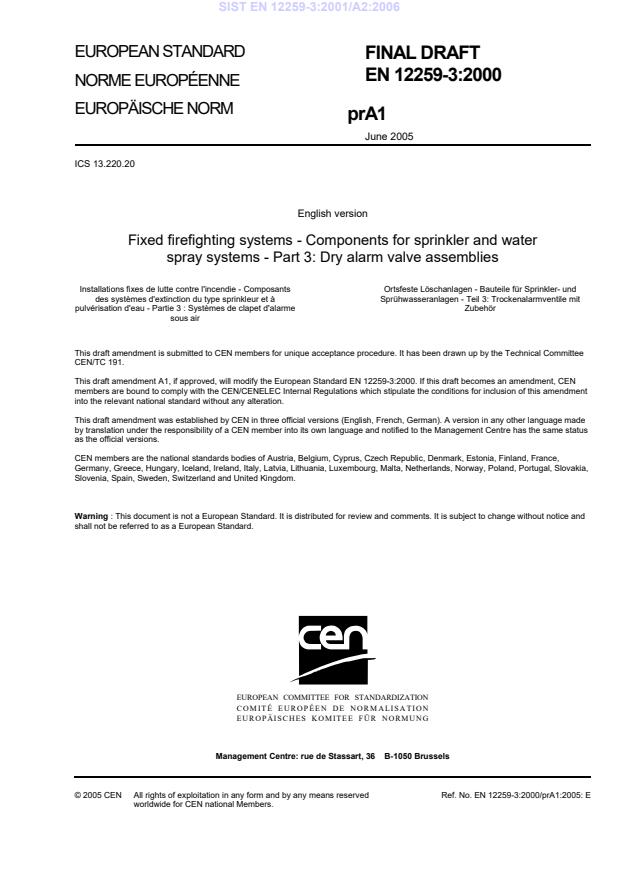
EUROPEAN STANDARD
FINAL DRAFT
EN 12259-3:2000
NORME EUROPÉENNE
EUROPÄISCHE NORM
prA1
June 2005
ICS 13.220.20
English version
Fixed firefighting systems - Components for sprinkler and water
spray systems - Part 3: Dry alarm valve assemblies
Installations fixes de lutte contre l'incendie - Composants Ortsfeste Löschanlagen - Bauteile für Sprinkler- und
des systèmes d'extinction du type sprinkleur et à Sprühwasseranlagen - Teil 3: Trockenalarmventile mit
pulvérisation d'eau - Partie 3 : Systèmes de clapet d'alarme Zubehör
sous air
This draft amendment is submitted to CEN members for unique acceptance procedure. It has been drawn up by the Technical Committee
CEN/TC 191.
This draft amendment A1, if approved, will modify the European Standard EN 12259-3:2000. If this draft becomes an amendment, CEN
members are bound to comply with the CEN/CENELEC Internal Regulations which stipulate the conditions for inclusion of this amendment
into the relevant national standard without any alteration.
This draft amendment was established by CEN in three official versions (English, French, German). A version in any other language made
by translation under the responsibility of a CEN member into its own language and notified to the Management Centre has the same status
as the official versions.
CEN members are the national standards bodies of Austria, Belgium, Cyprus, Czech Republic, Denmark, Estonia, Finland, France,
Germany, Greece, Hungary, Iceland, Ireland, Italy, Latvia, Lithuania, Luxembourg, Malta, Netherlands, Norway, Poland, Portugal, Slovakia,
Slovenia, Spain, Sweden, Switzerland and United Kingdom.
Warning : This document is not a European Standard. It is distributed for review and comments. It is subject to change without notice and
shall not be referred to as a European Standard.
EUROPEAN COMMITTEE FOR STANDARDIZATION
COMITÉ EUROPÉEN DE NORMALISATION
EUROPÄISCHES KOMITEE FÜR NORMUNG
Management Centre: rue de Stassart, 36 B-1050 Brussels
© 2005 CEN All rights of exploitation in any form and by any means reserved Ref. No. EN 12259-3:2000/prA1:2005: E
worldwide for CEN national Members.
EN 12259-3:2000/prA2:2005 (E)
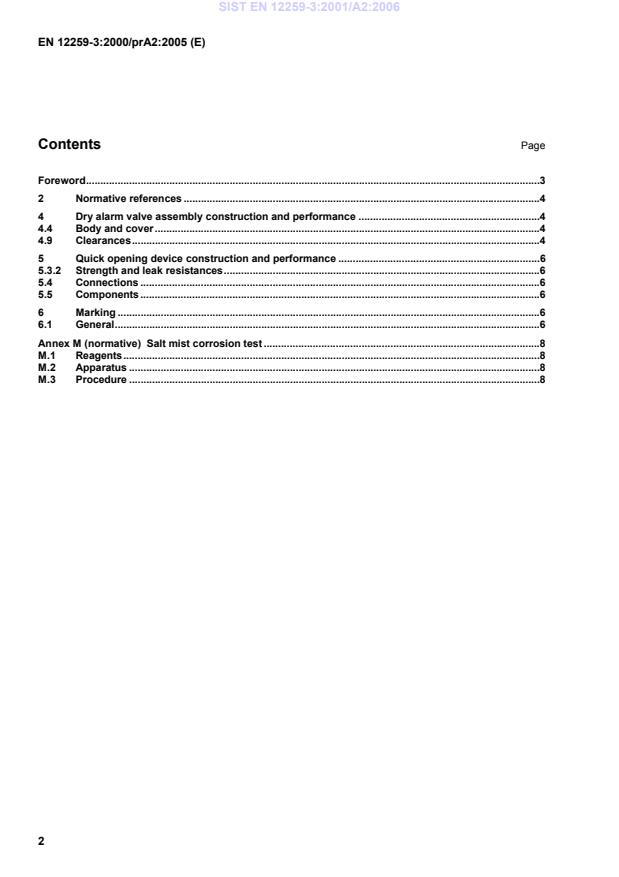
Contents Page
Foreword.3
2 Normative references .4
4 Dry alarm valve assembly construction and performance .4
4.4 Body and cover.4
4.9 Clearances.4
5 Quick opening device construction and performance .6
5.3.2 Strength and leak resistances.6
5.4 Connections .6
5.5 Components.6
6 Marking .6
6.1 General.6
Annex M (normative) Salt mist corrosion test .8
M.1 Reagents.8
M.2 Apparatus .8
M.3 Procedure .8
EN 12259-3:2000/prA2:2005 (E)
Foreword
This European Standard (EN 12259-3:2000/prA2:2005) has been prepared by Technical Committee
CEN/TC 191 “Fixed firefighting systems”, the secretariat of which is held by BSI.
This European Standard is currently submitted to the Unique Acceptance Procedure.
This European Standard has been prepared under a mandate given to CEN by the European Commission
and the European Free Trade Association, and supports essential requirements of EU Directive(s).
For relationship with EU Directive(s), see informative Annex ZA, which is an integral part of this European
Standard.
EN 12259-3:2000/prA2:2005 (E)
2 Normative references
Delete the following references:
ISO 7-1, Pipe threads where pressure-tight joints are made on the threads – Part 1: Dimensions, tolerances
and designation.
ISO 228-1, Pipe threads where pressure-tight joints are not made on the threads – Part 1: Designations,
dimensions and tolerances.
4 Dry alarm valve assembly construction and performance
4.4 Body and cover
Replace 4.4.1.1 with the following text:
4.4.1.1 The body and any cover shall be made of cast iron, bronze, brass, monel metal, stainless steel,
titanium or other materials with equivalent physical and mechanical properties.
Insert new subclause 4.4.1.2 as follows and renumber the old 4.4.1.2 as a new subclause 4.4.1.3:
4.4.1.2 Cover fasteners shall be made of steel, stainless steel, titanium or other materials with equivalent
physical and mechanical properties.
Replace 4.4.3.2 with the following text:
4.4.3.2 The normal design load of any fastener, excluding the force required to compress the gasket, shall not
exceed the minimum tensile strength specified in EN ISO 898-1 and ISO 898-2 or other appropriate standards
for materials not covered by ISO 898, when the dry alarm valve is pressurised to four times the rated working
pressure. The area of the application of pressure shall be calculated as follows:
a) if a full-
...
표준 EN 12259-3:2000/A2:2005는 고정 소방 시스템의 일환으로 스프링클러 및 물 분사 시스템 구성 요소에 관한 중요한 지침을 제공합니다. 본 표준의 주요 초점은 드라이 알람 밸브 조립체에 대한 수정된 허용 오차를 제시하여, EN 12259-3의 기준에 불일치하는 알람 밸브도 해당 표준의 요구 사항에 포함될 수 있도록 하는 것입니다. 이 표준의 강점은 넓은 적용 범위에 있으며, 다양한 환경에서의 소방 안전 시스템의 일관성과 신뢰성을 높이는 데 기여합니다. 특히, 드라이 알람 밸브의 설계 및 설치 과정에서의 유연성을 제공함으로써, 다양한 상황에 적합한 소방 시스템 구현을 가능하게 합니다. 이는 특히 건축물의 유형이나 목적에 따라 요구되는 다양한 설계 기준을 충족시키는 데 중요한 요소입니다. 또한, EN 12259-3는 알람 밸브의 성능과 안전성을 보장하는 명확한 기준을 설정하고 있어, 소방 시스템의 운영 시 발생할 수 있는 위험 요소를 최소화합니다. 이는 최종 사용자의 안전을 보장하며, 관련 부문에서 신뢰할 수 있는 제품 사용을 유도합니다. 따라서, SIST EN 12259-3:2001/A2:2006 문서는 특정 요구 사항을 충족하는 드라이 알람 밸브 조립체의 설치와 사용에 있어 결정적인 역할을 하며, 소방 안전 수칙을 준수하는 데 있어 중요한 참고자료로 기능합니다. 이 표준은 실제 적용 사례를 바탕으로 요구되는 성능 수준을 명확히 하여, 다양한 상황에서의 소방 안전 대책을 보다 체계적으로 마련하는 데 기여하고 있습니다.
SIST EN 12259-3:2001/A2:2006 문서는 고정 소방 시스템의 스프링클러 및 물 분사 시스템의 구성 요소에 관한 기준으로, 특히 건조 경고 밸브 조립에 대한 내용을 담고 있습니다. 이 표준의 주요 초점은 EN 12259-3 요구사항을 충족하지 않는 경고 밸브가 표준의 허용 오차 내에 들어올 수 있도록 수정된 내용을 포함한다는 점입니다. 표준의 강점 중 하나는 다양한 설치 상황에 맞춰 경고 밸브를 유연하게 조정할 수 있도록 허용한다는 것입니다. 이는 현장에서 여러 가지 조건에 대응할 수 있는 더 나은 솔루션을 제공합니다. 이러한 수정 사항은 제품의 호환성을 높이고, 소방 시스템의 신뢰성을 더욱 보장할 수 있는 기반을 마련합니다. 또한, 이 표준은 현대 소방 시스템의 안전성과 효율성을 보장하는 데 중요한 역할을 합니다. EN 12259-3:2000/A2:2005에서의 수정 사항들은 실제 운영에서의 문제를 최소화하고, 설치 및 유지보수 과정에서의 효율성 개선에 기여합니다. 고정 소방 시스템의 여러 구성 요소와의 통합적인 접근은 소방 안전 혁신을 촉진하고, 보다 안전한 환경을 조성하는 데 필수적입니다. 결론적으로, SIST EN 12259-3:2001/A2:2006은 고정 소방 시스템의 건조 경고 밸브 조립에 대한 요구 사항을 최신 기준으로 조정하여 안전성과 효율성을 동시에 강화하는 데 기여하는 유용한 표준입니다.
La norme EN 12259-3:2000/A2:2005 traite des systèmes fixes de lutte contre l'incendie, en se concentrant spécifiquement sur les composants des systèmes de sprinkleurs et de pulvérisation d'eau, notamment les assemblages de vannes d'alarme à sec. L'importance de cette norme réside dans sa capacité à établir des exigences claires et précises pour les dispositifs utilisés dans les systèmes de protection incendie. L'un des points forts de cette norme est sa portée, qui inclut des modifications aux tolérances permettant aux vannes d'alarme ne respectant pas entièrement la norme EN 12259-3 de se conformer aux exigences établies. Cela favorise une plus grande flexibilité pour les fabricants et les installateurs, tout en maintenant un niveau de sécurité élevé. En intégrant ces modifications, la norme assure que les systèmes d'alarme sont à la fois efficaces et fiables, améliorant ainsi la protection contre les incendies dans divers environnements. De plus, cette norme a une pertinence accrue dans le contexte actuel, où les exigences en matière de sécurité incendie sont de plus en plus strictes. La norme EN 12259-3:2000/A2:2005 répond à ce besoin en fournissant des recommandations précises qui aident à garantir que les systèmes de sprinkler fonctionnent de manière optimale, réduisant ainsi les risques liés aux incendies. En synthèse, la norme SIST EN 12259-3:2001/A2:2006 joue un rôle essentiel dans la régulation et l'amélioration des systèmes de lutte contre l'incendie, apportant à la fois innovation et sécurité. Ses modifications ouvrent la voie à une plus grande compatibilité et fiabilité des systèmes, ce qui en fait un document clé pour les professionnels du secteur.
La norme EN 12259-3:2000/A2:2005, intitulée "Systèmes fixes de lutte contre l'incendie - Composants pour les systèmes de gicleurs et de pulvérisation d'eau - Partie 3 : Assemblages de vannes à alarme sèche", présente un champ d'application essentiel pour l'industrie de la sécurité incendie. L'une des modifications clés apportées par cette norme concerne les tolérances, permettant aux vannes à alarme qui ne sont pas conformes à EN 12259-3 de répondre aux exigences de la norme. Cette révision est particulièrement pertinente, car elle offre une flexibilité qui peut encourager l'innovation tout en maintenant des critères de sécurité stricts. L'un des points forts de la norme réside dans son approche pragmatique, qui vise à intégrer des produits pouvant varier légèrement en spécifications tout en garantissant leur efficacité dans des systèmes de protection incendie. Cela répond à la réalité du marché où les évolutions technologiques et les améliorations des produits sont fréquentes. De plus, la norme acquiert une validité accrue en structurant les exigences pour les assemblages de vannes à alarme sèche, un composant critique des systèmes de gicleurs et de pulvérisation d'eau. La clarté des exigences assure une plus grande confiance dans la performance et la fiabilité des installations incendie, ce qui est crucial pour la protection des biens et des vies. En résumé, l'EN 12259-3:2000/A2:2005 joue un rôle fondamental en adaptant les tolérances des vannes à alarme, tout en maintenant un haut niveau de sécurité et de performance, ce qui renforce son application dans le domaine des systèmes fixes de lutte contre l'incendie. Ce standard est donc non seulement pertinent, mais également essentiel pour l’évolution de pratiques sécuritaires dans le secteur.
The standard EN 12259-3:2000/A2:2005 specifically addresses the components required for fixed firefighting systems, concentrating on dry alarm valve assemblies for sprinkler and water spray systems. Its scope is significant, as it brings vital modifications to tolerances, thereby allowing alarm valves that do not conform to the previous specifications to meet the outlined requirements. This flexibility increases the usability of the standard across varying applications, ensuring a wider range of dry alarm valve assemblies can be accepted into compliance. One of the notable strengths of this standard is its focus on enhancing the safety and reliability of fixed firefighting systems. By defining the specific tolerances and components necessary for dry alarm valves, EN 12259-3:2000/A2:2005 aids manufacturers and installers in ensuring that these critical systems function effectively during emergencies. Moreover, the modifications to tolerances facilitate innovation by permitting designs that may not fit within previously strict parameters, thus fostering development in firefighting technology. The relevance of this standard goes beyond compliance, as it supports end-users in achieving a higher level of safety. The alterations it introduces contribute to minimizing the risks associated with fire incidents by ensuring that the alarm systems are reliable and responsive. Additionally, this standard may impact regulatory practices in various jurisdictions, encouraging the adoption of best practices aligned with modern firefighting needs. Overall, EN 12259-3:2000/A2:2005 stands out for its detailed specifications and adaptive approach toward compliance. It not only strengthens the framework for fixed firefighting systems but also ensures that safety remains paramount in the design and implementation of sprinkler and water spray systems.
The EN 12259-3:2000/A2:2005 standard is a critical reference in the realm of fixed firefighting systems, specifically addressing the components for sprinkler and water spray systems with a focus on dry alarm valve assemblies. The scope of this document extends to the modification of tolerances, enabling alarm valves that previously did not conform to EN 12259-3 to align with the standard. This aspect of the standard is particularly significant as it enhances the flexibility and adaptability of existing firefighting systems, allowing for broader compliance without compromising safety or effectiveness. One of the key strengths of EN 12259-3 is its comprehensive approach to the design and installation of dry alarm valve assemblies. By clearly defining the standards and tolerances for these critical components, it helps ensure reliability and performance in various firefighting applications. The standard also promotes consistency across different installations, facilitating interoperability and maintenance for fire safety professionals. Moreover, the relevance of EN 12259-3 in contemporary firefighting practices cannot be overstated. As fire safety regulations evolve and facilities upgrade their system components, this standard serves as a benchmark for manufacturers and installers. By accommodating modifications to tolerances, the standard addresses the practical realities of engineering and installation, ensuring that even older systems can be brought up to modern safety standards. This adaptability is crucial in a landscape where fire safety technology is constantly advancing. In summary, EN 12259-3:2000/A2:2005 stands out for its thoughtful approach to the complexities of dry alarm valve assemblies within fixed firefighting systems. Its focus on modifying tolerances not only facilitates compliance but also reinforces the importance of reliability and safety in fire prevention.
SIST EN 12259-3:2001/A2:2006に関するレビューでは、主に標準自体の範囲、強み、関連性について焦点を当てています。この標準は、固定消防システムにおけるスプリンクラーおよび水スプレーシステムのコンポーネントに関するものであり、その特に乾燥警報弁のアセンブリについての規定を提供しています。 この標準の主な範囲は、EN 12259-3規格に準拠しない警報弁が、調整された許容範囲に従って標準の要件内に入ることを可能にする修正を含んでいます。このような修正は、信頼性の向上と、消防システムの性能を確保するために極めて重要です。特に、乾燥警報弁は火災警報システムの重要な要素であるため、標準の適用により、消防安全の強化に寄与しています。 この標準の強みは、実用性と柔軟性にあります。許容範囲の修正により、さまざまな設計や環境に合わせた適用が可能となり、実際の使用状況に応じた適切な導入が実現します。これにより、異なるメーカーの製品が互換性を持ち、全体的なシステムの効率が向上します。 さらに、EN 12259-3:2000/A2:2005は、国際的な基準に基づいているため、広範な認知度と受容性を有しています。これは、特にグローバルに展開する企業にとって、異なる地域での規制を遵守するために重要であり、国際的な市場における競争力を向上させます。 このように、SIST EN 12259-3:2001/A2:2006は、固定消防システムの重要な要素としての乾燥警報弁アセンブリに具体的なガイダンスを提供し、安全性と効率性を高めるための有用な標準です。
EN 12259-3:2000/A2:2005の標準は、スプリンクラーおよび水スプレーシステム用の固定消防システムに関連する重要なコンポーネントである乾燥警報弁アセンブリに特化した規定を設けています。この標準の範囲は、EN 12259-3に適合していない警報弁が、標準の要求事項に適合することを可能にするための許容範囲の修正に焦点を当てています。 この文書の強みは、標準化された基準が、消防システムの性能と安全性を向上させるための具体的なガイドラインを提供している点です。特に、乾燥警報弁アセンブリの適用において、柔軟性と互換性を持たせることができるため、異なる設計や製造プロセスを持つ警報弁が、より広範な施設に適用可能となります。 さらに、EN 12259-3:2000/A2:2005は、システムの信頼性向上に寄与し、火災時の迅速な反応を促進することで、最終的に人命と財産を守るための重要な役割を果たしています。これにより、建物や施設の安全性が確保され、ユーザーに対し大きな安心を提供します。 この標準の関連性は、消防技術の進歩とともに高まり続けており、特に新たな消防設備の開発において、EN 12259-3に基づく規定が製品設計や認証において重要視されています。正確な基準を設けることは、業界全体の標準化を促進し、製品の品質向上にも寄与するため、今後も継続的な見直しが求められるでしょう。
Die Norm EN 12259-3:2000/A2:2005 befasst sich mit fixen Brandschutzsystemen und legt spezielle Anforderungen an Komponenten für Sprinkler- und Wassernebelanlagen fest – insbesondere in Bezug auf die Trockenalarmventilgruppen. Der Fokus dieser Norm liegt auf der Anpassung der Toleranzen, um die Integration von Alarmventilen, die nicht den vorhergehenden Anforderungen der EN 12259-3 entsprechen, in die aktuellen Standards zu ermöglichen. Ein wesentlicher Stärke der Norm ist die Verbesserung der Flexibilität für Hersteller und Installateure. Durch die Modifikation der Toleranzen wird es ermöglicht, dass eine breitere Palette von Produkten den relevanten Anforderungen gerecht werden kann, ohne die Sicherheitsstandards zu kompromittieren. Dies ist besonders wichtig in Anbetracht der Vielfalt an Produkten und Technologien auf dem Markt. Die Norm ist von großer Relevanz für die Branche, da sie nicht nur Sicherheit und Zuverlässigkeit in der Brandbekämpfung gewährleistet, sondern auch dazu beiträgt, den Wettbewerb zu fördern, indem mehr Herstellern der Zugang zu den geforderten Standards erleichtert wird. Darüber hinaus sorgt diese Standardisierung dafür, dass die Qualität und Leistung von Trockenalarmventilgruppen auf einem hohen Niveau bleibt, was für die Integrität aller Brandschutzsysteme entscheidend ist. Insgesamt bietet die EN 12259-3:2000/A2:2005 sowohl technische Klarheit als auch wirtschaftliche Perspektiven, die in der heutigen zunehmend regulierten Umgebung von großer Bedeutung sind. Die Norm schafft somit eine solide Basis für weitere Entwicklungen in der Technologie der festen Brandschutzsysteme.
Die Norm EN 12259-3:2000/A2:2005 befasst sich mit festen Brandbekämpfungssystemen, insbesondere mit den Komponenten für Sprinkler- und Wassersprühanlagen, und konzentriert sich speziell auf Trockenalarmventilanlagen. Die vorliegende Norm ist entscheidend für die Gewährleistung der Sicherheit und Effizienz von Brandbekämpfungssystemen in verschiedenen Anwendungen. Der Geltungsbereich der Norm umfasst wesentliche Modifikationen zu den Toleranzen, die es ermöglichen, dass Alarmventile, die nicht vollständig den bisherigen Anforderungen der EN 12259-3 entsprechen, nun innerhalb der Normanforderungen berücksichtigt werden können. Dies ist besonders relevant, da es Betreiber und Hersteller in die Lage versetzt, bestehende Systeme zu optimieren und gleichzeitig die Sicherheitsanforderungen aufrechtzuerhalten. Zu den Stärken der EN 12259-3:2000/A2:2005 gehört die klare Definition von technischen Spezifikationen und Qualitätsstandards für Trockenalarmventilanlagen. Die Norm fördert die Standardisierung in der Branche und sorgt dafür, dass alle Systeme, unabhängig von ihrer Herkunft, sicher und zuverlässig arbeiten können. Darüber hinaus trägt sie zur Verbesserung der Entwicklung und Herstellung von Brandbekämpfungskomponenten bei, indem sie praxisnahe Lösungen und Anpassungen an bestehende Standards bietet. In Anbetracht der ständig steigenden Anforderungen an Brandschutz und -überwachung ist die Relevanz dieser Norm nicht zu unterschätzen. Feuerwehr- und Sicherheitsbehörden, Ingenieure und Planer vertrauen auf die Norm, um sicheres und wirkungsvolles Design und Betrieb von Sprinkler- und Wassersprühanlagen zu gewährleisten. Die Norm EN 12259-3:2000/A2:2005 stellt somit ein unverzichtbares Instrument für die Gewährleistung des Brandschutzes in vielen Bereichen dar.


Questions, Comments and Discussion
Ask us and Technical Secretary will try to provide an answer. You can facilitate discussion about the standard in here.
Loading comments...