

CEN/TS 99001:2008
(Main)Business support - Support services provided to small enterprises - Terminology, quality and performance
- Abstract
This Technical Specification establishes the general elements of a business support service of appropriate quality. The service should be tailored to the expectations of enterprises.
This Technical Specification specifies requirements on the business support service providers, as well as guidelines for enterprises, including self-employed persons. It focuses on the process of service provision rather than the nature or content of the service. It is not concerned with the internal organisation of either service providers or enterprises.
This Technical Specification can serve as a common reference for both enterprises and support service providers.
On the one hand, for service providers, it is intended to be:
a reference tool for how to structure the services provided;
a guideline for providing a service corresponding to actual needs and expectations;
a guideline for improving the quality of the service.
It clarifies the type of information exchanged between service provider and service receiver, i.e. the enterprise.
On the other hand, it is intended to help the managers to detect and specify the needs of their enterprises and to get a suitable service by:
expressing the needs of the enterprise;
interacting with the service provider;
choosing or seeking guidance on a suitable service provider;
evaluating the service received in line with documented requirements and expectations.
This Technical Specification also contains some more detailed advice on drawing up contracts and placing orders. It is intended to be a practical tool for enterprises to choose and evaluate their support service providers.
This Technical Specification concerns all types of business support services, irrespective of the domain in question (commercial, financial, training, IT, legal, marketing, organisational, technical, general assistance, etc.), with the exception of facilities management described in EN 15221 1 and EN 15221 2 (see note).
- Status
- Published
- Publication Date
- 30-Sep-2008
- Technical Committee
- CEN/TC 374 - Project Committee - Business Support Services
- Drafting Committee
- CEN/TC 374 - Project Committee - Business Support Services
- Current Stage
- 6060 - Definitive text made available (DAV) - Publishing
- Start Date
- 01-Oct-2008
- Due Date
- 09-Sep-2008
- Completion Date
- 01-Oct-2008

Overview
CEN/TS 99001:2008 - Business support: Support services provided to small enterprises - Terminology, quality and performance - is a CEN Technical Specification that defines a common, process‑oriented framework for delivering and assessing business support services to small enterprises (SEs) and self‑employed persons. It sets out requirements for service providers and practical guidelines for small business managers, focusing on how services are selected, performed and evaluated rather than on the internal organisation of either party. The document is intended as a reference tool to improve service quality and clarify the information exchange between provider and receiver. Facilities management services (EN 15221‑1 / EN 15221‑2) are explicitly excluded.
Key topics and requirements
- Terminology and scope: Definitions for “enterprise”, “small enterprise”, “micro enterprise”, “service provider” and related terms follow EU recommendations, helping ensure common understanding.
- Three phases of service provision:
- Selection - identifying needs, preparing requests, short‑listing providers, consultation and contracting.
- Performance - organising delivery, monitoring, handling modifications and managing the end of assignment.
- Assessment - evaluating outcomes against documented expectations and promoting ongoing improvement.
- Information exchange: Guidance on the type and timing of information to be shared between service provider and enterprise.
- Contractual guidance: Practical advice and considerations for drafting contracts and placing orders (scope, deliverables, price, change control).
- Quality principles and tools: Annexes include the six fundamental principles of good service provision, a code of conduct, assessment methods and a checklist for small enterprises to use during selection and evaluation.
- Non‑certification: The Technical Specification is not intended as a basis for formal certification of providers.
Applications and users
- Small business managers and founders use the standard to:
- express needs clearly,
- choose suitable providers,
- evaluate service performance and value for money.
- Business support organisations, consultants and public agencies use it to:
- structure and standardise support offers,
- design transparent service packages,
- implement monitoring and continuous improvement practices.
- Incubators, training providers and sectoral advisers can adopt the framework to align services with small enterprise expectations and to improve client satisfaction.
Related standards
- Excludes facilities management work covered by EN 15221‑1 and EN 15221‑2.
- Terminology and SME size thresholds reference EU guidance (Commission Recommendation C(2003)1422).
CEN/TS 99001:2008 is a practical, process‑focused reference for improving the quality, transparency and performance of business support services aimed at small enterprises. Keywords: CEN/TS 99001:2008, business support, small enterprises, service quality, service providers, service selection, service performance, service assessment.
Get Certified
Connect with accredited certification bodies for this standard

Great Wall Tianjin Quality Assurance Center
Established 1993, first batch to receive national accreditation with IAF recognition.
Hong Kong Quality Assurance Agency (HKQAA)
Hong Kong's leading certification body.

Innovative Quality Certifications Pvt. Ltd. (IQCPL)
Known for integrity, providing ethical & impartial Assessment & Certification. CMMI Institute Partner.
Sponsored listings
Frequently Asked Questions
CEN/TS 99001:2008 is a technical specification published by the European Committee for Standardization (CEN). Its full title is "Business support - Support services provided to small enterprises - Terminology, quality and performance". This standard covers: This Technical Specification establishes the general elements of a business support service of appropriate quality. The service should be tailored to the expectations of enterprises. This Technical Specification specifies requirements on the business support service providers, as well as guidelines for enterprises, including self-employed persons. It focuses on the process of service provision rather than the nature or content of the service. It is not concerned with the internal organisation of either service providers or enterprises. This Technical Specification can serve as a common reference for both enterprises and support service providers. On the one hand, for service providers, it is intended to be: a reference tool for how to structure the services provided; a guideline for providing a service corresponding to actual needs and expectations; a guideline for improving the quality of the service. It clarifies the type of information exchanged between service provider and service receiver, i.e. the enterprise. On the other hand, it is intended to help the managers to detect and specify the needs of their enterprises and to get a suitable service by: expressing the needs of the enterprise; interacting with the service provider; choosing or seeking guidance on a suitable service provider; evaluating the service received in line with documented requirements and expectations. This Technical Specification also contains some more detailed advice on drawing up contracts and placing orders. It is intended to be a practical tool for enterprises to choose and evaluate their support service providers. This Technical Specification concerns all types of business support services, irrespective of the domain in question (commercial, financial, training, IT, legal, marketing, organisational, technical, general assistance, etc.), with the exception of facilities management described in EN 15221 1 and EN 15221 2 (see note).
This Technical Specification establishes the general elements of a business support service of appropriate quality. The service should be tailored to the expectations of enterprises. This Technical Specification specifies requirements on the business support service providers, as well as guidelines for enterprises, including self-employed persons. It focuses on the process of service provision rather than the nature or content of the service. It is not concerned with the internal organisation of either service providers or enterprises. This Technical Specification can serve as a common reference for both enterprises and support service providers. On the one hand, for service providers, it is intended to be: a reference tool for how to structure the services provided; a guideline for providing a service corresponding to actual needs and expectations; a guideline for improving the quality of the service. It clarifies the type of information exchanged between service provider and service receiver, i.e. the enterprise. On the other hand, it is intended to help the managers to detect and specify the needs of their enterprises and to get a suitable service by: expressing the needs of the enterprise; interacting with the service provider; choosing or seeking guidance on a suitable service provider; evaluating the service received in line with documented requirements and expectations. This Technical Specification also contains some more detailed advice on drawing up contracts and placing orders. It is intended to be a practical tool for enterprises to choose and evaluate their support service providers. This Technical Specification concerns all types of business support services, irrespective of the domain in question (commercial, financial, training, IT, legal, marketing, organisational, technical, general assistance, etc.), with the exception of facilities management described in EN 15221 1 and EN 15221 2 (see note).
CEN/TS 99001:2008 is classified under the following ICS (International Classification for Standards) categories: 03.080.20 - Services for companies. The ICS classification helps identify the subject area and facilitates finding related standards.
CEN/TS 99001:2008 is associated with the following European legislation: Standardization Mandates: M/370. When a standard is cited in the Official Journal of the European Union, products manufactured in conformity with it benefit from a presumption of conformity with the essential requirements of the corresponding EU directive or regulation.
CEN/TS 99001:2008 is available in PDF format for immediate download after purchase. The document can be added to your cart and obtained through the secure checkout process. Digital delivery ensures instant access to the complete standard document.
Standards Content (Sample)
SLOVENSKI STANDARD
01-december-2008
Podpora poslovanju - Storitve v podporo majhnim podjetjem - Terminologija,
kakovost in delovanje
Business support - Support services provided to small enterprises - Terminology, quality
and performance
Wirtschaftsförderung - Unternehmensentwicklungsdienstleistungen für kleine und
mittelständische Unternehmen - Terminologie, Qualität und Leistung
Services aux entreprises - Services d'accompagnement et de conseil aux petites
entreprises - Terminologie, qualité et performances du service
Ta slovenski standard je istoveten z: CEN/TS 99001:2008
ICS:
03.080.20 Storitve za podjetja Services for companies
2003-01.Slovenski inštitut za standardizacijo. Razmnoževanje celote ali delov tega standarda ni dovoljeno.
TECHNICAL SPECIFICATION
CEN/TS 99001
SPÉCIFICATION TECHNIQUE
TECHNISCHE SPEZIFIKATION
October 2008
ICS 03.080.20
English Version
Business support - Support services provided to small
enterprises - Terminology, quality and performance
Services aux entreprises - Services d'accompagnement et Business support - Support Services für Kleinunternehmen
de conseil aux petites entreprises - Terminologie, qualité et - Begriffe, Qualität und Ausführung
performances du service
This Technical Specification (CEN/TS) was approved by CEN on 21 July 2008 for provisional application.
The period of validity of this CEN/TS is limited initially to three years. After two years the members of CEN will be requested to submit their
comments, particularly on the question whether the CEN/TS can be converted into a European Standard.
CEN members are required to announce the existence of this CEN/TS in the same way as for an EN and to make the CEN/TS available
promptly at national level in an appropriate form. It is permissible to keep conflicting national standards in force (in parallel to the CEN/TS)
until the final decision about the possible conversion of the CEN/TS into an EN is reached.
CEN members are the national standards bodies of Austria, Belgium, Bulgaria, Cyprus, Czech Republic, Denmark, Estonia, Finland,
France, Germany, Greece, Hungary, Iceland, Ireland, Italy, Latvia, Lithuania, Luxembourg, Malta, Netherlands, Norway, Poland, Portugal,
Romania, Slovakia, Slovenia, Spain, Sweden, Switzerland and United Kingdom.
EUROPEAN COMMITTEE FOR STANDARDIZATION
COMITÉ EUROPÉEN DE NORMALISATION
EUROPÄISCHES KOMITEE FÜR NORMUNG
Management Centre: rue de Stassart, 36 B-1050 Brussels
© 2008 CEN All rights of exploitation in any form and by any means reserved Ref. No. CEN/TS 99001:2008: E
worldwide for CEN national Members.
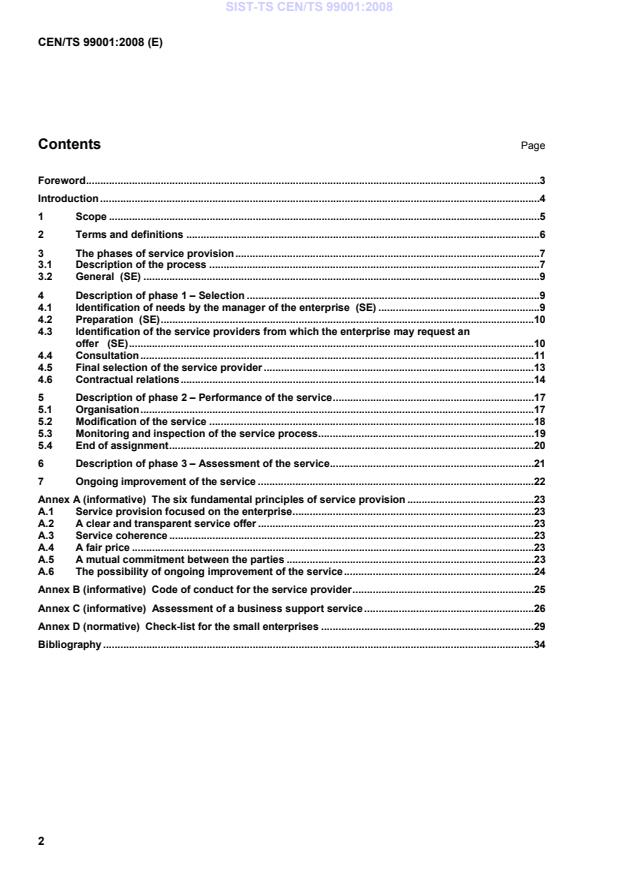
Contents Page
Foreword.3
Introduction .4
1 Scope .5
2 Terms and definitions .6
3 The phases of service provision.7
3.1 Description of the process .7
3.2 General (SE) .9
4 Description of phase 1 – Selection .9
4.1 Identification of needs by the manager of the enterprise (SE) .9
4.2 Preparation (SE).10
4.3 Identification of the service providers from which the enterprise may request an
offer (SE).10
4.4 Consultation.11
4.5 Final selection of the service provider .13
4.6 Contractual relations.14
5 Description of phase 2 – Performance of the service.17
5.1 Organisation.17
5.2 Modification of the service .18
5.3 Monitoring and inspection of the service process.19
5.4 End of assignment.20
6 Description of phase 3 – Assessment of the service.21
7 Ongoing improvement of the service .22
Annex A (informative) The six fundamental principles of service provision .23
A.1 Service provision focused on the enterprise.23
A.2 A clear and transparent service offer .23
A.3 Service coherence .23
A.4 A fair price .23
A.5 A mutual commitment between the parties .23
A.6 The possibility of ongoing improvement of the service.24
Annex B (informative) Code of conduct for the service provider.25
Annex C (informative) Assessment of a business support service .26
Annex D (normative) Check-list for the small enterprises .29
Bibliography .34
Foreword
This document (CEN/TS 99001:2008) has been prepared by Technical Committee CEN/TC 374 “Project
Committee - Business Support Services”, the secretariat of which is held by AFNOR.
Attention is drawn to the possibility that some of the elements of this document may be the subject of patent
rights. CEN [and/or CENELEC] shall not be held responsible for identifying any or all such patent rights.
This document has been prepared under a mandate given to CEN by the European Commission and the
European Free Trade Association, and supports essential requirements of EU Directive(s).
According to the CEN/CENELEC Internal Regulations, the national standards organizations of the following
countries are bound to announce this Technical Specification: Austria, Belgium, Bulgaria, Cyprus, Czech
Republic, Denmark, Estonia, Finland, France, Germany, Greece, Hungary, Iceland, Ireland, Italy, Latvia,
Lithuania, Luxembourg, Malta, Netherlands, Norway, Poland, Portugal, Romania, Slovakia, Slovenia, Spain,
Sweden, Switzerland and the United Kingdom.
Introduction
To be effective, the provision of business support services to small enterprises should be based upon a
common understanding between the managers of small enterprises on the one hand and the service
providers on the other hand.
If both parties use the same methods, in the same spirit, the quality of the services will be improved, as well
as the ongoing development of the small enterprise.
In order to show to each party the needs, challenges and obligations which the other party faces in the
process of the provision of a business support service, this document is presented, where appropriate, in two
columns, the left column containing recommendations for the small enterprises (SE), and the right column
containing requirements for the service providers (SP).
1 Scope
This Technical Specification establishes the general elements of a business support service of appropriate
quality. The service should be tailored to the expectations of enterprises.
This Technical Specification specifies requirements on the business support service providers, as well as
guidelines for enterprises, including self-employed persons. It focuses on the process of service provision
rather than the nature or content of the service. It is not concerned with the internal organisation of either
service providers or enterprises.
This Technical Specification can serve as a common reference for both enterprises and support service
providers.
On the one hand, for service providers, it is intended to be:
a reference tool for how to structure the services provided;
a guideline for providing a service corresponding to actual needs and expectations;
a guideline for improving the quality of the service.
It clarifies the type of information exchanged between service provider and service receiver, i.e. the enterprise.
On the other hand, it is intended to help the managers to detect and specify the needs of their enterprises and
to get a suitable service by:
expressing the needs of the enterprise;
interacting with the service provider;
choosing or seeking guidance on a suitable service provider;
evaluating the service received in line with documented requirements and expectations.
This Technical Specification also contains some more detailed advice on drawing up contracts and placing
orders. It is intended to be a practical tool for enterprises to choose and evaluate their support service
providers.
This Technical Specification concerns all types of business support services, irrespective of the domain in
question (commercial, financial, training, IT, legal, marketing, organisational, technical, general
assistance, etc.), with the exception of facilities management described in EN 15221-1 and EN 15221-2
(see note). These services may be provided over extended or predefined periods (days, weeks or months), be
performed by private or public organisations and be carried out within the framework of common business
relations including direct payment of fees by the enterprise. It should be noted that, because the range of
services offered by business support providers which fall within the scope of this document is very wide, not
all possible elements of each support provision process are covered by this document.
This Technical Specification is not intended to serve as a basis for certification of the service providers.
NOTE Facilities management services according to EN 15221-1 and EN 15221-2: services that support the main
activities of the enterprise in order to improve its effectiveness via the management and provision of appropriate support
services. Facilities management services are services relating to space and infrastructure (e.g. energy management,
cleaning, office arrangement renewal) and/or to persons and organisation (e.g. access control, fire extinguisher
maintenance, security, catering, shipping of merchandise, archiving and storage).
2 Terms and definitions
For the purposes of this document, the following terms and definitions apply.
2.1
enterprise
entity engaged in an economic activity, irrespective of its legal form; this includes self-employed persons and
family businesses engaged in craft or other activities, and partnerships or associations regularly engaged in
an economic activity
[Commission Recommendation C(2003) 1422]
2.2
small enterprise (SE)
enterprise which employs fewer than 50 people and whose annual turnover and/or annual balance sheet total
does not exceed EUR 10 million
[Commission Recommendation C(2003) 1422]
NOTE The small enterprise can be at any stage of its life cycle: creation, growth, maturity or transfer. By their nature,
small enterprises have few staff and may not have the management structures and resources of larger organisations.
Therefore, one person can incorporate all operating functions of the enterprise.
2.3
micro enterprise
enterprise which employs fewer than 10 people and whose annual turnover and/or annual balance sheet total
does not exceed EUR 2 million
[Commission Recommendation C(2003) 1422]
NOTE 1 The micro enterprise can be at any stage of its life cycle: creation, growth, maturity or transfer. By their nature,
micro enterprises have few staff and may not have the management structures and resources of larger organisations.
Therefore one person can incorporate all operating functions of the enterprise.
NOTE 2 In this Technical Specification, the term small enterprise (SE) is used for micro and small enterprises as
defined by the EU as well as self-employed persons.
2.4
self employed
person working for oneself as freelance or owner of a business that has no other employees
2.5
business support service
service provided by a third party (either private or public) external to the enterprise, which involves providing
advice, services or support of any kind and for any duration of time
NOTE 1 When services are provided within the framework of a policy initiated or supported by public authorities, these
services can sometimes be funded fully or in part. In this case, services are often provided by public, para-public or semi-
public structures (advisory committees, business start-up networks, for example).
NOTE 2 The support (or assistance) is primarily directed at issues faced by the manager of the enterprise in the
exercise of his/her multiple business processes thus making it easier for him/her to take decisions based on improved
control of the activities of the enterprise and its environment.
NOTE 3 Support can lead to specialised advisory service provision intended to meet the needs of the enterprise
identified by the manager of the enterprise.
2.6
service provider (SP)
private or public enterprise, structure or organisation which provides business support services
2.7
manager
person who directs and controls an enterprise (2.1)
NOTE The term manager is used for the manager of the enterprise himself/herself or a person on a team of the
enterprise or a group of people within the enterprise. In that case, we can use management or enterprise.
3 The phases of service provision
3.1 Description of the process
The service provision can be divided into three main phases:
1) the selection of a service provider which includes the identification of the appropriate service
provider, the analysis of the service offer and the contractual relations;
2) the performance of the service (during the provision of the service);
3) the assessment of the service.
For all the steps in this process, see Figure 1.
Figure 1 — Description of the service process
3.2 General (SE)
The decision to call on a service provider is ALWAYS the responsibility of the manager of the enterprise.
The initial need for a service may come from:
the manager of the enterprise himself/herself who has identified the need for an external service to
resolve a problem or to ensure that the activities of the enterprise are supported during the short or long
term, or to make up for his/her lack of experience in a particular domain;
the profession or public authorities encouraging the enterprise to engage in actions that are useful or
indispensable for the business (adapting to regulations).
Engaging a service provider may prove useful, in particular during the business start-up process. It may
ensure that the enterprise will benefit from appropriate support offered by certain support organisations during
start up and early years of development.
A check-list (see Annex D) summarises all the stages of the service provision and the recommendations to the
enterprise.
4 Description of phase 1 – Selection
4.1 Identification of needs by the manager of the enterprise (SE)
At first, the manager of the enterprise shall identify his/her motivations and determine the objectives of his/her
decision to use a service provider.
The manager of the enterprise should identify the need, type and availability of support services. For example:
suitable level of support, temporarily or long term, of an activity by an external service provider in order to,
for example:
retain the key resources of the enterprise;
perform services at a lower cost – for the same quality – than if they were carried out internally;
resolve problems relating to understaffing and/or under capacity.
access expert knowledge in order to deal with problems which the enterprise cannot resolve by itself or to
help it come out of its isolation by participating in a collective project.
advice regarding strategy and development of the enterprise during its start-up phase and during the
course of its life when it needs to begin a new stage in its development.
Several types of service providers exist. The enterprise should consider the differences between, for example:
public organisations and institutions which provide pre-defined services;
legal entities or private persons involved in free competition. This group includes organisations whose
skills or services are regulated;
professional associations, networks.
Public assistance mechanisms may sometimes lower the final cost of the service, either via aid provided to
the organisation, which provides the support service or via direct aid to the enterprise.
The existence of aid or a financing mechanism, which reduces the final cost of the service, is a selection
criterion to be considered.
It is recommended that the enterprise record the needs for external service.
4.2 Preparation (SE)
Where the need for a service provider has been identified, a plan for the service should be developed.
The plan should clearly outline the service to be provided, the results expected, the timelines for
implementation and the intermediate outcome. The short or long term expectations for the service provision
should also be included in the plan e.g. assuming that the service will become part of the enterprise or will be
taken over by the service provider over time.
The plan should assess the available resources within the enterprise such as financial resources, allocation of
manager/employee's time, predictable secondary effects (training, costs linked to changes, etc.). The
management may be obliged to define the limits of the service provider’s activity as early as this stage and
thus the share of the service that will be carried out by the management and/or by the enterprise.
The plan should identify the criteria to be used for selecting the service provider (field of expertise, speciality)
and the nature of the contract to be concluded (lump-sum contract, contract based on results, etc.).
Even if there is little time for the manager of the enterprise to search for a service provider or to express
his/her objectives in detail, it is fundamental that he/she takes the time to formalise in writing the general
objectives of the service that he/she expects. Otherwise there is a high risk that the service will not meet
his/her expectations.
The manager of the enterprise may be assisted in defining the needs and objectives of the enterprise by a
general service advisory body, a public service, a chamber of commerce or other type of chamber, federations
or professional organisations. Although the enterprise should ensure that this support does not impair the
objectivity and neutrality of the service provided if links with potential service providers exist.
4.3 Identification of the service providers from which the enterprise may request an offer
(SE)
Once the plan for the service has been defined and documented, the search for a suitable service provider
who is able to meet the needs of the enterprise can begin.
This identification stage may not be necessary where the enterprise has already previous experience with the
service provider either directly or based on recommendations from a reliable source or if the initial impetus
(see 3.2) does not come from the manager of the enterprise or if a pre-selection is communicated by an
organisation on which the manager of the enterprise can rely.
A review of the suitable service providers will enable the enterprise to make a more informed decision on the
most qualified and suitable service provider to meet the needs of the enterprise.
Factors to be considered in this review include:
internal quality assurance system: the service provider has made the effort to guarantee a certain level of
quality;
quality label delivered by an independent organisation: certification (EN ISO 9001 for example),
professional qualification, badge or charter of professional organisations, etc. This quality label is
important because:
the service provider has made the effort to obtain a label and is thus obliged to ensure that an
independent organisation evaluates its professionalism and the quality of its services;
certification bodies generally verify the description of the field of activities covered: title of the
certification, domain of the professional qualification;
NOTE If the enterprise requires the services of a regulated profession or activity, it is recommended to verify that the
service provider is registered by the organisation that regulates this profession or activity.
recommendation or word-of-mouth if the services previously delivered have met with the requirements;
public or private organisations that are either involved in providing information to enterprises or that work
within a domain corresponding to one of the business disciplines selected by the enterprise.
In general, a list of members published by professional associations, advisory bodies, etc., is based on no or
internal selection criteria. The associations concerned can provide information about the selection criteria they
apply.
Even if the identification process results in one single service provider, the manager of the enterprise should
go through with the service provider selection process to ensure that this service provider can offer a service
suitable for the enterprise.
If the identification process results in too many service providers, the manager of the enterprise should limit
the contacts to two or three, using, for example, the following criteria:
any information that demonstrates that the service provider is competent to provide the required service
adequately: for instance by making reference to the same type of service and adequate provision to
enterprises;
geographical proximity.
This phase should be carried out before any meeting with a service provider takes place, with one single
objective: the need to find a service provider with the skills required to provide the appropriate level of service.
4.4 Consultation
4.4.1 Consultation with the service provider(s) (SE)
The manager of the enterprise should objectively analyse the selection of the service provider(s) from which
an offer will be requested.
The manager of the enterprise should set aside time to contact the service provider(s) selected at this stage
and negotiate the service offer with them. This contact has two objectives:
to get to know the service providers (and vice versa) in order to make sure that the service provider
chosen will be able to provide the service adequately and efficiently;
to define the exact extent of the offer.
In particular the manager of the enterprise should:
define the problem, the objectives that he/she intends to achieve, the resources that can be assigned and
the possible assessment criteria for the results to be achieved. The manager of the enterprise should
provide all the information required for a proper understanding of the needs of the enterprise. The key
issues to be addressed are objectives, results, timelines and assessment criteria. It is recommended that
the manager of the enterprise prepares a written understanding of the service to be provided. This can be
done in a simple manner;
EXAMPLE “consider how accounts are maintained by defining what shall be performed/prepared within the
enterprise and what shall be carried out by the service provider. The accounting results shall be communicated on the xth
working day of the month (m + 1). Establish a monthly analytical chart within the same time period”.
explain to the service provider that all offers given will be evaluated in accordance with the fundamental
service criteria (indicated in Annex A);
ask the service provider to:
present the service organisation, experience, working methods and working teams;
validate the objectives to be obtained for the service to be provided or ensure that they are evaluated
together with the service provider, taking into account the latter’s experience in the domain in
question;
make a service offer, preferably in writing.
4.4.2 Analysis of the specific needs of the enterprise (SP)
It is fundamental for the service provider to understand the needs of the enterprise in order to make a suitable
offer. In-depth discussions with representatives of the enterprise are essential for the understanding of the
enterprise.
The service provider shall become acquainted with human, economic and physical aspects of the enterprise
and shall:
present its activities and fields of expertise to the enterprise;
enquire about the need expressed by the manager of the enterprise;
strive to identify the actual needs of the enterprise, the objectives and a solution suited to the context and
the means of the enterprise.
The service provider should together with the manager of the enterprise assess the enterprise commitment to
the service provision as this commitment is essential for the success of the service provision.
If the service provider lacks the resources or the expertise required to carry out the service provision, the
service provider should refuse to carry out the service. A basic requirement for providing appropriate quality
support services is that the necessary human and material resources are available to do the job properly. The
service provider needs to plan, as appropriate, the availability of staff and/or additional resources, with the
skills and competences to deliver the services required by the enterprise.
4.4.3 Elaboration and presentation of the service offer (SP)
Within a mutually agreed period, the service provider submits a written proposal to the enterprise, including:
a presentation of the service provider;
a presentation of the needs of the enterprise as understood by the service provider: initial enterprise
request, the problem it faces and its actual needs;
the work proposed, adapted to each enterprise: method selected, organisation, work phases, human and
material resources involved, the part to be performed by the enterprise, the time schedule, the
performance deadlines, the personnel to be involved;
the expected results;
the mutual commitments (between the service provider and the enterprise);
the assessment criteria for the results if they can be defined, or the commitment of resources;
the potential subcontractors or external resources that the service provider intends to use;
any financial terms clearly defined;
the administrative conditions;
the names and experience of the people who will actually do the work.
The service provider shall also consider giving assistance that will increase the competence of the
management, i.e. coaching.
The service provider shall not try to impose a common service offer that might not suit the needs of the
enterprise involved. The service offer should take into account the specific needs of the different types of
small enterprises: from prospective entrepreneurs through start-ups; established and growing enterprises of
various kinds, to enterprises that are about to be transferred to new owners (see Annexes A and B).
The proposal shall be clear and legible. It shall be phrased in such a manner that it can be read and
understood rapidly and allow the manager of the enterprise to come to a decision promptly.
If necessary, the service provider shall prepare the proposal by defining the service to be provided into key
stages. This will enable the manager of the enterprise to regularly check the progress of the service, and to
react when necessary.
In case of specific needs, the service provider can call on external resources (specialists, legal expert, etc.).
This shall be clearly explained to the manager of the enterprise and shall be included in the offer.
4.5 Final selection of the service provider
4.5.1 Analysis of the service offers (SE)
The enterprise should analyse, for each selected service provider, within a jointly agreed period, his/her
written offer, as regards the requirements in Clause 4.4.3.
4.5.2 Selection criteria and decision (SE)
The manager of the enterprise should base his/her decision on the following objective criteria:
the organisation of the service provider: its structure, sustainability, references, response time,
commitment to the offer (prices, deadlines, guarantees, etc.), its accessibility, its knowledge of the
enterprise as well as its experience in the field;
the staff allocated or employed by the service provider: the manager of the enterprise should take care in
particular to identify people in charge of the execution of the service, their skills and relevant experience;
the assurance that the service provider will not use any subcontractor without the consent of the
enterprise;
the extent to which the expected elements are included in the offer (see previous paragraph);
certain criteria such as the absence of a conflict of interests, confidentiality, codes of conduct
(see Annex B);
the cost of the service. Any cost should be in relation to:
the objectives to be attained and the enterprise’s resources;
the degree of customisation or off-the-shelf solution.
In addition, the decision may be based on subjective criteria such as the manner in which the service provider:
has made attempts to learn about the enterprise, its line of business and the context in which the
business is conducted;
has paid attention to and evaluated the expressed needs;
has been able to evaluate, with the manager of the enterprise, the level of involvement needed by the
enterprise to provide the service effectively;
has defined, in conjunction with the manager of the enterprise, the possible assessment criteria for the
expected results.
The enterprise should inform the service providers that have not been selected and should enter into a
contractual relationship with the selected service provider(s).
4.6 Contractual relations
4.6.1 General
Once a service provider has been selected, it is essential, in order to ensure the quality and success of the
service, to formalise the agreement including commitments, rights and obligations pertaining to each party.
Both parties should determine the need for a contract. Where a service is provided in a simple way, it may be
sufficient to outline the requirements in sufficient detail on an order form. Similarly, where a service is provided
for free or to a group of enterprises, there may be no need for a written contract. In certain countries, an oral
agreement has the same legal value as a written one. Nevertheless, the manager of the enterprise should
ensure that the service correspond to the needs of the enterprise. It is strongly recommended that, when no
written contract exists, the enterprise keep a comprehensive record of what was agreed.
In all other circumstances, a contract or an order form should be drawn up in accordance with the terms
described in 4.6.2. Usually, the service provider writes the contract; the enterprise has always the
responsibility of checking the terms of the contract. The contents of this written contract may vary depending
on the nature of the service to be provided and its duration.
For a complex service that is part of the enterprise’s strategy, it is necessary to draft a comprehensive
contract with the assistance of external professional expertise if needed.
4.6.2 The terms of the contract
The contract generally includes the following elements:
a) The proposal
The main objectives, frequency of the assignments, etc. and the expected outcomes of the service provision
shall be defined and agreed between both parties. Conditions for when the contract may be re-negotiated
should also be considered.
Certain services are of a recurrent nature: the same service is provided monthly or annually at the same time.
The contract shall specify the duration and frequency of these assignments either as a single assignment with
renewal by tacit agreement, or as a mission to be performed over a defined number of periods with
renegotiation of the contract.
b) The performance deadlines
The contract shall include the starting time, review periods and an end date. When the service is spread out
over time, interim deadlines can be fixed for specific tasks within the period of duration of the service
provision.
c) Financial conditions
The contract shall specify payment conditions including frequency. For example, it may stipulate that
instalments will be made at certain intervals during the course of the contract. These can be provided as a
lump sum or as a percentage of the work's progress.
Any penalties for not meeting the contractual conditions shall be clearly stipulated in the contract.
d) Confidentiality and legal and regulatory requirements
The service provider shall be subject to a confidentiality agreement in particular to intellectual property and
data protection. The professional conduct or standards, to which the service provider is subject, may be
specified or regulated either by professional or regulatory bodies.
e) The obligations of each party
The service provider is obliged to take responsibility for controlling the resources necessary to carry out the
service, in particular human resources: team allocation (number, hours, etc.), qualifications required, duration
and planning of the work. The service provider shall also provide the enterprise with information on the
competencies of the staff engaged, on progress of the service, in the form of an oral or written report or a
more formal progress meeting.
The service provider shall obtain agreement from the enterprise before using any subcontractor. The
enterprise should undertake to supply any assistance required by the service provider in terms of materials,
access to information and assignments to be executed under the supervision of the service provider.
f) Insurance, warranties, confidentiality agreement
Information on any insurance, warranties and confidentiality agreements should also be included in the
contract.
g) The mention of recourse to an amendment for any substantial modification of the service provision
Internal circumstances (change in the enterprise’s strategy for example) or external circumstances (changes
in legislation) may have an effect on the content of the contract, particularly if the service takes place over an
extended period of time.
In many instances, it is essential to review and possibly amend the contract with the agreement of the
enterprise and the service provider. An amendment containing the modifications to the contract (in particular
mutual commitments, deadlines and prices) shall be appended to the contract. An amendment may also
become necessary if the contract needs to be modified as a result of a rethinking of the requirements by
mutual agreement.
h) The means of renewal or termination if necessary
In the event of recurrent services, the conditions for renewal shall be stipulated.
In many instances, the contract’s fixed durations are short (annual) with renewal by tacit agreement. It is
possible however to envisage longer periods that are not subject to renewal and that require renegotiation of
the contract.
The contract shall include a termination clause to provide for the event that one of the parties defaults or
proves incapable of fulfilling its obligations. It is also necessary to include the rules of termination in the event
that one party decides not to renew the contract by tacit agreement but, instead, to terminate it.
As far as possible, milestones should be stipulated in the provision of the service in order to enable the
enterprise to disengage from the contract.
i) The procedure for dealing with disputes
During the performance of the service, disputes may arise, with regard to the quality of the service provided
(for example inadequate means, performance levels lower than expected) or with regard to excess costs that
have not been dealt with in amendments. The contract shall stipulate how disputes will be dealt with and
which court of law will be competent. In some countries, it may be preferable to include an arbitration clause
before referring any disputes to a court of law and to consider the dispute resolution facilities provided by
chambers of commerce or any other entities.
For services delivered cross border, the enterprise should also consider whether to include a clause in the
contract referring to the regulations of the country of the enterprise.
5 Description of phase 2 – Performance of the service
5.1 Organisation
(SE) (SP)
To ensure that the service is carried out correctly, the
The service provider shall provide the stipulated
following three essential requirements shall be
human resources and facilities, according to the
fulfilled:
terms of the contract in order to provide the service
with the appropriate quality.
- Information - Information
The enterprise, in conjunction with the service The service provider shall request from the enterprise
provider, should compile a list of information required all relevant information needed for the required
for the correct performance of the service. This list service. The service provider and the enterprise shall
should specify the conditions of access to information: agree on the type of information to be provided as
level of confidentiality of the information, persons well as the conditions for access and dissemination,
entitled to transmit it, conditions for disclosure. When the level of confidentiality; etc.
the information is not available internally, its location,
conditions of access and disclosure should be The service provider shall be informed of the internal
specified. It is also necessary to specify the conditions
regulation and the safety procedure of the enterprise
under which any relevant information is made and shall respect them.
available during the performance of the service.
- Human resources: - Human resources:
The manager of the enterprise should allocate the The service provider shall get assurance that the
appropriate human resources in terms of people, skills necessary resources, in terms of people, skills and
and time. The enterprise should confirm their time are made available from the enterprise that
availability and their suitability for the required receives the support service (how this is done need
assignments and shall communicate this to the not to be specified in detail; but it should be clear
persons concerned. The manager of the enterprise where the responsibility lies).
may also organise an information meeting with or
without the participation or the service provider in
In case of changes concerning the staff allocated by
order to ensure that his/her strategy has been the service provider, the service provider shall ensure
correctly understood. A written summary of the
that the new staff has the required competence and
meeting should be delivered to the participants. qualifications, and that the manager of the enterprise
has been advised and has agreed.
- Material equipment: - Material and equipment:
If special material or equipment is to be made
If specific material equipment is to be made available
available to the service provider in order to fulfil the
to the service provider, premises, IT hardware,
contracted service, this shall be stipulated in the
software, various tools, etc., this should be stipulated
contract.
in the contract. In conjunction with the service
provider, the enterprise should also draw up an
inventory of the equipment required, including the
date at which they are to be made available (or their
periods of use) and protective elements (keys or
access codes). If specific equipment needs to be
acquired outside the enterprise, the purchase or
hiring of this equipment should be arranged. Finally,
the manager of the enterprise should verify that this
equipment has been adequately insured.
5.2 Modification of the service
The service may be modified by an initiative from the enterprise or the service provider. These modifications
can be minor or significant.
(SE) (SP)
When a support service is being provided, it may When the service provider points out that a
prove necessary to supplement or modify the service significant modification of the service is required, as
as it was initially presented (changes in needs, the result of either additional modification request
occurrence of an unexpected event, changes in by the enterprise or modifications identified by the
regulations, etc.). service provider as being necessary for the
fulfilment of the service, the service provider shall
advise the enterprise of any significant
...