


FprEN 15664-1
(Main)Influence of metallic materials on water intended for human consumption - Dynamic rig test for assessment of metal release - Part 1: Design and operation
Influence of metallic materials on water intended for human consumption - Dynamic rig test for assessment of metal release - Part 1: Design and operation
This document specifies a procedure to determine the release of metals from metallic materials used in products intended to come into contact with drinking water.
The test can be used for three purposes:
a) To assess a material as a reference material for a new category of materials by metal release testing using the results of several investigations in different waters covering a broad range of water compositions;
b) To assess a material for an existing category for approval by way of metal release testing using the water defined in part 2, which exhibited the highest metal release when the reference material of the category was tested;
c) To obtain data on the interaction of local water with a material.
Einfluss metallischer Werkstoffe auf Wasser für den menschlichen Gebrauch - Dynamischer Prüfstandversuch für die Beurteilung der Abgabe von Metallen - Teil 1: Auslegung und Betrieb
Dieses Dokument legt ein Verfahren zur Bestimmung der Metallabgabe von metallischen Werkstoffen fest, die in Produkten verwendet werden, die für den Kontakt mit Trinkwasser vorgesehen sind.
Die Prüfung kann für die folgenden drei Aufgabenstellungen eingesetzt werden:
a) Beurteilung eines Referenzwerkstoffs für eine neue Werkstoffkategorie durch Prüfung der Metallabgabe, wobei die Ergebnisse mehrerer Untersuchungen mit verschiedenen Wässern zu verwenden sind, die eine große Spanne möglicher Wasserbeschaffenheiten abdecken.
b) Beurteilung eines Materials für eine bestehende Kategorie im Hinblick auf die Zulassung durch Prüfung der Metallabgabe unter Verwendung des in Teil 2 definierten Wassers, das bei der Prüfung des Referenzmaterials der Kategorie die höchste Metallabgabe aufwies;
c) Beurteilung der Wechselwirkung des örtlichen Wassers mit einem Werkstoff.
Influence des matériaux métalliques sur l'eau destinée à la consommation humaine - Banc d'essai dynamique pour l'évaluation du relargage de métaux - Partie 1 : Conception et fonctionnement
Le présent document spécifie un mode opératoire pour déterminer l’émission de métaux à partir de matériaux métalliques employés dans des produits destinés à entrer en contact avec de l’eau potable.
L’essai peut être utilisé pour trois buts :
a) évaluer un matériau comme matériau de référence pour une nouvelle catégorie de matériaux au moyen d’essais d’émission de métaux en utilisant les résultats de plusieurs investigations dans différentes eaux couvrant une large gamme de compositions de l’eau ;
b) évaluer un matériau pour une catégorie existante en vue de son approbation au moyen d’essais d’émission de métaux en utilisant l’eau définie dans la partie 2, qui a présenté l’émission de métaux la plus élevée lorsque le matériau de référence de la catégorie a été soumis à l’essai ;
c) obtenir des données sur l’interaction de l’eau locale avec un matériau.
Vpliv kovinskih materialov na pripravo pitne vode - Dinamično preskuševališče za ocenjevanje izločanja kovin - 1. del: Načrtovanje in delovanje
General Information
- Status
- Not Published
- Publication Date
- 28-Apr-2026
- Technical Committee
- CEN/TC 164 - Water supply
- Drafting Committee
- CEN/TC 164/WG 3 - Effects of materials in contact with drinking water
- Current Stage
- 5060 - Closure of Vote - Formal Approval
- Start Date
- 19-Feb-2026
- Due Date
- 15-Dec-2025
- Completion Date
- 19-Feb-2026
Relations
- Effective Date
- 28-Jan-2026
- Effective Date
- 29-Nov-2023
Overview
The draft European Standard FprEN 15664-1:2024, published by CEN, specifies a dynamic rig test method designed to assess the release of metals from metallic materials that come into contact with drinking water. This standard focuses on the design and operation of the test rig to simulate realistic domestic water distribution conditions, where metals can leach into water intended for human consumption. The test simulates alternating flow and stagnation periods to reproduce corrosion processes more accurately compared to traditional continuous flow tests.
This standard replaces EN 15664-1:2008+A1:2013 and serves as Part 1 within a series addressing metal release assessment, with Part 2 focusing on test water compositions. It applies to all metallic components in contact with drinking water, such as pipes and fittings, and supports regulatory compliance as well as product approvals.
Key Topics
Purpose of the Test:
- To evaluate new materials as potential reference materials for new categories based on metal release in diverse water types.
- To approve materials for existing categories by testing under the most aggressive water conditions determined in Part 2 of the standard.
- To analyze local water interactions with specific metallic materials for insight on corrosion behavior.
Test Rig and Methodology:
- Dynamic rig testing involves alternating cycles of through-flow and stagnation to simulate a domestic plumbing system.
- The rig includes test lines, control lines, and reference lines, ensuring reliable comparisons.
- A sampling regime collects fractional water samples to quantify the metal release over time.
- Rig assembly and flow parameters follow detailed guidelines for reproducibility and reliability.
Operating Conditions:
- Conditioning and stabilizing the rig before testing ensure consistent results.
- Hydraulic function and sampling volumes are controlled to reflect real-life water usage patterns.
- Stagnation times are critical as metals tend to leach more during water residency in pipes.
Water Quality and Analysis:
- The standard references complementary testing methods for water composition, including ICP-OES, ICP-MS, and ion chromatography.
- Test waters have defined compositions representing a range of potential real-world water chemistries.
- Analytical results allow calculation of metal concentrations, including mean, equivalent pipe concentration, and fixed stagnation times.
Applications
Product Evaluation and Certification:
Manufacturers of metallic plumbing components can use this test to certify materials against European and national standards for drinking water safety.Material Comparison and Selection:
Water utilities and engineers utilize the method to select suitable materials that minimize metal leaching in distribution systems.Regulatory Compliance:
Ensures compliance with directives such as the EU Council Directive 98/83/EC on drinking water quality by providing a scientifically sound testing framework.Water Quality Risk Assessment:
Helps public health agencies evaluate potential metal contamination risks from plumbing infrastructure, ensuring consumer safety.Research and Development:
Enables material scientists to study corrosion dynamics and metal release mechanisms under controlled, dynamic flow conditions.
Related Standards
- EN 15664-2: Test waters specification for metal release testing, complementing the rig design and operation guidelines in Part 1.
- EN 12502-1: Guidance for assessing corrosion likelihood in water distribution systems, relevant for interpreting corrosion product impacts.
- EN ISO 8044: Vocabulary for corrosion of metals and alloys, providing standardized terminology for test reporting.
- EN 1484: Guidelines for determining total and dissolved organic carbon in water analysis.
- EN ISO 11885 and EN ISO 17294 series: Instrumental methods (ICP-OES, ICP-MS) for the detection of trace metals in water samples.
By adopting FprEN 15664-1, stakeholders ensure a consistent and robust approach to evaluating the influence of metallic materials on drinking water safety, thereby facilitating product approval, reducing health risks, and enhancing water quality management.
Keywords: metal release testing, drinking water, dynamic rig test, corrosion assessment, metallic materials, water safety, plumbing materials, water distribution systems, CEN standard, EN 15664-1.

Get Certified
Connect with accredited certification bodies for this standard

BSI Group
BSI (British Standards Institution) is the business standards company that helps organizations make excellence a habit.

Bureau Veritas
Bureau Veritas is a world leader in laboratory testing, inspection and certification services.

DNV
DNV is an independent assurance and risk management provider.
Sponsored listings
Frequently Asked Questions
FprEN 15664-1 is a draft published by the European Committee for Standardization (CEN). Its full title is "Influence of metallic materials on water intended for human consumption - Dynamic rig test for assessment of metal release - Part 1: Design and operation". This standard covers: This document specifies a procedure to determine the release of metals from metallic materials used in products intended to come into contact with drinking water. The test can be used for three purposes: a) To assess a material as a reference material for a new category of materials by metal release testing using the results of several investigations in different waters covering a broad range of water compositions; b) To assess a material for an existing category for approval by way of metal release testing using the water defined in part 2, which exhibited the highest metal release when the reference material of the category was tested; c) To obtain data on the interaction of local water with a material.
This document specifies a procedure to determine the release of metals from metallic materials used in products intended to come into contact with drinking water. The test can be used for three purposes: a) To assess a material as a reference material for a new category of materials by metal release testing using the results of several investigations in different waters covering a broad range of water compositions; b) To assess a material for an existing category for approval by way of metal release testing using the water defined in part 2, which exhibited the highest metal release when the reference material of the category was tested; c) To obtain data on the interaction of local water with a material.
FprEN 15664-1 is classified under the following ICS (International Classification for Standards) categories: 67.250 - Materials and articles in contact with foodstuffs. The ICS classification helps identify the subject area and facilitates finding related standards.
FprEN 15664-1 has the following relationships with other standards: It is inter standard links to EN ISO 80601-2-13:2022, EN 15664-1:2008+A1:2013. Understanding these relationships helps ensure you are using the most current and applicable version of the standard.
FprEN 15664-1 is available in PDF format for immediate download after purchase. The document can be added to your cart and obtained through the secure checkout process. Digital delivery ensures instant access to the complete standard document.
Standards Content (Sample)
SLOVENSKI STANDARD
oSIST prEN 15664-1:2024
01-september-2024
Vpliv kovinskih materialov na pripravo pitne vode - Dinamično preskuševališče za
ocenjevanje izločanja kovin - 1. del: Načrtovanje in delovanje
Influence of metallic materials on water intended for human consumption - Dynamic rig
test for assessment of metal release - Part 1: Design and operation
Einfluss metallischer Werkstoffe auf Wasser für den menschlichen Gebrauch -
Dynamischer Prüfstandversuch für die Beurteilung der Abgabe von Metallen - Teil 1:
Auslegung und Betrieb
Influence des matériaux métalliques sur l'eau destinée à la consommation humaine -
Banc d'essai dynamique pour l'évaluation du relargage de métaux - Partie 1 :
Conception et fonctionnement
Ta slovenski standard je istoveten z: prEN 15664-1
ICS:
13.060.20 Pitna voda Drinking water
67.250 Materiali in predmeti v stiku z Materials and articles in
živili contact with foodstuffs
oSIST prEN 15664-1:2024 en,fr,de
2003-01.Slovenski inštitut za standardizacijo. Razmnoževanje celote ali delov tega standarda ni dovoljeno.
oSIST prEN 15664-1:2024
oSIST prEN 15664-1:2024
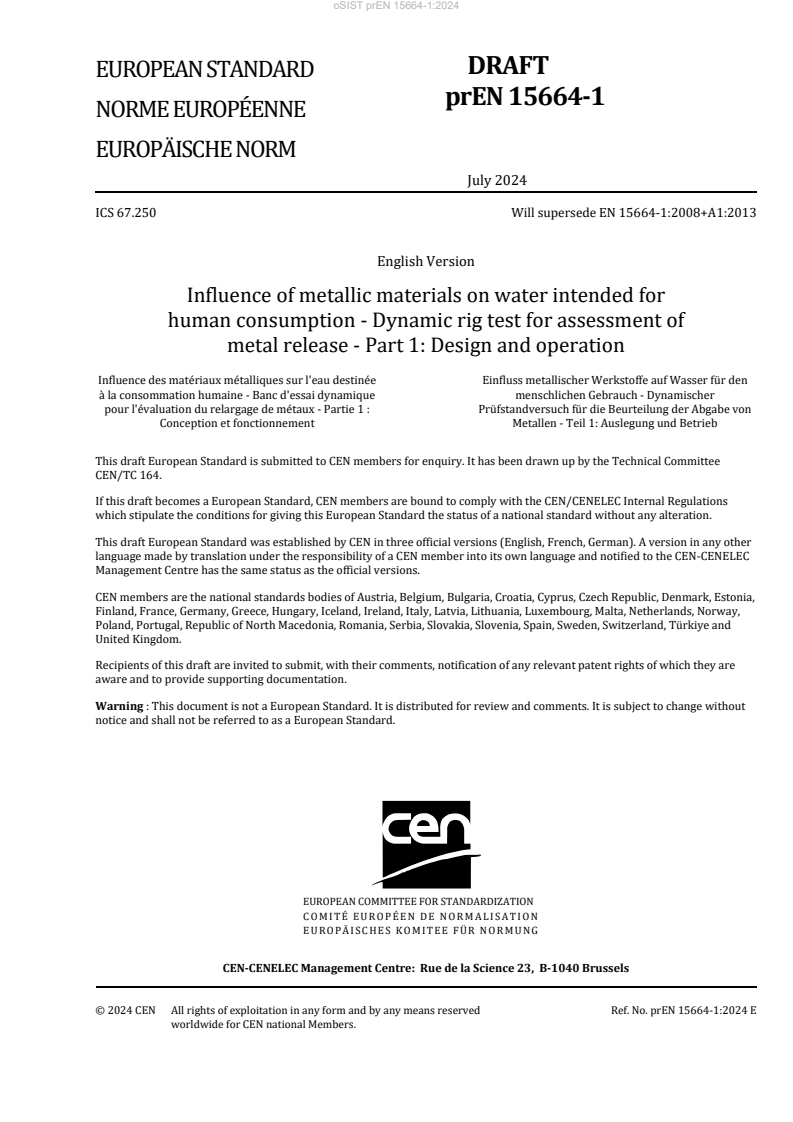
DRAFT
EUROPEAN STANDARD
prEN 15664-1
NORME EUROPÉENNE
EUROPÄISCHE NORM
July 2024
ICS 67.250 Will supersede EN 15664-1:2008+A1:2013
English Version
Influence of metallic materials on water intended for
human consumption - Dynamic rig test for assessment of
metal release - Part 1: Design and operation
Influence des matériaux métalliques sur l'eau destinée Einfluss metallischer Werkstoffe auf Wasser für den
à la consommation humaine - Banc d'essai dynamique menschlichen Gebrauch - Dynamischer
pour l'évaluation du relargage de métaux - Partie 1 : Prüfstandversuch für die Beurteilung der Abgabe von
Conception et fonctionnement Metallen - Teil 1: Auslegung und Betrieb
This draft European Standard is submitted to CEN members for enquiry. It has been drawn up by the Technical Committee
CEN/TC 164.
If this draft becomes a European Standard, CEN members are bound to comply with the CEN/CENELEC Internal Regulations
which stipulate the conditions for giving this European Standard the status of a national standard without any alteration.
This draft European Standard was established by CEN in three official versions (English, French, German). A version in any other
language made by translation under the responsibility of a CEN member into its own language and notified to the CEN-CENELEC
Management Centre has the same status as the official versions.
CEN members are the national standards bodies of Austria, Belgium, Bulgaria, Croatia, Cyprus, Czech Republic, Denmark, Estonia,
Finland, France, Germany, Greece, Hungary, Iceland, Ireland, Italy, Latvia, Lithuania, Luxembourg, Malta, Netherlands, Norway,
Poland, Portugal, Republic of North Macedonia, Romania, Serbia, Slovakia, Slovenia, Spain, Sweden, Switzerland, Türkiye and
United Kingdom.
Recipients of this draft are invited to submit, with their comments, notification of any relevant patent rights of which they are
aware and to provide supporting documentation.
Warning : This document is not a European Standard. It is distributed for review and comments. It is subject to change without
notice and shall not be referred to as a European Standard.
EUROPEAN COMMITTEE FOR STANDARDIZATION
COMITÉ EUROPÉEN DE NORMALISATION
EUROPÄISCHES KOMITEE FÜR NORMUNG
CEN-CENELEC Management Centre: Rue de la Science 23, B-1040 Brussels
© 2024 CEN All rights of exploitation in any form and by any means reserved Ref. No. prEN 15664-1:2024 E
worldwide for CEN national Members.
oSIST prEN 15664-1:2024
prEN 15664-1:2024 (E)
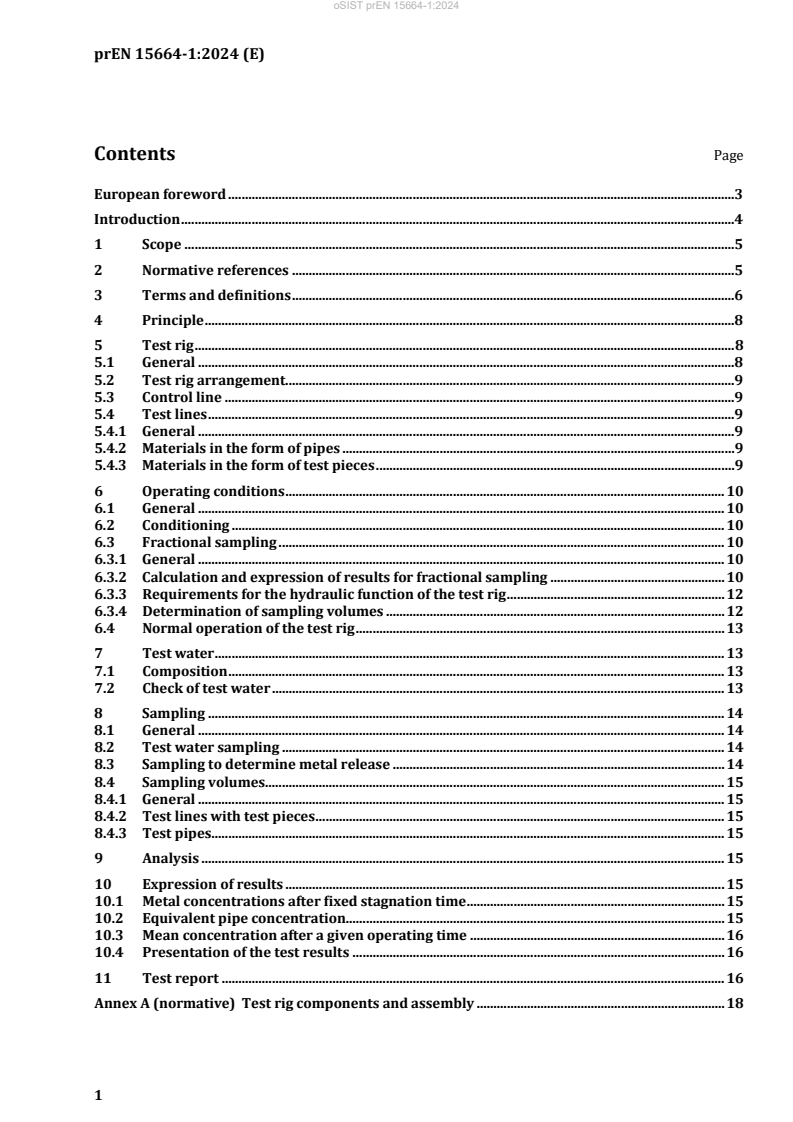
Contents Page
European foreword .3
Introduction .4
1 Scope .5
2 Normative references .5
3 Terms and definitions .6
4 Principle .8
5 Test rig .8
5.1 General .8
5.2 Test rig arrangement.9
5.3 Control line .9
5.4 Test lines .9
5.4.1 General .9
5.4.2 Materials in the form of pipes .9
5.4.3 Materials in the form of test pieces .9
6 Operating conditions . 10
6.1 General . 10
6.2 Conditioning . 10
6.3 Fractional sampling . 10
6.3.1 General . 10
6.3.2 Calculation and expression of results for fractional sampling . 10
6.3.3 Requirements for the hydraulic function of the test rig . 12
6.3.4 Determination of sampling volumes . 12
6.4 Normal operation of the test rig . 13
7 Test water . 13
7.1 Composition . 13
7.2 Check of test water . 13
8 Sampling . 14
8.1 General . 14
8.2 Test water sampling . 14
8.3 Sampling to determine metal release . 14
8.4 Sampling volumes. 15
8.4.1 General . 15
8.4.2 Test lines with test pieces . 15
8.4.3 Test pipes . 15
9 Analysis . 15
10 Expression of results . 15
10.1 Metal concentrations after fixed stagnation time . 15
10.2 Equivalent pipe concentration. 15
10.3 Mean concentration after a given operating time . 16
10.4 Presentation of the test results . 16
11 Test report . 16
Annex A (normative) Test rig components and assembly . 18
oSIST prEN 15664-1:2024
prEN 15664-1:2024 (E)
A.1 Test rig . 18
A.2 Test piece . 20
A.3 Connecting piece. 20
Annex B (normative) Test rig flow regime . 22
B.1 Test rig flow regime and sampling plan (24 h cycle) . 22
B.2 Test rig flow regime and sampling plan for 16 h stagnation time . 23
Annex C (normative) Test water monitoring and analysis . 24
C.1 Data on test water composition . 24
Annex D (informative) Example of graphs for expression of results . 26
oSIST prEN 15664-1:2024
prEN 15664-1:2024 (E)
European foreword
This document (prEN 16554-1:2024) has been prepared by Technical Committee CEN/TC 164 “Water
supply”, the secretariat of which is held by AFNOR.
This document is currently submitted to the CEN Enquiry.
This document will supersede EN 15664-1:2008+A1:2013.
This document is Part 1 of a series dealing with the test method to determine the release of metals from
metallic products into drinking water comprising:
— Part 1: Design and operation
— Part 2: Test waters
oSIST prEN 15664-1:2024
prEN 15664-1:2024 (E)
Introduction
This document is one of a series of test methods which support associated product standards.
NOTE 1 In respect of potential adverse effects on the quality of water intended for human consumption caused
by metallic materials, attention is drawn to relevant national regulations.
NOTE 2 Water intended for human consumption is hereafter referred to as “drinking water” and means the same
as the definition given at Article 2(1) of the Council Directive 98/83/EC on the quality of water intended for human
consumption.
Part 1 of EN 15664 describes a test method to produce contact waters for the assessment of metal release
from metallic materials.
The main application of metallic materials in water supply is within the domestic installation. The test
method given in this standard is designed to provide information on metal release over time from metallic
materials into drinking water.
The test is based on a programme of alternating periods of once-through flow and stagnation in a rig,
simulating the conditions in a domestic distribution system.
The test conditions are more relevant than conditions of continuous through-flow or sit and soak tests
and are applicable to all metallic materials in distribution systems.
Internal corrosion of metallic products in water conveying systems generally leads to the build-up of
layers, which might or might not be protective. The factors influencing corrosion are described in
EN 12502-1. Type and rate of the production of corrosion products and the rate of metal release can
depend on:
• characteristics of the metallic material;
• characteristics of the water;
• design and construction of the products and the complete system the products are installed in;
• tightness testing and commissioning of the system;
• operating conditions and duration of operation.
Corrosion product layers begin to form as soon as a metallic material comes into contact with water. Their
properties depend on the factors noted above and for a given water/material combination especially on
the operating conditions. It is not possible to reproduce the conditions of an actual installation in tests by
constant once-through flow or circulation of water. The flow regime (3.17) used in this test simulates the
operating conditions in domestic drinking water installations where stagnation times of water
considerably exceed the times of through-flow.
An assessment by testing is possible only if the influence of the flow regime (3.17) and the operation
period (3.20) is taken into consideration. A compilation of data is needed which has been determined
under defined conditions over a prolonged period of time. In most cases, metal release decreases with
operation time. For some alloying elements and impurities, however, an increase in their release can be
observed.
oSIST prEN 15664-1:2024
prEN 15664-1:2024 (E)
1 Scope
This document specifies a procedure to determine the release of metals from metallic materials used in
products intended to come into contact with drinking water.
The test can be used for three purposes:
a) To assess a material as a reference material for a new category of materials by metal release
testing using the results of several investigations in different waters covering a broad range of water
compositions;
b) To assess a material for an existing category for approval by way of metal release testing using
the water defined in part 2, which exhibited the highest metal release when the reference material
of the category was tested;
c) To obtain data on the interaction of local water with a material.
2 Normative references
The following referenced documents are indispensable for the application of this document. For dated
references, only the edition cited applies. For undated references, the latest edition of the referenced
document (including any amendments) applies.
EN 1484, Water analysis - Guidelines for the determination of total organic carbon (TOC) and dissolved
organic carbon (DOC)
EN 10088-1, Stainless steels - Part 1: List of stainless steels
EN 12502-1, Protection of metallic materials against corrosion - Guidance on the assessment of corrosion
likelihood in water distribution and storage systems - Part 1: General
EN 15664-2, Influence of metallic materials on water intended for human consumption - Dynamic rig test
for assessment of metal release - Part 2: Test waters
EN 25813, Water quality - Determination of dissolved oxygen - Iodometric method (ISO 5813)
EN ISO 5814, Water quality - Determination of dissolved oxygen - Electrochemical probe method (ISO 5814)
EN 27888, Water quality - Determination of electrical conductivity (ISO 7888)
EN ISO 6878, Water quality - Determination of phosphorus - Ammonium molybdate spectrometric method
(ISO 6878)
EN ISO 8044, Corrosion of metals and alloys - Vocabulary (ISO 8044)
EN ISO 9963-1, Water quality - Determination of alkalinity - Part 1: Determination of total and composite
alkalinity (ISO 9963-1)
EN ISO 10304-1, Water quality - Determination of dissolved anions by liquid chromatography of ions - Part
1: Determination of bromide, chloride, fluoride, nitrate, nitrite, phosphate and sulfate (ISO 10304-1)
EN ISO 11885, Water quality - Determination of selected elements by inductively coupled plasma optical
emission spectrometry (ICP-OES) (ISO 11885)
oSIST prEN 15664-1:2024
prEN 15664-1:2024 (E)
EN ISO 14911, Water quality - Determination of dissolved Li+, Na+, NH4+, K+, Mn2+, Ca2+, Mg2+, Sr2+ and
Ba2+ using ion chromatography - Method for water and waste water (ISO 14911)
EN ISO 15586, Water quality - Determination of trace elements using atomic absorption spectrometry with
graphite furnace (ISO 15586)
EN ISO 17294-1, Water quality - Application of inductively coupled plasma mass spectrometry (ICP-MS) -
Part 1: General requirements (ISO 17294-1)
EN ISO 17294-2, Water quality - Application of inductively coupled plasma mass spectrometry (ICP-MS) -
Part 2: Determination of selected elements including uranium isotopes (ISO 17294-2)
ISO 6058, Water quality — Determination of calcium content — EDTA titrimetric method
ISO 6059, Water quality — Determination of the sum of calcium and magnesium — EDTA titrimetric
method
ISO 9297, Water quality — Determination of chloride — Silver nitrate titration with chromate indicator
(Mohr's method)
ISO 9964-3, Water quality — Determination of sodium and potassium — Part 3: Determination of sodium
and potassium by flame emission spectrometry
ISO 10523, Water quality — Determination of pH
3 Terms and definitions
For the purposes of this document the terms and definitions given in EN ISO 8044, EN 12502-1 and the
following apply:
3.1
metal release testing
test for accepting a material with restricted composition as reference material of a new category or for
accepting a commercial alloy to an existing category
3.2
test rig
assembly of test lines, control lines and where necessary reference lines together with test water inlet
and discharge arrangements
Note 1 to entry: See Annex A, Figure A.1.
3.3
line
continuous part between a check valve and the corresponding flow regulator
3.4
control line
line containing a single length of pipe made of an inert material for the purposes of the test
3.5
test line
line containing test pieces or a test pipe
oSIST prEN 15664-1:2024
prEN 15664-1:2024 (E)
3.6
reference line
line containing test pieces each made of the same reference material or line containing a single length of
pipe made of a reference material
3.7
dummy lines
pipes made of an inert material for the purposes of the test used for the conditioning run of a newly built
test rig
3.8
test pipe
specimen that is representative of a construction product in the form of a pipe for use with drinking water
in terms of material composition and surface characteristics
3.9
test piece
specimen that is representative of a construction product, which is not a pipe, for use with drinking water
in terms of material composition
Note 1 to entry: See Annex A, Figure A.2.
3.10
category
group of materials with the same metal release characteristics in respect of their application in products
and behaviour in contact with drinking water
3.11
reference material
metallic material of a tightly defined composition for which the characteristics of metal release into
drinking water are known and reproducible, and are accepted for a category
3.12
surface characteristics
aspects of the surface of a product exposed to the water, which are derived from the production process
3.13
local water
water from a particular supply zone
3.14
test water
water used for testing purposes
3.15
contact water
test water which has been in contact with a test line
3.16
control water
test water which has been in contact with the control line
oSIST prEN 15664-1:2024
prEN 15664-1:2024 (E)
3.17
flow regime
consecutive alternating periods of flow, at a given flow rate, and stagnation of the test water in the test
rig
3.18
representative water sample
continuous column of water in the test line containing released corrosion products from the test pieces
or test pipe uninfluenced by the remainder of the test rig
3.19
fractional sampling
method used to check the proper hydraulic function of the rig and to determine the representative
volume of the water samples
3.20
period of operation or operation period (T)
period of time, expressed in weeks, during which the flow regime is operated for a particular test
3.21
stagnation time (t)
period of time, expressed in hours, when the test water is static in the test rig
3.22
run-time curve
graphical representation of the relationship between the mean of the metal concentration arising from
the sampling plan, MEP(T), or of the concentration after 4 hours of stagnation, over the period of
operation (T)
3.23
stagnation curve
graphical representation of the relationship between the measured metal concentration and the length
of the stagnation time (t) at a given period of operation (T)
4 Principle
Test pieces or test pipes of a material of defined geometry and given surface characteristics are installed
in a test rig which is operated for a period of time under controlled conditions of water quality,
temperature and flow regime.
Water samples are taken at specified operation periods after specified stagnation times throughout the
whole of the test and analysed for concentrations of relevant metals.
5 Test rig
5.1 General
The test rig shall be constructed in accordance with Annex A in addition to the requirements given in this
clause.
A test rig shall have: one line for control purposes (5.3); three identical test lines for each material
submitted for testing as set out in 5.4.
With the exception of the materials under test, all materials used in the test rig that come into contact
with the test water shall be inert for the purposes of the test.
oSIST prEN 15664-1:2024
prEN 15664-1:2024 (E)
Precautions shall be taken to ensure there is no transformation or contamination of the surface of test
pieces or pipes during preparation for installation or during the installation itself.
The materials for testing shall be in the form of pipes or test pieces. Where the material used for testing
is intended to be used for pipes and other applications, it shall be tested as a pipe.
5.2 Test rig arrangement
The test rig shall be arranged in the following way for the relevant purpose:
• To assess a material as a reference material for a new category of materials the test rig shall
comprise three test lines made up of the material under examination and a control line (metal release
testing). The rig shall be operated using different waters covering a broad range of water
compositions (see EN 15664-2).
• To assess a material for an existing category of materials the test rig shall comprise three test
lines made up of the material under examination and a control line (metal release testing). The rig
shall be operated using the water defined in part 2, which exhibited the highest metal release when
the reference material of the category was tested.
• To obtain data on the interaction of local water with a material the rig shall comprise three test
lines made up of the material under examination and a control line. The rig shall be operated with
the local water in question. This would include, for example, the effect of water treatment on the
metals under examination.
5.3 Control line
The line for control purposes shall contain a single length of pipe made of stainless steel conforming to
EN 10088-1, material no. 1.4401. The pipe shall have an inner diameter of (13 ± 1) mm.
5.4 Test lines
5.4.1 General
A test rig shall hav
...
Questions, Comments and Discussion
Ask us and Technical Secretary will try to provide an answer. You can facilitate discussion about the standard in here.
Loading comments...