

EN 15085-2:2020+A2:2025
(Main + Amendment)Railway applications - Welding of railway vehicles and components - Part 2: Requirements for welding manufacturer
- Abstract
This document defines the classification levels for welded components, the types of activity typically undertaken and the requirements to be fulfilled to demonstrate conformance.
- Status
- Published
- Publication Date
- 15-Jul-2025
- Technical Committee
- CEN/TC 256 - Railway applications
- Drafting Committee
- CEN/TC 256/WG 31 - Welding of railway vehicules and components
- Current Stage
- 6060 - Definitive text made available (DAV) - Publishing
- Start Date
- 16-Jul-2025
- Due Date
- 18-Aug-2027
- Completion Date
- 16-Jul-2025
Overview
EN 15085-2:2020+A2:2025 - Railway applications - Welding of railway vehicles and components - Part 2: Requirements for welding manufacturer (CEN, July 2025) defines what a welding manufacturer must do to demonstrate conformity when welding metallic parts for rail vehicles. It updates EN 15085-2:2020 with Amendment 2 (2025) and replaces EN 15085-2:2020+A1:2023. The standard is part of the EN 15085 series and is intended for manufacturers, assessors and certification bodies working in railway welding.
Key topics and technical requirements
- Classification levels (CL1, CL2, CL3): Components and manufacturers are assigned one of three classification levels based on the safety relevance of welded parts (high, medium, low). Examples include bogies, car bodies and fuel tanks (CL1); interior structural parts and non-pressurized containers (CL2); and simple attached parts like steps and covers (CL3).
- Types of manufacturer activity: New build, conversion, repair and maintenance activities are addressed with requirements proportionate to classification level.
- Personnel competence:
- Welders and welding operators: qualifications must match classification and welding process.
- Welding coordination: defined roles and competence levels (Level A - comprehensive, Level B - specific, Level C - basic) with tasks and responsibilities described in normative annexes.
- Inspection personnel: competence and role in demonstrating weld quality.
- Technical controls:
- Welding Procedure Specification (WPS) requirements and documentation for production.
- Supervision of subcontracting and requirements for subcontracted welding coordinators.
- Manufacturer’s declaration of welding activities and organization to demonstrate conformity.
- Normative references: links with EN 15085 Parts 1, 3–6, EN ISO 3834 (quality requirements for fusion welding), EN ISO 14731 (welding coordination) and other welding standards.
Applications and users
- Who uses it:
- Railway vehicle manufacturers and subcontractors performing welding
- Maintenance facilities performing repair welding
- Certification bodies and conformity assessors
- Design and quality engineers in rolling stock supply chains
- Practical uses:
- Determining required personnel qualifications and welding coordinator levels
- Defining manufacturer scope and classification for tenders and contracts
- Establishing documentation, WPS and subcontractor control for compliance audits
- Aligning welding quality management with safety-relevance assessments (e.g., EN 50126)
Related standards
- EN 15085 series (Parts 1, 3, 4, 5, 6)
- EN ISO 3834 (quality requirements for fusion welding)
- EN ISO 14731 (welding coordination)
Keywords: EN 15085-2:2020+A2:2025, welding manufacturer, railway welding, classification levels, welding coordination, WPS, EN 15085.
Relations
- Effective Date
- 07-May-2025
- Effective Date
- 28-Jan-2026
- Effective Date
- 28-Jan-2026
- Effective Date
- 28-Jan-2026
- Effective Date
- 28-Jan-2026
- Effective Date
- 28-Jan-2026
- Effective Date
- 28-Jan-2026
- Effective Date
- 28-Jan-2026
- Effective Date
- 28-Jan-2026
- Effective Date
- 28-Jan-2026
- Effective Date
- 28-Jan-2026
- Effective Date
- 28-Jan-2026
- Effective Date
- 28-Jan-2026
- Effective Date
- 28-Jan-2026
- Effective Date
- 28-Jan-2026
Get Certified
Connect with accredited certification bodies for this standard

DVS-ZERT GmbH
German welding certification society.
IRIS Certification (UNIFE)
International Railway Industry Standard certification.

TÜV SÜD Rail GmbH
TÜV SÜD railway certification services.
Sponsored listings
Frequently Asked Questions
EN 15085-2:2020+A2:2025 is a standard published by the European Committee for Standardization (CEN). Its full title is "Railway applications - Welding of railway vehicles and components - Part 2: Requirements for welding manufacturer". This standard covers: This document defines the classification levels for welded components, the types of activity typically undertaken and the requirements to be fulfilled to demonstrate conformance.
This document defines the classification levels for welded components, the types of activity typically undertaken and the requirements to be fulfilled to demonstrate conformance.
EN 15085-2:2020+A2:2025 is classified under the following ICS (International Classification for Standards) categories: 25.160.01 - Welding, brazing and soldering in general; 45.060.01 - Railway rolling stock in general. The ICS classification helps identify the subject area and facilitates finding related standards.
EN 15085-2:2020+A2:2025 has the following relationships with other standards: It is inter standard links to EN 15085-2:2020+A1:2023, EN ISO 3834-1:2021, EN ISO 3834-6:2024, EN 15085-4:2023, EN ISO 14554-1:2013, EN ISO 14731:2019, EN ISO 3834-3:2021, EN 15085-1:2023, EN 15085-6:2022, EN ISO 3834-4:2021, EN 15085-5:2023, EN ISO 3834-5:2021, EN ISO 3834-2:2021, EN 15085-3:2022+A1:2023, EN ISO 14554-2:2013. Understanding these relationships helps ensure you are using the most current and applicable version of the standard.
EN 15085-2:2020+A2:2025 is associated with the following European legislation: EU Directives/Regulations: 2016/797/EU; Standardization Mandates: M/483, M/591. When a standard is cited in the Official Journal of the European Union, products manufactured in conformity with it benefit from a presumption of conformity with the essential requirements of the corresponding EU directive or regulation.
EN 15085-2:2020+A2:2025 is available in PDF format for immediate download after purchase. The document can be added to your cart and obtained through the secure checkout process. Digital delivery ensures instant access to the complete standard document.
Standards Content (Sample)
SLOVENSKI STANDARD
01-september-2025
Železniške naprave - Varjenje železniških vozil in komponent - 2. del: Zahteve za
proizvajalce varilnih naprav (vključno z dopolnilom A2)
Railway applications - Welding of railway vehicles and components - Part 2:
Requirements for welding manufacturer
Bahnanwendungen - Schweißen von Schienenfahrzeugen und -fahrzeugteilen - Teil 2:
Anforderungen an Schweißbetriebe
Applications ferroviaires - Soudage des véhicules et des composants ferroviaires - Partie
2 : Exigences de qualité du constructeur
Ta slovenski standard je istoveten z: EN 15085-2:2020+A2:2025
ICS:
25.160.10 Varilni postopki in varjenje Welding processes
45.060.01 Železniška vozila na splošno Railway rolling stock in
general
2003-01.Slovenski inštitut za standardizacijo. Razmnoževanje celote ali delov tega standarda ni dovoljeno.
EN 15085-2:2020+A2
EUROPEAN STANDARD
NORME EUROPÉENNE
July 2025
EUROPÄISCHE NORM
ICS 25.160.01; 45.060.01 Supersedes EN 15085-2:2020+A1:2023
English Version
Railway applications - Welding of railway vehicles and
components - Part 2: Requirements for welding
manufacturer
Applications ferroviaires - Soudage des véhicules et des Bahnanwendungen - Schweißen von
composants ferroviaires - Partie 2 : Exigences de Schienenfahrzeugen und -fahrzeugteilen - Teil 2:
qualité du constructeur Anforderungen an Schweißbetriebe
This European Standard was approved by CEN on 24 August 2023 and includes Amendment 2 approved by CEN on 2 April 2025.
CEN members are bound to comply with the CEN/CENELEC Internal Regulations which stipulate the conditions for giving this
European Standard the status of a national standard without any alteration. Up-to-date lists and bibliographical references
concerning such national standards may be obtained on application to the CEN-CENELEC Management Centre or to any CEN
member.
This European Standard exists in three official versions (English, French, German). A version in any other language made by
translation under the responsibility of a CEN member into its own language and notified to the CEN-CENELEC Management
Centre has the same status as the official versions.
CEN members are the national standards bodies of Austria, Belgium, Bulgaria, Croatia, Cyprus, Czech Republic, Denmark, Estonia,
Finland, France, Germany, Greece, Hungary, Iceland, Ireland, Italy, Latvia, Lithuania, Luxembourg, Malta, Netherlands, Norway,
Poland, Portugal, Republic of North Macedonia, Romania, Serbia, Slovakia, Slovenia, Spain, Sweden, Switzerland, Türkiye and
United Kingdom.
EUROPEAN COMMITTEE FOR STANDARDIZATION
COMITÉ EUROPÉEN DE NORMALISATION
EUROPÄISCHES KOMITEE FÜR NORMUNG
CEN-CENELEC Management Centre: Rue de la Science 23, B-1040 Brussels
© 2025 CEN All rights of exploitation in any form and by any means reserved Ref. No. EN 15085-2:2020+A2:2025 E
worldwide for CEN national Members.
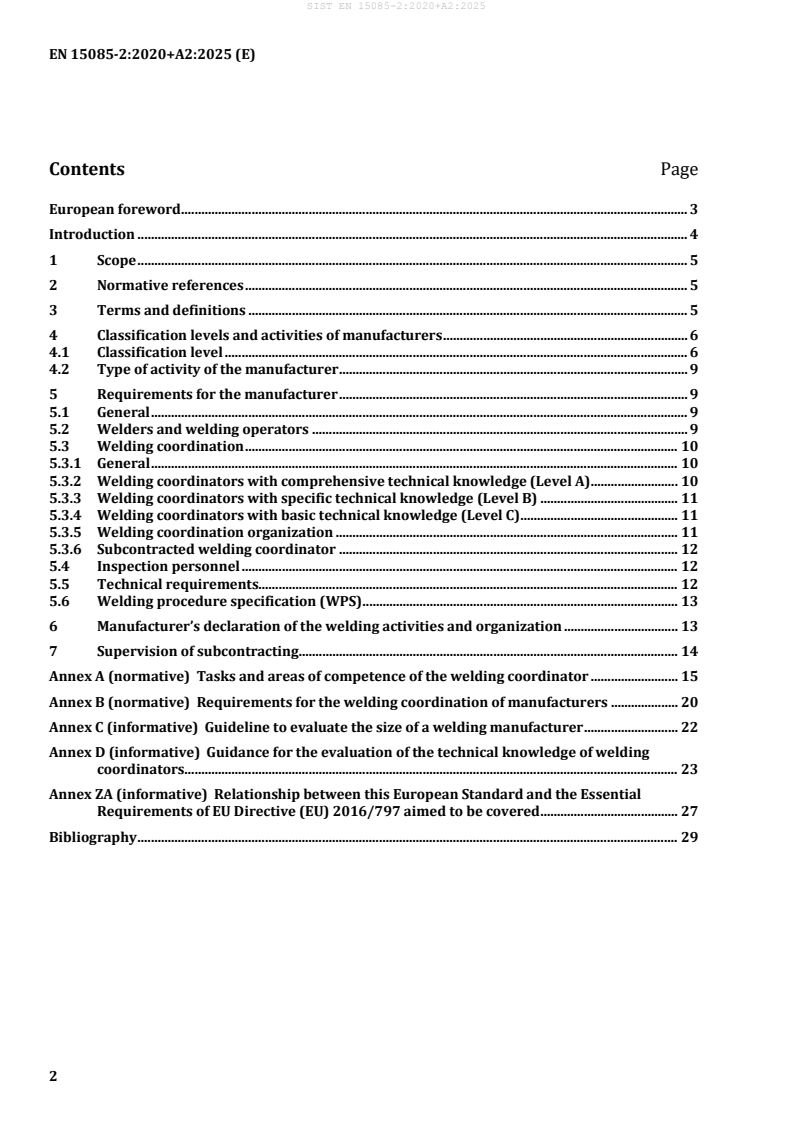
Contents Page
European foreword . 3
Introduction . 4
1 Scope . 5
2 Normative references . 5
3 Terms and definitions . 5
4 Classification levels and activities of manufacturers . 6
4.1 Classification level . 6
4.2 Type of activity of the manufacturer . 9
5 Requirements for the manufacturer . 9
5.1 General . 9
5.2 Welders and welding operators . 9
5.3 Welding coordination . 10
5.3.1 General . 10
5.3.2 Welding coordinators with comprehensive technical knowledge (Level A) . 10
5.3.3 Welding coordinators with specific technical knowledge (Level B) . 11
5.3.4 Welding coordinators with basic technical knowledge (Level C) . 11
5.3.5 Welding coordination organization . 11
5.3.6 Subcontracted welding coordinator . 12
5.4 Inspection personnel . 12
5.5 Technical requirements. 12
5.6 Welding procedure specification (WPS) . 13
6 Manufacturer’s declaration of the welding activities and organization . 13
7 Supervision of subcontracting . 14
Annex A (normative) Tasks and areas of competence of the welding coordinator . 15
Annex B (normative) Requirements for the welding coordination of manufacturers . 20
Annex C (informative) Guideline to evaluate the size of a welding manufacturer . 22
Annex D (informative) Guidance for the evaluation of the technical knowledge of welding
coordinators. 23
Annex ZA (informative) Relationship between this European Standard and the Essential
Requirements of EU Directive (EU) 2016/797 aimed to be covered . 27
Bibliography . 29
European foreword
This document (EN 15085-2:2020+A2:2025) has been prepared by Technical Committee CEN/TC 256
“Railway applications”, the secretariat of which is held by DIN.
This European Standard shall be given the status of a national standard, either by publication of an
identical text or by endorsement, at the latest by January 2026, and conflicting national standards shall
be withdrawn at the latest by January 2026.
Attention is drawn to the possibility that some of the elements of this document may be the subject of
patent rights. CEN shall not be held responsible for identifying any or all such patent rights.
This document includes Amendment 1 approved by CEN on 2023-08-24.
This document includes Amendment 2 approved by CEN on 2025-04-02.
This document supersedes #EN 15085-2:2020+A1:2023$.
!deleted text"
The start and finish of text introduced or altered by amendment is indicated in the text by tags !".
The start and finish of text introduced or altered by amendment is indicated in the text by tags #$.
This series of European Standards EN 15085 “Railway applications - Welding of railway vehicles and
components” consists of the following parts:
— Part 1: General;
— Part 2: Requirements for welding manufacturers;
— Part 3: Design requirements;
— Part 4: Production requirements;
— Part 5: Inspection, testing and documentation;
— Part 6: Maintenance welding requirements.
!This document has been prepared under a standardization request addressed to CEN by the European
Commission. The Standing Committee of the EFTA States subsequently approves these requests for its
Member States.
For the relationship with EU Legislation, see informative Annex ZA, which is an integral part of this
document.
Any feedback and questions on this document should be directed to the users’ national standards body.
A complete listing of these bodies can be found on the CEN website."
According to the CEN-CENELEC Internal Regulations, the national standards organisations of the
following countries are bound to implement this European Standard: Austria, Belgium, Bulgaria, Croatia,
Cyprus, Czech Republic, Denmark, Estonia, Finland, France, Germany, Greece, Hungary, Iceland, Ireland,
Italy, Latvia, Lithuania, Luxembourg, Malta, Netherlands, Norway, Poland, Portugal, Republic of North
Macedonia, Romania, Serbia, Slovakia, Slovenia, Spain, Sweden, Switzerland, Türkiye and the United
Kingdom.
Introduction
!Welding is a special process in the manufacture of railway vehicles and their parts. The required
provisions for this process are laid down in the standards series EN ISO 3834. The basis of these
provisions is the basic technical welding standards with respect to the special requirements for the
construction of railway vehicles.
This series of documents applies to welding of metallic materials in the manufacture and maintenance of
railway vehicles and their parts.
It describes the control for the welding process for railway vehicles and their components for new
manufacture and maintenance.
With respect to the railway environment, this series of standards defines the quality requirements for the
welding manufacturer to undertake new building and repair work.
Components, parts and subassemblies are assigned a classification level, based on their safety relevance.
According to these levels, qualifications for welding personnel of the manufacturer are specified.
This series provides an essential link between the weld performance class defined during design, the
quality of the weld, and the demonstration of the required quality by inspection.
This series of documents does not deal with product qualification.
NOTE This series of documents can also be used by internal and external parties, including certification bodies,
to assess the organization's ability to meet customer, regulatory and the organization's own requirements."
1 Scope
This document defines the classification levels for welded components, the types of activity typically
undertaken and the requirements to be fulfilled to demonstrate conformance.
2 Normative references
The following documents are referred to in the text in such a way that some or all of their content
constitutes requirements of this document. For dated references, only the edition cited applies. For
undated references, the latest edition of the referenced document (including any amendments) applies.
!EN 15085-1:2023, Railway applications — Welding of railway vehicles and components — Part 1:
General
EN 15085-3:2022+A1:2023, Railway applications — Welding of railway vehicles and components — Part
3: Design requirements
EN 15085-4:2023, Railway applications — Welding of railway vehicles and components — Part 4:
Production requirements
EN 15085-5:2023, Railway applications — Welding of railway vehicles and components — Part 5:
Inspection, testing and documentation
EN 15085-6:2022, Railway applications — Welding of railway vehicles and components — Part 6:
Maintenance welding requirements"
EN ISO 3834 (all parts), Quality requirements for fusion welding of metallic materials
EN ISO 14554 (all parts), Quality requirements for welding - Resistance welding of metallic materials
EN ISO 14731:2019, Welding coordination - Tasks and responsibilities (ISO 14731:2019)
3 Terms and definitions
For the purposes of this document, the terms and definitions given in !EN 15085-1:2023" and the
following apply.
ISO and IEC maintain terminological databases for use in standardization at the following addresses:
• IEC Electropedia: available at http://www.electropedia.org/
• ISO Online browsing platform: available at https://www.iso.org/obp
3.1
safety relevance
description of the consequences of a failure of a welded component with respect to the effects on persons,
facilities and the environment
Note 1 to entry: The safety relevance of a welded component is distinguished as follows:
Low: Failure of the welded component does not lead to any direct impairment of the overall function.
Consequential events with personal injuries are unlikely
Medium: Failure of the welded component leads to an impairment of the overall function and/or may lead to
consequential events with personal injuries
High: Failure of the welded component leads to consequential events with personal injuries and breakdown
of the overall function
Note 2 to entry: Safety relevance assessment should be done according to EN 50126 series.
4 Classification levels and activities of manufacturers
4.1 Classification level
Manufacturers and the components they weld are classified in three levels depending on the safety
relevance of the welded component (see 3.1).
The classification levels are defined as follows:
CL 1 For welded railway vehicles and their welded components with high safety relevance.
CL 2 For welded components of railway vehicles with medium safety relevance. (Welded joints
with high safety category according to !EN 15085-3:2022+A1:2023" are not
permitted)
CL 3 For welded components of railway vehicles with low safety relevance. (Welded joints with
high or medium safety category according to !EN 15085-3:2022+A1:2023" are not
permitted)
Table 1 allocates the most common components of railway vehicles in classification levels.
Deviations from the classification given in Table 1 are permitted.
Deviations that result in a lower classification than the ones given in Table 1 shall be documented and
justified. The approach for safety relevance assessment given in the EN 50126 series of standards may be
used for this purpose.
Table 1 — Allocation of components to their classification level
CL Component
CL 1 New build, conversion and repair of rail vehicles and their components
Examples for components:
— bogies (headstocks, solebars, cross bearers, bogie frames);
— underframes of locomotives, passenger rolling stock and freight wagons (extensions,
solebars, cross bearers, bolsters, assembly);
— car bodies (end and side walls, roof, driver cabin, floor plate assembly, energy
absorption modules, anti-climbers);
— freight wagon assembly (e.g. floor plates of car transporters, load fixing elements);
— draw and buffing gear;
— supporting frames, brackets and tensioning straps for exterior equipment (e.g. tanks,
electrical, air-conditioning and compressed air containers);
— wheelset mountings, axleboxes, spring supports, shock absorbers, vibration dampers;
— brake equipment (magnetic track brake, brake rods, brake triangles, brake cylinders,
brake cross beams);
— supporting frames for heavy duty vehicles including road/rail vehicles;
— welded components for drag transmission from bogie to vehicle (bolster);
— fuel tanks of vehicles;
— entrance and end doors (locking systems and structural elements);
— step frames, hand rails and railings on the outside of the vehicle or in entry areas;
— exterior self-supporting equipment boxes and underfloor containers (fresh water and
waste-water containers);
— roof construction (pantograph, panelling); e.g. equipment (CL 2), frames (CL 1)
— exterior traction and power equipment (transformer casing, transformer suspension,
engine suspension, transmission suspension, attachment for traction motor,
instrument racks);
— power transmission parts (traction coupling, cardan shafts);
— turning and tipping equipment (e.g. freight wagon);
— obstacle deflectors and snow ploughs;
— stanchions and lashing rings;
— exhaust systems including pipes;
— wheel scotches;
a
— pressure gas tanks, tanks and tank containers of rail vehicles with test pressure ;
a
— containers for dangerous materials ;
a
— compressed-air reservoirs for rail vehicles .
CL Component
CL 2 New build, conversion and repair of structural parts for rail vehicles, e.g.:
— parts inside of passenger coaches (partitions, walls, doors, panelling);
— supporting frame, brackets and tensioning straps for interior equipment (electrical, air-
conditioning and compressed air installations);
— driving cab equipment;
— lavatory parts and water containers with installations that are inside of the vehicle body;
— interior doors and ramps;
— fastenings for brake pipes;
— underframe equipment boxes that are supported by another frame;
— self-supporting gearboxes and consoles for hand brake operation;
— interior traction and power equipment (transformer casing, transformer suspension,
engine suspension, transmission suspension, attachment for traction motor,
instrument racks);
— seating frames;
— pressurized air pipes.
New build, conversion and repair of non-pressurized containers without special test
pressure, e.g.:
— payload container for non-dangerous materials;
— other transport containers.
CL 3 New build, conversion and repair production of simple attached parts for rail vehicles, e.g:
— cranks and levers for various operations;
— striking plates;
— interior equipment boxes and switch cabinets (including gearboxes and consoles for
hand brake operation that are supported by another frame);
— holders for index plates;
— covers for freight wagons (heat protection on tank wagons);
— steps, handrails, railings inside of the vehicle.
New build, conversion and repair of parts or trade supply parts for rail vehicles, for
instance:
— window frames;
— ventilation grilles.
a
If a harmonized standard for a specific product exists, e.g. EN 286 for compressed-air reservoirs or
EN 14025 for containers for dangerous materials, it supersedes the requirements of this document.
For welded joints between components with different classification levels, the higher classification level
shall be applied to the entire welded assembly.
The classification level for finishing welding of cast parts shall be the same as the entire welded assembly.
4.2 Type of activity of the manufacturer
A manufacturer of welded railway vehicles or components can undertake one or more of the types of
activities listed in Table 2. All activities shall conform to the requirements defined in the relevant part of
EN 15085 series of standards.
Table 2 — Types of activity
Type of activity Indicator Description
Calculation, design and documentation for the production and
Design D
maintenance of welded railway vehicles and components
Manufacturing, modification and testing of welded railway
Production P
vehicles and components (including replacement parts).
Repair of welded railway vehicles and components by welding
Maintenance M
(including testing).
Purchase and supply of welded components for new fabrication
Purchase and supply S or maintenance activities without carrying out welding
operations
5 Requirements for the manufacturer
5.1 General
The quality requirements for manufacturers performing welding activities on rail vehicles and
components are specified in the EN ISO 3834 series of standards. The relevant part of EN ISO 3834
requirements to be applied shall be determined by the classification level as follows: EN ISO 3834-2 for
CL 1, EN ISO 3834-3 for CL 2 or EN ISO 3834-4 for CL 3.
For resistance welding EN ISO 14554 shall be considered.
A manufacturer, who fulfils the CL 1 requirements for a particular activity may also perform the same
activity on components with CL 2 or CL 3 classification.
A manufacturer, who fulfils the CL 2 requirements for a particular activity may also perform the same
activity on components with CL 3 classification.
A manufacturer, who fulfils the CL 3 requirements for a particular activity may only perform the same
activity on components with CL 3 classification.
5.2 Welders and welding operators
The manufacturer shall have a sufficient number of welders and operators trained and qualified as
defined in !EN 15085-4:2023".
5.3 Welding coordination
5.3.1 General
Where welding activities are carried out it is the responsibility of the manufacturer to demonstrate that
welding coordination tasks are fulfilled.
The manufacturer shall have an adequate number of suitably qualified welding coordinators, with the
relevant technical knowledge and experience, for the tasks they undertake according to EN ISO 14731.
The manufacturer shall provide documentary evidence that the technical knowledge and experience of
the welding coordinator(s) is at the required level. Tasks and areas of competence of welding
coordinators are defined in Annex A.
For the purpose of this document, three levels of welding coordinators are defined below:
— Level A: Personnel with comprehensive technical knowledge according to EN ISO 14731 and
adequate professional experience for the relevant scope of application;
— Level B: Personnel with specific technical knowledge according to EN ISO 14731 and adequate
professional experience for the relevant scope of application;
— Level C: Personnel with basic technical knowledge according to EN ISO 14731 and adequate
professional experience for the relevant scope of application.
To assist the manufacturer to develop its welding coordination team the guidance in Annex D can be used
to evaluate the current level of technical knowledge of its welding coordinators and identify gaps for
personnel development.
The manufacturer shall have a written procedure on how to qualify and establish welding coordinators
according to this document.
5.3.2 Welding coordinators with comprehensive technical knowledge (Level A)
Personnel shall have comprehensive technical knowledge in welding and related technologies according
to EN ISO 14731 relevant to the assigned tasks and obtained by a combination of education, training and
/ or experience. In addition, an understanding of the EN 15085 series of standards shall be demonstrated.
As guidelines, to demonstrate comprehensive technical knowledge the following qualification may be
used:
a) Personnel with qualification according to Doc. IAB-252/EWF-416 – International Welding Engineer
(IWE) or European Welding Engineer (EWE);
b) Personnel with qualification according to Doc. IAB-252/EWF-416 – International Welding
Technologist (IWT) or European Welding Technologist (EWT) and evidence of comprehensive
technical knowledge.
5.3.3 Welding coordinators with specific technical knowledge (Level B)
Personnel shall have specific technical knowledge in welding and related technologies according to
EN ISO 14731 relevant to the assigned tasks and obtained by a combination of education, training and /
or experience. In addition, an understanding of the EN 15085 series of standards shall be demonstrated.
As guidelines, to demonstrate specific technical knowledge the following qualification may be used:
a) Personnel with qualification according to Doc. IAB-252/EWF-416 – International Welding
Technologist (IWT) or European Welding Technologist (EWT);
b) Personnel with qualification according to Doc. IAB-252/EWF-416 – International Welding Specialist
(IWS) or European Welding Specialist (EWS) and evidence of specific technical knowledge.
5.3.4 Welding coordinators with basic technical knowledge (Level C)
Personnel shall have basic technical knowledge in welding and related technologies according to
EN ISO 14731 relevant to the assigned tasks and obtained by a combination of education, training and /
or experience. In addition, an understanding of the EN 15085 series of standards shall be demonstrated.
As guidelines, to demonstrate basic technical knowledge the following qualification may be used:
a) Personnel with qualification according to Doc. IAB-252/EWF-416 – International Welding Specialist
(IWS) or European Welding Specialist (EWS);
b) Personnel with qualification according to Doc. IAB-252/EWF-416 – International Welding
Practitioner (IWP) or European Welding Practitioner (EWP) with evidence of basic technical
knowledge.
5.3.5 Welding coordination organization
The organization of the manufacturer shall be structured to allow welding coordinators to accept their
tasks and responsibilities without reservation according to EN ISO 14731 and be able to issue
instructions and make technical decisions related to welding independent of the manufacturing
operation.
The welding coordinator should be directly employed by the welding manufacturer; however, if the
manufacturer subcontracts a welding coordinator, the requirements of 5.3.6 shall apply.
The responsibilities, competencies and the relationships within the organization for all personnel
performing managerial, design, production or inspection work, which influence the quality of the welding
work, shall be documented. As a minimum, the following items shall be specified and described:
a) tasks of the welding coordinators (when there are several equal-graded welding coordinators, their
work and areas of responsibility shall be specified);
b) rules for deputising for the welding coordinator (also applies to recognized subcontracted welding
coordinator);
c) activities which require the involvement of the responsible welding coordinators e.g. contract
review;
d) measures which are required if the welding coordinator is absent (deputising for the welding
coordinator; welding work that is still permitted; cessation of welding work);
e) involvement of the welding coordinators in other processes (e.g. preparation of quotations, design,
subcontracting).
The minimum requirements for welding coordination based on classification level (CL) are defined in
Annex B.
The manufacturer shall ensure that all of its locations performing welding related tasks have the required
number and level of welding coordinators defined in Annex B, based on classification level and activities
performed.
For CL 1 the owners of the company / organization, general managers and production managers cannot
be recognized as a responsible welding coordinator. For small manufacturers – please see Annex C for
definition – recognition of the above mentioned personnel is possible, provided the requirements for
welding coordination personnel are met.
For CL 2 and CL 3 recognition of company / organization owners, general manager and production
managers is possible, provided the requirements for welding coordination personnel are met.
5.3.6 Subcontracted welding coordinator
Welding coordinators who are not permanently employed by the manufacturer are treated as
subcontracted welding coordinators. They can be recognized as the manufacturer’s welding coordinator
providing the following conditions are fulfilled:
a) The manufacturer shall ensure and demonstrate that the subcontracted welding coordinator is
available as necessary to fulfil his tasks according to Annex A.
b) The work of the subcontracted welding coordinator shall be defined according to 5.3.5 and
documented. The date, location, duration, and type of activities shall be recorded.
The welding coordination activity is the core issue in the field of application of this series of standards.
For this reason, the manufa
...