

EN 1304:2013
(Main)Clay roofing tiles and fittings - Product definitions and specifications
- Abstract
This European Standard specifies requirements for clay roofing tiles and fittings for pitched roof coverings and wall cladding and lining.
It applies to all tiles and fittings as defined in Clause 3.
Clay roofing tiles and clay fittings which conform to this European Standard are suitable for use as roof coverings, vertical wall cladding and lining.
This European Standard defines the minimum requirements for a product which if satisfactory at the time of delivery will ensure that the product is able to perform its function in relation to the performance levels declared for it, whilst subjected to the changes that occur in such materials during normal conditions of use.
The results obtained according to the European Standard apply to products at the time they are offered for sale.
- Status
- Published
- Publication Date
- 28-May-2013
- Withdrawal Date
- 29-Nov-2013
- Technical Committee
- CEN/TC 128 - Roof covering products for discontinuous laying and products for wall cladding
- Drafting Committee
- CEN/TC 128/SC 3 - Clay roofing tiles
- Current Stage
- 9093 - Decision to confirm - Review Enquiry
- Start Date
- 27-Feb-2023
- Completion Date
- 07-Oct-2026


Overview - EN 1304:2013 for clay roofing tiles and fittings
EN 1304:2013 is the CEN European Standard that sets product definitions and specifications for clay roofing tiles and clay fittings used on pitched roof coverings, vertical wall cladding and lining. It defines the minimum requirements a product must meet at the time of delivery so it will perform as declared during normal use. This edition supersedes EN 1304:2005 and is part of the CEN package for clay roofing products.
Key topics and technical requirements
The standard covers terminology, product types and measurable requirements, including:
- Product definitions - classification of tile types: plain tiles, special (hand-made) tiles, tiles with sidelock and/or headlock, over-and-under tiles, and coordinated vs uncoordinated fittings.
- Geometric characteristics - shape regularity, camber, dimensions and dimensional tolerances applicable to tile laying and cover widths.
- Fixing and structural characteristics - guidance on how tiles and fittings are designed to be fixed and interlock (longitudinal/transverse interlocks).
- Physical and mechanical characteristics - required test methods and performance aspects such as impermeability, flexural strength, and frost resistance.
- Fire performance - external fire exposure and reaction-to-fire classification references.
- Durability-related items - surface coatings (glaze, engobe), treatments, efflorescence, cracks and appearance considerations.
- Marking, labelling and conformity - requirements for product information, factory production control (FPC), initial type testing, sampling, and conformity assessment procedures.
- Annexes - normative and informative annexes cover test frequencies, appearance guidance, frost-resistance levels by country and relationship with EU construction directives (Annex ZA).
Relevant referenced test standards include EN 538, EN 539‑1/2, EN 1024 and EN 13501 parts 1 and 5.
Practical applications and users
Who uses EN 1304:
- Manufacturers of clay roofing tiles and fittings (product design, quality control and declaration)
- Architects, specifiers and consultants (selecting compliant products for pitched roofs and cladding)
- Roofing contractors and installers (understanding fixing/interlock types and laying tolerances)
- Test laboratories and certification bodies (initial type testing, FPC verification and conformity assessment)
- Distributors, regulators and clients (checking marking, labelling and declared performance)
Benefits: ensures consistent product quality, facilitates compliance with EU construction requirements, and supports safe, durable roof and cladding systems.
Related standards
- EN 538 (flexural strength)
- EN 539‑1 / EN 539‑2 (impermeability and frost tests)
- EN 1024 (geometric characteristics)
- EN 13501‑1 / EN 13501‑5 (reaction to fire and external fire on roofs)
Keywords: EN 1304, clay roofing tiles, clay fittings, product definitions, specifications, pitched roof, wall cladding, frost resistance, impermeability, flexural strength, CEN.
Relations
- Effective Date
- 13-Jun-2012
- Effective Date
- 28-Jan-2026
- Effective Date
- 28-Jan-2026
- Effective Date
- 28-Jan-2026
- Effective Date
- 28-Jan-2026
- Effective Date
- 28-Jan-2026
- Effective Date
- 28-Jan-2026
- Effective Date
- 28-Jan-2026
- Effective Date
- 28-Jan-2026
- Effective Date
- 28-Jan-2026
- Effective Date
- 28-Jan-2026
Get Certified
Connect with accredited certification bodies for this standard

DIBt (Deutsches Institut für Bautechnik)
German Institute for Building Technology.
DIN CERTCO
DIN Group product certification.

Aboma Certification B.V.
Specialized in construction, metal, and transport sectors.
Sponsored listings
Frequently Asked Questions
EN 1304:2013 is a standard published by the European Committee for Standardization (CEN). Its full title is "Clay roofing tiles and fittings - Product definitions and specifications". This standard covers: This European Standard specifies requirements for clay roofing tiles and fittings for pitched roof coverings and wall cladding and lining. It applies to all tiles and fittings as defined in Clause 3. Clay roofing tiles and clay fittings which conform to this European Standard are suitable for use as roof coverings, vertical wall cladding and lining. This European Standard defines the minimum requirements for a product which if satisfactory at the time of delivery will ensure that the product is able to perform its function in relation to the performance levels declared for it, whilst subjected to the changes that occur in such materials during normal conditions of use. The results obtained according to the European Standard apply to products at the time they are offered for sale.
This European Standard specifies requirements for clay roofing tiles and fittings for pitched roof coverings and wall cladding and lining. It applies to all tiles and fittings as defined in Clause 3. Clay roofing tiles and clay fittings which conform to this European Standard are suitable for use as roof coverings, vertical wall cladding and lining. This European Standard defines the minimum requirements for a product which if satisfactory at the time of delivery will ensure that the product is able to perform its function in relation to the performance levels declared for it, whilst subjected to the changes that occur in such materials during normal conditions of use. The results obtained according to the European Standard apply to products at the time they are offered for sale.
EN 1304:2013 is classified under the following ICS (International Classification for Standards) categories: 01.040.91 - Construction materials and building (Vocabularies); 91.100.25 - Terracotta building products. The ICS classification helps identify the subject area and facilitates finding related standards.
EN 1304:2013 has the following relationships with other standards: It is inter standard links to EN 1304:2005, EN 539-1:2005, EN 13501-5:2016, EN 538:1994, EN 539-2:2013, EN 13501-1:2018, CWA 17890:2022, CEN/TS 16459:2019, EN 1024:2012, EN 539-2:2006, CEN/TS 16459:2013. Understanding these relationships helps ensure you are using the most current and applicable version of the standard.
EN 1304:2013 is associated with the following European legislation: EU Directives/Regulations: 305/2011, 89/106/EEC, 89/109/EEC; Standardization Mandates: M/121, M/122. When a standard is cited in the Official Journal of the European Union, products manufactured in conformity with it benefit from a presumption of conformity with the essential requirements of the corresponding EU directive or regulation.
EN 1304:2013 is available in PDF format for immediate download after purchase. The document can be added to your cart and obtained through the secure checkout process. Digital delivery ensures instant access to the complete standard document.
Standards Content (Sample)
2003-01.Slovenski inštitut za standardizacijo. Razmnoževanje celote ali delov tega standarda ni dovoljeno.]GHONRYDach- und Formziegel - Begriffe und ProduktspezifikationenTuiles et accessoires en terre cuite - Définitions et spécifications des produitsClay roofing tiles and fittings - Product definitions and specifications91.100.25Ceramic building products01.040.91Gradbeni materiali in gradnja (Slovarji)Construction materials and building (Vocabularies)ICS:Ta slovenski standard je istoveten z:EN 1304:2013SIST EN 1304:2014en,fr,de01-januar-2014SIST EN 1304:2014SLOVENSKI
STANDARDSIST EN 1304:20051DGRPHãþD
EUROPEAN STANDARD NORME EUROPÉENNE EUROPÄISCHE NORM
EN 1304
May 2013 ICS 01.040.91; 91.100.25 Supersedes EN 1304:2005English Version
Clay roofing tiles and fittings - Product definitions and specifications
Tuiles et accessoires en terre cuite - Définitions et spécifications des produits
Dach- und Formziegel - Begriffe und ProduktspezifikationenThis European Standard was approved by CEN on 5 April 2013.
CEN members are bound to comply with the CEN/CENELEC Internal Regulations which stipulate the conditions for giving this European Standard the status of a national standard without any alteration. Up-to-date lists and bibliographical references concerning such national standards may be obtained on application to the CEN-CENELEC Management Centre or to any CEN member.
This European Standard exists in three official versions (English, French, German). A version in any other language made by translation under the responsibility of a CEN member into its own language and notified to the CEN-CENELEC Management Centre has the same status as the official versions.
CEN members are the national standards bodies of Austria, Belgium, Bulgaria, Croatia, Cyprus, Czech Republic, Denmark, Estonia, Finland, Former Yugoslav Republic of Macedonia, France, Germany, Greece, Hungary, Iceland, Ireland, Italy, Latvia, Lithuania, Luxembourg, Malta, Netherlands, Norway, Poland, Portugal, Romania, Slovakia, Slovenia, Spain, Sweden, Switzerland, Turkey and United Kingdom.
EUROPEAN COMMITTEE FOR STANDARDIZATION
COMITÉ EUROPÉEN DE NORMALISATION EUROPÄISCHES KOMITEE FÜR NORMUNG
Management Centre:
Avenue Marnix 17,
B-1000 Brussels © 2013 CEN All rights of exploitation in any form and by any means reserved worldwide for CEN national Members. Ref. No. EN 1304:2013: ESIST EN 1304:2014
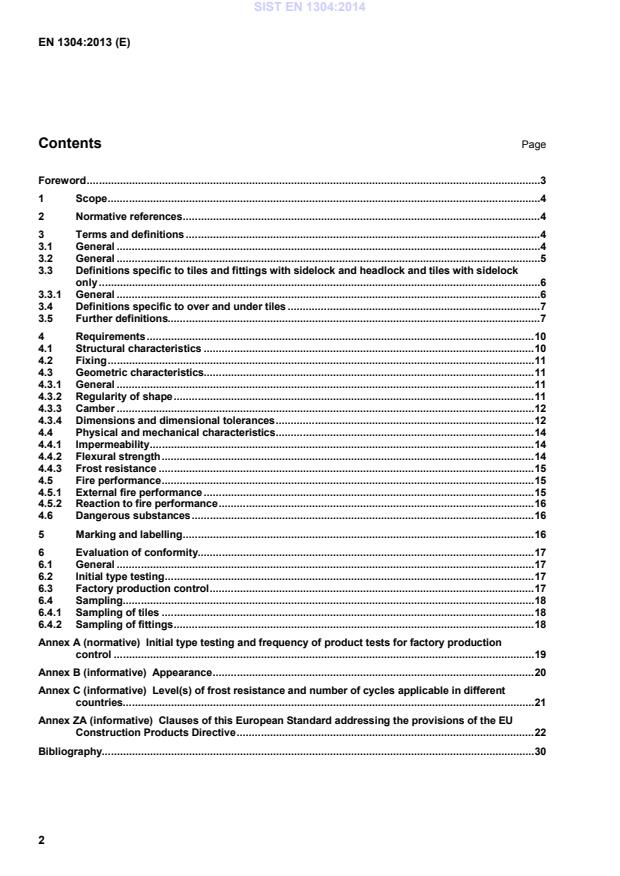
Initial type testing and frequency of product tests for factory production control . 19 Annex B (informative)
Appearance . 20 Annex C (informative)
Level(s) of frost resistance and number of cycles applicable in different countries . 21 Annex ZA (informative)
Clauses of this European Standard addressing the provisions of the EU Construction Products Directive . 22 Bibliography. 30
Impermeability test EN 539-2:2013, Clay roofing tiles for discontinuous laying — Determination of physical characteristics — Part 2: Test for frost resistance EN 1024, Clay roofing tiles for discontinuous laying — Determination of geometric characteristics EN 13501-1, Fire classification of construction products and building elements — Part 1: Classification using data from reaction to fire tests EN 13501-5, Fire classification of construction products and building elements — Part 5: Classification using data from external fire exposure to roof tests 3 Terms and definitions For the purposes of this document, the following terms and definitions apply. 3.1 General 3.1.1 clay roofing tiles products for discontinuous laying on pitched roofs, and for wall cladding, which are manufactured by shaping (extrusion and/or pressing), drying and firing of the prepared clay, with or without additives Note 1 to entry: All or part of their surface can be covered with an engobe or glaze. SIST EN 1304:2014
EXAMPLE interlocking verge tile, interlocking ventilation tile, tile-and-a-half, interlocking ridge tiles, interlocking or aligning hip tile, aligning valley tile, interlocking or aligning angle tiles 3.2.2.2 uncoordinated fittings fittings that are not required to align or interlock with the tile with which they are to be laid
EXAMPLE ridge tiles, hip tile, valley tile, verge tile, angle tiles 3.3 Definitions specific to tiles and fittings with sidelock and headlock and tiles with sidelock only 3.3.1 General 3.3.1.1 interlock system designed for the assembly of two adjoining tiles or fittings and usually including one or more raised parts called "ribs" and one or more concave parts called "grooves" 3.3.1.2 longitudinal interlock system allowing two tiles or fittings in the same horizontal course to be fitted together 3.3.1.3 transverse interlock system allowing two tiles or fittings from successive horizontal courses to be fitted together Note 1 to entry: Three examples of interlock are shown in Figure 1. The arrangement of ribs and grooves limits the extent of movement between the tiles and improves the resistance to the ingress of water.
Figure 1 — Examples of interlock 3.3.2 straight bond tiles and fittings tiles or coordinated fittings designed to be laid so that the longitudinal joints of successive courses are aligned SIST EN 1304:2014
Key 1 areas of water flow 2 interlock Figure 2 — Cross section and diagram of principle 3.4 Definitions specific to over and under tiles 3.4.1 under tiles tiles designed to be laid with their concave side facing upward and resting on the roofing support Note 1 to entry: Under tiles may have no nib, or one or more nibs for laying on battens. 3.4.2 over tiles tiles designed to be laid with their concave side facing downward and straddling two under tiles Note 1 to entry: In general, the same units are used as under tiles when laid with their concave side facing upward and over tiles when they are laid with their concave side facing downward. However, the profile of under tiles can differ from that of over tiles; they can have, for example, a flat base or a shape allowing for the seating of the product on its support. In the latter case, under tiles are equipped with two lateral upright sides. 3.4.3 over and under tiles with lugs to fix the headlap over and under tiles with lugs to fix the longitudinal overlap 3.5 Further definitions 3.5.1 additive material added in small quantities to the clay mix so as to facilitate the manufacture of the tile or fitting or to improve its characteristics SIST EN 1304:2014
Codes of practice in certain countries recommend two nail holes for certain types of tiles. When tiles and fittings are used as vertical cladding, they shall have appropriate means by which they may be fixed to an underlying support. 4.3 Geometric characteristics 4.3.1 General The geometric requirements are not applicable to uncoordinated clay fittings and special tiles. For the coordinated fittings only the relevant geometric characteristics that are necessary for their proper installation have to be determined. 4.3.2 Regularity of shape 4.3.2.1 Twist in relation to plain tiles and fittings, tiles and fittings with sidelock and headlock, tiles and fittings with sidelock only and overlapping tiles and fittings The mean value of the coefficients of twist calculated as described in EN 1024 shall comply with the requirements stated in Table 1.
Table 1 — Requirements for the mean value of coefficient of twist Tiles or fittings with total length mm Coefficient of twist Limit value % [ 300 ≤ 1,5 ≤ 300 ≤ 2,0 4.3.2.2 Uniformity of the transverse profile of over and under tiles and fittings The uniformity of the transverse profile of over and under tiles is evaluated by measuring the width of the narrow and wide parts of the tile. The difference between the largest and the smallest values of the width as set out in EN 1024 and measured at the narrow end of the tile, as well as the difference between the largest and the smallest values of the width measured at the wide end of the tile, shall not exceed 15 mm. SIST EN 1304:2014
mm Longitudinal camber Limit value % [ 300 ≤ 1,5 ≤ 300 ≤ 2,0 4.3.3.2 Plain tiles and fittings The mean value of the longitudinal and transverse cambers calculated as described in EN 1024 shall comply with the requirements stated in Table 3. Table 3 — Requirements for the mean value of longitudinal and transverse camber Tiles or fittings with total length mm Longitudinal and transverse camber Limit value % [ 300 ≤ 1,5 ≤ 300 ≤ 2,0 4.3.4 Dimensions and dimensional tolerances 4.3.4.1 General Individual dimensions or cover dimensions shall be measured according to the methods described in EN 1024.
For tiles and coordinated fittings with sidelock and headlock, and tiles or coordinated fittings with sidelock only (for the latter, in the transverse direction only), the manufacturer may choose between the declaration of the individual dimensions (a,b) or the cover dimensions (c,d), see Figure 3. Conformity to this document will thus be assessed with respect to the characteristic chosen by the manufacturer. For over and under tiles with lugs to fix the headlap, the manufacturer shall declare the minimal overlapped dimension (L2 according to EN 1024). For all other tiles or coordinated fittings, the measurements declared by the manufacturer shall be of individual products. SIST EN 1304:2014
Key a and b: Dimension of an individual product
c and d: Dimension of an overlapped group of products Figure 3 — Example of determination of the tile dimensions 4.3.4.2 Individual dimensions The mean values of the length and width of tiles, measured according to the methods described in EN 1024, shall fall within ± 2,0 % of the values declared by the manufacturer. This requirement does not apply to the width of over and under tiles. 4.3.4.3 Cover dimensions (gauge) The measured value of the mean cover dimension shall fall within ± 2,0 % of the cover dimension declared by the manufacturer. For tiles with sidelock and headlock with a variable longitudinal gauge, the measured maximum gauge shall not be smaller than that declared by the manufacturer. SIST EN 1304:2014
...