

EN 12485:2026
(Main)Chemicals used for treatment of water intended for human consumption - Calcium carbonate, high-calcium lime, half-burnt dolomite, magnesium oxide, calcium magnesium carbonate and dolomitic lime - Test methods
- Abstract
This document specifies the methods used for the chemical analyses and the determination of physical properties of calcium carbonate, high-calcium lime, half-burnt dolomite, magnesium oxide, calcium magnesium carbonate and dolomitic lime used to treat water for human consumption.
This document specifies the reference methods and, in certain cases, an alternative method which can be considered to be equivalent.
Any other methods may be used provided they are calibrated, either against the reference methods or against internationally accepted reference materials, in order to demonstrate their equivalence.
- Status
- Published
- Publication Date
- 26-May-2026
- Technical Committee
- CEN/TC 164 - Water supply
- Drafting Committee
- CEN/TC 164/WG 9 - Drinking water treatment
- Current Stage
- 6060 - Definitive text made available (DAV) - Publishing
- Start Date
- 27-May-2026
- Due Date
- 06-Feb-2026
- Completion Date
- 27-May-2026

Overview
EN 12485:2026 is a European Standard developed by CEN that specifies test methods for chemical analysis and physical property determination of chemicals used in the treatment of water intended for human consumption. This standard covers a range of water treatment chemicals including calcium carbonate, high-calcium lime, half-burnt dolomite, magnesium oxide, calcium magnesium carbonate, and dolomitic lime. The document establishes both reference and, where applicable, validated alternative methods to ensure reliable, accurate, and comparable results. Its focus is on maintaining water quality and safety through proper analytical testing of these essential chemicals.
Key Topics
- Chemical Test Methods: EN 12485:2026 details procedures for the analysis of major components such as calcium oxide (CaO), magnesium oxide (MgO), and carbon dioxide (CO₂) in water treatment chemicals.
- Physical Properties: The standard outlines methods for determining physical characteristics like screen oversize using air-jet and wet sieving techniques.
- Sample Preparation: Guidance on proper sampling, subsample selection, and sample preservation to avoid contamination or analytical error.
- Analytical Techniques:
- Gravimetric methods for free water and loss on ignition
- AAS (Atomic Absorption Spectroscopy) and ICP-OES (Inductively Coupled Plasma Optical Emission Spectroscopy) for minor and trace element detection
- Acidimetric titration, conductivity measurements, and XRF (X-ray Fluorescence) techniques for various constituents
- Reporting Requirements: Instructions for detailed test reporting, including method references, identification, results, and any deviations.
Applications
- Drinking Water Treatment: Ensures that chemicals used for water purification in municipal and industrial settings meet safety and quality standards, protecting public health.
- Compliance Verification: Enables manufacturers, suppliers, and water utility companies to demonstrate compliance with EU water quality regulations by employing harmonized test methods.
- Quality Control: Assists laboratories and quality assurance teams in selecting validated testing procedures for raw materials and finished products used in water treatment.
- Risk Management: Detection of trace levels of heavy metals (such as lead, cadmium, chromium, nickel, arsenic, antimony, selenium, and mercury) minimizes the risk of hazardous substances entering the water supply.
Related Standards
EN 12485:2026 is part of an integrated framework of European and international standards covering water treatment and laboratory analysis:
- EN 1017: Chemicals used for treatment of water intended for human consumption - Half-burnt dolomite
- EN 1018: Chemicals used for treatment of water intended for human consumption - Calcium carbonate
- EN 12518: Chemicals used for treatment of water intended for human consumption - High-calcium lime
- EN 16003: Chemicals used for treatment of water intended for human consumption - Calcium magnesium carbonate
- EN 16004: Chemicals used for treatment of water intended for human consumption - Magnesium oxide
- EN 16409: Chemicals used for treatment of water intended for human consumption - Dolomitic lime
- EN ISO 3696: Water for analytical laboratory use - Specification and test methods
- ISO 3165: Sampling of chemical products for industrial use - Safety in sampling
Practical Value
By following EN 12485:2026, organizations ensure their analytical procedures are robust, standardized, and recognized throughout Europe. Implementing these methods supports the delivery of safe, high-quality drinking water and helps organizations demonstrate due diligence in compliance with regulatory and consumer expectations. The standard is indispensable for laboratories, manufacturers, water utilities, and quality managers involved in the water treatment chemical supply chain.
Keywords: EN 12485:2026, water treatment chemicals, drinking water, test methods, calcium carbonate, high-calcium lime, dolomite, magnesium oxide, chemical analysis, physical properties, laboratory standards, compliance, CEN, quality assurance.
Relations
- Effective Date
- 18-Jan-2023
- Effective Date
- 03-Jun-2026
- Effective Date
- 03-Jun-2026
- Effective Date
- 03-Jun-2026
- Effective Date
- 03-Jun-2026
- Effective Date
- 03-Jun-2026
- Effective Date
- 03-Jun-2026
- Effective Date
- 03-Jun-2026
- Effective Date
- 03-Jun-2026
- Effective Date
- 03-Jun-2026
- Effective Date
- 03-Jun-2026
- Effective Date
- 03-Jun-2026
- Effective Date
- 03-Jun-2026
- Effective Date
- 03-Jun-2026
- Effective Date
- 03-Jun-2026
Get Certified
Connect with accredited certification bodies for this standard

ECOCERT
Organic and sustainability certification.

Eurofins Food Testing Global
Global leader in food, environment, and pharmaceutical product testing.

Intertek Bangladesh
Intertek certification and testing services in Bangladesh.
Sponsored listings
Frequently Asked Questions
EN 12485:2026 is a standard published by the European Committee for Standardization (CEN). Its full title is "Chemicals used for treatment of water intended for human consumption - Calcium carbonate, high-calcium lime, half-burnt dolomite, magnesium oxide, calcium magnesium carbonate and dolomitic lime - Test methods". This standard covers: This document specifies the methods used for the chemical analyses and the determination of physical properties of calcium carbonate, high-calcium lime, half-burnt dolomite, magnesium oxide, calcium magnesium carbonate and dolomitic lime used to treat water for human consumption. This document specifies the reference methods and, in certain cases, an alternative method which can be considered to be equivalent. Any other methods may be used provided they are calibrated, either against the reference methods or against internationally accepted reference materials, in order to demonstrate their equivalence.
This document specifies the methods used for the chemical analyses and the determination of physical properties of calcium carbonate, high-calcium lime, half-burnt dolomite, magnesium oxide, calcium magnesium carbonate and dolomitic lime used to treat water for human consumption. This document specifies the reference methods and, in certain cases, an alternative method which can be considered to be equivalent. Any other methods may be used provided they are calibrated, either against the reference methods or against internationally accepted reference materials, in order to demonstrate their equivalence.
EN 12485:2026 is classified under the following ICS (International Classification for Standards) categories: 71.100.80 - Chemicals for purification of water. The ICS classification helps identify the subject area and facilitates finding related standards.
EN 12485:2026 has the following relationships with other standards: It is inter standard links to EN 12485:2017, EN 1017:2014+A1:2017, EN 1018:2021, EN 16003:2011, EN 15798:2022, EN 19694-5:2016, EN 1017:2014, EN 16004:2011, EN 1018:2026, EN 1018:2006, EN 15798:2010, EN 12518:2014, EN 1017:2008, EN 16409:2013, EN 1018:2013+A1:2015. Understanding these relationships helps ensure you are using the most current and applicable version of the standard.
EN 12485:2026 is available in PDF format for immediate download after purchase. The document can be added to your cart and obtained through the secure checkout process. Digital delivery ensures instant access to the complete standard document.
Standards Content (Sample)
SLOVENSKI STANDARD
01-julij-2026
Kemikalije, ki se uporabljajo za pripravo pitne vode - Kalcijev karbonat, visoko
kalcijevo apno in polžgan dolomit, magnezijev oksid in kalcij-magnezijev karbonat
in dolomitno apno - Preskusne metode
Chemicals used for treatment of water intended for human consumption - Calcium
carbonate, high-calcium lime, half-burnt dolomite, magnesium oxide, calcium magnesium
carbonate and dolomitic lime - Test methods
Produkte zur Aufbereitung von Wasser für den menschlichen Gebrauch -
Calciumcarbonat, Weißkalk, halbgebrannter Dolomit, Magnesiumoxid,
Calciummagnesiumcarbonat und Dolomitkalk - Prüfverfahren
Produits chimiques utilisés pour le traitement de l'eau destinée à la consommation
humaine - Carbonate de calcium, chaux, dolomie semi-calcinée, oxyde de magnésium,
carbonate de calcium et de magnésium et chaux dolomitique - Méthodes d'essai
Ta slovenski standard je istoveten z: EN 12485:2026
ICS:
13.060.20 Pitna voda Drinking water
71.100.80 Kemikalije za čiščenje vode Chemicals for purification of
water
2003-01.Slovenski inštitut za standardizacijo. Razmnoževanje celote ali delov tega standarda ni dovoljeno.
EN 12485
EUROPEAN STANDARD
NORME EUROPÉENNE
May 2026
EUROPÄISCHE NORM
ICS 71.100.80 Supersedes EN 12485:2017
English Version
Chemicals used for treatment of water intended for human
consumption - Calcium carbonate, high-calcium lime, half-
burnt dolomite, magnesium oxide, calcium magnesium
carbonate and dolomitic lime - Test methods
Produits chimiques utilisés pour le traitement de l'eau Produkte zur Aufbereitung von Wasser für den
destinée à la consommation humaine - Carbonate de menschlichen Gebrauch - Calciumcarbonat, Weißkalk,
calcium, chaux et dolomie semi calcinée - Méthodes halbgebrannter Dolomit, Magnesiumoxid,
d'analyse Calciummagnesiumcarbonat und Dolomitkalk -
Prüfverfahren
This European Standard was approved by CEN on 13 March 2026.
CEN members are bound to comply with the CEN/CENELEC Internal Regulations which stipulate the conditions for giving this
European Standard the status of a national standard without any alteration. Up-to-date lists and bibliographical references
concerning such national standards may be obtained on application to the CEN-CENELEC Management Centre or to any CEN
member.
This European Standard exists in three official versions (English, French, German). A version in any other language made by
translation under the responsibility of a CEN member into its own language and notified to the CEN-CENELEC Management
Centre has the same status as the official versions.
CEN members are the national standards bodies of Austria, Belgium, Bulgaria, Croatia, Cyprus, Czech Republic, Denmark, Estonia,
Finland, France, Germany, Greece, Hungary, Iceland, Ireland, Italy, Latvia, Lithuania, Luxembourg, Malta, Netherlands, Norway,
Poland, Portugal, Republic of North Macedonia, Romania, Serbia, Slovakia, Slovenia, Spain, Sweden, Switzerland, Türkiye and
United Kingdom.
EUROPEAN COMMITTEE FOR STANDARDIZATION
COMITÉ EUROPÉEN DE NORMALISATION
EUROPÄISCHES KOMITEE FÜR NORMUNG
CEN-CENELEC Management Centre: Rue de la Science 23, B-1040 Brussels
© 2026 CEN All rights of exploitation in any form and by any means reserved Ref. No. EN 12485:2026 E
worldwide for CEN national Members.
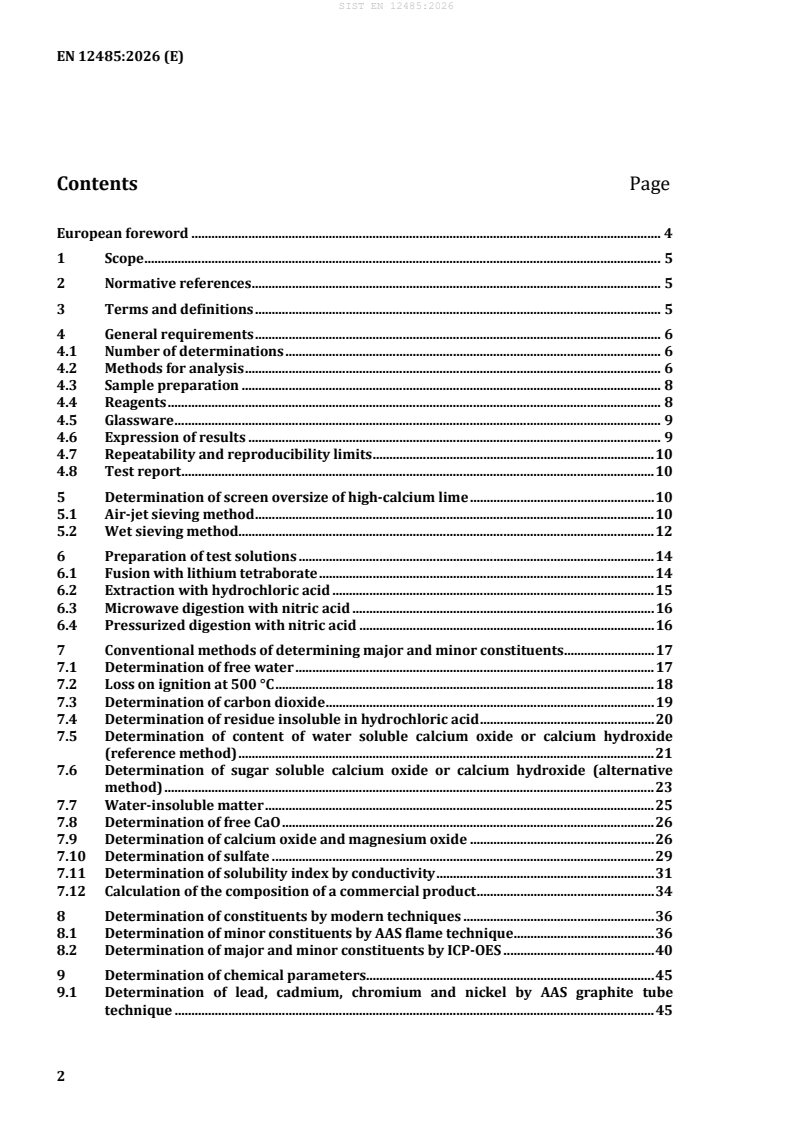
Contents Page
European foreword . 4
1 Scope . 5
2 Normative references . 5
3 Terms and definitions . 5
4 General requirements . 6
4.1 Number of determinations . 6
4.2 Methods for analysis . 6
4.3 Sample preparation . 8
4.4 Reagents . 8
4.5 Glassware . 9
4.6 Expression of results . 9
4.7 Repeatability and reproducibility limits . 10
4.8 Test report . 10
5 Determination of screen oversize of high-calcium lime . 10
5.1 Air-jet sieving method . 10
5.2 Wet sieving method. 12
6 Preparation of test solutions . 14
6.1 Fusion with lithium tetraborate . 14
6.2 Extraction with hydrochloric acid . 15
6.3 Microwave digestion with nitric acid . 16
6.4 Pressurized digestion with nitric acid . 16
7 Conventional methods of determining major and minor constituents . 17
7.1 Determination of free water . 17
7.2 Loss on ignition at 500 °C . 18
7.3 Determination of carbon dioxide . 19
7.4 Determination of residue insoluble in hydrochloric acid . 20
7.5 Determination of content of water soluble calcium oxide or calcium hydroxide
(reference method) . 21
7.6 Determination of sugar soluble calcium oxide or calcium hydroxide (alternative
method) . 23
7.7 Water-insoluble matter . 25
7.8 Determination of free CaO . 26
7.9 Determination of calcium oxide and magnesium oxide . 26
7.10 Determination of sulfate . 29
7.11 Determination of solubility index by conductivity . 31
7.12 Calculation of the composition of a commercial product . 34
8 Determination of constituents by modern techniques . 36
8.1 Determination of minor constituents by AAS flame technique . 36
8.2 Determination of major and minor constituents by ICP-OES . 40
9 Determination of chemical parameters. 45
9.1 Determination of lead, cadmium, chromium and nickel by AAS graphite tube
technique . 45
9.2 Determination of lead, cadmium, chromium and nickel by ICP-OES . 50
9.3 Determination of arsenic, antimony and selenium by AAS hydride technique . 54
9.4 Determination of mercury by cold-vapour technique . 57
Annex A (informative) Analytical scheme . 61
Annex B (informative) Precision data for the test methods . 68
Bibliography . 70
European foreword
This document (EN 12485:2026) has been prepared by Technical Committee CEN/TC 164 “Water
supply”, the secretariat of which is held by AFNOR.
This European Standard shall be given the status of a national standard, either by publication of an
identical text or by endorsement, at the latest by October 2026, and conflicting national standards shall
be withdrawn at the latest by October 2026.
Attention is drawn to the possibility that some of the elements of this document may be the subject of
patent rights. CEN shall not be held responsible for identifying any or all such patent rights.
This document supersedes EN 12485:2017.
Annexes A and B are informative. For further information on methodology see [1] to [6].
Significant technical differences between this edition and EN 12485:2017 are as follows:
a) Table 1 – XRF methods are added;
b) changed for requirements of water quality;
c) loss on ignition 550 °C changed to 500 °C;
d) unglazed porcelain or platinum crucible changed in glazed porcelain or platinum crucible.
Any feedback and questions on this document should be directed to the users’ national standards body.
A complete listing of these bodies can be found on the CEN website.
According to the CEN-CENELEC Internal Regulations, the national standards organisations of the
following countries are bound to implement this European Standard: Austria, Belgium, Bulgaria, Croatia,
Cyprus, Czech Republic, Denmark, Estonia, Finland, France, Germany, Greece, Hungary, Iceland, Ireland,
Italy, Latvia, Lithuania, Luxembourg, Malta, Netherlands, Norway, Poland, Portugal, Republic of North
Macedonia, Romania, Serbia, Slovakia, Slovenia, Spain, Sweden, Switzerland, Türkiye and the United
Kingdom.
1 Scope
This document specifies the methods used for the chemical analyses and the determination of physical
properties of calcium carbonate, high-calcium lime, half-burnt dolomite, magnesium oxide, calcium
magnesium carbonate and dolomitic lime used to treat water for human consumption.
This document specifies the reference methods and, in certain cases, an alternative method which can be
considered to be equivalent.
2 Normative references
The following documents are referred to in the text in such a way that some or all of their content
constitutes requirements of this document. For dated references, only the edition cited applies. For
undated references, the latest edition of the referenced document (including any amendments) applies.
EN 459-2, Building lime - Part 2: Test methods
EN 1017:2025, Chemicals used for treatment of water intended for human consumption - Half-burnt
dolomite
EN 1018:2021, Chemicals used for treatment of water intended for human consumption - Calcium
carbonate
EN 12518:2014, Chemicals used for treatment of water intended for human consumption - High-calcium
lime
EN 16003:2011, Chemicals used for treatment of water intended for human consumption - Calcium
magnesium carbonate
EN 16004:2011, Chemicals used for treatment of water intended for human consumption - Magnesium
oxide
EN 16409:2013, Chemicals used for treatment of water intended for human consumption - Dolomitic lime
ISO 3165, Sampling of chemical products for industrial use — Safety in sampling
ISO 4793:1980, Laboratory sintered (fritted) filters — Porosity grading, classification and designation
3 Terms and definitions
No terms and definitions are listed in this document.
ISO and IEC maintain terminology databases for use in standardization at the following addresses:
• ISO Online browsing platform: available at https://www.iso.org/obp
• IEC Electropedia: available at https://www.electropedia.org/
4 General requirements
4.1 Number of determinations
Two analyses shall be carried out to determine the various constituents (see Clause 6 to Clause 9; see
also 4.6).
4.2 Methods for analysis
The methods to be used for the analysis of half-burnt dolomite, calcium carbonate, high calcium lime,
magnesium oxide, calcium magnesium carbonate and dolomitic lime and the principle of each method
are listed in Table 1. Schematic diagrams of the analyses are given in Annex A (Figures A.1 to A.7).
NOTE 1 Any other methods can be used provided they are calibrated, either against the reference methods or
against internationally accepted reference materials, in order to demonstrate their equivalence.
NOTE 2 ICP-OES is a reference analytical instrument, but others can be used, as far they demonstrate
equivalence.
The requirement values for free MgO and free Mg(OH) in half-burnt dolomite shall be expressed as free
MgO in accordance with EN 1017. The same requirement is related to free CaO. The requirement value
for MgO in magnesium oxide shall be expressed as MgO in dry substance in accordance with EN 16004.
Therefore, the analysis of half-burnt dolomite and magnesium oxide shall be performed on a sample
which is bound-water free. Before starting the chemical analysis, the loss on ignition at 500 °C shall be
determined as described in 7.2. The analysis itself shall be performed on the material obtained after the
determination of the loss on ignition.
The requirement values for calcium carbonate, hydrated lime and calcium magnesium carbonate shall be
expressed in dry substance in accordance with EN 1018, EN 12518 and EN 16003. Therefore, the analysis
of these products shall be performed on a sample which has been dried in accordance with the procedure
described in 7.1.
For the determination of the water-soluble content of high-calcium lime, the method in 7.5 is considered
as the reference method. The sugar method described in 7.6 can be used as an alternative method if it is
demonstrated that the results obtained with this method are equivalent to those of the reference method.
The requirement values for CaO and MgO in dolomitic lime shall be expressed in accordance with
EN 16409. The requirement value for CaO and MgO in calcium magnesium dioxide shall be expressed as
CaO and MgO in bound-water free substance and for CaO and MgO in calcium magnesium dihydroxide
oxide shall be expressed as CaO and MgO in dry and bound-water free substance. Therefore, the analysis
of calcium magnesium dihydroxide oxide shall be performed on a sample which has been dried in
accordance with the procedure described in 7.1.
Table 1 — Methods for analysis
Determination Method Principle Standard
Screen oversize 5.1 Air-jet sieving EN 12518, EN 16409
5.2 Wet sieving EN 12518
Free water 7.1 Gravimetry EN 1018, EN 12518,
EN 16003, EN 16409
Loss on ignition at 500 °C 7.2 Gravimetry EN 1017, EN 12518,
EN 16004, EN 16409
Carbon dioxide 7.3 Gravimetry EN 1017, EN 12518,
EN 16004, EN 16409
Determination Method Principle Standard
Residue insoluble in 7.4 Gravimetry EN 1018, EN 16003
hydrochloric acid
Water-soluble calcium oxide or 7.5 Acidimetric titration EN 12518
calcium hydroxide
Sugar-soluble calcium oxide or 7.6 Acidimetric titration EN 12518
calcium hydroxide
Water-insoluble constituents 7.7 Gravimetry EN 12518
Free calcium oxide 7.8 Extraction, acidimetric EN 1017, EN 16004
titration
Calcium oxide and magnesium 7.9 Complexometric titration EN 1017, EN 1018,
oxide EN 16003, EN 16004,
XRF melting tablet
EN 16409
XRF powder tablet
Sulfate 7.10 Gravimetry EN 1017
Solubility index 7.11 Conductivity EN 12518
Magnesium 8.1 AAS (flame) EN 1017, EN 1018,
EN 16003, EN 16409,
or ICP-OES
EN 16004
8.2 XRF melting tablet
XRF powder tablet
Silicium,Aluminium,Iron 8.1 AAS (flame) EN 1017, EN 12518,
EN 16003, EN 16004,
or ICP-OES
EN 16409
8.2 XRF melting tablet
XRF powder tablet
Manganese 8.2 ICP-OES EN 12518, EN 16409
XRF melting tablet
XRF powder tablet
Sulfur 8.2 ICP-OES EN 1017
XRF melting tablet
XRF powder tablet
Lead, Cadmium, Chromium, 9.1 AAS (flameless) EN 1017, EN 1018,
Nickel EN 12518, EN 16003,
or or
EN 16004, EN 16409
9.2 ICP-OES
Arsenic, Antimony, Selenium 9.3 AAS (hydride) EN 1017, EN 1018,
EN 12518, EN 16003,
EN 16004, EN 16409
Mercury 9.4 AAS (cold-vapour EN 1017, EN 1018,
technique) EN 12518, EN 16003,
EN 16004, EN 16409
4.3 Sample preparation
The general recommendations specified in ISO 3165 shall be observed when sampling. Sampling shall be
performed in accordance with EN 459-2. For products less than 6 mm grain size, the size of the sample
shall be 1 l.
Before performing the chemical analyses, the size of the sample shall be reduced by using a sample
divider and/or by dividing it into four parts in order to obtain a suitable subsample. The coarse-grain
material in this sample shall be reduced to a size of less than 0,2 mm before performing the chemical
analysis.
When sampling milk of lime, the material from which the sample is to be taken shall be thoroughly mixed
with an electrically driven stirrer of adequate power. The milk of lime shall be dried before being analysed
chemically as described in 7.1.
Since the subsamples under examination are altered by the absorption of moisture and carbon dioxide,
their exposure to air shall be minimized. They shall therefore be transported and stored in air-tight
containers and all the handling shall be carried out as quickly as possible.
4.4 Reagents
All reagents shall be of a recognized analytical grade appropriate for the method being used.
Three types of water quality are used (essential requirements given below):
— specific electrical conductivity < 0,5 mS/m (at 25 °C), for most laboratory wet chemistry work
— specific electrical conductivity < 0,2 mS/m (at 25 °C), suitable for sensible analytical work
— specific electrical conductivity < 0,01 mS/m (at 25 °C), suitable for most stringent analytical
requirements
In all cases the concentration of the element(s) to be determined shall be low enough not to influence the
results of the analysis. This can be verified by analysing the blank solution.
The concentrated liquids used for the reagents in this standard have the following densities (ρ) (in grams
per millilitre at 20 °C):
— hydrochloric acid 1,16 to 1,19;
— nitric acid 1,40 to 1,42;
— ammonium hydroxide solution 0,88 to 0,91;
— triethanolamine 1,12.
Dilutions are specified as the sum of the volumes. Thus, (1 + 2) dilute hydrochloric acid means 1 part by
volume of concentrated hydrochloric acid mixed with 2 parts by volume of water.
The concentrations of reference and standard volumetric solutions are specified as amount-of-substance
concentrations, c (mol/l), while those of stock and standard solutions are specified as concentrations by
mass, ρ (g/l or mg/l).
Suitable element solutions for atomic absorption spectroscopy (AAS) and for optical emission
spectroscopy by inductively coupled plasma (ICP-OES) are commercially available and can be used as
stock solutions. They shall be prepared for the purposes of analysis in accordance with the
manufacturer’s instructions. The appropriate element standard solutions are prepared in accordance
with the instructions given in this document.
This document makes no stipulations relating to the shelf life of stock, standard and reference solutions.
In the case of stock solutions having an element concentration of 1 g/l, the manufacturer generally
specifies a shelf life of one year. The calibration solutions should be checked regularly.
4.5 Glassware
Glass containers and pipettes shall be cleaned with hot dilute nitric acid immediately before use and then
rinse with water. If determining trace elements rinse with water of a specific conductivity < 0,2 mS/m (at
25 °C).
4.6 Expression of results
The analytical results for the major and minor constituents shall be reported as mass fraction in %, while
those for trace elements shall be reported as mass fraction in milligrams per kilogram, as the mean of two
determinations. In general, analytical values shall be reported to three significant figures.
EXAMPLE:
— (CaO) = 91,2 %;
— (SiO ) = 3,70 %;
— (MnO ) = 0,15 %;
— (Cr) = 0,32 mg/kg;
— (Hg) = 0,05 mg/kg.
If the results of a duplicate determination differ from one another by more than twice the repeatability
standard deviation, the determination shall be repeated. The result shall then be deemed to be the mean
of the two results with the lowest difference.
To assess whether the analytical results meet the requirements laid down in EN 12518 for high-calcium
lime, in EN 1018 for calcium carbonate, in EN 1017 for half-burnt dolomite, in EN 16003 for calcium
magnesium carbonate, in EN 16004 for magnesium oxide and in EN 16409 for dolomitic lime, the results
have to be converted to the form in which the requirements are stated in the above standards.
Subclauses of this standard are given in Table 2 and contain the relevant calculation methods.
Table 2 — Methods for calculation of the results
Requirements from Parameter Required value Calculation described
standard for in
CaO , CaO CaCO
free 3
CO MgCO
EN 1017 7.12.2.3
2 3
MgO MgO
free
CaO CaCO
EN 1018 7.12.2.1
MgO
MgCO
CO CaCO
EN 12518 7.12.2.4
2 3
MgO, loss on (CO and H O)
2 2
ignition at
EN 16004 7.12.2.5
(1 050 ± 25) °C and
(500 ± 25) °C
MgO CaMg(CO )
3 2
EN 16003 7.12.2.2
MgCO
EN 16409 CaO, MgO CaO + MgO 7.12.2.6
4.7 Repeatability and reproducibility limits
The repeatability and reproducibility limits were determined in an interlaboratory test (see Annex B)
which was carried out in accordance with ISO 5725-2 and in which 28 laboratories took part.
4.8 Test report
The report shall contain the following information:
a) a complete identification of the sample;
b) a reference to this European Standard (including its year of publication);
c) the method used
d) results obtained and the method of expression used (see 4.6)
e) sample pretreatment, e.g. method of digestion (see Clause 6);
f) any deviation from this standard and an indication of any circumstances which can have affected the
results.
5 Determination of screen oversize of high-calcium lime
5.1 Air-jet sieving method
5.1.1 General
The method is used to determine the retention on sieving using airjet sieving apparatus.
5.1.2 Apparatus
5.1.2.1 Air-jet sieving apparatus, of the general form shown in Figure 1. The apparatus shall be set
to give a pressure difference of 2 kPa to 2,5 kPa across the sieves.
Key
1 housing
2 dish
3 sieve drum
4 lid
5 slit-nozzle
6 sieve
7 test sample
8 oversize material
9 undersize material
10 air jet
11 air discharge
12 pressure gauge socket, with dust hood
Figure 1 — Air-jet sieving apparatus
5.1.2.2 Test sieves, 200 mm diameter, aperture sizes 0,60 mm and 0,09 mm.
The effective operation of some makes of air-jet apparatus can require non-standard sieve frames and
additional gaskets. This is permissible, provided the sieving medium and general method of construction
comply with the requirements of this document.
5.1.2.3 Trays or other suitable containers of sufficient size to contain the test portion.
5.1.2.4 Balance, accurate to 0,1 mg.
5.1.2.5 Soft brush.
5.1.2.6 Ultrasonic cleaning bath for cleaning the mesh of the sieves.
5.1.2.7 Mallet, if there is a tendency for material to adhere to the lid of the apparatus. A rubber or
plastics tipped mallet is preferred.
5.1.3 Procedure
Weigh an appropriate amount (between 10 g and 50 g pending on the type of material) of the dry sample
to the nearest 1 mg (m). Fit the test sieve with the aperture size 0,09 mm into the apparatus and transfer
all of the test portion onto the sieve mesh. Take care not to lose any of the test portion.
Fit the lid and switch on the apparatus. Check that the vacuum created is above the minimum value stated
in the manufacturer’s instructions, and that the slit nozzle is rotating properly.
If material adheres to the lid of the apparatus, gently tap the centre of the lid with the mallet.
If the material agglomerates under the action of the air-jet, interrupt the sieving process, and break up
the agglomerates with the soft brush.
After (5 ± 0,2) min, switch off the apparatus and carefully remove the sieve. Transfer the material
retained on the sieve into a tray or other suitable container. Carefully clean the mesh of the sieve over the
tray using a soft brush.
Determine the mass of the residue, including the material brushed from the sieve mesh, and record the
mass to the nearest 1 mg.
Refit the sieve into the apparatus and transfer all of the residue back to the sieve mesh. Repeat the
weighing and sieving stages until the sieving end-point has been achieved, and record the end-point mass
to the nearest 1 mg. The sieving end-point is defined as being when not more than 0,2 % of the mass of
the original test portion passes through the sieve in 1 min.
Fit the 0,60 mm test sieve into the apparatus, and repeat the weighing and sieving stages until the mass
of the residue confirms that the sieving end-point has been reached. Record the end-point mass to the
nearest 1 mg.
5.1.4 Expression of results
The mass retained on each sieve expressed as m (P or ) in mass fraction in %, is given by the
0,60 0,09
following formula:
m × 100
m P =
0,60 or 0,09
m
(1)
where
m is the mass of the sample, in grams;
m is the mass of the residue retained on the test sieves, in grams.
5.2 Wet sieving method
5.2.1 General
The method is exclusively used for the determination of the retentions on sieving of milk of lime as
specified in EN 12518.
5.2.2 Apparatus
5.2.2.1 Balance, accurate to 0,1 mg.
5.2.2.2 500 ml wide-mouthed bottle, or other suitable vessel which can be sealed with a stopper.
5.2.2.3 200 mm diameter 0,60 mm and 0,09 mm aperture size test sieves.
5.2.2.4 5 mm bore rubber or plastics tubing.
5.2.2.5 Drying oven, thermostatically controlled to maintain a temperature of (105 ± 5) °C.
5.2.2.6 Two sintered glass filter crucibles, of porosity 2 (as specified in ISO 4793:1980)
(maximum porosity diameter 40 µm to 100 μm) with filter flask and adapter funnel for crucibles.
5.2.2.7 Desiccator.
5.2.2.8 Wash bottle.
5.2.2.9 Filtration apparatus.
5.2.3 Procedure
Superimpose the 0,60 mm mesh test sieve on the 0,09 mm mesh test sieve and wet the sieves with water.
Place a volume of milk of lime containing (50 ± 0,5) g of dry substance in a 500 ml wide-mouthed bottle.
Replace the stopper and shake the bottle for about 30 s. Remove the stopper immediately and pour the
contents of the bottle onto the sieves. Wash any residue remaining in the bottle or on the stopper with a
jet of water from the 5 mm bore tubing and at a pressure equal to a head of 1,2 m (approximately 10 kPa)
on to the sieves. Then use the jet to wash the residue on the 0,60 mm mesh test sieve for (2 ± 0,1) min.
Do not rub the residue through the sieve and take care not to flood the lower sieve during the operation.
At the end of this period, wash the residue to one side of the sieve.
Detach the 0,60 mm mesh test sieve and, using a wash bottle, transfer the residue from the sieve through
a glass funnel into one of the tared, sintered glass filter crucibles connected to the filtration apparatus.
When all the residue has been washed into the filter, and the water extracted, remove the filter containing
the residue and dry it at (105 ± 5) °C for 1 h. Cool the dried filter in a desiccator and reweigh.
Wash the residue on the 0,09 mm mesh test sieve for (5 ± 0,2) min. Transfer the residue to a tared filter
crucible, dry at (105 ± 5) °C until constant mass is reached, cool and reweigh as described above.
5.2.4 Expression of results
The mass retained on each sieve expressed as m (P ) in mass fraction in % is given by the
0,60 or 0,09
following formula:
m × 100
1
m P =
0,60 or 0,09
m
(2)
where
m is the mass of the dry substance in the test portion, in grams;
m is the mass of the residue retained on the test sieves, in grams.
6 Preparation of test solutions
6.1 Fusion with lithium tetraborate
6.1.1 General
Fusion with lithium tetraborate is used to dissolve:
— high-calcium lime as specified in EN 12518 in order to determine silicon, aluminium, iron and
manganese;
— half-burnt dolomite as specified in EN 1017 in order to determine calcium, magnesium, silicon,
aluminium and iron;
— calcium carbonate as specified in EN 1018 in order to determine calcium and magnesium;
— magnesium oxide as specified in EN 16004 in order to determine magnesium, silicon, aluminium and
iron;
— calcium magnesium carbonate as specified in EN 16003 in order to determine calcium and
magnesium;
— dolomitic lime as specified in EN 16409 in order to determine calcium, magnesium, silicon,
aluminium, iron and manganese.
6.1.2 Principle
After fusing the sparingly soluble oxide constituents of the sample with lithium tetraborate, the fusion
cake is dissolved in hydrochloric acid and the solution made up to 250 ml in a volumetric flask. Calcium,
magnesium, silicon, aluminium, iron and manganese are determined in aliquot parts of this solution by
flame-AAS (8.1) or ICP-OES (8.2).
6.1.3 Reagents
6.1.3.1 Lithium tetraborate, Li B O
2 4 7.
6.1.3.2 Hydrochloric acid, ρ = 1,16 g/ml.
6.1.3.3 Hydrochloric acid, diluted, (1 + 5).
6.1.4 Apparatus
Ordinary laboratory apparatus and the following:
6.1.4.1 Platinum-gold crucible.
6.1.4.2 Hot plate.
6.1.5 Procedure
Weigh (0,25 ± 0,02) g to the nearest 0,1 mg of the sample into a platinum-gold crucible and add 1,5 g of
lithium tetraborate (6.1.3.1). Roast at (1 000 ± 25) °C until the melt is clear. Remove from the heat, cover
the crucible with a watch glass and stand the crucible in water for a few seconds, remove and allow it to
stand until it has cooled completely.
Transfer the cold melt to a beaker using approximately 50 ml of hydrochloric acid (6.1.3.3) and dissolve
while stirring and heating at 100 °C. Then transfer the solution to a 250 ml volumetric flask with
water (4.4) and, after cooling to room temperature, add each 10 ml of the appropriate reagent solutions
(8.1.2.6 and 8.1.2.7 for the AAS measurement) or 1 ml of scandium solution (8.2.2.2, internal standard
solution for the ICP measurement) and make up to the mark with water (digestion solution (I) for AAS
and (II) for ICP).
6.2 Extraction with hydrochloric acid
6.2.1 General
Extraction with hydrochloric acid is used to dissolve samples exclusively in order to determine calcium
and magnesium.
6.2.2 Principle
The sample is boiled with hydrochloric acid and the solution filtered. The pH value is adjusted to 6 to 7
to precipitate the iron (III) and aluminium hydroxides. After refiltering, the filtrate is transferred to a
suitable volumetric flask.
6.2.3 Reagents
6.2.3.1 Hydrochloric acid, ρ = 1,16 g/ml.
6.2.3.2 Hydrogen peroxide solution, c (H O ) = 30 % (m/m).
2 2
6.2.3.3 Hydrogen peroxide solution, diluted, 1 + 9.
6.2.3.4 Ammonium hydroxide solution, c (NH ) = 25 % (m/m).
6.2.3.5 Ammonium hydroxide solution, diluted, 1 + 9.
6.2.3.6 Ammonium chloride, NH Cl.
6.2.4 Apparatus
Ordinary laboratory apparatus and the following:
6.2.4.1 Hot plate.
6.2.4.2 Magnetic stirrer and magnetic rod.
6.2.4.3 pH-meter with glass electrode.
6.2.5 Procedure
Weigh (1 ± 0,1) g of the sample to the nearest 1 mg, transfer it to a 250 ml beaker, moisten with 10 ml of
water, then gradually add 30 ml of hydrochloric acid (6.2.3.1). Make the solution up to about 100 ml with
water then boil it for 10 min. After boiling, filter the solution immediately through a fluted filter paper
(particle retention size 2,5 μm) into a 400 ml beaker and wash the residue well with water.
Add about 4 g of ammonium chloride (6.2.3.6) and a few drops of hydrogen peroxide (6.2.3.3) to the
solution, then dilute with about 150 ml of water and heat to boiling. During boiling, add ammonium
hydroxide solution dropwise (6.2.3.4) to adjust the pH value to 6 to 7 and precipitate aluminium
hydroxides and iron hydroxides and the silicic acid.
Continue boiling for 3 min and, after the precipitate has settled, filter the solution immediately through a
fluted filter paper (particle retention size 2,5 μm) into a 500 ml volumetric flask. Wash the filter residue
three times with ammonium hydroxide solution (6.2.3.5) and three times with water. After the solution
has cooled to room temperature, make the solution up to the mark with water and shake the contents of
the flask thoroughly (digestion solution III).
6.3 Microwave digestion with nitric acid
6.3.1 General
The purpose of this method of digestion is to release trace elements from the accompanying matrix and
determine the content of the various elements.
6.3.2 Principle
The sample is weighed into a perfluoroalkoxyethylene (PFA) beaker and nitric acid is added. After the
mixture has been placed in a microwave apparatus, digestion is carried out. Any undissolved component
is removed by filtering and the supernatant is used to determine the elements concerned.
6.3.3 Reagents
6.3.3.1 Nitric acid, ρ = 1,40 g/ml.
6.3.4 Apparatus
Ordinary laboratory apparatus and the following:
6.3.4.1 Microwave digestion apparatus, equipped with PFA digestion vessels and a programmable
pressure and temperature control unit. Performance ≥ 600 W.
6.3.4.2 50 ml polypropylene pressure vessel with screw lid.
6.3.4.3 Filtering apparatus.
6.3.5 Procedure
The mass of the test sample depends on the test method. For AAS, the recommended mass is (0,5 ± 0,05)
g and for ICP-OES (3 ± 0,05) g, weighed to the nearest 0,1 mg. In the first case, moisten the sample
with 4 ml of water and carefully add 3 ml of nitric acid (6.3.3.1), in the second case moisten with 5 ml of
water and add 10 ml of nitric acid (6.3.3.1).
Seal the digestion vessel and place in the microwave apparatus. Before programming the apparatus, the
heating conditions shall be determined, and a temperature and pressure versus time plot shall be
prepared.
Subject the test sample to a pressure of 500 kPa to 700 kPa and to a temperature of 90 °C for 10 min
during a heating-up phase. Then subject the test sample to a pressure of 1 000 kPa and a temperature
between 120 °C and 150 °C for 15 min to 20 min. Allow the digestion vessel to cool to room temperature.
Open the digestion vessel, introduce the solution into a 100 ml volumetric flask rinse and make up to the
mark with water. Filter and transfer the solution (digestion solution IV) to a polypropylene vessel in
order to avoid adsorption on the glass.
6.4 Pressurized digestion with nitric acid
6.4.1 General
The purpose of this method of digestion is to release trace elements from the accompanying matrix and
determine the content of the various elements.
6.4.2 Principle
The sample is weighed out into a polytetrafluorethylen (PTFE) beaker and nitric acid is added. After the
mixture has been placed in a pressure shell, digestion is carried out at 130 °C. Any undissolved
component is removed by filtering and the supernatant is used to determine the elements concerned.
6.4.3 Reagent
6.4.3.1 Nitric acid, ρ (HNO ) = 1,40 g/ml.
6.4.4 Apparatus
Ordinary laboratory apparatus and the following:
6.4.4.1 Pressure digestion system, consisting of a PTFE digestion vessel, pressure shell and a
heater.
6.4.4.2 50 ml polypropylene pressure vessel with screw lid.
6.4.4.3 Filtering apparatus.
6.4.5 Procedure
Weigh (0,5 ± 0,05) g to the nearest of 0,1 mg of the sample into the digestion vessel, moisten the sample
with 2 ml of water and add carefully 5 ml of nitric acid (6.4.3.1). Seal the pressure vessel, place it in a cold
drying oven and heat to 130 °C. After about 15 min, remove the pressure vessel from the drying oven and
cool it to room temperature. Open the pressurized digestion system, introduce the solution into a 100 ml
volumetric flask, rinse and make up to the mark with water. Filter and transfer the solution (digestion
solution V) to a polypropylene vessel in order to avoid adsorption on the glass.
7 Conventional methods of determining major and minor constituents
7.1 Determination of free water
7.1.1 General
Free water means the moisture attached to the product, in the case of milk of lime, it refers to the water
content of the suspension. The method does not apply for high-calcium quicklime, half-burnt dolomite or
calcium magnesium dioxide. The determination of the water content of milk of lime is required to
calculate the water-soluble content of the suspended hydrated lime (see 7.5).
7.1.2 Principle
When heating a sample of hydrated high-calcium lime, calcium carbonate, calcium magnesium carbonate
or calcium magnesium dihydroxide oxide to (105 ± 5) °C, or for milk of lime to (150 ± 5) °C the free water
is driven off. The loss of mass at this temperature is referred to as free water.
7.1.3 Apparatus
Ordinary laboratory apparatus and the following:
7.1.3.1 Drying oven, thermostatically controlled to maintain a temperature of (105 ± 5) °C or
(150 ± 5) °C (alternative equipment 1).
7.1.3.2 Automated moisture balance, being capable to be controlled between (105 ± 5) °C or
(150 ± 5) °C (alternative equipment 2).
7.1.3.3 Analytical balance accurate to 0,1 mg.
7.1.3.4 Desiccator containing drying agent.
7.1.3.5 Glazed porcelain or platinum crucible.
7.1.3.6 Pipette.
7.1.4 Procedure
7.1.4.1 Hydrated high-calcium lime, calcium carbonate, calcium magnesium carbonate and
calcium magnesium dihydroxide oxide
Weigh (5 ± 0,1) g to a nearest 1 mg of the sample in the as-delivered state in a pre-weighed crucible. Dry
the sample until constant mass using the oven (7.1.3.1) or the balance (7.1.3.2). When using the oven
limit the time of drying to approximately 2 h. Cover the crucible after removing it from the oven to
prevent carbon dioxide and water vapour in the atmosphere from being absorbed. Cool in the desiccator
and reweigh.
7.1.4.2 Milk of lime
Homogenize the suspension by shaking before taking the sample aliquot. Use a pipette to take
approximately 20 g and weigh to the nearest of 0,1 mg in a glass vessel. Dry the sample to constant mass
using the oven (7.1.3.1) or the balance (7.1.3.2). Cover the crucible after removing it from the oven to
prevent carbon dioxide and water vapour in the atmosphere from being absorbed. After cooling down to
ambient temperature in the dessicator, determine the loss in mass.
7.1.5 Expression of results
The free water content expressed as (H O) in mass fraction in % is given by the following formula:
mm−
( )
ω HO × 100
( )
m
(3)
where
m is the mass of the test portion before heating, in grams;
m is the mass of the test portion after heating, in grams.
7.2 Loss on ignition at 500 °C
7.2.1 General
The method is used to determine the loss on ignition after drying as specified in 7.1.
7.2.2 Principle
The loss on ignition at 500 °C is basically due the water of hydration.
7.2.3 Apparatus
Ordinary laboratory apparatus and the following:
7.2.3.1 Electric furnace capable of being maintained at (500 ± 25) °C, with a thermoelectric
temperature indicator.
7.2.3.2 Analytical balance accurate to 0,1 mg.
=
7.2.3.3 Desiccator containing phosphorous pentoxide, P O .
2 5
7.2.3.4 Glazed porcelain or platinum crucible.
7.2.4 Procedure
Weigh (5 ± 0,1) g to the nearest of 1 mg of the sample (m ) in a pre-weighed crucible. Heat the sample in
the furnace at (500 ± 25) °C for 2 h and then cool it in a desiccator. Cover the crucible after removing it
from the furnace to prevent carbon dioxide and water vapour in the atmosphere from being absorbed.
Cool in the desiccator and weigh (m ).
7.2.5 Expression of results
The loss on ignition at 500 °C expressed as LoI in mass fraction in % is given by the following formula:
mm−
( )
LoI × 100
( )
m
(4)
where
m is the mass of the sample before ignition at (500 ± 25) °C, in grams;
m is the mass of the sample after ignition at (500 ± 25) °C, in grams.
7.3 Determination of carbon dioxide
7.3.1 General
The method is used to determine carbon dioxide in high-calcium lime as specified in EN 12518, in half-
burnt dolomite as specified in EN 1017, in magnesium oxide as specified in EN 16004 and in dolomitic
lime as specified in EN 16409.
7.3.2 Principle
The carbon dioxide content of the materials concerned is determined from the loss on ignition at 1 050 °C.
The loss on ignition at 500 °C is basically due to free water and the water of hydration. The difference in
mass between the loss on ignition at (1 050 ± 25) °C and the loss on ignition at (500 ± 25) °C is equal to
the carbon dioxide content of the product.
7.3.3 Apparatus
Ordinary laboratory apparatus and the following:
7.3.3.1 Electric furnace capable of being maintained at (1 050 ± 25) °C, with a thermoelectric
temperature indicator.
7.3.3.2 Analytical balance accurate to 0,1 mg.
7.3.3.3 Desiccator containing phosphorous pentoxide, P O .
2 5
7.3.3.4 Glazed porcelain or platinum crucible.
7.3.4 Procedure
After determining the mass (m ) from the determination of the loss on ignition at (500 ± 25) °C (7.2.5),
heat the sample at (1 050 ± 25) °C for 3 h. Cover the crucible aft
...