

EN 15700:2023
(Main)Safety for conveyor belts for winter sport or tourist use
- Abstract
This European Standard is applicable for travelators, with or without a tunnel, for winter sport or leisure use.
These requirements are applicable to travelators for the transport of persons (either passengers or operators) wearing snow-sliding devices, or pedestrians wearing ski boots or heavy boots who may be holding their snow-sliding devices, for winter sports activities. For other uses, the persons (whether passengers or operators) shall wear suitable (enclosed and solid) footwear for travelators.
NOTE Snow-sliding devices include seated ski equipment for handicapped people.
This document has been prepared on the basis of the automatic operation of these installations with no staff permanently present at the actual installation.
It covers requirements relating to the prevention of accidents and the safety of operators.
This document covers all the significant hazards, hazardous situations and hazardous events specific to travelators for winter sport or leisure activities, when they are used in conformity to the application for which they are intended as well as for inappropriate applications that could be reasonably foreseen by the manufacturer (see Clause 4).
This document does not apply either to moving walkways as specified in EN 115 or to loading bands as specified in EN 1907.
This document does not apply to travelators manufactured prior to the date of its publication as an EN.
- Status
- Published
- Publication Date
- 01-Aug-2023
- Technical Committee
- CEN/TC 242 - Safety requirements for passenger transportation by rope
- Current Stage
- 6060 - Definitive text made available (DAV) - Publishing
- Start Date
- 02-Aug-2023
- Due Date
- 23-Dec-2020
- Completion Date
- 02-Aug-2023
- Directive
- 2006/42/EC - Directive 2006/42/EC of the European Parliament and of the Council of 17 May 2006 on machinery, and amending Directive 95/16/EC (recast)OJ Ref: 2024/1329, OJ L, OJ L, 2024/1329 OJ Date: 15-May-2024
Buy Documents



Overview
EN 15700:2023 - Safety for conveyor belts for winter sport or tourist use (CEN) specifies safety requirements for travelators (horizontal or inclined conveyor belts), with or without tunnels, used in winter-sport and leisure environments. The standard covers travelators intended to transport people wearing snow‑sliding devices (including seated ski equipment for disabled users) or pedestrians in ski boots/heavy boots. It is based on automated operation with no permanently present staff and addresses prevention of accidents and safety of operators and passengers. Note: EN 15700 excludes moving walkways (EN 115), loading bands (EN 1907), and travelators manufactured before its publication.
Key topics and technical requirements
The standard focuses on hazards, protective measures, design and verification. Major technical areas include:
- Scope & risk assessment: identification of significant hazards and foreseeable misuse specific to winter-sport travelators.
- Installation & terrain adaptation: requirements for siting, longitudinal profile and cross‑section design to suit slope and snow conditions.
- Carrier belt and accessories: design of the belt, guides, coverings, emergency flap and access flap, brushes and unloading drums/wheels.
- Speed, drive and start-up: permitted operating speeds, drive arrangement and safe automatic start procedures.
- Operating safety: emergency stops, safety devices/functions, belt rupture detection and monitoring (including belt re‑entry angle at unloading).
- Unloading configurations: provisions for lateral, mixed and exclusive lateral unloading.
- Tunnels and enclosures: compatibility, emergency doors, safety stop buttons and fire requirements for travelators in tunnels.
- Control & safety systems: control elements, secondary panels, resetting, alarms and electrical protection consistent with machine safety standards.
- Verification & validation: design, construction and site verification, calculations, material justification and tests; includes measurement methods (e.g., annex on the “6 mm maximum” gap between travelator sections).
- User information & marking: signage, instruction manuals, assembly/use/maintenance instructions and statutory marking requirements.
Practical applications and users
EN 15700:2023 is used to design, build, install, test and operate travelators in ski resorts, winter tourist facilities, indoor ski centers and similar leisure sites. Primary users:
- Travelator and conveyor manufacturers
- Mechanical, civil and electrical designers and engineers
- Ski area and resort operators / facility managers
- Installation and maintenance teams
- Safety assessors, notified bodies and conformity assessors
- Procuring organizations and regulatory authorities
Applying EN 15700 helps ensure safe passenger transport in snow and ski contexts, reduces accident risk, supports compliance with EU directives and harmonizes requirements across manufacturers and operators.
Related standards
EN 15700 cross‑references and works alongside standards such as EN 115, EN 1907, EN ISO 12100, EN ISO 13849, Eurocodes (EN 1990–1999) and electrical/machinery safety standards (EN 60204‑1, EN ISO 13850, etc.). These provide complementary rules for structural design, machine safety, controls and fire performance.
Relations
- Effective Date
- 01-Aug-2018
- Effective Date
- 09-Feb-2026
- Effective Date
- 09-Feb-2026
- Effective Date
- 09-Feb-2026
- Effective Date
- 09-Feb-2026
- Effective Date
- 09-Feb-2026
- Effective Date
- 28-Jan-2026
- Effective Date
- 28-Jan-2026
- Effective Date
- 28-Jan-2026
- Effective Date
- 28-Jan-2026
- Refers
EN 1991-1-3:2003 - Eurocode 1 - Actions on structures - Part 1-3: General actions - Snow loads - Effective Date
- 28-Jan-2026
- Effective Date
- 28-Jan-2026
- Refers
EN 12397:2017 - Safety requirements for cableway installations designed to carry persons - Operation - Effective Date
- 28-Jan-2026
- Effective Date
- 28-Jan-2026
- Effective Date
- 28-Jan-2026
Buy Documents
Get Certified
Connect with accredited certification bodies for this standard

DIBt (Deutsches Institut für Bautechnik)
German Institute for Building Technology.
DIN CERTCO
DIN Group product certification.

Aboma Certification B.V.
Specialized in construction, metal, and transport sectors.
Sponsored listings
Frequently Asked Questions
EN 15700:2023 is a standard published by the European Committee for Standardization (CEN). Its full title is "Safety for conveyor belts for winter sport or tourist use". This standard covers: This European Standard is applicable for travelators, with or without a tunnel, for winter sport or leisure use. These requirements are applicable to travelators for the transport of persons (either passengers or operators) wearing snow-sliding devices, or pedestrians wearing ski boots or heavy boots who may be holding their snow-sliding devices, for winter sports activities. For other uses, the persons (whether passengers or operators) shall wear suitable (enclosed and solid) footwear for travelators. NOTE Snow-sliding devices include seated ski equipment for handicapped people. This document has been prepared on the basis of the automatic operation of these installations with no staff permanently present at the actual installation. It covers requirements relating to the prevention of accidents and the safety of operators. This document covers all the significant hazards, hazardous situations and hazardous events specific to travelators for winter sport or leisure activities, when they are used in conformity to the application for which they are intended as well as for inappropriate applications that could be reasonably foreseen by the manufacturer (see Clause 4). This document does not apply either to moving walkways as specified in EN 115 or to loading bands as specified in EN 1907. This document does not apply to travelators manufactured prior to the date of its publication as an EN.
This European Standard is applicable for travelators, with or without a tunnel, for winter sport or leisure use. These requirements are applicable to travelators for the transport of persons (either passengers or operators) wearing snow-sliding devices, or pedestrians wearing ski boots or heavy boots who may be holding their snow-sliding devices, for winter sports activities. For other uses, the persons (whether passengers or operators) shall wear suitable (enclosed and solid) footwear for travelators. NOTE Snow-sliding devices include seated ski equipment for handicapped people. This document has been prepared on the basis of the automatic operation of these installations with no staff permanently present at the actual installation. It covers requirements relating to the prevention of accidents and the safety of operators. This document covers all the significant hazards, hazardous situations and hazardous events specific to travelators for winter sport or leisure activities, when they are used in conformity to the application for which they are intended as well as for inappropriate applications that could be reasonably foreseen by the manufacturer (see Clause 4). This document does not apply either to moving walkways as specified in EN 115 or to loading bands as specified in EN 1907. This document does not apply to travelators manufactured prior to the date of its publication as an EN.
EN 15700:2023 is classified under the following ICS (International Classification for Standards) categories: 91.140.90 - Lifts. Escalators. The ICS classification helps identify the subject area and facilitates finding related standards.
EN 15700:2023 has the following relationships with other standards: It is inter standard links to EN 15700:2011, EN 61496-1:2013, EN 60204-1:2018, EN 60947-5-1:2017, EN 62061:2005, EN 61496-2:2013, EN ISO 14119:2013, EN ISO 13857:2019, EN 619:2002+A1:2010, EN 115-1:2017, EN 1991-1-3:2003, EN 13501-1:2018, EN 12397:2017, EN ISO 13849-1:2015, EN 1907:2017. Understanding these relationships helps ensure you are using the most current and applicable version of the standard.
EN 15700:2023 is associated with the following European legislation: EU Directives/Regulations: 2006/42/EC, 2023/1230; Standardization Mandates: M/396, M/605. When a standard is cited in the Official Journal of the European Union, products manufactured in conformity with it benefit from a presumption of conformity with the essential requirements of the corresponding EU directive or regulation.
EN 15700:2023 is available in PDF format for immediate download after purchase. The document can be added to your cart and obtained through the secure checkout process. Digital delivery ensures instant access to the complete standard document.
Standards Content (Sample)
SLOVENSKI STANDARD
01-december-2023
Nadomešča:
SIST EN 15700:2012
Naprave za kontinuirni transport - Varnost tračnih transporterjev za zimske športe
ali turistične namene
Safety for conveyor belts for winter sport or tourist use
Sicherheit von Bandförderern für Wintersport- oder Freizeitaktivitäten
Sécurité des tapis roulants pour les activités de sports d'hiver ou de loisirs
Ta slovenski standard je istoveten z: EN 15700:2023
ICS:
53.040.10 Transporterji Conveyors
2003-01.Slovenski inštitut za standardizacijo. Razmnoževanje celote ali delov tega standarda ni dovoljeno.
EN 15700
NORME EUROPÉENNE
EUROPÄISCHE NORM
Août 2023
EUROPEAN STANDARD
ICS 91.140.90 Remplace l' EN 15700:2011
Version Française
Sécurité des tapis roulants pour les activités de sports
d'hiver ou de loisirs
Sicherheit von Bandförderern für Wintersport- oder Safety of travelators for winter sport or tourist use
Freizeitaktivitäten
La présente Norme européenne a été adoptée par le CEN le 12 septembre 2022.
Les membres du CEN sont tenus de se soumettre au Règlement Intérieur du CEN/CENELEC, qui définit les conditions dans
lesquelles doit être attribué, sans modification, le statut de norme nationale à la Norme européenne. Les listes mises à jour et les
références bibliographiques relatives à ces normes nationales peuvent être obtenues auprès du Centre de Gestion du CEN-
CENELEC ou auprès des membres du CEN.
La présente Norme européenne existe en trois versions officielles (allemand, anglais, français). Une version dans une autre
langue faite par traduction sous la responsabilité d'un membre du CEN dans sa langue nationale et notifiée au Centre de Gestion
du CEN-CENELEC, a le même statut que les versions officielles.
Les membres du CEN sont les organismes nationaux de normalisation des pays suivants: Allemagne, Autriche, Belgique, Bulgarie,
Chypre, Croatie, Danemark, Espagne, Estonie, Finlande, France, Grèce, Hongrie, Irlande, Islande, Italie, Lettonie, Lituanie,
Luxembourg, Malte, Norvège, Pays-Bas, Pologne, Portugal, République de Macédoine du Nord, République de Serbie, République
Tchèque, Roumanie, Royaume-Uni, Slovaquie, Slovénie, Suède, Suisse et Turquie.
COMITÉ EUROPÉEN DE NORMALISATION
EUROPÄISCHES KOMITEE FÜR NORMUNG
EUROPEAN COMMITTEE FOR STANDARDIZATION
CEN-CENELEC Management Centre: Rue de la Science 23, B-1040 Bruxelles
© 2023 CEN Tous droits d'exploitation sous quelque forme et de quelque manière Réf. n° EN 15700:2023 F
que ce soit réservés dans le monde entier aux membres nationaux du
CEN.
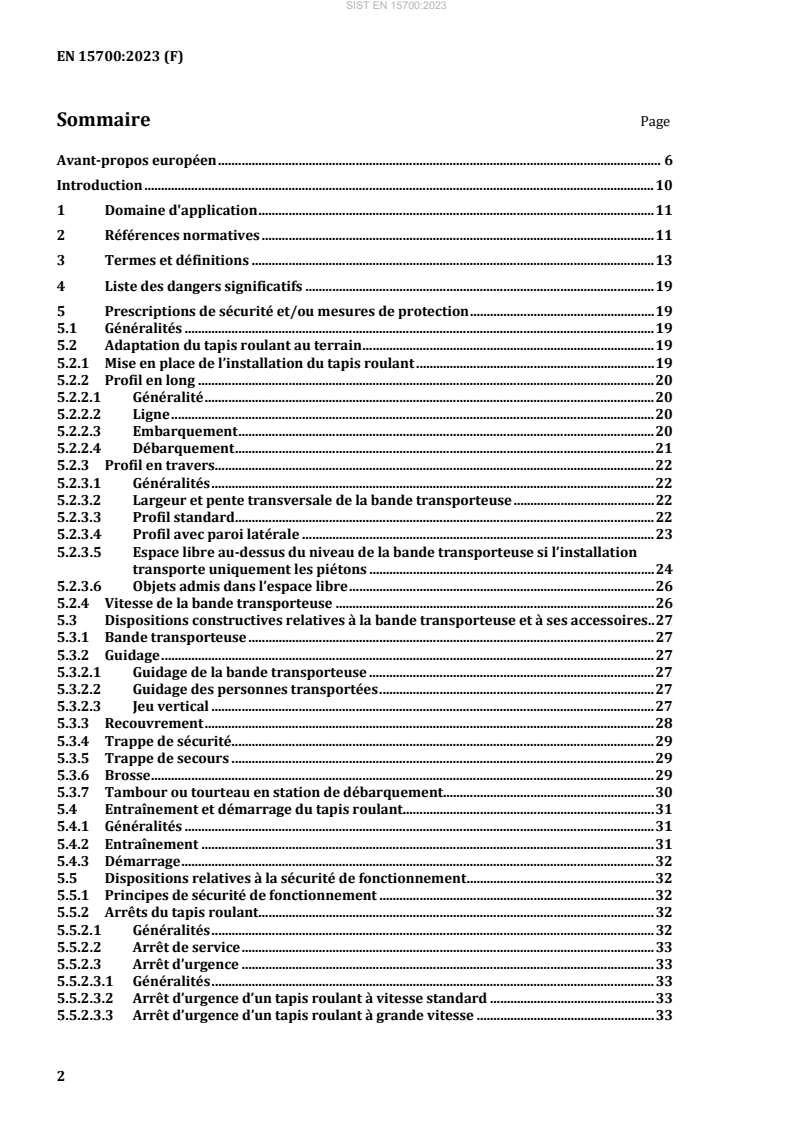
Sommaire Page
Avant-propos européen . 6
Introduction . 10
1 Domaine d'application . 11
2 Références normatives . 11
3 Termes et définitions . 13
4 Liste des dangers significatifs . 19
5 Prescriptions de sécurité et/ou mesures de protection . 19
5.1 Généralités . 19
5.2 Adaptation du tapis roulant au terrain . 19
5.2.1 Mise en place de l’installation du tapis roulant . 19
5.2.2 Profil en long . 20
5.2.2.1 Généralité . 20
5.2.2.2 Ligne . 20
5.2.2.3 Embarquement . 20
5.2.2.4 Débarquement . 21
5.2.3 Profil en travers. 22
5.2.3.1 Généralités . 22
5.2.3.2 Largeur et pente transversale de la bande transporteuse . 22
5.2.3.3 Profil standard . 22
5.2.3.4 Profil avec paroi latérale . 23
5.2.3.5 Espace libre au-dessus du niveau de la bande transporteuse si l’installation
transporte uniquement les piétons . 24
5.2.3.6 Objets admis dans l’espace libre . 26
5.2.4 Vitesse de la bande transporteuse . 26
5.3 Dispositions constructives relatives à la bande transporteuse et à ses accessoires . 27
5.3.1 Bande transporteuse . 27
5.3.2 Guidage . 27
5.3.2.1 Guidage de la bande transporteuse . 27
5.3.2.2 Guidage des personnes transportées . 27
5.3.2.3 Jeu vertical . 27
5.3.3 Recouvrement . 28
5.3.4 Trappe de sécurité. 29
5.3.5 Trappe de secours . 29
5.3.6 Brosse . 29
5.3.7 Tambour ou tourteau en station de débarquement. 30
5.4 Entraînement et démarrage du tapis roulant. 31
5.4.1 Généralités . 31
5.4.2 Entraînement . 31
5.4.3 Démarrage . 32
5.5 Dispositions relatives à la sécurité de fonctionnement . 32
5.5.1 Principes de sécurité de fonctionnement . 32
5.5.2 Arrêts du tapis roulant. 32
5.5.2.1 Généralités . 32
5.5.2.2 Arrêt de service . 33
5.5.2.3 Arrêt d’urgence . 33
5.5.2.3.1 Généralités . 33
5.5.2.3.2 Arrêt d’urgence d’un tapis roulant à vitesse standard . 33
5.5.2.3.3 Arrêt d’urgence d’un tapis roulant à grande vitesse . 33
5.5.2.4 Arrêt d’urgence avec distance d’arrêt prolongée . 34
5.5.2.4.1 Généralités . 34
5.5.2.4.2 Arrêt d’urgence avec distance d’arrêt prolongée pour un tapis roulant à vitesse
standard . 34
5.5.2.4.3 Arrêt d’urgence avec distance d’arrêt prolongée pour les tapis roulants à grande
vitesse . 34
5.5.2.5 Frein . 34
5.5.3 Dispositifs d’arrêt . 35
5.5.3.1 Dispositifs d'arrêt de service . 35
5.5.3.2 Dispositif d'arrêt d'urgence . 35
5.5.3.2.1 Généralités . 35
5.5.3.2.2 Dispositifs d’arrêt d’urgence pour la maintenance . 35
5.5.3.2.3 Dispositifs d’arrêt d’urgence exclusivement pour l’exploitation . 35
5.5.3.3 Dispositif de gestion du flux à l'arrivée . 36
5.5.3.4 Dispositif de surveillance de chute à l’arrivée . 37
5.5.3.5 Dispositions communes aux dispositifs visés en 5.5.3.3 et 5.5.3.4 . 37
5.5.4 Trappe de sécurité pour la surveillance du point rentrant de la bande transporteuse
au débarquement . 39
5.5.4.1 Objectifs . 39
5.5.4.2 Dispositions communes à la trappe de sécurité d’un tapis roulant à vitesse
standard et d’un tapis roulant à grande vitesse . 39
5.5.4.3 Dispositions spécifiques à la trappe de sécurité d’un tapis roulant à vitesse
standard . 39
5.5.4.4 Dispositions spécifiques à la trappe de sécurité d’un tapis roulant à grande
vitesse . 41
5.5.4.5 Conditions nécessaires au redémarrage automatique après un arrêt lié à
l’ouverture de la trappe de sécurité . 42
5.5.5 Dispositif de contrôle de position correcte de la trappe de secours et de la trappe
d’accès . 43
5.5.6 Dispositif de contrôle de rupture de bande transporteuse . 43
5.6 Dispositions particulières relatives à un tapis roulant avec débarquement latéral . 43
5.6.1 Dispositions particulières relatives à un tapis roulant à débarquement mixte . 43
5.6.1.1 Généralités . 43
5.6.1.2 Profil de la zone de débarquement latéral . 43
5.6.1.3 Rambardes . 43
5.6.1.4 Dispositif d'arrêt d’urgence . 43
5.6.2 Dispositions particulières relatives à un tapis roulant à débarquement latéral seul
................................................................................................................................................................... 44
5.6.2.1 Généralités . 44
5.6.2.2 Emplacement de la zone de débarquement latéral . 44
5.6.2.3 Dispositif de sécurité contre le dépassement de limite . 44
5.6.2.4 Protection du point rentrant en fin de bande transporteuse. 44
5.7 Dispositions particulières relatives aux galeries . 44
5.7.1 Généralités . 44
5.7.2 Adaptation de la galerie au tapis roulant . 44
5.7.2.1 Profil standard sous galerie . 44
5.7.2.2 Profil en travers sous galerie (cas asymétrique) . 45
5.7.2.3 Gabarit libre sous galerie . 46
5.7.3 Portes de secours . 48
5.7.4 Dispositifs d’arrêt d’urgence en galerie . 49
5.7.5 Prescriptions relatives au risque d’incendie . 49
5.8 Système de commande . 49
5.8.1 Généralités . 49
5.8.2 Poste de travail . 49
5.8.3 Réarmement . 50
5.8.4 Alarme . 51
5.9 Protection des biens et des personnes . 51
5.9.1 Sécurité du personnel et des utilisateurs . 51
5.9.1.1 Généralités . 51
5.9.1.2 Protecteurs fixes, protecteurs mobiles et mode de commande spécifique
« marche maintenance » . 51
5.9.1.3 Eclairage pour les opérations de maintenance . 52
5.9.2 Protection des installations . 52
5.9.3 Interrupteur principal . 53
5.9.4 Protection contre les courants électriques et l'électricité atmosphérique . 53
5.10 Calculs et justifications . 53
5.10.1 Calculs . 53
5.10.1.1 Dispositions générales . 53
5.10.1.2 Composants à justifier . 53
5.10.1.3 Actions et hypothèses de charges . 53
5.10.1.4 Résistance de certains composants et combinaisons d’actions . 54
5.10.1.4.1 Bande transporteuse . 54
5.10.1.4.2 Axes et Arbres . 54
5.10.1.4.3 Structures porteuses . 55
5.10.1.4.4 Galerie . 55
5.10.2 Justification des matériaux . 57
5.10.2.1 Aciers . 57
5.10.2.2 Matériaux des bandes transporteuses . 57
5.10.3 Présentation des calculs et justifications . 57
5.11 Documentation technique spécifique pour chaque installation de tapis roulant -
Convention d’utilisation . 58
6 Vérification des prescriptions de sécurité et/ou mesures de protection . 58
6.1 Portée de la documentation technique . 58
6.2 Vérifications pendant la phase de conception/construction . 58
6.3 Vérifications sur le site d'implantation . 59
7 Informations pour l'utilisation . 65
7.1 Généralités . 65
7.2 Signalisation . 65
7.3 Documents d'accompagnement (Notice d'instruction) . 66
7.3.1 Généralités . 66
7.3.2 Notice de montage . 66
7.3.2.1 Généralités . 66
7.3.2.2 Informations spécifiques aux conditions d’installation du tapis roulant . 67
7.3.2.3 Informations spécifiques aux aménagements des zones de débarquement et
d’embarquement . 68
7.3.2.4 Informations spécifiques aux aménagements du tapis roulant le long de la ligne
........................................................................................................................................................... 72
7.3.2.4.1 Généralités . 72
7.3.2.4.2 Intégration de l’installation de tapis roulant dans son environnement . 72
7.3.2.4.3 Tapis roulant non couvert d’une galerie . 72
7.3.3 Notice d'utilisation avec les instructions de maintenance . 74
7.3.3.1 Généralités . 74
7.3.3.2 Informations spécifiques aux procédures de vérification périodique . 74
7.3.3.2.1 Généralités . 74
7.3.3.2.2 Contrôles quotidiens . 74
7.3.3.2.3 Contrôles annuels. 76
7.3.3.2.4 Pièces de rechange . 76
7.3.3.3 Surveillance directe et indirecte de l’installation de tapis roulant. 76
7.3.3.4 Informations liées à la maintenance . 77
7.3.3.4.1 Généralités . 77
7.3.3.4.2 Elements à prendre en compte pour les instructions de maintenance . 77
7.3.3.4.3 Evaluation des risques des opérations de maintenance . 78
7.3.3.4.4 Informations à inclure dans les instructions de maintenance . 78
7.3.3.5 Exploitation de nuit . 79
7.3.3.6 Exploitation avec enfants de moins de 5 ans . 79
7.4 Marquage . 80
Annexe A (informative) Liste des dangers significatifs pour une installation de tapis
roulant . 81
Annexe B (informative) Exemples de méthode de mesures caractéristiques pour la sécurité
d’un tapis roulant . 84
Annexe C (informative) Distances d’arrêts théoriques des tapis roulants . 89
Annexe D (informative) La « méthode du cylindre » : un exemple de méthode de mesure
de la distance d’arrêt d’urgence lors du déclenchement de la trappe de sécurité d’un
tapis roulant . 90
Annexe E (normative) Convention d’utilisation . 92
Annexe F (informative) Signalisation . 94
Annexe G (informative) Tableaux des contrôles quotidiens et annuels . 96
Annexe ZA (informative) Relation entre la présente Norme européenne et les exigences
essentielles concernées de la Directive 2006/42/CE . 116
Bibliographie . 118
Avant-propos européen
Le présent document (EN 15700:2023) a été élaboré par le Comité technique CEN/TC 242
« Spécifications de sécurité des installations de transport à câble destinées aux personnes », dont le
secrétariat est tenu par AFNOR.
La présente Norme européenne devra recevoir le statut de norme nationale, soit par publication d’un
texte identique, soit par entérinement, au plus tard en février 2024 et les normes nationales en
contradiction devront être retirées au plus tard en février 2024.
L'attention est appelée sur le fait que certains des éléments du présent document peuvent faire l'objet de
droits de propriété intellectuelle ou de droits analogues. Le CEN et/ou le CENELEC ne sauraient être tenus
pour responsables de l’identification de ces droits de propriété en tout ou partie.
Le présent document remplace l'EN 15700:2011.
Par rapport à la précédente édition de la norme, les principaux changements sont les suivants :
— Ajout de spécifications pour les tapis roulants à grande vitesse (0.7
agrandissement du volume de sécurité sous les trappes de sécurité ;
— Ajout d’exigences constructives et de protection contre l’incendie pour les galeries installées pour
protéger les utilisateurs et l’installation contre les intempéries ;
— Ajout d’exigences pour les activités de maintenance : un mode maintenance est prévu pour
permettre aux opérateurs de réaliser les opérations de maintenance du tapis roulant en sécurité
avec le protecteur mobile ouvert ;
— Une délimitation plus claire entre la machine elle- même et son implantation dans
l’environnement.
Les modifications détaillées par rapport à l'EN 15700:2011 sont les suivantes :
— Le paragraphe 1 a été complété par des passages concernant le type des personnes transportées.
— Le paragraphe 2 a été complété par des références normatives.
— Le paragraphe 3 a été complété par des termes et des définitions.
— Le paragraphe 4 a été complété par une annexe listant les dangers significatifs.
— En 5.1 les exigences générales relatives aux prescriptions et/ou mesures de prévention, aux distances
de sécurité et aux protecteurs ont été complétées.
— En 5.2.1 l’exigence générale d’installation du tapis roulant afin de s’adapter au terrain a été précisée.
— En 5.2.2.3 (auparavant 5.2.3.3) l’exigence d’inclinaison de la plaque d’embarquement a été modifiée.
— En 5.2.2.4 (auparavant 5.2.3.4) l’exigence d’inclinaison de la plaque de débarquement a été modifiée.
— En 5.2.3.1 les exigences générales au profil en travers ont été ajoutées.
— En 5.2.3.2 (auparavant 5.2.4.1) l’exigence concernant la pente transversale de la bande transporteuse
a été complétée.
— En 5.2.3.3 (auparavant 5.2.4.2) les exigences concernant l’espace libre de tout obstacle ont été
complétées.
— En 5.2.3.4 (auparavant 5.2.4.3) les exigences concernant la distance de la paroi latérale et le bord
intérieur du guidage et les mains courantes motorisées ont été complétées.
— En 5.2.3.5 les exigences concernant l’espace libre au-dessus du niveau de la bande transporteuse si
l’installation transporte uniquement des piétons ont été complétées.
— En 5.2.3.5 les exigences concernant les objets admis dans l’espace libre ont été complétées.
— En 5.2.4 (auparavant 5.2.5) les exigences de vitesse de la bande transporteuse ont été complétées.
— En 5.3.2.1 les exigences de guidage de la bande transporteuse ont été complétées.
— En 5.3.2.2 les exigences de guidage des personnes transportées ont été complétées.
— En 5.3.3 les exigences de recouvrement ont été complétées.
— En 5.3.4 les exigences de la trappe de sécurité ont été ajoutées par symétrie avec le 5.3.5
— En 5.3.5 une indication sur les trappes de secours des tapis à grande vitesse a été ajoutée.
— Le paragraphe 5.3.6 a été ajouté détaillant les exigences concernant les brosses.
— Le paragraphe 5.3.7 a été ajouté détaillant l’exigence de dimension du tambour ou tourteau en station
de débarquement.
— En 5.4.1 les exigences générales aux installations électriques ont été complétées.
— En 5.4.2 l’exigence relative à la fonction de sécurité du dispositif permettant un entrainement manuel
en marche arrière de la bande transporteuse a été ajoutée.
— En 5.4.3 les exigences de démarrages du tapis roulant après un arrêt sans redémarrage automatique
ont été complétées.
— En 5.5.2 les exigences générales d’arrêts du tapis roulant ont été complétées.
— En 5.5.2.3 les exigences générales d’arrêts d’urgence du tapis roulant ont été complétées.
— Le paragraphe 5.5.2.3.2 a été ajouté explicitant les exigences des arrêts d’urgence d’un tapis roulant à
vitesse standard.
— Le paragraphe 5.5.2.3.3 a été ajouté explicitant les exigences des arrêts d’urgence d’un tapis roulant à
grande vitesse.
— Le paragraphe 5.5.2.4 a été ajouté explicitant les exigences générales des arrêts d’urgence avec
distance d’arrêt prolongée.
— Le paragraphe 5.5.2.4.1 a été ajouté explicitant les exigences générales des arrêts d’urgence avec
distance d’arrêt prolongée pour un tapis roulant à vitesse standard.
— Le paragraphe 5.5.2.4.2 a été ajouté explicitant les exigences générales des arrêts d’urgence avec
distance d’arrêt prolongée pour un tapis roulant à grande vitesse.
— En 5.5.2.5 une exigence sur les freins a été ajoutée.
— Le paragraphe 5.5.3.2.2 a été ajouté explicitant les exigences des dispositifs d’arrêt d’urgence pour la
maintenance.
— Le paragraphe 5.5.3.2.3 a été ajouté explicitant les exigences des dispositifs d’arrêt d’urgence pour
l’exploitation.
— En 5.5.3.3 les temporisations du dispositif de gestion du flux à l’arrivée ont été complétées en fonction
de la vitesse du tapis roulant.
— En 5.5.3.4 les temporisations du dispositif de gestion de chute à l’arrivée ont été complétées en
fonction de la vitesse du tapis roulant.
— En 5.5.3.5 le redémarrage automatique de la bande transporteuse suite à un arrêt par un des dispositifs
visés en 5.5.3.3 et 5.5.3.4 a été précisé. De plus, une exigence relative à la luminosité et l’ensoleillement a
été ajoutée.
— Le paragraphe 5.5.4.2 a été ajouté explicitant les dispositions communes à la trappe de sécurité d’un
tapis roulant à vitesse standard et d’un tapis roulants à grande vitesse.
— Le paragraphe 5.5.4.3 a été ajouté explicitant les dispositions spécifiques à la trappe de sécurité d’un
tapis roulant à vitesse standard.
— Le paragraphe 5.5.4.4 a été ajouté explicitant les dispositions spécifiques à la trappe de sécurité d’un
tapis roulant à grande vitesse.
— En 5.5.4.5 (auparavant 5.5.5) les conditions nécessaires au redémarrage automatique après un arrêt
lié à l’ouverture de la trappe de sécurité ont été complétées.
— En 5.5.5 (auparavant 5.5.4.3) les exigences concernant les trappes d’accès situées juste après la trappe
de sécurité pour un tapis roulant à grande vitesse ont été complétées.
— Le paragraphe 5.6.1 a été ajouté explicitant les dispositions particulières relatives à un tapis roulant à
débarquement mixte.
— Le paragraphe 5.6.2 a été ajouté explicitant les dispositions particulières relatives à un tapis roulant à
débarquement latéral seul.
— Le paragraphe 5.7 a été ajouté détaillant les dispositions particulières relatives aux galeries.
— Le paragraphe 5.7.4 « verrouillage de l’installation » a été supprimé car ses exigences sont données
dans Le paragraphe 5.9.3.
— Le paragraphe 5.8.1 a été ajouté explicitant les exigences générales du 5.8 (auparavant 5.6)
— En 5.8.2 (auparavant 5.6.1 et 5.6.2) le terme « coffret de commande » a été renommé « poste de
travail ». De plus, les exigences du poste de travail ont été complétées.
— En 5.8.3 (auparavant 5.6.3) l’objectif du réarmement a été complété.
— Le paragraphe 5.9.1.1 a été ajouté détaillant les exigences générales de Le paragraphe 5.9.1
(auparavant 5.7.1) relatif à la sécurité du personnel et des utilisateurs.
— Le paragraphe 5.9.1.2 a été ajouté détaillant les exigences concernant les protecteurs fixes, les
protecteurs mobiles et le mode de commande spécifique « marche maintenance ».
— Le paragraphe 5.9.1.3 a été ajouté explicitant les exigences concernant les éclairages pour les
opérations de maintenance.
— En 5.9.3 (auparavant 5.7.3) le type d’interrupteur principal a été précisé.
— En 5.9.4 (auparavant 5.7.5) les exigences concernant la protection contre les courants électriques et
l’électricité atmosphérique ont été complétées.
— En 5.10.1.2 (auparavant 5.8.1.2) les exigences concernant la justification vis-à-vis de la solidité des
axes ou des arbres des tambours, des plaques d’embarquement, de débarquement, de la trappe de
sécurité, des trottoirs et la galerie ont été ajoutées.
— En 5.10.1.3 (auparavant 5.8.1.3) les actions, effets et hypothèses de charges pour calculer les
composants ont été complétés.
— En 5.10.1.4.1 (auparavant 5.8.1.4.1) les exigences d’essai de résistance de bande transporteuse par le
fabricant ont été ajoutées. De plus, le coefficient de sécurité de résistance à la rupture de la bande à la
traction peut être diminué jusqu’à une certaine valeur si l’absence de risque pour les utilisateurs est
démontrée.
— Le paragraphe 5.10.1.4.2 a été ajouté explicitant les exigences de résistance des axes et des arbres.
— Le paragraphe 5.10.1.4.3 a été ajouté explicitant les exigences de résistance des galeries.
— En 5.10.2.2 (auparavant 5.8.2.2) les exigences concernant les matériaux des bandes transporteuses
ont été complétées.
— Le paragraphe 5.10.3 a été ajouté détaillant les exigences de présentation des calculs et des
justifications mentionnés dans le 5.10.
— Le paragraphe 5.11 a été ajouté déterminant les exigences de la convention d’utilisation du tapis
roulant établie entre le client et le fabricant.
— En 6.1 l’ensemble de la documentation technique est listé.
— En 6.2 les vérifications pendant la phase de conception/construction ont été complétées.
— En 6.3 les vérifications sur le site d’implantation ont été complétées.
— En 7.2 la signalisation appropriée sur la conduite à tenir a été complétée.
— En 7.3.1 les exigences générales du contenu des documents d’accompagnement ont été complétées.
— En 7.3.2 le contenu de la notice de montage a été complété.
— Le paragraphe 7.3.2.2 a été ajouté détaillant les informations spécifiques aux conditions d’installation
du tapis roulant.
— Le paragraphe 7.3.2.3 a été ajouté détaillant les informations spécifiques aux aménagements des zones
de débarquement et d’embarquement.
— Le paragraphe 7.3.2.4a été ajouté détaillant les informations spécifiques aux aménagements du tapis
roulant le long de la ligne.
— En 7.3.3.1 (auparavant 7.3.3) les exigences générales de la notice d’utilisation avec les instructions de
maintenance ont été complétées.
— Le paragraphe 7.3.3.2 a été ajouté détaillant les informations spécifiques aux procédures de
vérification périodique.
— Le paragraphe 7.3.3.3 a été ajouté détaillant les exigences concernant la surveillance directe et
indirecte de l’installation de tapis roulant.
— Le paragraphe 7.3.3.4 a été ajouté détaillant les informations liées à la maintenance.
— Le paragraphe 7.3.3.5 a été ajouté détaillant les exigences à l’exploitation de nuit.
— Le paragraphe 7.3.3.6 a été ajouté détaillant les exigences à l’exploitation des tapis roulants avec des
enfants de moins de 5 ans.
— En 7.4 les exigences de marquage du tapis roulant ont été complétées.
— L’Annexe A (informative) pour expliquer le paragraphe 4 a été ajoutée.
— L’Annexe B (informative) pour expliquer les exemples de méthode de mesures caractéristiques pour
la sécurité d’un tapis roulant a été ajoutée.
— L’Annexe C (informative) pour expliquer le paragraphe 5.5.2.1.1 a été ajoutée.
— L’Annexe D (informative) pour expliquer une méthode de mesure de la distance d’arrêt d’urgence lors
du déclenchement de la trappe de sécurité d’un tapis roulant a été ajoutée.
— L’Annexe E (normative) pour expliquer le paragraphe 5.11 a été ajoutée.
— L’Annexe F (informative) (auparavant Annexe B) a été complétée.
— L’Annexe G (informative) pour expliquer le paragraphe 7.3.3.2 a été ajoutée.
— L’Annexe ZA a été actualisée.
Le présent document a été élaboré dans le cadre d’une demande de normalisation faite au CEN par la
Commission européenne et l'Association européenne de libre-échange et vient à l'appui des exigences
essentielles de la (des) Directive(s) / du (des) Règlement(s) (UE).
Pour la relation avec la (les) Directive(s) ou le (les) Règlement(s) UE, voir l'Annexe ZA, informative, qui
fait partie intégrante du présent document.
Il convient que l’utilisateur adresse tout retour d’information et toute question concernant le présent
document à l’organisme national de normalisation de son pays. Une liste exhaustive desdits organismes
se trouve sur le site web du CEN.
Selon le règlement intérieur du CEN/CENELEC, les organismes de normalisation nationaux des pays
suivants sont tenus de mettre cette Norme européenne en application : Allemagne, Autriche, Belgique,
Bulgarie, Chypre, Croatie, Danemark, Espagne, Estonie, Finlande, France, Grèce, Hongrie, Irlande, Islande,
Italie, Lettonie, Lituanie, Luxembourg, Malte, Norvège, Pays-Bas, Pologne, Portugal, République de
Macédoine du Nord, République de Serbie, République tchèque, Roumanie, Royaume-Uni, Slovaquie,
Slovénie, Suède, Suisse et Turquie.
Introduction
Le présent document est une norme de type C telle que mentionnée dans l'EN ISO 12100:2010.
Le présent document concerne, en particulier, les groupes de parties prenantes suivants représentant les
acteurs du marché dans le domaine de la sécurité des machines :
— Fabricants de machines ;
— Organismes de santé et de sécurité (autorités réglementaires, organismes de prévention des risques
professionnels, surveillance du marché, etc.).
D’autres partenaires peuvent être concernés par le niveau de sécurité des machines atteint à l’aide du
document par les groupes de parties prenantes mentionnées ci-dessus :
— Utilisateurs de machines/employeurs ;
— Utilisateurs de machines/salariés (par exemple syndicats de salariés, organisations représentants des
personnes ayant des besoins particuliers) ;
— Prestataires de services, par exemple sociétés de maintenance ;
— Consommateurs (dans le cas de machines destinées à être utilisées par des consommateurs).
Les groupes de parties prenantes mentionnés ci-dessus ont eu la possibilité de participer à l’élaboration
du présent document.
Les machines concernées et l'étendue des phénomènes dangereux, des situations et des évènements
dangereux couverts sont indiqués dans le domaine d'application du présent document.
Lorsque des dispositions du présent document de type C sont différentes de celles mentionnées dans les
normes de type A ou B, les dispositions du présent document de type C prennent le pas sur les
dispositions des autres normes, pour les machines qui ont été conçues et fabriquées suivant les
dispositions du présent document de type C.
1 Domaine d'application
Ce document s’applique aux tapis roulants, avec ou sans galerie, pour les activités de sports d’hiver ou de
loisirs.
Ces prescriptions concernent les tapis roulants assurant le transport de personnes (utilisateurs ou
opérateurs) solidaires de leurs engins de glisse sur neige, de piétons chaussés de chaussures de skis ou
de grosses chaussures, pour les activités de sports d’hiver. Dans le cas d'une autre utilisation, les
personnes (utilisateurs ou opérateurs) sont munies de chaussures adaptées (chaussures fermées et
solides) aux tapis roulants. La norme prévoit que le tapis roulant est utilisé par les enfants de moins de 5
ans seulement s’ils sont accompagnés ou encadrés.
Le présent document traite des exploitations automatiques de ces appareils sans opérateur présent en
permanence directement sur l'installation.
Il comprend des prescriptions relatives à la prévention des accidents et à la protection des utilisateurs et
opérateurs.
Le présent document traite tous les phénomènes dangereux, situations et évènements dangereux
significatifs spécifiques aux tapis roulants, pour les activités de sports d'hiver ou de loisirs, lorsqu'ils sont
utilisés conformément à l'usage pour lequel ils ont été prévus ainsi que dans des cas de mauvaises
utilisations qui peuvent être raisonnablement prévisibles par le fabricant (voir Paragraphe 4).
Ce document ne s'applique ni aux trottoirs roulants définis dans l'EN 115-1:2017 ni aux tapis roulants
d'embarquement définis dans l'EN 1907:2017.
Ce document n'est pas applicable aux tapis roulants qui ont été fabriqués avant sa date de publication
comme Norme Européenne.
2 Références normatives
Les documents suivants sont cités dans le texte de sorte qu’ils constituent, pour tout ou partie de leur
contenu, des exigences du présent document. Pour les références datées, seule l’édition citée s’applique.
Pour les références non datées, la dernière édition du document de référence s'applique (y compris les
éventuels amendements).
EN 115-1:2017, Sécurité des escaliers mécaniques et trottoirs roulants — Partie 1 : Construc
...
SLOVENSKI STANDARD
oSIST prEN 15700:2020
01-marec-2020
Naprave za kontinuirni transport - Varnost tračnih transporterjev za zimske športe
ali turistične namene
Safety for conveyor belts for winter sport or tourist use
Sicherheit von Bandförderern für Wintersport- oder Freizeitaktivitäten
Sécurité des tapis roulants pour les activités de sports d'hiver ou de loisirs
Ta slovenski standard je istoveten z: prEN 15700
ICS:
53.040.10 Transporterji Conveyors
oSIST prEN 15700:2020 en,fr,de
2003-01.Slovenski inštitut za standardizacijo. Razmnoževanje celote ali delov tega standarda ni dovoljeno.
oSIST prEN 15700:2020
oSIST prEN 15700:2020
DRAFT
EUROPEAN STANDARD
prEN 15700
NORME EUROPÉENNE
EUROPÄISCHE NORM
December 2019
ICS 91.140.90 Will supersede EN 15700:2011
English Version
Safety for conveyor belts for winter sport or leisure use
Sécurité des tapis roulants pour les activités de sports Sicherheit von Bandförderern für Wintersport- oder
d'hiver ou de loisirs Freizeitaktivitäten
This draft European Standard is submitted to CEN members for enquiry. It has been drawn up by the Technical Committee
CEN/TC 242.
If this draft becomes a European Standard, CEN members are bound to comply with the CEN/CENELEC Internal Regulations
which stipulate the conditions for giving this European Standard the status of a national standard without any alteration.
This draft European Standard was established by CEN in three official versions (English, French, German). A version in any other
language made by translation under the responsibility of a CEN member into its own language and notified to the CEN-CENELEC
Management Centre has the same status as the official versions.
CEN members are the national standards bodies of Austria, Belgium, Bulgaria, Croatia, Cyprus, Czech Republic, Denmark, Estonia,
Finland, France, Germany, Greece, Hungary, Iceland, Ireland, Italy, Latvia, Lithuania, Luxembourg, Malta, Netherlands, Norway,
Poland, Portugal, Republic of North Macedonia, Romania, Serbia, Slovakia, Slovenia, Spain, Sweden, Switzerland, Turkey and
United Kingdom.
Recipients of this draft are invited to submit, with their comments, notification of any relevant patent rights of which they are
aware and to provide supporting documentation.
Warning : This document is not a European Standard. It is distributed for review and comments. It is subject to change without
notice and shall not be referred to as a European Standard.
EUROPEAN COMMITTEE FOR STANDARDIZATION
COMITÉ EUROPÉEN DE NORMALISATION
EUROPÄISCHES KOMITEE FÜR NORMUNG
CEN-CENELEC Management Centre: Rue de la Science 23, B-1040 Brussels
© 2019 CEN All rights of exploitation in any form and by any means reserved Ref. No. prEN 15700:2019 E
worldwide for CEN national Members.
oSIST prEN 15700:2020
prEN 15700:2019 (E)
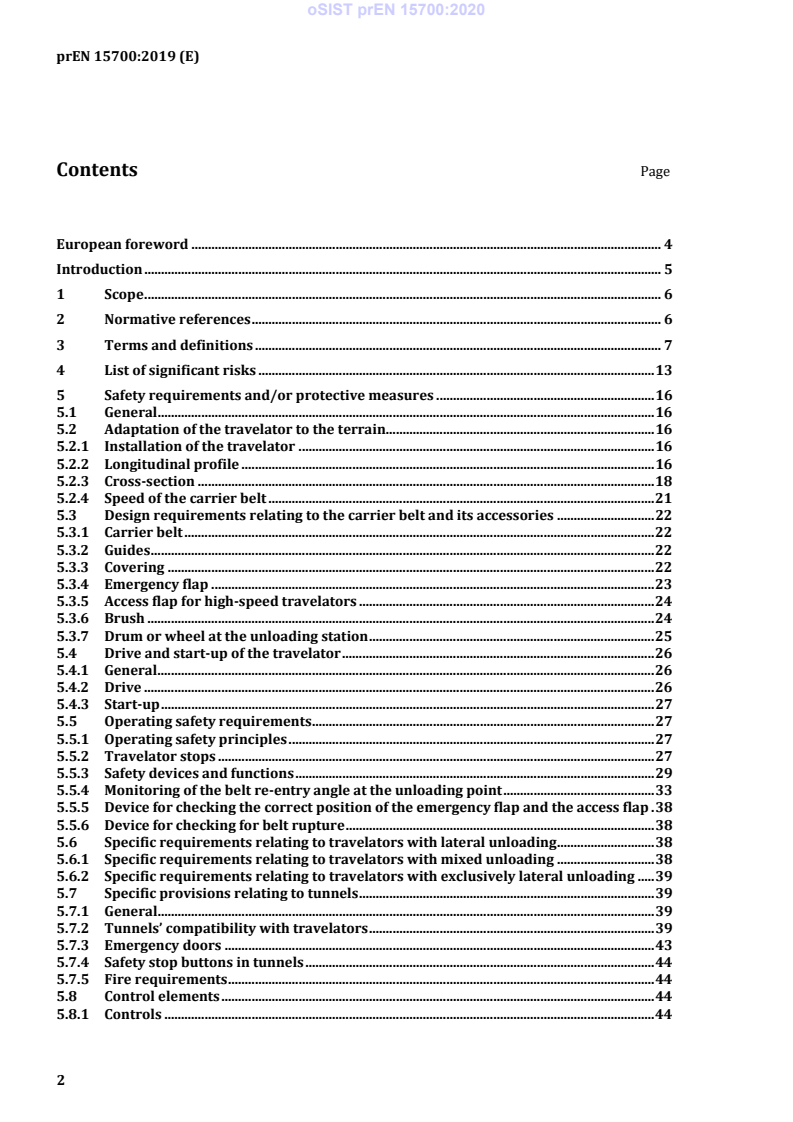
Contents Page
European foreword . 4
Introduction . 5
1 Scope . 6
2 Normative references . 6
3 Terms and definitions . 7
4 List of significant risks . 13
5 Safety requirements and/or protective measures . 16
5.1 General . 16
5.2 Adaptation of the travelator to the terrain. 16
5.2.1 Installation of the travelator . 16
5.2.2 Longitudinal profile . 16
5.2.3 Cross-section . 18
5.2.4 Speed of the carrier belt . 21
5.3 Design requirements relating to the carrier belt and its accessories . 22
5.3.1 Carrier belt . 22
5.3.2 Guides . 22
5.3.3 Covering . 22
5.3.4 Emergency flap . 23
5.3.5 Access flap for high-speed travelators . 24
5.3.6 Brush . 24
5.3.7 Drum or wheel at the unloading station . 25
5.4 Drive and start-up of the travelator . 26
5.4.1 General . 26
5.4.2 Drive . 26
5.4.3 Start-up . 27
5.5 Operating safety requirements . 27
5.5.1 Operating safety principles . 27
5.5.2 Travelator stops . 27
5.5.3 Safety devices and functions . 29
5.5.4 Monitoring of the belt re-entry angle at the unloading point . 33
5.5.5 Device for checking the correct position of the emergency flap and the access flap . 38
5.5.6 Device for checking for belt rupture . 38
5.6 Specific requirements relating to travelators with lateral unloading . 38
5.6.1 Specific requirements relating to travelators with mixed unloading . 38
5.6.2 Specific requirements relating to travelators with exclusively lateral unloading . 39
5.7 Specific provisions relating to tunnels . 39
5.7.1 General . 39
5.7.2 Tunnels’ compatibility with travelators . 39
5.7.3 Emergency doors . 43
5.7.4 Safety stop buttons in tunnels . 44
5.7.5 Fire requirements . 44
5.8 Control elements . 44
5.8.1 Controls . 44
oSIST prEN 15700:2020
prEN 15700:2019 (E)
5.8.2 Secondary control panel . 45
5.8.3 Resetting . 45
5.8.4 Alarm . 46
5.9 Protection of property and people . 46
5.9.1 Safety of personnel and passengers . 46
5.9.2 Protection of the installations . 48
5.9.3 Main switch . 48
5.9.4 Protection against electrical currents and atmospheric electrical discharges . 48
5.10 Calculations and justifications . 48
5.10.1 Calculations . 48
5.10.2 Justification of materials . 50
6 Verification of the safety requirements and/or protective measures . 50
6.1 General . 50
6.2 Verifications during the design/construction phase . 50
6.3 Verifications at the installation site . 51
7 User information . 56
7.1 General . 56
7.2 Signage . 56
7.3 Accompanying documents (Instruction manual) . 56
7.3.1 General . 56
7.3.2 Assembly instructions . 56
7.3.3 Instructions for use and maintenance . 64
7.4 Marking . 68
(normative) Method of measurement of the “6 mm maximum” between two
sections of the travelator . 69
(informative) Method of measurement of the “6 mm maximum” between two
sections of the travelator . 70
(informative) Distances between theoretical stoppages of the travelators . 73
Annex ZA (informative) Relationship between this standard and the essential
requirements of Directive 2006/42/EC intended to be covered . 76
oSIST prEN 15700:2020
prEN 15700:2019 (E)
European foreword
This document (prEN 15700:2019) has been prepared by Technical Committee CEN/TC 242 “Safety
requirements for passenger transportation by cable”, the secretariat of which is held by AFNOR.
This document is currently submitted for CEN comment.
It is intended to replace EN 15700:2011.
This document has been prepared under a mandate given to CEN by the European Commission and the
European Free Trade Association, and supports essential requirements of the EU Directive(s).
For the relationship with the EU Directive(s), see informative Annex ZA, which is an integral part of this
document.
oSIST prEN 15700:2020
prEN 15700:2019 (E)
Introduction
This document is a type C standard as stated in EN ISO 12100:2010.
The travelators covered and the range of hazardous phenomena, situations and events covered are
indicated in the scope of this document.
When the provisions of this type C standard differ from those stated in type A or B standards, the
provisions of this type C standard take precedence over the provisions of the other standards, for
travelators that have been designed and built according to the provisions of this type C standard.
oSIST prEN 15700:2020
prEN 15700:2019 (E)
1 Scope
This European Standard is applicable for travelators, with or without a tunnel, for winter sport or leisure
use.
These requirements are applicable to travelators for the transport of persons (either passengers or
operators) wearing snow-sliding devices, or pedestrians wearing ski boots or heavy boots who may be
holding their snow-sliding devices, for winter sports activities. For other uses, the persons (whether
passengers or operators) shall wear suitable (enclosed and solid) footwear for travelators.
NOTE Snow-sliding devices include seated ski equipment for handicapped people.
This document has been prepared on the basis of the automatic operation of these installations with no
staff permanently present at the actual installation.
It covers requirements relating to the prevention of accidents and the safety of operators.
This document covers all the significant hazards, hazardous situations and hazardous events specific to
travelators for winter sport or leisure activities, when they are used in conformity to the application for
which they are intended as well as for inappropriate applications that could be reasonably foreseen by
the manufacturer (see Clause 4).
This document does not apply either to moving walkways as specified in EN 115 or to loading bands as
specified in EN 1907.
This document does not apply to travelators manufactured prior to the date of its publication as an EN.
2 Normative references
The following documents referred to in the text constitute indispensable requirements of this document
in relation to some or all of their content. For dated references, only the cited edition applies. For undated
references, the latest edition of the referenced document (including any amendments) applies.
EN 115-1:2017, Safety of escalators and moving walks — Part 1: Construction and installation
EN 619:2002+A1:2010, Continuous handling equipment and systems — Safety and EMC requirements for
equipment for mechanical handling of unit loads
EN 981:1996+A1:2008, Safety of machinery — System of auditory and visual danger and information
signals
EN 1907:2017, Safety requirements for cableway installations designed to carry persons — Terminology
EN 1990:2002, Eurocode - Basis of structural design
EN 1991 (all parts), Eurocode 1 - Actions on structures
EN 1992 (all parts), Eurocode 2 - Design of concrete structures
EN 1993 (all parts), Eurocode 3 - Design of steel structures
EN 1994 (all parts), Eurocode 4 - Design of composite steel and concrete structures
EN 1995 (all parts), Eurocode 5 - Design of timber structures
oSIST prEN 15700:2020
prEN 15700:2019 (E)
EN 1996 (all parts), Eurocode 6 - Design of masonry structures
EN 1997 (all parts), Eurocode 7 - Geotechnical design
EN 1998 (all parts), Eurocode 8 - Design of structures for earthquake resistance
EN 1999 (all parts), Eurocode 9 - Design of aluminium structures
EN 1993-1-1, Eurocode 3: Design of steel structures — Part 1-1: General rules and rules for buildings
EN ISO 7731:2008, Ergonomics — Danger signals for public and work areas — Auditory danger signals
EN ISO 12100:2010, Safety of machinery General principles for design Risk assessment and risk
reduction
EN 13107:2015, Safety requirements for cableway installations designed to carry persons — Civil
engineering works
EN 13501-1:2018, Fire classification of construction products and building elements — Part
1: Classification using test data from reaction to fire tests
EN ISO 13849-1:2015, Safety of machinery — Safety-related parts of control systems — Part 1: General
principles for design
EN ISO 13850:2015, Safety of machinery — Emergency stop — Principles for design
EN ISO 13857:2008, Safety of machinery — Safety distances to prevent hazard zones being reached by
upper and lower limbs
EN ISO 14119:2013, Safety of machinery — Interlocking devices associated with guards — Principles for
design and selection
EN ISO 14120:2016, Safety of machinery — Guards — General requirements for the design and construction
of fixed and movable guards
EN 60204-1:2018, Safety of machinery — Electrical equipment of machines — Part 1: General
requirements (IEC 60204-1:2016, modified)
EN 60947-5-1:2017, Low-voltage switchgear and controlgear — Part 5-1: Control circuit devices and
switching elements — Electromechanical control circuit devices (IEC 60947-5-1:2016)
EN 61496-1:2013, Safety of machinery — Electro-sensitive protection equipment — Part 1: General
requirements and tests (IEC 61496-1:2012)
EN 61496-2:2013, Safety of machinery — Electro-sensitive protection equipment — Part 2: Particular
requirements for equipment using Active Opto-Electronic Protective Devices (AOPDs) (IEC 61496-2:2013)
EN 62061:2005, Safety of machinery — Operating safety of electrical/electronic/programmable electronic
safety-related systems (IEC 62061:2005)
3 Terms and definitions
For the purposes of this document, the terms and definitions given in EN ISO 12100:2010, EN 1907:2017,
EN 619:2002+A1:2010 and the following apply.
oSIST prEN 15700:2020
prEN 15700:2019 (E)
ISO and IEC maintain terminological databases for use in standardization at the following addresses:
• IEC Electropedia: available at http://www.electropedia.org/
• ISO Online browsing platform: available at http://www.iso.org/obp
3.1
installation of the travelator
a conveyor belt, with or without a tunnel, used as a permanent or temporary installation within its
environment (see Figure 1)
Key
A Tunnel
B Travelator
C Environment
(A)+B+C Installation of the travelator
Figure 1 Installation of the travelator
Note 1 to the Clause: The environment for the installation of the travelators specifically includes the necessary
adjustments in the vicinity of the travelator, the topography of the site, the infrastructure (in terms of chocks, and
the landscaping and civil engineering work required), natural risks, etc.
oSIST prEN 15700:2020
prEN 15700:2019 (E)
3.2
travelator
a continuous transport installation for transporting persons standing up, specifically consisting of:
a conveyor belt with its own driving system (an electric engine, drums or wheels, rollers, etc.);
a braking system, if required;
a cleaning brush, if required;
a load-bearing structure;
a safety flap;
an emergency flap;
an access flap;
a loading plate;
an unloading plate;
lateral walkways, if required;
lateral guards, if required;
Note 1 to the Clause: There are no safety flaps, emergency flaps or unloading plates in the case of a travelator
with exclusively lateral unloading.
3.3
carrier belt
a continuous or modular conveyor belt
Note 1 to the Clause: Modular belts are generally made of plastic elements.
3.4
tunnel
a structure partially or completely covering the travelator
3.5
standard-speed travelator
A travelator designed to have an operating speed lower than or equal to 0.7 m/s
3.6
high-speed travelator
a travelator designed to have an operating speed higher than 0.7 m/s but not exceeding 1.2 m/s
3.7
safety flap
a protective device located at the entry point of the carrier belt (see its position in Figure 3 and Figure 4)
3.8
emergency flap
a flap used to give wider access to the safety area 3.10 (see its position in Figure 4)
oSIST prEN 15700:2020
prEN 15700:2019 (E)
3.9
access flap
A flap used to give access to the driving system and other mechanical features of the travelator for certain
operations involving handling, upkeep, adjustment and maintenance (see its position in Figure 4)
3.10
safety area
an area totally free of obstacles located under the safety flap to avoid any risk of injury
3.11
loading area
an area from which persons step onto the travelator, the limits of which are defined in Figure 2
Key
1 Loading
2 Loading plate
3 Loading area
Figure 2 Loading area: limits
3.12
loading plate
an area of the travelator located before the exit point from the carrier belt provided so that people can
step onto it (see Figure 2)
Note 1 to the Clause: The loading plate may contain other features, such as an access flap.
3.13
loading area
an area outside the travelator from which people can step onto it (see Figure 2)
3.14
unloading area
an area from which persons can step off the travelator, the limits of which are defined in Figure 3
oSIST prEN 15700:2020
prEN 15700:2019 (E)
Key
1 Unloading
2 Unloading plate
3 Unloading area
4 Safety flap
Figure 3 Unloading area: limits
3.15
unloading plate
an area of the travelator after the safety flap from which people can step off it (see Figures 3 and 4)
Note 1 to the Clause: The unloading plate includes the emergency flap or the second part of the safety flap in
the case of high-speed travelators, and may include other features such as an access flap.
oSIST prEN 15700:2020
prEN 15700:2019 (E)
Key
1 Safety flap (or the 1st part of the safety flap for high-speed travelators)
2 Emergency flap (or the 2nd part of the safety flap for high-speed travelators)
3 Access flap, or other additional feature
4 Unloading plate
Figure 4 Unloading plate
3.16
unloading area
an area outside the travelator onto which people can step off it (see Figure 4)
3.17
drum
continuous belt travelator component used to drive or return the carrier belt
3.18
wheel
modular belt travelator component used to drive or return the carrier belt
3.19
safety function
the function of a machine that can cause an immediate increase in risk(s) if it malfunctions
[SOURCE: ISO 12100:2010, 3.30]
oSIST prEN 15700:2020
prEN 15700:2019 (E)
4 List of significant risks
This clause lists all the hazards, all the hazardous areas, and all the major hazardous situations and events
that are covered by this document, which have been identified as significant for this type of machinery
for the purposes of a risk assessment in accordance with the EN ISO 12100:2010 standard, which require
action to be taken to eliminate or reduce the risk.
The methods of checking to be used to demonstrate compliance include the following:
V a visual examination to check the required functions of the components;
T tests/checks to determine that the functions provided for perform correctly in accordance with
requirements;
M measurements to check that the requirements are met in terms of the specified limits;
D drawings (plans) and/or calculations to check that the design features of the components
supplied meet their requirements. Documents and instructions for use are available.
oSIST prEN 15700:2020
prEN 15700:2019 (E)
Table 1 — List of significant hazards
No Significant Hazardous situation Safety requirements & Reference in Verification
. hazard measures EN 15700
standard
1 Falls Users slip on the belt Non-slip surfaces 5.10.2.2
2 Falls Speed change or speed difference Design (speed, acceleration 5.2.2.3, 5.2.2.4,
between the user and the belt and transit areas) 5.2.4
3 Falls Too steep a gradient or too Installation requirements 7.3.2
significant a change in gradient (in the instruction manual)
4 Falls Badly designed and/or inadequate Design of evacuation 5.2.3, 5.7.3, 7.3.2
evacuation areas measures
5 Falls Travelator loses stability Installation requirements 5.2.1, 5.10, 7.3.2
(in the instruction manual)
6 Falls Travelator stops abruptly Design 5.2.3, 5.7.2
7 Falls, Travelator starts unintentionally Operating controls get 5.4.3, 5.5.3.6,
blocked 5.5.4.3, 5.8.1,
entanglement,
5.8.3, 5.8.4
Alarms
crushing
8 Falls, Hazardous movements of the Automatic starting is 5.4.3, 5.5.2,
machinery start up unexpectedly impossible in this case 5.8.3, 5.8.2,
entanglement,
5.9.1.2
crushing
9 Collision, Breakage of the carrier belt or Design 5.5.6, 5.10.1.4.1,
damage to the travelator 7.3.2.2
impact Device for checking for belt
rupture
10 Falls Congestion at the top station Design 5.2.2.4, 5.2.3.3,
5.2.3.4, 5.2.3.5,
5.5.3.4
11 Falls Presence of foreign bodies adjacent Design 5.2.3.3, 5.2.3.4,
to travelator 5.2.3.5, 5.2.3.6
12 Falls, Excess clearance between the belt Design 5.2.2.3, 5.2.2.4,
and the other parts of the travelator 5.3.2, 5.3.3,
entanglement,
5.5.4.2
crushing
13 Falls, Excess clearance between the Design 5.3.1
modular elements of the belt
entanglement,
crushing
14 Entanglement, Access to the rotating parts Blockage 5.3.2.2, 5.3.3,
5.3.7, 5.5.4.2.,
crushing
5.5.4.2.1.c),
5.5.5, 5.6.2.3,
5.6.2.4, 5.9.1
15 Electrical Access to electrical devices Design and requirements 5.9.1, 5.9.2,
hazard 5.9.3, 5.9.4
16 Crushing Safety flap blocked Design and instruction 5.3.4, 5.3.5,
manual 5.5.4.2, 5.3.7,
7.3.2, 7.3.3
17 Falls, Safety flap open Design of locking system 5.3.7, 5.3.4,
5.3.5, 5.5.4.3,
entanglement,
18 Jamming Emergency flap blocked Design and instruction 5.3.2.2, 5.3.3,
manual 5.3.5, 7.3
oSIST prEN 15700:2020
prEN 15700:2019 (E)
No Significant Hazardous situation Safety requirements & Reference in Verification
. hazard measures EN 15700
standard
19 Falls, emergency flap open Design of locking system 5.3.4, 5.3.5,
5.5.4.3, 5.5.5,
entanglement,
5.3.7
20 Falls, Access flap open Design of locking system 5.3.4, 5.3.5,
5.5.4.3, 5.5.5,
entanglement,
5.9.1.2
21 Entanglement, Drawing in of a limb between the Design 5.3.2.2, 5.3.3,
belt and safety flap, coverings or 5.3.4, 5.3.5,
crushing
guides 5.5.4, 5.3.7
22 Entanglement, Entanglement of an item of clothing Design 5.3.2.3, 5.3.3,
between the belt and the safety flap, 5.5.4,
crushing
coverings or guides
23 Falls Excess height measured between Design and/or installation 5.2.3, 5.7.2.,
the belt and the 7.3.2, 7.3.3
walkway/ground/snow as
appropriate
24 Falls Reversal of the running direction of Design 5.4.2
the belt
Check the controls
25 Mechanical Malfunction of the electrical circuit Automatic start impossible 5.5.1, 5.4.2,
hazard
(see EN ISO
12100:2010,
4.2.1)
26 Electrical Lightning strike Design 5.9.4, 5.9.2
hazard
27 Mechanical Lack of signage for the attention of Labels 7.2
hazard the travelator user; such signage is
Information
anticipated, but it is the operational
measures taken that must ensure
this signage is maintained;
28 Mechanical Operating in unsuitable climatic Requirement and 5.5.1, 5.9.2
hazard conditions information
29 Falls Insufficient snow removal Design (snow removal 5.3.6, 7.3
brush)
Information
30 Falls Presence of ice on the travelator Design (snow removal 5.3.6, 7.3
brush)
Information
31 Mechanical Poor access to emergency stop Ergonomic design 5.5.3.2
hazard buttons
32 Falls Unforeseen power supply Acceleration restricted 5.4.3, 5.5.2
disruption
33 Burns, Travelator catches fire (in the case Design 5.2.3, 5.7.2, 5.7.5
of tunnels);
suffocation Evacuation devices
34 Danger caused Human error caused by inaudible Noise emission 7.3.3.1
by noise information declaration(in the
instruction manual)
oSIST prEN 15700:2020
prEN 15700:2019 (E)
No Significant Hazardous situation Safety requirements & Reference in Verification
. hazard measures EN 15700
standard
35 Falls Falls from a great height in the case Design 7.3.2.4
of raised travelators (on supports,
raised structures, etc.)
36 Falls Falls into the machinery pit during Design of means of access 7.3.3.4
maintenance
37 Falls, Inadequate visibility in machinery Design 5.9.1.3
maintenance areas
collisions, and/or instruction manual
entanglement
38 Falls, Inadequate visibility for people Design 7.3.3.5
(night operations).
collisions and/or instruction manual
5 Safety requirements and/or protective measures
5.1 General
The travelators shall conform to the safety requirements and/or safety measures of this clause.
In addition, the travelators shall be designed according to the principles of EN ISO 12100:2010 governing
the specific, but not significant, hazards not covered by this document (e.g. cutting edges).
Guards shall comply with the requirements of EN ISO 14120:2016.
5.2 Adaptation of the travelator to the terrain
5.2.1 Installation of the travelator
The installation of the carrier belt must be set up in accordance with the builder’s indications, particularly
with regard to the longitudinal and transversal inclination of the structure and the means used to ensure
its stability.
5.2.2 Longitudinal profile
5.2.2.1 General
The longitudinal profile shall not cause a passenger to lose their balance.
5.2.2.2 Line
At no point shall the gradient of the travelator belt exceed 25%. Gradients of between 25% and 30% are
nevertheless acceptable for transporting pedestrians.
The difference in gradient between two consecutive sections of belt, each with a constant gradient and a
minimum length of 1.5 m, shall not exceed 12.5%.
5.2.2.3 Loading
A loading plate with a constant gradient and a minimum length of 1 m shall be installed at the lower end
of the travelator. Its gradient shall be between -10% and +5% with reference to the horizontal (see Figure
5).
oSIST prEN 15700:2020
prEN 15700:2019 (E)
At the start, the travelator belt shall have a uniform gradient over a minimum length of 1.5 m. This
gradient shall not exceed 17.5% when compared with the horizontal.
The clearance between the loading plate and the belt shall not exceed 6 mm during operation. This
requirement is verified using the method defined in Annex A.
Key
1 Loading plate
2 Belt
3 Drum or wheel
4 Horizontal
Figure 5 Loading: details
5.2.2.4 Unloading
The final section of the belt shall have a uniform gradient of +5% to +10% relative to the horizontal over
a minimum length of 1m (see Figure 6).
The penultimate section bearing the carrier belt shall have a minimum length of 1.5 m and shall have an
adjustable inclination so as to guarantee a maximum uniform gradient of 12.5% relative to the final
section.
The unloading plate shall present a gradient of between 0% and –15% relative to the horizontal.
The clearance between the safety flap and the unloading plate shall not exceed 6 mm during operation.
This provision applies to the safety flap when not in use. This requirement is verified using the method
defined in Annex A.
oSIST prEN 15700:2020
prEN 15700:2019 (E)
Key
1 Belt
2 Unloading area (L2: length of the unloading area)
3 Unloading plate (L3: length of the unloading plate)
4 Drum or wheel
5 Horizontal
6 Safety flap
Figure 6 Unloading: details
5.2.3 Cross-section
5.2.3.1 General
The cross-section and the positioning of the adjacent elements of a travelator are designed with the
following aims:
to prevent passengers from losing their balance;
to limit the consequences of any potential fall on their part;
to limit the consequences of any limbs getting jammed;
to enable people to leave the travelator without danger at any point in the line should the mechanism
be permanently halted;
to enable people to walk away so as to reach a safe place in the event of an evacuation.
oSIST prEN 15700:2020
prEN 15700:2019 (E)
5.2.3.2 Width and transverse gradient of the belt
The useful width of the belt shall not be less than 0.4 m.
The belt shall be horizontal in the transverse direction, with a tolerance of ±2%.
5.2.3.3 Standard profile
To prevent a skier from becoming stuck and then being run into by other passengers in the event that
their skis are trapped across the travelator, a space free from all obstacles shall be provided above the
level of the belt, except for the belt guides and covering, with a minimum width of 2 m centred on the
middle of the belt (see Figure 7).
If walkways are incorporated into the travelator, provision shall be made, over a width of at least 0.80 m
from the internal edge of the guides, for a space free from all obstacles, except for the belt guides and
covering (see Figure 7).
In this free space, the fall height shall not exceed 0.30 m between the level of the belt and the ground or
snow. The ground surface shall not be injurious.
NOTE: The value of 2 m generally corresponds to the length of Alpine skis.
Key
1 Belt
2 Covering
3 Lateral guides for passengers
4 Width of free space according to 5.2.4.2
5 Width of free space according to 5.2.4.3
6 Obstacle
7 Walkway if incorporated into the machine
Figure 7 Free space around the travelator (standard case)
oSIST prEN 15700:2020
prEN 15700:2019 (E)
5.2.3.4 Profile with a side wall
When it is supplied, a continuous smooth wall can be installed on the edge of one side of the travelator
between 0.15 m and 0.35 m from the inside edge of the guide, in order to avoid running into an obstacle
when falling outside the travelator. In order to avoid creating a walking area of inadequate width: no wall
may be located at a distance of between 35 and 60 cm from the covering
In this case, the 2 m width may be off-centre (see Figure 8) and the covering must be continuous right up
to the smooth wall.
On the other side of the travelator, provision shall be made, over a width of at least 0.80 m from the
internal edge of the guides, for a space free from all obstacles, except for the belt guides and covering (see
Figure 8).
In this free space, the fall height shall not exceed a value of 0.30 m between the level of the belt and the
ground or snow, and the ground surface must not be injurious.
At the edge of the travelator, if a motorised handrail is installed, it shall meet the requirements of EN 115-
1:2017.
Key
1 Belt
2 Covering
3 Lateral guides for passengers
4 Width of free space according to 5.2.4.2
5 Width of free space according to 5.2.4.3
6 Continuous smooth wall
7 Walkway if incorporated into the machine
8 Obstacle
Figure 8 Free space around the travelator if equipped with a wall
oSIST prEN 15700:2020
prEN 15700:2019 (E)
5.2.3.5 Free space above the level of the belt if the installation only transports pedestrians
If the travelator is used exclusively for transporting people not wearing snow-sliding devices, the width
of the free space above the level of the belt may be reduced to
a minimum of 0.6 mm. In this case, the wall that may potentially be placed on either or both sides of
the belt must not exceed 1.1 m in height; or
a minimum of 1.2 m if there is a wall on either or both sides of the belt that is higher than 1.1 m.
The wall shall not be positioned at a distance of between 35 and 60 cm as measured from the covering.
In this free space, the difference in level in relation to the belt shall be a maximum of 50 mm.
5.2.3.6 Objects allowed in the free space
Within the free spaces defined in Subclauses 5.2.4.2, 5.2.4.3, 5.2.4.4 and 5.7.2, it is permitted to install
electrical cabinets, stop button supports, loading and unloading aid devices (except for supports) and
flow management and fall surveillance devices as defined in 5.5.3.3, or any other control checking system
(counting cells, automatic speed management, etc.), in addition to potentially mechanisms encouraging
passengers to raise their ski sticks at the unloading point, sign panels and cameras, as long as they are
protected or designed in such a way as to reduce the risk of injury to the user.
NOTE Devices encouraging passengers to raise their ski sticks at the unloading point reduce the risk of unexpected
stoppages of the travelator because they reduce the likelihood of an unexpected opening of the safety flap due to
the impact of a ski stick during unloading.
5.2.3.7 Minimum walking area
In order to avoid creating a walking area of inadequate width: no wall may be located at a distance of
between 35 and 60 cm from the covering
5.2.4 Speed of the carrier belt
The maximum speed of the carrier belt of a travelator operating at standard speed shall not exceed 0.7
m/s.
The maximum speed of the carrier belt of a travelator operating at high speed shall not exceed 1.2 m/s.
All installations shall be capable of running at a speed not exceeding 0.4 m/s in order to transport
children.
A device shall be installed to monitor the maximum speed of the travelator. The associated safety function
shall have a level of PLR performance in accordance with EN ISO 13849-1:2015.
oSIST prEN 15700:2020
prEN 15700:2019 (E)
5.3 Design requirements relating to the carrier belt and its accessories
5.3.1 Carrier belt
The mesh or clamp systems of the belts shall not have any clearance greater than 4 mm.
The belt thickness shall be greater than 2 mm in order to meet the requirements of EN ISO 13857:2008.
5.3.2 Guides
5.3.2.1 Carrier belt guides
The belt shall be guided laterally, along its entire length, so that the two edges of the belt, regardless of
the conditions, are protected by the covering device in 5.3.3 (see Figure 9).
5.3.2.2 Passenger guides
Devices shall ensure that the skis or boots of the passengers are guided laterally at the start, en route and
at the destination. The guides shall have an overall height above the carrier belt of between 10 mm and
50 mm.
In order to avoid any risk of an item of clothing or part of the body becoming caught up or entangled, the
designs of the passenger guide devices and their assembly joints shall include the following features:
they must be made of smooth materials;
they must have no protruding elements.
5.3.2.3 Vertical clearance
The vertical clearance jv between the top surface of the carrier belt and the bottom of the passenger
guides shall not exceed 6 mm during operation.
5.3.3 Covering
A covering device (see Figure 9), which can also be used as a guide for passenger skis or boots, shall be
installed on either side of the carrier belt. In order to meet the requirements of EN ISO 13857:2008, the
width R of the covering shall comply with the following formula:
R ≥ 20 mm + jl
where
jl total lateral clearance between the belt and its guides that shall be indicated in the
manufacturer's instructions, jl = jl + jl , with jl as right-hand lateral clearance and jl as left-hand
d g d g
lateral clearance.
The covering device shall not be more than 50 mm higher than the carrier belt.
oSIST prEN 15700:2020
prEN 15700:2019 (E)
In order to avoid any risk of an item of clothing or part of the body becoming caught up or entangled, the
designs of the covering and their assembly joints shall include the following features:
they must be made of smooth materials;
they must have no protruding elements.
Key
1 Belt
2 Useful width of belt
3 Lateral guides for passengers
4 Covering (can also be used as ski or boot guides)
5 Lateral guides for belt
6 Lateral clearance for belt on left-hand side, jlg
7 Vertical clearance between top of the belt and bottom of the passenger lateral guide, jv
8 R: covering width
9 Lateral clearance for belt on right-hand side, jl
d
10 Walkway and/or snow and/or ground
Figure 9 Cross-section in line: belt and accessories
5.3.4 Emergency flap
At the unloading point, it shall be possible for a person trapped between the belt and the unloading
devices (in particular, the safety flap, the unloading plate, the supplementary safety device mentioned in
5.5.4.2.2 c)) to be released quickly by third parties or even by themselves.
The operation of these devices shall be single-action and possible without the use of any tools and shall
make it possible to release any component likely to entrap a passenger (e.g. safety flap and
supplementary safety device mentioned in 5.5.4.2.2 c)). Their function and mode of operation shall be
suitably indicated at the unloading area or on the devices. The emergency flap release area shall have a
minimum length of 50 cm and a width at least equal to that of the useful width of the belt.
NOTE: The safety flap of a high-speed travelator may act as an emergency flap.
oSIST prEN 15700:2020
prEN 15700:2019 (E)
5.3.5 Access flap for high-speed travelators
For high-speed travelators, the repositioning of the safety flap, once the latter has been fully opened, may
require an access flap.
For high-speed travelator designs that require an access trap, the latter is located after the safety flap (or,
if appropriate, after the second part of the safety flap), following in the operating direction of the
travelator, as shown in Figure 10.
Key
1 1st level of safety flap for a high-speed travelator
2 2nd level of the safety flap for a high-speed travelator, acting as an emergency flap
3 Access flap for a high-speed travelator
Figure 10 — Location of the access trap for certain high-speed travelators
5.3.6 Brush
For the cleaning of the carrier belt during operation, a brush may be installed.
It shall be installed in an area that is not accessible to the passengers. It must not be located above the
vertical plane passing through the axis of the driving drum, see Figure 11, prohibited zone
...