

CEN/TS 17626:2021
(Main)Molecular in vitro diagnostic examinations - Specifications for pre-examination processes for human specimen - Isolated microbiome DNA
- Abstract
This document specifies requirements and gives recommendations for the pre-examination phase of human specimens, such as stool, saliva, skin and urogenital specimens, intended for microbiome DNA examination. The pre-examination phase includes but is not limited to specimen collection, handling, transport, storage, processing, isolation of DNA, and documentation.
This document is applicable to molecular in vitro diagnostic examinations performed by medical laboratories. It is also intended to be used by laboratory customers, in vitro diagnostics developers and manufacturers, biobanks, institutions and commercial organizations performing biomedical research, and regulatory authorities.
Different dedicated measures are taken for pre-examination processes for infectious disease examination (e.g. targeted pathogen identification) and for microbiome DNA examination from tissue (e.g. biopsies). These are outside of the scope of this document.
Different dedicated measures are taken for pre-examination processes for saliva for human genomic DNA examination. These are not described in this document but are covered in CEN/TS 17305, Molecular in vitro diagnostic examinations - Specifications for pre-examination processes for saliva - Isolated DNA.
NOTE International, national or regional regulations or requirements can also apply to specific topics covered in this document.
- Status
- Published
- Publication Date
- 04-May-2021
- Technical Committee
- CEN/TC 140 - In vitro diagnostic systems
- Drafting Committee
- CEN/TC 140/WG 3 - Quality management in the medical laboratory
- Current Stage
- 6060 - Definitive text made available (DAV) - Publishing
- Start Date
- 05-May-2021
- Due Date
- 02-Sep-2021
- Completion Date
- 05-May-2021



Overview
CEN/TS 17626:2021 - "Molecular in vitro diagnostic examinations - Specifications for pre-examination processes for human specimen - Isolated microbiome DNA" - defines requirements and recommendations for the pre‑examination phase of human specimens intended for microbiome DNA analysis. It covers specimen types such as stool, saliva, skin and urogenital specimens and addresses all steps prior to molecular testing: specimen collection, handling, transport, storage, processing, DNA isolation and documentation. The Technical Specification targets molecular in vitro diagnostic (IVD) laboratories and related stakeholders and complements existing laboratory and safety standards.
Key topics and technical requirements
- Scope of pre‑examination processes: formalizes the workflow from donor/patient collection through DNA isolation to ensure a representative microbiome profile.
- Specimen collection and donor information: requirements for instructions, selection of collection devices and stabilization methods to reduce variability from self‑collection.
- Transport and storage: recommendations for use of stabilizers versus non‑stabilized devices and for maintaining specimen integrity during transport and storage.
- Laboratory reception and processing: procedures for specimen receipt, processing prior to DNA isolation, and storage before extraction.
- DNA isolation and quality control: requirements for choosing commercial kits or laboratory‑developed methods, and for assessing DNA quantity and quality (including controls for inhibitors and host DNA interference).
- Documentation and traceability: obligations for record‑keeping consistent with medical laboratory quality systems (e.g., EN ISO 15189).
- Annexed evidence: informative annexes present data on impacts of pre‑analytical variables (stabilization, storage, isolation methods) and on the importance of in‑process quality control materials.
Normative references include EN ISO 15189, ISO 15190 and ISO/TS 20658, aligning pre‑analytical best practices with laboratory competence and safety requirements.
Applications and who uses it
CEN/TS 17626:2021 is intended for:
- Medical laboratories performing molecular IVD microbiome testing
- IVD developers and manufacturers designing collection devices, stabilizers and DNA extraction kits
- Biobanks and research institutions conducting microbiome studies
- Laboratory customers and clinicians specifying specimen requirements
- Regulatory authorities assessing pre‑analytical processes and compliance
Practical uses include standardizing sample collection kits, creating SOPs for sample transport/storage, validating DNA extraction workflows, and reducing pre‑analytical bias in metagenomics or amplicon‑based microbiome assays.
Related standards
- CEN/TS 17305 (saliva - isolated human genomic DNA) - for saliva genomic DNA workflows
- EN ISO 15189, ISO 15190, ISO/TS 20658 - for laboratory quality, safety and sample handling
Keywords: CEN/TS 17626:2021, pre‑examination, microbiome DNA, molecular in vitro diagnostic, specimen collection, DNA isolation, laboratory standards, sample stabilization.
Relations
- Effective Date
- 25-Aug-2026
- Effective Date
- 25-Aug-2026
- Effective Date
- 28-Jan-2026
- Refers
EN ISO 15189:2022 - Medical laboratories - Requirements for quality and competence (ISO 15189:2022) - Effective Date
- 28-Jan-2026
Get Certified
Connect with accredited certification bodies for this standard

BSI Group
BSI (British Standards Institution) is the business standards company that helps organizations make excellence a habit.

TÜV Rheinland
TÜV Rheinland is a leading international provider of technical services.

TÜV SÜD
TÜV SÜD is a trusted partner of choice for safety, security and sustainability solutions.
Sponsored listings
Frequently Asked Questions
CEN/TS 17626:2021 is a technical specification published by the European Committee for Standardization (CEN). Its full title is "Molecular in vitro diagnostic examinations - Specifications for pre-examination processes for human specimen - Isolated microbiome DNA". This standard covers: This document specifies requirements and gives recommendations for the pre-examination phase of human specimens, such as stool, saliva, skin and urogenital specimens, intended for microbiome DNA examination. The pre-examination phase includes but is not limited to specimen collection, handling, transport, storage, processing, isolation of DNA, and documentation. This document is applicable to molecular in vitro diagnostic examinations performed by medical laboratories. It is also intended to be used by laboratory customers, in vitro diagnostics developers and manufacturers, biobanks, institutions and commercial organizations performing biomedical research, and regulatory authorities. Different dedicated measures are taken for pre-examination processes for infectious disease examination (e.g. targeted pathogen identification) and for microbiome DNA examination from tissue (e.g. biopsies). These are outside of the scope of this document. Different dedicated measures are taken for pre-examination processes for saliva for human genomic DNA examination. These are not described in this document but are covered in CEN/TS 17305, Molecular in vitro diagnostic examinations - Specifications for pre-examination processes for saliva - Isolated DNA. NOTE International, national or regional regulations or requirements can also apply to specific topics covered in this document.
This document specifies requirements and gives recommendations for the pre-examination phase of human specimens, such as stool, saliva, skin and urogenital specimens, intended for microbiome DNA examination. The pre-examination phase includes but is not limited to specimen collection, handling, transport, storage, processing, isolation of DNA, and documentation. This document is applicable to molecular in vitro diagnostic examinations performed by medical laboratories. It is also intended to be used by laboratory customers, in vitro diagnostics developers and manufacturers, biobanks, institutions and commercial organizations performing biomedical research, and regulatory authorities. Different dedicated measures are taken for pre-examination processes for infectious disease examination (e.g. targeted pathogen identification) and for microbiome DNA examination from tissue (e.g. biopsies). These are outside of the scope of this document. Different dedicated measures are taken for pre-examination processes for saliva for human genomic DNA examination. These are not described in this document but are covered in CEN/TS 17305, Molecular in vitro diagnostic examinations - Specifications for pre-examination processes for saliva - Isolated DNA. NOTE International, national or regional regulations or requirements can also apply to specific topics covered in this document.
CEN/TS 17626:2021 is classified under the following ICS (International Classification for Standards) categories: 11.100.01 - Laboratory medicine in general. The ICS classification helps identify the subject area and facilitates finding related standards.
CEN/TS 17626:2021 has the following relationships with other standards: It is inter standard links to ISO 15190:2020, ISO/TS 20658:2017, EN ISO 13165-1:2020, EN ISO 15189:2022. Understanding these relationships helps ensure you are using the most current and applicable version of the standard.
CEN/TS 17626:2021 is available in PDF format for immediate download after purchase. The document can be added to your cart and obtained through the secure checkout process. Digital delivery ensures instant access to the complete standard document.
Standards Content (Sample)
SLOVENSKI STANDARD
01-julij-2021
Molekularne diagnostične preiskave in vitro - Specifikacije za predpreiskovalne
procese za vzorce človeškega tkiva - Izolirana mikrobiom DNA
Molecular in vitro diagnostic examinations - Specifications for pre-examination processes
for human specimen - Isolated microbiome DNA
Molekularanalytische in-vitro-diagnostische Verfahren - Spezifikationen für
präanalytische Prozesse für menschliche Proben - Isolierte Mikrobiom-DNA
Analyses moléculaires de diagnostic in vitro - Spécifications relatives aux processus
préanalytiques pour les échantillons humains - ADN du microbiote isolé
Ta slovenski standard je istoveten z: CEN/TS 17626:2021
ICS:
11.100.10 Diagnostični preskusni In vitro diagnostic test
sistemi in vitro systems
2003-01.Slovenski inštitut za standardizacijo. Razmnoževanje celote ali delov tega standarda ni dovoljeno.
CEN/TS 17626
TECHNICAL SPECIFICATION
SPÉCIFICATION TECHNIQUE
May 2021
TECHNISCHE SPEZIFIKATION
ICS 11.100.01
English Version
Molecular in vitro diagnostic examinations - Specifications
for pre-examination processes for human specimen -
Isolated microbiome DNA
Analyses moléculaires de diagnostic in vitro - Molekularanalytische in-vitro-diagnostische Verfahren
Spécifications relatives aux processus préanalytiques - Spezifikationen für präanalytische Prozesse für
pour les échantillons humains - ADN du microbiote menschliche Proben - Isolierte Mikrobiom-DNA
isolé
This Technical Specification (CEN/TS) was approved by CEN on 19 March 2021 for provisional application.
The period of validity of this CEN/TS is limited initially to three years. After two years the members of CEN will be requested to
submit their comments, particularly on the question whether the CEN/TS can be converted into a European Standard.
CEN members are required to announce the existence of this CEN/TS in the same way as for an EN and to make the CEN/TS
available promptly at national level in an appropriate form. It is permissible to keep conflicting national standards in force (in
parallel to the CEN/TS) until the final decision about the possible conversion of the CEN/TS into an EN is reached.
CEN members are the national standards bodies of Austria, Belgium, Bulgaria, Croatia, Cyprus, Czech Republic, Denmark, Estonia,
Finland, France, Germany, Greece, Hungary, Iceland, Ireland, Italy, Latvia, Lithuania, Luxembourg, Malta, Netherlands, Norway,
Poland, Portugal, Republic of North Macedonia, Romania, Serbia, Slovakia, Slovenia, Spain, Sweden, Switzerland, Turkey and
United Kingdom.
EUROPEAN COMMITTEE FOR STANDARDIZATION
COMITÉ EUROPÉEN DE NORMALISATION
EUROPÄISCHES KOMITEE FÜR NORMUNG
CEN-CENELEC Management Centre: Rue de la Science 23, B-1040 Brussels
© 2021 CEN All rights of exploitation in any form and by any means reserved Ref. No. CEN/TS 17626:2021 E
worldwide for CEN national Members.
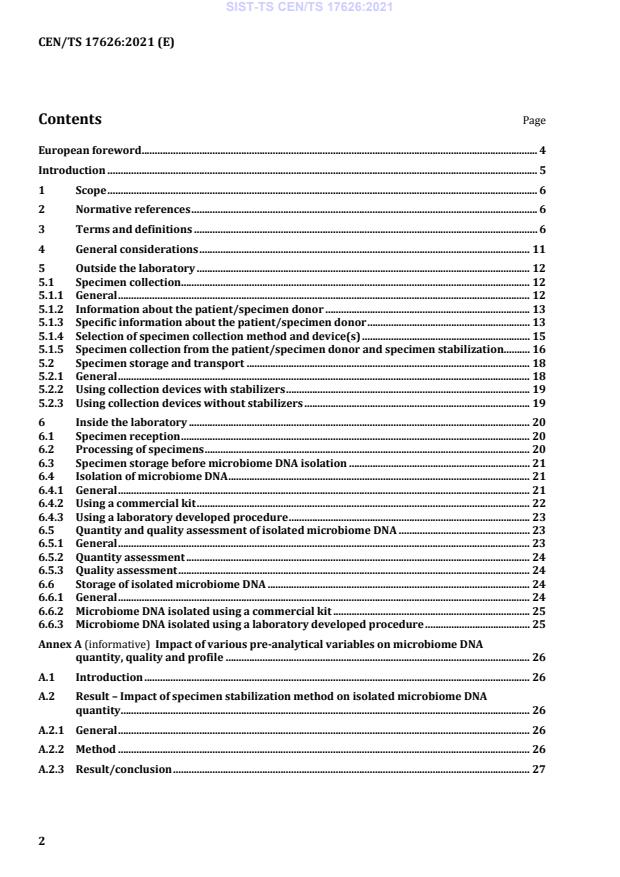
Contents Page
European foreword . 4
Introduction . 5
1 Scope . 6
2 Normative references . 6
3 Terms and definitions . 6
4 General considerations . 11
5 Outside the laboratory . 12
5.1 Specimen collection . 12
5.1.1 General . 12
5.1.2 Information about the patient/specimen donor . 13
5.1.3 Specific information about the patient/specimen donor . 13
5.1.4 Selection of specimen collection method and device(s) . 15
5.1.5 Specimen collection from the patient/specimen donor and specimen stabilization. 16
5.2 Specimen storage and transport . 18
5.2.1 General . 18
5.2.2 Using collection devices with stabilizers . 19
5.2.3 Using collection devices without stabilizers . 19
6 Inside the laboratory . 20
6.1 Specimen reception . 20
6.2 Processing of specimens . 20
6.3 Specimen storage before microbiome DNA isolation . 21
6.4 Isolation of microbiome DNA . 21
6.4.1 General . 21
6.4.2 Using a commercial kit . 22
6.4.3 Using a laboratory developed procedure . 23
6.5 Quantity and quality assessment of isolated microbiome DNA . 23
6.5.1 General . 23
6.5.2 Quantity assessment . 24
6.5.3 Quality assessment . 24
6.6 Storage of isolated microbiome DNA . 24
6.6.1 General . 24
6.6.2 Microbiome DNA isolated using a commercial kit . 25
6.6.3 Microbiome DNA isolated using a laboratory developed procedure . 25
Annex A (informative) Impact of various pre-analytical variables on microbiome DNA
quantity, quality and profile . 26
A.1 Introduction . 26
A.2 Result – Impact of specimen stabilization method on isolated microbiome DNA
quantity . 26
A.2.1 General . 26
A.2.2 Method . 26
A.2.3 Result/conclusion . 27
A.3 Result – Impact of specimen to stabilizer mass/volume ratio on isolated microbiome
DNA quantity and quality. 28
A.3.1 General . 28
A.3.2 Method . 28
A.3.3 Result/conclusion . 28
A.4 Result – Impact of different microbiome DNA isolation methods on microbiome DNA
profile. 29
A.4.1 General . 29
A.4.2 Method . 29
A.4.3 Result/conclusion . 30
A.5 Results – Impact of stabilization status and storage of collected specimens/samples
on microbiome DNA profile . 31
A.5.1 General . 31
A.5.2 Method . 31
A.5.3 Result/conclusion . 32
Annex B (informative) Importance of using an in-process quality control material . 33
B.1 Introduction . 33
B.2 Results . 33
B.2.1 General . 33
B.2.2 Method . 33
B.2.3 Result . 35
B.3 Conclusions . 35
Bibliography . 36
European foreword
This document (CEN/TS 17626:2021) has been prepared by Technical Committee CEN/TC 140 “In vitro
diagnostic medical devices”, the secretariat of which is held by DIN.
Attention is drawn to the possibility that some of the elements of this document may be the subject of
patent rights. CEN shall not be held responsible for identifying any or all such patent rights.
According to the CEN/CENELEC Internal Regulations, the national standards organisations of the
following countries are bound to announce this Technical Specification: Austria, Belgium, Bulgaria,
Croatia, Cyprus, Czech Republic, Denmark, Estonia, Finland, France, Germany, Greece, Hungary, Iceland,
Ireland, Italy, Latvia, Lithuania, Luxembourg, Malta, Netherlands, Norway, Poland, Portugal, Republic of
North Macedonia, Romania, Serbia, Slovakia, Slovenia, Spain, Sweden, Switzerland, Turkey and the
United Kingdom.
Introduction
Molecular in vitro diagnostics has enabled significant progress in medicine. Further progress is
expected using new technologies analysing the microbiome (e.g. bacteria, fungi, viruses, yeasts,
archaea) in human specimens.
The human microbiome has come into focus in many medical disciplines such as gastroenterology,
dermatology, or gynaecology as a potential biomarker for diagnosis and management of diseases, and
even as a therapeutic agent. Technologies analysing microbiome DNA such as shotgun metagenome or
amplicon-based sequencing (e.g. 16S or 18S rRNA gene sequencing) have accelerated this process and
are being increasingly performed in research and clinical practice.
However, the human microbiome profile can change drastically during the pre-examination process,
which includes the specimen collection, transport, storage, and processing. These changes can, for
example, be due to contamination of specimens with microbial cells or DNA from other sources than the
sampling site or due to undesired growth and/or instability of individual microorganisms and viruses.
Consequently, this makes the outcome from diagnostics or research unreliable or even impossible
because the subsequent microbiome DNA examination might not determine the real situation in the
patient but an artificial profile generated during the pre-examination processes. Therefore, special
measures have to be taken to secure the stability of the microbiome profile.
Specimens for microbiome analysis are often collected by donors/patients. Therefore, dedicated
measures are needed for informing donors/patients about and preparing them for the collection,
storage and transport of specimens, and to check the compliance with the instructions, in order to
reduce specimen variability.
In addition, isolation of microbiome DNA, which is representative in composition of the in vivo
microbiome of the respective body site, is critical. This can be especially challenging e.g. due to different
lysis requirements of the microorganisms (e.g. Gram-negative versus Gram-positive bacteria, or versus
fungi) as well as inhibitory compounds (e.g. PCR inhibitors) in the specimen, which can impact the
examination if not removed during the DNA isolation. The presence of high amounts of human host
DNA, in addition to DNA introduced by reagents such as remnant plasmid DNA from generation of
recombinant enzymes and/or DNA isolation kits, can further impact the examination result.
Therefore, standardization of the entire pre-examination workflow from specimen collection to the
microbiome DNA examination is needed.
Studies have been undertaken to determine the important influencing factors. This document draws
upon such work to codify and standardize the steps for microbiome DNA examination in what is
referred to as the pre-examination phase.
In this document, the following verbal forms are used:
— “shall” indicates a requirement;
— “should” indicates a recommendation;
— “may” indicates a permission;
— “can” indicates a possibility or a capability.
1 Scope
This document specifies requirements and gives recommendations for the pre-examination phase of
human specimens, such as stool, saliva, skin and urogenital specimens, intended for microbiome DNA
examination. The pre-examination phase includes but is not limited to specimen collection, handling,
transport, storage, processing, isolation of DNA, and documentation.
This document is applicable to molecular in vitro diagnostic examinations performed by medical
laboratories. It is also intended to be used by laboratory customers, in vitro diagnostics developers and
manufacturers, biobanks, institutions and commercial organizations performing biomedical research,
and regulatory authorities.
Different dedicated measures are taken for pre-examination processes for infectious disease
examination (e.g. targeted pathogen identification) and for microbiome DNA examination from tissue
(e.g. biopsies). These are outside of the scope of this document.
Different dedicated measures are taken for pre-examination processes for saliva for human genomic
DNA examination. These are not described in this document but are covered in CEN/TS 17305,
Molecular in vitro diagnostic examinations — Specifications for pre-examination processes for saliva —
Isolated DNA.
NOTE International, national or regional regulations or requirements can also apply to specific topics
covered in this document.
2 Normative references
The following documents are referred to in the text in such a way that some or all of their content
constitutes requirements of this document. For dated references, only the edition cited applies. For
undated references, the latest edition of the referenced document (including any amendments) applies.
EN ISO 15189, Medical laboratories — Requirements for quality and competence (ISO 15189)
ISO 15190, Medical laboratories — Requirements for safety
ISO/TS 20658, Medical laboratories — Requirements for collection, transport, receipt, and handling of
samples
3 Terms and definitions
For the purposes of this document, the terms and definitions given in EN ISO 15189 and the following
ones apply.
ISO and IEC maintain terminological databases for use in standardization at the following addresses:
— ISO Online browsing platform: available at https://www.iso.org/obp
— IEC Electropedia: available at https://www.electropedia.org/
3.1
aliquot
portion of a larger amount of homogeneous material, assumed to be taken with negligible sampling
error
Note 1 to entry: The term is usually applied to fluids.
Note 2 to entry: The definition is derived from the Compendium of Chemical Terminology Gold Book.
International Union of Pure and Applied Chemistry. Version 2.3.3., 2014; the PAC, 1990,62,1193 (Nomenclature
for sampling in analytical chemistry (Recommendations 1990)) p. 1206; and the PAC, 1990,62,2167 (Glossary of
atmospheric chemistry terms (Recommendations 1990)) p. 2173
3.2
ambient temperature
unregulated temperature of the surrounding air
3.3
analyte
component represented in the name of a measurable quantity
[SOURCE: EN ISO 17511:2003]
3.4
deoxyribonucleic acid
DNA
polymer of deoxyribonucleotides occurring in a double-stranded (dsDNA) or single-stranded (ssDNA)
form
[SOURCE: EN ISO 22174:2005, 3.1.2]
3.5
deoxyribonuclease
DNase
enzyme that catalyzes the degradation of DNA [3.4] into smaller components
3.6
deviation
departure from an approved instruction, procedure and/or method
[SOURCE: EN ISO 15378:2017, 3.7.5 modified — The words “approved (3.7.1) standard operating
procedure (SOP) (3.7.10)” have been replaced by “instruction, procedure and/or method”.]
3.7
diagnosis
identification of a health or disease state from its signs and/or symptoms, where the diagnostic process
can involve examinations [3.8] and tests for classification of an individual's condition into separate and
distinct categories or subclasses that allow medical decisions about treatment and prognosis to be
made
3.8
examination
analytical test
set of operations with the objective of determining the value or characteristics of a property
Note 1 to entry: Processes (i.e. set of operations) that start with the isolated analyte [3.3] and include all kinds
of parameter testing or chemical manipulation for quantitative or qualitative examination.
[SOURCE: EN ISO 15189:2012, 3.7, modified — The term and definition are used here without the
original Notes.]
3.9
examination manufacturer
analytical test manufacturer
entity that manufactures and/or produces the specific analytical test [3.8]
3.10
examination performance
analytical test performance
accuracy, precision, and sensitivity of a test to measure the analyte [3.3] of interest
Note 1 to entry: Other test performance characteristics such as robustness, repeatability can apply as well.
3.11
homogeneous
uniform in structure and composition
3.12
interfering substances
endogenous substances of a specimen [3.26]/sample [3.25] or exogenous substances (e.g. stabilization
reagent [3.28]) that can alter an examination result
3.13
laboratory developed procedure
modified commercially available in vitro diagnostic device or fully in house developed procedure
3.14
microbial biomass
measure of the mass (amount) of microbiome [3.15] in a specimen [3.26]/sample [3.25]
3.15
microbiome, human
entire community of all commensal, symbiotic and pathogenic microorganisms [3.18] and viruses inside
and on specific human body sites in a particular environment/habitat
[SOURCE: [1][2][3][4]]
3.16
microbiome DNA
microbial DNA
DNA [3.4] of the microorganisms [3.18] and DNA viruses comprising the human microbiome [3.15]
3.17
microbiome DNA profile
microbial DNA profile
amounts of DNA molecules from the microbiome [3.15] that are present in a specimen [3.26]/sample
[3.25] and can be measured in the absence of any losses, inhibition or interference
3.18
microorganisms
entity of microscopic size, encompassing bacteria, archaea, single celled eukaryotes (incl. fungi,
protozoa), and phages
[SOURCE: [1][2]]
3.19
nonconformity
non-fulfillment of a requirement
[SOURCE: EN ISO 9000:2015, 3.6.9, modified — Note 1 to entry deleted.]
3.20
pre-examination processes
pre-analytical workflow
pre-examination phase
pre-analytical phase
processes that start, in chronological order, from the clinician’s request and include the examination
request, preparation and identification of the patient, collection of the specimen(s) [3.24],
transportation to and within the medical laboratory, isolation of analytes [3.3], and ends when the
examination [3.8] begins
Note 1 to entry: The pre-examination phase includes preparative processes that influence the outcome of the
intended examination.
[SOURCE: EN ISO 15189:2012, 3.15, modified — An additional term has been added, the words
“primary sample(s)” have been replaced by “specimen(s)” and more details have been included.]
3.21
primary collection device
tool specifically intended by a manufacturer to obtain or obtain and contain or obtain, contain and
preserve a specimen [3.26] from the donor/patient
[SOURCE: EN ISO 18113-1:2009, 3.55, Modified – Notes to entry have been deleted, “apparatus” has
been changed to “tool, “to obtain or obtain and contain” has been added, “for in vitro diagnostic
examination” has been deleted.]
3.22
secondary collection device
container into which the specimen [3.26] is transferred from or together with the primary collection
device [3.21]
3.23
proficiency test
evaluation of participant performance against pre-established criteria by means of inter-laboratory
comparisons
[SOURCE: ISO/IEC 17043:2010, 3.7, modified — Term and definition are used here without the original
notes to entry.]
3.24
room temperature
for the purposes of this document, temperature in the range of 18 °C to 25 °C
Note 1 to entry: Local or national regulations can have different definitions.
3.25
sample
one or more parts taken from a specimen [3.26]
[SOURCE: EN ISO 15189:2012, 3.24, modified — The words “primary sample(s)” have been replaced by
“specimen(s)” and the example has been omitted.]
3.26
specimen
primary sample
discrete portion of a body fluid, breath, hair, stool, or biological material mechanically taken off body or
organ surfaces (e.g. by swabs, brushes, tapes, spatulas or blades) or tissue taken for examination of one
or more quantities or properties assumed to apply for the whole
[SOURCE: EN ISO 15189:2012, 3.16, modified — Notes to entry have been omitted.]
3.27
stability
ability of a specimen [3.26]/sample [3.25] material, when stored under specified conditions, to
maintain a stated property value within specified limits for a specified period of time
Note 1 to entry: The analyte for the purpose of this document is DNA.
[SOURCE: ISO Guide 30:2015, 2.1.15, modified — The words “reference material” have been replaced by
“specimen/sample material”.]
3.28
stabilizers
stabilization reagents
microbiome DNA stabilizers
compounds, solutions or mixtures that are designed to minimize changes of the microbiome DNA
profile [3.17] in a specimen [3.26] or sample [3.25] (by inhibition of undesired growth or decline of
microorganisms [3.18] and viruses, and/or of degradation and fragmentation of DNA [3.4])
3.29
storage
maintenance of biological material under conditions appropriate for intended use
3.30
validation
confirmation, through the provision of objective evidence, that the requirements for a specific intended
use or application have been fulfilled
Note 1 to entry: The term “validated” is used to designate the corresponding status.
[SOURCE: ISO 9000:2015, 3.8.13, modified — Note 1 and 3 to entry have been omitted.]
3.31
verification
confirmation, through provision of objective evidence, that specified requirements have been fulfilled
Note 1 to entry: The term “verified” is used to designate the corresponding status.
Note 2 to entry: Confirmation can comprise activities such as:
— performing alternative calculations;
— comparing a new design specification with a similar proven design specification;
— undertaking tests and demonstrations; and
— reviewing documents prior to issue
[SOURCE: ISO 9000:2015, 3.8.12, modified — Note 1 and 2 to entry have been omitted. New Note 2 to
entry has been added.]
3.32
workflow
series of activities necessary to complete a task
[SOURCE: ISO 20166-1:2018, 3.30]
4 General considerations
For general statements on medical laboratory quality management systems and in particular on
specimen collection, reception and handling (including avoidance of cross contaminations), see
EN ISO 15189, EN ISO/IEC 17025 or EN ISO/IEC 17020. The requirements on laboratory equipment,
reagents, and consumables according to EN ISO 15189 shall be followed; EN ISO/IEC 17025 and
EN ISO/IEC 17020 can also apply.
All steps of the pre-examination, examination and post-examination processes (i.e. the entire workflow)
can influence the diagnosis or research study results.
Thus, this entire workflow shall be specified, verified and validated during the development of the
examination, including in vitro diagnostic (IVD) medical devices. This includes specifically all pre-
examination process steps such as the examination request, preparation and identification of the
patient, collection of the primary sample(s), transportation to and within the medical laboratory,
storage and isolation of analytes. This shall also include determination of and information on the
stability of the specimen within the timeframe between taking the specimen and its analysis and
storage conditions such as duration, temperature limits and freeze/thaw cycles.
The microbiome profile can change drastically during the pre-examination phase [5][6][27][28].
Microbiome composition and densities are influenced by lifestyle conditions [7] and treatment of the
sampling site prior to specimen collection, and strongly differ depending on the body site and disease
state. The microbiome also differs from individual to individual. Different collection methods can vary
in microbial biomass yield and extent of human DNA contamination [6][7][8]. Upon removal of
specimens from the body undesirable growth or decline of certain microorganisms/viruses and
degradation and fragmentation of DNA can occur without rapid specimen stabilization by microbiome
DNA stabilizers, freezing or immediate microbiome DNA isolation (see also A.2 and A.5) [5][6]. Also,
different DNA isolation methods, particularly the lysis step, can influence the DNA profile and quantity
as different microorganisms have different lysis requirements to disrupt their cell walls and liberate the
DNA [6][9][10].
During the design and development of a microbiome DNA examination, a risk assessment shall be
performed (see also EN ISO 14971). Mitigation measures for eliminating or reducing identified risks
shall be established where required for ensuring the performance of the examination. It shall especially
be investigated and ensured that:
a) the microbiome DNA profile(s) intended to be analysed is/are not compromised in a manner
impacting the examination performance;
b) the microbiome DNA profile(s) intended to be analysed reflect(s) the in vivo situation;
c) the minimum amount and size/length of microbiome DNA required for the examination are not
compromised by the pre-examination workflow.
During the whole pre-examination process, precautions shall be taken to avoid contamination between
different specimens/samples or with microorganisms, viruses or DNA from other sources (such as
other body sites, reagents or devices, clinical and/or laboratory personnel handling the
specimens/samples, environment (e.g. air) [5][8][28]), for example by using single-use, DNA-free
material whenever feasible, or appropriate cleaning procedures between processing different
specimens/samples. Adequate process controls such as positive and negative controls should be
included, particularly for low microbial biomass specimens, to assess potential contamination. For
example, a negative control for collection (e.g. ‘blank swab sample’, liquid from rinsing a bronchoscope
before specimen collection or an ‘air control’ from the collection room), a negative control for DNA
isolation, a positive control for DNA isolation (see also Annex B) [11][12].
Safety procedures for the whole pre-examination process shall be in place and followed. Safety
regulations on specimen/sample collection, transport and handling shall be considered (see
EN ISO 15189, ISO 15190 and ISO/TS 20658). Where transport over public areas is required,
corresponding regulations or laws for packaging and transport shall be applied (e.g. International Air
Transport Association (IATA) for air transport).
For all pre-examination steps, the examination manufacturer's instructions shall be followed, if existing.
When, for justified reasons (e.g. unmet patient needs), a commercial product is not used in accordance
with the manufacturer's instructions, responsibility for its verification, validation, use and performance
lies with the laboratory.
5 Outside the laboratory
5.1 Specimen collection
5.1.1 General
For the selection of the specimen collection method and device(s), and for the specimen collection
procedure itself, the requirements for the intended molecular examination (e.g. with respect to disease
condition, microbiome quantity, specimen volume) should be considered (see also Clause 6).
Human microbiome composition and density vary depending on various factors. These include the body
site (e.g. gastrointestinal tract versus skin), the exact topographical specimen collection site (e.g. on
skin: foot plantar versus toe web space), the depth of the topographical site (e.g. surface versus deeper
layers of skin or mucosa), the health/disease state and type, and within the specimen itself (e.g.
different parts of a stool specimen) [13][14][15].
These factors can have implications for the workflow and shall be considered particularly for the
selection of the collection method and device(s) and for the collection.
5.1.2 Information about the patient/specimen donor
The documentation of the information about the patient/specimen donor shall include the identity of
the patient/specimen donor, which can be in the form of the name or a code.
The documentation should include, but is not limited to:
a) the information about routine medical treatment and special treatment prior to specimen collection
(e.g. treatment with antimicrobiotics or microbiotics (e.g. antibiotics, antimycotics, pro-
/prebiotics), general medication);
b) the type and purpose of the proposed examination requested;
c) the appropriate consent from the patient/specimen donor;
d) specific information on the relevant health status and routine and special treatment as specified
under the topographical subheadings 5.1.3.1 to 5.1.3.4.
See also EN ISO 15189.
5.1.3 Specific information about the patient/specimen donor
5.1.3.1 Specific information about the patient/specimen donor for specimens from gastro-
intestinal tract
Specimens from the gastro-intestinal tract can be collected from different topographical sites, e.g.
stomach, small or large intestine, or rectum and may comprise different specimen types, e.g. stool, swab
or brush material, lavages, gastric juice, requiring different information about the patient/specimen
donor. Aside from the information described in 5.1.2, the documentation should include, but is not
limited to:
a) the relevant health status of the specimen donor or patient e.g. healthy, disease type, concomitant
disease (particularly inflammatory bowel disease), bowel habit status/stool frequency/date and
time of last stool, stool consistency (e.g. according to the Bristol Stool Chart), demographics (e.g.
age, gender, geography, ethnicity, occupation); lifestyle (e.g. dietary habits/dietary record/last
dietary intake, body mass index [BMI], smoking history, pet ownership, last travel destination,
physical activity);
b) specific information about routine medical treatment and special treatment prior to specimen
collection (e.g. proton pump inhibitors or H2-receptor antagonists, general medication, food
supplements [e.g. vitamins, iron], fasting status, anaesthetics).
NOTE Differences in gut microbiome diversity and community structure have been associated with diseases
of the gastrointestinal tract such as inflammatory bowel disease (IBD)[16] and irritable bowel syndrome [17], as
well as metabolic disorders like type 2 diabetes mellitus and obesity [18].
EXAMPLE A minimal set of metadata about the patient/specimen donor is suggested by the International
Human Microbiome Consortium [19].
5.1.3.2 Specific information about the patient/specimen donor for specimens from skin
Specimens from the skin can be collected from different topographical sites and may comprise different
specimen types, e.g. swab, scrape, brush, and tape strip material, requiring different information about
the patient/specimen donor.
Aside from the information described in 5.1.2, the documentation should include, but is not limited to:
a) the relevant health status of the specimen donor or patient (e.g. healthy, disease type, concomitant
disease), demographics (e.g. age, gender, geography, ethnicity, occupation); lifestyle (e.g. hygiene
habits/date and time of last washing/showering/bathing, skin care cosmetics used, dietary habits,
body mass index (BMI), smoking history, pet ownership);
b) specific information about routine medical treatment and special treatment prior to specimen
collection (e.g. cutaneous medication).
5.1.3.3 Specific information about the patient/specimen donor for specimens from oral cavity,
nasopharyngeal region and respiratory tract
Specimens from the oral cavity, nasopharyngeal region and respiratory tract can be collected from
different topographical sites and may comprise different specimen types, e.g. saliva (whole mouth
unstimulated saliva (spit, drool) or stimulated saliva), rinses/washes, swab, sponge and brush material,
dental plaques, sputum (spontaneous, induced), lavages, washes and aspirates (e.g. bronchoalveolar
lavage BAL/bronchial washing specimens, bronchial aspirate) requiring different information about the
patient/specimen donor.
Aside from the information described in 5.1.2, the documentation should include, but is not limited to:
a) the relevant health status of the specimen donor or patient (e.g. healthy, disease type, concomitant
disease [such as airway inflammation], demographics (e.g. age, gender, geography, ethnicity,
occupation); lifestyle (e.g. hygiene habits/date and time of last mouth hygiene (e.g. tooth brushing,
mouth wash/rinsing), dietary habits/date and time of last dietary intake, body mass index (BMI),
pet ownership, smoking history);
b) specific information about routine medical treatment and special treatment prior to specimen
collection (e.g. topical medication).
5.1.3.4 Specific information about the patient/specimen donor for specimens from uro-genital
tract
Specimens from the uro-genital tract can be collected from different topographical sites in males and
females and may comprise different specimen types (e.g. vaginal, cervical, and urethral swabs; lavages;
scrapes; urine) requiring different information about the patient/specimen donor.
Aside from the information described in 5.1.2, the documentation should include, but is not limited to:
a) the relevant health status of the specimen donor or patient (e.g. healthy, disease type (particularly
urinary tract infection), concomitant disease, menstrual cycle/date of begin of the last menstrual
period, menopause, pregnancy); demographics (e.g. age, gender, geography, ethnicity); lifestyle
(e.g. date of last intercourse, hygiene habits, use of personal lubricants, smoking history, dietary
habits, body mass index (BMI));
b) specific information about routine medical treatment and special treatment prior to specimen
collection (e.g. contraceptives, topical medication).
5.1.4 Selection of specimen collection method and device(s)
5.1.4.1 General
The selected specimen collection method and device(s) should address the analytical test requirements,
be compatible with the microbiome DNA isolation method, preserve in the specimen the microbiome
DNA profile as present in vivo (i.e. in the patient/specimen donor), and avoid contamination and risks of
errors, particularly when self-collection will be performed by patients/specimen donors.
NOTE Different collection methods and devices can reach different topographical body sites (e.g. buccal
swabbing versus collection of saliva; rectal swabbing versus aspiration of colonic lavage fluid during
colonoscopy). They also can collect different quantities of specimen and specimens of different microbial biomass
(e.g. stool collection from a bowel movement versus rectal swabbing or versus aspiration of fluid during
colonoscopy) and reach different depths of e.g. skin or mucosa (e.g. swabbing versus scraping).
In order to prevent growth and/or decline of microorganisms, microbiome DNA degradation, and
fragmentation, and for a standardized collection, primary/secondary collection devices should be
selected that contain or allow the addition of microbiome DNA stabilizers, or that allow freezing of the
specimen for specimen stabilization.
Primary/secondary collection devices not allowing stabilization (i.e. by chemical stabilizers or freezing)
should only be selected, where microbiome DNA is isolated without delay after specimen collection and
where it has been verified and validated that the microbiome DNA profile is not compromised without
stabilization.
The microbiome DNA examination manufacturer’s instructions should contain specifications on the
specimen collection method and device(s) to be used.
Where the microbiome DNA examination manufacturer requires the usage of a dedicated specimen
collection method and device(s), these shall be used. Where the microbiome DNA examination
manufacturer does not provide any dedicated specifications on specimen collection method and
device(s) (e.g. due to (a) former less stringent legal framework(s)), but the microbiome DNA isolation
manufacturer does, these shall be followed.
Where no specifications on selecting a dedicated specimen collection method and device(s) are
provided, or where the requirements from the microbiome DNA examination manufacturer concerning
specimen collection method and device(s) are not compatible with additional examinations to be
performed with the same specimen/sample (e.g. metabolomics or bacterial culture where stabilizers
interfere), the laboratory shall specify, verify and validate the usage of appropriate dedicated specimen
collection method and device(s). This shall include the verification of the dedicated specimen collection
methods’ and device(s’) compatibility with the intended microbiome DNA isolation and examination
method. The laboratory shall write instructions for use and follow them.
5.1.4.2 Selection of collection method and devices for specimens from gastro-intestinal tract
For collection of specimens from the gastro-intestinal tract different collection methods and
primary/secondary devices can be selected, e.g. stool collection with primary/secondary collection
devices such as stool collection sheets, spatulas/spoons/brushes, tubes/cups or fecal occult blood test
cards); swabbing/brushing with primary/secondary collection devices such as swabs/brushes and
tubes; aspiration of colonic lavage specimens during colonoscopy or gastric juice aspiration using an
endoscope with tubings and suction trap as primary and tubes as secondary collection devices.
5.1.4.3 Selection of collection method and devices for specimens from skin
For collection of specimens from skin different collection methods and primary/secondary collection
devices can be selected, e.g. pre-moisturised or dry swabbing using primary/secondary collection
devices such as swabs or brushes and tubes; tape stripping using primary/secondary collection devices
such as adhesive tapes and tubes; surface scrapes using primary
...