

EN 15611:2020+A1:2022
(Main + Amendment)Railway applications - Braking - Relay valves
- Abstract
This document is applicable to relay valves designated to control the brake cylinder pressure of compressed air brakes fitted to railway vehicles, in association with an air brake distributor valve or other control device. It covers one stage relay valves and relay valves adjusting the brake cylinder pressure in response to a change in vehicle speed or load that is either continuously variable or in two or more stages, i.e. empty – loaded.
Relay valves operating with other pressures, in particular the brake pipe pressure, are not included.
This document specifies the requirements for the design, manufacture and testing of relay valves.
- Status
- Published
- Publication Date
- 15-Nov-2022
- Technical Committee
- CEN/TC 256 - Railway applications
- Drafting Committee
- CEN/TC 256/SC 3/WG 47 - Braking
- Current Stage
- 9093 - Decision to confirm - Review Enquiry
- Start Date
- 03-Dec-2025
- Completion Date
- 07-Oct-2026
- Directive
- 2016/797/EU - Directive (EU) 2016/797 of the European Parliament and of the Council of 11 May 2016 on the interoperability of the rail system within the European Union (Text with EEA relevance)OJ Ref: 2023/2584, OJ L, OJ L, 2023/2584 OJ Date: 21-Nov-2023
2016/797/EU - Directive (EU) 2016/797 of the European Parliament and of the Council of 11 May 2016 on the interoperability of the rail system within the European Union (Text with EEA relevance)OJ Ref: 2023/2584, OJ L, OJ L, 2023/2584 OJ Date: 21-Nov-2023
2016/797/EU - Directive (EU) 2016/797 of the European Parliament and of the Council of 11 May 2016 on the interoperability of the rail system within the European Union (Text with EEA relevance)OJ Ref: 2023/2584, OJ L, OJ L, 2023/2584 OJ Date: 21-Nov-2023
2016/797/EU - Directive (EU) 2016/797 of the European Parliament and of the Council of 11 May 2016 on the interoperability of the rail system within the European Union (Text with EEA relevance)OJ Ref: 2023/2584, OJ L OJ Date: 21-Nov-2023
2016/797/EU - Directive (EU) 2016/797 of the European Parliament and of the Council of 11 May 2016 on the interoperability of the rail system within the European Union (Text with EEA relevance)OJ Ref: 2023/2584, OJ L OJ Date: 21-Nov-2023
2016/797/EU - Directive (EU) 2016/797 of the European Parliament and of the Council of 11 May 2016 on the interoperability of the rail system within the European Union (Text with EEA relevance)OJ Ref: 2023/2584, OJ L, OJ L, 2023/2584 OJ Date: 21-Nov-2023
2016/797/EU - Directive (EU) 2016/797 of the European Parliament and of the Council of 11 May 2016 on the interoperability of the rail system within the European Union (Text with EEA relevance)OJ Ref: 2023/2584, OJ L, OJ L, 2023/2584 OJ Date: 21-Nov-2023
2016/797/EU - Directive (EU) 2016/797 of the European Parliament and of the Council of 11 May 2016 on the interoperability of the rail system within the European Union (Text with EEA relevance)OJ Ref: 2023/2584, OJ L, OJ L, 2023/2584 OJ Date: 21-Nov-2023
2016/797/EU - Directive (EU) 2016/797 of the European Parliament and of the Council of 11 May 2016 on the interoperability of the rail system within the European Union (Text with EEA relevance)OJ Ref: 2023/2584, OJ L, OJ L, 2023/2584 OJ Date: 21-Nov-2023
2016/797/EU - Directive (EU) 2016/797 of the European Parliament and of the Council of 11 May 2016 on the interoperability of the rail system within the European Union (Text with EEA relevance)OJ Ref: 2023/2584, OJ L, OJ L, 2023/2584 OJ Date: 21-Nov-2023
2016/797/EU - Directive (EU) 2016/797 of the European Parliament and of the Council of 11 May 2016 on the interoperability of the rail system within the European Union (Text with EEA relevance)OJ Ref: 2023/2584, OJ L, OJ L, 2023/2584 OJ Date: 21-Nov-2023
2016/797/EU - Directive (EU) 2016/797 of the European Parliament and of the Council of 11 May 2016 on the interoperability of the rail system within the European Union (Text with EEA relevance)OJ Ref: 2023/2584, OJ L, OJ L, 2023/2584 OJ Date: 21-Nov-2023
2016/797/EU - Directive (EU) 2016/797 of the European Parliament and of the Council of 11 May 2016 on the interoperability of the rail system within the European Union (Text with EEA relevance)OJ Ref: 2023/2584, OJ L, OJ L, 2023/2584 OJ Date: 21-Nov-2023

Overview
EN 15611:2020+A1:2022 - "Railway applications - Braking - Relay valves" (CEN) defines requirements for relay valves used to control brake cylinder pressure in compressed-air braking systems on railway vehicles. The standard applies to one-stage relay valves and relay valves that adjust brake cylinder pressure in response to vehicle speed or load (continuously variable or multi-stage such as empty/loaded). It excludes relay valves operated by other pressures (for example, brake pipe pressure). EN 15611:2020+A1:2022 specifies requirements for design, manufacture and testing, and includes functional, environmental and interface requirements to ensure safety and interoperability.
Key topics and requirements
- Scope and terminology: Definitions for relay valve types (A, B1, B2, C1, C2, C1D, C2D, E), input/output pressures and relay valve ratio.
- Design & manufacture: General design rules, pressure stress considerations, external appearance and marking requirements.
- Functional requirements:
- Minimum output pressure, accuracy, hysteresis and sensitivity of output pressure relative to control (input) pressure.
- Control signal characteristics for types B1/B2 and variable-load types (continuous or staged empty/loaded changeover).
- Rules for preventing or enabling change of relay valve ratio during a brake application.
- Flow and tightness performance requirements.
- Environmental & mechanical resilience:
- Shock and vibration (EN 61373 references).
- Temperature and other environmental conditions (EN 50125-1).
- Compressed air quality (ISO 8573-1).
- Materials and fire behaviour: Material selection, service life expectations and fire behaviour per EN 45545.
- Testing and assessment:
- Type tests, sampling and bench-test procedures.
- In-service assessment procedures and pass/fail criteria.
- Interface requirements: Mechanical, pneumatic and electrical interfaces and marking/identification expectations.
Applications and users
Who uses EN 15611:2020+A1:2022:
- Rolling stock manufacturers (OEMs) specifying relay valves for new vehicles.
- Brake-system component manufacturers designing and producing relay valves.
- Maintenance, testing and certification bodies conducting type tests and in-service assessments.
- Procurement and compliance teams ensuring components meet CEN requirements and EU directives.
Practical uses:
- Specifying relay valve performance for freight wagons, passenger coaches and locomotives.
- Verifying compatibility with distributor valves and load-sensing systems.
- Demonstrating conformity during product approval, procurement and maintenance cycles.
Related standards
Key referenced standards include:
- EN 14478 (vocabulary), EN 15355 (distributor valves), EN 15625 (variable load sensing), EN 45545-1/-2 (fire protection), EN 50125-1 (environmental conditions), EN 61373 (shock & vibration), EN ISO 228-1 (threads), ISO 8573-1 (compressed air quality).
Keywords: EN 15611:2020+A1:2022, relay valves, railway braking, brake cylinder pressure, compressed air brakes, distributor valve, type tests, design requirements.
Relations
- Effective Date
- 18-Jan-2023
- Effective Date
- 21-Sep-2022
- Effective Date
- 09-Feb-2026
- Effective Date
- 09-Feb-2026
- Effective Date
- 09-Feb-2026
- Effective Date
- 09-Feb-2026
- Effective Date
- 28-Jan-2026
- Effective Date
- 28-Jan-2026
- Effective Date
- 28-Jan-2026
- Refers
EN 45545-1:2013 - Railway applications - Fire protection on railway vehicles - Part 1: General - Effective Date
- 28-Jan-2026
- Effective Date
- 28-Jan-2026
- Effective Date
- 20-May-2026
- Effective Date
- 28-Jan-2026
- Effective Date
- 28-Jan-2026
- Effective Date
- 28-Jan-2026
Get Certified
Connect with accredited certification bodies for this standard

IRIS Certification (UNIFE)
International Railway Industry Standard certification.

TÜV SÜD Rail GmbH
TÜV SÜD railway certification services.

Bureau Veritas Railway Certification
Railway and transportation certification.
Sponsored listings
Frequently Asked Questions
EN 15611:2020+A1:2022 is a standard published by the European Committee for Standardization (CEN). Its full title is "Railway applications - Braking - Relay valves". This standard covers: This document is applicable to relay valves designated to control the brake cylinder pressure of compressed air brakes fitted to railway vehicles, in association with an air brake distributor valve or other control device. It covers one stage relay valves and relay valves adjusting the brake cylinder pressure in response to a change in vehicle speed or load that is either continuously variable or in two or more stages, i.e. empty – loaded. Relay valves operating with other pressures, in particular the brake pipe pressure, are not included. This document specifies the requirements for the design, manufacture and testing of relay valves.
This document is applicable to relay valves designated to control the brake cylinder pressure of compressed air brakes fitted to railway vehicles, in association with an air brake distributor valve or other control device. It covers one stage relay valves and relay valves adjusting the brake cylinder pressure in response to a change in vehicle speed or load that is either continuously variable or in two or more stages, i.e. empty – loaded. Relay valves operating with other pressures, in particular the brake pipe pressure, are not included. This document specifies the requirements for the design, manufacture and testing of relay valves.
EN 15611:2020+A1:2022 is classified under the following ICS (International Classification for Standards) categories: 45.040 - Materials and components for railway engineering. The ICS classification helps identify the subject area and facilitates finding related standards.
EN 15611:2020+A1:2022 has the following relationships with other standards: It is inter standard links to EN 15611:2020, EN 15611:2020/FprA1, ISO 8573-1:2010, EN 50125-1:2014, EN 61373:2010, EN 60721-3-5:1997, EN 15625:2021, EN 14478:2017, EN 45545-2:2020, EN 45545-1:2013, EN ISO 228-1:2003, EN 14198:2026, EN 16185-1:2014, EN 15355:2019+A1:2023, EN 14198:2016. Understanding these relationships helps ensure you are using the most current and applicable version of the standard.
EN 15611:2020+A1:2022 is associated with the following European legislation: EU Directives/Regulations: 2016/797/EU, 2016/797/EU, 2016/797/EU, 2016/797/EU, 2016/797/EU, 2016/797/EU, 2016/797/EU, 2016/797/EU, 2016/797/EU, 2016/797/EU, 2016/797/EU, 2016/797/EU, 2016/797/EU; Standardization Mandates: M/483. When a standard is cited in the Official Journal of the European Union, products manufactured in conformity with it benefit from a presumption of conformity with the essential requirements of the corresponding EU directive or regulation.
EN 15611:2020+A1:2022 is available in PDF format for immediate download after purchase. The document can be added to your cart and obtained through the secure checkout process. Digital delivery ensures instant access to the complete standard document.
Standards Content (Sample)
SLOVENSKI STANDARD
01-januar-2023
Železniške naprave - Zavore - Ventili za kontrolo tlaka (vključuje dopolnilo A1)
Railway applications - Braking - Relay valves
Bahnanwendungen - Bremse - Relaisventile
Applications ferroviaires - Freinage - Relais pneumatiques
Ta slovenski standard je istoveten z: EN 15611:2020+A1:2022
ICS:
23.060.99 Drugi ventili Other valves
45.040 Materiali in deli za železniško Materials and components
tehniko for railway engineering
2003-01.Slovenski inštitut za standardizacijo. Razmnoževanje celote ali delov tega standarda ni dovoljeno.
EN 15611:2020+A1
EUROPEAN STANDARD
NORME EUROPÉENNE
November 2022
EUROPÄISCHE NORM
ICS 45.040 Supersedes EN 15611:2020
English Version
Railway applications - Braking - Relay valves
Applications ferroviaires - Freinage - Relais Bahnanwendungen - Bremse - Relaisventile
pneumatiques
This European Standard was approved by CEN on 13 January 2020 and includes Amendment 1 approved by CEN on 2 October
2022.
CEN members are bound to comply with the CEN/CENELEC Internal Regulations which stipulate the conditions for giving this
European Standard the status of a national standard without any alteration. Up-to-date lists and bibliographical references
concerning such national standards may be obtained on application to the CEN-CENELEC Management Centre or to any CEN
member.
This European Standard exists in three official versions (English, French, German). A version in any other language made by
translation under the responsibility of a CEN member into its own language and notified to the CEN-CENELEC Management
Centre has the same status as the official versions.
CEN members are the national standards bodies of Austria, Belgium, Bulgaria, Croatia, Cyprus, Czech Republic, Denmark, Estonia,
Finland, France, Germany, Greece, Hungary, Iceland, Ireland, Italy, Latvia, Lithuania, Luxembourg, Malta, Netherlands, Norway,
Poland, Portugal, Republic of North Macedonia, Romania, Serbia, Slovakia, Slovenia, Spain, Sweden, Switzerland, Türkiye and
United Kingdom.
EUROPEAN COMMITTEE FOR STANDARDIZATION
COMITÉ EUROPÉEN DE NORMALISATION
EUROPÄISCHES KOMITEE FÜR NORMUNG
CEN-CENELEC Management Centre: Rue de la Science 23, B-1040 Brussels
© 2022 CEN All rights of exploitation in any form and by any means reserved Ref. No. EN 15611:2020+A1:2022 E
worldwide for CEN national Members.
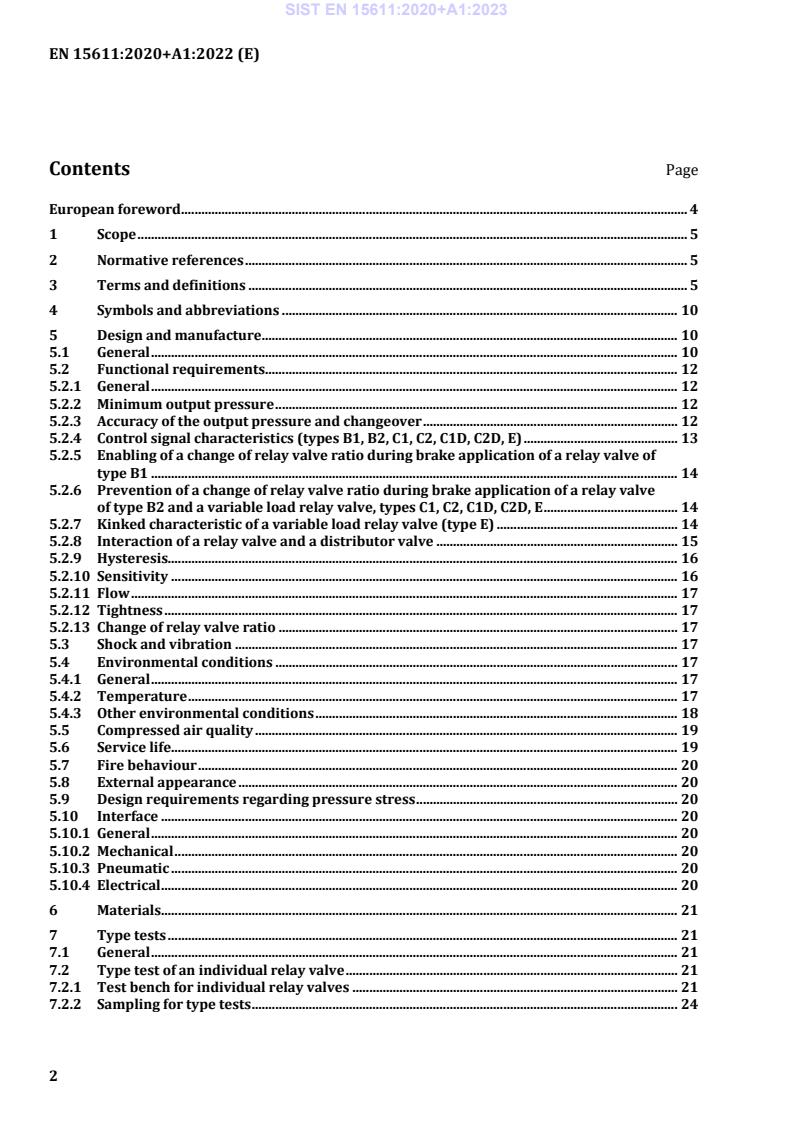
Contents Page
European foreword . 4
1 Scope . 5
2 Normative references . 5
3 Terms and definitions . 5
4 Symbols and abbreviations . 10
5 Design and manufacture . 10
5.1 General . 10
5.2 Functional requirements. 12
5.2.1 General . 12
5.2.2 Minimum output pressure . 12
5.2.3 Accuracy of the output pressure and changeover . 12
5.2.4 Control signal characteristics (types B1, B2, C1, C2, C1D, C2D, E) . 13
5.2.5 Enabling of a change of relay valve ratio during brake application of a relay valve of
type B1 . 14
5.2.6 Prevention of a change of relay valve ratio during brake application of a relay valve
of type B2 and a variable load relay valve, types C1, C2, C1D, C2D, E . 14
5.2.7 Kinked characteristic of a variable load relay valve (type E) . 14
5.2.8 Interaction of a relay valve and a distributor valve . 15
5.2.9 Hysteresis. 16
5.2.10 Sensitivity . 16
5.2.11 Flow . 17
5.2.12 Tightness . 17
5.2.13 Change of relay valve ratio . 17
5.3 Shock and vibration . 17
5.4 Environmental conditions . 17
5.4.1 General . 17
5.4.2 Temperature . 17
5.4.3 Other environmental conditions . 18
5.5 Compressed air quality . 19
5.6 Service life . 19
5.7 Fire behaviour . 20
5.8 External appearance . 20
5.9 Design requirements regarding pressure stress . 20
5.10 Interface . 20
5.10.1 General . 20
5.10.2 Mechanical . 20
5.10.3 Pneumatic . 20
5.10.4 Electrical . 20
6 Materials . 21
7 Type tests . 21
7.1 General . 21
7.2 Type test of an individual relay valve . 21
7.2.1 Test bench for individual relay valves . 21
7.2.2 Sampling for type tests . 24
7.2.3 Test temperature and air quality. 24
7.2.4 Procedure for type tests . 24
8 In-service assessment . 48
9 Designation . 48
10 Identification and marking . 48
Annex A (informative) In-service assessment . 49
A.1 General . 49
A.2 Test set-up and sampling . 49
A.3 Procedure . 49
A.4 Pass/fail criteria . 49
Annex ZA (informative) Relationship between this European Standard and the Essential
Requirements of Directive (EU) 2016/797 aimed to be covered . 50
Bibliography . 51
European foreword
This document (EN 15611:2020+A1:2022) has been prepared by Technical Committee CEN/TC 256
“Railway applications”, the secretariat of which is held by DIN.
This European Standard shall be given the status of a national standard, either by publication of an
identical text or by endorsement, at the latest by May 2023, and conflicting national standards shall be
withdrawn at the latest by May 2023.
Attention is drawn to the possibility that some of the elements of this document may be the subject of
patent rights. CEN shall not be held responsible for identifying any or all such patent rights
This document includes Amendment 1 approved by CEN on 2 October 2022.
This document supersedes !EN 15611:2020".
The start and finish of text introduced or altered by amendment is indicated in the text by tags !".
Compared to EN 15611:2008+A1:2010, the following changes have been made:
a) normative references have been updated;
b) terms and definitions have been revised;
c) requirements on design have been revised;
d) requirements on materials have been revised;
e) requirements on type testing have been revised;
f) requirements on in-service assessment have been revised
g) requirements on markings have been revised;
h) annexes have been revised.
This document has been prepared under a Standardization Request given to CEN by the European
Commission and the European Free Trade Association, and supports essential requirements of
EU Directive(s) / Regulation(s).
For relationship with EU Directive(s) / Regulation(s), see informative Annex ZA, which is an integral part
of this document.
Any feedback and questions on this document should be directed to the users’ national standards body.
A complete listing of these bodies can be found on the CEN website.
According to the CEN-CENELEC Internal Regulations, the national standards organizations of the
following countries are bound to implement this European Standard: Austria, Belgium, Bulgaria, Croatia,
Cyprus, Czech Republic, Denmark, Estonia, Finland, France, Germany, Greece, Hungary, Iceland, Ireland,
Italy, Latvia, Lithuania, Luxembourg, Malta, Netherlands, Norway, Poland, Portugal, Republic of North
Macedonia, Romania, Serbia, Slovakia, Slovenia, Spain, Sweden, Switzerland, Türkiye and the United
Kingdom.
1 Scope
This document is applicable to relay valves designated to control the brake cylinder pressure of
compressed air brakes fitted to railway vehicles, in association with an air brake distributor valve or
other control device. It covers one stage relay valves and relay valves adjusting the brake cylinder
pressure in response to a change in vehicle speed or load that is either continuously variable or in two or
more stages, i.e. empty – loaded.
Relay valves operating with other pressures, in particular the brake pipe pressure, are not included.
This document specifies the requirements for the design, manufacture and testing of relay valves.
2 Normative references
The following documents are referred to in the text in such a way that some or all of their content
constitutes requirements of this document. For dated references, only the edition cited applies. For
undated references, the latest edition of the referenced document (including any amendments) applies.
EN 14478:2017, Railway applications — Braking — Generic vocabulary
EN 15355:2019, Railway applications — Braking — Distributor valves and distributor-isolating devices
!EN 15625:2021", Railway applications — Braking — Automatic variable load sensing devices
EN 45545-1:2013, Railway applications — Fire protection on railway vehicles — Part 1: General
!EN 45545-2:2020", Railway applications — Fire protection on railway vehicles — Part 2:
Requirements for fire behaviour of materials and components
EN 50125-1:2014, Railway applications — Environmental conditions for equipment — Part 1: Rolling
stock and on-board equipment
EN 60721-3-5:1997, Classification of environmental conditions — Part 3: Classification of groups of
environmental parameters and their severities — Section 5: Ground vehicle installations
(IEC 60721-3-5:1997)
EN 61373:2010, Railway applications — Rolling stock equipment — Shock and vibration tests
(IEC 61373:2010)
EN ISO 228-1:2003, Pipe threads where pressure-tight joints are not made on the threads —Part 1:
Dimensions, tolerances and designation (ISO 228-1:2000)
ISO 8573-1:2010, Compressed air —Part 1: Contaminants and purity classes
3 Terms and definitions
For the purposes of this document, the terms and definitions given in EN 14478:2017, EN 15355:2019
and the following apply.
ISO and IEC maintain terminology databases for use in standardization at the following addresses:
— IEC Electropedia: available at https://www.electropedia.org/
— ISO Online browsing platform: available at https://www.iso.org/obp
3.1
relay valve
device, the main function of which is to control a pneumatic output pressure as a function of the variation
of one or more input pressures (see Figure 1)
Key
1 first input pressure
2 second input pressure
3 third input pressure
4 control signal – continuous load sensing pressure (LCP), or control signal – empty/load signal pressure (LSP),
or mechanical input (lever) or electrical input
5 auxiliary reservoir pressure, supply pressure (AR)
6 output pressure
7 relay valve
Figure 1 — Relay valve, pressures and signals
3.2
input pressure
control pressure received by the relay valve
Note 1 to entry: Pressure generally considered as being the output pressure from a distributor or a brake control
unit; sometimes referred to as pilot pressure or dummy brake cylinder pressure.
3.3
output pressure
pressure output from the relay valve, generally considered as being the brake cylinder pressure
Note 1 to entry: This pressure can also be used as the input pressure to another relay valve. The output pressure
can obtain one or more fixed levels or it can be changed continuously between a minimum and a maximum or vice
versa.
3.4
relay valve ratio
ratio of the output pressure value to input pressure value
3.5
control signal
signal used to change the relay valve ratio:
— received from the continuous load sensing device (LCP),
— received from empty-loaded changeover device (LSP),
— generated by the position of mechanical changeover,
— generated by other means, e.g. speed dependent
3.6
relay valve type A
relay valve with one fixed relay valve ratio, where the ratio can be less (step-down), equal or greater
(step-up) than 1
3.7
relay valve type B1
relay valve with two or more fixed relay valve ratios that can change during a brake application, where
the ratio can be less (step-down), equal or greater (step-up) than 1
Note 1 to entry: Typically, two stages “empty/load” relay valve, giving an empty (tare) or a loaded output
pressure proportional to input pressure dependant on the load signal input and used on vehicles operated in empty
or fully loaded condition. Alternatively, the ratio can be changed in function of speed.
3.8
relay valve type B2
relay valve with two or more fixed relay valve ratios that cannot change during a brake application, where
the ratio can be less (step-down), equal or greater (step-up) than 1
Note 1 to entry: Typically, two stage “empty/load” relay valve, giving an empty (tare) or a loaded output pressure
proportional to input pressure dependant on the load signal input. Blocking the relay valve ratio during brake
application is typically used to avoid frequent changeovers taking place on vehicles operated near the changeover
weight.
3.9
relay valve type C1
one stage relay valve with a continuously changeable relay valve ratio, where a load signal is used to
change the ratio
3.10
relay valve type C2
relay valve with a continuously changeable relay valve ratio, where a load signal is used to change the
ratio and with a multi-stage feature added
Note 1 to entry: Typically, a load signal is used to change the relay valve ratio and a control signal (automatic or
manual) is used to change the stage(s). The typical result is that at the same load and input pressure, in the lower
stage (e.g. P-mode, passenger train) results a lower output pressure and in a higher stage (e.g. R-mode, rapid
passenger train) this results in a higher output pressure.
3.11
function D for a relay valve
overlay function to relay valve type A, C1, C2 with two or more input pressures
Note 1 to entry: In this case the type of the relay valve is respectively AD, C1D and C2D.
3.12
relay valve type E
variable load relay valve with a special, non-linear characteristic, which automatically comes into
operation when the vehicle has more than a certain load
Note 1 to entry: The E type may be a combination of a C1 or C2 type and an additional functional block, or may
be a specific generic design. This function reduces (in comparison with a linear characteristic) the output pressure
for low input pressures to a certain level to limit the heat impact to the wheels during continuous braking.
3.13
sensitivity
change of input pressure causing a variation of output pressure, when the change of input pressure is in
the same direction, with no overshoot or reversal
3.14
initial sensitivity
change of input pressure, starting at 0 bar, which causes the output pressure to start increasing
(see Figure 2)
3.15
sensitivity at reversal
change of input pressure causing a variation of output pressure, when the input pressure is changing
from increasing to decreasing (see Figure 2)
3.16
hysteresis
difference in output pressure with the same input pressure, first rising to a value and then, having been
taken past that value, subsequently falls to the same value (see Figure 2)
Key
1 initial sensitivity
2 hysteresis
3 sensitivity at reversal
NOTE The figure is simplified for illustrative purposes, e.g. the real pressure development is not shown.
Figure 2 — Hysteresis and sensitivity
3.17
normal litre
unit of amount of a gas equal to the amount of 1 l at a pressure of 1,00 bar and at a standard temperature,
at 20 °C
Note 1 to entry: Air flow is often stated in normal litres per minute (Nl/min).
3.18
matched pair
combination of a distributor valve and one or more relay valves to achieve specific tolerances of brake
cylinder pressure and timings
Note 1 to entry: The combination is usually kept together throughout the lifetime of the components.
4 Symbols and abbreviations
For the purposes of this document, the symbols and abbreviations given in Table 1 apply.
Table 1 — Symbols and abbreviations
Symbol Designation Unit
p pressure bar
p
input pressure bar
i
p
output pressure bar
o
t time s
AR auxiliary reservoir pressure, supply pressure bar
BCP brake cylinder pressure bar
LCP control signal – continuous load sensing pressure bar
LSP control signal – empty/load signal pressure bar
5 Design and manufacture
5.1 General
A relay valve shall enable a distributor valve or a brake control unit to be used without any vehicle specific
modification to the distributor or the brake control unit, related to the brake cylinder volume. This
includes the independence of the brake application and release times, the inshot feature and the output
pressure development for any output (brake cylinder and piping) volume.
The use of a relay valve shall not alter any of the characteristics of the distributor and/or a brake control
unit that are not specified in this standard.
The use of a relay valve shall enable the brake cylinder pressure to be maintained between prescribed
limits. These limits may be defined by different brake modes or speed-dependent requirements or where
there is a requirement to maintain a nominal constant brake performance irrespective of load.
Table 2 below provides a description of relay valve types described in this standard in comparison to
EN 15611:2010.
Table 2 — Relay valve types
Basic type Design Optional additional Type Type
variants function
(EN 15611:2010) (new)
adaptable by none A A
one fixed ratio of diameters of
output/input pistons
multi input for “select
— AD
pressures or adjustable
high”
by screw
adaptable by ratio can change during
B1 B1
more than one fixed
diameters of brake application
ratio of output/ input
pistons
ratio cannot change
a
or adjustable
pressures
B2 B2
during brake application
by screw
none C C1
with a multi stage
C1 C2
feature added
two input pressures for
variable load relay
D C1D
“select high”
valve
two input pressures for
“select high”
D C2D
with a multi stage
feature added
variable load relay
special nonlinear
valve with kinked
characteristic (kink E E
b
valve)
characteristics
a
A multi stage relay valve with only two stages giving output pressures corresponding to empty or laden
vehicle can be named empty/load relay valve.
b
The E type may be a combination of a C1 or C2 type and additional functional block, or may be a specific
generic design.
The adjustment range of the output pressure for adjustable by screw, adaptable by the diameter of the
piston and variable load relay valves should be from 0,50 bar to 6,00 bar.
Adjustment of the maximum output pressure of a relay valve adjustable by screw should be achieved
without changing internal parts and be accessible without dismantling the device. However, an easily
removable protective device should be installed.
For a defined adjustment of a certain spring, the setting of the stops for low and high output pressures of
a variable load relay valve should be achieved without changing internal parts and be accessible without
dismantling the device. However, an easily removable protective device should be installed.
5.2 Functional requirements
5.2.1 General
The requirements shall be tested as given by Table 5.
5.2.2 Minimum output pressure
The specific minimum output pressure of a relay valve as response to a first brake step with an input
pressure of (0,75 ± 0,02) bar shall have a fixed value, defined by its documentation.
Figure 3 gives an example of the output pressure of a relay valve for different conditions of vehicle load.
Key
1 empty condition
2 loaded condition
3 input pressure (0,75 ± 0,02) bar
4 minimum output pressure loaded
5 minimum output pressure empty
NOTE The shown characteristic is an option.
Figure 3 — Example of the output pressure p of a relay valve (brake cylinder pressure) in
o
relation to the input pressure p for different conditions of vehicle load
i
5.2.3 Accuracy of the output pressure and changeover
5.2.3.1 General (all types)
The output pressure of the relay valve shall be within the following tolerances, related to the minimum
(empty)/maximum (loaded) figures, given by the type plate and the installation drawing of the relay
valve:
— ± 0,10 bar for nominal output pressures ≤ 3,80 bar at an input pressure of (3,80 ± 0,02) bar
(ratios ≤ 1);
— ± 0,15 bar for nominal output pressures > 3,80 bar at an input pressure of (3,80 ± 0,02) bar
(ratios > 1).
A relay valve may change from a ratio < 1 in empty to > 1 in loaded status.
5.2.3.2 Accuracy of the changeover of a multi-stage relay valve (types B1 and B2)
The relay valve shall be designed to changeover from the empty (low), to intermediate (if applicable),
and to the loaded (high) condition and reverse, as defined in 5.2.4, at specified values of the control signal
such as load signal pressure or load sensing pressure (LSP/LCP) or with a mechanical changeover. The
accuracy of the changeover shall be tested in accordance with 7.2.4.4 (types B1 and B2).
5.2.3.3 Accuracy of the changeover of a variable load relay valve with a multi-stage function
overlaid to the variable load brake function (types C2 and C2D)
It shall be possible at any input pressure and any load control pressure (LCP) to change from a lower to
a higher level of the output pressure or vice versa.
The ratio of the gradient of the output to the input pressures between the higher value of the output
pressure to the lower value shall be constant between first brake step and full service and within a
tolerance of ± 10 % for any load condition; this condition is related to a nominal input pressure of
3,80 bar and shall be initiated by a pneumatic or electric control signal.
The accuracy of the changeover shall be tested in accordance with 7.2.4.10 (types C2 and C2D).
5.2.3.4 Accuracy of the output pressure of a relay valve designed for two or more input pressures
(types AD, C1D and C2D)
The output pressure of the relay valve shall correspond to the highest of the input pressures. The
tolerance of the maximum output pressure values shall be ± 0,10 bar, if the nominal value is ≤ 3,80 bar
and ± 0,15 bar, if the nominal value is > 3,80 bar. In the case where two or more input pressures are
acting simultaneously, the output pressure tolerance shall be ± 0,20 bar, if the nominal value is ≤ 3,80 bar
and ± 0,30 bar, if the nominal value is > 3,80 bar.
The accuracy of the output pressure shall be tested in accordance with 7.2.4.13 (types AD, C1D and C2D).
5.2.3.5 Hysteresis of the output pressure in relation to the load control pressure (types C1, C2,
C1D, C2D)
For relay valves C1, C2 the differences of the output pressure, when load control pressure (LCP) has been
increased or decreased, shall not exceed 0,20 bar if the ratio is ≤ 1 and 0,30 bar if the ratio is > 1.
For a relay valve type C1D, C2D, the differences of the output pressure when load control pressure (LCP)
has been increased or decreased shall not exceed 0,25 bar if the ratio is ≤ 1 and 0,30 bar if the ratio is > 1.
For relay valves C1, C2, C1D, C2D in case that the quotient Delta-BCP/Delta-LCP is greater than 1, the
differences of the output pressure when load control pressure (LCP) has been increased or decreased
shall not exceed 0,30 bar if the quotient is ≤ 1 and 0,40 bar if the ratio is > 1.
The accuracy of the output pressure shall be tested in accordance with 7.2.4.7 (types C1, C2, C1D
and C2D).
5.2.4 Control signal characteristics (types B1, B2, C1, C2, C1D, C2D, E)
The design of the relay valve shall allow interaction with at least one of the following load signal types:
a) manual empty-load signal, where this signal is provided by a lever, either mounted directly on the
relay valve, or remotely operated on the vehicle to manually change from the low to the high output
pressure, or vice versa;
b) pneumatic empty/load signal, where the relay valve shall be designed to operate on receipt of the
relevant signal pressure dependent on the brake system design, as follows:
1) Where the control pressure LSP/LCP is ≤ 0,50 bar this indicates a load that is less than the
switching point and shall cause the relay valve to output its lower ratio. If LSP/LCP pressure
is ≥ 3,00 bar this indicates a load greater than the switching point and shall cause the relay valve
to output its higher ratio. Other switching points may be defined by the design documentation.
2) Where the changeover device is supplied from the BCP, the load signal can either be 0 bar and
shall cause relay valve to output its lower output ratio or equivalent to the brake cylinder
pressure and shall cause relay valve to output its higher ratio.
3) Where the changeover device is supplied from the AR, the load signal can either be 0 bar and
shall cause relay valve to output its lower output ratio or equivalent to the AR and shall cause
relay valve to output its higher ratio.
NOTE The signal pressure is typically supplied as a load control signal pressure (LSP) from a manually
operated pneumatic device, e.g. a changeover cock, or an automatic empty-load changeover device.
Alternatively, it is supplied as a continuous load sensing pressure (LCP).
c) variable load signal, i.e. where the load sensing pressure (LCP) comes from an automatic
continuously variable load sensing device (weighing valve) giving continuous load information,
see !EN 15625:2021";
d) speed dependent or other control signal, where the pressure settings shall be defined by the design
documentation.
5.2.5 Enabling of a change of relay valve ratio during brake application of a relay valve of
type B1
Whilst the brakes are applied, changes of the control signal shall initiate the change of the relay valve
ratio.
Higher pressure values of the control signal may be required to achieve a change of relay valve ratio for
other than freight applications e.g. for locomotives or multiple units. In this case the pressure values of
the control signal will be higher than the values contained in 7.2.4.5 and the test in 7.2.4.5 shall be
amended to meet the requirements of the specific relay valve application.
5.2.6 Prevention of a change of relay valve ratio during brake application of a relay valve of type
B2 and a variable load relay valve, types C1, C2, C1D, C2D, E
Whilst the brakes are applied with an output pressure ≥ 1,00 bar, changes of the control signal
of ± 0,50 bar shall not initiate a change of the relay valve ratio.
5.2.7 Kinked characteristic of a variable load relay valve (type E)
A variable load relay valve with kinked characteristic may be specified for use on freight wagons with
tread brakes.
A relay valve with a kinked characteristic shall be designed to operate in association with distributor
valves compliant with EN 15355:2019, for use on tread braked wagons of greater braked weight than a
value defined by the relevant documents. The required characteristic shall reduce the output pressure
(BCP) at lower brake demands whilst this output pressure (BCP) shall at moderate to high brake demands
again approach and finally restore the pressure value which, at the current load condition, is required to
achieve the brake performance equivalent to the one at maximum load and maximum brake force.
The relay valve characteristic shall be designed such that a change of characteristic is achieved at input
pressures A and B, see Figure 11, established for equivalent brake pipe reductions of 0,80 bar and
1,20 bar as sensed by the distributor. The values of input pressures A and B shall be in the range of
A = 1,80 bar to 2,00 bar and B = 2,90 bar to 3,15 bar. The increase in output pressure (BCP) achieved
between the input pressure values A and B shall increase in relation to the increase in input pressure.
The output pressure achieved for input pressure values below input pressure A shall be lower than the
equivalent straight-line characteristic for the maximum axle load. The output pressure achieved for input
pressure values above input pressure B shall return to the equivalent straight-line characteristic for the
maximum axle load.
The relay valve should realize output pressures which are located in the range of 33 %, 67 %, 80 % and
100 % of the equivalent fully loaded condition signal in relation to the load control pressure
(see Figure 11).
The typical values 33 %, 67 % in Figure 11 may change depending on the design of the brake system of a
freight wagon. The test procedure shall be adapted accordingly.
5.2.8 Interaction of a relay valve and a distributor valve
Any combination of a distributor valve and a relay valve (either integral or separate) shall be assessed as
set out in this standard and EN 15355:2019 (distributor valve standard).
a) For all distributor valve/relay valve combinations, except matched pairs of distributor valves and
relay valves:
1) For a test conducted using a distributor valve in combination with a relay valve for an input
pressure to the distributor valve of 0 bar (emergency brake application) and with the distributor
valve output pressure of 3,80 bar, which forms the input to the relay valve, the accuracy of the
relay valve output pressure shall be ± 0,20 bar for output to input ratios ≤ 1 and ± 0,25 bar for
ratios > 1. This applies only to the empty and loaded conditions dependent on the actual ratio.
2) The output pressure build-up time (brake application time measured using an emergency brake
application from the start of the rise of the output pressure to 95 % of its maximum value) of the
relay valve shall be 3 s to 6 s with an input pressure build-up time to the relay valve of 3 s to 5 s.
3) For brake release:
i) The output pressure shall continuously follow the drop of the input pressure from its
maximum to 0,40 bar. The drop of the input pressure until the start of the drop of the output
pressure shall be ≤ 0,30 bar for relay valves with a ratio of ≥ 1 and ≤ 0,5 for relay valves with
a relay valve ratio greater than 0,5 and less than 1.
ii) When the input pressure has fallen to 0,40 bar, the output pressure shall fall to 10 % of the
maximum output pressure obtained in 5.2.8, a), 2) in not more than 15 s.
b) For matched pairs of distributor valves and relay valves, if specifically required:
The following accuracy shall be achieved by the matched pair, if necessary, by adjustment of
the relay valve or distributor valve. The design of the relay valve shall allow for this adjustment
to be made. In combination with a distributor valve of a defined type the relay valve shall
ensure the following characteristics:
1) For a test conducted using a distributor valve in combination with a relay valve for an input
pressure to the distributor valve of 0 bar (emergency brake application) and with the
distributor valve output pressure of (3,80 ± 0,10) bar, which forms the input to the relay
valve, the accuracy of the relay valve output pressure shall be ± 0,10 bar. This applies to both
the empty and loaded conditions.
2) The output pressure build-up time (brake application time measured using an emergency
brake application from the start of the rise of the output pressure to 95 % of its maximum
value) of the relay valve shall be 3 s to 6 s with an input pressure build-up time to the relay
valve of 3 s to 5 s.
3) For relay valves of type C1, C2, C1D, C2D and E, this combination shall have a performance
at intermediate load conditions LCP4 and LCP6 (see Table 7), providing an output pressure
accuracy of ± 0,15 bar. At load condition LCP5 the output pressure accuracy shall
be ± 0,10 bar. This shall be tested with the load sensing pressure increasing.
4) For relay valves of type C2D when used in a matched pair, one input shall be declared being
the one to adjust the relay valve. For this input, the combination shall have a performance at
intermediate load conditions LCP4 and LCP6 (see Table 7), providing an output pressure
accuracy of ± 0,15 bar. At load condition LCP5 the output pressure accuracy shall
be ± 0,10 bar. This shall be tested with the load sensing pressure increasing. For the other
input(s), the before tolerances are increased by 0,05 bar, i.e. are respectively ± 0,20 bar
and ± 0,15 bar.
5) For brake release:
The output pressure shall continuously follow the drop of the input pressure from its
maximum to 0,05 bar. The time delay for the start of the drop of the output pressure shall
be ≤ 10 % of the total allowed release time for the distributor valve for relay valves with a
ratio ≥ 0,5 and ≤ 20 % for relay valves with a ratio of < 0,5.
When the input pressure has fallen to 0,05 bar, the output pressure shall fall to ≤ 0,05 bar not
more than 15 s later.
These requirements shall be tested in accordance with 7.2.4.16.
5.2.9 Hysteresis
The maximum hysteresis of
— relay valve type A shall be ≤ 0,10 bar,
— relay valve types AD, B1 and B2 shall be ≤ 0,15 bar,
— relay valve types C1 and C2, C1D and C2D and E shall be ≤ 0,20 bar.
This requirement shall be tested in accordance with 7.2.4.8 (types C1, C2, C1D and C2D), 7.2.4.9 (type E),
7.2.4.10 (types C2 and C2D) and 7.2.4.11 (types A, AD, B1 and B2).
5.2.10 Sensitivity
The sensitivity of a relay valve with a relay valve ratio of 1 or greater at ambient temperature (25 ± 10) °C
shall be ≤ 0,10 bar for type A, B1, B2, C1 and ≤ 0,2 bar for type !AD", C2, C1D, C2D, E.
The sensitivity of a relay valve with a relay valve ratio less than 1 shall be such that a minimum of 5 steps
of output pressure can be achieved between the initial input pressure and maximum input pressure.
After the initial brake application (inshot) the relay valve shall be capable of responding to changes of the
input signal in steps as defined by the test sequence in Clause 7 at ambient temperature. After a reduction
of the input pressure to 0,30 bar the output pressure shall be ≥ 0,10 bar in any load condition.
The sensitivity at reversal of a relay valve with a relay valve ratio of 1 or greater, shall be ≤ 0,30 bar.
The sensitivity at reversal of a relay valve with a relay valve ratio greater than 0,5 and less than 1 shall
be ≤ 0,50 bar.
There is no requirement for the sensitivity at reversal of a relay valve with a relay valve ratio less than 0,5.
These requirements shall be tested in accordance with 7.2.4.12 (all types).
5.2.11 Flow
The relay valve shall be capable of operating within the requirements of this standard with the possibility
of a wide variation in the volume attached to the output. Any volume limitations of a specific relay valve
shall be identified by the manufacturer in the relevant technical documents and the operating capability
confirmed as part of the vehicle test.
5.2.12 Tightness
The sealing arrangement within the relay valve shall prevent any unacceptable loss of air.
At an ambient temperature of (25 ± 10) °C, the relay valve shall not have a leakage rate greater than
0,005 Nl/min for the AR, 0,001 Nl/min for the input pressure and 0,003 Nl/min for the output pressure
and LCP/LSP.
At an ambient temperature of −25 °C, also at +70 °C the relay valve shall not have a leakage rate greater
than 0,01 Nl/min.
At −40 °C the relay valve shall not have a leakage rate greater than 0,1 Nl/min.
5.2.13 Change of relay valve ratio
The design shall enable the relay valve ratio to be controlled by one or more of the following means:
a) a mechanical means, e.g. a screw for adjusting the relay valve ratio (fixed setting, unchangeable
during operation);
b) mechanical means, e.g. a lever or electrical means e.g. a magnet valve to switch the relay valve ratio
during operation;
c) signal pressure(s) to switch the relay valve ratio from a first to a second (third) level of output
pressure or to change the relay valve ratio continuously.
5.3 Shock and vibration
The relay valve shall be able to operate without restriction under shock and vibration conditions as
specified by EN 61373:2010. The relevant class and category shall be defined according to
EN 61373:2010.
These requirements shall be tested in accordance with 7.2.4.14.
5.4 Environmental conditions
5.4.1 General
The design shall take into account that the relay valve shall be able to be placed into service and operate
normally in the conditions and climatic zones for which it is designed and in which it is likely to run, as
specified in this standard.
5.4.2 Temperature
The relay valves covered by this standard shall be able to operate at −40 °C ≤ ambient
temperature ≤ 70 °C without any deviation from the technical requirements specified in Clause 5 of this
standard, except the exceptions defined below.
— In the range from −40 °C ≤ ambient temperature < −25 °C and at +70 °C the pressure values A and B
(7.2.4.9) may have a tolerance of (1,90 ± 0,25) bar respectively (3,00 ± 0,25) bar
-------------------
...