

FprEN 12110-2
(Main)Tunnel boring machines - Air locks - Part 2: Safety requirements for the use of non-air breathing mixtures and saturation techniques in personnel locks and for pressurized transfer shuttles
General Information
- Abstract
This document sets out requirements for personnel locks which are intended to have the capability for mixed gas breathing techniques or saturation techniques at pressures not exceeding 2 000 kPa (20 bar) and associated with tunnelling work. These are in addition to the requirements of FprEN 12110-1:2026. The intended use of the air lock is agreed between the manufacturer and the user taking into account information on intended use, exposure techniques and decompression procedures provided by the user.
This document includes the external services connection panel as defined in 3.6 on the protective frame and everything downstream of that panel.
This document is not applicable to air locks and equipment which are manufactured before the date of publication of this document by CEN.
NOTE This document can help the design of air locks and bulkheads in other compressed air work in construction.
This document deals with all significant hazards, hazardous situations and events relevant to air locks when they are used as intended and under conditions of misuse which are reasonably foreseeable by the manufacturer (see Annex A).
This document does not cover the supply of services to the air lock from beyond the defined FprEN 12110-1:2026/FprEN 16191:2026 interface.
Noise hazards are covered in FprEN 12110-1:2026.
Vibration and EMC (Electromagnetic compatibility) hazards are not significant hazards for air locks and hence are not dealt with in this standard.
Mixed gas, air or oxygen is provided by the user.
The following topics are within the scope of this standard:
- the fire suppression system for the shuttle;
- the power supply to the shuttle;
- connections for a climate control system and gas supply to the shuttle.
The SI unit of pressure is the pascal (Pa) and multiples of it. The unit of pressure used in this document is the kilopascal (kPa), however as the unit of pressure used in the hyperbaric tunnelling industry is the bar and 1 bar = 100 kPa, all pressures are given in kPa with the equivalent in bar alongside in kPa (bar).
- Status
- Not Published
- Publication Date
- 23-Dec-2026
- Technical Committee
- CEN/TC 151 - Construction equipment and building material machines - Safety
- Drafting Committee
- CEN/TC 151/WG 4 - Tunnelling machines - Safety
- Current Stage
- 5020 - Submission to Vote - Formal Approval
- Start Date
- 24-Sep-2026
- Completion Date
- 24-Sep-2026



Overview
The European Standard prEN 12110-2:2023, developed by CEN Technical Committee TC 151, addresses the safety requirements for personnel locks and pressurized transfer shuttles used in tunnel boring machines (TBMs). This standard supplements prEN 12110-1 by focusing on the use of non-air breathing mixtures and saturation techniques at pressures up to 20 bar(g). It sets out detailed requirements for design, construction, testing, and operation to ensure worker safety during pressurized tunneling operations involving mixed gas atmospheres or saturation diving conditions.
The document is essential for manufacturers and users involved in tunneling works where workers are exposed to hyperbaric environments. It provides guidelines that mitigate risks associated with breathing mixtures, pressure exposures, and the use of mobile pressurized transfer shuttles. It also emphasizes that mixed gas supply and oxygen systems are user responsibilities, while the standard governs the safe equipment design and operation.
Key Topics
- Scope and Application: Additional requirements to prEN 12110-1 apply specifically to personnel locks designed for mixed gases or saturation exposures and pressurized transfer shuttles used in tunneling.
- Safety and Risk Reduction: Addresses hazards related to pressurized airlocks, mixed gas use, and saturation techniques. Includes risk identification and necessary protective measures.
- Design Pressure and Construction: Shuttles are treated as pressure vessels and must adhere to EN 13445 series pressure vessel requirements.
- Pressure Relief and Safety Valves: Mandates proper use of pressure relief valves to prevent overpressure situations and ensure safety.
- Components Specification: Pipes, hoses, valves, and gauges designed for helium and mixed gas compatibility, using materials approved for oxygen service. Mild steel is excluded for shuttle pipework.
- Operational Procedures: Defines docking, locking off, and transfer under pressure processes for personnel movement between hyperbaric systems.
- Shuttle Equipment Requirements: Necessitates fire suppression systems continuously connected and immediately available, power supply, and capability for climate control and gas supply.
- Ergonomics and Signal Design: Compliance with EN 894 series for display, control, signage, and warning devices.
- Testing and Verification: Emphasis on testing personnel locks and shuttles to verify safety compliance before use.
- Information and Marking: Guidelines on operator instructions, safety signs, and equipment marking to ensure proper use and maintenance.
Applications
prEN 12110-2:2023 is crucial for industries and projects involving:
- Tunnel construction using TBMs where personnel must be transferred safely between pressurized environments.
- Hyperbaric operations involving saturation diving techniques inside personnel locks.
- Deployment of pressurized transfer shuttles for secure movement of workers under pressure in confined spaces.
- Design and manufacture of airlocks and bulkheads for compressed air construction work.
- Safety management in mixed gas breathing and decompression procedures within the tunneling industry.
By adhering to the standard, manufacturers improve machinery safety and operators reduce risks of decompression sickness, gas toxicity, and equipment failure. This standard supports compliance with EU machinery directives and harmonizes safety practices across member countries.
Related Standards
- prEN 12110-1:2023 – Requirements for air locks using compressed air and oxygen systems.
- prEN 16191:2023 – General safety requirements for tunneling machinery.
- EN 13445 series – Design and fabrication of unfired pressure vessels, relevant for shuttle construction.
- EN 14931:2006 – Safety requirements for pressure vessels for human occupancy.
- EN ISO 12100:2010 – General principles for machinery safety and risk assessment.
- EN 894 series – Ergonomic requirements for design of displays and controls.
- EN 12021:2014 – Specification for compressed gases used in breathing apparatus.
- IEC 61310-1:2008 – Safety requirements for visual and acoustic machine signals.
Keywords: tunnel boring machines, TBM safety, air locks, personnel locks, pressurized transfer shuttles, mixed gas breathing mixtures, saturation techniques, construction equipment safety, compressed air work, hyperbaric transfer, European standards, CEN technical committee, EN 13445 pressure vessels, tunneling machinery safety, decompression procedures, fire suppression systems.
Relations
- Effective Date
- 18-Jan-2023
Get Certified
Connect with accredited certification bodies for this standard

DIBt (Deutsches Institut für Bautechnik)
German Institute for Building Technology.
DIN CERTCO
DIN Group product certification.
Zavod za gradbeništvo Slovenije (ZAG) - Inšpekcija
ZAG inspection body for construction products, structures, and materials.
Sponsored listings
Frequently Asked Questions
FprEN 12110-2 is a draft published by the European Committee for Standardization (CEN). Its full title is "Tunnel boring machines - Air locks - Part 2: Safety requirements for the use of non-air breathing mixtures and saturation techniques in personnel locks and for pressurized transfer shuttles". This standard covers: This document sets out requirements for personnel locks which are intended to have the capability for mixed gas breathing techniques or saturation techniques at pressures not exceeding 2 000 kPa (20 bar) and associated with tunnelling work. These are in addition to the requirements of FprEN 12110-1:2026. The intended use of the air lock is agreed between the manufacturer and the user taking into account information on intended use, exposure techniques and decompression procedures provided by the user. This document includes the external services connection panel as defined in 3.6 on the protective frame and everything downstream of that panel. This document is not applicable to air locks and equipment which are manufactured before the date of publication of this document by CEN. NOTE This document can help the design of air locks and bulkheads in other compressed air work in construction. This document deals with all significant hazards, hazardous situations and events relevant to air locks when they are used as intended and under conditions of misuse which are reasonably foreseeable by the manufacturer (see Annex A). This document does not cover the supply of services to the air lock from beyond the defined FprEN 12110-1:2026/FprEN 16191:2026 interface. Noise hazards are covered in FprEN 12110-1:2026. Vibration and EMC (Electromagnetic compatibility) hazards are not significant hazards for air locks and hence are not dealt with in this standard. Mixed gas, air or oxygen is provided by the user. The following topics are within the scope of this standard: - the fire suppression system for the shuttle; - the power supply to the shuttle; - connections for a climate control system and gas supply to the shuttle. The SI unit of pressure is the pascal (Pa) and multiples of it. The unit of pressure used in this document is the kilopascal (kPa), however as the unit of pressure used in the hyperbaric tunnelling industry is the bar and 1 bar = 100 kPa, all pressures are given in kPa with the equivalent in bar alongside in kPa (bar).
This document sets out requirements for personnel locks which are intended to have the capability for mixed gas breathing techniques or saturation techniques at pressures not exceeding 2 000 kPa (20 bar) and associated with tunnelling work. These are in addition to the requirements of FprEN 12110-1:2026. The intended use of the air lock is agreed between the manufacturer and the user taking into account information on intended use, exposure techniques and decompression procedures provided by the user. This document includes the external services connection panel as defined in 3.6 on the protective frame and everything downstream of that panel. This document is not applicable to air locks and equipment which are manufactured before the date of publication of this document by CEN. NOTE This document can help the design of air locks and bulkheads in other compressed air work in construction. This document deals with all significant hazards, hazardous situations and events relevant to air locks when they are used as intended and under conditions of misuse which are reasonably foreseeable by the manufacturer (see Annex A). This document does not cover the supply of services to the air lock from beyond the defined FprEN 12110-1:2026/FprEN 16191:2026 interface. Noise hazards are covered in FprEN 12110-1:2026. Vibration and EMC (Electromagnetic compatibility) hazards are not significant hazards for air locks and hence are not dealt with in this standard. Mixed gas, air or oxygen is provided by the user. The following topics are within the scope of this standard: - the fire suppression system for the shuttle; - the power supply to the shuttle; - connections for a climate control system and gas supply to the shuttle. The SI unit of pressure is the pascal (Pa) and multiples of it. The unit of pressure used in this document is the kilopascal (kPa), however as the unit of pressure used in the hyperbaric tunnelling industry is the bar and 1 bar = 100 kPa, all pressures are given in kPa with the equivalent in bar alongside in kPa (bar).
FprEN 12110-2 is classified under the following ICS (International Classification for Standards) categories: 91.220 - Construction equipment; 93.060 - Tunnel construction. The ICS classification helps identify the subject area and facilitates finding related standards.
FprEN 12110-2 has the following relationships with other standards: It is inter standard links to EN 12110:2014. Understanding these relationships helps ensure you are using the most current and applicable version of the standard.
FprEN 12110-2 is associated with the following European legislation: EU Directives/Regulations: 2006/42/EC, 2023/1230; Standardization Mandates: M/396, M/605. When a standard is cited in the Official Journal of the European Union, products manufactured in conformity with it benefit from a presumption of conformity with the essential requirements of the corresponding EU directive or regulation.
FprEN 12110-2 is available in PDF format for immediate download after purchase. The document can be added to your cart and obtained through the secure checkout process. Digital delivery ensures instant access to the complete standard document.
Standards Content (Sample)
SLOVENSKI STANDARD
01-maj-2023
Nadomešča:
SIST EN 12110:2014
Stroji za vrtanje predorov - Zračne zapore - 2. del: Varnostne zahteve za uporabo
mešanic dihalnih plinov v prostorih brez prezračevanja in tehnik nasičenja v
nepredušno zaprtih prostorih za osebje in za transportna vozila s kabinami pod
tlakom
Tunnel boring machines - Air locks - Part 2: Safety requirements for the use of non-air
breathing mixtures and saturation techniques in personnel locks and for pressurised
transfer shuttles
Tunnelbohrmaschinen - Druckluftschleusen - Teil 2: Sicherheitstechnische
Anforderungen bei der Verwendung von luftfremden Atemmischungen und
Sättigungsverfahren in Personenschleusen sowie unter Druck stehenden Transfer
Shuttles
Tunneliers - Sas de transfert - Partie 2: Prescription de sécurité pour l'utilisation de
mélanges respiratoires non-air et de techniques de saturation dans les sas du personnel
et pour les navettes de transfert pressurisées
Ta slovenski standard je istoveten z: prEN 12110-2
ICS:
91.220 Gradbena oprema Construction equipment
93.060 Gradnja predorov Tunnel construction
2003-01.Slovenski inštitut za standardizacijo. Razmnoževanje celote ali delov tega standarda ni dovoljeno.
DRAFT
EUROPEAN STANDARD
prEN 12110-2
NORME EUROPÉENNE
EUROPÄISCHE NORM
February 2023
ICS 91.220; 93.060 Will supersede EN 12110:2014
English Version
Tunnel boring machines - Air locks - Part 2: Safety
requirements for the use of non-air breathing mixtures
and saturation techniques in personnel locks and for
pressurised transfer shuttles
Tunneliers - Sas de transfert - Partie 2: Prescription de Tunnelbohrmaschinen - Druckluftschleusen - Teil 2:
sécurité pour l'utilisation de mélanges respiratoires Sicherheitstechnische Anforderungen bei der
non-air et de techniques de saturation dans les sas du Verwendung von luftfremden Atemmischungen und
personnel et pour les navettes de transfert Sättigungsverfahren in Personenschleusen sowie unter
pressurisées Druck stehenden Transfer Shuttles
This draft European Standard is submitted to CEN members for enquiry. It has been drawn up by the Technical Committee
CEN/TC 151.
If this draft becomes a European Standard, CEN members are bound to comply with the CEN/CENELEC Internal Regulations
which stipulate the conditions for giving this European Standard the status of a national standard without any alteration.
This draft European Standard was established by CEN in three official versions (English, French, German). A version in any other
language made by translation under the responsibility of a CEN member into its own language and notified to the CEN-CENELEC
Management Centre has the same status as the official versions.
CEN members are the national standards bodies of Austria, Belgium, Bulgaria, Croatia, Cyprus, Czech Republic, Denmark, Estonia,
Finland, France, Germany, Greece, Hungary, Iceland, Ireland, Italy, Latvia, Lithuania, Luxembourg, Malta, Netherlands, Norway,
Poland, Portugal, Republic of North Macedonia, Romania, Serbia, Slovakia, Slovenia, Spain, Sweden, Switzerland, Türkiye and
United Kingdom.
Recipients of this draft are invited to submit, with their comments, notification of any relevant patent rights of which they are
aware and to provide supporting documentation.
Warning : This document is not a European Standard. It is distributed for review and comments. It is subject to change without
notice and shall not be referred to as a European Standard.
EUROPEAN COMMITTEE FOR STANDARDIZATION
COMITÉ EUROPÉEN DE NORMALISATION
EUROPÄISCHES KOMITEE FÜR NORMUNG
CEN-CENELEC Management Centre: Rue de la Science 23, B-1040 Brussels
© 2023 CEN All rights of exploitation in any form and by any means reserved Ref. No. prEN 12110-2:2023 E
worldwide for CEN national Members.
prEN 12110-2:2023 (E)
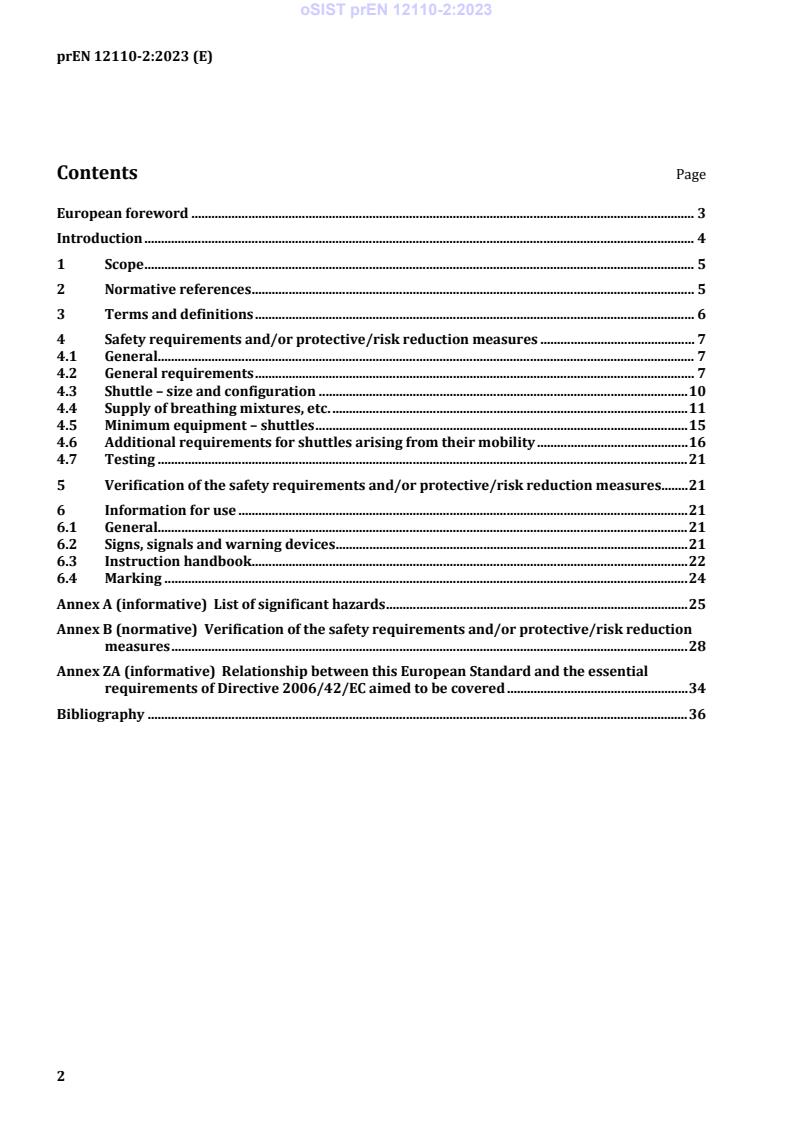
Contents Page
European foreword . 3
Introduction . 4
1 Scope . 5
2 Normative references . 5
3 Terms and definitions . 6
4 Safety requirements and/or protective/risk reduction measures . 7
4.1 General. 7
4.2 General requirements . 7
4.3 Shuttle – size and configuration . 10
4.4 Supply of breathing mixtures, etc. . 11
4.5 Minimum equipment – shuttles . 15
4.6 Additional requirements for shuttles arising from their mobility . 16
4.7 Testing . 21
5 Verification of the safety requirements and/or protective/risk reduction measures. 21
6 Information for use . 21
6.1 General. 21
6.2 Signs, signals and warning devices . 21
6.3 Instruction handbook. 22
6.4 Marking . 24
Annex A (informative) List of significant hazards . 25
Annex B (normative) Verification of the safety requirements and/or protective/risk reduction
measures . 28
Annex ZA (informative) Relationship between this European Standard and the essential
requirements of Directive 2006/42/EC aimed to be covered . 34
Bibliography . 36
prEN 12110-2:2023 (E)
European foreword
This document (prEN 12110-2:2023) has been prepared by Technical Committee CEN/TC 151
“Construction equipment and building material machines – Safety”, the secretariat of which is held by
DIN.
This document is currently submitted to the CEN Enquiry.
This document together with prEN 12110-1 will supersede EN 12110:2014.
prEN 12110-2:2023 includes the following significant technical changes with respect to EN 12110:2014:
— the standard has been split into two parts; this part deals with mixed gas use and pressurized transfer
shuttle, neither of which was covered in EN 12110:2014;
— revision of definitions;
— revision of all safety requirements;
— update of list of significant hazards;
— revision of Annex ZA.
prEN 12110, Tunnel boring machines — Air locks comprises the following parts:
— Part 1 — Requirements for air locks utilising compressed air as the pressurising or breathing medium
along with requirements for oxygen breathing systems for decompression purposes.
— Part 2 — Safety requirements for the use of non-air breathing mixtures and saturation techniques in
personnel locks and for pressurised transfer shuttles.
For simplicity in use, the structure of part 2 has been aligned with that of part 1 to the greatest extent
possible. This has resulted in the repetition of some text in both parts but greater clarity for users.
The standard has been prepared under a Standardization Request given to CEN by the European
Commission and the European Free Trade Association, and support essential requirements of
EU Directive(s) / Regulation(s).
For relationship with EU Directive(s) / Regulation(s), see informative Annex ZA, which is an integral part
of this document.
prEN 12110-2:2023 (E)
Introduction
This document is a type C standard as stated in EN ISO 12100:2010.
The machinery and equipment concerned and the extent to which hazards, hazardous situations and
events are covered are indicated in the scope of this document.
When provisions of this type C standard are different from those which are stated in type A or B
standards, the provisions of this type C standard take precedence over the provisions of the other
standards, for machines that have been designed and built according to the provisions of this type C
standard.
prEN 12110-2:2023 (E)
1 Scope
This document sets out additional requirements to those in prEN 12110-1 for personnel locks which are
intended to have the capability for mixed gas breathing techniques or saturation techniques at pressures
not exceeding 20 bar(g) and associated with tunnelling work. This document also sets out requirements
for pressurized transfer shuttles as defined in 3.1.
prEN 12110-1 applies to the design, construction, equipping, marking and testing of air locks, as defined
in 3.3, in tunnelling. prEN 12110-1 also covers requirements for manlocks utilizing compressed air as the
pressurizing and breathing medium along with requirements for oxygen breathing systems for
decompression purposes.
Air locks are normally an integral part of TBMs. Hence there are interfaces between the scope of
prEN 12110-1:2023 and prEN 16191:2023. These are detailed in Clause 4 of this document.
The intended use of the machinery is agreed between the manufacturer and the user taking into account
information on intended use, exposure techniques and decompression procedures provided by the user.
This document is not applicable to machinery and equipment which is manufactured before the date of
publication of this document by CEN.
NOTE This document can help the design of air locks and bulkheads in other compressed air work in construction.
This document deals with all significant hazards, hazardous situations and events relevant to such
machinery when they are used as intended and under conditions of misuse which are reasonably
foreseeable by the manufacturer (see Annex A).
This document does not cover the supply of services to the air lock from beyond the defined
prEN 12110-1:2023/prEN 16191:2023 interface. This interface is set out in the text.
Vibration, noise and EMC (Electromagnetic compatibility) hazards are not significant hazards for air
locks.
The provision of mixed gas, air or oxygen is the responsibility of the user.
During transfer under pressure operations, the shuttle requires a fire suppression system, a climate
control system, a power supply and a gas supply. Of these, the fire suppression system requires to be
continuously connected and available for immediate activation. It is therefore considered to be part of
the shuttle equipment covered by this standard as is the power supply. For the other two services only
the capability to supply them is considered to be part of the shuttle requirements.
2 Normative references
The following documents are referred to in the text in such a way that some or all of their content
constitutes requirements of this document. For dated references, only the edition cited applies. For
undated references, the latest edition of the referenced document (including any amendments) applies.
EN 894-1:1997+A1:2008, Safety of machinery — Ergonomics requirements for the design of displays and
control actuators — Part 1: General principles for human interactions with displays and control actuators
EN 894-2:1997+A1:2008, Safety of machinery — Ergonomics requirements for the design of displays and
control actuators — Part 2: Displays
EN 894-3:2000+A1:2008, Safety of machinery — Ergonomics requirements for the design of displays and
control actuators — Part 3: Control actuators
EN 894-4:2010, Safety of machinery — Ergonomics requirements for the design of displays and control
actuators — Part 4: Location and arrangement of displays and control actuators
prEN 12110-2:2023 (E)
EN 12021:2014, Respiratory equipment — Compressed gases for breathing apparatus
EN 13445-1:2021, Unfired pressure vessels — Part 1: General
EN 13445-2:2021, Unfired pressure vessels — Part 2: Materials
EN 13445-3:2021, Unfired pressure vessels — Part 3: Design
EN 13445-4:2021, Unfired pressure vessels — Part 4: Fabrication
EN 13445-5:2021, Unfired pressure vessels — Part 5: Inspection and testing
EN 14931:2006, Pressure vessels for human occupancy (PVHO) — Multi-place pressure chamber systems
for hyperbaric therapy — Performance, safety requirements and testing
prEN 16191:2023, Tunnelling machinery — Safety requirements
EN 61310-1:2008, Safety of machinery — Indication, marking and actuation — Part 1: Requirements for
visual, acoustic and tactile signals (IEC 61310-1:2007)
EN ISO 12100:2010, Safety of machinery — General principles for design — Risk assessment and risk
reduction (ISO 12100:2010)
IEC/TR 60877:1999, Procedures for ensuring the cleanliness of industrial-process measurement and
control equipment in oxygen service
ISO 1161:2016, Series 1 freight containers — Corner and intermediate fittings — Specifications
ISO 6405-1:2017, Earth-moving machinery — Symbols for operator controls and other displays — Part 1:
Common symbols
ISO 10799-2:2011, Cold-formed welded structural hollow sections of non-alloy and fine grain steels — Part
2: Dimensions and sectional properties
3 Terms and definitions
For the purposes of this document, the terms and definitions given in prEN ISO 12100-1:2022 and the
following apply.
ISO and IEC maintain terminology databases for use in standardization at the following addresses:
— ISO Online browsing platform: available at https://www.iso.org/obp/
— IEC Electropedia: available at https://www.electropedia.org/
3.1
pressurized transfer shuttle “shuttle”
mobile personnel lock for undertaking the transfer under pressure of personnel from one fixed
hyperbaric system to another
3.2
non-saturation mode
short duration exposures to pressure in which compression, working period and decompression are all
completed within a single working shift which is insufficiently long to allow all body tissues to become
saturated
prEN 12110-2:2023 (E)
3.3
locking off
process of separating the shuttle from the personnel lock after they had been clamped together to allow
persons to pass between them under pressure
3.4
docking
process of aligning and clamping a shuttle to a personnel lock to allow persons to pass between them
under pressure
3.5
protective frame
robust steel frame within which the shuttle is mounted to provide impact protection and to facilitate
lifting
3.6
external services connection panel
panel within the protective frame on which there are connection points for externally supplied services
such as mixed gas, compressed air, power, etc.
4 Safety requirements and/or protective/risk reduction measures
4.1 General
Air locks shall comply with the safety requirements and/or protective/risk reduction measures of this
clause, unless modified by requirements of the relevant specific part of the standard series. In addition,
the machine shall be designed according to the principles of EN ISO 12100:2010 for relevant but not
significant hazards which are not dealt with by this document.
Personnel locks intended for the use of breathing mixtures including as part saturation techniques shall
conform to the requirements of prEN 12110-1:2023. Additional requirements specifically required for
the use of breathing mixtures or saturation exposure techniques are set out below in 4.1 to 4.4.17.
Shuttles shall conform with the requirements of prEN 12110-2:2023, 4.1 to 4.4.17 as well as 4.5 to 4.7 in
respect of risks arising from the mobility of the shuttle. Many of the clauses in prEN 12110-2:2023
relating to requirements for shuttles in turn make reference to requirements in prEN 12110-1:2023 to
limit duplication of text.
4.2 General requirements
4.2.1 Design pressure
The requirements for design pressure and calculation method in prEN 12110-1:2023, 4.2.1 shall be
adhered to for shuttles.
Shuttles as pressure vessels shall be designed, fabricated and tested in conformity with
prEN 12110-1:2023, 4.2.1 and EN 13445-1:2021, EN 13445-2:2021, EN 13445-3:2021, EN 13445-4:2021
and EN 13445-5:2021.
4.2.2 Pressure relief valve
The requirements for pressure relief valves in prEN 12110-1:2023, 4.2.2 shall apply to shuttle
compartments also.
prEN 12110-2:2023 (E)
4.2.3 Pipes, hoses, valves and gauges
4.2.3.1 General
Pipes, hoses and valves which form an integral part of the shuttle shall conform with the requirements of
prEN 12110-1:2023, 4.2.3.1.
All pipework, hoses, valves and gauges containing helium shall be suitable for helium operation.
NOTE Helium can cause separation of the layers of a hose.
4.2.3.2 Pipework
Only materials specified for oxygen use in prEN 12110-1:2023, 4.2.3.2 shall be used for the conveyance
of breathing mixtures.
Pipework on shuttles shall conform with prEN 12110-1:2023, 4.2.3.2, however mild steel shall not be
used for pipework on shuttles.
4.2.3.3 Hoses
Hoses on personnel locks intended for mixed gas use or on shuttles shall conform with the requirements
of prEN 12110-1:2023, 4.2.3.3.
4.2.3.4 Valves
Valves on personnel locks intended for mixed gas use or on shuttles shall conform with the requirements
of prEN 12110-1:2023, 4.2.3.4.
4.2.3.5 Servo-operated valves
The requirements of prEN 12110-1:2023, 4.2.3.5 in respect of servo valves shall apply to shuttles.
4.2.3.6 Gauges
Gauges on personnel locks intended for mixed gas use or on shuttles shall conform with the requirements
of prEN 12110-1:2023, 4.2.3.6.
Gauges used in mixed gas systems shall be helium compatible.
4.2.3.7 Pressure regulators
Pressure regulators shall be fitted to compressed air, oxygen and mixed gas supplies to shuttles.
4.2.3.8 Gas analysis
Connections including means of isolation to allow for removal or calibration, shall be provided for gas
analysis equipment to be fitted to personnel locks and shuttles. Means shall be provided to ensure the
gas analysis information and the locations for which it is required shall meet the requirements of 4.4.15.
Gas analysis equipment may be supplied by the user.
4.2.3.9 Protection against inlet line breaks
The requirements of prEN 12110-1:2023, 4.2.3.9 in respect of protection against line breaks shall apply
to shuttles.
Outflow lines shall be fitted with excess flow detection and prevention as required by
prEN 12110-1:2023, 4.2.3.4.
prEN 12110-2:2023 (E)
4.2.4 Air lock control functions
On shuttles there shall be a pressure gauge outside each compartment, for controlling the pressure in the
compartment. In addition, there shall be a pressure gauge inside each compartment adjacent to the
compartment door, indicating the pressure of the adjacent compartment or trunking.
For shuttles there shall be separate slow acting valves outside each compartment for controlling the
pressurization and de-pressurization of the compartment. The valves shall be within 500 mm of the gauge
display for controlling the pressure in the compartment. It shall be possible to observe the gauge whilst
operating the valves. Valves and gauges shall be mounted on a control panel.
4.2.5 Fire protection
Personnel locks and material locks shall be constructed from materials and components selected to
Shuttles shall be fitted with a fire suppression system which shall conform with the requirements of
prEN 12110-1:2023, 4.2.5 which relate to personnel locks. All parts of the fire suppression system outside
the shuttle compartment shall be mounted within the protective frame (see 4.6.5). In addition, there shall
be a fire suppression system covering the power supply (see 4.2.6, 4.6.18) if mounted within the
protective frame.
4.2.6 Electrical equipment
The requirements of prEN 12110-1:2023, 4.2.6 in respect of electrical equipment shall apply to shuttles.
All electrically powered equipment on the shuttle shall be controlled from the shuttle control panel.
Connections to the TBM main and emergency power supplies shall be possible when the shuttle is in the
docking position and at the point of transfer to the tunnel transport vehicle.
The shuttle shall have an on-board power supply, see 4.6.18 for use during transfer under pressure.
Electrical installations in the shuttle shall be earthed.
4.2.7 Lighting and Emergency Lighting
The valves and gauges shall be lit with an intensity of 200 lux at the valve or gauge display in accordance
with EN 894-2:1997+A1:2008.
The shuttle emergency power supply (see 4.6.18) shall come into operation automatically when required.
Lighting levels may be reduced to 15 lux in each compartment of the shuttle at seat level and at least
100 lux at any control panel.
4.2.8 Control panel – mixed gas operations
The requirements of 4.2.8 shall apply to shuttles.
Instructions for the functional operation of the control panel shall be in the instruction handbook.
NOTE 1 Instructions for the functional operation of the control panel are the responsibility of the manufacturer.
NOTE 2 Instructions for procedural operation of the control panel are the responsibility of the user.
4.2.9 Doors, closing and sealing
The requirements of prEN 12110-1:2023, 4.2.9 in respect of doors, closing and sealing shall apply to
shuttles.
4.2.10 Inlets to pipes
The requirements of prEN 12110-1:2023, 4.2.10 shall apply to shuttles.
prEN 12110-2:2023 (E)
4.2.11 Services in shuttle
No services shall pass through the shuttle.
4.3 Shuttle – size and configuration
4.3.1 Number of compartments
Shuttles shall be of single compartment construction with a main compartment only or shall consist of
two directly interconnected compartments, a main compartment and an entrance compartment,
depending on the country of intended use. In two compartment shuttles, it shall be possible to use the
entrance compartment as an entry lock in an emergency.
Shuttle doors shall conform with 4.3.4.
4.3.2 Dimensional requirements
4.3.2.1 Dimensions
Shuttles and their protective frames shall meet the following requirements.:
Table 1 — Dimensional requirements
Main compartment Entrance compartment
Minimum cross-sectional dimension 1,5 m diameter with a non-slip As main compartment
floor covering
Minimum length See 4.3.2.2 below Compartment door must
open clear of seats
Minimum number of persons 4 2
3 3
Minimum volume per person 1 m 1 m
Maximum width of protective frame 1,75 m
Maximum height of protective frame 1,75 m
In the absence of specific information from the user, the designer of a TBM shall be entitled to assume
that the protective frame shall not exceed 1,75 m wide, 1,75 m high and 5,0 m long.
NOTE It is a requirement of prEN 12110-2:2023 that means should be provided to align the shuttle docking
flange with the TBM docking flange and thereby allow the docking clamp to be closed. Means can include a docking
alignment frame and guide rails on to which the shuttle can be driven.
4.3.2.2 Compartment lengths
The shuttle shall be large enough and so designed that before locking off it shall be possible for a casualty
to be placed on a rescue stretcher (of at least 1,85 m length) under pressure in the main compartment
and clear of the closing door. Where fitted, the entry compartment shall accommodate 2 persons sitting
and still allow the outer compartment door to open/close.
4.3.3 Seats
The requirements of prEN 12110-1:2023, 4.3.3 in respect of seats shall apply to shuttles. In shuttles less
than 1,8 m in diameter, seats shall either be in a single line or shall be staggered so as not to be opposite
each other.
prEN 12110-2:2023 (E)
4.3.4 Door openings, dimensions
The doors of the personnel lock or shuttle used for docking as part of transfer under pressured operations
shall be 800 mm in diameter.
4.3.5 Floor coverings
The floor of the shuttle shall be covered with a non-slip covering.
4.3.6 Trunking
For personnel locks intended for use with saturation exposures the entrance compartment shall be fitted
with a length of trunking 800 mm internal diameter and 30 mm wall thickness, terminating in a docking
flange. The length of trunking shall be sufficient to permit unimpeded operation of the docking clamp.
The compartment of a shuttle which is intended to be docked with a TBM lock or bulkhead shall be fitted
with a length of trunking 800 mm internal diameter and 30 mm wall thickness, terminating in a docking
flange. The length of trunking shall be sufficient to permit unimpeded operation of the docking clamp.
Trunking shall be considered to be part of the pressure vessel to which it is attached and shall be
designed, fabricated and tested accordingly.
Where required by intended use both compartments of a shuttle may be fitted with trunking and a
docking clamp.
4.4 Supply of breathing mixtures, etc.
4.4.1 Gas supplies from tunnel to personnel lock
The supply of mixed gas to the personnel lock via the TBM for pressurization or breathing purposes shall
be as in prEN 16191:2023.
The extent of the scope of prEN 12110-1:2023 in respect of mixed gas supplies from the TBM to personnel
locks shall be from immediately upstream of the gas analysis point. Everything upstream of that point
comes within the scope of prEN 16191:2023.
Mixed gas supplies provided from a transport vehicle within the TBM backup should be considered as
being on, from or via the TBM.
4.4.2 General principles
For mixed gas installations on personnel locks or shuttles, back flow shall be prevented by non-return
valves in each gas supply line.
Unintended cross connection between the supply of oxygen, breathing mixture or compressed air shall
be prevented by design of the fittings. Unintended interchange of masks for breathing
mixture/compressed air with those for oxygen shall be prevented by design of the fittings.
The pressure of the gas arriving at the prEN 12110-1:2023/prEN 16191:2023 interface shall not exceed
40 bar.
When the intended use includes the capability for mixed gas breathing, a connection point will be
required on the TBM at which gas brought into the tunnel in cylinders can be connected to the gas supply
lines on the TBM.
prEN 12110-2:2023 (E)
4.4.3 Breathing mixture supply
For any personnel lock compartment intended for use with mixed gas, there shall be separate primary,
secondary and emergency breathing mixture supply lines via the TBM. The primary and secondary
supply lines shall feed a common inlet manifold. The emergency supply line shall feed a separate inlet
manifold. These manifolds shall feed separate main and emergency breathing mixture supply lines via
the control panel for pressurization of each compartment of the personnel lock.
Breathing mixture shall also be supplied from the respective inlet manifolds via the control panel to
separate main and emergency manifolds in each compartment of the personnel lock, to which masks can
be connected. Manifolds in the entry compartment of a personnel lock may be omitted where the user
indicates that only non-saturation mode exposures are intended to be undertaken.
The communications system required by prEN 12110-1:2023, 4.4.6.1 shall include the mixed gas
connection point on the TBM.
NOTE Manifolds allowing for mixed gas breathing through masks in the main compartment of the personnel
lock and also serve as connection points for breathing mixture supplies to umbilicals for use in the working chamber
in non-saturation mode exposures.
For the shuttle, there shall be main and emergency breathing mixture supply lines from the external
services connection panel to the shuttle control panel. From the control panel there shall be separate
supply lines to each compartment of the shuttle for pressurising that compartment. There shall also be
separate supply lines to main and emergency manifolds in each compartment to which masks can be
connected.
4.4.4 Compressed air supply
There shall be a compressed air supply line from the external services connection panel to the shuttle
control panel and from the panel to each compartment of the shuttle for pressurization of the
compartment. If required by the intended use of the shuttle, there shall be a compressed air supply line
to dedicated manifolds in each compartment to which masks can be connected.
4.4.5 Decompression oxygen supply
If required by the intended use of the shuttle there shall be a supply line for oxygen for decompression
purposes from the external services connection panel to the shuttle control panel. The oxygen supply
system shall conform with the requirements of prEN 12110-1:2023, 4.4.
4.4.6 Metabolic oxygen make-up
For any personnel lock intended to be pressurised with mixed gas there shall be a supply of oxygen for
metabolic oxygen make up. The flow shall be controlled from the control panel. The supply shall be
designed to discharge predetermined quantities of oxygen into a ventilation stream in the lock. Oxygen
shall be supplied to each compartment separately via the control panel.
The supply shall be from a source mounted externally on the personnel lock. The source shall be separate
to that for oxygen for decompression purposes.
4.4.7 Inlet flow controls
For any personnel lock intended for use with mixed gas, immediately upstream of the control panel on
each mixed gas inlet supply line, there shall be a fast acting shutoff valve and further upstream a non-
return valve.
There shall be a sampling point for a gauge indicating the pressure of the incoming supply upstream of
the valves and for a device indicating the composition (% oxygen by volume and % helium by volume) of
the supply. These devices shall display their data on the personnel lock control panel.
prEN 12110-2:2023 (E)
NOTE A gas analyser can potentially service more than one supply as continuous monitoring of each supply is
not always required.
There shall be a slow acting valve to release pressure safely and bleed off gas from each supply line
downstream of the shutoff valve. Means shall be provided to allow any gas mixture with an oxygen
content of 23,5% or more to be discharged into the exhaled oxygen discharge line (prEN 12110-1:2023,
4.4.9.9).
4.4.8 Manifolds
Each manifold in a manlock or shuttle compartment to which masks can be connected shall have at least
one spare connection point. All connection points shall be self-sealing and be capable of being capped
when not in use to prevent ingress of dirt.
The failure of one connection point shall not result in the failure of all connection points simultaneously.
4.4.9 Design of breathing mixture supply pipework
The breathing mixture supply for pressurization of a compartment shall be sufficient to compress the
compartment at a rate of 1 bar per minute.
The breathing mixture supply to a manifold shall be designed in accordance with EN 14931:2006 to
provide a nominal flow of 75 l/min at working pressure to each connection point. The total supply flow
rate to the manifold may be reduced by the simultaneity factors “coefficient K” in EN 14931:2006, 4.7.1,
Table 3.
Testing for this requirement shall be done using air.
4.4.10 Helium reclaim
A helium reclaim system shall be installed if required by the intended use. It shall not adversely affect the
performance of the breathing mixture supply. All pipes, hoses, fittings, etc. connecting the reclaim system
to the personal lock or shuttle shall conform with the requirements of this part.
4.4.11 Flushing of trunking
Where trunking is fitted to a personnel lock (4.3.6), there shall be separate supplies of air and breathing
mixture to the trunking. Control shall be as set out in 4.4.15. There shall be a gauge to indicate the
pressure in the trunking displaying at the trunking. There shall also be a slow acting valve for
depressurising the trunking.
4.4.12 Breathing mixture supply to intermediate chamber
Main and emergency breathing mixture supplies to the intermediate chamber shall be provided via the
personnel lock control panel. There shall be separate main and emergency supply lines from the
respective inlet manifolds to the control panel for this purpose.
Control functions and information relating to the supply shall be as set out in 4.4.15.
The interface between the scope of prEN 12110-1:2023 and prEN 16191:2023 in respect of the
intermediate chamber shall be immediately downstream of the gas analysis sampling point on the control
panel.
4.4.13 Alternative layout
Where space constraints require it, an alternative pipework layout shall be permissible provided that an
equivalent or greater level of functionality and control can be demonstrated with the proposed layout.
The ability of the lock attendant to exercise informed control over all functions from the control panel
shall not be reduced.
prEN 12110-2:2023 (E)
4.4.14 Provision of umbilicals
Umbilicals for supplying personnel breathing mixed gas shall be provided by the user. For non-saturation
exposures the connection points for the main and emergency breathing mixture supplies to the umbilicals
shall be in the main compartment of the personnel lock. For saturation exposures they shall be in the
intermediate chamber.
4.4.15 Control functions and information – personnel locks
Means shall be provided for the following functions and information to be available at the control panel
of a personnel lock in addition to the control functions and information required by prEN 12110-1:2023,
4.4.6.1 and 4.4.6.2:
— gauges indicating the pressure in each inlet supply line for breathing mixture via the TBM;
— the composition (O and He as % by volume) in each inlet supply line for breathing mixture via the
TBM;
— slow acting valves to control the flow of breathing mixture downstream of the panel for each supply
line to each compartment for compression purposes;
— slow acting valves to control the flow of breathing mixture downstream of the panel for each supply
line to each compartment for BIBS supply;
— slow acting valves to control the de-pressurization of each compartment;
— slow acting valves to control the flow of breathing mixture downstream of the panel in each supply
line to the intermediate chamber for BIBS supply;
— gauges indicating the pressure downstream of the panel in each line supplying breathing mixture to
a compartment of the personnel lock, the intermediate chamber or any BIBS supply;
— the composition (O as % by volume and partial pressure, He as % by volume) downstream of the
panel in each line supplying breathing mixture to a compartment of the personnel lock, the
intermediate chamber or any BIBS supply;
— high and low oxygen level alarms for each line supplying breathing mixture to the panel with the
capability to adjust alarm points at the panel;
— a gauge indicating the pressure in the intermediate chamber;
See 4.2.3.6 for digital gauge option. The 2-bar gauge is required to enable more precise control of the
final stages of decompression.
and He concentrations (O as % by volume and partial pressure, He as % by volume) in each
— the O2 2
lock compartment and the intermediate chamber (if fitted);
— the CO and CO concentrations (as partial pressure) in each lock compartment and the intermediate
chamber (if fitted);
— the temperature and humidity in each lock compartment;
— clock with display as real time, elapsed time and stopwatch function with a display in hours, minutes
and seconds;
prEN 12110-2:2023 (E)
— voice communications with each lock compartment and the intermediate chamber with helium
speech unscrambler capability;
— means to provide unscrambled voice communications and CCTV links with each person using
breathing mixture via an umbilical – depending on intended use and to be agreed with user;
— views of the interior of main compartment and intermediate chamber using CCTV;
— Data recording device capable of recording the pressure, temperature, humidity along with O and
He concentrations in each supply line from the panel and lock compartment at 20 sec intervals];
— Audible high and low oxygen level alarms for each supply line from the panel with the capability to
adjust alarm points at the panel.
Valves may be physically located at the control panel or operated remotely from the control panel.
Means shall be provided for the following functions and information to be available at the trunking (or
optionally at the control panel if requested by user):
— gauges indicating the pressure in each supply line to the trunking;
— a gauge indicating the pressure in the trunking;
— slow acting valves to control the flow in each supply line to the trunking;
— slow acting valves to control the de-pressurization of the trunking.
4.4.16 Communications
The microphone should be located in the operator`s position at head level.
Means shall be provided at the operator’s position to listen to communications both by headphones and
through a loudspeaker unit.
4.4.17 Ventilation
When operation in non-saturation mode is intended, means shall be provided for ventilating the
personnel locks with fresh air. Air shall be supplied at a rate of at least 50 l/min per person, measured at
the chamber pressure. There shall be a device to indicate ventilation rate. If automatically controlled,
ventilation shall be performed with pressure variations less than ± 0,05 bar. It shall also be possible to
maintain this tolerance manually.
When operation in saturation mode is intended, means shall be provided to ventilate or flush any
compartment or chamber into which exhaled gas is discharged so as to maintain the pressure and
atmospheric composition required by the intended use.
4.5 Minimum equipment – shuttles
4.5.1 Minimum equipment for shuttles
The requirements of prEN 12110-1:2023, 4.4.6.2 shall apply to shuttles.
4.5.2 Oxygen breathing system (including gas mixtures with more than 23,5 % oxygen)
Where the intended use of the shuttle includes the use of oxygen decompression, the requirements of
prEN 12110-1:2023, 4.4.9 shall be complied with.
prEN 12110-2:2023 (E)
4.6 Additional requirements for shuttles arising from their mobility
4.6.1 Docking clamp
A clamping device shall be fitted to the shuttle capable of forming and maintaining a pressure tight seal
between the docking flange on the shuttle and the docking flange on a personnel lock or bulkhead. The
clamp shall be prevented from opening when the trunking is pressurised by a mechanical interlock
mounted on the shuttle and activated by pressure in the trunking. The interlock shall be readily visible
and shall be clearly identifiable when in the locked position.
The clamp can be power operated however it shall always be possible to open or close the clamp manually
such as in the event of failure of the powered system. Manual opening of the clamp requires specific
override interaction with the interlock. When the trunking is not pressurised, it shall be possible to
release the interlock manually.
The clamp shall be designed as part of the shuttle pressure system.
4.6.2 Docking flanges
The main compartment of a shuttle shall be fitted with a length of trunking 800 mm internal diameter
and 30 mm wall thickness, terminating in a docking flange. The flange shall be formed as an upstand
around the end of the trunking. The upstand shall be 30 mm high by 30 mm wide giving an overall
external diameter across the flange of 920 mm.
Length of trunking should be sufficient to allow the clamp and interlock (4.6.1) to operate freely.
There shall be a docking flange or the means to attach a docking flange at both ends of the shuttle if
required by the intended use of the shuttle by the user.
4.6.3 Alignment equipment
There shall be means to align the shuttle docking flange with the TBM docking flange and thereby allow
the docking clamp to be closed. The tolerances in the relative alignment of the trunking on the shuttle
and the trunking on the personnel lock/bulkhead within which the docking clamp can be closed shall be
agreed between the manufacturer and the user.
NOTE Alignment equipment can include a docking frame and guide rails on the TBM on to which the shuttle
can be driven or by providing height adjustment capability within the undercarriage of the shuttle (see
prEN 16191:2023, 4.2.8.4).
4.6.4 Wheel gauge
Unless required otherwise by the user for the intended use, the wheel gauge for rail mounting shall be
900 mm.
4.6.5 Protective frame
The shuttle shall be fitted within a protective frame to minimise the risk of impact damage and facilitate
lifting. The protective frame may incorporate an undercarriage with wheels to facilitate its movement
and handling. The bottom corners of the frame shall be formed from bottom castings to ISO 1161:2016.
The frame shall be fabricated from 120 x 60 x 3 mm structural hollow section to ISO 10799-2:2011 or
stronger. There may be a protective non-flammable cover over the top of the frame.
Where the means of alignment for docking is provided by height adjustment capability within the
undercarriage of the shuttle, adjustment shall always be possible manually. Access for undertaking
adjustment shall be provided by design.
prEN 12110-2:2023 (E)
4.6.6 Prevention of unintended movement
Where the protective frame has a wheeled undercarriage or is mounted on a wheeled platform there shall
be a system for preventing unintended movement of the frame.
4.6.7 Lifting points
The protective frame shall be fitted with lifting points. The load of the shuttle in service to be taken by
the lifting points shall include the weight of the shuttle, a full crew of occupants, the protective frame and
all essential equipment mounted within
...