

EN 17355:2020
(Main)Railway applications - Communication device for urban rail - System requirements
- Abstract
This document defines the following elements for urban rail rolling stock:
- the functional requirements for a communication device between passengers and driver or operations control centre (OCC);
- the dynamic behaviour of the communication device.
This document is applicable to the categories I to III of urban rail rolling stock defined in CEN/CLC Guide 26:
- (I) Metros;
- (II) Trams;
- (III) Light Rail.
NOTE 1 CEN/CLC Guide 26 defines metro, tram and light rail as public transport systems permanently guided at least by one rail, intended for the operation of local, urban and suburban passenger services with self-propelled vehicles and operated either segregated or not from general road and pedestrian traffic.
This document applies to urban rail rolling stock both with and without driver.
NOTE 2 The communication device is different from the PAS, but it can share some parts of the PAS to achieve its functionalities.
NOTE 3 The PAS is regarded as a safety relevant system whereas communication device is non-safety relevant aid to passengers.
- Status
- Published
- Publication Date
- 04-Aug-2020
- Withdrawal Date
- 27-Feb-2021
- Technical Committee
- CEN/TC 256 - Railway applications
- Drafting Committee
- CEN/TC 256/WG 36 - Emergency and alarm systems
- Current Stage
- 9093 - Decision to confirm - Review Enquiry
- Start Date
- 05-Mar-2026
- Completion Date
- 14-Oct-2026



Overview
EN 17355:2020 is a European standard developed by CEN that defines system requirements for communication devices used in urban rail applications. It specifically addresses communication devices installed on rolling stock used in metros, trams, and light rail systems. The standard ensures that passengers can effectively communicate with authorized personnel such as the driver or the operations control centre (OCC) using these devices.
This standard applies to urban rail vehicles both with and without a driver, covering a broad range of modern public transport systems guided by rails. It distinguishes communication devices from passenger alarm systems (PAS), highlighting that communication devices act as non-safety relevant aids, while PAS are considered safety-critical.
Key Topics
Functional requirements: EN 17355:2020 specifies how the communication device should operate, enabling passengers to initiate contact with the driver or OCC swiftly and reliably.
Dynamic behaviour: The standard outlines expected response times and operational flow to ensure timely connection between passengers and authorized persons.
Interface design:
- Communication device interfaces must be clearly identifiable and use intuitive visual and audible feedback.
- The activation control for the communication device must be separate from the PAS control but may share some passenger interface elements for efficiency.
- Button color and shape standards ensure usability and accessibility.
Communication protocols:
- Communication must be bi-directional, initiated by passenger action and acknowledged by authorized personnel.
- The alerting system must respond within 2 seconds to ensure fast handling.
- Multiple simultaneous requests trigger additional alerts and can enable broadcast communication from authorized persons.
System integration:
- The communication device is designed to operate without any interference with critical safety systems like the PAS or braking system.
- It supports driver only operation (DOO) and staff on board operation (SOO) modes.
- Optional integration with TTCMS (Train Control and Monitoring System) and OCC enhances operational reliability.
Applications
EN 17355:2020 plays a crucial role in ensuring safe and efficient passenger communication on urban rail transport. Key applications include:
Passenger assistance: Facilitates passengers in making direct contact with authorized personnel for information, help, or reporting incidents.
Operations support: Enables quick communication between passengers and OCC, enhancing response times during service disruptions or emergencies.
Accessibility compliance: Provides user-friendly interfaces aligned with ergonomic and safety standards for diverse passenger needs.
Driverless urban rail systems: Communication devices are integral to driverless trains, enabling an alternative channel of passenger communication with control centres.
This standard benefits urban rail operators by improving customer service, streamlining communication workflows, and supporting regulatory compliance related to passenger interface technologies.
Related Standards
For integrated urban rail communications and safety systems, EN 17355:2020 works alongside the following key documents:
EN 16334-2: Railway applications - Passenger alarm system - System requirements for urban rail - defines safety-critical alarm systems.
CEN/CLC Guide 26: Classification and definitions for urban rail rolling stock such as metros, trams, and light rail vehicles.
EN 16584 series: Design standards for passenger-related equipment, including safety signage and interface ergonomic elements.
ISO 3864-1: Safety colors and signs - standardizes the graphical symbols and visual cues used on communication interfaces.
EN 16186-1: Anthropometric data and visibility requirements for driver’s cab, supporting ergonomic design relevant to communication devices.
IEC 60050-821: Terminology for signalling and security apparatus in railways, ensuring common understanding of technical terms.
Implementing EN 17355:2020 ensures urban rail systems deliver reliable, accessible passenger communication solutions aligned with European best practices-enhancing passenger experience and operational safety in public rail transit.
Relations
- Effective Date
- 28-Jan-2026
- Effective Date
- 28-Jan-2026
Get Certified
Connect with accredited certification bodies for this standard

IRIS Certification (UNIFE)
International Railway Industry Standard certification.

TÜV SÜD Rail GmbH
TÜV SÜD railway certification services.

Bureau Veritas Railway Certification
Railway and transportation certification.
Sponsored listings
Frequently Asked Questions
EN 17355:2020 is a standard published by the European Committee for Standardization (CEN). Its full title is "Railway applications - Communication device for urban rail - System requirements". This standard covers: This document defines the following elements for urban rail rolling stock: - the functional requirements for a communication device between passengers and driver or operations control centre (OCC); - the dynamic behaviour of the communication device. This document is applicable to the categories I to III of urban rail rolling stock defined in CEN/CLC Guide 26: - (I) Metros; - (II) Trams; - (III) Light Rail. NOTE 1 CEN/CLC Guide 26 defines metro, tram and light rail as public transport systems permanently guided at least by one rail, intended for the operation of local, urban and suburban passenger services with self-propelled vehicles and operated either segregated or not from general road and pedestrian traffic. This document applies to urban rail rolling stock both with and without driver. NOTE 2 The communication device is different from the PAS, but it can share some parts of the PAS to achieve its functionalities. NOTE 3 The PAS is regarded as a safety relevant system whereas communication device is non-safety relevant aid to passengers.
This document defines the following elements for urban rail rolling stock: - the functional requirements for a communication device between passengers and driver or operations control centre (OCC); - the dynamic behaviour of the communication device. This document is applicable to the categories I to III of urban rail rolling stock defined in CEN/CLC Guide 26: - (I) Metros; - (II) Trams; - (III) Light Rail. NOTE 1 CEN/CLC Guide 26 defines metro, tram and light rail as public transport systems permanently guided at least by one rail, intended for the operation of local, urban and suburban passenger services with self-propelled vehicles and operated either segregated or not from general road and pedestrian traffic. This document applies to urban rail rolling stock both with and without driver. NOTE 2 The communication device is different from the PAS, but it can share some parts of the PAS to achieve its functionalities. NOTE 3 The PAS is regarded as a safety relevant system whereas communication device is non-safety relevant aid to passengers.
EN 17355:2020 is classified under the following ICS (International Classification for Standards) categories: 13.320 - Alarm and warning systems; 45.060.01 - Railway rolling stock in general. The ICS classification helps identify the subject area and facilitates finding related standards.
EN 17355:2020 has the following relationships with other standards: It is inter standard links to EN 16334-2:2020, EN 16186-6:2024. Understanding these relationships helps ensure you are using the most current and applicable version of the standard.
EN 17355:2020 is associated with the following European legislation: Standardization Mandates: M/483, M/486. When a standard is cited in the Official Journal of the European Union, products manufactured in conformity with it benefit from a presumption of conformity with the essential requirements of the corresponding EU directive or regulation.
EN 17355:2020 is available in PDF format for immediate download after purchase. The document can be added to your cart and obtained through the secure checkout process. Digital delivery ensures instant access to the complete standard document.
Standards Content (Sample)
SLOVENSKI STANDARD
01-oktober-2020
Železniške naprave - Komunikacijske naprave za mestno železnico - Sistemske
zahteve
Railway applications - Communication device for urban rail - System requirements
Bahnanwendungen - Kommunikationseinrichtung für Fahrgäste für
Schienennahverkehrsnetze - Systemanforderungen
Applications ferroviaires - Système de communication pour le rail urbain - Presriptions
relatives au système
Ta slovenski standard je istoveten z: EN 17355:2020
ICS:
13.320 Alarmni in opozorilni sistemi Alarm and warning systems
45.140 Oprema za podzemne vlake, Metro, tram and light rail
tramvaje in lahka tirna vozila equipment
2003-01.Slovenski inštitut za standardizacijo. Razmnoževanje celote ali delov tega standarda ni dovoljeno.
EN 17355
EUROPEAN STANDARD
NORME EUROPÉENNE
August 2020
EUROPÄISCHE NORM
ICS 13.320; 45.060.01
English Version
Railway applications - Communication device for urban
rail - System requirements
Applications ferroviaires - Système de communication Bahnanwendungen - Kommunikationseinrichtung für
pour le rail urbain - Exigences système Fahrgäste städtischer Schienenbahnen -
Systemanforderungen
This European Standard was approved by CEN on 17 May 2020.
CEN members are bound to comply with the CEN/CENELEC Internal Regulations which stipulate the conditions for giving this
European Standard the status of a national standard without any alteration. Up-to-date lists and bibliographical references
concerning such national standards may be obtained on application to the CEN-CENELEC Management Centre or to any CEN
member.
This European Standard exists in three official versions (English, French, German). A version in any other language made by
translation under the responsibility of a CEN member into its own language and notified to the CEN-CENELEC Management
Centre has the same status as the official versions.
CEN members are the national standards bodies of Austria, Belgium, Bulgaria, Croatia, Cyprus, Czech Republic, Denmark, Estonia,
Finland, France, Germany, Greece, Hungary, Iceland, Ireland, Italy, Latvia, Lithuania, Luxembourg, Malta, Netherlands, Norway,
Poland, Portugal, Republic of North Macedonia, Romania, Serbia, Slovakia, Slovenia, Spain, Sweden, Switzerland, Turkey and
United Kingdom.
EUROPEAN COMMITTEE FOR STANDARDIZATION
COMITÉ EUROPÉEN DE NORMALISATION
EUROPÄISCHES KOMITEE FÜR NORMUNG
CEN-CENELEC Management Centre: Rue de la Science 23, B-1040 Brussels
© 2020 CEN All rights of exploitation in any form and by any means reserved Ref. No. EN 17355:2020 E
worldwide for CEN national Members.
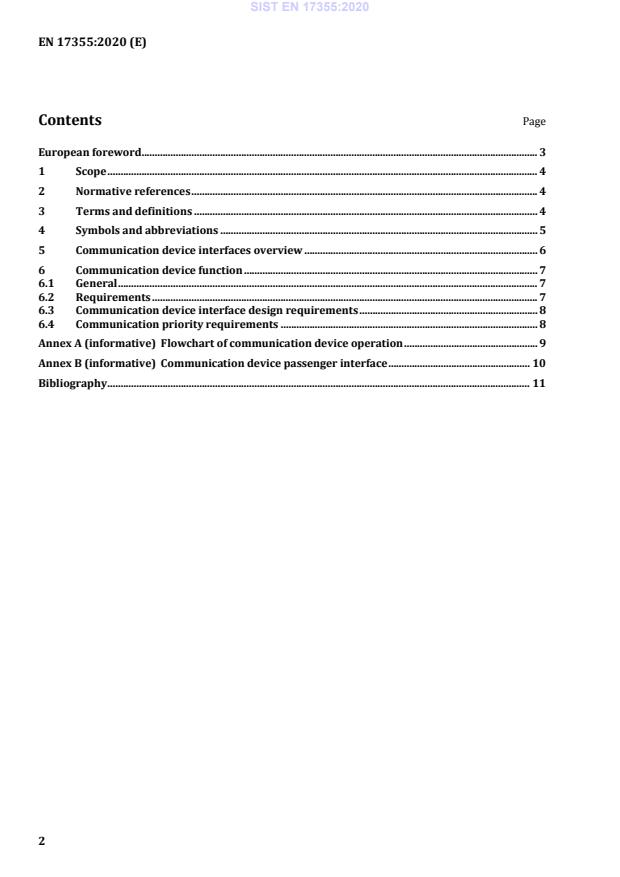
Contents Page
European foreword . 3
1 Scope . 4
2 Normative references . 4
3 Terms and definitions . 4
4 Symbols and abbreviations . 5
5 Communication device interfaces overview . 6
6 Communication device function . 7
6.1 General . 7
6.2 Requirements . 7
6.3 Communication device interface design requirements . 8
6.4 Communication priority requirements . 8
Annex A (informative) Flowchart of communication device operation . 9
Annex B (informative) Communication device passenger interface . 10
Bibliography . 11
European foreword
This document (EN 17355:2020) has been prepared by Technical Committee CEN/TC 256 “Railway
applications”, the secretariat of which is held by DIN.
This European Standard shall be given the status of a national standard, either by publication of an
identical text or by endorsement, at the latest by February 2021, and conflicting national standards shall
be withdrawn at the latest by February 2021.
Attention is drawn to the possibility that some of the elements of this document may be the subject of
patent rights. CEN shall not be held responsible for identifying any or all such patent rights.
This document has been prepared under a mandate given to CEN by the European Commission and the
European Free Trade Association.
According to the CEN-CENELEC Internal Regulations, the national standards organisations of the
following countries are bound to implement this European Standard: Austria, Belgium, Bulgaria, Croatia,
Cyprus, Czech Republic, Denmark, Estonia, Finland, France, Germany, Greece, Hungary, Iceland, Ireland,
Italy, Latvia, Lithuania, Luxembourg, Malta, Netherlands, Norway, Poland, Portugal, Republic of North
Macedonia, Romania, Serbia, Slovakia, Slovenia, Spain, Sweden, Switzerland, Turkey and the United
Kingdom.
1 Scope
This document defines the following elements for urban rail rolling stock:
— the functional requirements for a communication device between passengers and driver or
operations control centre (OCC);
— the dynamic behaviour of the communication device.
This document is applicable to the categories I to III of urban rail rolling stock defined in
CEN/CLC Guide 26:
— (I) Metros;
— (II) Trams;
— (III) Light Rail.
NOTE 1 CEN/CLC Guide 26 defines metro, tram and light rail as public transport systems permanently guided at
least by one rail, intended for the operation of local, urban and suburban passenger services with self-propelled
vehicles and operated either segregated or not from general road and pedestrian traffic.
This document applies to urban rail rolling stock both with and without driver.
NOTE 2 The communication device is different from the PAS, but it can share some parts of the PAS to achieve
its functionalities.
NOTE 3 The PAS is regarded as a safety relevant system whereas communication device is non-safety relevant
aid to passengers.
2 Normative references
The following documents are referred to in the text in such a way that some or all of their content
constitutes requirements of this document. For dated references, only the edition cited applies. For
undated references, the latest edition of the referenced document (including any amendments) applies.
EN 16334-2, Railway applications — Passenger alarm system — Part 2: System requirements for urban rail
3 Terms and definitions
For the purposes of this document, the terms and definitions given in EN 16334-2 and the following apply.
ISO and IEC maintain terminological databases for use in standardization at the following addresses:
• IEC Electropedia: available at http://www.electropedia.org/
• ISO Online browsing platform: available at https://www.iso.org/obp/ui
3.1
authorized person
person involved in operational activities and who is authorized to deal with the situation following
communication device operation
Note 1 to entry: An authorized person could be, for example, a staff member on duty either on the urban rail
vehicle or at an OCC, as defined by operational rules.
3.2
communication device
system used to enable passengers to speak with authorized persons
3.3
communication device interface
interface used by passengers to communicate with authorized persons
3.4
driver only operation
DOO
train without authorized pe
...