

EN 16867:2020+A1:2021/prA2
(Amendment)Building hardware - Mechatronic door furniture - Requirements and test methods
- Abstract
1.1 General
This document applies to Mechatronic door furniture (MDF) fitted on the door set which gives the possibility to control the locking and/or release part through an electronic authorization means. This can be operable by credentials (i.e. card, code, biometric).
The MDF according to this document is combined with locks according to EN 12209, EN 14846, prEN 15685 or may be a part of an emergency exit device according to EN 179, EN 1125 or EN 13637.
The MDF may be standalone or linkable to an external control system.
The document would allow classifying the MDF upon several characteristics such as category of use, durability, environmental, security, and type of operating device.
The suitability of the MDF for use on fire or smoke-door assemblies is determined by fire resistance tests conducted in addition to the performance testing specified by this document.
1.2 Exclusions
This document does not cover:
- mechatronic cylinders according to EN 15684;
- electromechanical operated locks and striking plates according to EN 14846.
- Status
- Not Published
- Publication Date
- 26-Jun-2025
- Technical Committee
- CEN/TC 33 - Doors, windows, shutters and building hardware
- Drafting Committee
- CEN/TC 33/WG 4 - Building hardware
- Current Stage
- 4097 - End of interruption of work - split/merged
- Start Date
- 05-Sep-2024
- Completion Date
- 14-Oct-2026

Overview
EN 16867:2020+A1:2021/prA2 is a European standard developed by CEN that specifies requirements and test methods for mechatronic door furniture (MDF) used in building hardware. This standard applies to door furniture integrated on door sets that enable locking and unlocking through electronic authorization means, such as cards, codes, or biometric credentials. The document ensures that these advanced mechatronic components meet rigorous functional, durability, environmental, and security requirements to support modern access control systems.
Key to this standard is the classification of MDF according to use categories, durability, environmental resistance, security level, and type of electronic or mechanical operating devices. The standard also addresses the suitability of MDF for installation on fire and smoke control door assemblies, which requires additional fire resistance testing.
Key Topics
Scope and Application
EN 16867 covers standalone or networked MDF combined with locks compliant with EN 12209, EN 14846, or prEN 15685, and may be part of emergency exit devices per EN 179, EN 1125, or EN 13637. It excludes mechatronic cylinders per EN 15684 and electromechanical locks covered by EN 14846.Electronic Authorization Systems
Operation via credentials such as RFID cards, PIN codes, or biometric data enhances building security by enabling controlled access and monitoring.Performance and Durability Testing
The standard outlines test methods to ensure MDF’s mechanical durability, resistance to environmental factors, and reliability under frequent use.Fire and Smoke Door Compatibility
Detailed provisions ensure MDF’s compliance with fire and smoke protection requirements, supported by relevant fire resistance testing and national regulations.Classification System
MDF products are classified by:- Usage category (public, residential, commercial)
- Durability levels (operational cycles)
- Environmental conditions (temperature, humidity)
- Security features (tamper resistance, electronic security)
- Type of operating device (keypad, card reader, biometric sensor)
Applications
Commercial Buildings: MDF provides secure and flexible access control in offices, retail spaces, and public facilities, increasing safety through electronic authorization and audit trails.
Residential Complexes: Enables convenient, secure entry without physical keys, supporting modern smart home and apartment building access management.
Emergency Exit Doors: Integration with emergency exit devices ensures compliance with safety regulations while maintaining controlled access under normal conditions.
Smart Building Systems: Linkable MDF components can integrate with external control systems, enabling centralized security management and enhanced operational efficiency.
Fire and Safety Doors: Ensures compliance with fire safety standards, maintaining building safety without compromising access control.
Related Standards
- EN 12209: Hardware for locks and latches - Requirements and test methods
- EN 14846: Electromechanical locks and striking plates
- EN 15685 (prEN): Further lock standards under development
- EN 179, EN 1125, EN 13637: Emergency exit devices and panic hardware
- EN 15684: Mechatronic cylinders (excluded in EN 16867)
Practical Value
EN 16867:2020+A1:2021/prA2 provides manufacturers, specifiers, and installers with a harmonized framework to design, test, and implement mechatronic door furniture that meets European safety, security, and quality benchmarks. By complying with this standard, products achieve higher trustworthiness, ensure compatibility with fire safety regulations, and support the growing demand for electronic access control in building infrastructure.
Adopting this standard facilitates innovation in smart locks, enhances building security through electronic authorization, and contributes to safer, smarter built environments worldwide.
Relations
- Effective Date
- 28-Feb-2024
- Effective Date
- 21-Dec-2022
Get Certified
Connect with accredited certification bodies for this standard

DIBt (Deutsches Institut für Bautechnik)
German Institute for Building Technology.
DIN CERTCO
DIN Group product certification.

Aboma Certification B.V.
Specialized in construction, metal, and transport sectors.
Sponsored listings
Frequently Asked Questions
EN 16867:2020+A1:2021/prA2 is a draft published by the European Committee for Standardization (CEN). Its full title is "Building hardware - Mechatronic door furniture - Requirements and test methods". This standard covers: 1.1 General This document applies to Mechatronic door furniture (MDF) fitted on the door set which gives the possibility to control the locking and/or release part through an electronic authorization means. This can be operable by credentials (i.e. card, code, biometric). The MDF according to this document is combined with locks according to EN 12209, EN 14846, prEN 15685 or may be a part of an emergency exit device according to EN 179, EN 1125 or EN 13637. The MDF may be standalone or linkable to an external control system. The document would allow classifying the MDF upon several characteristics such as category of use, durability, environmental, security, and type of operating device. The suitability of the MDF for use on fire or smoke-door assemblies is determined by fire resistance tests conducted in addition to the performance testing specified by this document. 1.2 Exclusions This document does not cover: - mechatronic cylinders according to EN 15684; - electromechanical operated locks and striking plates according to EN 14846.
1.1 General This document applies to Mechatronic door furniture (MDF) fitted on the door set which gives the possibility to control the locking and/or release part through an electronic authorization means. This can be operable by credentials (i.e. card, code, biometric). The MDF according to this document is combined with locks according to EN 12209, EN 14846, prEN 15685 or may be a part of an emergency exit device according to EN 179, EN 1125 or EN 13637. The MDF may be standalone or linkable to an external control system. The document would allow classifying the MDF upon several characteristics such as category of use, durability, environmental, security, and type of operating device. The suitability of the MDF for use on fire or smoke-door assemblies is determined by fire resistance tests conducted in addition to the performance testing specified by this document. 1.2 Exclusions This document does not cover: - mechatronic cylinders according to EN 15684; - electromechanical operated locks and striking plates according to EN 14846.
EN 16867:2020+A1:2021/prA2 is classified under the following ICS (International Classification for Standards) categories: 91.190 - Building accessories. The ICS classification helps identify the subject area and facilitates finding related standards.
EN 16867:2020+A1:2021/prA2 has the following relationships with other standards: It is inter standard links to EN 16867:2020+A2:2024, EN 16867:2020+A1:2021. Understanding these relationships helps ensure you are using the most current and applicable version of the standard.
EN 16867:2020+A1:2021/prA2 is available in PDF format for immediate download after purchase. The document can be added to your cart and obtained through the secure checkout process. Digital delivery ensures instant access to the complete standard document.
Standards Content (Sample)
SLOVENSKI STANDARD
01-junij-2023
Stavbno okovje - Mehatronsko okovje za vrata - Zahteve in preskusne metode -
Dopolnilo A2
Building hardware - Mechatronic door furniture - Requirements and test methods
Schlösser und Baubeschläge - Mechatronische Türbeschläge - Anforderungen und
Prüfverfahren
Quincaillerie pour le bâtiment - Poignée de porte mécatronique - Exigences et méthodes
d'essai
Ta slovenski standard je istoveten z: EN 16867:2020+A1:2021/prA2
ICS:
91.190 Stavbna oprema Building accessories
SIST EN en,fr,de
16867:2020+A1:2022/oprA2:2023
2003-01.Slovenski inštitut za standardizacijo. Razmnoževanje celote ali delov tega standarda ni dovoljeno.
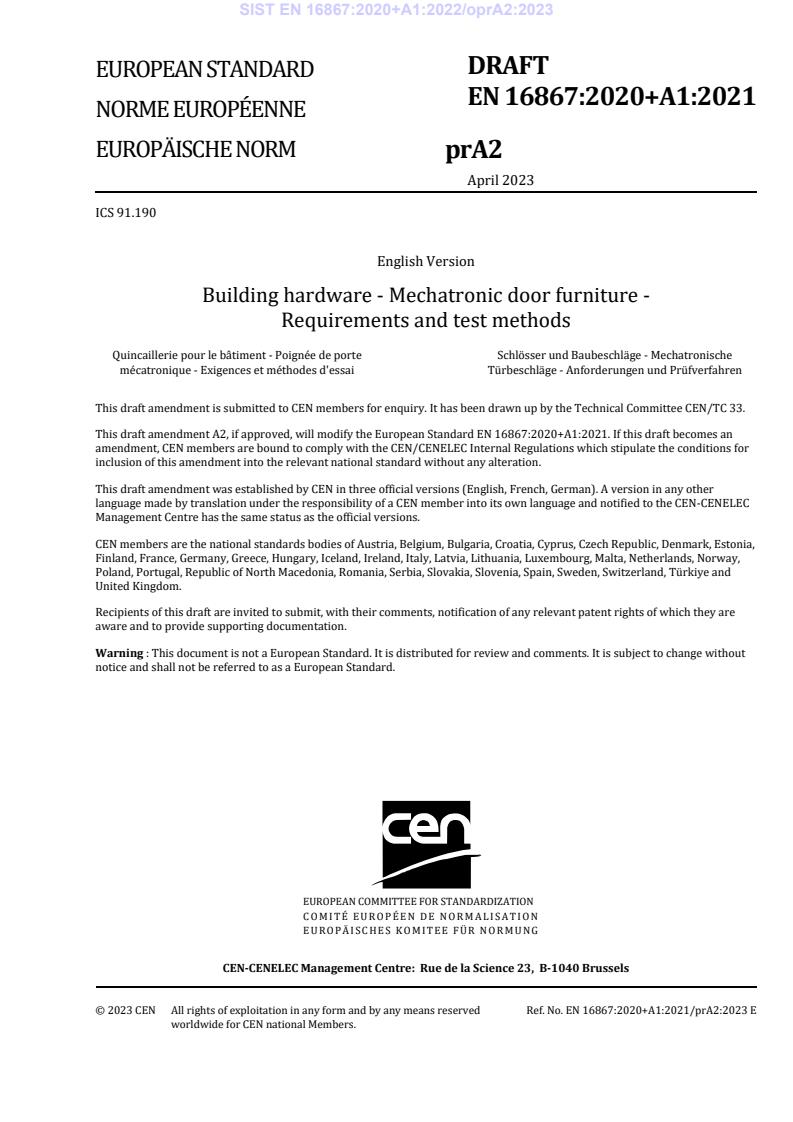
DRAFT
EUROPEAN STANDARD
EN 16867:2020+A1:2021
NORME EUROPÉENNE
EUROPÄISCHE NORM
prA2
April 2023
ICS 91.190
English Version
Building hardware - Mechatronic door furniture -
Requirements and test methods
Quincaillerie pour le bâtiment - Poignée de porte Schlösser und Baubeschläge - Mechatronische
mécatronique - Exigences et méthodes d'essai Türbeschläge - Anforderungen und Prüfverfahren
This draft amendment is submitted to CEN members for enquiry. It has been drawn up by the Technical Committee CEN/TC 33.
This draft amendment A2, if approved, will modify the European Standard EN 16867:2020+A1:2021. If this draft becomes an
amendment, CEN members are bound to comply with the CEN/CENELEC Internal Regulations which stipulate the conditions for
inclusion of this amendment into the relevant national standard without any alteration.
This draft amendment was established by CEN in three official versions (English, French, German). A version in any other
language made by translation under the responsibility of a CEN member into its own language and notified to the CEN-CENELEC
Management Centre has the same status as the official versions.
CEN members are the national standards bodies of Austria, Belgium, Bulgaria, Croatia, Cyprus, Czech Republic, Denmark, Estonia,
Finland, France, Germany, Greece, Hungary, Iceland, Ireland, Italy, Latvia, Lithuania, Luxembourg, Malta, Netherlands, Norway,
Poland, Portugal, Republic of North Macedonia, Romania, Serbia, S
...