Industrial trucks - Electromagnetic compatibility

This European Standard is applicable to industrial trucks, regardless of the power source (called only trucks) as defined in ISO/DIS 5053 1, and their electrical/electronic systems when used in residential, commercial, light industry and industrial environments (specified in EN 61000-6-3:2007 and EN 61000-6-2:2005).
This European Standard specifies:
-   the requirements and the limit values for electromagnetic emission and immunity to external electromagnetic fields;
-   the procedure and criteria for testing trucks and their electrical/electronic systems.
This European Standard is not applicable to:
-   non-stacking low-lift straddle carriers;
-   stacking high-lift straddle carriers;
-   any pedestrian propelled trucks, excepted those which are equipped with load handling devices which have electrical powered lifting devices;
-   trucks intended for use in the public domain ) with maximum speed exceeding 30 km/h;
-   positioning system of driverless industrial trucks;
-   interaction between systems on the trucks;
-   interference to on-board radio equipment;
-   equipment connected to AC-mains which is only used when the truck is not being operated (e.g. on board charger).

Flurförderzeuge - Elektromagnetische Verträglichkeit

Diese Europäische Norm gilt für Flurförderzeuge, unabhängig von der Energiequelle, wie in ISO 5053 1:2015 definiert, und ihre elektrischen/elektronischen Systeme, die im Wohnbereichen, Geschäfts- und Gewerbebe-reichen sowie in Industriebereichen eingesetzt werden (festgelegt in EN 61000 6 3:2007 und EN 61000 6 2:2005).
Diese Europäische Norm legt fest:
–   Anforderungen und Grenzwerte für die elektromagnetische Störaussendung und Störfestigkeit gegen äußere elektromagnetische Felder;
–   Prüfverfahren und -kriterien für Flurförderzeuge und ihre elektrischen/elektronischen Systeme.
Diese Europäische Norm gilt nicht für:
–   nicht stapelfähige Niederhub-Portalhubwagen;
–   stapelfähige Hochhub-Portalhubwagen;
–   handbetriebene Flurförderzeuge, außer denen, die mit elektrisch betriebenen Hubeinrichtungen ausge-stattet sind;
–   Flurförderzeuge mit einer Höchstgeschwindigkeit über 30 km/h, die für den Einsatz in öffentlichen Bereichen  vorgesehen sind;
–   Positioniersysteme von fahrerlosen Flurförderzeugen;
–   Wechselwirkungen zwischen den Systemen auf Flurförderzeugen;
–   Störeinflüsse auf Funkanlagen im Flurförderzeug;
–   Ausrüstungen, die mit dem Netz verbunden werden und nur arbeiten, wenn das Flurförderzeug nicht in Betrieb ist (z. B. Onboard-Ladegerät).

Chariots de manutention - Compatibilité électromagnétique

Vozila za talni transport - Elektromagnetna združljivost - Dopolnilo A1

Ta evropski standard se uporablja za vozila za talni transport ne glede na vrsto pogona (imenovana samo vozila), kot določa ISO/DIS 5053 1, in njihove električne/elektronske sisteme, ki se uporabljajo v stanovanjskih, poslovnih, manj zahtevnih industrijskih ter industrijskih okoljih (glej EN 61000-6-3:2007 in EN 61000-6-2:2005).
Ta evropski standard določa:
–   zahteve in mejne vrednosti za elektromagnetne emisije in odpornost na zunanja elektromagnetna polja;
–   postopek in merila za preskušanje vozil in njihovih električnih/elektronskih sistemov.
Ta evropski standard se ne uporablja za:
–   nakladalnike za nizko dvigovanje brez zlaganja;
–   nakladalnike za visoko dvigovanje brez zlaganja;
–   ročno gnana vozila, razen tistih, ki so opremljena z napravami za upravljanje tovora in imajo dvižne naprave na električni pogon;
–   vozila, namenjena za uporabo v javnem prevozu z največjo hitrostjo nad 30 km/h;
–   vozila za talni transport brez voznika in njihove sisteme;
–   medsebojni vpliv med sistemi na vozilih;
–   motnje vgrajene radijske opreme;
–   opremo, ki je povezana z električnim omrežjem in se uporablja samo v času, ko vozilo ni upravljano (vgrajeni polnilnik).

General Information

Status
Published
Publication Date
27-Aug-2019
Current Stage
9093 - Decision to confirm - Review Enquiry
Start Date
15-Apr-2021
Completion Date
14-Apr-2025

Relations

Overview

EN 12895:2015+A1:2019 - "Industrial trucks - Electromagnetic compatibility" (CEN) defines electromagnetic emission and immunity requirements for industrial trucks and their electrical/electronic systems used in residential, commercial, light-industrial and industrial environments. The standard sets test procedures, limits and acceptance criteria for EMC (electromagnetic compatibility) of self‑propelled trucks (per ISO 5053-1), helping manufacturers and test laboratories verify that truck electrical systems do not cause or suffer unacceptable electromagnetic interference.

Key topics and technical requirements

  • Scope and exclusions

    • Applies to industrial trucks regardless of power source; excludes certain straddle carriers, most pedestrian-propelled trucks (except those with electrically powered lifting devices), driverless truck positioning systems, and trucks >30 km/h intended for public domain.
    • Does not cover interference to on‑board radio equipment or AC‑mains equipment used only when the truck is not operated (e.g., on‑board chargers).
  • Emission limits

    • Electric field at 10 m, antenna height 3 m:
      • 30–75 MHz: 34 dBµV/m
      • 75–400 MHz: 34 → 45 dBµV/m (increasing with frequency)
      • 400–1 000 MHz: 45 dBµV/m
  • Immunity requirements

    • Radiated RF immunity (EN 61000‑4‑3 based):
      • 27–1 000 MHz: 20 V/m (80% AM, 1 kHz)
      • >1.0–2.0 GHz: 3 V/m (80% AM)
      • >2.0–2.7 GHz: 1 V/m (80% AM)
    • Electrostatic discharge (EN 61000‑4‑2): 8 kV contact, 15 kV air
    • Power‑frequency magnetic fields (EN 61000‑4‑8): examples include 0 Hz @ 1 000 A/m (3 s) and 50 Hz @ 30 A/m (3 s) (test arrangements described in the standard).
  • Test approaches

    • Two routes: complete‑truck testing or electrical/electronic system testing with components configured as in the truck.
    • Specific test procedures for driving systems, load‑handling drives, power steering and auxiliary electrical equipment are included.
    • Test report and criteria defined; Annex ZA maps to EMC Directive requirements.

Applications - who uses this standard

  • Truck manufacturers (OEMs) - design and validate EMC performance of trucks and subsystems.
  • Component suppliers / electrical system designers - verify immunity and emissions for motors, controllers, steering systems and auxiliary electronics.
  • Test laboratories and certification bodies - perform standardized EMC testing for market access and CE compliance.
  • Compliance, safety and procurement teams - assess vendor conformity to EMC limits for warehouse, retail and industrial environments.

Related standards

  • EN 61000‑6‑3 (emission for residential/commercial/light industrial)
  • EN 61000‑6‑2 (immunity for industrial environments)
  • EN 61000‑4‑3, EN 61000‑4‑2, EN 61000‑4‑8 (immunity test methods)
  • EN 55012, EN 55016 series (measurement apparatus and disturbance methods)
  • ISO 5053‑1, EN ISO 3691‑1 (truck classification and safety)

Keywords: EN 12895, electromagnetic compatibility, industrial trucks, EMC testing, emission limits, immunity requirements, truck electrical systems, CEN standard.

Standard
EN 12895:2015+A1:2019
English language
18 pages
sale 10% off
Preview
sale 10% off
Preview
e-Library read for
1 day
Standard
EN 12895:2015+A1:2019
English language
18 pages
sale 10% off
Preview
sale 10% off
Preview
e-Library read for
1 day

Frequently Asked Questions

EN 12895:2015+A1:2019 is a standard published by the European Committee for Standardization (CEN). Its full title is "Industrial trucks - Electromagnetic compatibility". This standard covers: This European Standard is applicable to industrial trucks, regardless of the power source (called only trucks) as defined in ISO/DIS 5053 1, and their electrical/electronic systems when used in residential, commercial, light industry and industrial environments (specified in EN 61000-6-3:2007 and EN 61000-6-2:2005). This European Standard specifies: - the requirements and the limit values for electromagnetic emission and immunity to external electromagnetic fields; - the procedure and criteria for testing trucks and their electrical/electronic systems. This European Standard is not applicable to: - non-stacking low-lift straddle carriers; - stacking high-lift straddle carriers; - any pedestrian propelled trucks, excepted those which are equipped with load handling devices which have electrical powered lifting devices; - trucks intended for use in the public domain ) with maximum speed exceeding 30 km/h; - positioning system of driverless industrial trucks; - interaction between systems on the trucks; - interference to on-board radio equipment; - equipment connected to AC-mains which is only used when the truck is not being operated (e.g. on board charger).

This European Standard is applicable to industrial trucks, regardless of the power source (called only trucks) as defined in ISO/DIS 5053 1, and their electrical/electronic systems when used in residential, commercial, light industry and industrial environments (specified in EN 61000-6-3:2007 and EN 61000-6-2:2005). This European Standard specifies: - the requirements and the limit values for electromagnetic emission and immunity to external electromagnetic fields; - the procedure and criteria for testing trucks and their electrical/electronic systems. This European Standard is not applicable to: - non-stacking low-lift straddle carriers; - stacking high-lift straddle carriers; - any pedestrian propelled trucks, excepted those which are equipped with load handling devices which have electrical powered lifting devices; - trucks intended for use in the public domain ) with maximum speed exceeding 30 km/h; - positioning system of driverless industrial trucks; - interaction between systems on the trucks; - interference to on-board radio equipment; - equipment connected to AC-mains which is only used when the truck is not being operated (e.g. on board charger).

EN 12895:2015+A1:2019 is classified under the following ICS (International Classification for Standards) categories: 33.100.01 - Electromagnetic compatibility in general; 53.060 - Industrial trucks. The ICS classification helps identify the subject area and facilitates finding related standards.

EN 12895:2015+A1:2019 has the following relationships with other standards: It is inter standard links to EN 12895:2015, EN 12895:2015/prA1:2018. Understanding these relationships helps ensure you are using the most current and applicable version of the standard.

EN 12895:2015+A1:2019 is associated with the following European legislation: EU Directives/Regulations: 2014/30/EU; Standardization Mandates: M/552. When a standard is cited in the Official Journal of the European Union, products manufactured in conformity with it benefit from a presumption of conformity with the essential requirements of the corresponding EU directive or regulation.

You can purchase EN 12895:2015+A1:2019 directly from iTeh Standards. The document is available in PDF format and is delivered instantly after payment. Add the standard to your cart and complete the secure checkout process. iTeh Standards is an authorized distributor of CEN standards.

Standards Content (Sample)


SLOVENSKI STANDARD
01-november-2019
Vozila za talni transport - Elektromagnetna združljivost - Dopolnilo A1
Industrial trucks - Electromagnetic compatibility
Flurförderzeuge - Elektromagnetische Verträglichkeit
Chariots de manutention - Compatibilité électromagnétique
Ta slovenski standard je istoveten z: EN 12895:2015+A1:2019
ICS:
33.100.01 Elektromagnetna združljivost Electromagnetic compatibility
na splošno in general
53.060 Industrijski tovornjaki Industrial trucks
2003-01.Slovenski inštitut za standardizacijo. Razmnoževanje celote ali delov tega standarda ni dovoljeno.

EN 12895:2015+A1
EUROPEAN STANDARD
NORME EUROPÉENNE
August 2019
EUROPÄISCHE NORM
ICS 33.100.01; 53.060 Supersedes EN 12895:2015
English Version
Industrial trucks - Electromagnetic compatibility
Chariots de manutention - Compatibilité Flurförderzeuge - Elektromagnetische Verträglichkeit
électromagnétique
This European Standard was approved by CEN on 17 July 2015 and includes Amendment 1 approved by CEN on 12 February
2019.
CEN members are bound to comply with the CEN/CENELEC Internal Regulations which stipulate the conditions for giving this
European Standard the status of a national standard without any alteration. Up-to-date lists and bibliographical references
concerning such national standards may be obtained on application to the CEN-CENELEC Management Centre or to any CEN
member.
This European Standard exists in three official versions (English, French, German). A version in any other language made by
translation under the responsibility of a CEN member into its own language and notified to the CEN-CENELEC Management
Centre has the same status as the official versions.

CEN members are the national standards bodies of Austria, Belgium, Bulgaria, Croatia, Cyprus, Czech Republic, Denmark, Estonia,
Finland, France, Germany, Greece, Hungary, Iceland, Ireland, Italy, Latvia, Lithuania, Luxembourg, Malta, Netherlands, Norway,
Poland, Portugal, Republic of North Macedonia, Romania, Serbia, Slovakia, Slovenia, Spain, Sweden, Switzerland, Turkey and
United Kingdom.
EUROPEAN COMMITTEE FOR STANDARDIZATION
COMITÉ EUROPÉEN DE NORMALISATION

EUROPÄISCHES KOMITEE FÜR NORMUNG

CEN-CENELEC Management Centre: Rue de la Science 23, B-1040 Brussels
© 2019 CEN All rights of exploitation in any form and by any means reserved Ref. No. EN 12895:2015+A1:2019 E
worldwide for CEN national Members.

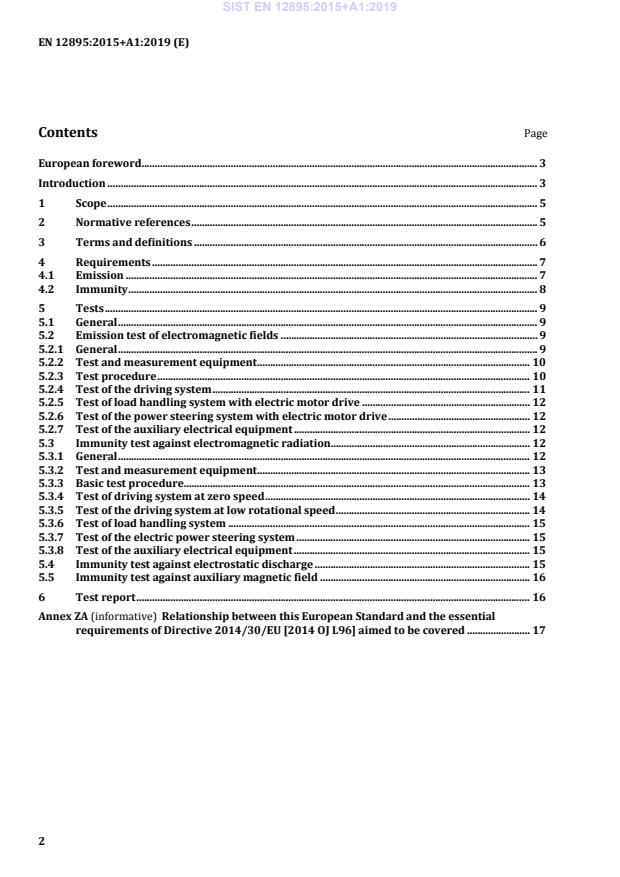
Contents Page
European foreword . 3
Introduction . 3
1 Scope . 5
2 Normative references . 5
3 Terms and definitions . 6
4 Requirements . 7
4.1 Emission . 7
4.2 Immunity . 8
5 Tests . 9
5.1 General . 9
5.2 Emission test of electromagnetic fields . 9
5.2.1 General . 9
5.2.2 Test and measurement equipment . 10
5.2.3 Test procedure . 10
5.2.4 Test of the driving system . 11
5.2.5 Test of load handling system with electric motor drive . 12
5.2.6 Test of the power steering system with electric motor drive . 12
5.2.7 Test of the auxiliary electrical equipment . 12
5.3 Immunity test against electromagnetic radiation . 12
5.3.1 General . 12
5.3.2 Test and measurement equipment . 13
5.3.3 Basic test procedure . 13
5.3.4 Test of driving system at zero speed . 14
5.3.5 Test of the driving system at low rotational speed . 14
5.3.6 Test of load handling system . 15
5.3.7 Test of the electric power steering system . 15
5.3.8 Test of the auxiliary electrical equipment . 15
5.4 Immunity test against electrostatic discharge . 15
5.5 Immunity test against auxiliary magnetic field . 16
6 Test report . 16
Annex ZA (informative) Relationship between this European Standard and the essential
requirements of Directive 2014/30/EU [2014 OJ L96] aimed to be covered . 17

European foreword
This document (EN 12895:2015+A1:2019) has been prepared by Technical Committee CEN/TC 150
“Industrial trucks - Safety”, the secretariat of which is held by BSI.
This European Standard shall be given the status of a national standard, either by publication of an
identical text or by endorsement, at the latest by February 2020, and conflicting national standards
shall be withdrawn at the latest by February 2020.
Attention is drawn to the possibility that some of the elements of this document may be the subject of
patent rights. CEN [and/or CENELEC] shall not be held responsible for identifying any or all such patent
rights.
This document includes Amendment 1 approved by CEN on 12 February 2019.
This document supersedes !EN 12895:2015".
The start and finish of text introduced or altered by amendment is indicated in the text by tags !".
!The main changes compared to the previous version are:
− updated normative references;
− new Annex ZA;
− minor typographic corrections."
This document has been prepared under a mandate given to CEN by the European Commission and the
European Free Trade Association, and supports essential requirements of EU Directive(s).
For relationship with EU Directive(s), see informative !Annex ZA, which is" an integral part of this
document.
According to the CEN-CENELEC Internal Regulations, the national standards organisations of the
following countries are bound to implement this European Standard: Austria, Belgium, Bulgaria,
Croatia, Cyprus, Czech Republic, Denmark, Estonia, Finland, France, Germany, Greece, Hungary, Iceland,
Ireland, Italy, Latvia, Lithuania, Luxembourg, Malta, Netherlands, Norway, Poland, Portugal, Republic of
North Macedonia, Romania, Serbia, Slovakia, Slovenia, Spain, Sweden, Switzerland, Turkey and the
United Kingdom.
Introduction
With the use of electronic devices in areas where industrial trucks operate, there is a need to ensure
that industrial trucks are provided with adequate immunity to external electromagnetic fields. As
industrial trucks are fitted with electrical and electronic devices, there is a need to ensure that emission
of electromagnetic fields from the trucks meets acceptable limits.
High frequency electrical disturbances emerge during the normal operation of many parts of the
industrial trucks and systems. They are generated within a large frequency range with different
electrical characteristics.
Electrostatic discharges are relevant to industrial trucks.
The test methods and acceptance criteria included in this document are suitable for industrial trucks in
view the specific characteristics and the operating parameters of this machinery; the tests have been
designed to reflect the construction of industrial trucks.
Two approaches are described to achieve compliance:
— complete truck tests;
— electrical/electronic systems with the components in the same configuration as in the truck.
In some situations trucks can be foreseen to be used in environments where the level of electro-
magnetic disturbances are likely to exceed the test levels within the scope of this European Standard. In
these situations, levels and/or frequencies outside the specified test parameters will need to be applied.
In addition, many areas are not homogeneous for their EMC classification; for example, hospitals and
airports have areas with different levels of classifications, for the areas outside the generic standard
definitions special rules can be applicable.
1 Scope
This European Standard is applicable to industrial trucks, regardless of the power source (called only
trucks) as defined in !ISO 5053-1:2015", and their electrical/electronic systems when used in
residential, commercial, light industry and industrial environments (specified in EN 61000-6-3:2007
and EN 61000-6-2:2005).
This European Standard specifies:
— the requirements and the limit values for electromagnetic emission and immunity to external
electromagnetic fields;
— the procedure and criteria for testing trucks and their electrical/electronic systems.
This European Standard is not applicable to:
— non-stacking low-lift straddle carriers;
— stacking high-lift straddle carriers;
— any pedestrian propelled trucks, excepted those which are equipped with load handling devices
which have electrical powered lifting devices;
1)
— trucks intended for use in the public domain with maximum speed exceeding 30 km/h;
— positioning system of driverless industrial trucks;
— interaction between systems on the trucks;
— interference to on-board radio equipment;
— equipment connected to AC-mains which is only used when the truck is not being operated (e.g. on
board charger).
2 Normative references
The following documents, in whole or in part, are normatively referenced in this document and are
indispensable for its application. For dated references, only the edition cited applies. For undated
references, the latest edition of the referenced document (including any amendments) applies.
2)
!EN 55012:2007 , Vehicles, boats and internal combustion engines - Radio disturbance characteristics
- Limits and methods of measurement for the protection of off-board receivers"
3)
!EN 55016-1-1:2010 , Specification for radio disturbance and immunity measuring apparatus and
methods — Part-1-1: Radio disturbance and immunity measuring apparatus — Measuring apparatus
(CISPR 16-1-1:2010)"
4)
!EN 55016-1-4:2010 , Specification for radio disturbance and immunity measuring apparatus and
methods — Part 1-4: Radio disturbance and immunity measuring apparatus — Antennas and test sites for
radiated disturbance measurements (CISPR 16-1-4:2010)"

1) For trucks used in the public domain, other specific European Directives and national requirements are to be applied.
!2) This document is impacted by the amendment EN 55012:2007/A1:2009."
!3) This document is impacted by the amendments EN 55016-1-1:2010/A1:2010 and EN 55016-1-1:2010/A2:2014."
!EN 55016-2-3:2017, Specification for radio disturbance and immunity measuring apparatus and
methods - Part 2-3: Methods of measurement of disturbances and immunity - Radiated disturbance
measurements"
!EN 61000-4-2:2009", Electromagnetic compatibility (EMC) — Part 4-2: Testing and measurement
techniques — Electrostatic discharge immunity test (IEC 61000-4-2)
5)
!EN 61000-4-3:2006 ", Electromagnetic compatibility (EMC) — Part 4-3: Testing and measurement
techniques — Radiated, radio-frequency, electromagnetic field immunity test (IEC 61000-4-3)
!EN 61000-4-8:2010", Electromagnetic compatibility (EMC) — Part 4-8: Testing and measurement
techniques — Power frequency magnetic field immunity test (IEC 61000-4-8)
EN 61000-6-2:2005, Electromagnetic compatibility (EMC) — Part 6-2: Generic standards — Immunity for
industrial environments (IEC 61000-6-2:2005)
6)
!EN 61000-6-3:2007 ", Electromagnetic compatibility (EMC) — Part 6-3: Generic standards —
Emission standard for residential, commercial and light-industrial environments (IEC 61000-6-3:2006)
!EN ISO 3691-1:2015", Industrial trucks — Safety requirements and verification — Part 1: Self-
propelled industrial trucks, other than driverless trucks, variable-reach trucks and burden-carrier trucks
(ISO 3691-1:2011)
!ISO 5053-1:2015, Industrial trucks - Terminology and classification - Part 1: Types of industrial
trucks"
3 Terms and definitions
For the purposes of this document, the terms and definitions given in applicable parts of EN ISO 3691
and the following apply.
3.1
test sample
truck and/or electrical/electronic system, electrical machines, system configuration for subjecting to
type test
Note 1 to entry: Motors and generators are examples of electrical machines.
Note 2 to entry: The system configuration is set up with maximum cable and harness lengths.
3.2
electrical/electronic system
electrical/electronic component(s) or a set of components intended to be part of a machine together
with any associated electrical connections and wiring, that performs one or more specialized functions
and operates on its own
Note 1 to entry: Also referred to as system.

!4) This document is impacted by the amendments EN 55016-1-4:2010/A1:2012 and EN 55016-1-4:2010/A2:2017."
!5) This document is impacted by the amendments EN 61000-4-3:2006/A1:2008 and EN 61000-4-3:2006/A2:2010."
!6) This document is impacted by the amendment EN 61000-6-3:2007/A1:2011."
3.3
narrowband emission
emission that has a bandwidth less than that of a measuring apparatus or receiver
Note 1 to entry: The bandwidth set at 9 kHz from 0,15 MHz - 30 MHz and 120 kHz above 30 MHz.
Note 2 to entry: Electrical components will radiate emissions of narrow- or broadband type.
3.4
broadband emission
emission that has a bandwidth greater than that of a measuring apparatus or receiver
Note 1 to entry: The bandwidth set at 9 kHz from 0,15 MHz - 30 MHz and 120 kHz above 30 MHz.
Note 2 to entry: High voltage ignition system will radiate broadband emissions.
4 Requirements
4.1 Emission
For trucks/systems the limit values for the electric field at 10 m distance from the truck with an
antenna height of 3 m shall be in accordance with Figure 1.
30 MHz to 75 MHz 34 dB μV/m
75 MHz to 400 MHz 34 dB μV/m to 45 dB μV/m increasing in direct proportion with the
frequency
400 MHz to 1 000 MHz 45 dB μV/m

Key
1 electric field (dB µV/m)
2 frequency (MHz)
Figure 1 — Maximum limits of electromagnetic emissions
For trucks that can be connected to the AC-mains network while operational, in addition to the above
the limits stated in !Table 1 of EN 61000-6-3:2007" shall be met.
4.2 Immunity
For trucks/systems the immunity to electromagnetic environments shall be above or equal to the limit
values specified in Table 1 when tested in accordance to the test methods specified in Table 1.
Table 1 — Immunity - Enclosure port
Test in
Environmental Limit
Units Normative references accordance
Phenomena values
with clause
1. Truck
1.1 Electromagnetic field:  !EN 61000-4-3:2006" 5.3
- Frequency 27 – 1 000 MHz
- Strength 20 V/m
(unmodulated,rms)
- Amplitude 80 % AM (1 kHz)
modulated
1.2 Electromagnetic field:  !EN 61000-4-3:2006" 5.3
- Frequency >1,0 – 2,0 GHz
- Strength 3 V/m
(unmodulated,rms)
- Amplitude 80 % AM (1 kHz)
modulated
1.3 Electromagnetic field:  !EN 61000-4-3:2006" 5.3
- Frequency > 2,0 – 2,7 GHz
- Strength 1 V/m
...


SLOVENSKI STANDARD
01-november-2019
Vozila za talni transport - Elektromagnetna združljivost - Dopolnilo A1
Industrial trucks - Electromagnetic compatibility
Flurförderzeuge - Elektromagnetische Verträglichkeit
Chariots de manutention - Compatibilité électromagnétique
Ta slovenski standard je istoveten z: EN 12895:2015+A1:2019
ICS:
33.100.01 Elektromagnetna združljivost Electromagnetic compatibility
na splošno in general
53.060 Industrijski tovornjaki Industrial trucks
2003-01.Slovenski inštitut za standardizacijo. Razmnoževanje celote ali delov tega standarda ni dovoljeno.

EN 12895:2015+A1
EUROPEAN STANDARD
NORME EUROPÉENNE
August 2019
EUROPÄISCHE NORM
ICS 33.100.01; 53.060 Supersedes EN 12895:2015
English Version
Industrial trucks - Electromagnetic compatibility
Chariots de manutention - Compatibilité Flurförderzeuge - Elektromagnetische Verträglichkeit
électromagnétique
This European Standard was approved by CEN on 17 July 2015 and includes Amendment 1 approved by CEN on 12 February
2019.
CEN members are bound to comply with the CEN/CENELEC Internal Regulations which stipulate the conditions for giving this
European Standard the status of a national standard without any alteration. Up-to-date lists and bibliographical references
concerning such national standards may be obtained on application to the CEN-CENELEC Management Centre or to any CEN
member.
This European Standard exists in three official versions (English, French, German). A version in any other language made by
translation under the responsibility of a CEN member into its own language and notified to the CEN-CENELEC Management
Centre has the same status as the official versions.

CEN members are the national standards bodies of Austria, Belgium, Bulgaria, Croatia, Cyprus, Czech Republic, Denmark, Estonia,
Finland, France, Germany, Greece, Hungary, Iceland, Ireland, Italy, Latvia, Lithuania, Luxembourg, Malta, Netherlands, Norway,
Poland, Portugal, Republic of North Macedonia, Romania, Serbia, Slovakia, Slovenia, Spain, Sweden, Switzerland, Turkey and
United Kingdom.
EUROPEAN COMMITTEE FOR STANDARDIZATION
COMITÉ EUROPÉEN DE NORMALISATION

EUROPÄISCHES KOMITEE FÜR NORMUNG

CEN-CENELEC Management Centre: Rue de la Science 23, B-1040 Brussels
© 2019 CEN All rights of exploitation in any form and by any means reserved Ref. No. EN 12895:2015+A1:2019 E
worldwide for CEN national Members.

Contents Page
European foreword . 3
Introduction . 3
1 Scope . 5
2 Normative references . 5
3 Terms and definitions . 6
4 Requirements . 7
4.1 Emission . 7
4.2 Immunity . 8
5 Tests . 9
5.1 General . 9
5.2 Emission test of electromagnetic fields . 9
5.2.1 General . 9
5.2.2 Test and measurement equipment . 10
5.2.3 Test procedure . 10
5.2.4 Test of the driving system . 11
5.2.5 Test of load handling system with electric motor drive . 12
5.2.6 Test of the power steering system with electric motor drive . 12
5.2.7 Test of the auxiliary electrical equipment . 12
5.3 Immunity test against electromagnetic radiation . 12
5.3.1 General . 12
5.3.2 Test and measurement equipment . 13
5.3.3 Basic test procedure . 13
5.3.4 Test of driving system at zero speed . 14
5.3.5 Test of the driving system at low rotational speed . 14
5.3.6 Test of load handling system . 15
5.3.7 Test of the electric power steering system . 15
5.3.8 Test of the auxiliary electrical equipment . 15
5.4 Immunity test against electrostatic discharge . 15
5.5 Immunity test against auxiliary magnetic field . 16
6 Test report . 16
Annex ZA (informative) Relationship between this European Standard and the essential
requirements of Directive 2014/30/EU [2014 OJ L96] aimed to be covered . 17

European foreword
This document (EN 12895:2015+A1:2019) has been prepared by Technical Committee CEN/TC 150
“Industrial trucks - Safety”, the secretariat of which is held by BSI.
This European Standard shall be given the status of a national standard, either by publication of an
identical text or by endorsement, at the latest by February 2020, and conflicting national standards
shall be withdrawn at the latest by February 2020.
Attention is drawn to the possibility that some of the elements of this document may be the subject of
patent rights. CEN [and/or CENELEC] shall not be held responsible for identifying any or all such patent
rights.
This document includes Amendment 1 approved by CEN on 12 February 2019.
This document supersedes !EN 12895:2015".
The start and finish of text introduced or altered by amendment is indicated in the text by tags !".
!The main changes compared to the previous version are:
− updated normative references;
− new Annex ZA;
− minor typographic corrections."
This document has been prepared under a mandate given to CEN by the European Commission and the
European Free Trade Association, and supports essential requirements of EU Directive(s).
For relationship with EU Directive(s), see informative !Annex ZA, which is" an integral part of this
document.
According to the CEN-CENELEC Internal Regulations, the national standards organisations of the
following countries are bound to implement this European Standard: Austria, Belgium, Bulgaria,
Croatia, Cyprus, Czech Republic, Denmark, Estonia, Finland, France, Germany, Greece, Hungary, Iceland,
Ireland, Italy, Latvia, Lithuania, Luxembourg, Malta, Netherlands, Norway, Poland, Portugal, Republic of
North Macedonia, Romania, Serbia, Slovakia, Slovenia, Spain, Sweden, Switzerland, Turkey and the
United Kingdom.
Introduction
With the use of electronic devices in areas where industrial trucks operate, there is a need to ensure
that industrial trucks are provided with adequate immunity to external electromagnetic fields. As
industrial trucks are fitted with electrical and electronic devices, there is a need to ensure that emission
of electromagnetic fields from the trucks meets acceptable limits.
High frequency electrical disturbances emerge during the normal operation of many parts of the
industrial trucks and systems. They are generated within a large frequency range with different
electrical characteristics.
Electrostatic discharges are relevant to industrial trucks.
The test methods and acceptance criteria included in this document are suitable for industrial trucks in
view the specific characteristics and the operating parameters of this machinery; the tests have been
designed to reflect the construction of industrial trucks.
Two approaches are described to achieve compliance:
— complete truck tests;
— electrical/electronic systems with the components in the same configuration as in the truck.
In some situations trucks can be foreseen to be used in environments where the level of electro-
magnetic disturbances are likely to exceed the test levels within the scope of this European Standard. In
these situations, levels and/or frequencies outside the specified test parameters will need to be applied.
In addition, many areas are not homogeneous for their EMC classification; for example, hospitals and
airports have areas with different levels of classifications, for the areas outside the generic standard
definitions special rules can be applicable.
1 Scope
This European Standard is applicable to industrial trucks, regardless of the power source (called only
trucks) as defined in !ISO 5053-1:2015", and their electrical/electronic systems when used in
residential, commercial, light industry and industrial environments (specified in EN 61000-6-3:2007
and EN 61000-6-2:2005).
This European Standard specifies:
— the requirements and the limit values for electromagnetic emission and immunity to external
electromagnetic fields;
— the procedure and criteria for testing trucks and their electrical/electronic systems.
This European Standard is not applicable to:
— non-stacking low-lift straddle carriers;
— stacking high-lift straddle carriers;
— any pedestrian propelled trucks, excepted those which are equipped with load handling devices
which have electrical powered lifting devices;
1)
— trucks intended for use in the public domain with maximum speed exceeding 30 km/h;
— positioning system of driverless industrial trucks;
— interaction between systems on the trucks;
— interference to on-board radio equipment;
— equipment connected to AC-mains which is only used when the truck is not being operated (e.g. on
board charger).
2 Normative references
The following documents, in whole or in part, are normatively referenced in this document and are
indispensable for its application. For dated references, only the edition cited applies. For undated
references, the latest edition of the referenced document (including any amendments) applies.
2)
!EN 55012:2007 , Vehicles, boats and internal combustion engines - Radio disturbance characteristics
- Limits and methods of measurement for the protection of off-board receivers"
3)
!EN 55016-1-1:2010 , Specification for radio disturbance and immunity measuring apparatus and
methods — Part-1-1: Radio disturbance and immunity measuring apparatus — Measuring apparatus
(CISPR 16-1-1:2010)"
4)
!EN 55016-1-4:2010 , Specification for radio disturbance and immunity measuring apparatus and
methods — Part 1-4: Radio disturbance and immunity measuring apparatus — Antennas and test sites for
radiated disturbance measurements (CISPR 16-1-4:2010)"

1) For trucks used in the public domain, other specific European Directives and national requirements are to be applied.
!2) This document is impacted by the amendment EN 55012:2007/A1:2009."
!3) This document is impacted by the amendments EN 55016-1-1:2010/A1:2010 and EN 55016-1-1:2010/A2:2014."
!EN 55016-2-3:2017, Specification for radio disturbance and immunity measuring apparatus and
methods - Part 2-3: Methods of measurement of disturbances and immunity - Radiated disturbance
measurements"
!EN 61000-4-2:2009", Electromagnetic compatibility (EMC) — Part 4-2: Testing and measurement
techniques — Electrostatic discharge immunity test (IEC 61000-4-2)
5)
!EN 61000-4-3:2006 ", Electromagnetic compatibility (EMC) — Part 4-3: Testing and measurement
techniques — Radiated, radio-frequency, electromagnetic field immunity test (IEC 61000-4-3)
!EN 61000-4-8:2010", Electromagnetic compatibility (EMC) — Part 4-8: Testing and measurement
techniques — Power frequency magnetic field immunity test (IEC 61000-4-8)
EN 61000-6-2:2005, Electromagnetic compatibility (EMC) — Part 6-2: Generic standards — Immunity for
industrial environments (IEC 61000-6-2:2005)
6)
!EN 61000-6-3:2007 ", Electromagnetic compatibility (EMC) — Part 6-3: Generic standards —
Emission standard for residential, commercial and light-industrial environments (IEC 61000-6-3:2006)
!EN ISO 3691-1:2015", Industrial trucks — Safety requirements and verification — Part 1: Self-
propelled industrial trucks, other than driverless trucks, variable-reach trucks and burden-carrier trucks
(ISO 3691-1:2011)
!ISO 5053-1:2015, Industrial trucks - Terminology and classification - Part 1: Types of industrial
trucks"
3 Terms and definitions
For the purposes of this document, the terms and definitions given in applicable parts of EN ISO 3691
and the following apply.
3.1
test sample
truck and/or electrical/electronic system, electrical machines, system configuration for subjecting to
type test
Note 1 to entry: Motors and generators are examples of electrical machines.
Note 2 to entry: The system configuration is set up with maximum cable and harness lengths.
3.2
electrical/electronic system
electrical/electronic component(s) or a set of components intended to be part of a machine together
with any associated electrical connections and wiring, that performs one or more specialized functions
and operates on its own
Note 1 to entry: Also referred to as system.

!4) This document is impacted by the amendments EN 55016-1-4:2010/A1:2012 and EN 55016-1-4:2010/A2:2017."
!5) This document is impacted by the amendments EN 61000-4-3:2006/A1:2008 and EN 61000-4-3:2006/A2:2010."
!6) This document is impacted by the amendment EN 61000-6-3:2007/A1:2011."
3.3
narrowband emission
emission that has a bandwidth less than that of a measuring apparatus or receiver
Note 1 to entry: The bandwidth set at 9 kHz from 0,15 MHz - 30 MHz and 120 kHz above 30 MHz.
Note 2 to entry: Electrical components will radiate emissions of narrow- or broadband type.
3.4
broadband emission
emission that has a bandwidth greater than that of a measuring apparatus or receiver
Note 1 to entry: The bandwidth set at 9 kHz from 0,15 MHz - 30 MHz and 120 kHz above 30 MHz.
Note 2 to entry: High voltage ignition system will radiate broadband emissions.
4 Requirements
4.1 Emission
For trucks/systems the limit values for the electric field at 10 m distance from the truck with an
antenna height of 3 m shall be in accordance with Figure 1.
30 MHz to 75 MHz 34 dB μV/m
75 MHz to 400 MHz 34 dB μV/m to 45 dB μV/m increasing in direct proportion with the
frequency
400 MHz to 1 000 MHz 45 dB μV/m

Key
1 electric field (dB µV/m)
2 frequency (MHz)
Figure 1 — Maximum limits of electromagnetic emissions
For trucks that can be connected to the AC-mains network while operational, in addition to the above
the limits stated in !Table 1 of EN 61000-6-3:2007" shall be met.
4.2 Immunity
For trucks/systems the immunity to electromagnetic environments shall be above or equal to the limit
values specified in Table 1 when tested in accordance to the test methods specified in Table 1.
Table 1 — Immunity - Enclosure port
Test in
Environmental Limit
Units Normative references accordance
Phenomena values
with clause
1. Truck
1.1 Electromagnetic field:  !EN 61000-4-3:2006" 5.3
- Frequency 27 – 1 000 MHz
- Strength 20 V/m
(unmodulated,rms)
- Amplitude 80 % AM (1 kHz)
modulated
1.2 Electromagnetic field:  !EN 61000-4-3:2006" 5.3
- Frequency >1,0 – 2,0 GHz
- Strength 3 V/m
(unmodulated,rms)
- Amplitude 80 % AM (1 kHz)
modulated
1.3 Electromagnetic field:  !EN 61000-4-3:2006" 5.3
- Frequency > 2,0 – 2,7 GHz
- Strength 1 V/m
...

Questions, Comments and Discussion

Ask us and Technical Secretary will try to provide an answer. You can facilitate discussion about the standard in here.

Loading comments...

SIST EN 12895:2015+A1:2019 は、産業用トラックの電磁両立性に関する欧州標準であり、幅広い適用範囲を持っています。この標準は、ISO/DIS 5053 1で定義された産業用トラックに適用され、住居、商業、軽工業および産業環境で使用される電気/電子システムに関する要件を明確に定めています。 この標準の強みは、電磁放射と外部電磁場に対する免疫の要件および限界値を詳述している点です。これにより、産業用トラックが様々な環境で安定して稼働できることを保障します。また、トラックやその電子システムの試験手順及び評価基準も詳細に説明されており、実用性が高いです。 さらに、SIST EN 12895:2015+A1:2019は、工業界での利用において非常に重要な基準です。電磁両立性の要求を満たすことは、製品の性能と安全性を確保するために不可欠であり、特に電子機器が増加する中で、製品が他の機器に悪影響を与えないことを保証します。 ただし、この標準は一部のトラック、例えば非スタッキングの低リフトストラドルキャリアや公道での使用を目的とした最高速度が30 km/hを超えるトラックには適用されません。この明確な範囲設定により、適用対象を明確にし、必要な基準を特定する助けとなります。 総じて、SIST EN 12895:2015+A1:2019は、電磁両立性の適用において重要なガイドラインを提供し、産業用トラックの安全かつ効率的な運用を支える優れた標準といえます。

The standard EN 12895:2015+A1:2019 provides a comprehensive framework for ensuring electromagnetic compatibility in industrial trucks, covering a diverse range of power sources and their respective electrical and electronic systems. Its applicability extends across various environments, including residential, commercial, light industry, and industrial settings, aligning with the stipulations outlined in EN 61000-6-3:2007 and EN 61000-6-2:2005. A notable strength of this standard is its clear specification of requirements and limit values for electromagnetic emissions and immunity to external electromagnetic fields. This precision helps manufacturers and operators establish a clear benchmark for performance, fostering a safer and more reliable operation of industrial trucks in different environments. Furthermore, it outlines the procedures and criteria necessary for testing the electrical and electronic systems of trucks, which enhances accountability and compliance within the industry. However, the standard has defined exclusions that ensure focus on relevant applications. It explicitly does not apply to various categories of trucks such as non-stacking low-lift straddle carriers and stacking high-lift straddle carriers, along with certain pedestrian-propelled trucks and devices not in use while operating. This strategic limitation helps refine the standard's relevance, ensuring it addresses scenarios that can impact electromagnetic compatibility effectively. Overall, EN 12895:2015+A1:2019 stands as an essential standard that underlines the importance of electromagnetic compatibility in industrial trucks, contributing to improved safety, performance, and compliance across a wide range of operational contexts. The precise definitions and criteria provided enhance the authority of the standard while remaining highly pertinent to current industry needs.

SIST EN 12895:2015+A1:2019 표준은 산업 트럭에 대한 전자기 호환성을 규명하는 중요한 문서로, 다양한 전원 공급원에 관계없이 적용됩니다. 이 표준의 주요 범위는 주거, 상업 및 경공업, 산업 환경에서 사용되는 산업 트럭 및 그 전기/전자 시스템에 대한 요구 사항 및 한계값을 명시하고 있어, 현대 산업 환경에서의 적용성을 높이고 있습니다. 이 표준의 강점 중 하나는 전자기 방출 및 외부 전자기 필드에 대한 면역성을 규정하는 명확한 요구 사항을 제공한다는 점입니다. 문제 발생 시 신속하게 대응할 수 있도록 test 절차와 기준을 포함하고 있어, 사용자와 제조업체 모두에게 중요한 기준이 됩니다. 이로 인해, 기업은 새로운 제품이 이러한 전자기적 기준을 준수하도록 사전에 검증할 수 있습니다. 또한, SIST EN 12895:2015+A1:2019은 산업 트럭 관련 다양한 시스템 간의 상호작용이나 드라이버리스 산업 트럭의 위치 지정 시스템 같은 특정 분야는 제외하고 있어, 보다 칼슘한 적용 범위를 형성하고 있습니다. 이러한 요소는 사용자가 필요로 하는 특정 조건에 맞춰 표준을 준수할 수 있도록 돕습니다. 결론적으로, SIST EN 12895:2015+A1:2019 표준은 산업 트럭의 전자기 호환성을 확보하는 데 매우 중요한 역할을 하며, 각기 다른 환경과 조건에서의 안정성과 신뢰성 보장을 위해 필수적입니다. 이 표준은 현대의 전자기 환경에서 산업 트럭의 안전성과 효율성을 높이는 데 기여하고 있습니다.

Die Norm EN 12895:2015+A1:2019 zu elektromagnetischer Verträglichkeit von Flurförderzeugen bietet einen umfassenden Rahmen für die Einhaltung von Sicherheits- und Leistungsstandards in verschiedenen Einsatzbereichen. Diese europäische Norm ist besonders relevant für industrielle Gabelstapler unabhängig von der Energiequelle, da sie Anforderungen und Grenzwerte für elektromagnetische Emissionen sowie die Immunität gegenüber externen elektromagnetischen Feldern definiert. Ein großes Plus der Norm ist die Klarheit, mit der sie die Prüfverfahren und Kriterien zur Bewertung der elektrischen und elektronischen Systeme von Flurförderzeugen festlegt. Dies stärkt nicht nur das Vertrauen der Anwender in die Sicherheitsstandards, sondern erleichtert auch Herstellern die Einhaltung gesetzlicher Vorgaben. Die Norm berücksichtigt dabei vielseitige Anwendungsumgebungen, darunter Wohn-, Handels- und leichte Industriegebiete sowie industrielle Umgebungen, was ihre Anwendbarkeit in der Praxis erheblich erhöht. Ein weiterer bedeutender Aspekt ist die detaillierte Abgrenzung der Norm hinsichtlich ihrer Anwendbarkeit. Es werden genau diejenigen Flurförderzeuge ausgeschlossen, die nicht in den Geltungsbereich fallen, wie z.B. nicht stapelbare Niederhubwagen und Geh-Universalkarren, was eine gezielte Fokussierung auf relevante Fahrzeugtypen ermöglicht. Diese Präzision verhindert Missverständnisse und sorgt dafür, dass nur die entsprechenden Produkte und Systeme unter diese Norm fallen. Die Relevanz der Norm steigt in Anbetracht der fortschreitenden Technologisierung der Industrie, wo elektromagnetische Störungen gravierende Auswirkungen auf die Funktionalität von Flurförderzeugen haben können. Mit der Norm EN 12895:2015+A1:2019 wird ein wichtiger Leitfaden geboten, um die Wechselwirkungen zwischen elektrischen Systemen und den jeweiligen Einsatzbedingungen zu adressieren. Insgesamt ist die Norm EN 12895:2015+A1:2019 ein entscheidendes Dokument für die Sicherstellung der elektromagnetischen Verträglichkeit von Flurförderzeugen, da sie nicht nur detaillierte Anforderungen formuliert, sondern auch ein hohes Maß an Klarheit und Fokussierung bietet, die sowohl Herstellern als auch Nutzern zugutekommt.

La norme SIST EN 12895:2015+A1:2019 se révèle essentielle pour garantir la compatibilité électromagnétique des chariots industriels, qu'ils soient à hydrogène, électriques ou à combustion. Le champ d'application de cette norme est particulièrement pertinent, car elle couvre non seulement les chariots utilisés dans divers environnements tels que résidentiels, commerciaux et industriels, mais elle clarifie également les exigences concernant les systèmes électriques et électroniques associés. Parmi les points forts de cette norme, on note l'établissement de valeurs limites précises en matière d'émissions électromagnétiques et d'immunité face aux champs électromagnétiques externes. Cela constitue un atout majeur pour les fabricants et les utilisateurs de chariots industriels, car cela leur permet de s'assurer que leurs équipements ne perturbent pas d'autres appareils et restent fonctionnels dans des environnements électromagnétiques complexes. De plus, le document propose une procédure de test claire, accompagnée de critères définis pour les chariots et leurs systèmes électriques et électroniques, garantissant ainsi une approche systématique pour évaluer la conformité. La norme exclut certains types de chariots, tels que les transporteurs à faible levée non empilables et les chariots à propulsion piétonne, reliant ce cadre réglementaire spécifiquement aux dispositifs dotés de systèmes de levage électriques. Cela permet d'éviter des confusions sur l'applicabilité de la norme à différents équipements. En résumé, la norme SIST EN 12895:2015+A1:2019 est un instrument fondamental pour le secteur des chariots industriels, apportant une structure nécessaire à la conformité électromagnétique dans un monde où les contraintes électromagnétiques sont de plus en plus surveillées. Sa révision récente souligne son adaptation continue aux défis technologiques et environnementaux contemporains.

SIST EN 12895:2015+A1:2019는 산업 트럭의 전자기 호환성에 관한 유럽 표준으로, 전원 공급원에 관계없이 산업 트럭과 그 전기/전자 시스템에 적용됩니다. 이 표준은 주거, 상업, 경량 산업 및 산업 환경에서의 사용을 대상으로 하며, 전자기 방출 및 외부 전자기 필드에 대한 면역성에 대한 요구 사항 및 한계 값을 명시하고 있습니다. 이 표준의 강점은 명확하게 규정된 시험 절차와 기준입니다. 이를 통해 산업 트럭의 전기/전자 시스템의 안전성과 신뢰성을 높이고, 다양한 환경에서의 성능을 보장합니다. 또한, 전자기 간섭을 최소화하도록 설계되어, 사용자와 주변 장비의 안전성을 강화하는 데 기여합니다. SIST EN 12895:2015+A1:2019는 전자기 호환성에 대한 필수 기준을 제공하여, 제조업체가 제품을 설계하고 인증하는 데 있어 중요한 가이드라인 역할을 합니다. 이를 통해 산업 트럭에 대한 국제적 신뢰성을 확보하고, 유럽 시장에서의 경쟁력을 높이는 데 중요한 기초를 마련합니다. 다만, 이 표준은 몇 가지 특정 장비에 대해서는 적용되지 않으며, 비적재 저상 스트래들 캐리어, 보행자 추진 트럭(전기 구동 리프팅 장비가 장착되지 않은 경우) 및 공공 도메인에서 사용되는 고속 트럭 등은 제외됩니다. 이러한 범위를 명확히 함으로써, SIST EN 12895:2015+A1:2019는 사용자와 제조업체가 준수해야 할 명확한 기준을 제공하며, 관련 업계의 표준화를 촉진하는 데 기여합니다.

Die Norm EN 12895:2015+A1:2019 befasst sich mit der elektromagnetischen Verträglichkeit von Industriefahrzeugen, wobei der Fokus auf den elektrischen und elektronischen Systemen dieser Fahrzeuge lieg. Diese europäische Norm findet Anwendung auf verschiedene Arten von Industriefahrzeugen, gleichgültig welche Energiequelle sie nutzen. Sie adressiert Betriebe in Wohn-, Handels-, Leichtindustrie- und Industrieumgebungen und schafft damit einen umfassenden Rahmen für den sicheren Betrieb in diesen Sektoren. Ein großes Stärke der Norm liegt in der detaillierten Festlegung von Anforderungen und Grenzwerten für elektromagnetische Emissionen sowie der Immunität gegenüber externen elektromagnetischen Feldern. Durch diese Anforderungen wird sichergestellt, dass Industriefahrzeuge in unterschiedlichen Umgebungen zuverlässig und ohne Beeinträchtigungen durch elektromagnetische Störungen arbeiten können. Darüber hinaus werden die Verfahren und Kriterien für die Prüfung der Fahrzeuge und ihrer elektrischen/elektronischen Systeme klar spezifiziert, was zu einer einheitlichen Überprüfung und Qualitätssicherung beiträgt. Die Relevanz der Norm EN 12895:2015+A1:2019 wird durch ihre umfassende Anwendbarkeit unterstrichen. Sie ist entscheidend für Hersteller und Betreiber von Industriefahrzeugen, die sicherstellen müssen, dass ihre Geräte den aktuellen Standards für elektromagnetische Verträglichkeit entsprechen. Indem sie spezifische Parameter für den Betrieb in verschiedenen Umgebungen festlegt, ermöglicht diese Norm eine gezielte Nutzung und Implementierung von Sicherheitsmaßnahmen, was die allgemeine Betriebssicherheit erhöht. Zusammenfassend bietet die Norm nicht nur klare Vorgaben zur Sicherstellung der elektromagnetischen Verträglichkeit von Industriefahrzeugen, sondern spielt auch eine zentrale Rolle in der Qualitätssicherung und Betriebssicherheit in verschiedenen Anwendungsbereichen – ein unverzichtbares Dokument für alle Akteure in diesem Sektor.

The EN 12895:2015+A1:2019 standard is a comprehensive and pivotal document addressing the electromagnetic compatibility of industrial trucks. Its primary scope extends to all types of industrial trucks, regardless of their power source, ensuring that they meet stringent requirements in various environments such as residential, commercial, light industry, and more robust industrial settings. This versatility underscores the standard’s significant relevance across multiple sectors. One of the key strengths of this standard is its clear specification of the requirements and limit values for electromagnetic emissions and immunity against external electromagnetic fields. This focus ensures that industrial trucks operate without causing detrimental interference to nearby electronic systems, which is critical in environments rich in electronic devices. Furthermore, the inclusion of precise testing procedures and criteria for evaluating the electrical and electronic systems of trucks enhances the reliability of compliance and performance. The delineation of non-applicable vehicles such as non-stacking low-lift straddle carriers and specific pedestrian propelled trucks ensures that the standard maintains clarity in its application. By excluding certain types of trucks, EN 12895:2015+A1:2019 directs attention to those vehicles most likely to impact electromagnetic environments, thus concentrating resources and compliance efforts where they are most needed. Overall, the standard’s structured approach to defining electromagnetic compatibility in industrial trucks provides a strong foundation for manufacturers, users, and regulatory bodies. Its emphasis on ensuring electrical systems in trucks are rigorously tested against electromagnetic interference fosters a safer and more efficient operational landscape across industries, highlighting its enduring significance in the realm of industrial machinery and technology.

La norme EN 12895:2015+A1:2019, intitulée "Trucks industriels – Compatibilité électromagnétique", constitue un document fondamental pour l'évaluation des camions industriels, quels que soient leur type de source d'énergie. Elle se concentre sur les systèmes électriques et électroniques utilisés dans divers environnements tels que résidentiels, commerciaux et industriels, offrant ainsi une large portée. Un des points forts de cette norme est la clarté des exigences qu'elle établit concernant les émissions électromagnétiques et l'immunité aux champs électromagnétiques externes. Les limites précises pour ces éléments permettent aux fabricants et aux utilisateurs de s'assurer que les camions respectent des critères de performance optimaux pour opérer en toute sécurité et efficacité dans des environnements diversifiés. De plus, la norme fournit des procédures et des critères de test détaillés pour les camions et leurs systèmes électromagnétiques, ce qui renforce la confiance des utilisateurs quant à la conformité des équipements avec les réglementations en matière d'électromagnétisme. Cela est particulièrement pertinent dans un cadre de plus en plus réglementé où la sécurité et la fiabilité des équipements industriels sont primordiales. Cependant, il est important de noter que la norme ne s'applique pas à certains types de véhicules, tels que les chariots à mât bas non empilables ou les véhicules propulsés par des piétons (à l'exception de ceux équipés de dispositifs de levage électriques). Cette limitation souligne le besoin de spécificités dans le cadre d’applications particulières, assujettissant certaines configurations à d’autres standards ou exigences. En somme, la norme EN 12895:2015+A1:2019 est d'une grande pertinence pour le secteur des camions industriels, car elle garantit une approche structurée et systématique en matière de compatibilité électromagnétique. Sa capacité à adresser les besoins d'un éventail d'applications tout en énonçant des critères clairs et rigoureux fait de ce document un outil essentiel pour les professionnels du secteur.

SIST EN 12895:2015+A1:2019は、工業用トラックに関する重要な標準化文書であり、特に電磁両立性に焦点を当てています。この標準の適用範囲は広く、電源の種類に関係なく工業用トラックとその電気/電子システムに適用されます。これは、住宅、商業、軽工業、および工業環境において使用されることが想定されています。 この標準の強みは、電磁放射と外部の電磁場に対する耐性に関する要件や制限値を明確に定義している点です。これにより、トラックの安全性と信頼性が保証され、製品が市場での競争力を高める要因となります。また、トラックとその電気/電子システムの試験手順および基準が具体的に示されているため、製造業者は規制遵守を効率よく行なうことができます。 さらに、この文書は適用外の機器についても詳細に説明しており、例えば、特定のストラドルキャリアや30 km/hを超える公道用のトラックなどが含まれています。この明確な区分は、業界関係者が自社製品の適用性を判断する際に役立ちます。 SIST EN 12895:2015+A1:2019は、産業界全体における電磁両立性の達成に寄与し、製造元とユーザーが安定した製品を提供できるようにするための重要な指針となります。そのため、この標準の理解と遵守は、工業用トラックの安全で持続可能な使用のために不可欠です。