

EN ISO 19123-1:2023
(Main)Geographic information - Schema for coverage geometry and functions - Part 1: Fundamentals (ISO 19123-1:2023)
General Information
- Abstract
This document defines a conceptual schema for coverages. A coverage is a mapping from a spatial, temporal or spatiotemporal domain to attribute values sharing the same attribute type. A coverage domain consists of a collection of direct positions in a coordinate space that can be defined in terms of spatial and/or temporal dimensions, as well as non-spatiotemporal (in ISO 19111:2019, “parametric”) dimensions. Examples of coverages include point clouds, grids, meshes, triangulated irregular networks, and polygon sets. Coverages are the prevailing data structures in a number of application areas, such as remote sensing, meteorology and mapping of depth, elevation, soil and vegetation. This document defines the coverage concept including the relationship between the domain of a coverage and its associated attribute range. This document defines the characteristics of the domain. The characteristics of the attribute range are not defined in this document, but are defined in implementation standards. Consequently, the standardization target of this document consists of implementation standards, not concrete implementations themselves.
- Status
- Published
- Publication Date
- 04-Jul-2023
- Technical Committee
- CEN/TC 287 - Geographic Information
- Drafting Committee
- CEN/TC 287 - Geographic Information
- Current Stage
- 6060 - Definitive text made available (DAV) - Publishing
- Start Date
- 05-Jul-2023
- Completion Date
- 05-Jul-2023


Overview
EN ISO 19123-1:2023 (ISO 19123-1:2023) defines a conceptual schema for coverages in the geographic information domain. A coverage is described as a mapping from a spatial, temporal or spatiotemporal domain to attribute values that share the same type. This Part 1 document establishes the fundamental concepts and relationships - notably the coverage domain (collection of direct positions in coordinate space) and the connection to the coverage’s attribute range. The standard is deliberately conceptual: it specifies characteristics of domains and realization variants but leaves attribute-range details to implementation standards.
Key Topics
- Coverage concept and classification
- Formal definition of coverages and how domains map to ranges.
- Coverage classification along topological and dimensional axes (spatial, temporal, parametric).
- Domain characteristics
- Direct positions, coordinate types (mathematical vs physical), and coordinate reference systems (CRS) - referencing ISO 19111:2019 for parametric dimensions.
- Range and realization views
- Geometry/value pair, domain/range, partitioned and functional views that support different implementation strategies.
- Interpolation and sampling
- Concepts of interpolation, discrete vs continuous coverages and probing via functions such as evaluate().
- Specific coverage types
- Definitions and characteristics for multi-point, grid, multi-curve, multi-surface, TINs, and multi-solid coverages.
- Grid-related topics: grid definitions, grid axis types, rectified & referenceable grids, and cell layouts (pixel-in-centre vs pixel-in-corner).
- Conformance and testing
- Conformance clauses and normative annexes (including conformance tests) that guide interoperability verification.
Applications
EN ISO 19123-1:2023 is applicable wherever coverage data structures are used:
- Remote sensing and Earth observation (raster/gridded products)
- Meteorology and climate modeling (spatiotemporal fields)
- Bathymetry, elevation and terrain mapping (grids, TINs)
- Soil science, vegetation monitoring and environmental modeling
- GIS software vendors, data modelers, standards bodies and integrators building interoperable coverage services and APIs
Who Should Use It
- GIS architects and data modelers designing coverage-aware systems
- Software developers implementing coverage services or APIs
- National mapping agencies, meteorological services and remote sensing product providers
- Standards committees and QA teams performing interoperability testing
Related Standards
- ISO 19111:2019 (coordinate reference systems and parametric dimensions)
- EN ISO 19123:2007 (superseded by EN ISO 19123-1:2023)
EN ISO 19123-1:2023 is a foundational reference for anyone implementing or standardizing coverage-based geographic information systems and ensures a consistent, interoperable conceptual basis for coverages across domains.
Relations
- Effective Date
- 17-Feb-2016
- Effective Date
- 25-Aug-2026
- Effective Date
- 25-Aug-2026
- Effective Date
- 09-Feb-2026
- Effective Date
- 28-Jan-2026
- Consolidated By
ISO 19123-1:2023 - Geographic information — Schema for coverage geometry and functions — Part 1: Fundamentals - Effective Date
- 12-Feb-2026
Get Certified
Connect with accredited certification bodies for this standard

BSI Group
BSI (British Standards Institution) is the business standards company that helps organizations make excellence a habit.

NYCE
Mexican standards and certification body.
Sponsored listings
Frequently Asked Questions
EN ISO 19123-1:2023 is a standard published by the European Committee for Standardization (CEN). Its full title is "Geographic information - Schema for coverage geometry and functions - Part 1: Fundamentals (ISO 19123-1:2023)". This standard covers: This document defines a conceptual schema for coverages. A coverage is a mapping from a spatial, temporal or spatiotemporal domain to attribute values sharing the same attribute type. A coverage domain consists of a collection of direct positions in a coordinate space that can be defined in terms of spatial and/or temporal dimensions, as well as non-spatiotemporal (in ISO 19111:2019, “parametric”) dimensions. Examples of coverages include point clouds, grids, meshes, triangulated irregular networks, and polygon sets. Coverages are the prevailing data structures in a number of application areas, such as remote sensing, meteorology and mapping of depth, elevation, soil and vegetation. This document defines the coverage concept including the relationship between the domain of a coverage and its associated attribute range. This document defines the characteristics of the domain. The characteristics of the attribute range are not defined in this document, but are defined in implementation standards. Consequently, the standardization target of this document consists of implementation standards, not concrete implementations themselves.
This document defines a conceptual schema for coverages. A coverage is a mapping from a spatial, temporal or spatiotemporal domain to attribute values sharing the same attribute type. A coverage domain consists of a collection of direct positions in a coordinate space that can be defined in terms of spatial and/or temporal dimensions, as well as non-spatiotemporal (in ISO 19111:2019, “parametric”) dimensions. Examples of coverages include point clouds, grids, meshes, triangulated irregular networks, and polygon sets. Coverages are the prevailing data structures in a number of application areas, such as remote sensing, meteorology and mapping of depth, elevation, soil and vegetation. This document defines the coverage concept including the relationship between the domain of a coverage and its associated attribute range. This document defines the characteristics of the domain. The characteristics of the attribute range are not defined in this document, but are defined in implementation standards. Consequently, the standardization target of this document consists of implementation standards, not concrete implementations themselves.
EN ISO 19123-1:2023 is classified under the following ICS (International Classification for Standards) categories: 35.240.70 - IT applications in science. The ICS classification helps identify the subject area and facilitates finding related standards.
EN ISO 19123-1:2023 has the following relationships with other standards: It is inter standard links to EN ISO 19123:2007, ISO 19111:2019, ISO 19107:2019, ISO 19103:2015, EN 15194:2017/FprA1:2022, ISO 19123-1:2023. Understanding these relationships helps ensure you are using the most current and applicable version of the standard.
EN ISO 19123-1:2023 is available in PDF format for immediate download after purchase. The document can be added to your cart and obtained through the secure checkout process. Digital delivery ensures instant access to the complete standard document.
Standards Content (Sample)
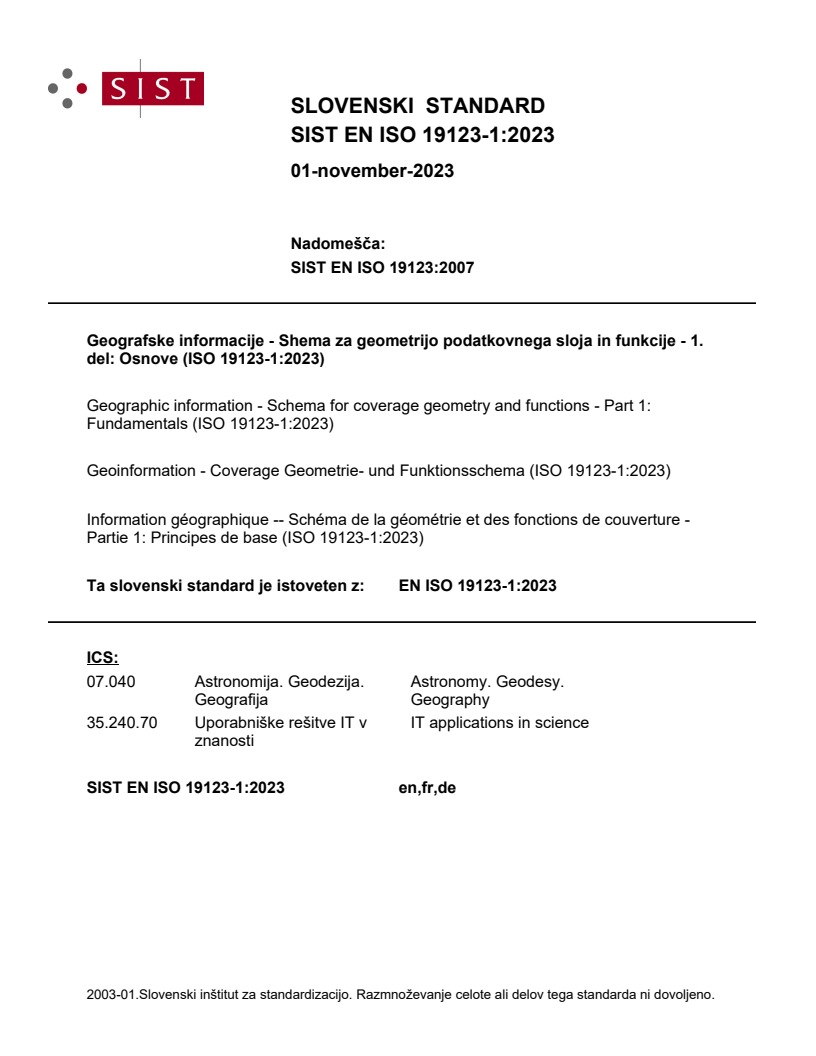
SLOVENSKI STANDARD
01-november-2023
Nadomešča:
SIST EN ISO 19123:2007
Geografske informacije - Shema za geometrijo podatkovnega sloja in funkcije - 1.
del: Osnove (ISO 19123-1:2023)
Geographic information - Schema for coverage geometry and functions - Part 1:
Fundamentals (ISO 19123-1:2023)
Geoinformation - Coverage Geometrie- und Funktionsschema (ISO 19123-1:2023)
Information géographique -- Schéma de la géométrie et des fonctions de couverture -
Partie 1: Principes de base (ISO 19123-1:2023)
Ta slovenski standard je istoveten z: EN ISO 19123-1:2023
ICS:
07.040 Astronomija. Geodezija. Astronomy. Geodesy.
Geografija Geography
35.240.70 Uporabniške rešitve IT v IT applications in science
znanosti
2003-01.Slovenski inštitut za standardizacijo. Razmnoževanje celote ali delov tega standarda ni dovoljeno.
EN ISO 19123-1
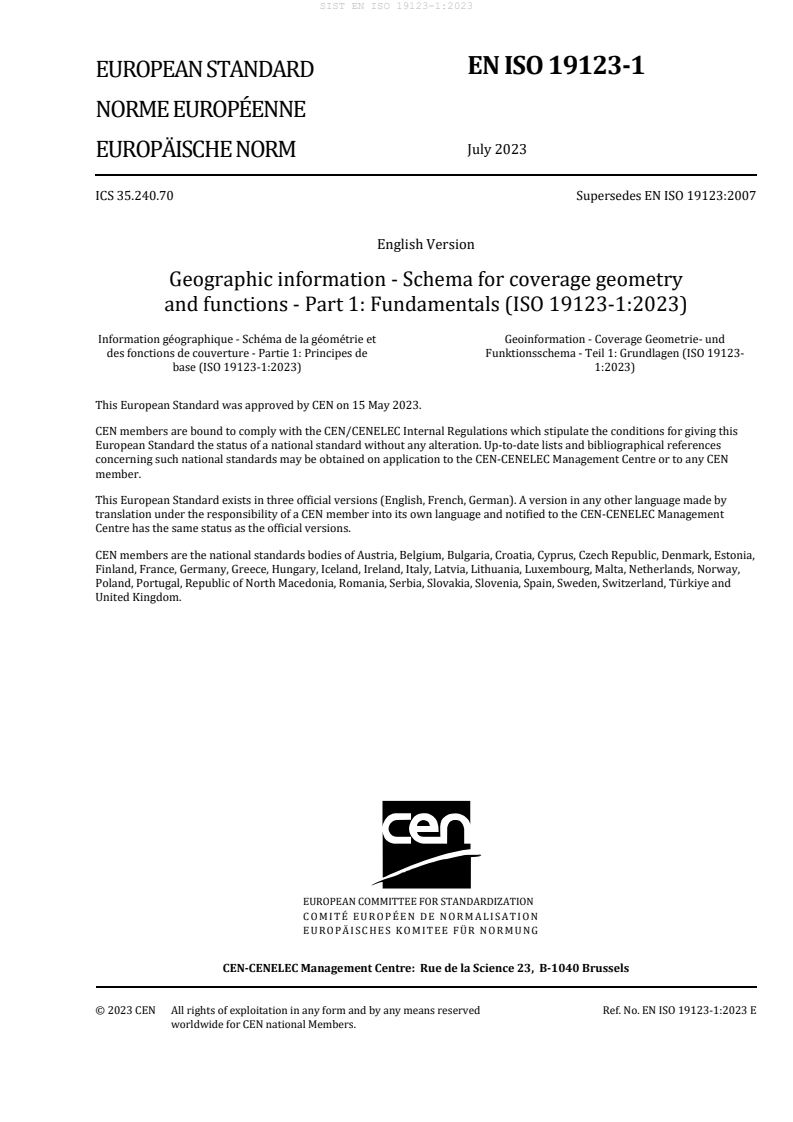
EUROPEAN STANDARD
NORME EUROPÉENNE
July 2023
EUROPÄISCHE NORM
ICS 35.240.70 Supersedes EN ISO 19123:2007
English Version
Geographic information - Schema for coverage geometry
and functions - Part 1: Fundamentals (ISO 19123-1:2023)
Information géographique - Schéma de la géométrie et Geoinformation - Coverage Geometrie- und
des fonctions de couverture - Partie 1: Principes de Funktionsschema - Teil 1: Grundlagen (ISO 19123-
base (ISO 19123-1:2023) 1:2023)
This European Standard was approved by CEN on 15 May 2023.
CEN members are bound to comply with the CEN/CENELEC Internal Regulations which stipulate the conditions for giving this
European Standard the status of a national standard without any alteration. Up-to-date lists and bibliographical references
concerning such national standards may be obtained on application to the CEN-CENELEC Management Centre or to any CEN
member.
This European Standard exists in three official versions (English, French, German). A version in any other language made by
translation under the responsibility of a CEN member into its own language and notified to the CEN-CENELEC Management
Centre has the same status as the official versions.
CEN members are the national standards bodies of Austria, Belgium, Bulgaria, Croatia, Cyprus, Czech Republic, Denmark, Estonia,
Finland, France, Germany, Greece, Hungary, Iceland, Ireland, Italy, Latvia, Lithuania, Luxembourg, Malta, Netherlands, Norway,
Poland, Portugal, Republic of North Macedonia, Romania, Serbia, Slovakia, Slovenia, Spain, Sweden, Switzerland, Türkiye and
United Kingdom.
EUROPEAN COMMITTEE FOR STANDARDIZATION
COMITÉ EUROPÉEN DE NORMALISATION
EUROPÄISCHES KOMITEE FÜR NORMUNG
CEN-CENELEC Management Centre: Rue de la Science 23, B-1040 Brussels
© 2023 CEN All rights of exploitation in any form and by any means reserved Ref. No. EN ISO 19123-1:2023 E
worldwide for CEN national Members.
Contents Page
European foreword . 3
European foreword
This document (EN ISO 19123-1:2023) has been prepared by Technical Committee ISO/TC 211
"Geographic information/Geomatics" in collaboration with Technical Committee CEN/TC 287
“Geographic Information” the secretariat of which is held by BSI.
This European Standard shall be given the status of a national standard, either by publication of an
identical text or by endorsement, at the latest by January 2024, and conflicting national standards shall
be withdrawn at the latest by January 2024.
Attention is drawn to the possibility that some of the elements of this document may be the subject of
patent rights. CEN shall not be held responsible for identifying any or all such patent rights.
This document supersedes EN ISO 19123:2007.
Any feedback and questions on this document should be directed to the users’ national standards
body/national committee. A complete listing of these bodies can be found on the CEN website.
According to the CEN-CENELEC Internal Regulations, the national standards organizations of the
following countries are bound to implement this European Standard: Austria, Belgium, Bulgaria,
Croatia, Cyprus, Czech Republic, Denmark, Estonia, Finland, France, Germany, Greece, Hungary, Iceland,
Ireland, Italy, Latvia, Lithuania, Luxembourg, Malta, Netherlands, Norway, Poland, Portugal, Republic of
North Macedonia, Romania, Serbia, Slovakia, Slovenia, Spain, Sweden, Switzerland, Türkiye and the
United Kingdom.
Endorsement notice
The text of ISO 19123-1:2023 has been approved by CEN as EN ISO 19123-1:2023 without any
modification.
INTERNATIONAL ISO
STANDARD 19123-1
First edition
2023-06
Geographic information — Schema for
coverage geometry and functions —
Part 1:
Fundamentals
Information géographique — Schéma de la géométrie et des fonctions
de couverture —
Partie 1: Principes de base
Reference number
ISO 19123-1:2023(E)
ISO 19123-1:2023(E)
© ISO 2023
All rights reserved. Unless otherwise specified, or required in the context of its implementation, no part of this publication may
be reproduced or utilized otherwise in any form or by any means, electronic or mechanical, including photocopying, or posting on
the internet or an intranet, without prior written permission. Permission can be requested from either ISO at the address below
or ISO’s member body in the country of the requester.
ISO copyright office
CP 401 • Ch. de Blandonnet 8
CH-1214 Vernier, Geneva
Phone: +41 22 749 01 11
Email: copyright@iso.org
Website: www.iso.org
Published in Switzerland
ii
ISO 19123-1:2023(E)
Contents Page
Foreword .v
Introduction .vii
1 Scope . 1
2 Normative references . 1
3 Terms, definitions, abbreviated terms and notation . 1
3.1 Terms and definitions . 1
3.2 Abbreviated terms . 8
4 Conformance . 8
4.1 Notation . 8
4.2 Interoperability and conformance testing . 9
4.3 Organization . 9
5 Coverages .10
5.1 Overview . 10
5.2 Coverage packages . 11
5.3 Probing coverages: evaluate() function .12
5.4 Domain of a coverage . 12
5.4.1 Concept . .12
5.4.2 Coordinates . 13
5.4.3 Mathematical versus physical coordinates . 14
5.4.4 Coordinate reference systems and axes . 14
5.4.5 Coverage classification along topological dimensions . 16
5.5 Range of a coverage . 16
5.6 Interpolation. 17
5.6.1 Concept . . 17
5.6.2 Discrete and continuous coverages . 18
5.7 Common point rule . 19
5.8 Realization variants . 19
5.8.1 Overview . 19
5.8.2 Geometry/value pair view . 19
5.8.3 Domain/range view .20
5.8.4 Partitioned view . 21
5.8.5 Functional view . 21
5.9 Envelope . 21
6 Multi-point coverages .22
7 Grid coverages .23
7.1 Overview . 23
7.2 Grids . 24
7.2.1 Grid definition. 24
7.2.2 Grid axis types . 27
7.3 Rectified and referenceable grid coverages .30
7.4 Grid cells . 31
7.4.1 Grid cell concept . 31
7.4.2 Pixel-in-centre, pixel-in-corner . 32
7.5 Grid coverage . 32
7.6 Further grid coverage types .33
8 Multi-curve coverages .34
8.1 Overview .34
8.2 General multi-curve coverages . 35
8.3 Segmented curve coverages . 35
9 Multi-surface coverages .36
9.1 Overview . 36
iii
ISO 19123-1:2023(E)
9.2 General multi-surface coverages . 36
9.3 Further surface coverages . 37
9.3.1 General . 37
9.3.2 Thiessen polygon coverages. 37
9.3.3 Triangulated irregular networks (TINs) .38
10 Multi-solid coverages .39
Annex A (normative) Conformance tests .41
Annex B (informative) Interpolation methods .45
Annex C (informative) Sequential enumeration .49
Annex D (normative) Legacy data-centric coverage specification .60
Bibliography .77
iv
ISO 19123-1:2023(E)
Foreword
ISO (the International Organization for Standardization) is a worldwide federation of national standards
bodies (ISO member bodies). The work of preparing International Standards is normally carried out
through ISO technical committees. Each member body interested in a subject for which a technical
committee has been established has the right to be represented on that committee. International
organizations, governmental and non-governmental, in liaison with ISO, also take part in the work.
ISO collaborates closely with the International Electrotechnical Commission (IEC) on all matters of
electrotechnical standardization.
The procedures used to develop this document and those intended for its further maintenance are
described in the ISO/IEC Directives, Part 1. In particular, the different approval criteria needed for the
different types of ISO document should be noted. This document was drafted in accordance with the
editorial rules of the ISO/IEC Directives, Part 2 (see www.iso.org/directives).
ISO draws attention to the possibility that the implementation of this document may involve the use
of (a) patent(s). ISO takes no position concerning the evidence, validity or applicability of any claimed
patent rights in respect thereof. As of the date of publication of this document, ISO had not received
notice of (a) patent(s) which may be required to implement this document. However, implementers are
cautioned that this may not represent the latest information, which may be obtained from the patent
database available at www.iso.org/patents. ISO shall not be held responsible for identifying any or all
such patent rights.
Any trade name used in this document is information given for the convenience of users and does not
constitute an endorsement.
For an explanation of the voluntary nature of standards, the meaning of ISO specific terms and
expressions related to conformity assessment, as well as information about ISO's adherence to
the World Trade Organization (WTO) principles in the Technical Barriers to Trade (TBT), see
www.iso.org/iso/foreword.html.
This document was prepared by Technical Committee ISO/TC 211, Geographic information/Geomatics,
in collaboration with the European Committee for Standardization (CEN) Technical Committee CEN/
TC 287, Geographic Information, in accordance with the Agreement on technical cooperation between
ISO and CEN (Vienna Agreement), in collaboration with the Open Geospatial Consortium (OGC), and in
collaboration with the IEEE GRSS Earth Science Informatics Technical Committee.
This first edition cancels and replaces ISO 19123:2005, which has been technically revised.
The main changes are as follows:
— the document has been renamed as “Part 1: Fundamentals”, since a new “Part 2: Coverage
Implementation Schema” has been published;
— the text has been simplified for better understanding;
— concepts, while in principle unchanged, have been defined more rigorously and some errors have
been corrected;
— the approach to standardization taken in this document has been changed. This edition of the
document defines a high-level, generic concept of coverages with an interface definition from
which many different (not necessarily interoperable) implementation structures can be derived.
The previous edition of this document, ISO 19123:2005, defined a single generic data structure
for coverages. The previous model remains valid as one of the many possible data structures
that can implement the ISO 19123-1 interface. This data structure, which is defined in Annex D,
supports backward compatibility. Standardization targets that referenced ISO 19123 can continue
referencing those same classes, although new realizations are not encouraged to do so. It is noted,
however, that the coverage definition terms in Clause 3 which are owned by other documents have
been updated to refer to newer editions of the documents (including their definitions) where such
newer editions are available;
v
ISO 19123-1:2023(E)
— all operations except evaluate() have been removed, for simplification purposes. ISO 19123-3 now
specifies the operations requirements;
— the Scope has been extended to include Mesh;
— the concept of discrete and continuous coverages has been generalized to achieve an improved
conceptual basis and to allow for coverages which are discrete along some domain axes and
continuous along other domain axes. This is achieved by using the coordinate reference system axes
as the basis for the definitions so that any axis individually can be discrete or continuous. Since this
is a generalization of the previous concept it is backward compatible. As a side effect, this reworking
has greatly simplified the structure of this document;
— updates in ISO 19103 have been reflected, and corresponding adjustments have been made where
necessary. The informative Annex on “UML notation” has been deleted since UML notation is now
described in ISO 19103;
— all coordinate-related definitions are based on ISO 19111, and corresponding adjustments have
been made to this document as necessary;
— the definition of image CRS has been moved from ISO 19111 to this document;
— the definition of interpolation is based on the interpolation definition of ISO 19107 in order to avoid
duplicate and diverging definitions;
— the UML diagrams have been redrawn for clarity, in order to correct errors, and to follow the new
conventions established in ISO/TC 211;
— the bibliography has been revised to include additional references and has been reformatted.
A list of all parts in the ISO 19123 series can be found on the ISO website.
Any feedback or questions on this document should be directed to the user’s national standards body. A
complete listing of these bodies can be found at www.iso.org/members.html.
vi
ISO 19123-1:2023(E)
Introduction
This document defines, at a high, implementation-independent level, the notion of coverages as digital
representations of space-time varying phenomena, corresponding to the notion of a field in physics.
Such coverages can be discrete or continuous.
Historically, geographic information has been treated in terms of two fundamental data types called
"vector data" and "raster data".
"Vector data" deals with discrete phenomena, each of which is conceived of as a feature. The spatial
characteristics of a discrete real-world phenomenon are represented by a set of one or more geometric
primitives (points, curves, surfaces or solids). Other characteristics of the phenomenon are recorded as
feature attributes. Usually, a single feature is associated with a single set of attribute values. ISO 19107
provides a schema for describing features in terms of geometric and topological primitives.
"Raster data", on the other hand, deals with phenomena that vary over space and time, mathematically
described by “fields”. It contains a set of values, each associated with one of the elements in an array of
points or cells. Raster data is often associated with a method for interpolating values at spatial positions
between the points or within the cells.
The coverage concept, originally adopted from the Abstract Specification of the Open Geospatial
[15]
Consortium (OGC), generalizes these and further data structures, such as point clouds, into a model
for representing phenomena that vary continuously over space and time, and possibly over further
dimensions such as spectral bands. Formally, a coverage is a function from a spatial (such as horizontal
x and y and vertical height or depth), temporal, other (in ISO 19111:2019 nomenclature: parametric)
domain or any combination thereof to values of some data type.
A coverage consists of a set of spatio-temporally extended geometric (often geographic) objects,
each with associated attribute values. The spatio-temporal locations with which attribute values are
associated are called “direct positions”.
Formally, a coverage itself is a subtype of a feature as defined in ISO 19101-1. The coverage feature is
a set of features all sharing some key properties, such as the same attribute definition and coordinate
reference system.
NOTE Direct positions can be of different dimensions. For example, in a raster image modelled as a coverage,
the direct positions will be the grid points; in a multi-solid coverage a direct position is given by the interior of a
3D solid.
In practice, coverages encompass regular and irregular grids, point clouds and general meshes.
Examples include raster data, point clouds, meshes such as triangulated irregular networks and
polygon sets. Coverages are multi-dimensional, including examples such as 1D sensor timeseries, 2D
satellite images, 3D x/y/t image timeseries and x/y/z geophysical voxel data, and 4D x/y/z/t climate
and ocean data. Coordinate axes of such coverages can have spatial, temporal, or any other meaning,
and they can be combined freely for n-dimensional coverages.
EXAMPLE The electromagnetic spectrum is an example of an axis with neither spatial nor temporal
semantics. Such a spectral axis can be defined as a “parametric CRS” as established in ISO 19111.
A coverage which provides values only at the direct positions is called “a discrete coverage”. If
interpolation information is added so that values can be obtained also between the coverage’s direct
positions, such a coverage is called “a continuous coverage”.
Just as the concepts of discrete and continuous phenomena are not mutually exclusive, their
representations as discrete coverages are not mutually exclusive. The same phenomenon can be
represented as either a discrete feature or a coverage, depending on the particular context and
requirements. A city can be viewed as a discrete coverage that returns a single value for each attribute,
such as its name, area and total population, but it can also be represented as a continuous coverage that
returns values such as population density, land value or air quality index for each location in the city.
vii
ISO 19123-1:2023(E)
A coverage, moreover, can be derived by bundling a collection of discrete features sharing a common
attribute definition, the values of the coverage at each position being the values of the attributes of
the feature located at that position. Conversely, a collection of discrete features can be derived from a
coverage by extracting all direct positions with their associated attribute values.
The previous edition of this document, ISO 19123:2005, addressed coverage modelling on both
a conceptual and (to some extent) an implementation level, effectively mixing both. Coverage
modelling has now been split into two separate, but related documents: ISO 19123-1 (this document),
which establishes an abstract, high-level coverage model, and ISO 19123-2, which establishes an
implementation-level model ensuring interoperability, based on the concepts of ISO 19123-1. A
corresponding high-level processing model for coverages is defined in ISO 19123-3.
viii
INTERNATIONAL STANDARD ISO 19123-1:2023(E)
Geographic information — Schema for coverage geometry
and functions —
Part 1:
Fundamentals
1 Scope
This document defines a conceptual schema for coverages. A coverage is a mapping from a spatial,
temporal or spatiotemporal domain to attribute values sharing the same attribute type. A coverage
domain consists of a collection of direct positions in a coordinate space that can be defined in terms of
spatial and/or temporal dimensions, as well as non-spatiotemporal (in ISO 19111:2019, “parametric”)
dimensions. Examples of coverages include point clouds, grids, meshes, triangulated irregular networks,
and polygon sets. Coverages are the prevailing data structures in a number of application areas, such
as remote sensing, meteorology and mapping of depth, elevation, soil and vegetation. This document
defines the coverage concept including the relationship between the domain of a coverage and its
associated attribute range. This document defines the characteristics of the domain. The characteristics
of the attribute range are not defined in this document, but are defined in implementation standards.
Consequently, the standardization target of this document consists of implementation standards, not
concrete implementations themselves.
2 Normative references
The following documents are referred to in the text in such a way that some or all of their content
constitutes requirements of this document. For dated references, only the edition cited applies. For
undated references, the latest edition of the referenced document (including any amendments) applies.
ISO 19103, Geographic information — Conceptual schema language
ISO 19107, Geographic information — Spatial schema
ISO 19111, Geographic information — Referencing by coordinates
3 Terms, definitions, abbreviated terms and notation
3.1 Terms and definitions
For the purposes of this document, the following terms and definitions apply.
ISO and IEC maintain terminology databases for use in standardization at the following addresses:
— ISO Online browsing platform: available at https:// www .iso .org/ obp
— IEC Electropedia: available at https:// www .electropedia .org/
3.1.1
analytical coverage
coverage where the mapping function from domain to range is given by an analytical mathematical
function
ISO 19123-1:2023(E)
3.1.2
axis
tuple of axis name, axis abbreviation, axis direction, axis unit and further
information
Note 1 to entry: This definition is established in accordance with ISO 19111:2019, Table 26 and subclause 10.4.
Note 2 to entry: Inside a coordinate reference system (CRS) containing several axes the axis names are required
to be pairwise different.
Note 3 to entry: The axis unit (of measure) defines the set of values which can be used as a coordinate along this
axis. These can be numbers (such as in Latitude and Longitude) or general strings (such as in timestamps or
special identifiers like “FL100” in aviation).
3.1.3
cell
neighbourhood around a direct position in a coverage grid, not overlapping with any other
direct position neighbourhood in the coverage grid
Note 1 to entry: Coverage cell is synonymous to grid cell.
Note 2 to entry: All cells of a grid coverage together establish a tessellation (i.e. complete, overlap-free cover) of
the grid space.
3.1.4
continuous coverage
coverage that returns values for both direct positions and positions between direct positions
3.1.5
coordinate
one of a sequence of measures designating the position of a point
Note 1 to entry: In a coordinate reference system, the coordinate numbers are usually qualified by units. Some
coordinates may use a unit representation, for example date/time conformant with ISO 8601-1. When coordinates
are an index (ordinal coordinates) they are unitless (which possibly can be represented by a unit of 1).
[SOURCE: ISO 19111:2019, 3.1.5, modified — Original note 1 to entry has been amended.]
3.1.6
coordinate reference system
coordinate system that is related to an object by a datum
[SOURCE: ISO 19111:2019, 3.1.9, modified — Notes 1 and 2 to entry have been deleted.]
3.1.7
coordinate system
set of mathematical rules for specifying how coordinates are to be assigned to points
Note 1 to entry: A coordinate system contains an ordered sequence of one or more axes; their names are required
to be pairwise different.
[SOURCE: ISO 19111:2019, 3.1.11, modified — Note 1 to entry has been added.]
3.1.8
coordinate tuple
tuple composed of coordinates
Note 1 to entry: The number of coordinates in the coordinate tuple equals the dimension of the coordinate
system; the order of coordinates in the coordinate tuple is identical to the order of the axes of the coordinate
system.
[SOURCE: ISO 19111:2019, 3.1.13]
ISO 19123-1:2023(E)
3.1.9
coverage
function which returns values from its range for any direct position within its domain
3.1.10
coverage coordinate reference system
coverage CRS
coordinate reference system (CRS) in which all coordinates in a coverage domain are expressed
Note 1 to entry: Sometimes a coverage’s CRS is also referred to as the coverage’s native CRS to express that this is
the CRS to which all the coverage’s location data refer.
3.1.11
coverage dimension
number of separate decisions needed to describe a direct position in a coverage
domain
Note 1 to entry: This is equivalent to “the number of axes in the coverage domain CRS”.
Note 2 to entry: This definition is based on the term "coordinate dimension" defined in ISO 19107:2019, 3.17.
3.1.12
coverage geometry
domain of a coverage described in terms of geometric objects
3.1.13
Delaunay triangulation
network of triangles such that the circle passing through the vertices of any triangle does not contain,
in its interior, the vertex of any other triangle
3.1.14
direct position
position inside one of the geometric objects in a coverage described by a coordinate tuple
within the coverage coordinate reference system
Note 1 to entry: A direct position is described by an ordered sequence of coordinates. The number of elements in
a direct position is established by the number of axes of the coverage CRS.
Note 2 to entry: This is consistent with the definition in ISO 19136-1:2020, 3.1.20.
3.1.15
discrete coverage
coverage that returns value only for the direct positions within its domain
Note 1 to entry: Discrete coverages have values only for their direct positions, whereas continuous coverages can
be interpolated, thereby providing values between direct positions in addition.
3.1.16
domain
set of geometric objects
Note 1 to entry: Examples of such geometric objects are points, lines, faces and solids. All elements within a
domain (set) are of a single given type.
3.1.17
external coordinate reference system
coordinate reference system whose datum is independent of the object that is located by it
Note 1 to entry: This term is kept only for backwards compatibility and is not used in nor fundamental to the
coverage definition of this document.
[SOURCE: ISO 19130-1:2018, 3.25, modified — Note 1 to entry has been added.]
ISO 19123-1:2023(E)
3.1.18
evaluation
determination of the values of a coverage at a direct position within the domain of the
coverage
3.1.19
feature
abstraction of real world phenomena
[SOURCE: ISO 19101-1:2014, 4.1.11, modified — Note 1 to entry has been removed.]
3.1.20
feature attribute
characteristic of a feature
Note 1 to entry: The value associated with a direct position. Also known as “feature property” and may support
potential attribute, quality, or characteristic of a feature.
[SOURCE: ISO 19101-1:2014, 4.1.12, modified — Original notes to entry and examples have been deleted
and a new Note 1 to entry added.]
3.1.21
function
rule that associates each element from a domain (“source domain”, or
“domain” of the function) to a unique element in another domain (“target domain”, “co-domain” or
“range” of the function)
[SOURCE: ISO 19107:2019, 3.41]
3.1.22
geometric dimension
largest number n such that each point in a set of points can be associated with a
n
subset that has that point in its interior and is topologically isomorphic to 𝔼 , Euclidean n-space
[SOURCE: ISO 19107:2019, 3.48 modified — Original notes to entry have been deleted.]
3.1.23
geometric object
spatial object representing a geometric set
Note 1 to entry: A geometric object consists of a geometric primitive, a collection of geometric primitives, or a
geometric complex treated as a single entity. A geometric object may be the spatial representation of a feature
object.
[SOURCE: ISO 19107:2019, 3.49]
3.1.24
geometric set
set of direct positions
Note 1 to entry: A geometric set describes a single geometric object. The domain of a coverage consists of a set
of such geometric objects. In the case of point clouds and grid data where each geometric set consists of only
one single point, the domain is a set of these direct positions. For higher-dimensional geometric sets, such as
curves, surfaces and solids, the set can be described through other means than enumeration, such as Boundary
Representation or constructive solid geometry (CSG).
[SOURCE: ISO 19136-1:2020, 3.1.32, modified — Original note to entry has been deleted and a new Note
1 to entry has been added.]
ISO 19123-1:2023(E)
3.1.25
georectified
corrected for positional displacement with respect to the surface of the Earth
Note 1 to entry: This term is kept only for backwards compatibility and is not fundamental to the coverage
definition of this document.
[SOURCE: ISO 19115-2:2019, 3.11, modified — Note 1 to entry has been added.]
3.1.26
georeferenceable
associated with a geopositioning information that can be used to convert grid coordinate values to
values of coordinates referenced to an external coordinate reference system related to the Earth by a
datum
Note 1 to entry: This term is kept only for backwards compatibility and is not fundamental to the coverage
definition of this document.
[SOURCE: ISO/TS 19163-1:2016, 4.9, modified — Note 1 has been added.]
3.1.27
georeferencing
geopositioning an object using a correspondence model mapping coverage domain elements
to ground coordinates
3.1.28
grid
covering of a multi-dimensional region using quadrilateral shapes (in the 2D case) or their
n-dimensional generation (in the nD case) with no overlaps and gaps
Note 1 to entry: The term "grid" originates historically from a 2D view: in ISO 19123 a grid consists of a network
composed of one or more sets of curves in which the members of each set intersect the members of the other
sets. Meantime, nD grids (including 1D) are known and in use. The “covering” of a region is also known as a
"tessellation" in mathematics.
Note 2 to entry: The ISO 19123 definition is equivalent to the revised definition of this document.
3.1.29
grid coordinate reference system
grid CRS
coordinate reference system of a grid coverage
Note 1 to entry: This is consistent with the definition in ISO 19136-2:2015, 4.2.1.
3.1.30
grid coordinates
sequence of coordinates specifying a position on a grid
Note 1 to entry: This is consistent with the definition in ISO 19115-2:2019, 3.15.
3.1.31
grid coverage
coverage whose domain is described by a grid
3.1.32
grid point
point of a grid
ISO 19123-1:2023(E)
3.1.33
image coordinate reference system
image CRS
engineering grid coverage coordinate reference system (CRS)
Note 1 to entry: The CRS of a raster image (without georeferencing) is a 2D grid with Cartesian axes; this special
case of an index CRS is commonly referred to as "image CRS".
3.1.34
index coordinate reference system
index CRS
coverage coordinate reference system (CRS) in which all axes are Cartesian
3.1.35
mesh
geometry with associated topology of dimension greater than zero
Note 1 to entry: Geometry and topology are defined in ISO 19107. Mesh examples include curves, TINs and solids.
Points (and point clouds) resemble geometries with dimension zero.
3.1.36
pixel
smallest element of a digital image to which attributes are assigned
Note 1 to entry: A pixel is the smallest unit of display for a visible image.
Note 2 to entry: This term originated as a contraction of "picture element".
[SOURCE: ISO 19101-2:2018, 3.28, modified — Note 1 to entry has been moved to Note 2 to entry and a
new Note 1 to entry has been added.]
3.1.37
point cloud
collection of data points in 3D space
Note 1 to entry: The distance between points is generally non-uniform and hence all three coordinates (Cartesian
or spherical) for each point must be specifically encoded.
[SOURCE: ISO/TS 19130-2:2014, 4.51]
3.1.38
point coverage
coverage that has a domain composed of points
3.1.39
polygon coverage
coverage that has a domain composed of polygons
3.1.40
range
set of values associated by a function, the coverage, with the domain of a coverage
Note 1 to entry: This is consistent with the more generic definition of range in ISO 19107.
Note 2 to entry: Coverage range types and values correspond to the notion of feature attribute types and values.
3.1.41
raster
rectilinear grid
Note 1 to entry: The term is also used as an imprecise generic term for imagery and gridded coverage data.
Note 2 to entry: Historically, the term derives from the scanning lines display pattern on a cathode ray tube.
ISO 19123-1:2023(E)
3.1.42
rectified grid
grid for which there is an affine transformation between the grid coordinates and the coordinates of an
external coordinate reference system
Note 1 to entry: If the coordinate reference system is related to the Earth by a datum, the grid is a georectified
grid.
Note 2 to entry: This term is kept only for backwards compatibility and is not used in nor fundamental to the
coverage definition of this document.
3.1.43
referenceable grid
grid with an external coordinate reference system whose type is either geodetic or projected
Note 1 to entry: If the coordinate reference system is related to the Earth by a datum, the grid i
...