

EN 13791:2019
(Main)Assessment of in-situ compressive strength in structures and precast concrete components
- Abstract
(1) This document:
- gives methods and procedures for the estimation of the in situ compressive strength and characteristic in situ compressive strength of concrete in structures and precast concrete components using direct methods (core testing) and indirect methods, e.g. ultra-sonic pulse velocity, rebound number;
NOTE To align with the design standard EN 1992-1-1, where the compressive strength is based on 2:1 cylinders, the in situ compressive strength is based in 2:1 cores of diameter ≥ 75 mm.
- provides principles and guidance for establishing the relationships between test results from indirect test methods and the in situ compressive strength;
- provides procedures and guidance for assessing the conformity with the compressive strength class of concrete supplied to structures under construction where standard tests indicate doubt or where the quality of execution is in doubt.
(2) This document provides requirements for determining the in situ strength at test locations and the characteristic strength of test regions, but how this information is to be applied needs to be considered in the light of the specific situation and engineering judgement applied to the specific case.
(3) This document does not include the assessment of the quality of concrete for properties other than compressive strength, e.g. durability-related properties.
(4) This document is not for the assessment of conformity of concrete compressive strength in accordance with EN 206 or EN 13369, except as indicated in EN 206:2013+A1:2016, 5.5.1.2 or 8.4.
(5) This document does not cover the procedures or criteria for the routine conformity control of precast concrete components using either direct or indirect measurements of the in situ strength.
(3) This document does not include the assessment of the quality of concrete for properties other than compressive strength, e.g. durability-related properties.
(4) This document is not for the assessment of conformity of concrete compressive strength in accordance with EN 206 or EN 13369, except as indicated in EN 206:2013+A1:2016, 5.5.1.2 or 8.4.
(5) This document does not cover the procedures or criteria for the routine conformity control of precast concrete components using either direct or indirect measurements of the in-situ strength.
- Status
- Published
- Publication Date
- 20-Aug-2019
- Withdrawal Date
- 28-Feb-2020
- Technical Committee
- CEN/TC 104 - Concrete ( performance, production, placing and compliance criteria )
- Drafting Committee
- CEN/TC 104/SC 1 - Revision of ENV 206
- Current Stage
- 9093 - Decision to confirm - Review Enquiry
- Start Date
- 24-Jun-2025
- Completion Date
- 07-Oct-2026


Overview
EN 13791:2019 (CEN) defines methods for the assessment of in‑situ compressive strength of concrete in structures and precast components. It covers both direct methods (core testing) and indirect methods (for example, ultrasonic pulse velocity (UPV) and rebound number). The standard focuses on estimating in‑situ compressive strength and the characteristic in‑situ compressive strength for structural assessment and for cases where conformity of supplied concrete is in doubt.
Key scope points:
- In‑situ strength is referenced to 2:1 cores (length:diameter) with diameter ≥ 75 mm to align with EN 1992‑1‑1 practice.
- Guidance is given for establishing relationships between indirect test results and core strength.
- Procedures for assessing conformity with a compressive strength class during construction are included.
- The standard does not cover properties other than compressive strength (e.g., durability) or routine factory control of precast elements.
Key topics and requirements
- Core testing procedures and conversion principles to determine in‑situ compressive strength (see EN 12504‑1).
- Indirect testing principles (UPV, rebound hammer) and guidance for calibrating these methods against cores.
- Definition of test regions and test locations, and requirements for the number and distribution of tests.
- Statistical evaluation of results: how to treat outliers and determine whether a test region represents a single concrete strength class.
- Two distinct applications: (1) estimating in‑situ strength for existing structures (Clause 8) and (2) assessing compressive strength class where standard tests indicate doubt (Clause 9).
- Limitations and exceptions: not a substitute for EN 206/EN 13369 conformity procedures except where explicitly referenced.
Practical applications and users
Who uses EN 13791:2019:
- Structural engineers performing assessments of existing buildings and infrastructure.
- Testing laboratories and nondestructive testing (NDT) practitioners calibrating UPV or rebound hammer data to core results.
- Contractors, site inspectors and quality control teams investigating suspected non‑conformity of on‑site concrete.
- Producers and certifiers when resolving contested compressive strength claims.
Practical benefits:
- Provides standardized, reproducible methods for converting field measurements into engineering values for design checks and repair decisions.
- Helps determine whether remedial action or further testing is required when in‑situ strength is uncertain.
Related standards
- EN 1992‑1‑1 (Eurocode 2) - design of concrete structures
- EN 1990 - basis of structural design
- EN 206 - concrete specification, performance, production and conformity
- EN 12504‑1 / EN 12504‑2 / EN 12504‑4 - testing cored specimens, rebound number, UPV
- EN 13369 / EN 13670 - precast rules and execution of concrete structures
Note: EN 13791:2019 should be applied with professional engineering judgement and where helpful, consult CEN/TR 17086 for worked examples and further guidance.
Relations
- Effective Date
- 28-Aug-2019
- Effective Date
- 28-Jan-2026
- Refers
EN 12390-2:2019 - Testing hardened concrete - Part 2: Making and curing specimens for strength tests - Effective Date
- 28-Jan-2026
- Effective Date
- 28-Jan-2026
- Effective Date
- 28-Jan-2026
- Effective Date
- 28-Jan-2026
- Effective Date
- 28-Jan-2026
- Effective Date
- 28-Jan-2026
- Effective Date
- 28-Jan-2026
- Effective Date
- 28-Jan-2026
- Effective Date
- 28-Jan-2026
- Effective Date
- 28-Jan-2026
- Effective Date
- 28-Jan-2026
- Effective Date
- 28-Jan-2026
- Effective Date
- 28-Jan-2026
Get Certified
Connect with accredited certification bodies for this standard

DIBt (Deutsches Institut für Bautechnik)
German Institute for Building Technology.
DIN CERTCO
DIN Group product certification.

Aboma Certification B.V.
Specialized in construction, metal, and transport sectors.
Sponsored listings
Frequently Asked Questions
EN 13791:2019 is a standard published by the European Committee for Standardization (CEN). Its full title is "Assessment of in-situ compressive strength in structures and precast concrete components". This standard covers: (1) This document: - gives methods and procedures for the estimation of the in situ compressive strength and characteristic in situ compressive strength of concrete in structures and precast concrete components using direct methods (core testing) and indirect methods, e.g. ultra-sonic pulse velocity, rebound number; NOTE To align with the design standard EN 1992-1-1, where the compressive strength is based on 2:1 cylinders, the in situ compressive strength is based in 2:1 cores of diameter ≥ 75 mm. - provides principles and guidance for establishing the relationships between test results from indirect test methods and the in situ compressive strength; - provides procedures and guidance for assessing the conformity with the compressive strength class of concrete supplied to structures under construction where standard tests indicate doubt or where the quality of execution is in doubt. (2) This document provides requirements for determining the in situ strength at test locations and the characteristic strength of test regions, but how this information is to be applied needs to be considered in the light of the specific situation and engineering judgement applied to the specific case. (3) This document does not include the assessment of the quality of concrete for properties other than compressive strength, e.g. durability-related properties. (4) This document is not for the assessment of conformity of concrete compressive strength in accordance with EN 206 or EN 13369, except as indicated in EN 206:2013+A1:2016, 5.5.1.2 or 8.4. (5) This document does not cover the procedures or criteria for the routine conformity control of precast concrete components using either direct or indirect measurements of the in situ strength. (3) This document does not include the assessment of the quality of concrete for properties other than compressive strength, e.g. durability-related properties. (4) This document is not for the assessment of conformity of concrete compressive strength in accordance with EN 206 or EN 13369, except as indicated in EN 206:2013+A1:2016, 5.5.1.2 or 8.4. (5) This document does not cover the procedures or criteria for the routine conformity control of precast concrete components using either direct or indirect measurements of the in-situ strength.
(1) This document: - gives methods and procedures for the estimation of the in situ compressive strength and characteristic in situ compressive strength of concrete in structures and precast concrete components using direct methods (core testing) and indirect methods, e.g. ultra-sonic pulse velocity, rebound number; NOTE To align with the design standard EN 1992-1-1, where the compressive strength is based on 2:1 cylinders, the in situ compressive strength is based in 2:1 cores of diameter ≥ 75 mm. - provides principles and guidance for establishing the relationships between test results from indirect test methods and the in situ compressive strength; - provides procedures and guidance for assessing the conformity with the compressive strength class of concrete supplied to structures under construction where standard tests indicate doubt or where the quality of execution is in doubt. (2) This document provides requirements for determining the in situ strength at test locations and the characteristic strength of test regions, but how this information is to be applied needs to be considered in the light of the specific situation and engineering judgement applied to the specific case. (3) This document does not include the assessment of the quality of concrete for properties other than compressive strength, e.g. durability-related properties. (4) This document is not for the assessment of conformity of concrete compressive strength in accordance with EN 206 or EN 13369, except as indicated in EN 206:2013+A1:2016, 5.5.1.2 or 8.4. (5) This document does not cover the procedures or criteria for the routine conformity control of precast concrete components using either direct or indirect measurements of the in situ strength. (3) This document does not include the assessment of the quality of concrete for properties other than compressive strength, e.g. durability-related properties. (4) This document is not for the assessment of conformity of concrete compressive strength in accordance with EN 206 or EN 13369, except as indicated in EN 206:2013+A1:2016, 5.5.1.2 or 8.4. (5) This document does not cover the procedures or criteria for the routine conformity control of precast concrete components using either direct or indirect measurements of the in-situ strength.
EN 13791:2019 is classified under the following ICS (International Classification for Standards) categories: 91.080.40 - Concrete structures. The ICS classification helps identify the subject area and facilitates finding related standards.
EN 13791:2019 has the following relationships with other standards: It is inter standard links to EN 13791:2007, EN 12504-4:2021, EN 12390-2:2019, EN 13670:2009, EN 13369:2018, EN 12504-2:2021, EN 1990:2002, EN 12504-1:2019, EN 206:2013+A1:2016, EN 12350-1:2019, EN 12390-3:2019, EN 1168:2005+A3:2011, EN 1992-1-1:2004, CEN/TR 17086:2020, EN 1992-1-1:2023. Understanding these relationships helps ensure you are using the most current and applicable version of the standard.
EN 13791:2019 is available in PDF format for immediate download after purchase. The document can be added to your cart and obtained through the secure checkout process. Digital delivery ensures instant access to the complete standard document.
Standards Content (Sample)
SLOVENSKI STANDARD
01-oktober-2019
Nadomešča:
SIST EN 13791:2007
Ocenjevanje in-situ tlačne trdnosti betona v konstrukcijah in v montažnih
betonskih elementih
Assessment of in-situ compressive strength in structures and precast concrete
components
Bewertung der Druckfestigkeit von Beton in Bauwerken oder in Bauwerksteilen
Évaluation de la résistance à la compression sur site des structures et des éléments
préfabriqués en béton
Ta slovenski standard je istoveten z: EN 13791:2019
ICS:
91.080.40 Betonske konstrukcije Concrete structures
91.100.30 Beton in betonski izdelki Concrete and concrete
products
2003-01.Slovenski inštitut za standardizacijo. Razmnoževanje celote ali delov tega standarda ni dovoljeno.
EN 13791
EUROPEAN STANDARD
NORME EUROPÉENNE
August 2019
EUROPÄISCHE NORM
ICS 91.080.40 Supersedes EN 13791:2007
English Version
Assessment of in-situ compressive strength in structures
and precast concrete components
Évaluation de la résistance à la compression sur site Bewertung der Druckfestigkeit von Beton in
des structures et des éléments préfabriqués en béton Bauwerken oder in Bauwerksteilen
This European Standard was approved by CEN on 7 July 2019.
CEN members are bound to comply with the CEN/CENELEC Internal Regulations which stipulate the conditions for giving this
European Standard the status of a national standard without any alteration. Up-to-date lists and bibliographical references
concerning such national standards may be obtained on application to the CEN-CENELEC Management Centre or to any CEN
member.
This European Standard exists in three official versions (English, French, German). A version in any other language made by
translation under the responsibility of a CEN member into its own language and notified to the CEN-CENELEC Management
Centre has the same status as the official versions.
CEN members are the national standards bodies of Austria, Belgium, Bulgaria, Croatia, Cyprus, Czech Republic, Denmark, Estonia,
Finland, France, Germany, Greece, Hungary, Iceland, Ireland, Italy, Latvia, Lithuania, Luxembourg, Malta, Netherlands, Norway,
Poland, Portugal, Republic of North Macedonia, Romania, Serbia, Slovakia, Slovenia, Spain, Sweden, Switzerland, Turkey and
United Kingdom.
EUROPEAN COMMITTEE FOR STANDARDIZATION
COMITÉ EUROPÉEN DE NORMALISATION
EUROPÄISCHES KOMITEE FÜR NORMUNG
CEN-CENELEC Management Centre: Rue de la Science 23, B-1040 Brussels
© 2019 CEN All rights of exploitation in any form and by any means reserved Ref. No. EN 13791:2019 E
worldwide for CEN national Members.
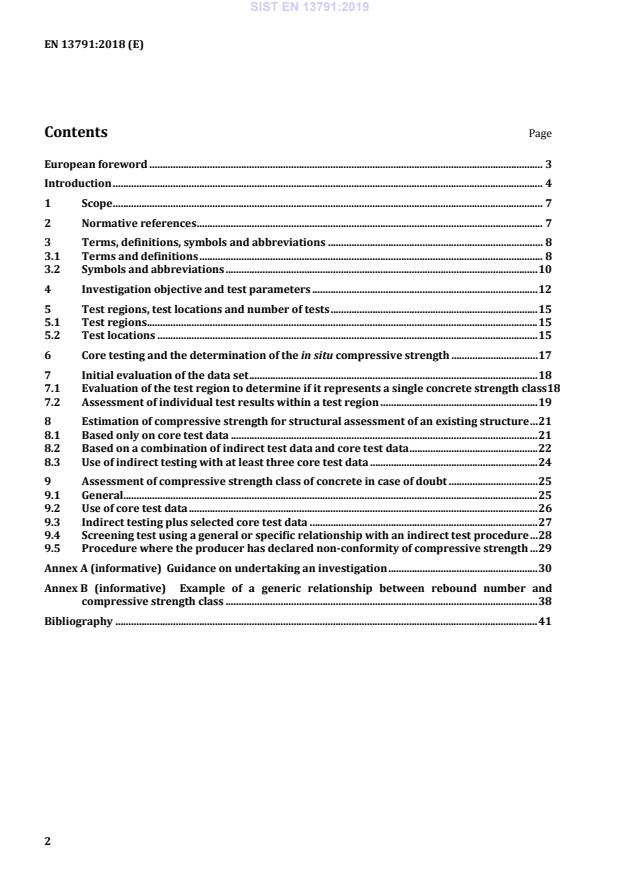
EN 13791:2018 (E)
Contents Page
European foreword . 3
Introduction . 4
1 Scope . 7
2 Normative references . 7
3 Terms, definitions, symbols and abbreviations . 8
3.1 Terms and definitions . 8
3.2 Symbols and abbreviations . 10
4 Investigation objective and test parameters . 12
5 Test regions, test locations and number of tests . 15
5.1 Test regions . 15
5.2 Test locations . 15
6 Core testing and the determination of the in situ compressive strength . 17
7 Initial evaluation of the data set . 18
7.1 Evaluation of the test region to determine if it represents a single concrete strength class18
7.2 Assessment of individual test results within a test region . 19
8 Estimation of compressive strength for structural assessment of an existing structure . 21
8.1 Based only on core test data . 21
8.2 Based on a combination of indirect test data and core test data . 22
8.3 Use of indirect testing with at least three core test data . 24
9 Assessment of compressive strength class of concrete in case of doubt . 25
9.1 General. 25
9.2 Use of core test data . 26
9.3 Indirect testing plus selected core test data . 27
9.4 Screening test using a general or specific relationship with an indirect test procedure . 28
9.5 Procedure where the producer has declared non-conformity of compressive strength . 29
Annex A (informative) Guidance on undertaking an investigation . 30
Annex B (informative) Example of a generic relationship between rebound number and
compressive strength class . 38
Bibliography . 41
European foreword
This document (EN 13791:2019) has been prepared by Technical Committee CEN/TC 104 “Concrete
and related products”, the secretariat of which is held by SN.
This European Standard shall be given the status of a national standard, either by publication of an
identical text or by endorsement, at the latest by February 2020, and conflicting national standards
shall be withdrawn at the latest by February 2020.
Attention is drawn to the possibility that some of the elements of this document may be the subject of
patent rights. CEN shall not be held responsible for identifying any or all such patent rights.
This document supersedes EN 13791:2007.
The main changes compared to EN 13791:2007 are:
a) the standard is fully revised but for continuity the methodological approaches and scope is retained
as well as much of the previous layout;
b) the primary focus is on the determination of the characteristic in situ compressive strength for
application with EN 1990 and EN 1992-1-1;
c) more comprehensive guidance is provided on applying the procedures, particularly with respect to
defining a test result, a measurement, volume of concrete, test location, small test region and test
region;
d) requirements to set out the purpose of the investigation, procedures to be adopted, test methods,
test locations and test regions to be defined prior to commencing the testing, are included;
e) Clause 8, "Estimation of compressive strength for structural assessment of an existing structure",
covers the previous requirements for assessment of characteristic in situ compressive strength by
either testing cores or indirect methods;
f) Clause 9, "Assessment of compressive strength class of concrete in case of doubt", covers previous
requirements for the assessment where conformity of concrete based on standard tests is in doubt;
g) approaches A and B in EN 13791:2007 are no longer valid;
h) EN 13791 is aligned with the requirements of EN 206.
According to the CEN-CENELEC Internal Regulations, the national standards organisations of the
following countries are bound to implement this European Standard: Austria, Belgium, Bulgaria,
Croatia, Cyprus, Czech Republic, Denmark, Estonia, Finland, France, Germany, Greece, Hungary, Iceland,
Ireland, Italy, Latvia, Lithuania, Luxembourg, Malta, Netherlands, Norway, Poland, Portugal, Republic of
North Macedonia, Romania, Serbia, Slovakia, Slovenia, Spain, Sweden, Switzerland, Turkey and the
United Kingdom.
EN 13791:2018 (E)
Introduction
(1) This document covers two applications of in situ strength assessments. These are:
— to estimate in situ characteristic compressive strength of a test region and/or in situ strength at
specific locations;
— assessment of compressive strength class of concrete supplied to a structure under construction
where there is doubt about the compressive strength based on results of standard tests or doubt
about the quality of execution.
(2) Both applications have a number of common steps as shown in Table 1, but the assessment methods
differ. The reason for this difference is that with the estimation of the in situ strength (Clause 8) there is
no presumption as to what this should be and the uncertainty associated with the number of data are
taken into account when estimating the value. The in situ strength determined in accordance with
Clause 8 is a value based on testing a finished structure or element, as referred to by EN 1992-1-1:2004,
A.2.3.
NOTE Information may be available on the original quality of the supplied concrete, but the in situ strength
may have changed over time.
(3) Most of the procedures in Clause 9 apply where there is verification that the concrete supplied is in
accordance with the producer's declaration of performance for compressive strength but test results
from samples taken on site indicate non-conformity, and where this difference cannot be resolved by
other means. As the procedures given in CEN standards for the verification of the declaration of
performance are regarded as being reliable, the assumption is that the concrete conforms to the
specified characteristic strength and the applied statistical tests check the validity of this hypothesis.
Where a Clause 9 assessment indicates non-conformity of compressive strength then the 9.5 procedure
should be adopted by the producer and other involved parties.
(4) The Clause 8 and Clause 9 procedures have different approaches that may lead to significantly
different outcomes.
(5) Unless indicated otherwise, the provisions given in this document apply to concrete structures
made from normal-weight, lightweight or heavyweight concrete.
(6) This document only covers the use of a single relationship between an indirect test method (UPV or
rebound hammer) and compressive strength. The combined use of both UPV and rebound hammer
techniques with core strength is a useful technique, but the procedures are not detailed in this
document.
(7) This document was developed with the expectation that it will be used with EN 1992-1-1. If it is
used in conjunction with other design standards, some of the factors may need modification. In
addition, this document uses the EN 1992-1-1:2004, 3.1.6, recommended value of 1,0 for the factor α
cc
and EN 1992-1-1:2004, A.2.3, recommended value of 0,85 for the factor η. Where national provisions
adopt different values for these coefficients then adjustments to the appropriate formula within this
Standard may be required.
(8) Techniques outside the range of those specified in this document may be given in provisions valid in
the place of use. For example, these include:
— combining two indirect test methods with core testing;
— use of cores of diameter less than 50 mm;
— use of pull-out testing;
— a screening test conforming to the principles specified in 9.4;
— in the Clause 8 procedures, provisions for less than 8 cores without indirect testing;
— assessing the strength gradient across a section after a fire;
— in the Clause 9 procedures, comparing an element where the concrete quality is in doubt with a
similar element containing conforming concrete.
In addition, provisions valid in the place of use may give requirements for other aspects not specified in
this document. For example, these include:
— relationship between 2:1 and 1:1 core compressive strengths if a value other than 0,82 is justified
on the basis of test data for the local materials;
— relationship between in situ compressive strength and core length to diameter ratio for values
other than 2:1 or 1:1;
— relationship between in situ compressive strength for lightweight concretes and core length to
diameter ratio;
— adjustment to core strength for cores containing transverse reinforcement;
— relationship between core strength and the strength of a cast cylinder of equal diameter and length;
— factors when the assessment is other than with EN 1992-1-1 or EN 1990;
— factor η given in A.2.3 of EN 1992-1-1:2004 where the national provisions use a value different to
the recommended value of 0,85;
— in 8.3 different criteria for structural assessment;
— in 9.2 and 9.3 different criteria where the criteria for compressive strength in
EN 206:2013+A1:2016, B.3.1, were not used for the assessment of a number of loads delivered to a
construction site;
— guidance on appropriate actions where the producer of the concrete has declared non-conformity
or where the concrete has been proven to be non-conforming.
(9) Guidance on undertaking an investigation is given in Annex A.
(10) Further guidance and background information on this revision of EN 13791 and worked examples
of the calculations are given in CEN/TR 17086 [1].
EN 13791:2018 (E)
Table 1 — Guidance on relevant clauses
Action Clause
Objective of the investigation Clause 4, A.1
Selection of test methods A.3, A.4
Selection of assessment method: A.2
for determination of in situ strength based on:
— core test data; 8.1
— indirect testing calibrated against test specimens; 8.2
— core and indirect testing. 8.3
or, for assessment of compressive strength where production control data
show conformity and identity testing data indicate non-conformity based on:
— core test data; 9.2
— indirect testing and selected core testing; 9.3
— screening test. 9.4
Procedure where the producer has declared non-conformity of compressive
9.5
strength
Selection of test regions and test locations 5.1, 5.2, A.4
Determination of in situ strength from core test data Clause 6
Evaluation of data set to see if it comprises a single concrete 7.1
Evaluation of data set to see if it includes outliers 7.2
Assessment and use of the data A.4, A.5, A.6
1 Scope
(1) This document:
— gives methods and procedures for the estimation of the in situ compressive strength and
characteristic in situ compressive strength of concrete in structures and precast concrete
components using direct methods (core testing) and indirect methods, e.g. ultra-sonic pulse
velocity, rebound number;
NOTE To align with the design standard EN 1992-1-1, where the compressive strength is based on 2:1
cylinders, the in situ compressive strength is based in 2:1 cores of diameter ≥ 75 mm.
— provides principles and guidance for establishing the relationships between test results from
indirect test methods and the in situ compressive strength;
— provides procedures and guidance for assessing the conformity with the compressive strength class
of concrete supplied to structures under construction where standard tests indicate doubt or
where the quality of execution is in doubt.
(2) This document provides requirements for determining the in situ strength at test locations and the
characteristic strength of test regions, but how this information is to be applied needs to be considered
in the light of the specific situation and engineering judgement applied to the specific case.
(3) This document does not include the assessment of the quality of concrete for properties other than
compressive strength, e.g. durability-related properties.
(4) This document is not for the assessment of conformity of concrete compressive strength in
accordance with EN 206 or EN 13369, except as indicated in EN 206:2013+A1:2016, 5.5.1.2 or 8.4.
(5) This document does not cover the procedures or criteria for the routine conformity control of
precast concrete components using either direct or indirect measurements of the in situ strength.
2 Normative references
The following documents are referred to in the text in such a way that some or all of their content
constitutes requirements of this document. For dated references, only the edition cited applies. For
undated references, the latest edition of the referenced document (including any amendments) applies.
EN 206:2013+A1:2016, Concrete — Specification, performance, production and conformity
EN 1990:2002, Eurocode — Basis of structural design
EN 1992-1-1:2004, Eurocode 2: Design of concrete structures — Part 1-1: General rules and rules for
buildings
EN 12350-1, Testing fresh concrete — Part 1: Sampling
EN 12390-2, Testing hardened concrete — Part 2: Making and curing specimens for strength tests
EN 12390-3, Testing hardened concrete — Part 3: Compressive strength of test specimens
EN 12504-1, Testing concrete in structures — Part 1: Cored specimens — Taking, examining and testing
in compression
EN 12504-2, Testing concrete in structures — Part 2: Non-destructive testing — Determination of
rebound number
EN 13791:2018 (E)
EN 12504-4, Testing concrete — Part 4: Determination of ultrasonic pulse velocity
EN 13369:2018, Common rules for precast concrete products
EN 13670, Execution of concrete structures
3 Terms, definitions, symbols and abbreviations
3.1 Terms and definitions
For the purposes of this document, the following terms and definitions apply.
ISO and IEC maintain terminological databases for use in standardization at the following addresses:
• IEC Electropedia: available at http://www.electropedia.org/
• ISO Online browsing platform: available at http://www.iso.org/obp
NOTE Abbreviations related to expressions of compressive strength and their meaning are given in 3.2.
3.1.1
core length factor
factor for converting the core test measurement or a core test result to the equivalent value of the same
diameter core with a length that is twice its diameter
3.1.2
indirect test
non-destructive test in accordance with either EN 12504-2 for rebound number or EN 12504-4 for
ultrasonic pulse velocity (UPV)
3.1.3
load
quantity of concrete transported in a vehicle comprising one or more batches
3.1.4
maturity
function of age and temperature such that for a given concrete, any batch with the same maturity has
the same compressive strength
Note 1 to entry: Maturity is often expressed as equivalent age in days at 20 °C. In accordance with EN 13670,
maturity calculations shall be based on an appropriate maturity function, proven for the type of cement or
combination of cement and addition in use.
3.1.5
rebound number
median of at least nine valid rebound hammer readings taken at one test location after adjusting where
necessary for the orientation of the rebound hammer
Note 1 to entry: The rebound number is expressed as a whole number.
Note 2 to entry: The procedure for determining the rebound number is specified in EN 12504-2.
3.1.6
screening test
indirect test procedure with a generic or specific relationship to compressive strength
Note 1 to entry: The established relationship may be used to indicate conformity to a specified compressive
strength class.
3.1.7
small test region
for structural assessment a small test region is one that is sufficiently small for the variations in the in-
situ compressive strength to be primarily due to the selected test locations and testing variability and
not due to variations in the quality of the concrete supplied
3.1.8
test location
limited area selected for measurements usually used to estimate one test result that is to be used in the
assessment of in-situ compressive strength
Note 1 to entry: See Clause 6 (9) and 8.1 (2) for the exception.
3.1.9
test region
one or several similar structural elements or precast concrete components known or assumed to be
made from concrete with the same constituents and the same compressive strength class or equivalent
to the defined volume associated with identity testing for compressive strength
Note 1 to entry: A test region contains test locations.
3.1.10
test result
arithmetic mean of the measurements or in the case of a rebound number the median of the
measurements taken at a test location
Note 1 to entry: A test result may comprise a single ≥ 75 mm diameter core or a single UPV measurement.
3.1.11
ultrasonic pulse velocity
UPV
speed at which an ultrasonic pulse passes through concrete
Note 1 to entry: The procedure for determining the UPV is specified in EN 12504-4.
EN 13791:2018 (E)
3.2 Symbols and abbreviations
CLF core length factor
G critical value according to Grubbs’ test
p
k characteristic fractile factor [SOURCE: EN 1990:2002]
n
m number of valid indirect test results in test region under investigation
n number of core test results
p number of parameters of the correlation curve
s estimate of the overall standard deviation of in situ compressive strength
NOTE 1 See Formula (6) for the calculation of s.
s residual standard deviation, which is a measure of the spread of the core strength test data
c
around the fitted regression curve
NOTE 2 See Formula (8) for the calculation of s .
c
s standard deviation of all the estimated strength values, which is a measure of the spread of the
e
estimated core strengths around its mean value
NOTE 3 See Formula (7) for the calculation of s .
e
x indirect test value at test location "i" that is used for the correlation
i,cor
x indirect test value at test location "0" (where the in situ strength is required for structural
assessment purposes)
x
mean of the m indirect test values used for the correlation
NOTE 4 The abbreviations used for compressive strength are given in Table 2.
Table 2 — Abbreviations used for compressive strength
Abbreviation Description and explanation
Compressive strength determined from samples of concrete taken in accordance
f or f with EN 12350-1, made into cylinder or cube specimens and cured in accordance
c c,cube
with EN 12390-2 and tested in accordance with EN 12390-3.
Compressive strength of a core determined in accordance with EN 12504-1.
f
c,core
NOTE This is a generic abbreviation used to cover all length to diameter ratios.
Compressive strength of a core determined in accordance with EN 12504-1.
f or f
c,1:1core c,2:1core
NOTE Where the length to diameter ratio of the core is 1:1 the abbreviation fc,1:1core is
used and where the length to diameter ratio is 2:1, the abbreviation fc:2:1core is used.
Compressive strength of a core taken at a test location within a structural element
or precast concrete component expressed in terms of the strength of a 2:1 core of
diameter ≥ 75 mm.
f
c,is
NOTE 1 If more than one core is taken at a test location, the test result is the mean of the
individual test measurements.
NOTE 2 This value is based on the in situ moisture condition and it is not adjusted to a
standard moisture condition.
Characteristic in situ compressive strength (expressed as the strength of a 2:1
core of diameter ≥ 75 mm), i.e. the in situ compressive strength below which 5 %
of test results are expected to fall if all the volume of concrete under
consideration had been cored and tested.
f
ck,is
NOTE 1 These values are not normalized to a standard moisture condition.
NOTE 2 The in situ volume of concrete under consideration is unlikely to be the same
volume used to determine the conformity of the fresh concrete in accordance with
EN 206. It is generally a smaller volume.
f Estimated in situ compressive strength at a specific test location.
c,is,est
Highest value of in situ compressive strength in a set of "n" test locations
(expressed as the strength of a 2:1 core of diameter ≥ 75 mm).
f
c,is,highest
NOTE If more than one core is taken at a test location, the core test values for each test
location are averaged and the "highest value" is the highest of these averaged
measurements.
Lowest value of in situ compressive strength in the set of "n" test locations
(expressed as the strength of a 2:1 core of diameter ≥ 75 mm).
f
c,is,lowest
NOTE If more than one core is taken at a test location, the core test values for each test
location are averaged and the "lowest value" is the lowest of these averaged
measurements.
Indirect test value converted to its equivalent in situ compressive strength using a
f
c,is,reg
regression equation.
Minimum characteristic strength of 2:1 cylindrical test specimens associated with
the specified compressive strength class.
f
ck,spec
NOTE For example f is 30 MPa for compressive strength class C30/37. See EN 206
ck,spec
for all strength classes.
Mean in situ compressive strength of a set of "i" test locations (expressed as the
f
c,m(i)is
strength of a 2:1 core of diameter ≥ 75 mm).
EN 13791:2018 (E)
4 Investigation objective and test parameters
(1) Prior to commencing testing on site, the following shall be determined and documented:
a) objective of the investigation;
b) standards, test methods and assessment techniques to be applied;
NOTE 1 See A.3 and test method standards for limitations on test methods.
c) test region(s) and test locations;
d) number of measurements per test location;
e) if cores are being taken, the diameter and length of the cores to be taken from the surface;
NOTE 2 The specified diameter of the core refers to the finished core diameter and not the hole size.
f) where the cores are to be cut to obtain the trimmed length(s) for testing;
g) technique to be used to prepare the ends of the cores;
h) whether sampling and testing shall be undertaken by a laboratory that has accredited procedures
according to ISO/IEC 17025 [3];
i) method of reinstatement after cores have been taken;
j) any deviations from the procedures specified in this document.
(2) Figure 1 and Figure 2 are flowcharts to help select the appropriate techniques and clauses.
(3) Guidance on undertaking an investigation is provided in Annex A.
Figure 1 — Flowchart for the estimation of characteristic in situ compressive strength for the
test region and the in situ compressive strength at specific locations
EN 13791:2018 (E)
Figure 2 — Flowchart for assessment of compressive strength class of supplied concrete in cases
of doubt
5 Test regions, test locations and number of tests
5.1 Test regions
(1) The test regions shall be defined. They may comprise a series of similar elements, one large element
or the defined volume associated with identity testing (on-site control) for compressive strength.
Different concretes with regard to mix design shall have separate test regions. Where the concrete
strengths are not known, engineering judgement shall be applied to group elements into test regions
and the test results checked to see whether they comprise more than one concrete.
NOTE 1 With existing structures it may not be known whether the concrete:
—was produced on or off-site;
—was supplied as a designed or prescribed concrete;
—came from different sources, at different times;
—has undergone variations in curing due to variable exposure.
For these reasons the in situ concrete may fall across a range of compressive strength classes.
(2) Concretes from different batching plants may be placed in the same test region provided the same
mix design and constituents are used, e.g. on a large site or ready-mixed concrete plant where there are
two or more batching plants.
(3) Where the elements under investigation comprise precast concrete components and in situ
concrete, the precast concrete components and the in situ concrete shall form different test regions.
(4) The concept of a small test region is used in this document. Such a small test region shall not include
loads that are known or suspected as being significantly different to the other loads comprising this test
region.
NOTE 2 See definition in 3.1.7.
(5) For Clause 9 procedures, if the volume of concrete is not more than about 30 m , supplied in a single
day and there is no indication that one of the loads may be different to the others, it may be assumed
that the supplied concrete does not vary significantly and the variation in test results is primarily due to
location within the test region and test variability.
5.2 Test locations
(1) The number of test locations per test region is dependent on the volume of concrete involved, the
purpose of the testing and the required confidence of the estimation. The number of test locations per
test region shall be determined and specified.
(2) The selection of the test locations shall enable the objective of the investigation (see Clause 4) to be
achieved. Each test location shall be determined and specified. The minimum number of test locations
are specified in 8.1 and Clause 9.
NOTE 1 Guidance on the assessment of existing structures is provided in EN 1998-3 [4].
(3) The number of individual test measurements to achieve a test result varies with the method of test,
see Table 3.
(4) Where the objective of the investigation is to estimate the characteristic in situ compressive strength
(f ), the test locations within the test region shall be selected to take account of the typical variations
ck,is
in strength within the elements, see A.4 for guidance on selecting test locations.
EN 13791:2018 (E)
(5) The site conditions to be considered shall include:
— general site location, and ease of transporting test equipment;
— accessibility to suspect region onsite;
— safety of personnel onsite and of the general public.
(6) When selecting test locations avoid prestressing steel and ducts and try to avoid:
— cracked areas;
— highly stressed or critical sections;
— reinforcement.
(7) The use of a covermeter or radar to help ensure the proposed locations are free of reinforcement or
prestressing steel is recommended.
(8) Where indirect test methods are to be applied, see the relevant test method standard for performing
the test and the relevant section of this document for guidance on the minimum number of test
locations per test region.
Table 3 — Types of test and their relationship between test locations and regions
Test Location Region
The minimum number of valid test results for
estimating the characteristic in situ
compressive strength of a test region is eight
A test result may be the strength of a
provided the core diameter ≥ 75 mm, see
single core, the mean core strength if
8.1 (2), where it is recommended to core at
more than one core is taken at the test
Compressive least ten test locations, to allow for possible
location, e.g. when a long core is
strength from cores outliers. For a small test region a lower
divided into two or more shorter
(EN 12504-1) number of valid test results may be permitted,
cores. See also Clause 6 for
see 8.1 (6). The minimum number of valid test
requirements for cores with diameters
results from ≥ 75 mm diameter cores for use in
less than 75 mm.
combination with indirect testing is three, see
8.3, where at least four test locations should be
cored to allow for a possible outlier.
The test result in accordance with A regularly spaced rebound hammer survey
EN 12504-2 is the rebound number will show variations in concrete surface
a
Rebound number
and it comprises the median of a hardness over the structure and identify parts
(EN 12504-2)
minimum of 9 valid readings at a test of the test region where cores should be taken
location. or further investigations undertaken.
A test result may be a single
measurement of the ultrasonic pulse
A regularly spaced UPV survey will show
velocity measured directly or
variations in concrete density over the
a
UPV indirectly, through a section of
structure and identify parts of the test region
concrete, or the mean ultrasonic pulse
(EN 12504-4)
where cores should be taken or further
velocity if more than one
investigations undertaken.
measurement is taken at the test
location.
a
Neither the rebound number nor ultrasonic pulse velocity are direct measurements of compressive
strength, but when specifically calibrated against the concrete used in the structure they may be used to
estimate the in situ compressive strength, see Clause 8.
NOTE 2 If the plot of frequency against test value is a symmetrical bell shape around the mean value, the
distribution of test results may be taken as being Gaussian. If there are low peaks in the distribution, these
indicate test locations that might need further investigation.
6 Core testing and the determination of the in situ compressive strength
(1) For the Clause 9 procedures, core testing shall not be undertaken on cores with a maturity less than
that used as the basis for conformity testing, e.g. 28 days at 20 °C.
(2) Core testing shall be carried out in accordance with EN 12504-1 where specimens are stored in
sealed containers, apart from when they are either trimmed to length or the ends are capped ready for
testing.
(3) The densities of the cores should be determined in accordance with EN 12390-7 and reported.
NOTE 1 The density of the core is helpful when interpreting core measurements.
(4) Cores with a trimmed length : diameter ratio of 2:1 or 1:1 and a diameter ≥ 75 mm shall be specified
except where it is not practical. If due to reinforcement detailing it is not practical to use ≥ 75 mm
diameter cores, core diameters not less than 50 mm shall be specified.
NOTE 2 No requirements are specified for converting cores other than 2:1 and 1:1 into an in situ compressive
strength (f ).
c,is
NOTE 3 Further guidance on selecting core sizes is given in A.4.
(5) Cores should be free from reinforcement. Where a core contains reinforcement that is arranged
perpendicular to the direction of loading, this shall be recorded and evaluated separately.
(6) Any core that contains reinforcement in the direction of coring or close to the direction of coring
shall be rejected immediately and a further core taken from the same test location.
(7) For determining the in situ strength, the core test result is converted to the equivalent value of a 2:1
core using the core length factor (CLF). For normal-weight and heavyweight concrete the factor for
converting a 1:1 core to a 2:1 core is 0,82 unless a different value is given in the provisions valid in the
place of use or a different value has been justified by testing. For other length to diameter ratios, the CLF
shall be given in provisions valid in the place of use. For lightweight concretes the CLF shall be given in
the provisions valid in the place of use or justified by testing.
(8) The requirements to determine the in situ compressive strength at a test location are given in
Table 4.
NOTE 4 The aggregate size has a significant influence on the measured strength when the core diameter
divided by the upper aggregate size is less than about 3.
NOTE 5 The direction of coring is normally expressed as either vertical or horizontal to the element as cast.
This standard, or its predecessor EN 13791:2007, does not differentiate between either direction of coring.
(9) Where cores equal to or greater than 50 mm diameter and less than 75 mm diameter are being
taken for the purposes of determining the mean strength and there is no interest in obtaining an
estimate of the compressive strength at each test location, a single core may be taken at each test
location (see 8.1 for the minimum number of test locations).
NOTE 6 The strength of smaller cores have a higher variability and therefore the minimum number of cores
has been increased to give the same confidence in the test result. There is evidence that with 20 mm upper
aggregate size, 100 mm diameter 2:1 cores are approximately 7 % stronger than 50 mm diameter cores (see
EN 12504-1), but there was insufficient evidence to quantify the difference for 1:1 cores and so it is not taken into
account.
EN 13791:2018 (E)
NOTE 7 To have the same confidence in the test result at a specific test location as that given by an ≥ 75 mm
core, the mean of a number of small diameter cores (see Table 4) is needed; however, the same confidence in the
mean strength to a test region may be achieved by increasing the number of test locations and taking a single
small diameter core at each test location (see 8.1)
Table 4 — Requirements to achieve a test result for a test location
Requirement Core diameter Core diameter
a
50 mm ≥ 75 mm
b
Nominal: 1:1 Nominal: 2:1 Nominal: 1:1
Length : diameter
Permitted range: 0,90:1 to Permitted range: Permitted range:
ratio
1,10:1 1,95:1 to 2,05:1 0,90:1 to 1,10:1
Minimum number of
core compressive
strength values to 3 1 1
achieve a test result at a
test location
In situ compressive
c c
CLF (mean of f mean of f CLF (mean of
c,1:1core c,2:1core
strength at test location
d d
values) values f values)
c,1:1core
(f )
c,is
a
For diameter above 50 mm and less than 75 mm, the minimum number of core compressive strength values
should be interpolated and specified.
b
No provisions are given for 2:1 cores with a diameter of 50 mm.
c
See Clause 6 (7) for the value of the CLF.
d
If a single core has been taken, f = f or CLF x f .
c,is c,2:1core c,1:1core
7 Initial evaluation of the data set
7.1 Evaluation of the test region to determine if it represents a single concrete strength
class
(1) Where it is not known that the proposed test region contains a single compressive strength (more
likely in the case when Clause 8 procedures are to be applied), all available information on the
production control and site records should be used to determine the test regions and locations that
need specific investigation. Although it is reasonable to assume that the concrete within a single
element comprises one compressive strength class, there are rare exceptions where the assumption is
not valid, e.g. when a load destined for another element was discharged into the element under
investigation; however, such a load might also be identified as a high or low outlier, see 7.2. Visually
inspect the location and strength data to check if there are any anomalous test results that may indicate
the test region contains two or more compressive strengths. While careful selection of the test regions
will minimize the risk of including two compressive strengths in a test region, it does not exclude the
possibility.
NOTE 1 For example, the test region may have been based on all the columns within a building. If the data
appears to be from two populations, "similarly located elements" would be all columns of a similar size on one or
more floors (the strength of the concrete in the columns may have been lower in the upper floors or some
columns may have been cast with higher strength concrete in order to take care of temporary cold weather).
NOTE 2 The location of the core (top, middle or bottom of an element) will have an impact on strength, but if
the recommendations in A.4 are followed, these variations will be reduced. Generally it is safe to assume that the
concrete in any single element comprises concrete from a single strength class.
(2) If there is evidence from the test results that the test region may contain two compressive strengths,
either:
— split the data set into two test regions, but note the minimum requirements for a test region or
— split the data into two sets and determine if the mean strengths are different using, for example,
a t-test.
NOTE 3 As Clause 8 covers the determination of a characteristic in situ compressive strength and this is based
on the mean strength and standard deviation, a test that determines if the mean strengths are significantly
different is the appropriate approach.
NOTE 4 There is a natural strength variation dependent on casting height due to compacting procedure and
efficiency.
(3) If a t-test is being used to determine if the mean strengths are different or one group has a higher
value than the other group, the variances shall be pooled.
(4) If the mean strengths are shown to be significantly different the data shall be split into two test
regions; if the mean strengths are not significantly different, the data set shall be regarded as being a
single test region.
(5) This check is not required for investigations under the Clause 9 procedures.
7.2 Assessment of individual test results within a test region
(1) If a data set appears to contain one or more test results that are unusually low or high, these test
results should be checked to determine if they are statistical outliers.
NOTE 1 See A.6 for guidance on handling outliers.
(2) A set of indirect test results may also contain outliers, which may indicate a need for further
investigation at this test location, e.g. a core test.
(3) By assessing, for example, the difference between the lowest or highest test result and the mean of
all the test results, it is possible to determine if the lowest or highest result is a statistical outlier. The
action to take if one or more results are statistical outliers is a matter of engineering judgement.
(4) Any established method for assessing statistical outliers is permitted.
NOTE 2 See, for example, ISO 5725 [5] and ASTM E178 [6].
(5) The Grubb test may be used to determine statistical outliers provided the data are distributed
normally. The highest test value of n consecutive test values should be considered an outlier when
f − f
c,, is highest
c,m n is
( )
> G (1)
p
s
(6) Critical values (G ) for testing for outliers are given in Table 5, which are based on a significance
p
level of 1 %.
NOTE 3 Other significance levels may be adopted for establishing the Gp values.
EN 13791:2018 (E)
Table 5 — Critical values (G ) for testing for outliers
p
Number of test values G
p
4 1,496
5 1,7
...