

EN 16019:2014
(Main)Railway applications - Automatic coupler - Performance requirements, specific interface geometry and test method
- Abstract
This European Standard specifies the requirements for Type 10 automatic couplers for railway applications.
It defines the minimum interface requirements in order to allow automatic coupling (mechanical and pneumatic) of two Type 10 automatic couplers.
The interfaces of the end coupler specified in this European Standard:
- enable the rescue of a train set in an event of a breakdown by another trainset of different type, without the need to use an intermediate coupler adapter, accessories or component;
- are the reference interfaces to which the rescue coupler defined by EN 15020 will comply.
It does not define:
- interface requirements concerning electrical connections;
- clearance requirements around the coupler head;
- the height above top of rail for the coupler;
- the position of the pivot point of the coupler.
- Status
- Published
- Publication Date
- 25-Mar-2014
- Technical Committee
- CEN/TC 256 - Railway applications
- Drafting Committee
- CEN/TC 256/WG 33 - Coupling devices
- Current Stage
- 9093 - Decision to confirm - Review Enquiry
- Start Date
- 17-Apr-2025
- Completion Date
- 07-Oct-2026
- Directive
- 2008/57/EC - DIRECTIVE 2008/57/EC OF THE EUROPEAN PARLIAMENT AND OF THE COUNCIL of 17 June 2008 on the interoperability of the rail system within the Community (Recast)OJ Ref: C 249/04 OJ Date: 08-Jul-2016

Overview
EN 16019:2014 - "Railway applications - Automatic coupler - Performance requirements, specific interface geometry and test method" - is a CEN European Standard that defines the minimum interface, performance and test requirements for Type 10 automatic couplers used on railway vehicles. It specifies the coupler head geometry and functional behaviour needed to allow automatic mechanical and pneumatic coupling of two Type 10 couplers and to enable rescue operations between different trainsets without intermediate adapters.
Key topics and technical requirements
Scope and intent
- Applies to Type 10 (Scharfenberg-style) automatic coupler heads and interfaces.
- Interfaces are the reference for rescue couplers defined in EN 15020.
- Exclusions: electrical connections, local clearance around the coupler head, coupler height above rail, and pivot point position are not specified.
Coupler head components
- Defined elements include: male cone, female cone, gathering horn, hook plate, coupling link, central pin, tension springs, release bar, trigger device and coupler head housing.
Functional positions
- Clear definitions of ready-to-couple, coupled and uncoupled states and visible status indication (e.g., contrasting release bar).
Load and mechanical performance
- Design to withstand specified loads in normal operation: tensile 1 000 kN and compressive 1 500 kN (lower rescue-only values referenced to EN 15020).
- Coupler lock play (slack) limit in new condition: ≤ 0.8 mm.
Gathering range and coupling geometry
- Interface geometry and gathering ranges (horizontal/vertical mismatch tolerance) are defined so automatic coupling works in curves and with vertical offset. Annexes contain dimensional drawings and gathering range examples.
Testing
- Type tests: strength (tensile/compressive), dimensional checks, gathering range.
- Routine tests: visual, dimensional and functional checks.
- Normative references include EN 15020, EN ISO 6892-1 (tensile testing) and ISO 2768 (tolerances).
Applications and who uses it
- Rolling stock manufacturers and component suppliers specifying or producing Type 10 couplers.
- Design and qualification engineers for vehicle coupling systems and interfaces.
- Test laboratories performing type and routine tests against the standard.
- Maintenance and fleet managers ensuring interoperability and safe rescue operations.
- Procurement and standards teams referencing mandatory interface dimensions when acquiring vehicles or couplers to ensure cross-compatibility across European fleets.
Related standards
- EN 15020 - Rescue coupler requirements and interface for compatibility with EN 16019.
- EN ISO 6892-1 - Metallic materials tensile testing methods used for strength verification.
- ISO 2768 - General dimensional tolerances.
- Annex ZA in EN 16019 references conformity aspects to EU Directive 2008/57/EC on interoperability.
EN 16019:2014 is essential for ensuring interoperable, safe and tested automatic coupling interfaces (Type 10) across European railway fleets, supporting both routine operations and emergency rescue procedures.
Relations
- Effective Date
- 25-Aug-2026
- Effective Date
- 25-Aug-2026
- Effective Date
- 04-Mar-2026
- Effective Date
- 28-Jan-2026
- Effective Date
- 28-Jan-2026
- Effective Date
- 28-Jan-2026
- Effective Date
- 28-Jan-2026
- Effective Date
- 28-Jan-2026
- Effective Date
- 28-Jan-2026
- Effective Date
- 28-Jan-2026
- Effective Date
- 28-Jan-2026
- Effective Date
- 28-Jan-2026
- Effective Date
- 28-Jan-2026
- Effective Date
- 28-Jan-2026
Get Certified
Connect with accredited certification bodies for this standard

IRIS Certification (UNIFE)
International Railway Industry Standard certification.

TÜV SÜD Rail GmbH
TÜV SÜD railway certification services.

Bureau Veritas Railway Certification
Railway and transportation certification.
Sponsored listings
Frequently Asked Questions
EN 16019:2014 is a standard published by the European Committee for Standardization (CEN). Its full title is "Railway applications - Automatic coupler - Performance requirements, specific interface geometry and test method". This standard covers: This European Standard specifies the requirements for Type 10 automatic couplers for railway applications. It defines the minimum interface requirements in order to allow automatic coupling (mechanical and pneumatic) of two Type 10 automatic couplers. The interfaces of the end coupler specified in this European Standard: - enable the rescue of a train set in an event of a breakdown by another trainset of different type, without the need to use an intermediate coupler adapter, accessories or component; - are the reference interfaces to which the rescue coupler defined by EN 15020 will comply. It does not define: - interface requirements concerning electrical connections; - clearance requirements around the coupler head; - the height above top of rail for the coupler; - the position of the pivot point of the coupler.
This European Standard specifies the requirements for Type 10 automatic couplers for railway applications. It defines the minimum interface requirements in order to allow automatic coupling (mechanical and pneumatic) of two Type 10 automatic couplers. The interfaces of the end coupler specified in this European Standard: - enable the rescue of a train set in an event of a breakdown by another trainset of different type, without the need to use an intermediate coupler adapter, accessories or component; - are the reference interfaces to which the rescue coupler defined by EN 15020 will comply. It does not define: - interface requirements concerning electrical connections; - clearance requirements around the coupler head; - the height above top of rail for the coupler; - the position of the pivot point of the coupler.
EN 16019:2014 is classified under the following ICS (International Classification for Standards) categories: 45.040 - Materials and components for railway engineering. The ICS classification helps identify the subject area and facilitates finding related standards.
EN 16019:2014 has the following relationships with other standards: It is inter standard links to ISO 2768-1:1989, ISO 2768-2:1989, EN 15020:2022+A1:2026, EN 12631:1999, EN ISO 6892-1:2019, EN 15020:2022, EN ISO 14160:2021, EN ISO 13408-3:2011, EN ISO 13408-5:2011, EN ISO 13408-6:2011, EN ISO 14160:2011, EN ISO 13408-1:2011, EN ISO 13408-6:2021, EN ISO 13408-1:2015. Understanding these relationships helps ensure you are using the most current and applicable version of the standard.
EN 16019:2014 is associated with the following European legislation: EU Directives/Regulations: 2008/57/EC; Standardization Mandates: M/483. When a standard is cited in the Official Journal of the European Union, products manufactured in conformity with it benefit from a presumption of conformity with the essential requirements of the corresponding EU directive or regulation.
EN 16019:2014 is available in PDF format for immediate download after purchase. The document can be added to your cart and obtained through the secure checkout process. Digital delivery ensures instant access to the complete standard document.
Standards Content (Sample)
2003-01.Slovenski inštitut za standardizacijo. Razmnoževanje celote ali delov tega standarda ni dovoljeno.RVHEQDBahnanwendungen - Automatische Kupplung - Leistungsanforderungen, spezifische Schnittstellengeometrie und PrüfverfahrenApplications ferroviaires - Attelage automatique - Exigences concernant la performance, la géométrie des interfaces et les méthodes d'essaiRailway applications - Automatic coupler - Performance requirements, specific interface geometry and test method45.040Materiali in deli za železniško tehnikoMaterials and components for railway engineeringICS:Ta slovenski standard je istoveten z:EN 16019:2014SIST EN 16019:2014en,fr,de01-maj-2014SIST EN 16019:2014SLOVENSKI
STANDARD
EUROPEAN STANDARD NORME EUROPÉENNE EUROPÄISCHE NORM
EN 16019
March 2014 ICS 45.040 English Version
Railway applications - Automatic coupler - Performance requirements, specific interface geometry and test method
Applications ferroviaires - Attelage automatique - Exigences concernant la performance, la géométrie des interfaces et les méthodes d'essai
Bahnanwendungen - Automatische Kupplung - Leistungsanforderungen, spezifische Schnittstellengeometrie und Prüfverfahren This European Standard was approved by CEN on 17 November 2013.
CEN members are bound to comply with the CEN/CENELEC Internal Regulations which stipulate the conditions for giving this European Standard the status of a national standard without any alteration. Up-to-date lists and bibliographical references concerning such national standards may be obtained on application to the CEN-CENELEC Management Centre or to any CEN member.
This European Standard exists in three official versions (English, French, German). A version in any other language made by translation under the responsibility of a CEN member into its own language and notified to the CEN-CENELEC Management Centre has the same status as the official versions.
CEN members are the national standards bodies of Austria, Belgium, Bulgaria, Croatia, Cyprus, Czech Republic, Denmark, Estonia, Finland, Former Yugoslav Republic of Macedonia, France, Germany, Greece, Hungary, Iceland, Ireland, Italy, Latvia, Lithuania, Luxembourg, Malta, Netherlands, Norway, Poland, Portugal, Romania, Slovakia, Slovenia, Spain, Sweden, Switzerland, Turkey and United Kingdom.
EUROPEAN COMMITTEE FOR STANDARDIZATION
COMITÉ EUROPÉEN DE NORMALISATION EUROPÄISCHES KOMITEE FÜR NORMUNG
CEN-CENELEC Management Centre:
Avenue Marnix 17,
B-1000 Brussels © 2014 CEN All rights of exploitation in any form and by any means reserved worldwide for CEN national Members. Ref. No. EN 16019:2014 ESIST EN 16019:2014
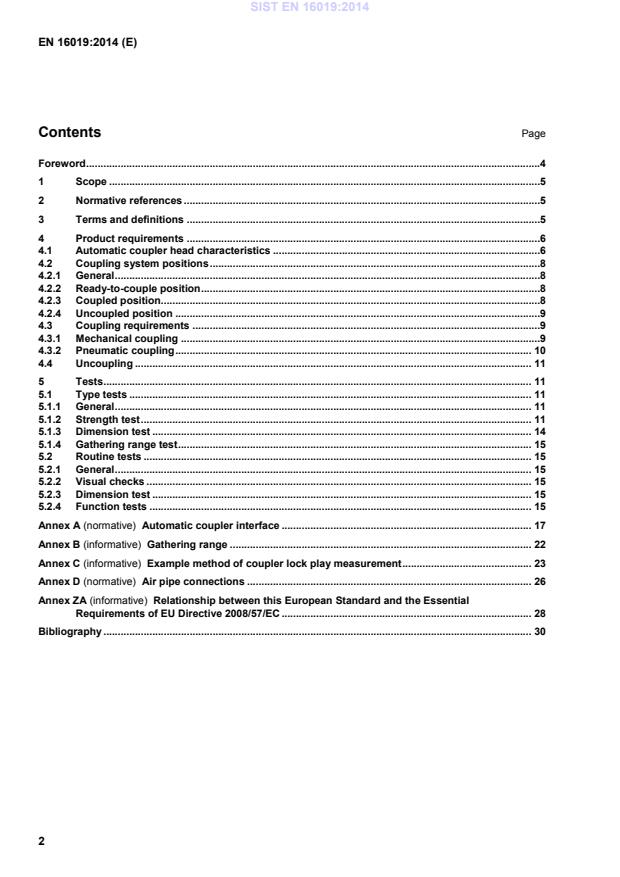
Automatic coupler interface . 17 Annex B (informative)
Gathering range . 22 Annex C (informative)
Example method of coupler lock play measurement . 23 Annex D (normative)
Air pipe connections . 26 Annex ZA (informative)
Relationship between this European Standard and the Essential Requirements of EU Directive 2008/57/EC . 28 Bibliography . 30
Figure 1 — Principle arrangement of coupler head . 7 Figure 2 — Ready-to-couple position . 8 Figure 3 — Coupled position . 9 Figure 4 — Uncoupled position . 9 Figure 5 — Successful coupling in curves . 10 Figure 6 — Unsuccessful coupling in curves . 10 Figure 7 — Strain gauges on the coupler head housing for the tensile test (tensile and compressive) . 12 Figure 8 — Strain gauge on the hook plate for the tensile test . 13 Figure 9 — Strain gauges on the coupling link for the tensile test . 13 Figure A.1 — Automatic coupler head (front view) . 17 Figure A.2 — Automatic coupler head (top view) . 18 Figure A.3 — Automatic coupler head (lateral view) . 19 Figure A.4 — Automatic coupler head in the coupled position (cross section) . 20 Figure A.5 — Automatic coupler head (isometric view) . 21 Figure B.1 — Typical gathering range of the Type 10 coupler . 22 Figure B.2 — Typical gathering range of the Type 10 coupler with guide bar . 22 Figure C.1 — Coupler lock play gauge Type 10 . 23 Figure C.2 — Coupler lock play gauge . 24 Figure C.3 — Coupler lock play measurement . 25 Figure D.1 — Brake pipe valve . 26 Figure D.2 — Main reservoir and uncoupling valve . 27
Rescue coupler -
Performance requirements, specific interface geometry and test methods EN ISO 6892-1, Metallic materials - Tensile testing - Part 1: Method of test at room temperature (ISO 6892-1) ISO 2768 (all parts), General tolerances 3 Terms and definitions For the purposes of this document, the following terms and definitions apply. 3.1 Type 10 automatic coupler latch-type automatic coupler allowing the mechanical, pneumatic and in some cases electrical connection between two train units or train sets without manual assistance, also known as “Scharfenberg® system Type 10” automatic coupler1) 3.2 coupler head part of couplers, consisting of coupler head housing with gathering elements, coupler lock, uncoupling device, air pipe connections and an appropriate interface towards the rear part of the coupler
1) Scharfenberg® is a registered trademark of Voith Turbo Scharfenberg, Salzgitter, Germany. This information is given for the convenience of users of this European Standard and does not constitute an endorsement by CEN of the product bearing this trademark. Equivalent products may be used if they can be shown to lead to the same results. SIST EN 16019:2014
Key 1 coupler face
6 male cone
11 trigger device 2 female cone 7 tension spring
12 release bar 3 main pin
8 coupling link pin 13 trigger 4 hook plate 9 coupler head housing
5 coupling link 10 release bar holder
Figure 1 — Principle arrangement of coupler head When coupled, the coupler lock elements are subjected to tensile load and form a parallelogram ensuring equilibrium of forces and an equal load distribution onto both coupling links. The equilibrium of forces prevents involuntary unlocking of the coupler locks and reduces wear. Compressive loads are transmitted through the flat coupler faces of the coupler heads. The automatic coupler head shall be designed to withstand the following forces without permanent deformation: — tensile load = 1 000 kN; — compressive load = 1 500 kN. These values are for normal operating conditions. If the coupler is used only for rescue conditions, lower values are allowed; these loads are defined in EN 15020. SIST EN 16019:2014
Figure 2 — Ready-to-couple position 4.2.3 Coupled position As the coupler faces mate, the male cones entering the female cones shall press the triggers backwards, in order for the release bars to be released. The release bar shall be retracted in the coupler head housings when they engage with the trigger devices. After the release
...