

EN 16723-2:2017
(Main)Natural gas and biomethane for use in transport and biomethane for injection in the natural gas network - Part 2: Automotive fuels specification
- Abstract
This European Standard specifies the requirements and test methods for natural gas (group L and H, as in EN 437), biomethane and blends of both at the point of use as automotive fuels.
This European Standard applies to the previously mentioned fuels irrespective of the storage state (compressed or liquefied).
To check compliance with some requirements set by the standard, LNG or liquefied biomethane should be re-gasified prior to testing.
- Status
- Published
- Publication Date
- 06-Jun-2017
- Withdrawal Date
- 30-Dec-2017
- Current Stage
- 9092 - Decision on results of review/2YR ENQ - revise - Review Enquiry
- Start Date
- 06-Feb-2023
- Completion Date
- 14-Oct-2026

Overview
EN 16723-2:2017 (CEN) - "Natural gas and biomethane for use in transport and biomethane for injection in the natural gas network - Part 2: Automotive fuels specification" - defines quality requirements and test methods for natural gas, biomethane and their blends used as automotive fuels. The standard covers fuels at the point of use whether compressed (CNG) or liquefied (LNG/liquefied biomethane); liquefied fuels should be re‑gasified prior to testing where required. Reference conditions for measurements are ISO standard reference conditions (15 °C, 101,325 kPa).
Key topics and technical requirements
- Scope and definitions: Clarifies terms such as biomethane, biogas, methane number (MN), Wobbe index, CNG/LNG and reference conditions.
- Parameters & limits: Specifies limits and test methods for parameters that affect engine performance, durability and safety, including:
- Total volatile silicon (limit noted in standard: 0.3 mg Si/m3)
- Hydrogen (maximum around 2 % mol/mol)
- Oxygen (≤ 1 % mol/mol)
- Hydrogen sulfide + carbonyl sulfide (≤ 5 mg/m3)
- Total sulfur (including odorization) (limit cited: 30 mgS/m3)
- Methane Number (minimum index referenced: 65)
- Amines, compressor oil, dust impurities and water/hydrocarbon dew points
- Test methods and sampling: References established analytical standards (EN ISO series such as EN ISO 10715 for sampling, EN ISO 13443 for reference conditions, and other EN ISO test methods).
- Climate-dependent characteristics: Requirements and tests for dew points and behavior at varying pressures.
- Marking and labelling: Guidance to support consumer information and vehicle compatibility.
Practical applications
- Quality control for producers and upgraders of biomethane and suppliers of natural gas for transport.
- Fuel specification and acceptance testing at refuelling stations, fuel terminals and vehicle fleet depots (CNG/LNG).
- Technical input for procurement contracts, conformity checks and vehicle compatibility verification (ensuring acceptable Wobbe index, methane number and contaminant levels).
- Basis for emission control, engine warranty conditions and safe operation of gas engines and sensors (e.g., silicon limits to protect oxygen sensors).
Who uses this standard
- Biomethane and natural gas producers, upgraders and liquefaction facilities
- Fuel suppliers and refuelling station operators
- Automotive OEMs, engine and sensor manufacturers (vehicle compatibility)
- Gas network operators, testing laboratories, certification bodies and regulators
Related standards
- EN 16723-1 (Part 1: biomethane for injection to the gas grid)
- EN 16726 (gas infrastructure - quality of gas)
- EN 437, EN 16942 and various EN ISO standards cited for sampling and analytical methods (e.g., EN ISO 10715, EN ISO 13443, EN ISO 6976 series).
Keywords: EN 16723-2:2017, biomethane, natural gas, automotive fuels, CNG, LNG, Wobbe index, methane number, fuel specification, CEN, gas quality.
Relations
- Effective Date
- 28-Jan-2026
- Effective Date
- 28-Jan-2026
- Effective Date
- 28-Jan-2026
- Effective Date
- 28-Jan-2026
- Effective Date
- 28-Jan-2026
- Effective Date
- 28-Jan-2026
- Effective Date
- 28-Jan-2026
- Effective Date
- 09-Feb-2026
Get Certified
Connect with accredited certification bodies for this standard

DNV
DNV is an independent assurance and risk management provider.

Lloyd's Register
Lloyd's Register is a global professional services organisation specialising in engineering and technology.
DNV Energy Systems
Energy and renewable energy certification.
Sponsored listings
Frequently Asked Questions
EN 16723-2:2017 is a standard published by the European Committee for Standardization (CEN). Its full title is "Natural gas and biomethane for use in transport and biomethane for injection in the natural gas network - Part 2: Automotive fuels specification". This standard covers: This European Standard specifies the requirements and test methods for natural gas (group L and H, as in EN 437), biomethane and blends of both at the point of use as automotive fuels. This European Standard applies to the previously mentioned fuels irrespective of the storage state (compressed or liquefied). To check compliance with some requirements set by the standard, LNG or liquefied biomethane should be re-gasified prior to testing.
This European Standard specifies the requirements and test methods for natural gas (group L and H, as in EN 437), biomethane and blends of both at the point of use as automotive fuels. This European Standard applies to the previously mentioned fuels irrespective of the storage state (compressed or liquefied). To check compliance with some requirements set by the standard, LNG or liquefied biomethane should be re-gasified prior to testing.
EN 16723-2:2017 is classified under the following ICS (International Classification for Standards) categories: 27.190 - Biological sources and alternative sources of energy; 75.160.30 - Gaseous fuels. The ICS classification helps identify the subject area and facilitates finding related standards.
EN 16723-2:2017 has the following relationships with other standards: It is inter standard links to EN 437:2021, EN ISO 13443:2005, EN 16942:2024, EN ISO 10715:2022, EN 16726:2015, CEN/TR 17238:2018, EN 17278:2021, prEN 16723. Understanding these relationships helps ensure you are using the most current and applicable version of the standard.
EN 16723-2:2017 is associated with the following European legislation: Standardization Mandates: M/475. When a standard is cited in the Official Journal of the European Union, products manufactured in conformity with it benefit from a presumption of conformity with the essential requirements of the corresponding EU directive or regulation.
EN 16723-2:2017 is available in PDF format for immediate download after purchase. The document can be added to your cart and obtained through the secure checkout process. Digital delivery ensures instant access to the complete standard document.
Standards Content (Sample)
2003-01.Slovenski inštitut za standardizacijo. Razmnoževanje celote ali delov tega standarda ni dovoljeno.Zemeljski plin in biometan za uporabo v prometu in biometan za dodajanje v omrežje zemeljskega plina - 2. del: Specifikacije goriv za motorna vozilaErdgas und Biomethan zur Verwendung im Transportwesen und Biomethan zur Einspeisung ins Erdgasnetz - Teil 2: Festlegungen für Kraftstoffe für KraftfahrzeugeGaz naturel et biométhane pour utilisation dans le transport et biométhane pour injection dans les réseaux de gaz naturel - Partie 2 : Spécifications du carburant pour véhicules automobilesNatural gas and biomethane for use in transport and biomethane for injection in the natural gas network - Part 2: Automotive fuels specification75.160.30Plinska gorivaGaseous fuels43.060.40Sistemi za gorivoFuel systemsICS:Ta slovenski standard je istoveten z:EN 16723-2:2017SIST EN 16723-2:2017en,fr,de01-september-2017SIST EN 16723-2:2017SLOVENSKI
STANDARD
EUROPEAN STANDARD NORME EUROPÉENNE EUROPÄISCHE NORM
EN 16723-2
June
t r s y ICS
t yä s { râ
y wä s x rä u r English Version
Natural gas and biomethane for use in transport and biomethane for injection in the natural gas network æ Part
tã Automotive fuels specification Gaz naturel et biométhane pour utilisation dans le transport et biométhane pour injection dans les réseaux de gaz naturel æ Partie
t ã Spécifications du carburant pour véhicules automobiles
Erdgas und Biomethan zur Verwendung im Transportwesen und Biomethan zur Einspeisung ins Erdgasnetz æ Teil
tã Festlegungen für Kraftstoffe für Kraftfahrzeuge This European Standard was approved by CEN on
s r April
t r s yä
egulations which stipulate the conditions for giving this European Standard the status of a national standard without any alterationä Upætoædate lists and bibliographical references concerning such national standards may be obtained on application to the CENæCENELEC Management Centre or to any CEN memberä
translation under the responsibility of a CEN member into its own language and notified to the CENæCENELEC Management Centre has the same status as the official versionsä
CEN members are the national standards bodies of Austriaá Belgiumá Bulgariaá Croatiaá Cyprusá Czech Republicá Denmarká Estoniaá Finlandá Former Yugoslav Republic of Macedoniaá Franceá Germanyá Greeceá Hungaryá Icelandá Irelandá Italyá Latviaá Lithuaniaá Luxembourgá Maltaá Netherlandsá Norwayá Polandá Portugalá Romaniaá Serbiaá Slovakiaá Sloveniaá Spainá Swedená Switzerlandá Turkey and United Kingdomä
EUROPEAN COMMITTEE FOR STANDARDIZATION COMITÉ EUROPÉEN DE NORMALISATION EUROPÄISCHES KOMITEE FÜR NORMUNG
CEN-CENELEC Management Centre:
Avenue Marnix 17,
B-1000 Brussels
t r s y CEN All rights of exploitation in any form and by any means reserved worldwide for CEN national Membersä Refä Noä EN
s x y t uæ tã t r s y ESIST EN 16723-2:2017
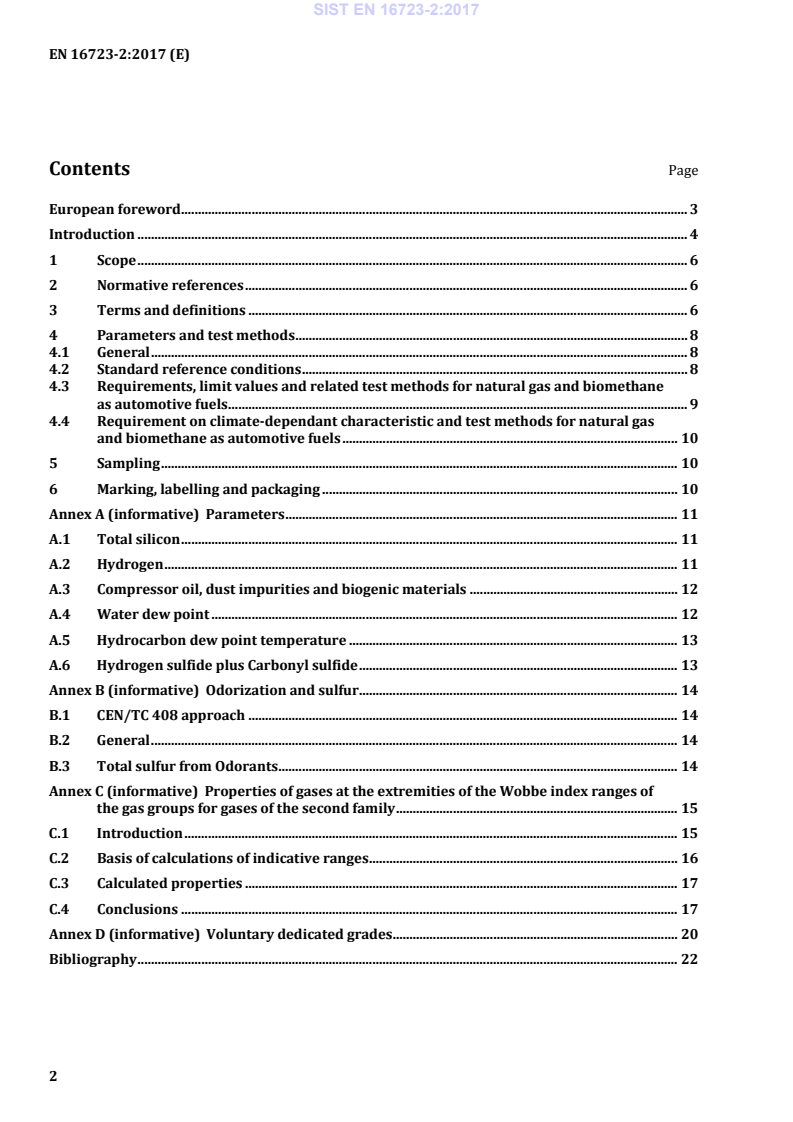
Parameters . 11 A.1 Total silicon . 11 A.2 Hydrogen . 11 A.3 Compressor oil, dust impurities and biogenic materials . 12 A.4 Water dew point . 12 A.5 Hydrocarbon dew point temperature . 13 A.6 Hydrogen sulfide plus Carbonyl sulfide . 13 Annex B (informative)
Odorization and sulfur . 14 B.1 CEN/TC 408 approach . 14 B.2 General . 14 B.3 Total sulfur from Odorants . 14 Annex C (informative)
Properties of gases at the extremities of the Wobbe index ranges of the gas groups for gases of the second family . 15 C.1 Introduction . 15 C.2 Basis of calculations of indicative ranges . 16 C.3 Calculated properties . 17 C.4 Conclusions . 17 Annex D (informative)
Voluntary dedicated grades . 20 Bibliography . 22 SIST EN 16723-2:2017
Key 1 biogas from digestion or thermos-chemical process 7 non-grid sourced natural gas 2 upgrading 8 local dedicated infrastructure 3 injection into the gas grid 9 automotive use 4 natural gas grid 10 domestic and industrial use 5 conditioning 11 Part 1: grid specification 6 refuelling station 12 Part 2: automotive specification Figure 1 — Representation of some flows and uses of biomethane and natural gas SIST EN 16723-2:2017
15 °C (combustion);
and 15 °C and 101,325 kPa (metering). In assessing compliance with this European Standard, parameters should be determined directly at ISO Standard Reference conditions. If the properties are only available at other reference conditions and the actual gas composition is not known, then conversion to ISO Standard Reference conditions shall be carried out using the procedure described in EN ISO 13443. SIST EN 16723-2:2017
Requirements, limit values and related test methods for natural gas and biomethane as automotive fuels Information on Wobbe index and calorific value can be found in Annex C. Table 1 — Requirements, limit values and related test methods for natural gas and biomethane as automotive fuels Parameter Unit Limit valuesa Test method (informative) Min Max Total volatile silicon (as Si) mgSi/m3
0,3b EN ISO 16017-1:2000 TDS-GC-MS Hydrogen % mol/mol _ 2 EN ISO 6974-3 EN ISO 6974-6 EN ISO 6975 Hydrocarbon dew point temperature (from 0,1 to 7 MPa absolute pressure) °C _
«2 (as in EN 16726) ISO 23874 ISO/TR 11150 ISO/TR 12148 Oxygen % mol/mol _ 1 EN ISO 6974- series EN ISO 6975 Hydrogen sulfide + Carbonyl sulfide (as sulfur) mg/m3 _ 5 (as in EN 16726) EN ISO 6326-1 EN ISO 6326-3 EN ISO 19739 S total (including odorization) mgS/m3
30c EN ISO 6326-5 EN ISO 19739 Methane Number Index 65d
(as in EN 16726)
Annex A of EN 16726:2015 Compressor oil
e ISO 8573-2 Dust impurities
e, f ISO 8573-4 Amine mg/m3
10 VDI 2467 Blatt 2:1991–08 Water dew point See 4.4 a Limit values are absolute, the number of the decimal places shall not imply the accuracy of the test methods. b Levels above 0,1 mgSi/m3 can severely harm switching type oxygen sensors of some automotive vehicles (see DNV GL report). However, a limit set at this level would present difficulty in terms of analytical measurement (current quantification limits are at best 0,10 mg Si/m3, which would imply setting a limit of 0,30 mg Si/m3). And currently biomethane production processes cannot guarantee a level of siloxanes below 0,5 mgSi/m3. c Currently, there is a difference between the automotive industry needs for sulfur content (10 mgS/m3 including odorization) and the values the gas industry can provide (30 mg/m3 including odorization). See Annex B. It is possible to cover this parameter in a national foreword. d The methane number depends on the composition of the distributed natural gas. It should be noted that only a small fraction of the distributed natural gas has a methane number below (MWM) of 70. e The fuel shall be free from impurities other than “de minimis” levels of compressor oil and dust impurities. In the context of this European Standard, “de minimis” means an amount that does not render the fuel unacceptable for use in end user applications. f Fuelling stations providing LNG should ensure a maximum particle contamination of 10 mg/l of LNG to protect the automotive vehicle system from debris, providing performance equivalent to a filter with maximum pore size of 5 and 10
% efficiency. SIST EN 16723-2:2017
«10 °C at 20 000 kPa ISO 6327 (applicability at 20 000 kPa) Class B
«20 °C at 20 000 kPa
Class C
«30 °C at 20 000 kPa
5 Sampling Components shall be sampled according to EN ISO 10715 as those of EN 16726. This sampling method has not been validated for biomethane or mixtures with natural gas, however further work is undertaken towards validation. Other components as siloxanes need special attention/validation in sampling. Measures shall be taken to avoid any contamination of the sample from the moment of sampling until the analysis can be performed. 6 Marking, labelling and packaging Information to be marked on dispensing pumps and nozzles used for delivering automotive NG/biomethane fuel and the dimensions of the label shall be in accordance with EN 16942. SIST EN 16723-2:2017
Parameters A.1 Total silicon Some raw biogas, in particular from landfill, sewage or municipal biowaste contains significant amounts of siloxanes volatilized during anaerobic digestion. Siloxanes are components in various household products and construction materials and can be used as de-foamers during biomass fermentation. Silicon impurities need to be removed during upgrading of biogas to biomethane. During combustion of biomethane, siloxanes and other organo silicon compounds form silica which generates deposits, e.g. on valves, lambda oxygen sensors and cylinder walls, causing abrasion, malfunction of exhaust emission control or blockage of pistons and cylinder heads, respectively. In particular, automotive vehicle engines are affected by residual silicon contamination in biomethane. Automotive vehicles with spark ignition engines are developed for fuels, e.g. gasoline, gasoline ethanol blends and natural gas which all are literally free of silicon. The absence of silicon impurities enabled the use of lambda oxygen sensors upstream of the catalyst for exhaust gas control. Deposition of silica on sensor elements impedes oxygen diffusion. Higher silicon contents misalign oxygen sensors and reduce their durability. The analysis method for silicon in natural gas has not yet been fully validated and the limit value for silicon defined in the table of parameters is preliminary. Although preliminary, the definition of a low maximum silicon limit has been considered as an important step to protect automotive vehicles from silicon contaminated gas as far as possible. Besides siloxanes, biogases may also contain organic silicon compounds other than siloxanes which are also converted to silica upon combustion. A.2 Hydrogen There are proposals to inject hydrogen (H2) from renewable sources in the natural gas network. This measure would allow the very large transport and storage capacities of the existing infrastructure, particularly underground storage facilities and high-pressure pipelines, to be used for indirect electricity transport and storage. The results of the GERG study “Admissible Hydrogen Concentrations in Natural Gas Systems” (see Bibliography [24]) show that an admixture of up to 10 % by volume of hydrogen to natural gas is possible in some parts of the natural gas system. However there are still some important areas where issues remain (GERG is the European Gas Research Group, Brussels): — underground porous rock storage: hydrogen is a good substrate for sulphate-reducing and sulfur-reducing bacteria. As a result, there are risks associated with: bacterial growth in underground gas storage facilities leading to the formation of H2S; the consumption of H2, and the plugging of reservoir rock. A limit value for the maximum acceptable hydrogen concentration in natural gas cannot be defined at the moment. (H2-related aspects concerning wells have not been part of this project); — steel tanks in natural gas automotive veh
...