

EN 18051:2026
(Main)Automotive fuels - Determination of content of butoxy-benzene in middle distillates - Gas chromatographic method using a flame ionization detector (GC-FID)
- Abstract
This document specifies a test method for the determination of the content of n-butyl phenyl ether (BPE, CAS: 1126-79-0, also known as butoxy-benzene) in gas oils, kerosene, diesel fuel and biodiesel blends. The method uses a two-column gas chromatograph with an FID-type of detector. The application range is 0,27 mg/l to 19,75 mg/l of BPE, with the minimum and maximum reporting levels being 0,09 mg/l and 21,89 mg/l respectively.
NOTE This corresponds to 1 % to 185 % of the average marking level of the ACCUTRACE™ Plus required by Commission Implementing Decision (EU) 2022/197 [1] of 17 January 2022 establishing a common fiscal marker for gas oils and kerosene.
The method is found to be applicable to determinations beyond this range or for specific other chemical markers that fall within the distillation temperature range of middle-distillates, but for that no precision has been determined.
WARNING — The use of this document can involve hazardous materials, operations and equipment. This document does not purport to address all of the safety problems associated with its use. It is the responsibility of the user of this document to establish appropriate safety and health practices and to determine the applicability of regulatory limitations prior to use.
- Status
- Published
- Publication Date
- 31-Aug-2027
- Technical Committee
- CEN/TC 19 - Gaseous and liquid fuels, lubricants and related products of petroleum, synthetic and biological origin
- Drafting Committee
- CEN/TC 19/WG 9 - Chromatographic test methods
- Current Stage
- 6060 - Definitive text made available (DAV) - Publishing
- Start Date
- 16-Sep-2026
- Due Date
- 01-Sep-2027
- Completion Date
- 01-Sep-2027

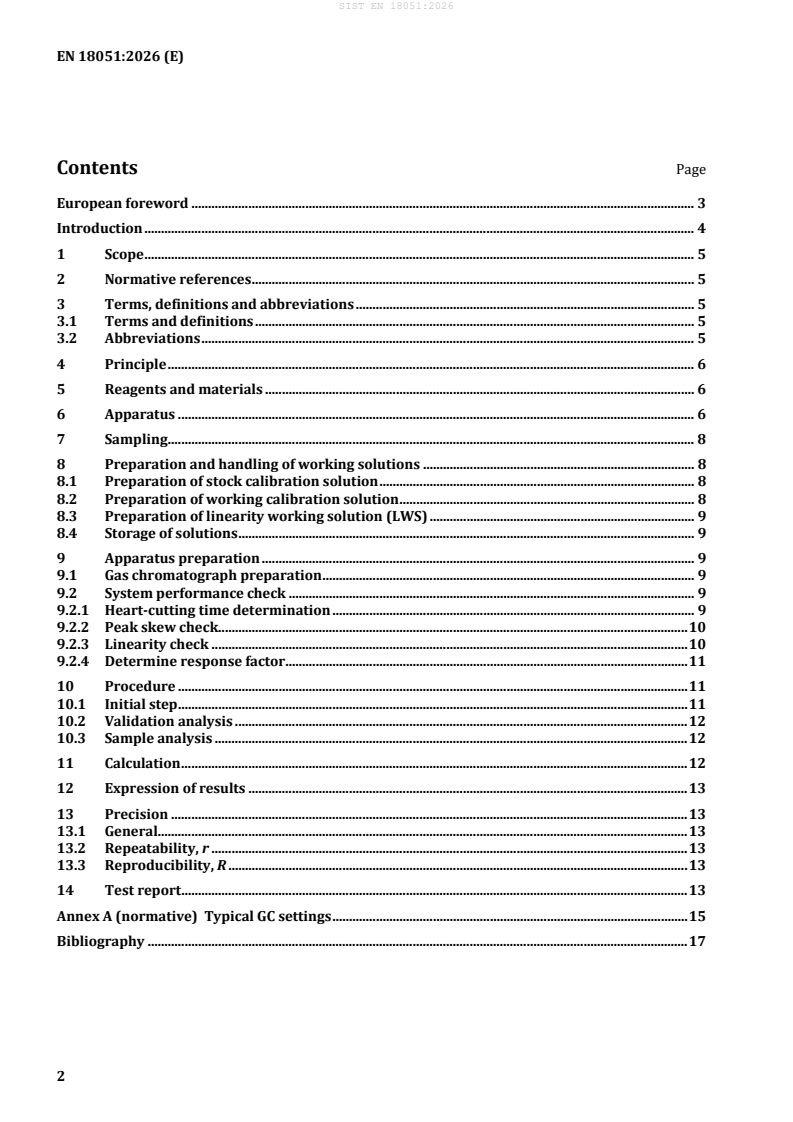
EN 18051:2026 is a CEN European Standard for measuring n-butyl phenyl ether (BPE), also known as butoxy-benzene, in middle distillates by gas chromatography with a flame ionization detector (GC-FID). It is intended for gas oils, kerosene, diesel fuel and biodiesel blends, and it gives laboratories a defined way to check fuel-marker content.
The document focuses on a two-column GC method with a heart-cut transfer step, working solutions, calibration, system checks, calculation and precision. It is written for testing laboratories, customs laboratories and fuel quality staff who need a repeatable measurement method for the ACCUTRACE™ Plus marker and related BPE determinations.
What does EN 18051:2026 specify?
EN 18051:2026 specifies a test method for determining the content of BPE in middle distillates. It sets the scope, the GC-FID principle, the required preparations, the calculation of results and the precision statement for the method.
The method applies to gas oils, kerosene, diesel fuel and biodiesel blends. The stated application range is 0,27 mg/l to 19,75 mg/l of BPE, with reporting levels of 0,09 mg/l and 21,89 mg/l. The scope also notes that the method can be used beyond that range or for other chemical markers in the middle-distillate boiling range, but no precision is given for those uses.
| Annex | What it covers |
|---|---|
| Annex A | Typical GC settings, including column configuration, temperature program, pressures and example chromatograms |
The document is organized into Clauses 1 to 14, covering scope, references, terms, principle, reagents, apparatus, sampling, solution preparation, apparatus preparation, procedure, calculation, expression of results, precision and test report.
What are the key requirements of EN 18051:2026?
Sampling, reagents and solutions
EN 18051:2026 requires samples to be taken in accordance with EN ISO 3170 or EN ISO 3171 unless a commodity specification says otherwise. Samples should be kept at room temperature and protected from heat and humidity before analysis.
The method uses reagent-grade chemicals, purified gases, BPE-free diesel and a suitable solvent. In practice, this means the analyst must avoid contamination and use the same matrix background for calibration and sample work.
The working solutions are prepared from a stock calibration solution and a working calibration solution, then a set of linearity working solutions (LWS) is made to cover the expected range. This matters because the method relies on calibration in the right concentration range before any sample result is accepted.
GC setup and performance checks
EN 18051:2026 uses a two-column GC with at least one FID, a split inlet and heart-cutting technology. Clause 9 requires the instrument to be prepared, then checked for heart-cutting time, peak skew, linearity and response factor.
The heart-cutting time is set by running a calibration solution and identifying when BPE transfers cleanly to the analytical column. This ensures the marker is separated from the bulk fuel and helps avoid wrong peak identification.
The peak skew ratio must stay within the stated limits, and linearity requires a correlation coefficient of at least 0,999 with a small intercept. In practice, the lab must prove that the detector response is stable enough to support quantification.
Analysis, calculation and precision
EN 18051:2026 requires neat injection of samples and standards, with a validation step at the start of a sequence or daily basis. A blank check is used to confirm that no BPE peak appears in the solvent or BPE-free diesel.
The BPE concentration is calculated from the response factor and peak area, and results are reported to the nearest 0,01 mg/l. Clause 13 gives repeatability and reproducibility expressions derived from interlaboratory data, so users can judge whether two results are acceptably close.
The test report must identify the product, cite EN 18051:2026, state the result, list any agreed deviations, note unusual features and give the test date. That helps audits, traceability and dispute handling.
What terms does EN 18051:2026 define?
- BPE - n-butyl phenyl ether, the target marker measured by this method.
- FID - flame ionization detector, the detector used for quantification in the GC.
- GC - gas chromatograph, the instrument used to separate and measure BPE.
- LWS - linearity working solution, a set of prepared standards used to check linear response.
- SCS - stock calibration solution, the primary prepared solution used to make other standards.
- WCS - working calibration solution, the diluted standard used for calibration and checks.
- RF - absolute response factor, the factor used to convert peak area into concentration.
- MS - mass spectrometry, mentioned as an alternative detector approach in the background context.
Who uses EN 18051:2026?
EN 18051:2026 is used by laboratories that test automotive fuels and middle distillates for marker content. It is also relevant to customs laboratories and organizations working with fiscal markers in gas oils and kerosene.
In practice, users apply it for routine quality control, compliance checking, method validation and dispute resolution. Fuel blenders, producers and regulatory laboratories use the same method when they need comparable BPE results across sites.
What changed in EN 18051:2026 from the previous edition?
EN 18051:2026 supersedes EN 18051:2024.
The foreword states three changes from the previous edition:
- improved precision statements after a second interlaboratory study
- a modified scope of application
- more detail on the test procedure
Which standards are used with EN 18051:2026?
- EN ISO 3170 - supports manual sampling of hydrocarbon liquids when samples are taken by hand.
- EN ISO 3171 - supports automatic pipeline sampling of petroleum liquids.
- EN ISO 4259-1:2026 - provides the framework used for evaluating precision data and the repeatability/reproducibility statements.
What does the EN 18051:2026 document contain?
EN 18051:2026 contains the full test method from sampling through reporting, including solution preparation, GC preparation, and day-to-day validation steps. It also gives the calculation formulas for concentration, response factor and fiscal marker content.
Annex A provides the typical GC settings, including the oven program, injector temperature, inlet pressure, split ratio, detector temperature, column dimensions and example analytical columns used in the interlaboratory work. It also includes an exemplary chromatogram and the heart-cut/backflush timing concept, which are practical references for setting up the instrument.
Relations
- Effective Date
- 28-May-2025
- Effective Date
- 14-Oct-2026
Get Certified
Connect with accredited certification bodies for this standard

Element Materials Technology
Materials testing and product certification.

ABS Group Brazil
ABS Group certification services in Brazil.

ABS Quality Evaluations Inc.
American Bureau of Shipping quality certification.
Sponsored listings
Frequently Asked Questions
EN 18051:2026 is a standard published by the European Committee for Standardization (CEN). Its full title is "Automotive fuels - Determination of content of butoxy-benzene in middle distillates - Gas chromatographic method using a flame ionization detector (GC-FID)". This standard covers: This document specifies a test method for the determination of the content of n-butyl phenyl ether (BPE, CAS: 1126-79-0, also known as butoxy-benzene) in gas oils, kerosene, diesel fuel and biodiesel blends. The method uses a two-column gas chromatograph with an FID-type of detector. The application range is 0,27 mg/l to 19,75 mg/l of BPE, with the minimum and maximum reporting levels being 0,09 mg/l and 21,89 mg/l respectively. NOTE This corresponds to 1 % to 185 % of the average marking level of the ACCUTRACE™ Plus required by Commission Implementing Decision (EU) 2022/197 [1] of 17 January 2022 establishing a common fiscal marker for gas oils and kerosene. The method is found to be applicable to determinations beyond this range or for specific other chemical markers that fall within the distillation temperature range of middle-distillates, but for that no precision has been determined. WARNING — The use of this document can involve hazardous materials, operations and equipment. This document does not purport to address all of the safety problems associated with its use. It is the responsibility of the user of this document to establish appropriate safety and health practices and to determine the applicability of regulatory limitations prior to use.
This document specifies a test method for the determination of the content of n-butyl phenyl ether (BPE, CAS: 1126-79-0, also known as butoxy-benzene) in gas oils, kerosene, diesel fuel and biodiesel blends. The method uses a two-column gas chromatograph with an FID-type of detector. The application range is 0,27 mg/l to 19,75 mg/l of BPE, with the minimum and maximum reporting levels being 0,09 mg/l and 21,89 mg/l respectively. NOTE This corresponds to 1 % to 185 % of the average marking level of the ACCUTRACE™ Plus required by Commission Implementing Decision (EU) 2022/197 [1] of 17 January 2022 establishing a common fiscal marker for gas oils and kerosene. The method is found to be applicable to determinations beyond this range or for specific other chemical markers that fall within the distillation temperature range of middle-distillates, but for that no precision has been determined. WARNING — The use of this document can involve hazardous materials, operations and equipment. This document does not purport to address all of the safety problems associated with its use. It is the responsibility of the user of this document to establish appropriate safety and health practices and to determine the applicability of regulatory limitations prior to use.
EN 18051:2026 is classified under the following ICS (International Classification for Standards) categories: 75.160.20 - Liquid fuels; 75.160.40 - Biofuels. The ICS classification helps identify the subject area and facilitates finding related standards.
EN 18051:2026 has the following relationships with other standards: It is inter standard links to EN 18051:2024, EN ISO 3171:1999. Understanding these relationships helps ensure you are using the most current and applicable version of the standard.
EN 18051:2026 is available in PDF format for immediate download after purchase. The document can be added to your cart and obtained through the secure checkout process. Digital delivery ensures instant access to the complete standard document.
Standards Content (Sample)
Contents
- Introduction
- 1 Scope
- 2 Normative references
- 3 Terms, definitions and abbreviations
- 3.1 Terms and definitions
- 3.2 Abbreviations
- 4 Principle
- 5 Reagents and materials
- 5.1 Purity of reagents and gasses
- 5.8 Fuel marker, n-butyl phenyl ether (CAS: 1126-79-0) with known analytical purity
- 6 Apparatus
- 6.1 Gas chromatograph (GC)
- 6.2 GC columns (see A.1)
- 6.3 Micro-syringe, of appropriate volume, for example 5 µl, for introduction of the
- 6.4 Analytical balance, capable of weighing to the nearest 0,000 1 g (or 0,1 mg)
- 6.5 Autopipettes, of 1 ml, 5 ml or 10 ml capacity
- 6.6 Volumetric flasks, glass, of 50 ml or 100 ml capacity, with stoppers
- 6.7 Transfer pipette, for instance a dropping pipette and rubber bulbs
- 6.8 GC Autosampler vials, (1,5 ml to 2 ml) with crimp or screw caps
- 7 Sampling
- 8 Preparation and handling of working solutions
- 8.1 Preparation of stock calibration solution
- 8.2 Preparation of working calibration solution
- 8.3 Preparation of linearity working solution (LWS)
- 8.4 Storage of solutions
- 9 Apparatus preparation
- 9.1 Gas chromatograph preparation
- 9.2 System performance check
- 10 Procedure
- 10.1 Initial step
- 10.2 Validation analysis
- 10.3 Sample analysis
- 11 Calculation
- 12 Expression of results
- 13 Precision
- 13.1 General
- 13.2 Repeatability, r
- 13.3 Reproducibility, R
- 14 Test report
- Annex A
- Bibliography
Introduction
This document supports implementation in the market of Commission Implementing Decision (EU) 2022/197 [1] of the European Commission with regards to common distillate fuel marking. For the proper functioning of the internal market, the European Commission has established Directives providing for a common marking system to identify gas oils and kerosene, which have been released for consumption exempt from excise duty, or which are subject to a reduced excise duty rate. In a review in 2019, the Commission’s evaluation identified the shortcomings of the actual marker (Solvent Yellow 124) in terms of its lack of resilience to common removal methods.
Consequently, a new, colourless chemical marker, butoxy-benzene (CAS Registry Number 1126-79-0), was chosen to replace Solvent Yellow 124 as of 18 January 2024. This product or fiscal marker is
commercially available as ACCUTRACE™ Plus from DOW.
At the time of publication of the decision [1], a gas chromatography technique using a mass spectrometer (GC-MS) as detector was promoted by DOW. That technique did not have a precision statement in line with ISO 4259-1. The first contacts in 2022 with the European Commission and the EU Customs laboratories led CEN to conclude that the GC-MS would not be further standardized. This document has then been developed to present a simpler alternative to the market compared to the GC-MS method.
The test method described in this document is based on a standard [2] previously prepared for a former fuel marker, ACCUTRACE™ S10 (3-secbutyl-4-decyloxyphenylmethanetriyltribenzene), which is used in a few European countries.
To determine the initial method precision, CEN cooperated with the EU Customs laboratories (CLEN) who studied an improvement of the GC-MS method. The two organizations used the same samples to develop precision. Bias of the test method described in this document against the ILIAD 606 method [3] has not been determined in that study.
As for some reasons the sample distribution in the combined study encountered issues and the initial precision was not as expected via the pilot study by CEN. Hence a new study was performed that resulted in an improved precision and better-defined scope of application.
ACCUTRACE Plus and ACCUTRACE S10 are the trade names of products supplied by DOW Chemicals. This information is given for the convenience of users of this document and does not constitute an endorsement by CEN of the products named. Equivalent products may be used.
SIST EN 18051:2026 EN 18051:2026 (E)
1 Scope
This document specifies a test method for the determination of the content of n-butyl phenyl ether (BPE, CAS: 1126-79-0, also known as butoxy-benzene) in gas oils, kerosene, diesel fuel and biodiesel blends. The method uses a two-column gas chromatograph with an FID-type of detector. The application range is 0,27 mg/l to 19,75 mg/l of BPE, with the minimum and maximum reporting levels being 0,09 mg/l and 21,89 mg/l respectively.
NOTE This corresponds to 1 % to 185 % of the average marking level of the ACCUTRACE™ Plus required by Commission Implementing Decision (EU) 2022/197 [1] of 17 January 2022 establishing a common fiscal marker for gas oils and kerosene.
The method is found to be applicable to determinations beyond this range or for specific other chemical markers that fall within the distillation temperature range of middle-distillates, but for that no precision has been determined.
WARNING — The use of this document can involve hazardous materials, operations and equipment. This document does not purport to address all of the safety problems associated with its use. It is the responsibility of the user of this document to establish appropriate safety and health practices and to determine the applicability of regulatory limitations prior to use.
2 Normative references
The following documents are referred to in the text in such a way that some or all of their content constitutes requirements of this document. For dated references, only the edition cited applies. For undated references, the latest edition of the referenced document (including any amendments) applies. EN ISO 3170, Hydrocarbon liquids — Manual sampling (ISO 3170) EN ISO 3171, Petroleum liquids — Automatic pipeline sampling (ISO 3171)
3 Terms, definitions and abbreviations
3.1 Terms and definitions
No terms and definitions are listed in this document.
ISO and IEC maintain terminology databases for use in standardization at the following addresses:
- ISO Online browsing platform: available at https://www.iso.org/obp
- IEC Electropedia: available at https://www.electropedia.org/
3.2 Abbreviations
For the purposes of this document, the following abbreviations apply:
BPE n-butyl phenyl ether FID flame ionization detector GC gas chromatograph LWS linearity working solution MS mass spectrometry RF absolute response factor SCS stock calibration solution
SIST EN 18051:2026 EN 18051:2026 (E) WCS working calibration solution
4 Principle
A test portion is run neat on a two-column gas-chromatographic system. A pre-separation takes place on a non-polar pre-column. The middle-distillate part with the component, n-butyl phenyl ether or BPE, that is the main part of the ACCUTRACE™ Plus fuel marker, is transferred towards a polar analytical column by using a heart-cut technique. The GC is set towards optimum flow and temperature setting for the analytical column.
The response areas for the BPE-specific sequential time interval over the entire chromatogram is determined in a pre-calibration, linearity check step. A flame-ionization detector (FID) is used for assignment and quantification by reference to an external standard using a BPE-free diesel-type fuel.
5 Reagents and materials
5.1 Purity of reagents and gasses
Reagent grade chemicals shall be used in all tests.
Any hydrocarbon, oxygen or water present in the gases used (5.2, 5.3 and 5.4), shall be removed by applying an appropriate filter.
5.2 Carrier gas, helium or hydrogen, minimum volume fraction of 99,995 % purity. NOTE Helium and hydrogen have been proven to achieve the required level of detection, and were used during the interlaboratory study (see 13.1), but nitrogen is an option as well. 5.3 Hydrogen gas, minimum volume fraction of 99,995 % purity, for use as FID combustion gas. 5.4 Nitrogen gas, minimum volume fraction of 99,995 % purity or better, for use as FID make-up gas. 5.5 Compressed air, for use as FID combustion gas.
5.6 Diesel fuel, free of BPE.
5.7 Solvent, purity ≥ 99 %. It has been proven that with m-Xylene the required level of detection can be achieved, but lower hazard solvents such as cyclohexane or heptane are suitable as well.
5.8 Fuel marker, n-butyl phenyl ether (CAS: 1126-79-0) with known analytical purity
This product is also known as BPE and is commercially available as the EU fiscal marker or as ACCUTRACE™ Plus solution.
6 Apparatus
6.1 Gas chromatograph (GC)
6.1.1 Gas chromatograph, accommodating two capillary columns and equipped with at least one
flame ionization detector (FID) and one split inlet, and Deans-switching technology, capable to be operated under the typical conditions given in Annex A (see also Figure 1). Heart-cut techniques other than Deans switches are allowed. If these are placed outside the oven, one shall ensure that no condensation occurs.
SIST EN 18051:2026 EN 18051:2026 (E)
Key a aux b pre-column c analysis column d monitor column e FID back detector f FID front detector Figure 1 — Schematic overview of the configuration 6.1.2 Sample inlet system, consisting of a split inlet, able to be operated under the typical conditions given in Annex A.
6.1.3 Column temperature programmer, able to be operated under the typical conditions given in
Annex A.
NOTE Columns are heated in the same oven compartment or in separate oven compartments. 6.1.4 Flame ionization detector(s), able to be operated under the typical conditions given in Annex A. NOTE A second FID connected to the monitor column (a so-called front detector) facilitates the analyser preparation and set-up.
6.2 GC columns (see A.1)
6.2.1 Pre-column, having a non-polar phase.
6.2.2 Analytical column, having a polar phase.
6.3 Micro-syringe, of appropriate volume, for example 5 µl, for introduction of the
calibration/validation mixtures and samples.
6.4 Analytical balance, capable of weighing to the nearest 0,000 1 g (or 0,1 mg)
6.5 Autopipettes, of 1 ml, 5 ml or 10 ml capacity
6.6 Volumetric flasks, glass, of 50 ml or 100 ml capacity, with stoppers
6.7 Transfer pipette, for instance a dropping pipette and rubber bulbs
6.8 GC Autosampler vials, (1,5 ml to 2 ml) with crimp or screw caps
SIST EN 18051:2026 EN 18051:2026 (E)
...