

EN 1422:2014
(Main)Sterilizers for medical purposes - Ethylene oxide sterilizers - Requirements and test methods
- Abstract
This European Standard specifies the requirements and the relevant tests for automatically controlled sterilizers employing ethylene oxide (EO) gas as the sterilant, either as a pure gas or a mixture with other gases, being used for the sterilization of medical devices and their accessories.
This European Standard specifies requirements for ethylene oxide sterilizers (EO-sterilizers) working at super or sub-atmospheric pressure for:
- the performance and design of sterilizers to ensure that the process is capable of sterilizing medical devices;
- the equipment and controls of these sterilizers necessary for the validation and routine control of the sterilization processes.
The test loads described in this European Standard are selected to represent a number of loads for the evaluation of the performance of EO sterilizers for medical devices. However, specific loads may require the use of other test loads.
This European Standard does not specify those tests which are necessary to determine the probability of a processed product being sterile, nor the routine quality control tests required prior to release of sterile product. These topics are addressed in prEN ISO 11135:2012.
This European Standard does not specify requirements for occupational safety associated with the design and operation of EO sterilization facilities.
NOTE 1 For further information on safety, see examples in the Bibliography. National or regional regulations can exist.
This European Standard does not cover sterilizers which employ the injection of EO or mixtures containing EO directly into packages or into a flexible chamber.
NOTE 2 See EN ISO 14937.
This European Standard is not intended as a checklist for suitability of an existing EO sterilizer when assessing compliance with prEN ISO 11135:2012. This standard is not intended to be applied retrospectively.
This European Standard does not cover analytical methods for determining levels of residual EO and/or its reaction products.
NOTE 3 For further information see ISO 10993 7.
- Status
- Published
- Publication Date
- 20-May-2014
- Technical Committee
- CEN/TC 102 - Sterilizers for medical purposes
- Drafting Committee
- CEN/TC 102/WG 6 - Gas sterilizers
- Current Stage
- 9093 - Decision to confirm - Review Enquiry
- Start Date
- 15-Apr-2020
- Completion Date
- 21-Oct-2026
- Directive
- 93/42/EEC - Medical devices

Overview
EN 1422:2014 is the CEN European standard that defines requirements and test methods for ethylene oxide sterilizers (EO sterilizers) used for medical devices. It applies to automatically controlled EO sterilizers operating at super‑ or sub‑atmospheric pressure and covers design, performance, instrumentation and testing needed to demonstrate sterilizer capability and support process validation and routine control.
Key topics
- Scope & exclusions
- Applies to EO gas (pure or mixed) sterilizers for medical devices; excludes systems that inject EO directly into packages or flexible chambers.
- Does not define microbiological sterility probability or routine product release QC (see prEN ISO 11135:2012) and does not cover analytical methods for residual EO (see ISO 10993‑7) or occupational safety requirements.
- Design and construction
- Requirements for sterilizer chamber, doors/interlocks, pipework, EO vaporizers, evacuation and emission control, thermal insulation and loading equipment.
- Instrumentation & controls
- Specifications for indicating, measuring and recording instruments: temperature sensors, pressure sensors, relative humidity (RH), EO concentration measurement, timers and cycle counters, and data recording for validation and routine monitoring.
- Process control & software
- Automatic cycle control, override/fault handling, software verification/validation and sterilization cycle definition to ensure reproducible EO processes.
- Performance testing
- Physical and microbiological reference tests, chamber profile testing, leak tests and representative test loads to evaluate sterilizing performance, EO removal (flushing) and aeration behavior.
- Documentation & environmental aspects
- Manufacturer information, packaging/marking, service/environment requirements and an informative environmental checklist (Annex E).
Applications and users
EN 1422:2014 is intended for:
- Manufacturers of EO sterilizers designing products to meet European performance requirements.
- Validation and quality engineers performing type tests, factory acceptance tests, validation/re‑validation and routine performance tests.
- Medical device manufacturers, hospital sterilisation departments and contract sterilization service providers assessing sterilizer capability.
- Regulatory bodies, notified bodies and test laboratories using standardized test methods for conformity assessment.
Practical uses include design verification, performance qualification, routine monitoring program development, procurement specifications and supporting regulatory compliance for EO sterilization equipment.
Related standards
- prEN ISO 11135:2012 - validation and routine control of EO sterilization processes (microbiological validation)
- ISO 10993‑7 - guidance on residual ethylene oxide and reaction products
- EN ISO 14937 - general sterilization requirements (see text)
Keywords: EN 1422:2014, ethylene oxide sterilizers, EO sterilizers, medical device sterilization, sterilizer validation, sterilization process controls, CEN standard.
Relations
- Effective Date
- 21-Nov-2009
- Effective Date
- 08-Jul-2026
- Effective Date
- 08-Jul-2026
- Effective Date
- 18-Feb-2026
- Effective Date
- 09-Feb-2026
- Effective Date
- 09-Feb-2026
- Effective Date
- 09-Feb-2026
- Effective Date
- 28-Jan-2026
- Effective Date
- 28-Jan-2026
- Effective Date
- 28-Jan-2026
- Effective Date
- 28-Jan-2026
- Effective Date
- 28-Jan-2026
- Effective Date
- 28-Jan-2026
- Effective Date
- 28-Jan-2026
- Effective Date
- 28-Jan-2026
Get Certified
Connect with accredited certification bodies for this standard

BSI Group
BSI (British Standards Institution) is the business standards company that helps organizations make excellence a habit.

TÜV Rheinland
TÜV Rheinland is a leading international provider of technical services.

TÜV SÜD
TÜV SÜD is a trusted partner of choice for safety, security and sustainability solutions.
Sponsored listings
Frequently Asked Questions
EN 1422:2014 is a standard published by the European Committee for Standardization (CEN). Its full title is "Sterilizers for medical purposes - Ethylene oxide sterilizers - Requirements and test methods". This standard covers: This European Standard specifies the requirements and the relevant tests for automatically controlled sterilizers employing ethylene oxide (EO) gas as the sterilant, either as a pure gas or a mixture with other gases, being used for the sterilization of medical devices and their accessories. This European Standard specifies requirements for ethylene oxide sterilizers (EO-sterilizers) working at super or sub-atmospheric pressure for: - the performance and design of sterilizers to ensure that the process is capable of sterilizing medical devices; - the equipment and controls of these sterilizers necessary for the validation and routine control of the sterilization processes. The test loads described in this European Standard are selected to represent a number of loads for the evaluation of the performance of EO sterilizers for medical devices. However, specific loads may require the use of other test loads. This European Standard does not specify those tests which are necessary to determine the probability of a processed product being sterile, nor the routine quality control tests required prior to release of sterile product. These topics are addressed in prEN ISO 11135:2012. This European Standard does not specify requirements for occupational safety associated with the design and operation of EO sterilization facilities. NOTE 1 For further information on safety, see examples in the Bibliography. National or regional regulations can exist. This European Standard does not cover sterilizers which employ the injection of EO or mixtures containing EO directly into packages or into a flexible chamber. NOTE 2 See EN ISO 14937. This European Standard is not intended as a checklist for suitability of an existing EO sterilizer when assessing compliance with prEN ISO 11135:2012. This standard is not intended to be applied retrospectively. This European Standard does not cover analytical methods for determining levels of residual EO and/or its reaction products. NOTE 3 For further information see ISO 10993 7.
This European Standard specifies the requirements and the relevant tests for automatically controlled sterilizers employing ethylene oxide (EO) gas as the sterilant, either as a pure gas or a mixture with other gases, being used for the sterilization of medical devices and their accessories. This European Standard specifies requirements for ethylene oxide sterilizers (EO-sterilizers) working at super or sub-atmospheric pressure for: - the performance and design of sterilizers to ensure that the process is capable of sterilizing medical devices; - the equipment and controls of these sterilizers necessary for the validation and routine control of the sterilization processes. The test loads described in this European Standard are selected to represent a number of loads for the evaluation of the performance of EO sterilizers for medical devices. However, specific loads may require the use of other test loads. This European Standard does not specify those tests which are necessary to determine the probability of a processed product being sterile, nor the routine quality control tests required prior to release of sterile product. These topics are addressed in prEN ISO 11135:2012. This European Standard does not specify requirements for occupational safety associated with the design and operation of EO sterilization facilities. NOTE 1 For further information on safety, see examples in the Bibliography. National or regional regulations can exist. This European Standard does not cover sterilizers which employ the injection of EO or mixtures containing EO directly into packages or into a flexible chamber. NOTE 2 See EN ISO 14937. This European Standard is not intended as a checklist for suitability of an existing EO sterilizer when assessing compliance with prEN ISO 11135:2012. This standard is not intended to be applied retrospectively. This European Standard does not cover analytical methods for determining levels of residual EO and/or its reaction products. NOTE 3 For further information see ISO 10993 7.
EN 1422:2014 is classified under the following ICS (International Classification for Standards) categories: 11.080 - Sterilization and disinfection; 11.080.10 - Sterilizing equipment. The ICS classification helps identify the subject area and facilitates finding related standards.
EN 1422:2014 has the following relationships with other standards: It is inter standard links to EN 1422:1997+A1:2009, EN 13445-5:2026, EN 13445-3:2026, EN 13445-3:2021+A1:2026, EN 61010-2-040:2005, EN 61326-1:2006, EN 61010-1:2010, EN ISO 11138-2:2017, EN 13445-5:2021+A1:2024, EN ISO 3746:2010, EN ISO 11607-1:2020, EN 14222:2021+A1:2025, EN 868-4:2025, EN ISO 10993-7:2008, EN 13445-3:2021. Understanding these relationships helps ensure you are using the most current and applicable version of the standard.
EN 1422:2014 is associated with the following European legislation: EU Directives/Regulations: 93/42/EEC; Standardization Mandates: M/023. When a standard is cited in the Official Journal of the European Union, products manufactured in conformity with it benefit from a presumption of conformity with the essential requirements of the corresponding EU directive or regulation.
EN 1422:2014 is available in PDF format for immediate download after purchase. The document can be added to your cart and obtained through the secure checkout process. Digital delivery ensures instant access to the complete standard document.
Standards Content (Sample)
2003-01.Slovenski inštitut za standardizacijo. Razmnoževanje celote ali delov tega standarda ni dovoljeno.Sterilizatorji za uporabo v medicini - Sterilizatorji z etilenoksidom - Zahteve in preskusne metodeSterilisatoren für medizinische Zwecke - Ethylenoxid-Sterilisatoren - Anforderungen und PrüfverfahrenStérilisateurs à usage médical - Stérilisateurs à l'oxyde d'éthylène - Exigences et méthodes d'essaiSterilizers for medical purposes - Ethylene oxide sterilizers - Requirements and test methods11.080.10Sterilizacijska opremaSterilizing equipmentICS:Ta slovenski standard je istoveten z:EN 1422:2014SIST EN 1422:2014en,fr,de01-oktober-2014SIST EN 1422:2014SLOVENSKI
STANDARDSIST EN 1422:2000+A1:20091DGRPHãþD
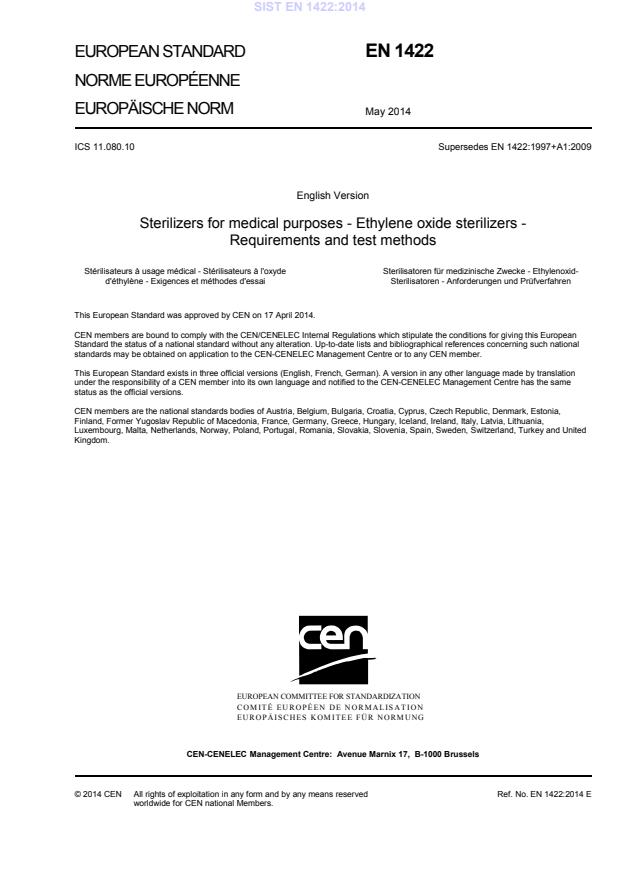
EUROPEAN STANDARD NORME EUROPÉENNE EUROPÄISCHE NORM
EN 1422
May 2014 ICS 11.080.10 Supersedes EN 1422:1997+A1:2009English Version
Sterilizers for medical purposes - Ethylene oxide sterilizers - Requirements and test methods
Stérilisateurs à usage médical - Stérilisateurs à l'oxyde d'éthylène - Exigences et méthodes d'essai
Sterilisatoren für medizinische Zwecke - Ethylenoxid-Sterilisatoren - Anforderungen und Prüfverfahren This European Standard was approved by CEN on 17 April 2014.
CEN members are bound to comply with the CEN/CENELEC Internal Regulations which stipulate the conditions for giving this European Standard the status of a national standard without any alteration. Up-to-date lists and bibliographical references concerning such national standards may be obtained on application to the CEN-CENELEC Management Centre or to any CEN member.
This European Standard exists in three official versions (English, French, German). A version in any other language made by translation under the responsibility of a CEN member into its own language and notified to the CEN-CENELEC Management Centre has the same status as the official versions.
CEN members are the national standards bodies of Austria, Belgium, Bulgaria, Croatia, Cyprus, Czech Republic, Denmark, Estonia, Finland, Former Yugoslav Republic of Macedonia, France, Germany, Greece, Hungary, Iceland, Ireland, Italy, Latvia, Lithuania, Luxembourg, Malta, Netherlands, Norway, Poland, Portugal, Romania, Slovakia, Slovenia, Spain, Sweden, Switzerland, Turkey and United Kingdom.
EUROPEAN COMMITTEE FOR STANDARDIZATION
COMITÉ EUROPÉEN DE NORMALISATION EUROPÄISCHES KOMITEE FÜR NORMUNG
CEN-CENELEC Management Centre:
Avenue Marnix 17,
B-1000 Brussels © 2014 CEN All rights of exploitation in any form and by any means reserved worldwide for CEN national Members. Ref. No. EN 1422:2014 ESIST EN 1422:2014
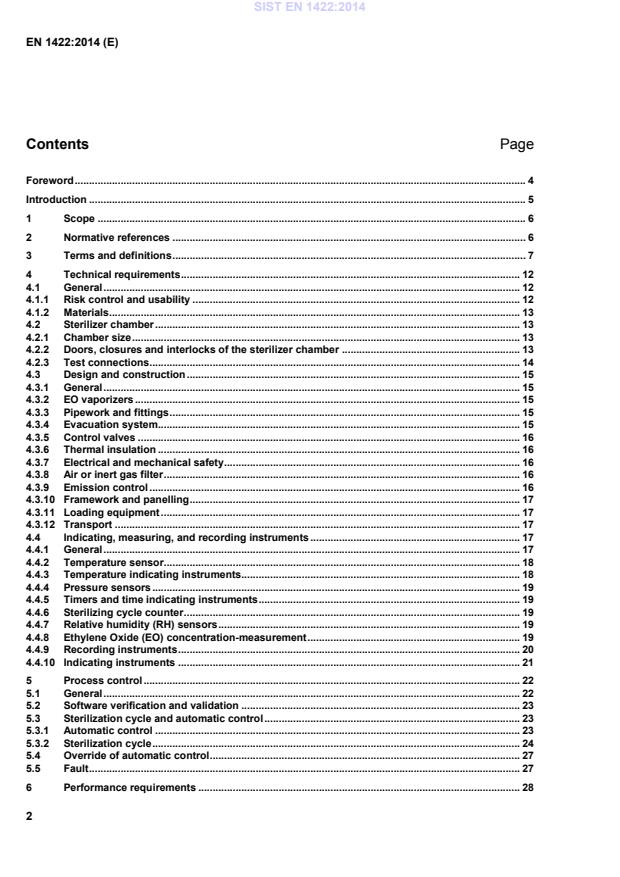
Contents Page Foreword . 4 Introduction . 5 1 Scope . 6 2 Normative references . 6 3 Terms and definitions . 7 4 Technical requirements . 12 4.1 General . 12 4.1.1 Risk control and usability . 12 4.1.2 Materials . 13 4.2 Sterilizer chamber . 13 4.2.1 Chamber size . 13 4.2.2 Doors, closures and interlocks of the sterilizer chamber . 13 4.2.3 Test connections . 14 4.3 Design and construction . 15 4.3.1 General . 15 4.3.2 EO vaporizers . 15 4.3.3 Pipework and fittings . 15 4.3.4 Evacuation system. 15 4.3.5 Control valves . 16 4.3.6 Thermal insulation . 16 4.3.7 Electrical and mechanical safety . 16 4.3.8 Air or inert gas filter . 16 4.3.9 Emission control . 16 4.3.10 Framework and panelling . 17 4.3.11 Loading equipment . 17 4.3.12 Transport . 17 4.4 Indicating, measuring, and recording instruments . 17 4.4.1 General . 17 4.4.2 Temperature sensor. 18 4.4.3 Temperature indicating instruments. 18 4.4.4 Pressure sensors . 19 4.4.5 Timers and time indicating instruments . 19 4.4.6 Sterilizing cycle counter . 19 4.4.7 Relative humidity (RH) sensors . 19 4.4.8 Ethylene Oxide (EO) concentration-measurement . 19 4.4.9 Recording instruments . 20 4.4.10 Indicating instruments . 21 5 Process control . 22 5.1 General . 22 5.2 Software verification and validation . 23 5.3 Sterilization cycle and automatic control . 23 5.3.1 Automatic control . 23 5.3.2 Sterilization cycle . 24 5.4 Override of automatic control . 27 5.5 Fault . 27 6 Performance requirements . 28 SIST EN 1422:2014
6.1 Sterilizing performance . 28 6.1.1 Loading configuration . 28 6.1.2 Physical parameters . 28 6.1.3 Microbiological efficacy . 28 6.2 EO removal (flushing) . 29 6.3 Aeration . 29 7 Sound power . 29 8 Packaging, marking and labelling . 29 9 Information to be supplied by the manufacturer . 30 10 Service and local environment . 32 10.1 General . 32 10.2 Electricity . 33 10.3 Sterilant . 33 10.4 Circulation systems . 33 10.5 Steam . 33 10.6 Water . 34 10.7 Air and inert gasses . 34 10.8 Drainage and discharges . 34 10.9 Ventilation and environment . 34 10.10 Lighting . 34 Annex A (normative) Test instrumentation . 35 Annex B (normative) Leak test cycle . 36 Annex C (normative) Sterilizer chamber profile testing. 37 C.1 Sterilizer chamber internal surfaces . 37 C.2 Empty sterilizer chamber . 37 Annex D (normative) Microbiological test for EO sterilizers . 38 D.1 General . 38 D.2 Test equipment. 38 D.3 Procedure . 39 D.4 Interpretation of results . 40 Annex E (informative) Environmental aspects . 41 E.1 Environmental aspects regarding the life cycle of EO sterilizers . 41 E.2 EO (brief description) . 41 E.3 Environmental impact . 41 Annex ZA (informative) Relationship between this European Standard and the Essential Requirements of EU Directive 93/42/EEC on medical devices . 44 Bibliography . 48
Foreword This document (EN 1422:2014) has been prepared by Technical Committee CEN/TC 102 “Sterilizers for medical purposes”, the secretariat of which is held by DIN. This European Standard shall be given the status of a national standard, either by publication of an identical text or by endorsement, at the latest by November 2014 and conflicting national standards shall be withdrawn at the latest by May 2017. Attention is drawn to the possibility that some of the elements of this document may be the subject of patent rights. CEN [and/or CENELEC] shall not be held responsible for identifying any or all such patent rights. This document supersedes EN 1422:1997+A1:2009. This document has been prepared under a mandate given to CEN by the European Commission and the European Free Trade Association, and supports essential requirements of EU Directive. For relationship with EU Directive, see informative Annex ZA, which is an integral part of this document. Annexes A, B, C and D are normative and form part of this European Standard. Annexes E and ZA are for information only. The standard is a full technical revision of the previous version. The following amendments have been made in comparison with EN 1422:1997+A1:2009: — new specification of the scope of the standard, e.g. explicit exclusion of sterilizers which employ the injection of EO or mixtures containing EO directly into packages or into a flexible chamber and removal of different types A and B of EO-sterilizers ; — normative references have been updated; — layout of the standard brought in line with the standard for LTSF-sterilization (EN 14180); — the additional requirements from the machinery directive, introduced by the revision of the medical devices directive 2007/47/EC have been addressed (see revised Annex ZA), i.e. update of technical requirements and Tables ZA.1 and ZA.2; — requirements have been rephrased to be performance requirements instead of design requirements; — addition of an environmental checklist; —
Annex B has been thoroughly revised and Annex D has been deleted. According to the CEN-CENELEC Internal Regulations, the national standards organizations of the following countries are bound to implement this European Standard: Austria, Belgium, Bulgaria, Croatia, Cyprus, Czech Republic, Denmark, Estonia, Finland, Former Yugoslav Republic of Macedonia, France, Germany, Greece, Hungary, Iceland, Ireland, Italy, Latvia, Lithuania, Luxembourg, Malta, Netherlands, Norway, Poland, Portugal, Romania, Slovakia, Slovenia, Spain, Sweden, Switzerland, Turkey and the United Kingdom. SIST EN 1422:2014
Introduction Ethylene oxide (EO) sterilizers employing EO gas as the sterilant, either as a pure gas or in admixture with other gases, are primarily used for the sterilization of heat labile material or product. The EO-sterilizer specified in this European standard can be used for medical, dental, pharmaceutical veterinary and industrial or related purposes. The tests described in this European Standard are reference tests intended for use in demonstrating conformity with the performance requirements specified in this European Standard. They can be used in type tests, works tests, in validation and re-validation tests, or in periodic and routine tests carried out by the user. Validation and routine control of sterilization processes are essential to ensure their efficacy. This European Standard does not cover validation and routine control of EO processes (see prEN ISO 11135:2012). EO is a highly reactive chemical which can present a toxic, flammable or explosive hazard if incorrectly handled (see Annex E). The performance requirements specified in this document are not intended for the process to be effective in inactivating the causative agents of spongiform encephalopathies such as scrapie, bovine spongiform encephalopathy and Creutzfeld-Jakob disease. Planning and design of products complying with this standard should consider not only technical issues but also the environmental impact from the product during its life-cycle. Environmental aspects are addressed in Annex E of this standard. By performing tests concurrently and/or in a logical sequence, the total number of tests carried out and waste arising from such tests, is reduced. As a result the burden on the environment can be reduced (see also Annex E). SIST EN 1422:2014
1 Scope This European Standard specifies the requirements and the relevant tests for automatically controlled sterilizers employing ethylene oxide (EO) gas as the sterilant, either as a pure gas or a mixture with other gases, being used for the sterilization of medical devices and their accessories. This European Standard specifies requirements for ethylene oxide sterilizers (EO-sterilizers) working at super or sub-atmospheric pressure for: — the performance and design of sterilizers to ensure that the process is capable of sterilizing medical devices; — the equipment and controls of these sterilizers necessary for the validation and routine control of the sterilization processes. The test loads described in this European Standard are selected to represent a number of loads for the evaluation of the performance of EO sterilizers for medical devices. However, specific loads may require the use of other test loads. This European Standard does not specify those tests which are necessary to determine the probability of a processed product being sterile, nor the routine quality control tests required prior to release of sterile product. These topics are addressed in prEN ISO 11135:2012. This European Standard does not specify requirements for occupational safety associated with the design and operation of EO sterilization facilities. NOTE 1 For further information on safety, see examples in the Bibliography. National or regional regulations can exist. This European Standard does not cover sterilizers which employ the injection of EO or mixtures containing EO directly into packages or into a flexible chamber. NOTE 2 See EN ISO 14937. This European Standard is not intended as a checklist for suitability of an existing EO sterilizer when assessing compliance with prEN ISO 11135:2012. This standard is not intended to be applied retrospectively. This European Standard does not cover analytical methods for determining levels of residual EO and/or its reaction products. NOTE 3 For further information see ISO 10993-7. 2 Normative references The following documents, in whole or in part, are normatively referenced in this document and are indispensable for its application. For dated references, only the edition cited applies. For undated references, the latest edition of the referenced document (including any amendments) applies. EN 764-7, Pressure equipment - Part 7: Safety systems for unfired pressure equipment EN 868-4, Packaging for terminally sterilized medical devices - Part 4: Paper bags - Requirements and test methods EN 868–5, Packaging for terminally sterilized medical devices - Part 5: Sealable pouches and reels of porous materials and plastic film construction - Requirements and test methods SIST EN 1422:2014
EN 13445-3, Unfired pressure vessels - Part 3: Design EN 13445-5, Unfired pressure vessels - Part 5: Inspection and testing EN 14222, Stainless steel shell boilers EN 61010–1:2010, Safety requirements for electrical equipment for measurement, control and laboratory use — Part 1: General requirements (IEC 61010-1:2010) EN 61010-2-040:2005, Safety requirements for electrical equipment for measurement, control and laboratory use — Part 2-040: Particular requirements for sterilizers and washer-disinfectors used to treat medical materials (IEC 61010-2-040:2005) EN 61326-1:2006, Electrical equipment for measurement, control and laboratory use — EMC requirements — Part 1: General requirements (IEC 61326-1:2005) EN ISO 3746:2010, Acoustics - Determination of sound power levels and sound energy levels of noise sources using sound pressure - Survey method using an enveloping measurement surface over a reflecting plane (ISO 3746:2010) EN ISO 10993-7:2008, Biological evaluation of medical devices - Part 7: Ethylene oxide sterilization residuals (ISO 10993-7:2008) prEN ISO 11135:2012, Sterilization of health-care products — Ethylene oxide — Requirements for the development, validation and routine control of a sterilization process for medical devices (ISO/DIS 11135:2012) EN ISO 11138-1, Sterilization of health care products - Biological indicators - Part 1: General requirements (ISO 11138-1) EN ISO 11138-2, Sterilization of health care products - Biological indicators - Part 2: Biological indicators for ethylene oxide sterilization processes (ISO 11138-2) EN ISO 11607-1, Packaging for terminally sterilized medical devices - Part 1: Requirements for materials, sterile barrier systems and packaging systems (ISO 11607-1) EN ISO 14971:2012, Medical devices - Application of risk management to medical devices (ISO 14971:2007, Corrected version 2007-10-01) 3 Terms and definitions For the purposes of this document, the following terms and definitions apply. 3.1 aeration part of the sterilization process during which ethylene oxide and/or its reaction products desorb from the medical device until predetermined levels are reached Note 1 to entry: This can be performed within the sterilizer and/or in a separate chamber or room. [SOURCE: prEN ISO 11135:2012, 3.1] SIST EN 1422:2014
3.2 air admission stage stage of the cycle beginning with the attainment of the pre-set pressure on the last evacuation of the flushing stage or sterilant removal stage when filtered air is admitted to allow the chamber pressure to equilibrate with ambient pressure [SOURCE: ISO/TS 11139:2006, 2.48] 3.3 automatic controller programmed device that, in response to cycle parameters, operates the sterilizer sequentially through the operating cycle(s) 3.4 biological indicator test system containing viable microorganisms providing a defined resistance to a specified sterilization process [SOURCE: ISO/TS 11139:2006, 2.3] 3.5 calibration set of operations that establish, under specified conditions, the relationship between values of a quantity indicated by a measuring instrument or measuring system, or values represented by a material measure or a reference material, and the corresponding values realized by standards [SOURCE: ISO/TS 11139:2006, 2.4] 3.6 conditioning treatment of product within the sterilization cycle, but prior to ethylene oxide admission, to attain a predetermined temperature and relative humidity Note 1 to entry: This part of the sterilization cycle can be carried out either at or above atmospheric pressure or under vacuum. 3.7 controlling regulating variables to specification 3.8 cycle complete indication that the operating cycle has been completed according to programme and that the sterilized load is ready for removal from the sterilizer chamber Note 1 to entry: Upon indication of “cycle complete” a further period of aeration of the processed load can be required. 3.9 ethylene oxide exposure time the period of the sterilization cycle between the end of EO injection and the beginning of EO removal 3.10 fault one or more of the process parameters lying outside of its/their specified tolerance(s) [SOURCE: ISO/TS 11139:2006, 2.19] SIST EN 1422:2014
3.11 flushing stage of the sterilization cycle in which the ethylene oxide is removed from the load and free chamber space of the sterilization chamber Note 1 to entry: Flushing is also known as purging. 3.12 indicating displaying a value, fault or cycle stage 3.13 medical device any instrument, apparatus, implement, machine, appliance, implant, in vitro reagent or calibrator, software, material or other similar or related article, intended by the manufacturer to be used, alone or in combination, for human beings for one or more of the specific purpose(s) of —
diagnosis, prevention, monitoring, treatment or alleviation of disease, —
diagnosis, monitoring, treatment, alleviation of or compensation for an injury, —
investigation, replacement, modification or support of the anatomy or of a physiological process, —
supporting or sustaining life, —
control of conception —
disinfection of medical devices, —
providing information for medical purposes by means of in vitro examination of specimens derived from the human body, and which does not achieve its primary intended action in or on the human body by pharmacological, immunological or metabolic means, but which may be assisted in its function by such means [SOURCE: EN ISO 13485:2012, 3.7] 3.14 monitoring checking against specifications 3.15 preconditioning treatment of product, prior to the sterilization cycle, in a room or chamber to attain specified limits for temperature and relative humidity [SOURCE: prEN ISO 11135:2012, 3.25] SIST EN 1422:2014
3.16 process challenge device PCD item designed to constitute a defined resistance to a sterilization process and used to assess performance of the process [SOURCE: ISO/TS 11139:2006, 2.33] Note 1 to entry: The device is so constituted that a physical, biological or chemical indicator can be put in the place which is the most difficult to reach by sterilizing agent(s). Interference of the indicator with the function of the process challenge device is not acceptable. 3.17 process parameter specified value for a process variable [SOURCE: ISO/TS 11139:2006, 2.34] Note 1 to entry: The specification for a sterilization process includes the process parameters and their tolerances. 3.18 process temperature specified chamber temperature for the sterilization cycle 3.19 process variable condition within a sterilization process, changes in which alter microbicidal effectiveness [SOURCE: ISO/TS 11139:2006, 2.35] EXAMPLES Time, temperature, pressure, concentration, humidity. 3.20 recording collecting and storing data Note 1 to entry: Data storing can be realised electronically or by hard copy. 3.21 response time time required for a 90 % change in sensor output when exposed to a step change in the variable being measured 3.22 risk assessment overall process comprising a risk analysis and a risk evaluation [SOURCE: EN ISO 14971:2012, 2.18] 3.23 risk control process through which decisions are reached and protective measures are implemented for reducing risks to, or maintaining risks within, specified levels [SOURCE: EN ISO 14971:2012, 2.19] SIST EN 1422:2014
3.24 services supplies from an external source, needed for the function of equipment EXAMPLE Electricity, water, compressed air, drainage. [SOURCE: ISO/TS 11139:2006, 2.41] 3.25 sterile free from viable microorganisms [SOURCE: ISO/TS 11139:2006, 2.43] 3.26 sterilizer apparatus designed to achieve sterilization [SOURCE: EN 285:2006+A2:2009, 3.35] 3.27 EO sterilization cycle treatment in a sealed chamber comprising air removal, conditioning (if used), injection of ethylene oxide, exposure to ethylene oxide, removal of ethylene oxide and flushing (if used), and air/inert gas admission [SOURCE: prEN ISO 11135:2012, 3.48] Note 1 to entry: EO sterilization cycle does not include aeration (if required). 3.28 sterilization load product(s) to be, or that has been, sterilized together using a given sterilization process [SOURCE: ISO/TS 11139:2006, 2.48] 3.29 software validation confirmation and provision of objective evidence that the requirements for a specific intended use or specification of the software have been fulfilled Note 1 to entry: In accordance to EN ISO 9000. 3.30 sterilization process series of actions or operations needed to achieve the specified requirements for sterility [SOURCE: ISO/TS 11139:2006, 2.49] Note 1 to entry This series of actions or operations includes pre-treatment (if necessary), exposure to the EO under defined conditions and any necessary post-treatment required for the removal of EO and its by-products to the point where it is safe for the operator to remove the load from the sterilization chamber. It does not include any cleaning, disinfection or packaging operations that precede the sterilization process. SIST EN 1422:2014
3.31 type test series of checks and tests for a particular design of sterilizer to demonstrate compliance with the requirements of this European Standard Note 1 to entry: Additional type tests can be required by the purchaser to show compliance to a specific specification. 3.32 usable chamber volume defined space within the sterilizer chamber, which is not restricted by fixed or mobile parts and which is available to accept the sterilization load EXAMPLE The available space on a pallet of defined dimensions. Note 1 to entry: The maximum load volume is likely to be less than the usable chamber volume as space is required to allow for circulation of sterilant gasses. [SOURCE: prEN ISO 11135:2012, 3.56] 3.33 verification confirmation through provision of objective evidence that specified requirements have been fulfilled [SOURCE: EN 62304:2006, 3.33] 3.34 works test series of tests performed prior to delivery to demonstrate compliance of equipment with its specification Note 1 to entry : In accordance with EN ISO 15883-1:2009. 4 Technical requirements 4.1 General If a pressure vessel according to the Pressure Equipment Directive (PED) is used for the sterilization, the vessel shall comply with EN 13445-3, EN 13445-5 and EN 764-7. If a shell boiler is used to generate the steam used in the sterilizer, it shall comply with EN 14222. NOTE 1 See Council Directive concerning pressure equipment (97/23/EEC) [3]. NOTE 2 Sterilizer chambers that run sterilization cycles designed to operate completely below 1,5 bar, do not fall under the Pressure Vessel Directive (PED). Appropriate pressure relief valves can used to ensure over pressurisation does not occur. NOTE 3
Other European directives can apply. Examples of directives that can apply include, but are not restricted to, the LVD [5], EMC [4], ATEX [2], REACH [10]. 4.1.1 Risk control and usability 4.1.1.1 Risk assessment and risk control for sterilizer design and software shall be performed following the procedures and requirements given in EN ISO 14971:2012, Clauses 5, 6 and 7. 4.1.1.2 Risk analysis shall address the specific EO-sterilizer design and features. Measures taken for risk reduction shall consider aspects as user knowledge, experience, training, ergonomics and usability. SIST EN 1422:2014
NOTE EN ISO 12100 or EN 61508–1 can provide further helpful information. 4.1.2 Materials 4.1.2.1 All materials used for the construction of an EO-sterilizer and instrumentation (for example, door seals, gaskets welds, ancillary items, pipe work, valves and sensors) which can come into contact with EO and other process chemicals (for example water, compressed air and steam) shall be of materials which, under the designed operating conditions: — are not corroded by EO, its diluent gasses or potential contaminants or steam and/or be subject to metallic corrosion; — will not react with EO, its diluent gasses or potential contaminants or steam; — will not promote the polymerization or decomposition of EO; — will not allow diffusion of EO to an extent which impairs their safe operation. Due attention should be paid to the effects of mechanical effects and differential expansion when dissimilar metals are used in contact. NOTE 1 When selecting materials for construction, the material safety data sheet for EO can be referenced. NOTE 2 The compatibility of materials with ethylene oxide has been addressed in literature (e.g.[6]). 4.1.2.2 The admissible pressure and temperature range (see 9.2) shall be specified when selecting materials for construction. 4.2 Sterilizer chamber 4.2.1 Chamber size The internal dimensions of the chamber shall be designated by reference to the principle dimensions, measured in millimetres: a) for cylindrical horizontal or cylindrical vertical chambers: — diameter, — depth; b) for rectangular parallelepiped chambers: — width, — height, — depth; c) for other configurations the chamber shall be specified in analogy to a) or b). 4.2.2 Doors, closures and interlocks of the sterilizer chamber 4.2.2.1 After closing the sterilizer door, it shall be possible to open it before a cycle has been started. SIST EN 1422:2014
NOTE For automated loading and unloading systems, loading and unloading doors can be opened simultaneously for loading and unloading during routine sterilization cycles. 4.2.2.2 Once a sterilization cycle is initiated, it shall not be possible to open the unloading door until a “cycle complete” indication is obtained, without the use of a special key, code or tool as specified by the manufacturer. 4.2.2.3 It shall not be possible to open any sterilizer door during a cycle. For maintenance purposes it shall only be possible to open any door when the sterilizer is in a condition that presents no hazard to the operator or ancillary equipment, using a special key, code or tool as specified by the manufacturer. 4.2.2.4 In case of an interrupted cycle (e.g. due to a fault), the sterilizer shall be brought to a condition that presents no hazard to the operator or ancillary equipment, taking into account EO and inert gases being used during the process. Opening of the door shall require the use of a special key, code or tool as specified by the manufacturer. 4.2.2.5 Provision shall be made to permit access to the contact surfaces for the purposes of cleaning and replacing the door seal. 4.2.2.6 For dedicated test or maintenance cycles, the records shall clearly indicate that this is not a routine sterilization cycle. The ‘cycle complete’ indication on the sterilizer may be different from the normal cycle complete indication and/or opening the unloading door may require the use of a special key, code or tool as specified by the manufacturer. 4.2.2.7 The device used to start the automatic operating cycle shall be located at the loading side of the sterilizer or in the control room. 4.2.2.8 For maintenance purposes it shall be possible to open both doors simultaneously on double-ended sterilizers using a special key, code or tool as specified by the manufacturer. 4.2.2.9 For double-ended sterilizers both ends of the sterilizer shall be fitted with a device to indicate whether the door at that end can be opened. In addition, if there is a control room, an indication of which door can be opened shall also be provided in the control room. If the doors are controlled from a control room, no indications at the doors whether a door can be opened, are required. 4.2.2.10 The indication ‘cycle complete’ shall be cancelled when a door is opened. NOTE After the ‘cycle complete’ indication, additional degassing/aeration could be required to achieve safe conditions for the operators. 4.2.2.11 The door closing and locking mechanism shall be designed in such a way that the operator is not endangered, such as a safety edge or an auto reverse function. 4.2.2.12 If a powered chamber door is fitted, systems shall be provided to permit the removal of persons or objects entrapped by the moving door before the pressure, force and temperature specified in EN 61010-1:2010,10.1 and EN 61010-2-040:2005, 7.1.101, 7.101 and 7.102 are exceeded. NOTE This can be achieved, e.g. by reversing the direction of the door movement. 4.2.3 Test connections 4.2.3.1 The number and types of test connections shall be specified. It shall be specified how test equipment can be introduced into the sterilizer chamber. Test connection(s) (if fitted) shall be designed in such a way that all areas of the chamber can be reached in a suitable manner with suitable measurement techniques. SIST EN 1422:2014
NOTE 1 If the measurement of EO-concentration or RH is required, this needs to be taken into account when specifying the dimensions for the test connections to allow easy access for the measuring systems. NOTE 2 Increasing the number of test connections increases the risk of leakage. NOTE 3 Failure to provide test connections could complicate the performance of validation. 4.2.3.2 Test connections shall be at points of easy access, but not in pipes for media transport (e.g. steam, EO, air), and the test connections shall be specified. 4.2.3.3 The test connections shall be provided with caps and sealed with EO proof and mechanically resistant seals. NOTE It is recommended to keep the number of test connections to a minimum for reasons of safety. 4.3 Design and construction 4.3.1 General Components, including ancillary vessels that are connected to sterilizer chamber and that are required to contain the admissible design pressure of the chamber or higher, may need to comply with the requirements of the PED or other relevant directives. All components in the piping network shall be marked and/or identified according to their functions (see EN 60073). The maintenance or replacement frequency for all components of the equipment shall be established and documented. 4.3.2 EO vaporizers EO vaporizers shall be constructed so that the heating surface in contact with EO is cleanable by the method specified by the manufacturer. 4.3.3 Pipework and fittings 4.3.3.1 Pipework shall be designed to prevent accumulation of condensate. NOTE Insulation of pipework can reduce the amount of condensate formed. 4.3.3.2 All pipework and fittings carrying EO shall be made by welding or brazing unless the joint is intended to be demountable for maintenance purposes. NOTE Flexible hoses which are designed to, or can inadvertently, carry EO are preferably constructed from stainless steel or stainless steel internally lined with polytetrafluoroethylene (PTFE), nitrile rubber, or other material of demonstrated equivalent performance. 4.3.4 Evacuation system 4.3.4.1 Sterilizers shall be provided with means to evacuate the chamber to meet process specifications. NOTE 1 Minimization of the amount of water used is a consideration when designing evacuation (see also Annex E). NOTE 2 EO can dissolve in water and oil. 4.3.4.2 The sterilizer shall be provided with a means for leak testing which shall include the sterilizer chamber and all relevant connected pipeworks and fittings. SIST EN 1422:2014
4.3.5 Control valves When removal of connecting pipes is necessary for maintenance of the valves connected to the chamber, it shall be possible to leak test the connecting pipes to the valves. 4.3.6 Thermal insulation Any surface that can attain a temperature exceeding 55 °C during normal operation shall be insulated, except where this would interfere with the function and operation of the sterilizer. 4.3.7 Electrical and mechanical safety 4.3.7.1 Safety of the design shall be based on risk assessment. Technical solutions shall consider applicable standards. NOTE 1 For general design see EN 61010–1 and EN 61010–2–040. NOTE 2 Additional guidance is given in EN ISO 12100. NOTE 3 For guidance regarding specific design aspects, EN 60204–1 can apply. The guidance in EN 60204–1 can reduce testing. 4.3.7.2 Sterilizers shall comply with EN 61326-1 regarding electromagnetic compatibility (EMC). Sterilizers operating in areas intended for medical electrical equipment or in the vicinity of other sensitive equipment shall be regarded as Class B equipment as specified in EN 61326-1. The immunity performance criteria selected shall ensure that sterilizer performance as specified in 5.2 is met when exposed to disturbance phenomena of EN 61326-1:2006, Table 2. 4.3.8 Air or inert gas filter 4.3.8.1 Microbial (re)contamination of the sterilization load shall be prevented. 4.3.8.2 When filters are fitted to prevent (re)contamination, they shall be readily accessible for replacement. The filter shall retain not less than 99,5 % of particles greater than 0,3
Air filters should be constructed from materials resistant to corrosion and biodegradation. NOTE 1 A readily detachable pre-filter designed to retain dust particles greater than 25 life of the filter. NOTE 2 It is recommended that the filter material is supported in a manner which restricts its distortion and movement during use in order to minimise damage to the filter medium. 4.3.8.3 Each filter shall have a control valve fitted directly between the filter and chamber, to isolate the filter. 4.3.9 Emission control All exhaust emissions from sterilizers shall be controlled and – if necessary – discharged via a suitable emission control system according to manufacturer's instructions. NOTE National and local requirements for occupational health and safety and the environment can be consulted as they can apply to potential EO exposure. SIST EN 1422:2014
4.3.10 Framework and panelling 4.3.10.1 If the sides of the sterilizer need not to be accessible for normal operation, they shall be enclosed with panelling. NOTE Some types of large industrial sterilizers and sterilizers designed to be recessed into existing walls providing a continuous joint with the sterilizer front panelling, do not need to be provided with side panelling. 4.3.10.2 Removal or opening of a panel used as a physical barrier to provide protection (guard) shall require the use of an access device. The panelling shall be long-term corrosion-resistant. Instructions for cleaning of the panelling shall be provided. NOTE Ventilation openings can be provided in the panelling. 4.3.10.3 The panelling of the sterilizer shall allow access for maintenance work. Such panelling shall be demountable or the dimensions of any personal access shall be not less than 500 mm wide and not less than 1500 mm hig
...