

EN 14803:2020+A1:2024
(Main + Amendment)Waste management - Identification and/or determination of the quantity of waste
- Abstract
This document specifies general requirements and verifications for methods of identification of waste containers and/or determination of the quantity of waste and other reusable materials including:
- safety requirements;
- interface requirements and performances;
- data to be treated and their integrity.
This document is applicable to systems for handling containers conforming to the EN 840 series.
Although this document does not cover systems for handling containers not conforming to the EN 840 series, users are encouraged to apply the requirements of this document to these systems as far as possible.
This document is applicable to systems both for billing and not for billing.
This document is applicable to systems both for billing and not for billing.
- Status
- Published
- Publication Date
- 29-Oct-2024
- Technical Committee
- CEN/TC 183 - Waste management
- Drafting Committee
- CEN/TC 183/WG 3 - Identification and/or determination of waste
- Current Stage
- 9060 - Closure of 2 Year Review Enquiry - Review Enquiry
- Start Date
- 02-Dec-2025
- Completion Date
- 02-Dec-2025

Overview
EN 14803:2020+A1:2024 - Waste management - Identification and/or determination of the quantity of waste - is a CEN European standard that defines general requirements and verification methods for systems used to identify waste containers and/or determine the quantity of waste (DQW). The standard covers safety, interface performance and data handling (including integrity) for systems that work with containers conforming to the EN 840 series. It applies to both billing and non-billing systems and includes Amendment 1 (approved September 2024).
Key topics and technical requirements
- Scope and applicability
- Applies primarily to systems handling EN 840 series containers; users are encouraged to apply the requirements to other containers where feasible.
- Intended for identification (ID) and determination of quantity of waste (DQW) systems used in municipal and commercial waste collection.
- Data carriers and identification
- Requirements for transponders (RFID/data carriers), their positioning on containers, and read/write modes (RO, R/W, WORM).
- Annexes provide normative and recommended transponder positions for different lifting devices (comb, trunnion, BG).
- Sensing devices and interfaces
- Performance and installation criteria for sensing devices and antennas used to read data carriers.
- Defined interfaces and data flows: IF1 (container ↔ sensing device), IF2 (sensing device ↔ On Board Computer, aligned with EN 16815 CleANopen), IF3 (On Board Computer ↔ Data Processing Centre).
- Determination of quantity of waste (DQW)
- Requirements for weighing systems (automatic and non-automatic weighing instruments), OBC (On Board Computer) functionality, and data transfer.
- References to metrological standards (EN 45501, OIML R51).
- Data integrity, security and safety
- Rules for data structure, transfer, storage and integrity, including encryption/malfunction considerations.
- Safety and health requirements tied to EN 840 and vehicle standards (EN 1501).
- Manufacturer registration and compliance
- Annex D: procedures and responsibilities for manufacturer/supplier code assignment and registry management.
Applications and users
- Municipal waste authorities implementing pay-as-you-throw or usage-based billing
- Refuse collection vehicle manufacturers and integrators
- RFID/transponder and sensing device suppliers
- Weighing instrument and OBC manufacturers
- System integrators and software providers for Data Processing Centres (DPC)
- Standards bodies and metrology authorities
Related standards
- EN 840 series (mobile waste containers)
- EN 1501 (refuse collection vehicles)
- EN 45501, OIML R51 (weighing & metrology)
- EN 16815 (CleANopen application profile)
- EN 60068-2-6 / EN 60068-2-27 (environmental testing)
- ISO 11784 (RFID code structure)
EN 14803:2020+A1:2024 is essential for stakeholders designing interoperable, secure and metrologically sound waste identification and weighing systems that support efficient waste management, billing and data integrity.
Relations
- Effective Date
- 04-Sep-2024
- Effective Date
- 04-Sep-2024
- Effective Date
- 25-Aug-2026
- Effective Date
- 09-Feb-2026
- Effective Date
- 09-Feb-2026
- Effective Date
- 09-Feb-2026
- Effective Date
- 28-Jan-2026
- Effective Date
- 28-Jan-2026
- Effective Date
- 28-Jan-2026
- Effective Date
- 28-Jan-2026
- Effective Date
- 28-Jan-2026
- Effective Date
- 28-Jan-2026
- Effective Date
- 28-Jan-2026
- Effective Date
- 28-Jan-2026
- Effective Date
- 28-Jan-2026
Get Certified
Connect with accredited certification bodies for this standard

CIS Institut d.o.o.
Personal Protective Equipment (PPE) certification body. Notified Body NB-2890 for EU Regulation 2016/425 PPE.

Kiwa BDA Testing
Building and construction product certification.
Kmetijski inštitut Slovenije
Agricultural Institute of Slovenia. Soil testing, plant health, agricultural product analysis.
Sponsored listings
Frequently Asked Questions
EN 14803:2020+A1:2024 is a standard published by the European Committee for Standardization (CEN). Its full title is "Waste management - Identification and/or determination of the quantity of waste". This standard covers: This document specifies general requirements and verifications for methods of identification of waste containers and/or determination of the quantity of waste and other reusable materials including: - safety requirements; - interface requirements and performances; - data to be treated and their integrity. This document is applicable to systems for handling containers conforming to the EN 840 series. Although this document does not cover systems for handling containers not conforming to the EN 840 series, users are encouraged to apply the requirements of this document to these systems as far as possible. This document is applicable to systems both for billing and not for billing. This document is applicable to systems both for billing and not for billing.
This document specifies general requirements and verifications for methods of identification of waste containers and/or determination of the quantity of waste and other reusable materials including: - safety requirements; - interface requirements and performances; - data to be treated and their integrity. This document is applicable to systems for handling containers conforming to the EN 840 series. Although this document does not cover systems for handling containers not conforming to the EN 840 series, users are encouraged to apply the requirements of this document to these systems as far as possible. This document is applicable to systems both for billing and not for billing. This document is applicable to systems both for billing and not for billing.
EN 14803:2020+A1:2024 is classified under the following ICS (International Classification for Standards) categories: 13.030.40 - Installations and equipment for waste disposal and treatment. The ICS classification helps identify the subject area and facilitates finding related standards.
EN 14803:2020+A1:2024 has the following relationships with other standards: It is inter standard links to EN 14803:2020/FprA1, EN 14803:2020, ISO 11784:1996, EN 60204-1:2018, EN 60068-2-6:2008, EN 60068-2-27:2009, EN 1501-3:2021, EN 45501:1992, EN 1501-4:2023, EN 840-5:2020, EN ISO 7250-1:2017, EN 1501-1:2021, EN 840-1:2020, EN 1501-5:2021, EN 45501:2015. Understanding these relationships helps ensure you are using the most current and applicable version of the standard.
EN 14803:2020+A1:2024 is available in PDF format for immediate download after purchase. The document can be added to your cart and obtained through the secure checkout process. Digital delivery ensures instant access to the complete standard document.
Standards Content (Sample)
SLOVENSKI STANDARD
01-januar-2025
Ravnanje z odpadki - Identifikacija in/ali ugotavljanje količine odpadkov (vključno
z dopolnilom A1)
Waste management - Identification and/or determination of the quantity of waste
Abfallwirtschaft - Identifikation und/oder Mengenbestimmung von Abfall
Gestion des déchets - Identification et/ou détermination de la quantité de déchets
Ta slovenski standard je istoveten z: EN 14803:2020+A1:2024
ICS:
13.030.01 Odpadki na splošno Wastes in general
2003-01.Slovenski inštitut za standardizacijo. Razmnoževanje celote ali delov tega standarda ni dovoljeno.
EN 14803:2020+A1
EUROPEAN STANDARD
NORME EUROPÉENNE
October 2024
EUROPÄISCHE NORM
ICS 13.030.40 Supersedes EN 14803:2020
English Version
Waste management - Identification and/or determination
of the quantity of waste
Gestion des déchets - Identification et/ou Abfallwirtschaft - Identifikation und/oder
détermination de la quantité de déchets Mengenbestimmung von Abfall
This European Standard was approved by CEN on 27 April 2020 and includes Amendment 1 approved by CEN on 23 September
2024.
CEN members are bound to comply with the CEN/CENELEC Internal Regulations which stipulate the conditions for giving this
European Standard the status of a national standard without any alteration. Up-to-date lists and bibliographical references
concerning such national standards may be obtained on application to the CEN-CENELEC Management Centre or to any CEN
member.
This European Standard exists in three official versions (English, French, German). A version in any other language made by
translation under the responsibility of a CEN member into its own language and notified to the CEN-CENELEC Management
Centre has the same status as the official versions.
CEN members are the national standards bodies of Austria, Belgium, Bulgaria, Croatia, Cyprus, Czech Republic, Denmark, Estonia,
Finland, France, Germany, Greece, Hungary, Iceland, Ireland, Italy, Latvia, Lithuania, Luxembourg, Malta, Netherlands, Norway,
Poland, Portugal, Republic of North Macedonia, Romania, Serbia, Slovakia, Slovenia, Spain, Sweden, Switzerland, Türkiye and
United Kingdom.
EUROPEAN COMMITTEE FOR STANDARDIZATION
COMITÉ EUROPÉEN DE NORMALISATION
EUROPÄISCHES KOMITEE FÜR NORMUNG
CEN-CENELEC Management Centre: Rue de la Science 23, B-1040 Brussels
© 2024 CEN All rights of exploitation in any form and by any means reserved Ref. No. EN 14803:2020+A1:2024 E
worldwide for CEN national Members.
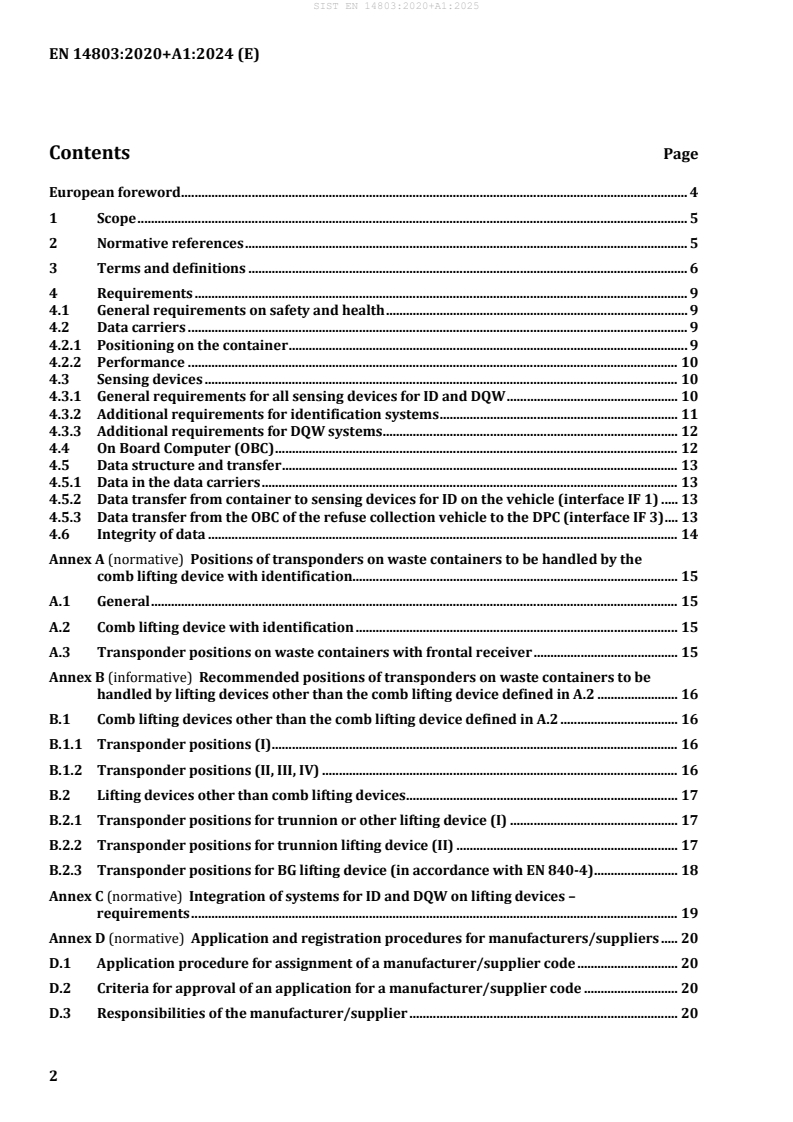
Contents Page
European foreword . 4
1 Scope . 5
2 Normative references . 5
3 Terms and definitions . 6
4 Requirements . 9
4.1 General requirements on safety and health . 9
4.2 Data carriers . 9
4.2.1 Positioning on the container . 9
4.2.2 Performance . 10
4.3 Sensing devices . 10
4.3.1 General requirements for all sensing devices for ID and DQW . 10
4.3.2 Additional requirements for identification systems . 11
4.3.3 Additional requirements for DQW systems . 12
4.4 On Board Computer (OBC) . 12
4.5 Data structure and transfer . 13
4.5.1 Data in the data carriers . 13
4.5.2 Data transfer from container to sensing devices for ID on the vehicle (interface IF 1) . 13
4.5.3 Data transfer from the OBC of the refuse collection vehicle to the DPC (interface IF 3) . 13
4.6 Integrity of data . 14
Annex A (normative) Positions of transponders on waste containers to be handled by the
comb lifting device with identification. 15
A.1 General . 15
A.2 Comb lifting device with identification . 15
A.3 Transponder positions on waste containers with frontal receiver . 15
Annex B (informative) Recommended positions of transponders on waste containers to be
handled by lifting devices other than the comb lifting device defined in A.2 . 16
B.1 Comb lifting devices other than the comb lifting device defined in A.2 . 16
B.1.1 Transponder positions (I) . 16
B.1.2 Transponder positions (II, III, IV) . 16
B.2 Lifting devices other than comb lifting devices . 17
B.2.1 Transponder positions for trunnion or other lifting device (I) . 17
B.2.2 Transponder positions for trunnion lifting device (II) . 17
B.2.3 Transponder positions for BG lifting device (in accordance with EN 840-4) . 18
Annex C (normative) Integration of systems for ID and DQW on lifting devices –
requirements . 19
Annex D (normative) Application and registration procedures for manufacturers/suppliers . 20
D.1 Application procedure for assignment of a manufacturer/supplier code . 20
D.2 Criteria for approval of an application for a manufacturer/supplier code . 20
D.3 Responsibilities of the manufacturer/supplier . 20
D.4 Responsibilities RA for manufacturer/supplier register . 21
D.5 Register of manufacturers/suppliers . 21
D.5.1 Publication and availability . 21
D.5.2 Contents . 21
D.6 Costs aspects . 22
D.7 Disclaimer . 22
Bibliography . 23
European foreword
This document (EN 14803:2020+A1:2024) has been prepared by Technical Committee CEN/TC 183
“Waste management”, the secretariat of which is held by DIN.
This European Standard shall be given the status of a national standard, either by publication of an
identical text or by endorsement, at the latest by April 2025, and conflicting national standards shall be
withdrawn at the latest by April 2025.
Attention is drawn to the possibility that some of the elements of this document may be the subject of
patent rights. CEN shall not be held responsible for identifying any or all such patent rights.
This document includes Amendment 1 approved by CEN on 23 September 2024.
This document supersedes !EN 14803:2020".
The start and finish of text introduced or altered by amendment is indicated in the text by tags !".
The main changes compared with the previous edition [EN 14803:2006] are listed below:
a) The Introduction has been deleted.
b) Clause 2 "Normative References" and Clause 3 "Terms and definitions" have been revised.
c) 4.2.1.2.4 "Optical data carrier position (dot code/ bar code) for automatic reading", 4.2.1.2.5
"Optical data carrier (dot code/bar code) position for manual reading", Table 2 "Test requirements
and acceptance criteria for bar code/dot code stickers", 4.5 "Data processing centre (DPC)" and
4.6.1.2 "Bar code/dot code" have been deleted.
d) Table 4 "Code structure of the unique identification in the transponder" has been updated.
e) 4.7 "Integrity of data" has been revised.
f) A.2 "Comb lifting device with identification" has been revised.
g) Former Annex B "Positions of optical data carriers (dot code/bar code labels) on waste containers"
has been deleted.
Any feedback and questions on this document should be directed to the users’ national standards body.
A complete listing of these bodies can be found on the CEN website.
According to the CEN-CENELEC Internal Regulations, the national standards organisations of the
following countries are bound to implement this European Standard: Austria, Belgium, Bulgaria,
Croatia, Cyprus, Czech Republic, Denmark, Estonia, Finland, France, Germany, Greece, Hungary, Iceland,
Ireland, Italy, Latvia, Lithuania, Luxembourg, Malta, Netherlands, Norway, Poland, Portugal, Republic of
North Macedonia, Romania, Serbia, Slovakia, Slovenia, Spain, Sweden, Switzerland, Türkiye and the
United Kingdom.
1 Scope
This document specifies general requirements and verifications for methods of identification of waste
containers and/or determination of the quantity of waste and other reusable materials including:
— safety requirements;
— interface requirements and performances;
— data to be treated and their integrity.
This document is applicable to systems for handling containers conforming to the EN 840 series.
Although this document does not cover systems for handling containers not conforming to the EN 840
series, users are encouraged to apply the requirements of this document to these systems as far as
possible.
This document is applicable to systems both for billing and not for billing.
2 Normative references
The following documents are referred to in the text in such a way that some or all of their content
constitutes requirements of this document. For dated references, only the edition cited applies. For
undated references, the latest edition of the referenced document (including any amendments) applies.
EN 840-1, Mobile waste and recycling containers — Part 1: Containers with 2 wheels with a capacity up to
400 l for comb lifting devices — Dimensions and design
EN 840-2, Mobile waste and recycling containers — Part 2: Containers with 4 wheels with a capacity up to
1 300 l with flat lid(s), for trunnion and/or comb lifting devices — Dimensions and design
EN 840-3, Mobile waste and recycling containers — Part 3: Containers with 4 wheels with a capacity up to
1 300 l with dome lid(s), for trunnion and/or comb lifting devices — Dimensions and design
EN 840-4, Mobile waste and recycling containers — Part 4: Containers with 4 wheels with a capacity up to
1 700 l with flat lid(s), for wide trunnion or BG- and/or wide comb lifting devices — Dimensions and design
EN 840-5, Mobile waste and recycling containers — Part 5: Performance requirements and test methods
EN 840-6, Mobile waste and recycling containers — Part 6: Safety and health requirements
EN 1501 (all parts), Refuse collection vehicles — General requirements and safety requirements
EN 45501, Metrological aspects of non-automatic weighing instruments
EN 60068-2-6, Environmental testing — Part 2-6: Tests — Test Fc: Vibration (sinusoidal) (IEC 60068-2-6)
EN 60068-2-27, Environmental testing — Part 2-27: Tests — Test Ea and guidance: Shock
(IEC 60068-2-27)
EN 60204-1, Safety of machinery — Electrical equipment of machines — Part 1: General requirements
EN ISO 7250-1, Basic human body measurements for technological design — Part 1: Body measurement
definitions and landmarks (ISO 7250-1:2017)
ISO 11784, Radio frequency identification of animals — Code structure
OIML R 51, Automatic catchweighing instruments
3 Terms and definitions
For the purposes of this document, the following terms and definitions apply.
ISO and IEC maintain terminological databases for use in standardization at the following addresses:
— ISO Online browsing platform: available at https://www.iso.org/obp
— IEC Electropedia: available at https://www.electropedia.org/
3.1
identification
ID
process which consists in accurately recognising and verifying a waste container by reading a data
carrier
3.2
determination of the quantity of waste
DQW
determination of the weighing of the waste mass and/or counting of emptying operations
3.3
data carrier
device carrying data which can be recognised by an electro-magnetic, optical or other reading device
3.4
interface
IF
boundary linking two systems
Note 1 to entry: The interface could be a mechanical interface, a data interface, an electrical interface etc.
Note 2 to entry: IF2 now corresponds to EN 16815 “CleANopen – Application profile for municipal vehicles”.
Note 3 to entry: For the purposes of this document, interfaces (IF) are numbered as follows in Table 1:
Table 1 — Data flow and interfaces
Data —IF3— On Board —IF2— Sensing —IF1— Container
Processing Computer devices
Centre (OBC)
(DPC)
3.5
malfunction
non-deliberate modification, addition, omission or suppression of signals or data
3.6 Data processing
3.6.1
storage
recording of data relating to the collection of waste
3.6.2
transfer
process or method of transmitting data relating to the collection of waste
3.6.3
read
process of retrieving data from some machine-readable medium and, as appropriate, the contention
and error control management, and channel and source decoding required to recover and communicate
the data entered at source
3.6.4
read only
RO
distinguishing a transponder in which the data is stored in an unchangeable manner and can therefore
only be read
3.6.5
read/write
R/W
applied to a radio frequency identification system, it is the ability both read data from a transponder
and to change data (write process) using a suitable programming device
3.6.6
write once/read many
WORM
distinguishing a transponder that can be partly or totally programmed once by the user, and thereafter
only read
3.6.7
sensing device
system with one or more sensors which detects and/or processes and transfers signals and/or data
3.6.8
encryption
means of securing data, often applied to a plain or clear text, by converting it to a form that is
unintelligible in the absence of an appropriate decryption key
3.7 Identification systems
3.7.1
transponder
data carrier (also called “electromagnetic label”) associated with the object to be identified
Note 1 to entry: The transponder is intended to receive a radio frequency signal and to return a different radio
frequency signal containing relevant information.
3.7.2
positioning system by geographical co-ordinates
GNSS
identification of a location with geographical co-ordinates
3.7.3
antenna
electronic component which emits or receives energy to/from a data carrier within a radio frequency
spectrum
Note 1 to entry: Antennas are also used to receive data from GNSS satellites.
3.7.4
transponder reader
sensing device which, with an antenna, transmits a radio signal according to a given frequency towards
one or more transponders and receives a signal back
Note 1 to entry: The reader is used to establish dialogue without contact with the transponder and to exchange
data.
3.8 Systems for the determination of the quantity of waste (DQW systems)
3.8.1
weighing
determination of the waste mass
3.8.2
automatic weighing instrument
instrument that weighs without the intervention of an operator and follows a pre-determined program
of automatic process characteristic of the instrument
[SOURCE: International Organization of Legal Metrology (OIML R51), 2010, Automatic catchweighing
instruments – Part 1: Metrological and technical requirements – Tests (§ T.1.1)]
3.8.3
non-automatic weighing instrument
instrument that requires the intervention of an operator during the weighing process, for example to
deposit on or remove from the receptor the load to be measured and also to obtain the result
[SOURCE: EN 45501]
3.8.4
On Board Computer
OBC
electronic device for storing and receiving data and performing calculations, and which is fitted on the
refuse collection vehicle, and which transfers data from/to sensing devices and to/from the data
processing centre (DPC)
3.8.5
data processing centre
DPC
electronic device for storing, receiving and giving back data and performing calculations separate from
the vehicle; the DPC transfers data from/to OBCs
4 Requirements
4.1 General requirements on safety and health
4.1.1 Every component and procedure for identification (ID) and/or determination of the quantity of
waste (DQW) shall not influence the safety and/or on the correct operation of the refuse collection
vehicle (RCV) including the lifting device.
4.1.2 The fitting of components to the waste container shall not have any influence on the safe use of
the waste container.
4.1.3 All components for ID and DQW, when used on vehicles conforming to EN 1501 (all parts), shall
conform to the EMC requirements as defined in EN 1501 (all parts).
4.1.4 If an existing RCV or lifting device is modified by fitting an ID or DQW system then the
conformity with EN 1501 (all parts) and relevant standards shall be checked again.
If the fitting of the sensing devices changes one or more characteristics of the RCV and its associated
lifting device (maximum permissible mass, operating, etc.), new characteristics shall be included in the
documentation of the RCV and of the lifting device.
A lifting device equipped with systems for ID and DQW shall fulfil the requirements defined in Annex C.
NOTE Attention is drawn to the conformity with the requirements of the Machinery Directive (98/37/EC)
and the EMC Directives (89/336/EC, 95/54/EC) if an existing refuse collection vehicle or lifting device is modified
by fitting an ID or DQW system.
4.1.5 The system consisting of the OBC and the sensing devices for ID and for DQW shall be
galvanically separated from the controlling unit of the lifting device and shall not negatively affect the
functions of the chassis, bodywork and lifting device.
4.1.6 The components for ID or DQW shall be fitted in such a way that they do not generate any risk
for any person (driver, operator, other person) under normal and emergency situations.
4.1.7 Where handling of elements by persons is necessary, dimensions of related devices shall be
based on EN ISO 7250-1.
4.1.8 All electrical systems shall conform to EN 60204-1.
4.1.9 Every component shall be installed in accordance with the instructions of its manufacturer.
4.2 Data carriers
4.2.1 Positioning on the container
4.2.1.1 Manufacturer's instructions
The manufacturer of ID devices shall provide detailed instructions on the assembly of fitting of data
carriers on the containers in particular regarding dimensions, tolerances and orientation.
4.2.1.2 Position
4.2.1.2.1 General
The position of data carriers on containers shall be such that safe and unambiguous communication
with the reader is possible and that the risk that the data carrier is damaged is minimal.
4.2.1.2.2 Transponder position for automatic reading or writing
If containers are lifted by the comb lifting device defined in Annex A (A.2), the position of transponders
shall be such that the axis of the transponders are aligned with the position indicated in Annex A (A.3).
If containers are not lifted by the comb lifting device defined in Annex A (A.2), other positions can be
used, for which recommendations are given in Annex B.
4.2.1.2.3 Transponder position for manual reading or writing
The transponder position shall conform to ergonomic recommendations to allow the reading and the
writing
...