

EN 1022:2023
(Main)Furniture - Seating - Determination of stability
General Information
- Abstract
This document specifies test methods and requirements for the determination of the stability of all types of seating for adults weighing up to 110 kg, without regard to use, materials, design/construction or manufacturing process.
The test methods described can be used for seating for children and heavier adults by modifying test loads and loading points.
This document does not apply to children’s highchairs, table mounted chairs and bath seats which are covered by other European Standards.
This standard contains two Annexes:
Annex A (normative) – Seat loading pad data
Annex B (normative) – Test parameters
- Status
- Published
- Publication Date
- 28-Nov-2023
- Technical Committee
- CEN/TC 207 - Furniture
- Drafting Committee
- CEN/TC 207/WG 9 - Test methods
- Current Stage
- 6060 - Definitive text made available (DAV) - Publishing
- Start Date
- 29-Nov-2023
- Due Date
- 05-Feb-2023
- Completion Date
- 29-Nov-2023

Overview
EN 1022:2023 - Furniture - Seating - Determination of stability (CEN) specifies test methods and requirements to determine the stability of seating intended for adults up to 110 kg. It covers all types of seating regardless of material or construction and describes how to apply forces, test equipment, and pass/fail requirements. The methods can be adapted for children’s seating or heavier users by modifying loads and loading points. The standard excludes children’s highchairs, table-mounted chairs and bath seats (these are covered by other European standards).
Key topics and technical requirements
- Scope and exclusions: Stability tests for adult seating up to 110 kg; excludes certain child- or fixture-specific products.
- Test methods: Procedures for forward, rearward and sideways stability including specific sequences, durations and slow application of forces to avoid dynamic loading.
- Loading point template & seat loading pad: Detailed geometry and mass distribution for the loading point template and seat loading pad (see Annex A for pad data). A modified loading point template is introduced in this edition.
- Test equipment and set-up: Requirements for loading devices, pivoting pads, support apparatus, floor conditions, stops and loading discs. Emphasis on preventing artificial restraint or unnatural deformation during testing.
- Seating types covered: All seating including single column seats, reclining and multi-position seats, and loungers (with specific rearwards tests).
- Tolerances & conditions: Specified tolerances for forces, masses, dimensions and angles; ambient test conditions and pre-test storage.
- Annexes:
- Annex A (normative) - Seat loading pad data
- Annex B (normative) - Test parameters
- Annex C (informative) - Semi-circular loading template sections
- Recent updates: EN 1022:2023 supersedes EN 1022:2018 and includes clarifications on arm rests, sideways stability for swivelling arm pads, improved tests for raised side edges, and expanded recliner/lounger rearward stability requirements.
Practical applications
- Manufacturers use EN 1022:2023 to design seating that meets recognized seating stability criteria and to validate prototypes.
- Test laboratories and certification bodies apply the specified test methods to produce compliance reports and safety certifications.
- Product designers, specifiers and procurement teams rely on the standard when selecting or specifying seating for contract, healthcare, hospitality and public environments.
- Regulators and conformity assessment schemes reference EN 1022 for safety compliance and market surveillance.
Related standards
- CEN furniture committee publications and specific standards for children’s highchairs, table-mounted chairs and bath seats (refer to national standards bodies for exact references).
Keywords: EN 1022:2023, seating stability test, furniture seating stability, seat loading pad, loading point template, single column seat, loungers, CEN standard.
Relations
- Effective Date
- 18-Jan-2023
- Effective Date
- 10-Jun-2026
- Effective Date
- 28-Jan-2026
- Referred By
EN 16139:2013 - Furniture - Strength, durability and safety - Requirements for non-domestic seating - Effective Date
- 28-Jan-2026
- Effective Date
- 28-Jan-2026
- Referred By
EN 1725:1998 - Domestic furniture - Beds and mattresses - Safety requirements and test methods - Effective Date
- 28-Jan-2026
- Referred By
EN 12520:2010 - Furniture - Strength, durability and safety - Requirements for domestic seating - Effective Date
- 28-Jan-2026
- Referred By
EN 12520:2024 - Furniture - Safety, strength and durability - Requirements for domestic seating - Effective Date
- 28-Jan-2026
- Referred By
EN 12520:2015 - Furniture - Strength, durability and safety - Requirements for domestic seating - Effective Date
- 28-Jan-2026
Frequently Asked Questions
EN 1022:2023 is a standard published by the European Committee for Standardization (CEN). Its full title is "Furniture - Seating - Determination of stability". This standard covers: This document specifies test methods and requirements for the determination of the stability of all types of seating for adults weighing up to 110 kg, without regard to use, materials, design/construction or manufacturing process. The test methods described can be used for seating for children and heavier adults by modifying test loads and loading points. This document does not apply to children’s highchairs, table mounted chairs and bath seats which are covered by other European Standards. This standard contains two Annexes: Annex A (normative) – Seat loading pad data Annex B (normative) – Test parameters
This document specifies test methods and requirements for the determination of the stability of all types of seating for adults weighing up to 110 kg, without regard to use, materials, design/construction or manufacturing process. The test methods described can be used for seating for children and heavier adults by modifying test loads and loading points. This document does not apply to children’s highchairs, table mounted chairs and bath seats which are covered by other European Standards. This standard contains two Annexes: Annex A (normative) – Seat loading pad data Annex B (normative) – Test parameters
EN 1022:2023 is classified under the following ICS (International Classification for Standards) categories: 97.140 - Furniture. The ICS classification helps identify the subject area and facilitates finding related standards.
EN 1022:2023 has the following relationships with other standards: It is inter standard links to EN 1022:2018, EN 581-2:2026, EN 81-72:2020, EN 16139:2013, EN 16139:2025, EN 1725:1998, EN 12520:2010, EN 12520:2024, EN 12520:2015. Understanding these relationships helps ensure you are using the most current and applicable version of the standard.
EN 1022:2023 is available in PDF format for immediate download after purchase. The document can be added to your cart and obtained through the secure checkout process. Digital delivery ensures instant access to the complete standard document.
Standards Content (Sample)
SLOVENSKI STANDARD
01-februar-2024
Nadomešča:
SIST EN 1022:2019
Pohištvo - Sedežno pohištvo - Ugotavljanje stabilnosti
Furniture - Seating - Determination of stability
Möbel - Sitzmöbel - Bestimmung der Standsicherheit
Mobilier - Sièges - Détermination de la stabilité
Ta slovenski standard je istoveten z: EN 1022:2023
ICS:
97.140 Pohištvo Furniture
2003-01.Slovenski inštitut za standardizacijo. Razmnoževanje celote ali delov tega standarda ni dovoljeno.
EN 1022
EUROPEAN STANDARD
NORME EUROPÉENNE
November 2023
EUROPÄISCHE NORM
ICS 97.140 Supersedes EN 1022:2018
English Version
Furniture - Seating - Determination of stability
Mobilier - Sièges - Détermination de la stabilité Möbel - Sitzmöbel - Bestimmung der Standsicherheit
This European Standard was approved by CEN on 22 October 2023.
CEN members are bound to comply with the CEN/CENELEC Internal Regulations which stipulate the conditions for giving this
European Standard the status of a national standard without any alteration. Up-to-date lists and bibliographical references
concerning such national standards may be obtained on application to the CEN-CENELEC Management Centre or to any CEN
member.
This European Standard exists in three official versions (English, French, German). A version in any other language made by
translation under the responsibility of a CEN member into its own language and notified to the CEN-CENELEC Management
Centre has the same status as the official versions.
CEN members are the national standards bodies of Austria, Belgium, Bulgaria, Croatia, Cyprus, Czech Republic, Denmark, Estonia,
Finland, France, Germany, Greece, Hungary, Iceland, Ireland, Italy, Latvia, Lithuania, Luxembourg, Malta, Netherlands, Norway,
Poland, Portugal, Republic of North Macedonia, Romania, Serbia, Slovakia, Slovenia, Spain, Sweden, Switzerland, Türkiye and
United Kingdom.
EUROPEAN COMMITTEE FOR STANDARDIZATION
COMITÉ EUROPÉEN DE NORMALISATION
EUROPÄISCHES KOMITEE FÜR NORMUNG
CEN-CENELEC Management Centre: Rue de la Science 23, B-1040 Brussels
© 2023 CEN All rights of exploitation in any form and by any means reserved Ref. No. EN 1022:2023 E
worldwide for CEN national Members.
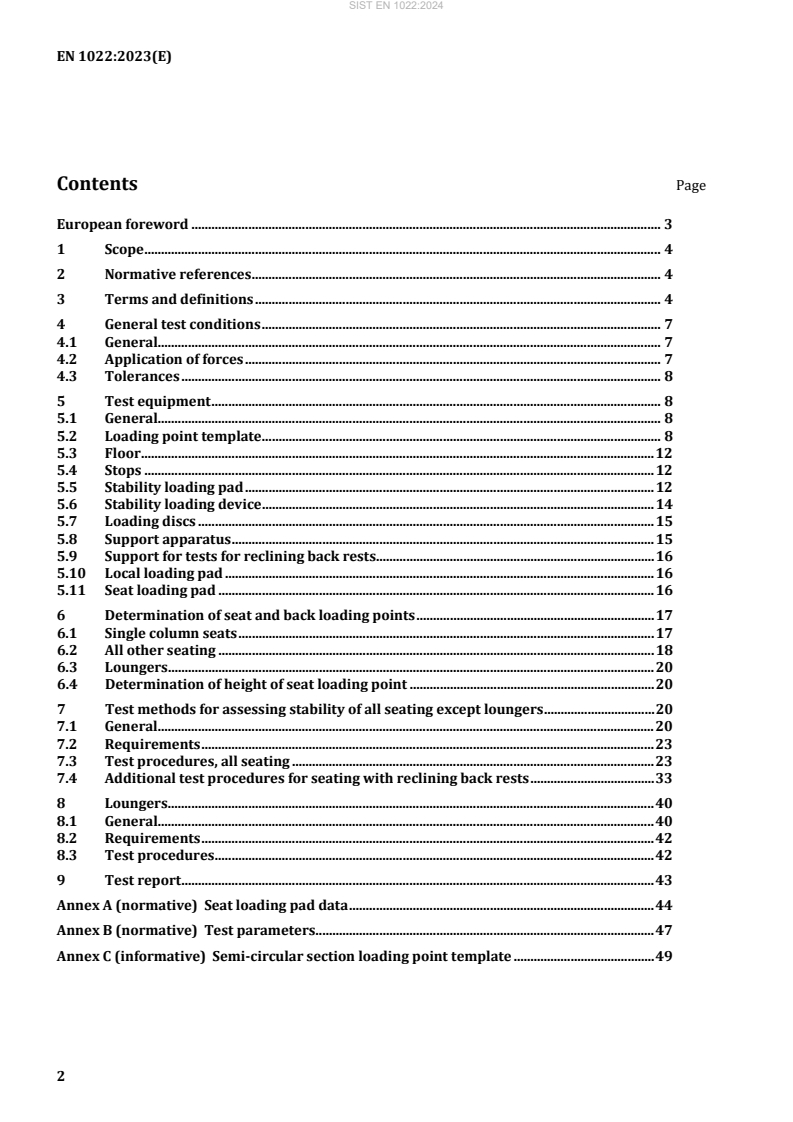
Contents Page
European foreword . 3
1 Scope . 4
2 Normative references . 4
3 Terms and definitions . 4
4 General test conditions . 7
4.1 General. 7
4.2 Application of forces . 7
4.3 Tolerances . 8
5 Test equipment . 8
5.1 General. 8
5.2 Loading point template . 8
5.3 Floor . 12
5.4 Stops . 12
5.5 Stability loading pad . 12
5.6 Stability loading device . 14
5.7 Loading discs . 15
5.8 Support apparatus . 15
5.9 Support for tests for reclining back rests. 16
5.10 Local loading pad . 16
5.11 Seat loading pad . 16
6 Determination of seat and back loading points . 17
6.1 Single column seats . 17
6.2 All other seating . 18
6.3 Loungers . 20
6.4 Determination of height of seat loading point . 20
7 Test methods for assessing stability of all seating except loungers . 20
7.1 General. 20
7.2 Requirements . 23
7.3 Test procedures, all seating . 23
7.4 Additional test procedures for seating with reclining back rests . 33
8 Loungers . 40
8.1 General. 40
8.2 Requirements . 42
8.3 Test procedures . 42
9 Test report . 43
Annex A (normative) Seat loading pad data . 44
Annex B (normative) Test parameters . 47
Annex C (informative) Semi-circular section loading point template . 49
European foreword
This document (EN 1022:2023) has been prepared by Technical Committee CEN/TC 207 “Furniture”, the
secretariat of which is held by UNI.
This European Standard shall be given the status of a national standard, either by publication of an
identical text or by endorsement, at the latest by May 2024, and conflicting national standards shall be
withdrawn at the latest by May 2024.
Attention is drawn to the possibility that some of the elements of this document may be the subject of
patent rights. CEN shall not be held responsible for identifying any or all such patent rights.
This document supersedes EN 1022:2018.
— The scope has been amended to specifically exclude products that require the user to actively affect
stability.
— The definition of arm rest has been improved.
— The sideways stability of seating with swivelling arm rest pads has been defined.
— The standard has been aligned with other standards to refer to single column seating, rather than
swivelling seating.
— A modified loading point template has been introduced.
— The sideways stability test for seating with raised side edges has been improved.
— Rearwards stability tests for loungers have been introduced.
— The clarification of rearward stability of multi-position reclining seating has been introduced.
— Requirements for single column seating with reclining back rests and foot/leg rests has been added.
Any feedback and questions on this document should be directed to the users’ national standards body.
A complete listing of these bodies can be found on the CEN website.
According to the CEN-CENELEC Internal Regulations, the national standards organisations of the
following countries are bound to implement this European Standard: Austria, Belgium, Bulgaria, Croatia,
Cyprus, Czech Republic, Denmark, Estonia, Finland, France, Germany, Greece, Hungary, Iceland, Ireland,
Italy, Latvia, Lithuania, Luxembourg, Malta, Netherlands, Norway, Poland, Portugal, Republic of North
Macedonia, Romania, Serbia, Slovakia, Slovenia, Spain, Sweden, Switzerland, Türkiye and the United
Kingdom.
1 Scope
This document specifies test methods and requirements for the determination of the stability of all types
of seating for adults weighing up to 110 kg, without regard to use, materials, design/construction or
manufacturing process.
The test methods described can be used for seating for children and heavier adults by modifying test
loads and loading points.
This document does not apply to seating for sitting, perching or leaning that requires an action from the
user in order to keep the body posture in a stable position.
This document does not apply to children’s highchairs, table mounted chairs and bath seats which are
covered by other European Standards.
This document contains three Annexes:
Annex A (normative) – Seat loading pad data
Annex B (normative) – Test parameters
Annex C (informative) – Semi-circular section of seat and back loading template
2 Normative references
There are no normative references in this document.
3 Terms and definitions
For the purposes of this document, the following terms and definitions apply.
ISO and IEC maintain terminology databases for use in standardization at the following addresses:
— ISO Online browsing platform: available at https://www.iso.org/obp/
— IEC Electropedia: available at https://www.electropedia.org/
3.1
arm rest
part of the seating able to support the arms of the user when seated, with a height above the seat loading
point of at least 100 mm, but not greater at any point in the horizontal plane than 400 mm above the seat
loading point, extending horizontally forward at least 175 mm from the back loading point
Note 1 to entry: See Figure 1.
Dimensions in millimetres
Key
1 seat loading point
2 arm rest zone
Figure 1 — Arm rest zone
3.2
back rest
element that supports the back of the user higher than 100 mm above the height of the seat loading point
3.3
foot rest
part intended to support the feet of the user which assists the user getting on or off an item of seating
Note 1 to entry: A foot rest can or cannot be permanently attached to the structure of the item of seating.
3.4
leg rest
extension of the seat area intended to support the legs of the user
Note 1 to entry: A leg rest can or cannot be permanently attached to the structure of the item of seating, and may
not be suitable for use as an item of seating itself.
3.5
load bearing structure
components of the item of seating such as the frame, seat, back and arm supports and suspension which
are able to bear forces
3.6
lounger
item of seating intended for reclined posture with at least one back rest position such that back rest angle
is 45 degrees or less to the horizontal, and a leg rest which is an integral part of the product and intended
to support the full body weight of a user
Note 1 to entry: See Figure 2.
Key
θ back rest angle
Figure 2 — Example of lounger
3.7
median plane
vertical plane running from front to rear through the centre of the seat, dividing the item of seating into
two parts
Note 1 to entry: In most instances the two parts are symmetrical.
Note 2 to entry: See Figure 3.
Key
1 transverse plane
2 median plane
A seat loading point
Figure 3 — Transverse and median plane
3.8
overturning
action where an item of seating pivots to a position beyond which the item continues to fall
3.9
raised side edge
side edge of the item of seating, higher than 50 mm above the height of the seat loading point
3.10
stability
ability to withstand forces that tend to cause the loaded seating to overturn
3.11
supporting point
foot of a leg, castor or glide
3.12
single column seat
item of seating, whose upper part, which includes the seat, is mounted on a single support with a diameter
of up to 120 mm at its narrowest point
3.13
transverse plane
vertical plane perpendicular to the median plane passing through the seat loading point
Note 1 to entry: See Figure 3.
4 General test conditions
4.1 General
The furniture shall be tested as delivered. Knock-down furniture shall be assembled according to the
instructions supplied with it. Knock-down fittings shall be tightened before testing.
If the furniture can be assembled or combined in different ways, the most adverse configuration shall be
used for each test.
Unless otherwise specified by the manufacturer, the sample for test shall be stored in indoor ambient
conditions for at least 24 h immediately prior to testing.
The tests shall be carried out at indoor ambient conditions but if during a test the temperature is outside
the range 15 °C to 27 °C the maximum and/or minimum temperature shall be recorded in the test report.
4.2 Application of forces
The test forces shall be applied sufficiently slowly to ensure that negligible dynamic load is applied.
Unless otherwise stated, overturning forces shall be maintained for (5 ± 2) seconds.
For rearwards stability tests defined in 7.4.2, 7.4.3, and 7.4.4, the loading discs shall be applied within
60 s and then maintained in position for 60 ± 5 s.
The forces may be replaced by masses. The relationship 10 N = 1 kg shall be used.
The weight of the loading pad and any associated equipment shall be considered when applying the test
load.
4.3 Tolerances
Unless otherwise stated the following tolerances are applicable:
— forces: ± 5 % of the nominal force;
— masses: ± 1 % of the nominal mass;
— dimensions: all dimensions less than 300 mm shall have a tolerance of ± 1 mm of the nominal
dimension, all other dimensions shall have a tolerance of ± 0,5 % of the nominal dimension;
— angles: ± 2° of the nominal angle.
The accuracy for the positioning of loading pads shall be ± 5 mm.
For the purposes of uncertainty measurement, test results are not considered to be adversely affected
when the above tolerances are met.
5 Test equipment
5.1 General
The equipment shall not inhibit deformation nor cause unnatural deformation of the unit/component, i.e.
it shall be able to move so that it can follow the deformation of the unit/component during testing.
All loading pads shall be capable of pivoting in relation to the direction of the applied force. The pivot
point shall be as close as practically possible to the load surface.
If a loading pad tends to slide, use a slip resistant material between the loading device and the item of
seating.
Unless otherwise specified, the tests may be applied by any suitable device because results are dependent
only upon correctly applied forces and not upon the apparatus.
5.2 Loading point template
Consisting of two shaped members (see Figure 4) fastened together by a pivot at one end. The contours
of the shaped surfaces are so devised as to sink into the upholstery. A semi-circular section (Figure 5) is
fitted to the seat portion, in such a way that the arc of the semi-circular section is in line with the back
template when set to 90° (see Figure 6) and it is 75mm higher in comparison to the seat loading point A
to simulate the top of the seat loading pad (see Figure 11). For this purpose, the loading point template,
+1
with an additional mass applied at the seat loading point, shall be 20 kg.
−0
The weight of distribution of different parts of the template is shown in Table 1.
Table 1 — Weight distribution of template components
Mass of the seat Mass of the back Mass of the additional Total weight
portion, including the portion mass
(kg)
additional plate
(kg) (kg)
(kg)
+1
(2 ± 1) (1,7 ± 0,7) (16 ± 1,5)
−0
The apparatus is marked as shown in Figure 6a).
Dimensions in millimetres
Key
1 top of back portion 6 seat portion
2 rear of seat portion 7 front of seat portion
3 back portion 8 bottom of back portion
4 seat loading point (A) 9 loading point for additional load (D)
5 back loading point (B) P pivot point
Figure 4 — Loading surface curves for loading point template
Dimensions in millimetres
Figure 5 — Semi-circular section
Dimensions in millimetres
a) Marking of the loading point template
b) Example of loading point template assembly
Key
1 typical section of back portion 8 semi-circular section
2 typical section of seat portion A seat loading point (all seating except stools)
3 back portion B back loading point (all seating except stools)
4 flange C seat loading point (stools)
5 straight edge for the determination of seat or back inclination D loading point for additional load
6 seat portion (stools) P pivot point
7 mark to fix 90°
Figure 6 — Loading point template
So that the template can be positioned easily with the two members at 90° to each other, a line is drawn
on the back portion.
5.3 Floor
Horizontal, flat and rigid with a smooth surface.
5.4 Stops
Unless otherwise stated, stops shall be of the minimum height required to prevent sliding and shall not
inhibit overturning.
5.5 Stability loading pad
A loading pad as shown in Figure 7. The circular pad may be made of any suitable material (e.g. plastic or
wood). The extension piece shall be made of aluminium. Where it is not possible to use the pad with
extension piece, a stability loading pad without the extension piece may be used.
The mass of the stability loading pad is not defined but shall be considered during force applications.
Dimensions in millimetres
Key
a grip material on a 300 mm R surface, recessed into a groove so that only the gripper teeth protrude. The
carpet gripper placement shown is one example, other configurations are acceptable
Enlarged detail of the locating point for the rod (see item 3 in Figure 9) of the front and side stability loading
A
fixture”
Figure 7 — Stability loading pad
5.6 Stability loading device
A loading device in principle functioning as shown in Figure 8.
Key
a hold down strap
b centre line of seat
c for details see Figure 7
d for details see Figure 9
Figure 8 — Stability loading device – principle
Dimensions in millimetres
Key
1 sufficient to clear all foam and fabric and allow for set back
2 centre line/centre of gravity of weight
3 rod with spherical tip
4 additional load
X enlarged detail of rod with spherical tip
Figure 9 — Example of front and side stability loading fixture
5.7 Loading discs
Discs with a mass of 10 kg each, with a diameter of 350 mm and a thickness of 48 mm. The centre of
gravity shall be the centre of the disc. The surface friction of the disc (disc to disc) shall be such that the
force to initiate movement shall be 31 N ± 9 N.
5.8 Support apparatus
An apparatus to support the main stack of the loading discs in reclining seating tests. It shall be as light
as possible and not heavier than 2,5 kg. Figure 10 shows a basic design.
Dimensions in millimetres
Key
1 height adjustable support bars
2 pivot point
Figure 10 — Support apparatus
5.9 Support for tests for reclining back rests
Polypropylene sheet 1,5 mm ± 0,65 mm thick, 360 mm ± 10 mm wide and 700 mm ± 15 mm high.
5.10 Local loading pad
Rigid cylindrical object 100 mm in diameter, with a flat face and a 12 mm edge radius.
5.11 Seat loading pad
Naturalistically shaped rigid indenter with a hard, smooth surface having overall dimensions within the
limits shown in Figure 11.
For details of design see Annex A.
Dimensions in millimetres
Key
1 seat loading point
Figure 11 — Seat loading pad – Overall dimensions
6 Determination of seat and back loading points
6.1 Single column seats
6.1.1 Seat loading point “A”
The point at which the single column seat's axis (whether rotating or not) intersects with the seat surface
when the seat is in a position as close as possible to the horizontal.
NOTE Single column seating with adjustable seat depth and back rest height will have loading points marked
differently depending on the positions defined in Table 2.
Points A and B shall be defined after the components are set according to Table 2.
6.1.2 Back loading point “B”
Point B on the centre line of the back rest is determined using the loading point template (5.2), which is
applied to the seat surface.
If it is not possible to find Point B according to the template, then it shall be located 300 mm over the
point A which was used to measure seat height.
6.2 All other seating
6.2.1 General
The seat and back loading points shall be determined using the template as specified in 5.2 in the manner
specified in 6.2.2 or 6.2.3.
In some cases it may not be possible to determine the loading points by means of the template.
In such cases the seat loading point (A) shall be 175 mm forward of the seat/back junction, or at the point
closest to this that allows the seat load to be applied. The back loading point (B) shall be a point 300 mm
upward from the seat/back junction.
Where the geometry of the back rest does not allow the back force to be applied at the point defined by
the above method, the force shall be applied at the nearest point (up or down the back) and the bending
moment (back force, N, multiplied by floor to back loading point distance, m) shall remain constant.
If the number of seats in the item is not obvious, divide the total seat length (in mm) by 600 mm and
round to the nearest whole number to determine the number of seats. Divide the total seat length into
seats of equal length.
6.2.2 Seating with a back rest
For seating with adjustable back rests, set the back rest to its most upright position.
Adjust the template such that the angle between the seat and back portions is 90°.
For upholstered and flexible seating position the loaded template (5.2) on the centre line of the seat as
far towards the rear as possible, without applying force to the back rest. Adjust the position of the
template by pushing the back loading portion into the back of the seating so that it is in contact with the
back rest, allowing the shape of the seat portion of the template to correlate with that of the seat (see
Figure 12a).
— For rigid seating, position the unloaded template (5.2) on the centre line of the seat as far towards
the rear as possible without applying force to the back rest.
— Adjust the position of the template by pushing the back loading portion into the back so that it is in
contact with the back rest and apply the specified load to the template.
— Where possible, ensure that point A on the template is in contact with the seating surface (see
Figure 12b). Where this is not possible ensure the top of the horizontal part of the loading point
template is as close to horizontal as possible.
— In cases where the template can be settled in more than one position, the position having the smallest
angle between the seat and back portions of the template shall be used.
— The angle shall in no cases be less than 90°.
— Mark the required seat loading point (A), and back loading point (B) from the template. If relevant,
repeat the procedures on the other seat(s).
Where the geometry of the back rest does not allow the back force to be applied at the point defined by
the above method, the force shall be applied at the nearest point (up or down the back) and the bending
moment (back force, N, multiplied by floor to back loading point distance, m) shall remain constant.
6.2.3 Seating without a back rest
Set up the template (5.2) at 90° as shown in Figure 6. Place it on each seating position as shown in
Figure 12c). Mark the seat loading point (A) with the aid of the mark C from the template.
a) Upholstered/flexible seating with a back
b) Rigid seating with a back
c) Seating without a back/stools
Key
1 front of stool
A seat loading point – seating with back rests
B back loading point
C seat loading point – seating without back rests
Figure 12 — Determination of seat and back loading point
6.3 Loungers
Seat and back loading points shall be determined using the procedure defined in 6.2.
6.4 Determination of height of seat loading point
Place the seat loading pad (5.11) on the seat surface so that point 1 of the seat loading pad (5.11) is as
close as possible to the seat loading point (A). Apply a force of 600 N at point 1 of the seat loading pad
(5.11). The height of the seat loading point (H) is the distance from the floor to the seat surface at loading
point 1 of the seat loading pad (5.11).
The mass of the seat loading pad shall be considered when applying the force.
NOTE If it is not possible to align Point A from the seat loading pad (5.11) with Point A over the column (6.1.1),
the measurement of seat height, H, (6.4) will be taken as the point given by the seat loading pad (5.11), in the closest
possible location to Point A over the column (6.1.1).
7 Test methods for assessing stability of all seating except loungers
7.1 General
The stability tests defined in Clause 7 are not applicable to seating which has both the height of the seat
loading point (6.4) < 200 mm and a mass < 5 kg.
Position the seating on the floor (5.3) with its components as specified in Table 2.
Table 2 — Positioning of seating components
Tilt
Back rest Back rest Castors and
Clause Test Seat height Seat stiffness Arm rest Foot rest Leg rest
in height position base
adjustment
7.3.1 Forwards highest foremost highest most upright maximum most likely most likely most likely to most likely to
overturning position position position position tension to cause to cause cause cause
overturning overturning overturning overturning
7.3.2 Forwards highest foremost most most upright maximum most likely most likely most likely to most likely to
overturning for position position onerous position tension to cause to cause cause cause
seating with position overturning overturning overturning overturning
foot rest
7.3.3 Corner stability highest foremost most most upright maximum most likely most likely most likely to most likely to
test position position onerous position tension to cause to cause cause cause
position overturning overturning overturning overturning
7.3.4 Sideways highest foremost highest
...