

FprEN 18151
(Main)Refrigerators and freezers for laboratory and medical applications - Terminology, requirements, testing
- Abstract
This document specifies terminology, requirements and test methods for electrically operated medical refrigerating appliances as defined in 3.2 intended for the cold storage of blood components, biological specimen, vaccines, medicines, reagents, or other laboratory preparations used in medical practice and research.
This document applies to medical refrigerating appliances equipped with a remote or integrated compression-type refrigerating system.
This document covers construction characteristics relevant for the thermal and energy performance.
This document covers characteristics of LN2 cryogenic freezers but does not provide test methods.
This document does not cover hygienic and safety aspects and ergonomic principles.
NOTE Examples of standards for safety requirements applicable to medical refrigerating appliances are EN IEC 60335-1 and EN IEC 60335-2-89 or EN 61010-1 and EN IEC 61010-2-011.
This document is not applicable to:
- refrigerated incubators;
- refrigerated cells and refrigerated containers > 2 000 l;
- equipment that rely only on passive cooling;
- appliances for which the primary function is other than cold storage;
- appliances intended for short term storage;
- appliances intended for fully or partially off-grid operation.
- Status
- Not Published
- Publication Date
- 24-Mar-2027
- Technical Committee
- CEN/TC 44 - Household refrigerating appliances and commercial refrigerated cabinets
- Drafting Committee
- CEN/TC 44/WG 6 - Commercial beverage coolers and ice cream freezers
- Current Stage
- 4599 - Dispatch of FV draft to CMC - Finalization for Vote
- Start Date
- 17-Sep-2026
- Completion Date
- 17-Sep-2026

Overview
The draft European Standard FprEN 18151:2024 by CEN specifies critical terminology, requirements, and test methods for electrically operated medical refrigerators and freezers. These appliances are designed for cold storage of sensitive medical and laboratory materials such as blood components, biological specimens, vaccines, medicines, reagents, and other medical or research-related preparations. The document addresses construction and performance characteristics that impact thermal efficiency and energy consumption, focusing on compression-type refrigerating systems, whether integrated or remote.
Importantly, this standard excludes aspects such as hygiene, safety, and ergonomic principles, referencing other standards like EN IEC 60335-1 and EN IEC 61010-1 for those requirements. It also clarifies the scope by excluding refrigerated incubators, large refrigerated containers over 2000 liters, passive cooling systems, non-storage appliances, short-term storage appliances, and off-grid operational models.
Key Topics
Medical Refrigerating Appliance Types
The standard categorizes appliances based on storage temperature and intended medical application:- Blood Bank Refrigerators (2°C to 6°C) for blood and components storage
- Plasma Freezers (−45°C to −30°C) for frozen plasma and components
- Laboratory Refrigerators (+2°C to +16°C) for pharmaceuticals and reagents
- Laboratory Freezers (−45°C to −10°C) for frozen laboratory materials
- Ultralow Freezers (−90°C to −45°C) for biological samples needing ultra-low temperatures
- Cryogenic Freezers (−150°C to −90°C) for highly sensitive biological substances
Terminology and Definitions
The document offers comprehensive definitions covering refrigerants, components (evaporators, condensers), refrigerating system types, storage terms, and physical appliance dimensions to create a unified industry vocabulary.Construction and Performance Requirements
Specifications cover appliance build quality related to thermal insulation, electrical components, refrigerants, and operating characteristics that impact temperature control and energy efficiency.Testing Methods
Standardized test conditions and procedures ensure consistent verification of performance, including temperature stability, insulation effectiveness, volume measurements, and energy consumption evaluations.Classification Systems
Appliances are classified by storage temperature ranges and climate classes to specify operational environments and conditions, ensuring relevance to laboratory and medical settings.
Applications
FprEN 18151 is essential for manufacturers, testing laboratories, healthcare facilities, and regulatory bodies involved in medical refrigeration. It supports:
Medical Research & Diagnostics
Ensuring reliable cold storage of samples and reagents under precisely controlled temperatures improves diagnostic accuracy and research outcomes.Blood and Plasma Storage
Blood banks and transfusion centers benefit from standardized appliances to safely preserve blood and plasma, maintaining viability and safety.Pharmaceutical and Vaccine Management
Hospitals and pharmacies require compliant refrigeration solutions to store vaccines and medicines that require strict thermal stability.Laboratory Operations
Diagnostic and research labs need equipment that meets defined thermal and energy performance standards to support various biochemical and biological tests.
Related Standards
While FprEN 18151 focuses on terminology, requirements, and performance testing for medical refrigerating appliances, it is complementary to several other normative documents:
EN IEC 60335-1 & EN IEC 60335-2-89
Cover general and specific safety requirements for electrical household and commercial refrigerating appliances, ensuring user and operator safety.EN 61010-1 & EN IEC 61010-2-011
Address safety for electrical equipment used in laboratory, measurement, and control applications, including refrigerating systems.ISO and IEC Terminology Databases
Reference platforms for standardized technical vocabulary, promoting global coherence in terminology for refrigeration and medical technology.
Keywords
Medical refrigerators, laboratory freezers, blood bank refrigerators, plasma storage, vaccine refrigeration, compression-type refrigerating system, thermal performance, energy consumption, medical refrigeration standards, CEN standards, refrigerated medical appliances, cold storage for medicines, laboratory refrigeration testing.
Get Certified
Connect with accredited certification bodies for this standard

BSI Group
BSI (British Standards Institution) is the business standards company that helps organizations make excellence a habit.

TÜV Rheinland
TÜV Rheinland is a leading international provider of technical services.

TÜV SÜD
TÜV SÜD is a trusted partner of choice for safety, security and sustainability solutions.
Sponsored listings
Frequently Asked Questions
FprEN 18151 is a draft published by the European Committee for Standardization (CEN). Its full title is "Refrigerators and freezers for laboratory and medical applications - Terminology, requirements, testing". This standard covers: This document specifies terminology, requirements and test methods for electrically operated medical refrigerating appliances as defined in 3.2 intended for the cold storage of blood components, biological specimen, vaccines, medicines, reagents, or other laboratory preparations used in medical practice and research. This document applies to medical refrigerating appliances equipped with a remote or integrated compression-type refrigerating system. This document covers construction characteristics relevant for the thermal and energy performance. This document covers characteristics of LN2 cryogenic freezers but does not provide test methods. This document does not cover hygienic and safety aspects and ergonomic principles. NOTE Examples of standards for safety requirements applicable to medical refrigerating appliances are EN IEC 60335-1 and EN IEC 60335-2-89 or EN 61010-1 and EN IEC 61010-2-011. This document is not applicable to: - refrigerated incubators; - refrigerated cells and refrigerated containers > 2 000 l; - equipment that rely only on passive cooling; - appliances for which the primary function is other than cold storage; - appliances intended for short term storage; - appliances intended for fully or partially off-grid operation.
This document specifies terminology, requirements and test methods for electrically operated medical refrigerating appliances as defined in 3.2 intended for the cold storage of blood components, biological specimen, vaccines, medicines, reagents, or other laboratory preparations used in medical practice and research. This document applies to medical refrigerating appliances equipped with a remote or integrated compression-type refrigerating system. This document covers construction characteristics relevant for the thermal and energy performance. This document covers characteristics of LN2 cryogenic freezers but does not provide test methods. This document does not cover hygienic and safety aspects and ergonomic principles. NOTE Examples of standards for safety requirements applicable to medical refrigerating appliances are EN IEC 60335-1 and EN IEC 60335-2-89 or EN 61010-1 and EN IEC 61010-2-011. This document is not applicable to: - refrigerated incubators; - refrigerated cells and refrigerated containers > 2 000 l; - equipment that rely only on passive cooling; - appliances for which the primary function is other than cold storage; - appliances intended for short term storage; - appliances intended for fully or partially off-grid operation.
FprEN 18151 is classified under the following ICS (International Classification for Standards) categories: 01.040.11 - Health care technology (Vocabularies); 11.100.99 - Other standards related to laboratory medicine; 97.040.30 - Domestic refrigerating appliances. The ICS classification helps identify the subject area and facilitates finding related standards.
FprEN 18151 is available in PDF format for immediate download after purchase. The document can be added to your cart and obtained through the secure checkout process. Digital delivery ensures instant access to the complete standard document.
Standards Content (Sample)
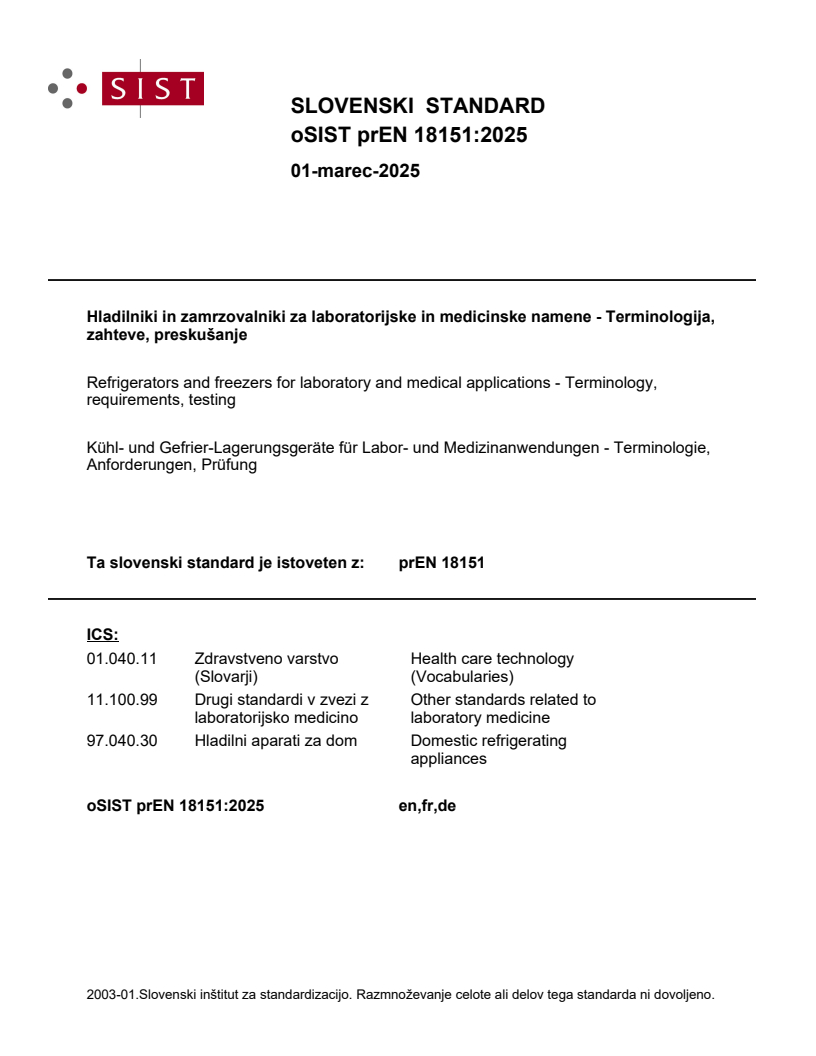
SLOVENSKI STANDARD
oSIST prEN 18151:2025
01-marec-2025
Hladilniki in zamrzovalniki za laboratorijske in medicinske namene - Terminologija,
zahteve, preskušanje
Refrigerators and freezers for laboratory and medical applications - Terminology,
requirements, testing
Kühl- und Gefrier-Lagerungsgeräte für Labor- und Medizinanwendungen - Terminologie,
Anforderungen, Prüfung
Ta slovenski standard je istoveten z: prEN 18151
ICS:
01.040.11 Zdravstveno varstvo Health care technology
(Slovarji) (Vocabularies)
11.100.99 Drugi standardi v zvezi z Other standards related to
laboratorijsko medicino laboratory medicine
97.040.30 Hladilni aparati za dom Domestic refrigerating
appliances
oSIST prEN 18151:2025 en,fr,de
2003-01.Slovenski inštitut za standardizacijo. Razmnoževanje celote ali delov tega standarda ni dovoljeno.
oSIST prEN 18151:2025
oSIST prEN 18151:2025
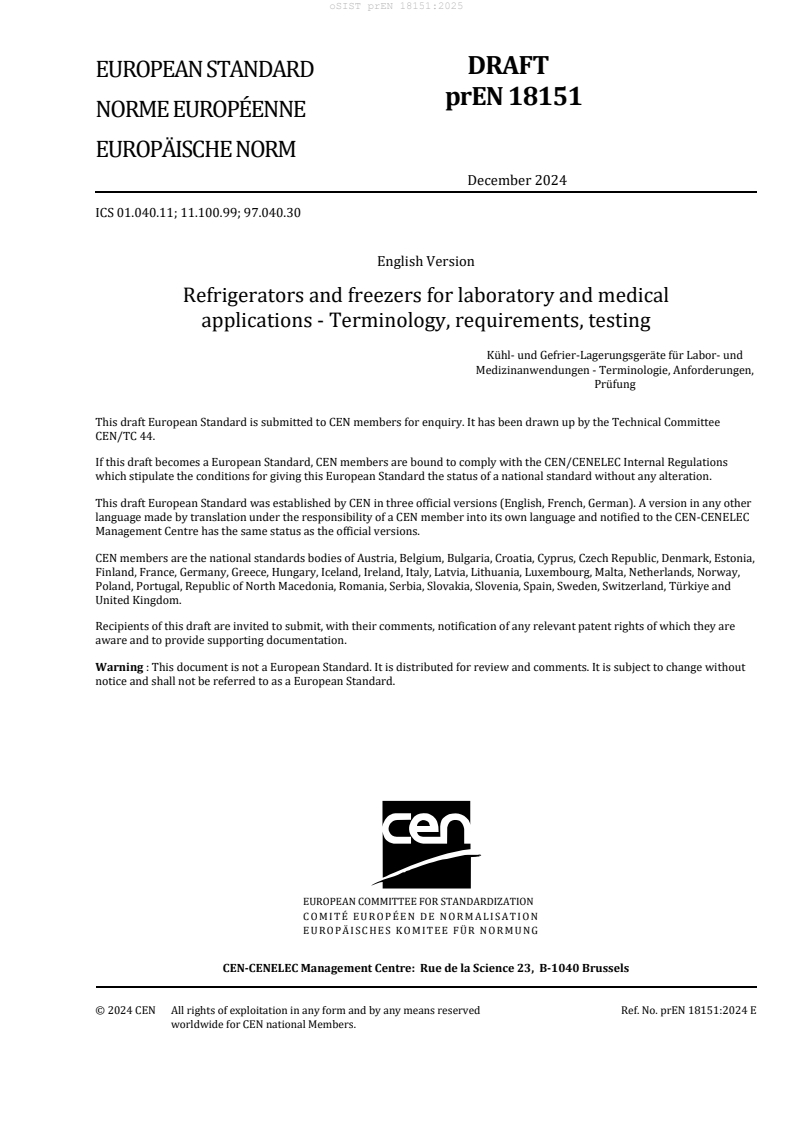
DRAFT
EUROPEAN STANDARD
prEN 18151
NORME EUROPÉENNE
EUROPÄISCHE NORM
December 2024
ICS 01.040.11; 11.100.99; 97.040.30
English Version
Refrigerators and freezers for laboratory and medical
applications - Terminology, requirements, testing
Kühl- und Gefrier-Lagerungsgeräte für Labor- und
Medizinanwendungen - Terminologie, Anforderungen,
Prüfung
This draft European Standard is submitted to CEN members for enquiry. It has been drawn up by the Technical Committee
CEN/TC 44.
If this draft becomes a European Standard, CEN members are bound to comply with the CEN/CENELEC Internal Regulations
which stipulate the conditions for giving this European Standard the status of a national standard without any alteration.
This draft European Standard was established by CEN in three official versions (English, French, German). A version in any other
language made by translation under the responsibility of a CEN member into its own language and notified to the CEN-CENELEC
Management Centre has the same status as the official versions.
CEN members are the national standards bodies of Austria, Belgium, Bulgaria, Croatia, Cyprus, Czech Republic, Denmark, Estonia,
Finland, France, Germany, Greece, Hungary, Iceland, Ireland, Italy, Latvia, Lithuania, Luxembourg, Malta, Netherlands, Norway,
Poland, Portugal, Republic of North Macedonia, Romania, Serbia, Slovakia, Slovenia, Spain, Sweden, Switzerland, Türkiye and
United Kingdom.
Recipients of this draft are invited to submit, with their comments, notification of any relevant patent rights of which they are
aware and to provide supporting documentation.
Warning : This document is not a European Standard. It is distributed for review and comments. It is subject to change without
notice and shall not be referred to as a European Standard.
EUROPEAN COMMITTEE FOR STANDARDIZATION
COMITÉ EUROPÉEN DE NORMALISATION
EUROPÄISCHES KOMITEE FÜR NORMUNG
CEN-CENELEC Management Centre: Rue de la Science 23, B-1040 Brussels
© 2024 CEN All rights of exploitation in any form and by any means reserved Ref. No. prEN 18151:2024 E
worldwide for CEN national Members.
oSIST prEN 18151:2025
prEN 18151:2024(E)
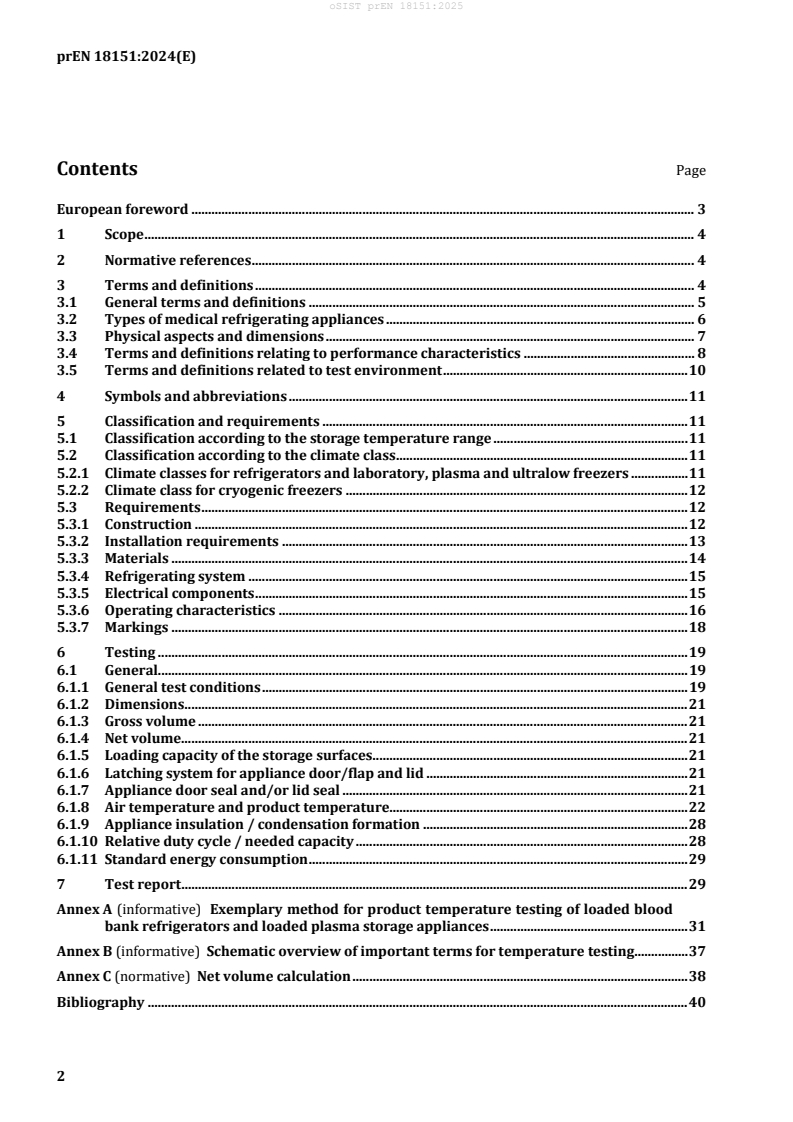
Contents Page
European foreword . 3
1 Scope . 4
2 Normative references . 4
3 Terms and definitions . 4
3.1 General terms and definitions . 5
3.2 Types of medical refrigerating appliances . 6
3.3 Physical aspects and dimensions . 7
3.4 Terms and definitions relating to performance characteristics . 8
3.5 Terms and definitions related to test environment . 10
4 Symbols and abbreviations . 11
5 Classification and requirements . 11
5.1 Classification according to the storage temperature range . 11
5.2 Classification according to the climate class . 11
5.2.1 Climate classes for refrigerators and laboratory, plasma and ultralow freezers . 11
5.2.2 Climate class for cryogenic freezers . 12
5.3 Requirements . 12
5.3.1 Construction . 12
5.3.2 Installation requirements . 13
5.3.3 Materials . 14
5.3.4 Refrigerating system . 15
5.3.5 Electrical components . 15
5.3.6 Operating characteristics . 16
5.3.7 Markings . 18
6 Testing . 19
6.1 General. 19
6.1.1 General test conditions . 19
6.1.2 Dimensions. 21
6.1.3 Gross volume . 21
6.1.4 Net volume. 21
6.1.5 Loading capacity of the storage surfaces . 21
6.1.6 Latching system for appliance door/flap and lid . 21
6.1.7 Appliance door seal and/or lid seal . 21
6.1.8 Air temperature and product temperature. 22
6.1.9 Appliance insulation / condensation formation . 28
6.1.10 Relative duty cycle / needed capacity . 28
6.1.11 Standard energy consumption . 29
7 Test report . 29
Annex A (informative) Exemplary method for product temperature testing of loaded blood
bank refrigerators and loaded plasma storage appliances . 31
Annex B (informative) Schematic overview of important terms for temperature testing . 37
Annex C (normative) Net volume calculation . 38
Bibliography . 40
oSIST prEN 18151:2025
prEN 18151:2024 (E)
European foreword
This document (prEN 18151:2024) has been prepared by Technical Committee CEN/TC 44
“Commercial and Professional Refrigerating Appliances and Systems, Performance and Energy
Consumption”, the secretariat of which is held by UNI.
This document is currently submitted to the CEN Enquiry.
oSIST prEN 18151:2025
prEN 18151:2024(E)
1 Scope
This document specifies terminology, requirements and test methods for electrically operated medical
refrigerating appliances as defined in 3.2 intended for the cold storage of blood components, biological
specimen, vaccines, medicines, reagents, or other laboratory preparations used in medical practice and
research.
This document applies to medical refrigerating appliances equipped with a remote or integrated
compression-type refrigerating system.
This document covers construction characteristics relevant for the thermal and energy performance.
This document does not cover hygienic and safety aspects and ergonomic principles.
NOTE Examples of standards for safety requirements applicable to medical refrigerating appliances are
EN IEC 60335-1 and EN IEC 60335-2-89 or EN 61010-1 and EN IEC 61010-2-011.
This document is not applicable to:
— refrigerated incubators;
— refrigerated cells and refrigerated containers > 2 000 l;
— passive cooling equipment;
— appliances having functionality other than exclusively for storage;
— appliances intended for short term storage;
— appliances intended for fully or partially off-grid operation.
2 Normative references
The following documents are referred to in the text in such a way that some or all of their content
constitutes requirements of this document. For dated references, only the edition cited applies. For
undated references, the latest edition of the referenced document (including any amendments) applies.
EN IEC 60335-1, Household and similar electrical appliances - Safety - Part 1: General requirements
EN IEC 60335-2-89, Household and similar electrical appliances - Safety - Part 2-89: Particular
requirements for commercial refrigerating appliances and ice-makers with an incorporated or remote
refrigerant unit or motor-compressor
EN 61010-1, Safety requirements for electrical equipment for measurement, control, and laboratory
use — Part 1: General requirements
EN IEC 61010-2-011, Safety requirements for electrical equipment for measurement, control, and
laboratory use - Part 2-011: Particular requirements for refrigerating equipment
3 Terms and definitions
For the purposes of this document, the following terms and definitions apply.
ISO and IEC maintain terminology databases for use in standardization at the following addresses:
— ISO Online browsing platform: available at https://www.iso.org/obp/
— IEC Electropedia: available at https://www.electropedia.org/
oSIST prEN 18151:2025
prEN 18151:2024 (E)
3.1 General terms and definitions
3.1.1
medical refrigerating appliance
insulated cabinet with one or more compartments that are controlled at specific temperatures and are
of suitable size and equipped for laboratory and medical use, cooled by natural convection or a forced
convection system whereby the cooling is achieved by one or more energy-consuming components
Note 1 to entry: Medical refrigerating appliance is hereafter referred to as refrigerating appliance.
Note 2 to entry: Medical refrigerating appliances are used for storage of products of human and non-human origin,
like blood components, human cells and tissues, pharmaceuticals, vaccines, chemicals, veterinary products and
products of animal origin.
3.1.2
refrigerant
fluid used for heat transfer in a refrigerating system, which absorbs heat at a low temperature and at a
low pressure of the fluid and rejects heat at a higher temperature and at a higher pressure of the fluid,
usually involving changes of phase of the fluid
3.1.3
condenser
heat exchanger from which heat in the refrigerant is rejected to an external cooling medium (usually
the air surrounding the appliance)
3.1.4
evaporator
heat exchanger which absorbs heat from the compartment to be refrigerated and transfers this to the
refrigerant
3.1.5
compression-type refrigerating system
system in which refrigeration is affected by the vaporization at low pressure in a heat exchanger
(evaporator) of a liquid refrigerant, the vapour thus formed being restored to the liquid state by
mechanical compression to a higher pressure and subsequent cooling in another heat exchanger
(condenser)
3.1.6
refrigerating system
compression-type refrigerating system of the refrigerating appliance
3.1.7
refrigerated product
refrigerated or frozen products that can be stored in refrigerating appliances
EXAMPLE Products are substances for laboratory use, medicinal products, vaccines, plasma or blood.
3.1.8
plasma
liquid part of unclotted blood
Note 1 to entry: Plasma samples can contain anti-coagulants.
oSIST prEN 18151:2025
prEN 18151:2024(E)
3.1.9
blood product (blood and blood components)
whole blood, red cells, frozen cells, platelet concentrates, apheresis platelets, granulocyte concentrates,
and fresh or frozen plasma
3.1.10
short term storage
storage of products under protective and stable temperature conditions for a period of less than 24 h
3.1.11
passive cooling equipment
appliances where a thermal energy storage device is supplying the cooling needs
3.1.12
storage temperature classification
nominal operating temperature range of a refrigerating appliance
3.1.13
off-grid operation
appliance that is not fully reliant on grid electricity for operation; operation can be 100 % off grid or
part of the operational period can be independent of the grid
Note 1 to entry: Off-grid electricity generally originates from local renewable energy sources.
3.2 Types of medical refrigerating appliances
3.2.1
blood bank refrigerator
refrigerating appliance intended to be used in the blood transfusion medicine for the storage of whole
blood or blood components (e.g., blood cells or plasma) at a protective and stable temperature between
2°C and 6°C
3.2.2
plasma freezer
refrigerating appliance intended to be used in the blood transfusion medicine for the storage of blood
plasma or blood components in frozen state at a protective and stable temperature between −45°C and
−30°C
3.2.3
laboratory refrigerator
refrigerating appliance intended to be used in health centres, hospitals, pharmacies, as well as in
diagnostic and research laboratories for the storage of pharmaceuticals, vaccines, cultures, chemicals,
reagents, or other laboratory preparations at a protective and stable temperature between +2 °C and
+16 °C
3.2.4
laboratory freezers
refrigerating appliances intended to be used in health centres, hospitals, pharmacies, as well as in
diagnostic and research laboratories for the storage of pharmaceuticals, vaccines, cultures, chemicals,
reagents, or other laboratory preparations in frozen state at a protective and stable temperature
between −45 °C and −10 °C
oSIST prEN 18151:2025
prEN 18151:2024 (E)
3.2.5
ultralow freezer
refrigerating appliance intended to be used in health centres, hospitals, pharmacies, as well as in
diagnostic and research laboratories for the storage of blood components and blood plasma, human
cells, tissues, vaccines, or other laboratory preparations in frozen state at a protective and stable
temperature between −90 °C and −45 °C
3.2.6
cryogenic freezer
refrigerating appliance intended to be used in health centres, hospitals, pharmacies, as well as in
diagnostic and research laboratories for the storage of blood components and blood plasma, human
cells, tissues, vaccines, or other laboratory preparations in frozen state at a protective and stable
temperature between −150 °C and −90 °C
3.3 Physical aspects and dimensions
3.3.1
shelf
horizontal surface, excluding the base deck, on which the products can be placed
3.3.2
base deck
lowest display surface of a refrigerating appliance
3.3.3
storage surface
refrigerated display area where the vertical clearance above any shelf or base deck is greater than or
equal to 100 mm, measured perpendicularly above the plane of the shelf or base deck and within the
bounds of any load limit
EXAMPLE Shelves and drawers.
3.3.4
gross volume
total volume inside the inner walls of the refrigerating appliance with the door or lid closed, without
taking into account any interior fittings
3.3.5
net volume
storage volume inside the refrigerating appliance which can be used for storage of refrigerated
products within the load limit
3.3.6
load limit
boundary surface consisting of a plane or several planes within which the air temperature inside the
refrigerating appliance can be maintained within the limits declared
3.3.7
load limit line
permanently marked boundary line denoting the edge of the load limit surface
3.3.8
interior fittings
equipment parts and parts necessary for operation in the interior of the refrigerating appliance
oSIST prEN 18151:2025
prEN 18151:2024(E)
EXAMPLE Shelves, drawers, baskets, rails, trays, and air duct systems.
3.3.9
compartment
enclosed space within a refrigerating appliance, which is directly accessible through one or more
external doors
3.3.10
depth
horizontal distance, including rear spacers for air circulation channel, between the front and the rear of
the refrigerating appliance
3.3.11
width
horizontal distance between the two external sides of the refrigerating appliance
3.3.12
height
vertical distance from the floor to the top of the refrigerating appliance
Note 1 to entry: If the refrigerating appliance has adjustable feet, the height defined shall be the minimum and the
maximum height necessary at installation of the appliance.
3.3.13
overall external dimensions at installation
dimensions of the right parallelepiped bounded by the length, depth, and height of the refrigerating
appliance, including its projecting accessories, space necessary for air circulation and any handles, as
shown in Figure 1
3.3.14
overall space required in use
total space taken up by the refrigerating appliance (height, width and depth) necessary for normal use
with doors or lids open, as shown in Figure 1
3.3.15
upright cabinet
refrigerating appliance in which the compartment(s) are accessible from the front
3.3.16
chest
refrigerating appliance in which the compartment(s) are accessible from the top
3.4 Terms and definitions relating to performance characteristics
3.4.1
appliance internal air temperature
air temperature inside the compartments of the refrigerating appliance measured by means of a
measuring device (3.5.1)
3.4.2
reference body
thermal mass placed inside the refrigerating appliance and equipped with a temperature sensor
intended to simulate the product temperature
Note 1 to entry: See also Annex B for a schematic overview.
oSIST prEN 18151:2025
prEN 18151:2024 (E)
3.4.3
product temperature
temperature of the refrigerated product, simulated by means of a thermal lagging device
3.4.4
defrosting
removal of frost, snow, and ice from a refrigerating appliance
3.4.5
automatic defrosting
defrosting where no action is necessary by the user to initiate the removal of frost accumulation and to
restore normal operation
3.4.6
rated
value declared by the manufacturer (e.g. volume, energy consumption, usage)
3.4.7
standard energy consumption
energy used by a refrigerating appliance over a specified period of time or for a specified operation
condition stated in kWh (kilowatt hour)
3.4.8
temperature control
device that is intended to automatically regulate the temperature within the refrigerating appliance
Note 1 to entry: Unless otherwise stated, a two position (e.g. open or closed) control is not included within the
meaning of a temperature control.
3.4.9
temperature setpoint
desired temperature inside the refrigerating appliance as set by the temperature control device
3.4.10
intermittent temperature control
temperature control type where the compressor of the refrigerating appliance is switched off when the
temperature setpoint is reached and switched on again when the pre-defined hysteresis (temperature
rise) is reached
3.4.11
user-adjustable temperature control
temperature control intended for adjustment by the user to vary the temperature within a refrigerating
appliance
3.4.12
temperature control setting
setting of a user-adjustable temperature control selected for the measurement of energy or
performance in accordance with this document
3.4.13
compressor control cycle
definite repetitive swings in compressor power caused by on/off operation of a temperature control
device
oSIST prEN 18151:2025
prEN 18151:2024(E)
Note 1 to entry: The period of a compressor control cycle is the time between a control event and its repetition
on the next cycle.
3.4.14
relative duty cycle
ratio of the compressor power-on time to the total duration of the compressor control cycle under
intermittent temperature control
3.4.15
temperature homogeneity
spatial temperature deviation, characterized by the maximum temperature difference between two
measurement points in the interior of the refrigerating appliance
3.4.16
temperature stability
temporal temperature deviation, characterized by the maximum temperature difference at a given
measurement point in the interior of the refrigerating appliance
3.4.17
steady state
stable operating conditions that meet certain criteria
Note 1 to entry: These criteria are specified in 5.2.2.6 of this document.
3.4.18
temperature rise time
time taken, after the interruption of power supply to the refrigerating system of a refrigerating
appliance, for the temperature to increase by a defined amount
Note 1 to entry: Specific testing is given in 5.2.2.8.2 of this document.
3.5 Terms and definitions related to test environment
3.5.1
air temperature measuring device
cylindrical solid mass made of brass or tin-covered copper having a weight of 25 g ± 5 % and a
maximum dimension of 18 mm and equipped with a temperature sensor for the measurement of the air
temperature inside the refrigerating equipment compartments
Note 1 to entry: See also Annex B for a schematic overview.
3.5.2
test bag
bag, of plastics material, complete with collecting tube and port(s), with a capacity of 450 ml and filled
with 300 ml blood, plasma or 0,9 % saline solution to be used during testing of blood bank refrigerators
and plasma freezers under loaded conditions as specified in Annex A
3.5.3
ambient temperature
measured temperature in the space surrounding the refrigerating appliance under test
Note 1 to entry: The ambient temperature is measured as specified in 5.2.2.5.
oSIST prEN 18151:2025
prEN 18151:2024 (E)
4 Symbols and abbreviations
Vn net volume
5 Classification and requirements
5.1 Classification according to the storage temperature range
Medical refrigerating appliances conforming to this document shall be classified into six categories
based on the storage temperature range (see Table 1):
Table 1 — Classification of medical refrigerating appliances
Storage
Appliance classification Example of application
temperature range
Storage of whole blood or blood components
Blood bank refrigerators (e.g. blood cells or plasma) for transfusion +2 °C to +6 °C
purposes
Storage of medicinal products,
pharmaceuticals, vaccines, cultures,
Laboratory refrigerators +2 °C to +16 °C
chemicals, reagents, or other laboratory
preparations
Storage of pharmaceuticals, vaccines,
Laboratory freezers cultures, chemicals, reagents, or other −45 °C to −10 °C
laboratory preparations in frozen state
Storage of blood plasma or blood components
Plasma freezers −45 °C to −30 °C
in frozen state
Storage blood components and blood plasma,
Ultralow freezers human cells, tissues, vaccines, or other −90 °C to −45 °C
laboratory preparations in deep-frozen state
Storage of blood components and blood
plasma, human cells, tissues, vaccines, or
Cryogenic freezers −150 °C to −90 °C
other laboratory preparations at cryogenic
temperatures
5.2 Classification according to the climate class
5.2.1 Climate classes for refrigerators and laboratory, plasma and ultralow freezers
Medical refrigerating appliances conforming to this document are classified into one (or more) of four
climate classes. The range of ambient temperatures in which the appliances are intended to be used,
and for which the required storage temperatures are to be met, are shown in Table 2.
oSIST prEN 18151:2025
prEN 18151:2024(E)
Table 2 — Climate classes
Description Class Ambient temperature range, °C
Extended temperate SN +10 to +32
Temperate N +16 to +32
Subtropical ST +16 to +38
Tropical T +16 to +43
The energy consumption measurement shall be carried out according to 6.1.11.
5.2.2 Climate class for cryogenic freezers
Cryogenic freezers conforming to this document are classified into one climate class. The range of
ambient temperatures in which the appliance is intended to be used, and for which the required storage
temperatures are to be met, is +16 to +25.
5.3 Requirements
5.3.1 Construction
5.3.1.1 Strength and rigidity
The refrigerating appliance and its parts shall be constructed with adequate strength and rigidity for
normal conditions of handling, transport and use. Attention shall be given to the following:
a) interior fittings shall be sufficiently strong for the duty required;
b) where sliding shelves, baskets or trays are fitted they shall retain their shape and ease of movement
when fully loaded;
c) any fitments which are provided with stops to prevent accidental removal shall be self-supporting
when fully loaded and withdrawn to the limit of the stops;
d) the storage surfaces shall withstand an evenly distributed load of at least 100 kg/m ;
e) refrigerating appliances and accessories that are not securely connected to parts of the building
shall be designed to be stable. If these requirements cannot be met, the manufacturer shall specify
measures to enable a stable installation.
5.3.1.2 Pipes and connections
Pipes and connections to moving or resiliently mounted parts shall be arranged so as not to foul or
transmit harmful vibrations to other parts. All other pipes and connections shall be designed in order to
prevent failure due to fatigue. Where necessary, pipes and valves shall be adequately thermally
insulated.
5.3.1.3 Interior fittings and surfaces
The interior fittings shall permit the refrigerated products to be stored clearly arranged and without
damage.
oSIST prEN 18151:2025
prEN 18151:2024 (E)
It shall be ensured that the refrigerated products have sufficient distance to the inner surfaces of the
refrigerating appliance when used as intended, so that the quality of the refrigerated products is not
impaired.
5.3.1.4 Load limit line
The limits up to which the refrigerated products can be put in the usable space shall be clearly,
permanently and visibly marked and indicated (e.g. information in the instructions for use, design of the
load limit mark in accordance with EN ISO 23953-2).
5.3.1.5 Door, lid, and closure devices
Doors, lids, and closure devices shall be sized to fit their openings and shall close and seal as per the
manufacturer’s information. The refrigerating appliances can have a sliding door or multiple doors. The
doors and lids can be opaque or transparent.
The opening angle for each door or lid shall allow the interior fittings to be operated and pulled out
without obstruction. The opening angle for each lid shall be at least 85° and for each door at least 90°.
Appliance lids shall be designed in such a way that they stay open in any position with an opening angle
of > 30°.
Doors and lids shall be equipped with closure devices to prevent unauthorized opening of the
refrigerating appliance.
5.3.1.6 Durability of door hinges and handles
The durability test of door hinges and handles shall be carried out according to 6.1.11. Hinges and
handles shall withstand 50 000 opening/closing cycles without damages which could impair
functionality or air tightness. After the test, the air tightness test shall be carried out according to 6.1.7,
and the result shall meet the requirements from 5.3.1.7.
5.3.1.7 Air tightness of door and lid
Doors and lids seal shall ensure airtight separation of the interior from the environment when tested in
accordance with 6.1.7.
5.3.1.8 Gross volume
The gross volume as defined in 3.3.4 shall be calculated according to 6.1.3 and expressed in litres (l).
5.3.1.9 Net volume
The net volume as defined in 3.3.5 shall be calculated according to 6.1.4 and expressed in litres (l).
5.3.2 Installation requirements
5.3.2.1 Installation and set-up
The method of installation and set-up of the refrigerating appliance shall be described in the
instructions for use.
A relocation can be affected either by means of castors or carrying devices mounted to the refrigerating
appliance, which are dimensioned in accordance with the loads, or with the aid of a transport device.
If the refrigerating appliance has castors, measures shall be taken to prevent unintentional movement
of the appliance. This can be achieved, for example, by locking brakes on the castors and/or by
adjustable feet that relieve the load from the castors.
For free-standing refrigerating appliances, measures for horizontal adjustment shall be provided (e.g.
adjustable feet).
oSIST prEN 18151:2025
prEN 18151:2024(E)
5.3.2.2 Dimensions at installation and usage
The manufacturer shall indicate the overall external dimensions required for the installation of the
refrigerating appliance and the overall space required during usage in the instructions for use (see
Figure 1).
Key
1 depth
2 width
3 space necessary for free circulation of air
a) overall dimensions
b) space required in use
c) overall space required in use
Figure 1 — Linear dimensions (example: top view for an upright cabinet)
5.3.3 Materials
5.3.3.1 General
The materials shall be durable and shall not favour the development of mould or emit odours. Under
normal conditions of use, materials in contact with foodstuffs shall be resistant to moisture and shall
neither be toxic nor contaminate them.
5.3.3.2 Wear resistance
Internal and external finishes shall be resistant to wear and shall not crack, chip, flake, rub off or soften
under normal conditions of use.
5.3.3.3 Corrosion resistance
Metal parts used in the construction of cabinets shall have resistance to corrosion appropriate to their
location and function. The materials used shall be corrosion-resistant to cleaning and disinfection
agents as specified by the manufacturer instructions.
oSIST prEN 18151:2025
prEN 18151:2024 (E)
5.3.3.4 Thermal insulation
5.3.3.4.1 Efficiency
The thermal insulation shall be efficient and permanently fixed. In particular, the insulating material
shall not be subject to shrinkage and shall not allow under normal working conditions an accumulation
of moisture.
5.3.3.4.2 Vapour barrier
Suitable means shall be used to prevent deterioration of the thermal insulation by the ingress of
moisture.
5.3.3.4.3 Containment of insulation material
Where the insulation space is vented to the inside, it shall be ensured that particles of the insulation
material cannot escape into the refrigerated space. For fibrous insulation materials, it shall not be
possible to insert a rigid probe of 1 mm diameter through any aperture which allows access to the
insulating material, the probe being applied with negligible force.
5.3.4 Refrigerating system
5.3.4.1 Design and construction
The design and construction of all parts of the refrigerating system subject to internal pressure shall
take into account the maximum working pressure to which they are subjected when the appliance is in
operation or at rest.
For refrigerating appliances with components thereof which are charged with refrigerant prior to
transportation, the maximum ambient temperature during transit shall be taken into account.
5.3.4.2 Condensation
There shall be suitable means to prevent water condensed on cold surfaces of the refrigerating
appliance and its parts from affecting the operation of the refrigerating system or its controls.
5.3.4.3 Refrigerant
The refrigerant type used in the appliance shall be classified in accordance with ISO 817. The
refrigerant type and quantity shall be reported on the marking plate. Where a blend of refrigerants is
used, the composition of the blend shall be reported.
5.3.5 Electrical components
5.3.5.1 General
Electrical components which comply with the requirements specified in one of the applicable safety
standards are also considered satisfying the functional need of a medical refrigerating appliance. Useful
standards are listed in Bibliography.
5.3.5.2 Switch-on indicator
There shall be a recognizable visual signal to indicate that the refrigerating appliance is connected to
power and switched on.
oSIST prEN 18151:2025
prEN 18151:2024(E)
5.3.6 Operating characteristics
5.3.6.1 Air temperature and product temperature
The refrigerating appliance shall be equipped with a temperature control device that ensures that the
air and product temperatures given in Table 3 are maintained in the steady-state with defrosting cycles
and the door closed.
Table 3— Air temperature range and product temperature range of the refrigerating appliance
in steady-state operation
Reference Temperature Limit
temperature homogeneity in temperatures
Appliance type
setpoint accordance
with 5.2.2.3
°C K °C
Blood bank
+4 4 +2 to +6
refrigerators
Laboratory
+5 6 +2 to +8
refrigerators
Laboratory
−25 10 ≤ −15
freezers
Plasma freezers −32 10 ≤ −27
Ultralow freezers −80 20 −90 to −70
−150 to −130
Cryogenic
- 150 20
freezers
LN2 cryogenic
< −196 20 to 80 −150 to −120
freezer
NOTE 1 Air temperature range is measured with measuring body
defined in 3.9 and product temperature range is measured with reference
body defined in 3.16.
NOTE 2 LN2 cryogenic freezer are freezers using liquid nitrogen as
operating fluid.
NOTE 3 Temperature homogeneity of LN2 cryogenic freezer depends
on filling height of liquid nitrogen and measuring points location.
The temperature homogeneity values specified in Table 3 shall be maintained throughout the entire
ambient and temperature setpoint range according to the manufacturer's instructions.
In freezers for plasma storage, the limit temperature of −27 °C shall not be exceeded at the highest
adjustable temperature setpoint.
oSIST prEN 18151:2025
prEN 18151:2024 (E)
5.3.6.2 Monitoring of the product temperature
5.3.6.2.1 General
For temperature monitoring, a monitoring device shall be provided whose temperature sensor is
located in at least one reference body, as proxy of the refrigerated product. In addition, the device shall
be ensured, when temperature alarm limits are exceeded or undershot, that the refrigerated product
are still at the permissible temperature when the alarm is triggered.
For monitoring the product temperature, a device shall be provided whose temperature sensor is
located in at least one reference body acting as blood proxy, which, when temperature alarm limits are
exceeded or undershot, ensures that the products are still at the permissible temperature when the
alarm is triggered.
NOTE Examples of reference bodies are:
a) metallic or non-metallic reference body set-ups with suitable positioning option for the
temperature sensor, such as infusion bottles in accordance with EN ISO 8536-1 with a nominal
volume of 100 ml, filled with a liquid suitable for the applicable temperature range;
b) electronic devices with a suitable attenuation filter.
The reference body shall be validated by a suitable method to ensure that the measured temperature
value in the reference body corresponds to the temperature value of the sample substance inside the
refrigerating appliance.
At least one reference body shall be placed in a position inside the refrigerating appliance where the
highest product temperature is expected.
The operator has the option of setting warning values and/or alarm values on the refrigerating
appliance. An exception is made for blood bank refrigerators, where the alarm values of 2 °C (lower
alarm value) and 6 °C (upper alarm value) are required.
This monitoring temperature device shall emit a visual and an audible alarm signal when the
temperature exceeds or falls below the value specified by the operator. The temperature monitoring
device shall have a potential-free changeover contact suitable for alarm triggering on a remote
monitoring system.
It shall not be possible to switch off the visual alarm signal.
For the audible alarm signal, there shall be the possibility of alarm suppression. The alarm signal shall
recur automatically at intervals of no more than 30 min until the adjusted appliance temperature is
reached again. Permanent suppression of the audible alarm signal shall only be possible by authorized
personnel.
It shall be possible to check the temperature monitoring device by a test alarm function.
In case of a temperature control failure for blood bank refrigerators and refrigerators for medicinal
products and laboratory use, a safety device shall prevent the appliance from cooling below the lower
limit temperature according to Table 3.
5.3.6.2.2 Changing of controller settings
At the operator's request, the control unit shall be equipped with a system that only permits program
changes to be made by authorized personnel.
oSIST prEN 18151:2025
prEN 18151:2024(E)
5.3.6.3 Temperature rise inside in case of power failure
In the event of power failure, an audible alarm signal shall be set off at the refrigerating appliance for at
least 12 h. For the audible alarm signal, there shall be the possibility of alarm suppression. This safety
device shall have a potential-free changeover contact.
5.3.6.4 Noise emission
The noise emission shall be specified by the manufacturer, stating the measurement method.
5.3.6.5 Automatic defrosting
If the refrigerating appliance is equipped with a defrosting device, it shall be ensured that the
evaporator is completely free of ice at the end of the defrosting phase.
Temperature monitoring shall not be switched off during the defrosting phase.
The product temperature (reference body temperature) shall not exceed the tolerances for the relevant
limit temperature given in Table 3 during the defrosting phase.
5.3.6.6 Condensation
Adequate precautions shall be taken to ensure that the appliance is condensation-free at the climate
classes specified by the manufacture.
5.3.6.7 Relative duty cycle / capacity needed
The refrigerating appliance shall be operated at the reference temperature setpoint and the highest
permissible ambient temperature in accordance with Table 3 in the steady-state in accordance
with 5.2.2.6.
In case of discontinuous temperature control of the air temperature, the cooling unit of the refrigerating
appliance is switched on. Hereby, a relative duty cycle of 80 % shall not be exceeded over a period of
24 h in order to ensure an adequate power reserve.
5.3.7 Markings
5.3.7.1 Load limit
The limits up to which the refrigerated products can be put in the usable space shall be clearly,
permanently and visibly marked and indicated (e.g. information in the instructions for use, design of the
load limit mark in accordance with EN ISO 23953-2).
5.3.7.2 Marking plate
All labels, including the relevant warnings, shall be legible and permanently attached to the appliance in
an easily accessible place.
All labels shall comply with the relevant requirements of EN IEC 60335-1 and EN IEC 60335-2-89 or
EN 61010-1 and EN IEC 61010-2-011.
Information for appliance identification shall be indicated on a name plate.
The permissible ambient temperature range and air temperature range shall be indicated on the name
plate.
The net volume of the appliance in litres or cubic metres should be indicated on the name plate.
5.3.7.3 Information to be supplied by the manufacturer
The instructions for use should contain at least the following information:
a) energy consumption (5.2.5);
oSIST prEN 18151:2025
prEN 18151:2024 (E)
b) indication of the temperature rise inside in case of power failure (5.2.2.8.2);
c) temperature homogeneity (5.2.2.3) at the reference ambient temperature; and
d) temperature stability (5.2.2.4) at the reference ambient temperature.
6 Testing
6.1 General
6.1.1 General test conditions
The tests described below are type tests.
When checking the properties of a refrigerating appliance, all tests shall be carried out on the same
appliance.
The tests are shown in Table 4. The refrigerating appliances shall comply with the requirements
specified in this document when using the required test method.
Table 4 — List of all required tests and test requirements and related subclauses in this
document
Test requirements Test method
Tests and test requirements
Subclause Subclause
General test conditions — 6.1.1
Dimensions — 6.1.2
Gross volume 5.3.1.6 6.1.3
Net volume 5.3.1.7 6.1.4
Loading capacity of the storage surfaces 5.3.1.1 6.1.5
Locking system for appliance door/flap and lid 5.3.1.4 6.1.6
Appliance door and lid seal 5.3.1.5 6.1.7
Stability` 5.3.1.1 -
Air temperature and product temperature 5.3.6.1 6.1.8
Testing the air temperature — 6.1.8
Monitoring the product temperature 5.3.6.2 6.1.8
Appliance insulation/condensation 5.3.6.6 6.1.9
Relative duty cycle/ capacity needed 5.3.6.7 6.1.10
Standard energy consumption — 6.1.11
Exemplary method for product temperature testing of
loaded blood bank refrigerators and loaded plasma — Annex A
storage appliances
oSIST prEN 18151:2025
prEN 18151:2024(E)
The refrigerating appliance with all interior fittings supplied as a standard by the manufacturer, which
shall be fitted in th
...