


EN 12599:2026
(Main)Ventilation for buildings - Test procedures and measurement methods to hand over air conditioning and ventilation systems for non-residential buildings
General Information
- Abstract
This document specifies checks, measurement methods and procedures in order to verify the fitness for purpose of the installed ventilation systems and air conditioning systems according to design.
It establishes a procedure intended to technically support the handing over and inspection of these systems.
This document enables the choice between checks and measurements when sufficient, and additional measurements, when necessary.
This document applies to mechanical ventilation systems (including the mechanical part of hybrid systems) and full and (partial) air conditioning systems in non-residential (parts of) buildings.
This document does not apply to:
— heat generating systems and their control;
— refrigerating systems and their control;
— distribution of heating and cooling medium to the air handling units;
— compressed air supplying systems;
— water conditioning systems;
— central steam generating systems for air humidifying;
— electric supply systems.
This document is not applicable to ventilation systems and air conditioning systems for industrial or other special process environments.
- Status
- Not Published
- Publication Date
- 06-Oct-2026
- Technical Committee
- CEN/TC 156 - Ventilation for buildings
- Drafting Committee
- CEN/TC 156/WG 8 - Installation
- Current Stage
- 6055 - CEN Ratification completed (DOR) - Publishing
- Start Date
- 05-Jul-2026
- Due Date
- 29-Apr-2026
- Completion Date
- 05-Jul-2026

Overview
EN 12599:2026 from CEN addresses the standardized procedures for testing and verifying the performance of ventilation and air conditioning systems in non-residential buildings. The document outlines essential checks, measurement methods, and inspection protocols aimed at ensuring installed systems meet design requirements and operational fitness for purpose. The focus is on mechanical ventilation systems, including the mechanical components of hybrid systems, as well as full and partial air conditioning systems, specifically in commercial, public, and other non-residential environments.
EN 12599:2026 does not cover heat generation, refrigeration, distribution of heating/cooling mediums, or systems serving industrial/process-specific environments.
Key Topics
Fitness for Purpose Verification
EN 12599:2026 details systematic procedures-completeness checks, functional checks, and targeted measurements-to technically support the handover and inspection of HVAC installations. The goal is to prove that systems perform as intended according to design documentation.Administrative Checks
Prior to physical inspection, project documentation must be reviewed for completeness, including: design specifications, inventory records, operation and maintenance manuals, balancing reports, and existing measurement data.Completeness and Functional Checks
Inspectors confirm that installed systems match contract specifications, technical rules, and that balancing has been carried out. Functional checks assess whether key components-such as fans, filters, dampers, and control devices-operate according to specifications under varying operating conditions.System Measurements and Sampling
Measurements commonly focus on air flow rates, temperature, humidity, air tightness, and sound levels. The standard supports both spot checks and statistical sampling for similar equipment types. Additional or extended measurements may be conducted if standard checks indicate possible issues.Ductwork Airtightness
Procedures are included for classifying and testing ductwork airtightness, referencing EN 16798-3 airtightness classes (ATC). At least 10% of total duct surface area is recommended for testing, with methods defined for measuring leakage factors and interpreting results.Reporting
Detailed reporting templates and requirements ensure clear communication of test results, compliance status, and any required remedial actions during the handover process.
Applications
EN 12599:2026 is a key reference for:
Commissioning Authorities, Facility Managers, and Contractors
Ensuring that new or refurbished HVAC systems in non-residential buildings conform to design and operate efficiently before final acceptance.Building Inspectors and Quality Assurance Professionals
Applying consistent verification and measurement methods for ventilation and air conditioning system handover.Consultants and HVAC Designers
Specifying and documenting HVAC system requirements and commissioning criteria in line with standardized European methodologies.
Typical settings include office buildings, schools, hospitals, retail centers, and public facilities.
Related Standards
- EN 16211: Ventilation for buildings - Measurement of air flows on site – Methods.
- EN 16798-3: Ventilation for buildings - Part 3: Performance requirements for non-residential buildings.
- EN ISO 7730: Ergonomics of the thermal environment - Analytical determination of thermal comfort.
- JCGM 100: Guide to the expression of uncertainty in measurement.
EN 12599:2026 supersedes EN 12599:2012 and aligns with modernized European requirements for building ventilation system acceptance and quality assurance.
Implementing this standard aids in achieving optimal indoor air quality, occupant comfort, system reliability, and compliance with EU building regulations.
Relations
- Effective Date
- 19-Jan-2023
Get Certified
Connect with accredited certification bodies for this standard

DIBt (Deutsches Institut für Bautechnik)
German Institute for Building Technology.
DIN CERTCO
DIN Group product certification.

Aboma Certification B.V.
Specialized in construction, metal, and transport sectors.
Sponsored listings
Frequently Asked Questions
EN 12599:2026 is a draft published by the European Committee for Standardization (CEN). Its full title is "Ventilation for buildings - Test procedures and measurement methods to hand over air conditioning and ventilation systems for non-residential buildings". This standard covers: This document specifies checks, measurement methods and procedures in order to verify the fitness for purpose of the installed ventilation systems and air conditioning systems according to design. It establishes a procedure intended to technically support the handing over and inspection of these systems. This document enables the choice between checks and measurements when sufficient, and additional measurements, when necessary. This document applies to mechanical ventilation systems (including the mechanical part of hybrid systems) and full and (partial) air conditioning systems in non-residential (parts of) buildings. This document does not apply to: — heat generating systems and their control; — refrigerating systems and their control; — distribution of heating and cooling medium to the air handling units; — compressed air supplying systems; — water conditioning systems; — central steam generating systems for air humidifying; — electric supply systems. This document is not applicable to ventilation systems and air conditioning systems for industrial or other special process environments.
This document specifies checks, measurement methods and procedures in order to verify the fitness for purpose of the installed ventilation systems and air conditioning systems according to design. It establishes a procedure intended to technically support the handing over and inspection of these systems. This document enables the choice between checks and measurements when sufficient, and additional measurements, when necessary. This document applies to mechanical ventilation systems (including the mechanical part of hybrid systems) and full and (partial) air conditioning systems in non-residential (parts of) buildings. This document does not apply to: — heat generating systems and their control; — refrigerating systems and their control; — distribution of heating and cooling medium to the air handling units; — compressed air supplying systems; — water conditioning systems; — central steam generating systems for air humidifying; — electric supply systems. This document is not applicable to ventilation systems and air conditioning systems for industrial or other special process environments.
EN 12599:2026 is classified under the following ICS (International Classification for Standards) categories: 91.140.30 - Ventilation and air-conditioning systems. The ICS classification helps identify the subject area and facilitates finding related standards.
EN 12599:2026 has the following relationships with other standards: It is inter standard links to EN 12599:2012. Understanding these relationships helps ensure you are using the most current and applicable version of the standard.
EN 12599:2026 is available in PDF format for immediate download after purchase. The document can be added to your cart and obtained through the secure checkout process. Digital delivery ensures instant access to the complete standard document.
Standards Content (Sample)
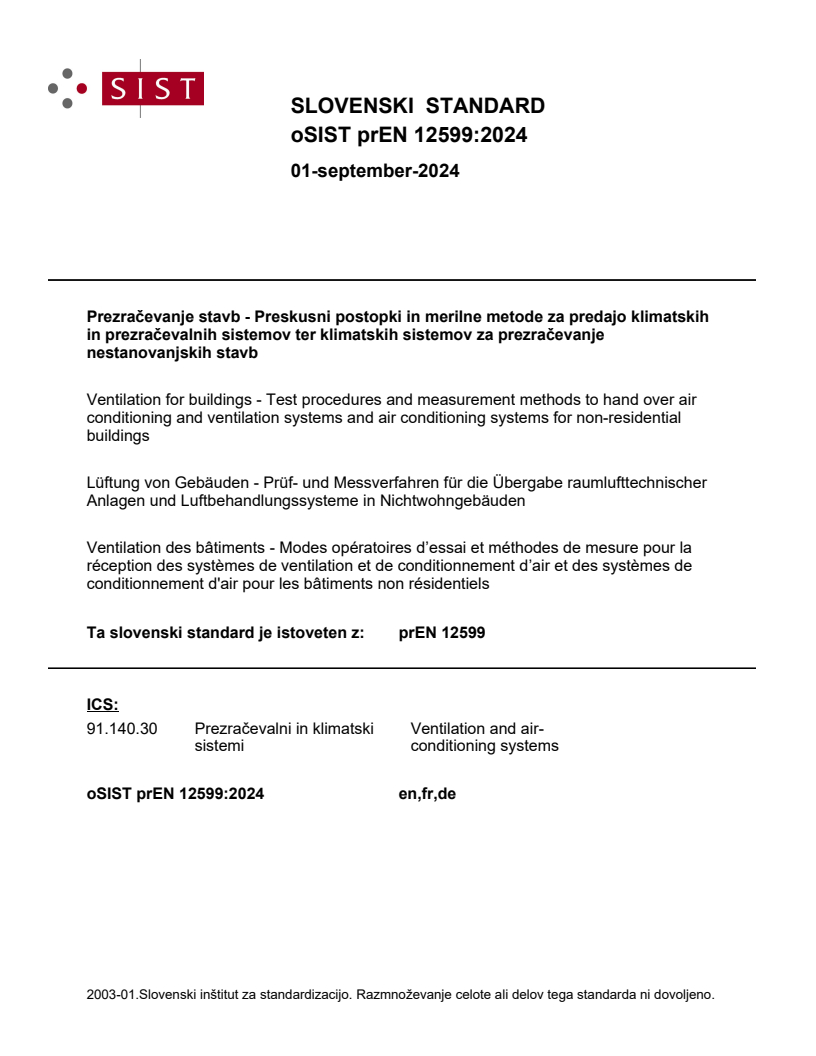
SLOVENSKI STANDARD
oSIST prEN 12599:2024
01-september-2024
Prezračevanje stavb - Preskusni postopki in merilne metode za predajo klimatskih
in prezračevalnih sistemov ter klimatskih sistemov za prezračevanje
nestanovanjskih stavb
Ventilation for buildings - Test procedures and measurement methods to hand over air
conditioning and ventilation systems and air conditioning systems for non-residential
buildings
Lüftung von Gebäuden - Prüf- und Messverfahren für die Übergabe raumlufttechnischer
Anlagen und Luftbehandlungssysteme in Nichtwohngebäuden
Ventilation des bâtiments - Modes opératoires d’essai et méthodes de mesure pour la
réception des systèmes de ventilation et de conditionnement d’air et des systèmes de
conditionnement d'air pour les bâtiments non résidentiels
Ta slovenski standard je istoveten z: prEN 12599
ICS:
91.140.30 Prezračevalni in klimatski Ventilation and air-
sistemi conditioning systems
oSIST prEN 12599:2024 en,fr,de
2003-01.Slovenski inštitut za standardizacijo. Razmnoževanje celote ali delov tega standarda ni dovoljeno.
oSIST prEN 12599:2024
oSIST prEN 12599:2024
DRAFT
EUROPEAN STANDARD
prEN 12599
NORME EUROPÉENNE
EUROPÄISCHE NORM
July 2024
ICS 91.140.30 Will supersede EN 12599:2012
English Version
Ventilation for buildings - Test procedures and
measurement methods to hand over air conditioning and
ventilation systems and air conditioning systems for non-
residential buildings
Ventilation des bâtiments - Procédures d'essai et Lüftung von Gebäuden - Prüf- und Messverfahren für
méthodes de mesure pour la réception des die Übergabe raumlufttechnischer Anlagen
installations de conditionnement d'air et de ventilation
This draft European Standard is submitted to CEN members for enquiry. It has been drawn up by the Technical Committee
CEN/TC 156.
If this draft becomes a European Standard, CEN members are bound to comply with the CEN/CENELEC Internal Regulations
which stipulate the conditions for giving this European Standard the status of a national standard without any alteration.
This draft European Standard was established by CEN in three official versions (English, French, German). A version in any other
language made by translation under the responsibility of a CEN member into its own language and notified to the CEN-CENELEC
Management Centre has the same status as the official versions.
CEN members are the national standards bodies of Austria, Belgium, Bulgaria, Croatia, Cyprus, Czech Republic, Denmark, Estonia,
Finland, France, Germany, Greece, Hungary, Iceland, Ireland, Italy, Latvia, Lithuania, Luxembourg, Malta, Netherlands, Norway,
Poland, Portugal, Republic of North Macedonia, Romania, Serbia, Slovakia, Slovenia, Spain, Sweden, Switzerland, Türkiye and
United Kingdom.
Recipients of this draft are invited to submit, with their comments, notification of any relevant patent rights of which they are
aware and to provide supporting documentation.
Warning : This document is not a European Standard. It is distributed for review and comments. It is subject to change without
notice and shall not be referred to as a European Standard.
EUROPEAN COMMITTEE FOR STANDARDIZATION
COMITÉ EUROPÉEN DE NORMALISATION
EUROPÄISCHES KOMITEE FÜR NORMUNG
CEN-CENELEC Management Centre: Rue de la Science 23, B-1040 Brussels
© 2024 CEN All rights of exploitation in any form and by any means reserved Ref. No. prEN 12599:2024 E
worldwide for CEN national Members.
oSIST prEN 12599:2024
prEN 12599:2024 (E)
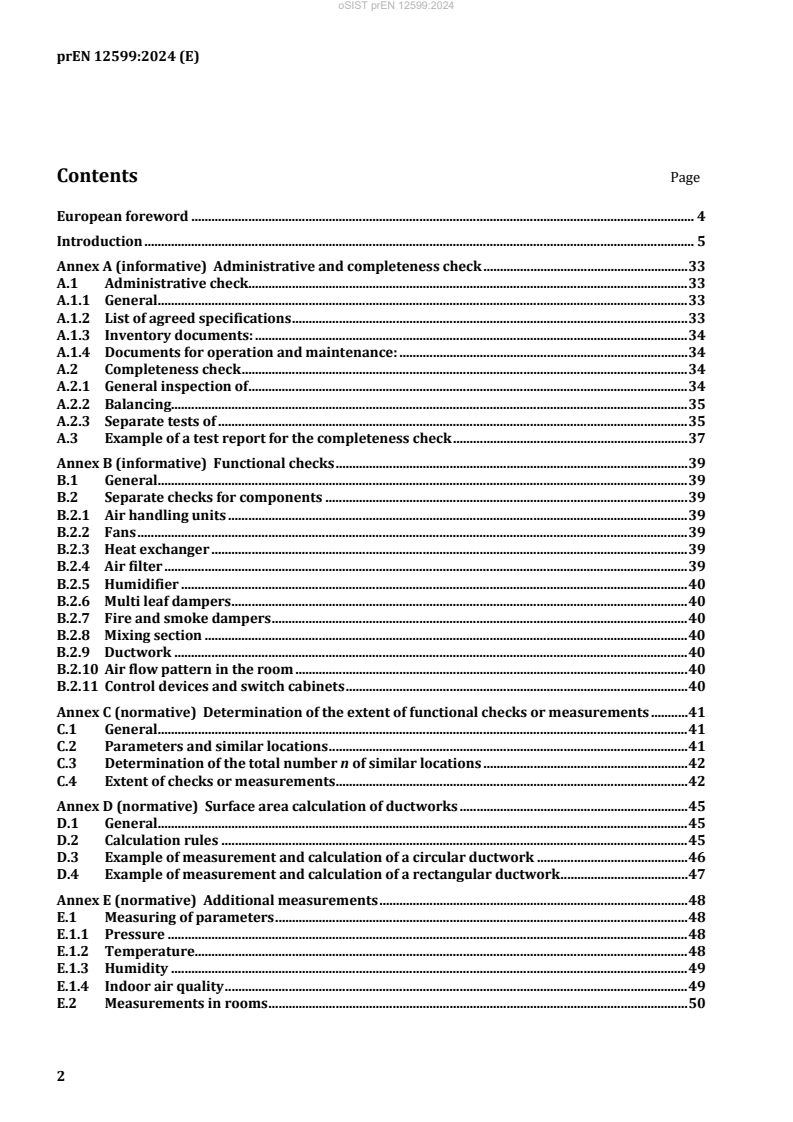
Contents Page
European foreword . 4
Introduction . 5
Annex A (informative) Administrative and completeness check . 33
A.1 Administrative check. 33
A.1.1 General. 33
A.1.2 List of agreed specifications . 33
A.1.3 Inventory documents: . 34
A.1.4 Documents for operation and maintenance: . 34
A.2 Completeness check . 34
A.2.1 General inspection of . 34
A.2.2 Balancing. 35
A.2.3 Separate tests of . 35
A.3 Example of a test report for the completeness check . 37
Annex B (informative) Functional checks . 39
B.1 General. 39
B.2 Separate checks for components . 39
B.2.1 Air handling units . 39
B.2.2 Fans . 39
B.2.3 Heat exchanger . 39
B.2.4 Air filter . 39
B.2.5 Humidifier . 40
B.2.6 Multi leaf dampers . 40
B.2.7 Fire and smoke dampers . 40
B.2.8 Mixing section . 40
B.2.9 Ductwork . 40
B.2.10 Air flow pattern in the room . 40
B.2.11 Control devices and switch cabinets . 40
Annex C (normative) Determination of the extent of functional checks or measurements . 41
C.1 General. 41
C.2 Parameters and similar locations . 41
C.3 Determination of the total number n of similar locations . 42
C.4 Extent of checks or measurements . 42
Annex D (normative) Surface area calculation of ductworks . 45
D.1 General. 45
D.2 Calculation rules . 45
D.3 Example of measurement and calculation of a circular ductwork . 46
D.4 Example of measurement and calculation of a rectangular ductwork . 47
Annex E (normative) Additional measurements . 48
E.1 Measuring of parameters . 48
E.1.1 Pressure . 48
E.1.2 Temperature. 48
E.1.3 Humidity . 49
E.1.4 Indoor air quality . 49
E.2 Measurements in rooms . 50
oSIST prEN 12599:2024
prEN 12599:2024 (E)
E.2.1 General . 50
E.2.2 Thermal environment . 51
E.2.3 Ventilation effectiveness . 52
E.2.4 Acoustic environment . 52
Annex F (informative) Technical Specifications for checks and measurements for the
purpose of handing over . 53
Annex G (informative) Examples for determination of the number of functional checks and
measurements . 54
G.1 Functional checks . 54
G.2 Measurements . 54
Annex H (informative) Examples for measurement uncertainty . 56
H.1 Uncertainty of the result of a measurement . 56
H.2 Type B evaluation of standard uncertainty . 56
H.3 Combined standard uncertainty . 58
H.4 Expanded uncertainty . 58
H.5 Examples . 59
Annex I (informative) Calculations on airflow correction under reference conditions . 62
Bibliography . 64
oSIST prEN 12599:2024
prEN 12599:2024 (E)
European foreword
This document (prEN 12599:2024) has been prepared by Technical Committee CEN/TC 156 “Ventilation
for buildings”, the secretariat of which is held by BSI.
This document is currently submitted to the CEN Enquiry.
This document will supersede EN 12599:2012.
This document includes the following significant technical changes with respect to EN 12599:2012:
— the scope was modified so that EN 12599 applies for non-residential buildings. It was deleted that it
can be used for residential buildings. The procedures specified can support handing over and
inspections of systems.
— the normative references have been updated;
— the air flow measurement methods were transferred to EN 16211;
— the method of measuring the ductwork air tightness according to the air tightness classes of
EN 16798-3 was included;
— Annex C on the determination of the extend of functional checks in measurements for e.g. similar
locations was revised. New sampling levels based on sampling errors were specified;
— Annex D was included in Clause 8 “Measurements”;
— the surface area calculation of ductworks was included as new Annex D;
— “Special measurements” were renamed to “Additional measurements”;
— the determination of the measurement uncertainty was revised.
oSIST prEN 12599:2024
prEN 12599:2024 (E)
Introduction
The measurement methods and procedures presented in this document are specified in such a way that
they are particularly suitable for the handover of ventilation and air conditioning systems even though
verification of the fitness for purpose of the installed ventilation systems and air conditioning systems
can be useful in different stages of the life cycle of ventilation systems. That means not only the stage of
handing over. Due to the accessibility, for some measurements it might be of advantage to perform them
during installation (e.g. air tightness).
The measuring methods in this document in connection with document EN 16211 are applicable in the
frame of the energy inspection of air-conditioning systems according to EN 16798-17 and
CEN/TR 16798-18.
oSIST prEN 12599:2024
prEN 12599:2024 (E)
1 Scope
This document specifies checks, measurement methods and procedures in order to verify the fitness for
purpose of the installed ventilation systems and air conditioning systems according to design.
It establishes a procedure intended to technically support the handing over and inspection of these
systems.
This document enables the choice between checks and measurements when sufficient, and additional
measurements, when necessary.
This document applies to mechanical ventilation systems (including the mechanical part of hybrid
systems) and full and (partial) air conditioning systems in non-residential (parts of) buildings.
This document does not apply to:
— heat generating systems and their control;
— refrigerating systems and their control;
— distribution of heating and cooling medium to the air handling units;
— compressed air supplying systems;
— water conditioning systems;
— central steam generating systems for air humidifying;
— electric supply systems.
This document is not applicable to ventilation systems and air conditioning systems for industrial or
other special process environments.
2 Normative references
The following documents are referred to in the text in such a way that some or all of their content
constitutes requirements of this document. For dated references, only the edition cited applies. For
undated references, the latest edition of the referenced document (including any amendments) applies.
EN 16211, Ventilation for buildings - Measurement of air flows on site - Methods
EN 16798-3, Energy performance of buildings - Ventilation for buildings - Part 3: For non-residential
buildings - Performance requirements for ventilation and room-conditioning systems (Modules M5-1, M5-4)
EN ISO 7730, Ergonomics of the thermal environment - Analytical determination and interpretation of
thermal comfort using calculation of the PMV and PPD indices and local thermal comfort criteria (ISO 7730)
JCGM 100, Evaluation of measurement data — Guide to the expression of uncertainty in measurement
3 Terms and definitions
For the purposes of this document, the following terms and definitions apply.
ISO and IEC maintain terminology databases for use in standardization at the following addresses:
— IEC Electropedia: available at https://www.electropedia.org/
— ISO Online browsing platform: available at https://www.iso.org/obp
oSIST prEN 12599:2024
prEN 12599:2024 (E)
3.1
handover
process of transferring responsibility for an installation to another person or organization
3.2
check
examination of something, without resorting to measurements, in order to make certain that it is correct
or the way it should be
3.3
administrative check
check of documentation and specifications of an installation
3.4
completeness check
check of the completeness and the arrangement of an installation
3.5
functional check
check of the operation of a primary function of an installation
Note 1 to entry: An example of primary function of a ventilation installation is to provide air flow rate.
3.6
balancing
process of adjusting the flow rates in each circuit of an installation to meet the specifications
4 Test and check procedure
To verify the fitness of purpose of an installed system by checks and measurements it is necessary to
specify performance criteria for the checks and measurements (e.g. maximal permissible errors, sample
selection) as well as for the installation (e.g. tolerances). Annex F gives a list of specifications.
The following steps shall be carried out in the given order:
a) completeness checks;
b) functional checks;
c) measurements;
d) additional measurements;
e) report.
In general, functional checks and measurements on the system are performed for each component of the
system. For same kind of components at comparable locations and operation conditions the functional
checks and measurements may be performed on a sample selection. The extent of functional checks and
measurements shall be determined according to Annex C.
Ensure the system is running in adjusted and safe condition.
The additional measurements in accordance with Clause 9 and Annex E shall be carried out only when
required and especially agreed.
The steps of the checks, measurements and report are shown in Table 1.
oSIST prEN 12599:2024
prEN 12599:2024 (E)
Table 1 — List of checks, measurements and report to verify the quality of the systems
Required steps Purpose Activities Annexes
Check the Completeness of
documents
1. Specifications
Verify that the
Administrative check documentation of the 2. Inventory Annex A
installation is complete
3. operation and
maintenance
4. measurement reports
1. Comparison of
equipment with the design
Ensure that the ventilating
2. Compliance with
and air conditioning
technical rules (contract
Completeness checks system has been installed Annex A
and official)
entirely in accordance
with contract
3. Balancing
1. Put system into use Annex C
2. Operation of Determination of extent
Verify the operation of the
components and system
Functional checks
Annex B
system
3. Accessibility
Survey of performance of
4. Cleanliness components and systems
1. Determine which
measurements and
recordings are necessary
2. Extent of
Verify on a statistical basis
measurements, specified
Annex C
that the system achieves
by means the sampling
Measurements
the values according to
Determination of extent
level SL
design
3. Measurements
4. Accompanying
measurements (see 8.5)
5. Air tightness
1. Determine which
In case of doubts
measurements and
concerning the quality of
recordings are necessary
Annex E
Additional measurements the system or parts of the
(if necessary) system additional 2. Determine uncertainty
Additional measurements
measurements can be of the measurements
applicable.
3. Measurements
Annex A
Report 1. Report
Example of completeness
See Clause 9 2. Handing over the report
check report
5 Administrative check
Prior to inspection, checks and measurements of the installation on site the administrative check of the
available documents shall be done.
It shall be checked whether all relevant documents are available, including
oSIST prEN 12599:2024
prEN 12599:2024 (E)
— A list of all specifications;
— all inventory documents;
— all documents necessary for operation, maintenance;
— the balancing reports;
— the existing reports of measurements (e.g. the air tightness test) if any.
Details of the administrative check are included in Annex A.
6 Completeness check
The completeness check is intended to ensure that installation is done according to specification and in
compliance with the relevant technical rules.
The following checks are included:
— Comparison of the delivered system with the specification, with regard to amount, number of pieces
and material and, if necessary, also with regard to characteristics and spare parts;
— Comparison of the delivered system with the specification, with regard to location of material and
components;
— Comparison of the delivered system with the specification, with regard to arrangement of the
installation;
Check that the balancing has been done according to the report.
An example description of the completeness check is included in Annex A.
7 Functional checks
The purpose of the functional check is to verify the operation of installation in different operational
conditions in compliance with the relevant technical rules and the specification. The check shows
whether the particular elements of the system such as filters, fans, heat exchangers, coolers, humidifiers
etc. have been properly installed.
In the case of occupancy control or demand control it should be checked if the reaction of the system to
changes of sensor value is in accordance with the design requirements.
Functional checks shall be carried out on all types of installed equipment.
Before starting the checks, a checklist should be drawn up.
The extent of functional checks is specified in Annex C.
The locations for the checks should be specified.
Instruction for the procedure and a list of functional checks are given in Annex B.
8 Measurements
8.1 General
The purpose of the measurements is to verify that the system achieves the design conditions and set
points as specified.
oSIST prEN 12599:2024
prEN 12599:2024 (E)
Together with the measurements results, the measurement conditions shall be recorded according to the
measurement procedures in 8.4.
When measurements take place at other conditions than design conditions they may be converted into
temperature and pressure design conditions.
If some of the tests are already done prior to the handing over the documentation should be verified in
the administrative check.
8.2 Range of measurements
Table 2 indicates which measurements are necessary for each type of ventilation and air conditioning
system.
The extent of measurements is defined in Annex C.
oSIST prEN 12599:2024
prEN 12599:2024 (E)
Table 2 — Measurements
Total Central Duct-
Room
system system/appliance work
Type of
systems/Functions
Z 2 2 1 0 1 2 1 1 0 0 2 2
H 2 2 1 1 1 2 1 1 2 0 2 2
Ventilation
System
C 2 2 1 1 1 2 1 1 2 2 2 2
M/D 2 2 1 1 1 2 1 1 2 1 2 2
HC 2 2 1 1 1 2 1 1 1 2 2 2
HM/HD/
2 2 1 1 1 2 1 1 1 1 2 2
Partial air
CM/CD
conditioning
MD 2 2 1 1 1 2 1 1 2 1 2 2
system
HCM/MCD/
2 2 1 1 1 2 1 1 1 1 2 2
CHD/HMD
Full air
conditioning HCMD 2 2 1 1 1 2 1 1 1 1 2 2
system
Explanations
Figures 0–2 indicate the relevance of a measurement in order to verify the fitness of purpose of the system.
0 measurement not relevant
1 required measurement
2 optional measurement
C cooling
D dehumidification
H heating
M humidification (moisture)
Z without any thermodynamic functions (zero)
a
Outdoor air, supply and exhaust air
b
Depending on control principles, if relevant
8.3 Procedure
Before starting the measurement, the measuring locations shall be specified and the procedures and
measuring devices shall be agreed upon and given in the technical documents.
Additional cleanliness test
Current drawn and power by
the motor
a
air flow
a
air temperature
pressure drop across filter
ductwork leakage test
Supply air flow (mechanical)
extract air flow (mechanical)
b
supply air temperature
supply air humidity
sound pressure level
Indoor air velocity
oSIST prEN 12599:2024
prEN 12599:2024 (E)
The number of measuring points in a room should take into account the floor area and the measured
parameters. At least one measuring position is required for measurements in rooms of area up to 20 m ;
larger rooms should be subdivided accordingly. For the measurements in the room, the measuring
positions in the occupied zone shall be agreed on between the parties concerned, preferably at positions
intended for intensive occupancy.
With regard to the selection of the measuring instruments the overall uncertainty shall be taken into
account.
The indoor climate factors and air flow rates, heating, cooling and humidifying performances, electrical
characteristics and other design data shall be measured at the ventilation system design air flow rate. The
expanded measurement uncertainty of the measured values is given in Table 3.
Table 3 — Expanded measurement uncertainty U of measurands
Measurand Expanded measurement uncertainty
a
U
Air flow rate, each individual room ±15 %
Air flow rate, each system ±10 %
Supply air temperature ±2 °C
Relative humidity [RH] ±15 % RH
Air velocity in occupied zone ±0,05 m/s
Air temperature in occupied zone ±1,5 °C
A-weighted sound pressure level in the room ±3 dBA
a
This document does not define tolerances for the design values itself.
Lower expanded measurement uncertainties can be required. This should be defined in the
documentation of the system.
8.4 Measuring methods and measuring devices
8.4.1 General
In the case of measurements in ducts and air conditioning systems with negative pressure, measurement
error due to an air infiltration by the opening made for the insertion of the measuring device should be
avoided.
In any case, the openings in the ducts shall be sealed after measuring.
Take into account that weather conditions may influence the measurement and measurement
uncertainty.
8.4.2 Measurement of the air flow rate
The air flow rate can be evaluated by different methods according to EN 16211.
The air flow rate of the ventilation system is measured in the duct or system and the following methods
can be used:
— Fixed devices for air flow rate measurement, or
— Multi-point measurement in the duct cross-section with or without measurement plane criteria.
oSIST prEN 12599:2024
prEN 12599:2024 (E)
If ventilation systems are equipped with fixed devices to measure the air flow rate (e.g. pressure ports at
the inlet cone of a fan with a corresponding characteristic) should be preferably used for the purpose of
handing over.
To measure the total air flow rate in larger ventilation systems with the multi-point measurement method
the necessary undisturbed straight flow sections are often not given and the method without
measurement plane criteria is recommended.
Measurements at the outdoor air intake or the exhaust vent determining the total air flow rate of a
ventilation system are only recommended if no measurement can be done inside the system or duct.
The air flow rate at air terminal devices can be measured by the methods with following measurement
equipment:
— fixed devices, e.g. reference pressure at the plenum box;
— tight bag (only supply terminals); or
— flow hoods.
8.4.3 Measurement of the ductwork airtightness
8.4.3.1 Principle
The ductwork airtightness is tested in relation to a specified tightness class.
This document provides procedures to test on site the air distributions system tightness (classified with
ATC ) and the ductwork tightness (classified with ATC ) according to EN 16798-3.
System Ductwork
The duct's component tightness (classified with ATC ) cannot be tested on site.
Component
NOTE 1 Component tightness testing are covered for duct systems in EN 1507, EN 12237 and EN 17192 and for
technical ductwork products in EN 15727 and EN 1751.
The air tightness classes shall be specified according to EN 16798-3 as in Table 4.
According to the representativity of the sample tested (see 8.4.3.2) either ATC or ATC is
System Ductwork
measurable as defined in EN 16798-3:
— ATC represents the air distribution system leakage, it includes the whole installed air
System
distribution system including all components but not including the air handling unit (AHU) and heat
recovery (relevant for system performance)
— ATC represents the ductwork leakage, it is the leakage of ducts, fittings, sound attenuators
Ductwork
and dampers measured in a real assembly or section on site.
Table 4 — Classification of system air tightness class
Air leakage limit
f
Air tightness class
max
3 −1 −2
m s ⋅ m
ATC 7 not classified
0,65 −3
0,067 5 × p × 10
ATC 6
t
0,65 −3
0,027 × p × 10
ATC 5
t
oSIST prEN 12599:2024
prEN 12599:2024 (E)
Air leakage limit
f
Air tightness class
max
3 −1 −2
m s ⋅ m
0,65 −3
0,009 × p × 10
ATC 4
t
0,65 −3
0,003 × p × 10
ATC 3
t
0,65 −3
ATC 2 0,001 × p × 10
t
0,65 −3
0,000 33 × p × 10
ATC 1
t
NOTE p is the test pressure in Pa.
t
The classification ATC represents the airtightness of the whole installed system. This value can be
System
used as an input for the Energy Performance-Calculation. To obtain ATC the full ductwork shall be
System
measured or in large and complex ductwork systems, the airtightness shall be measured in a
representative part of the system. As described in 8.4.3.2, it is recommended to test 10 % of the duct
surface including all duct types and a variety of sizes and components. The testing may be performed in
several continuous sections.
The classification ATC represent the airtightness of part of the installed ductwork. The sample to
Ductwork
be tested shall be selected consistently with the test objective and it is recommended to follow 8.4.3.2.
NOTE 2 This measurement can be used, for example, to check the quality of the work of a craftsman during the
construction, or to check the tightness of a complex junction.
The airtightness measurement should be performed when the concerned part of the ductwork is installed
and still accessible.
After the start of operation a second tightness test can be necessary, for example if an irregularity
happens during the start up. (In the case of a malfunction e.g. of fire dampers, the pressure can exceed
the allowed pressure and damage the ductwork.)
NOTE 3 Airtight duct equipment and fittings (low ATC class) are necessary to implement an airtight
Component
ductwork but are not sufficient to guarantee an airtight ductwork.
8.4.3.2 Tested duct section
8.4.3.2.1 Sample for testing a specific installation in situ
The following paragraph apply to estimate ATC . The test sample to estimate ATC depends
System Ductwork
on the purpose of the test.
The section to be tested shall be sealed off from the rest of the system before commencing the test. The
test sample shall contain all kind of duct (dimensions, shape, material, etc.), duct mounted equipment and
fittings, including the connection to the air handling unit or ventilation unit of the duct section under
investigation.
The air tightness measurements of the ductwork can be divided into several sections which are tested
separately. The leakage factor is calculated by the total leakage flow and the total surface area.
If an air tightness test is performed at deviating conditions this shall be reported with the measurement
results.
oSIST prEN 12599:2024
prEN 12599:2024 (E)
8.4.3.2.2 Ductwork surface area
The ductwork surface area of the section shall be at least 10 % of the total ductwork surface area, and if
possible, at least 10 m . The ductwork surface shall be calculated according to Annex D.
The normal ratio between the total joint length and ductwork surface area is:
L
−1
1≤ ≤ 1,5 in m (1)
A
j
where
L is the total joint length in m;
A
is the ductwork surface area, in m .
j
If the system L/A is larger than 1,5 the result of the measurement shall be dealt with by the designer.
j
8.4.3.2.3 The number of ductwork to test
If there are several ventilation units and air handling units, the number of ductworks to be tested can be
reduced according to Annex C.
8.4.3.2.4 Specific devices
The test report shall specify whether flexible sleeve, plenum boxes and chilled beam are included or not
in the tested sample (see Figure 1 and Figure 2).
Key
1 exhaust or supply unit or chilled beams
2 sealing instead of unit
3 plenum box
Figure 1 — Testing with device included
oSIST prEN 12599:2024
prEN 12599:2024 (E)
Key
4 exhaust or supply unit or chilled beams
5 plenum box
6 sealing in the duct
Figure 2 — Testing with device not included
8.4.3.2.5 Size of the tested system
Inside a ductwork a flow rate undergoes pressure losses due to friction and dynamic losses. The impact
on the result of the airtightness test depends on the length of the tested section, dynamic losses (bend
and junction), the test pressure and the airtightness class of the ductwork.
Figure 3 provide the recommended maximum length to be tested for a maximum expanded measurement
uncertainty of 5 %. This length is the distance between the measuring device and the farthest part of the
ductwork. If the tested length is larger than the maximum length the pressure shall be measured at the
end of the section and at the location of the measuring device. If the difference of pressure is larger than
10 %, the section shall be divided into sub-section to be tested.
The average diameter can be roughly estimated or calculated according to Formula (2):
n
L
i
× (2)
∑
2
DL
D
av tot
i=1
i
where
D Average ductwork diameter, in m;
av
L Length of the longest branch tested, in m;
tot
n Number of different diameter of ductwork in the longest branch;
D Nominal diameter (or hydraulic diameter for non-circular ducts) of the ductwork section, in
i
m;
L Length of ductwork section, in m.
i
For ductwork tighter than class ATC 4 the maximum length won’t probably be a constraint as it is always
above 150 m. For ductwork with an average diameter bigger than 315 mm, the maximum flow rate that
can be provided by the measuring device will probably be more restrictive than the maximum length that
can be tested.
=
oSIST prEN 12599:2024
prEN 12599:2024 (E)
a)
b)
c)
oSIST prEN 12599:2024
prEN 12599:2024 (E)
d)
Key
p test pressure, in Pa
test
L maximum length to be tested, in m
max
Figure 3 — Recommended maximum length to be tested according to the ductwork airtightness
class, the test pressure and the average diameter of the section under test
8.4.3.3 Measurement device
The test rig for positive pressure is assembled as shown in Figure 4. For negative pressure the fan is
placed in reverse direction.
Key
1 fan with variable air flow
2 air flow meter
3 pressure gauge meter
4 adaptor
5 system to be tested
Figure 4 — Test rig for air leakage measurements (positive pressure)
oSIST prEN 12599:2024
prEN 12599:2024 (E)
The static pressure measurement gauge should not be significantly influenced by the dynamic pressure.
Test locations and measurement device shall be described in the test report.
The test rig shall be inspected before use on site. Periodic calibration of the measurement system used in
this test method according to manufacturer specifications or to standardized quality insurance systems
is required.
The air flow rate shall be measured with a maximum expanded uncertainty of 5 %.
The measured leakage flow rate shall be corrected if the temperature and/or atmospheric pressure are
different from the standard conditions (+20 °C and 1 013 hPa) according to Annex I.
Differential pressure shall be measured using instruments having a maximum permissible measurement
error of 3 % of reading or 0,5 Pa, whichever is the greatest.
The barometric pressure shall be measured using instruments having a maximum permissible
measurement error of 500 Pa.
Temperature shall be measured using instruments having a maximum permissible measurement error
of 1 K.
NOTE Using measurement equipment operating on the mass-flow-principle, the aforementioned correction of
the temperature and atmospheric pressure is not necessary.
8.4.3.4 Measurement procedure
The air tightness class should be verified in a measurement at a test pressure of ± 250 Pa, or at the design
pressure if greater than 300 Pa. For supply ductwork the positive test pressures apply and for extract
ductwork the negative.
The test pressure is the pressure difference between the surrounding environment and the inside of the
duct.
The test pressure shall be maintained for at least five minutes and at the end of this period the leakage
flow shall be measured.
The leakage factor (f) shall be determined by the air leakage flow rate (q ) divided by the internal surface
v
area (A ).
s
(3)
fq= / A
vs
where
3 −1 −2
f
is leakage factor in m s m ;
3 −1
q
is air leakage flow rate in m s ;
v
A
is internal surface area m .
s
8.4.3.5 Expression of results
The leakage factor (f) shall be lower than the air leakage limit (f ), corresponding to the required air
max
tightness class, specified in Table 4 at the test pressure (p ).
test
The test report shall present:
1) measured values of:
— ductwork surface area (A);
oSIST prEN 12599:2024
prEN 12599:2024 (E)
— total joint length (L);
— test pressure (p );
test
— if specific devices (flexible sleeve, plenum boxes, chilled beam) are included or not in the sample
tested;
— leakage flow rate (q ) corrected for temperature and barometric pressure;
v
2) calculated values of:
— leakage factor (f);
— air leakage limit (f ) (according to the formulas given in Table 1) at the measured test pressure
max
(p );
test
— air tightness class achieved.
8.4.4 Measurement of the indoor air velocity
8.4.4.1 Principle
Indoor air flow pattern is usually turbulent. The air velocity varies from place to place within the room,
the variations being random with regard to magnitude and direction. Therefore, an exact measurement
of the air velocity is complicated. Generally, it is sufficient to measure the mean air velocity at selected
positions.
In rooms up to approximately 20 m floor area, one measurement position is sufficient. Large rooms (e.g.
landscaped offices) should be measured on the similar basis to the foregoing and positions in the
occupied zone should be chosen where higher air velocities can be expected. Measurements should
preferably be taken at positions intended for intensive occupancy, e.g. at the desk in an office.
8.4.4.2 Measurement device
The indoor air velocity should preferably be determined by means of an omnidirectional probe which is
sensitive to the velocity from whatever direction.
For more information see EN ISO 7726 and EN 13182.
Table 5 gives the requirements for air velocity v measuring devices.
a
oSIST prEN 12599:2024
prEN 12599:2024 (E)
Table 5 — Requirements for air velocity measuring devices
Measuring Directional
Uncertainty Time constant Comments
range sensitivity
m/s m/s (90 %)
The probes shall be
calibrated in a calibration
0,2 s
duct with unidirectional
if fluctuations are
low-turbulent flow. The
measured
relative standard deviation
of the fluctuations as a
function of time shall be less
omnidirectional, see
than 5 %.
±[0,05 + 0,05 ⋅ v ]
0,05 − 1
a
EN 13182
Calibration with laser
2 s
anemometer can also be
if no
used.
fluctuations are The change in measured
measured value due to air temperature
fluctuation within ± 4 K shall
be negligibly small.
The accuracy of the results of measurement of room air flow using the measurement methods described
depends mainly on the differing properties of the measurement probes and on the systematic error of
the measuring equipment. The probes shall meet the minimum requirements and be regularly calibrated.
8.4.4.3 Measurement procedure
Because the permissible mean indoor air velocities are given as a function of the turbulence intensity
(and the air temperature), it is necessary that mean air velocity and turbulence intensity are measured.
If, however, the curves for a turbulence intensity higher than 40 % are used, only mean air velocity needs
to be determined.
Due to the various magnitudes of the velocity fluctuations different measurement times are necessary.
Generally, a measurement period of 100 s is sufficient. For every fifth measurement point, the
measurements should be repeated. For room air velocities with large fluctuations a measuring time of
180 s is required. Fluctuations are deemed large, if the means of two consecutive measurements at a
single measurement point differ by more than 10 %.
The air temperature shall be measured at all measurement points. Supply air temperature should also be
measured.
Attention should be given to:
— position of sun shade blinds;
— temperatures of windows, walls, floor, ceiling;
— occupation of the room;
— distribution of casual and other heat sources (lighting, machines);
— control systems (maintain steady conditions during the measurement);
— air leakage of the room enclosures;
— type and location of furniture, fittings, machines etc.;
oSIST prEN 12599:2024
prEN 12599:2024 (E)
— estimation of the thermal load in the room.
For more information, see EN ISO 7726.
8.4.5 Measurement of air temperature
8.4.5.1 Principle
Air temperature measurements may be required in the room, at the extract air terminal device or in the
duct.
When – due to high or low surface temperatures (windows, cooling/heating panels etc.) – thermal
discomfort is suspected, it may be necessary to evaluate the operative temperature.
8.4.5.2 Measurement device
See EN ISO 7726.
8.4.5.3 Measurement procedure
When measuring the air temperature precautions shall b
...