

EN 4707:2020
(Main)Aerospace series - Acid pickling of aluminium and aluminium alloys without hexavalent chromium
- Abstract
This document specifies the acid pickling of aluminium and aluminium alloys free from hexavalent chromium.
- Status
- Published
- Publication Date
- 14-Jan-2020
- Withdrawal Date
- 30-Jul-2020
- Technical Committee
- ASD-STAN - Aerospace
- Drafting Committee
- ASD-STAN/D 4 - Metallic
- Current Stage
- 6060 - Definitive text made available (DAV) - Publishing
- Start Date
- 15-Jan-2020
- Completion Date
- 15-Jan-2020

Overview
EN 4707:2020 - Aerospace series: Acid pickling of aluminium and aluminium alloys without hexavalent chromium is a CEN European Standard that specifies safe, controlled acid pickling processes for aluminium parts used in aerospace applications. Published January 2020 (approved April 2019) and superseding EN 4707:2014, the standard focuses on pickling sequences, bath chemistries, process controls and inspections while excluding use of hexavalent chromium.
Key topics and technical requirements
- Scope and purpose: Defines acid pickling as a pre‑treatment for penetrant inspection, anodizing, adhesive bonding, welding/brazing, chemical milling, painting and conversion coatings.
- Pickling chemistries: Four pickling types are specified:
- Type A - Nitric or sulfonitric
- Type B - Phosphosulfonitric
- Type C - Sulfonitro‑ferric (fluoride free)
- Type D - Sulfonitro‑ferric with fluoride
- Example bath (Type C): illustrative composition and parameters are given (e.g., sulphuric acid 275–300 g/L, nitric acid 120–175 g/L, ferric ions 15–20 g/L; temperature 50–60 °C; immersion 8–10 min). Water conductivity for operating solutions and final rinses must be ≤ 20 µS/cm.
- Process schedule & rinsing: Mandatory water rinsing after each bath with at least one recycled rinse followed by non‑recycled/low‑flow rinse. Rinsing temperature should not exceed 40 °C.
- Drying and handling: Drying temperature not to exceed 80 °C; parts must be protected against contamination and stored clean/dry when intended for bonding or painting.
- Inspection & control:
- Visual acceptance criteria: homogeneous appearance, free from pitting, stains or contamination.
- Water break test after degreasing to verify cleanliness (optional for automatic lines).
- Chemical analysis of baths at regular intervals (active components, heavy metals, chloride); monitor aluminium/contaminant content and etching rate. Discard baths if pitting or precipitation occurs.
- Quality assurance: Processor approval guided by EN 9100 (referenced) and purchaser/agreed tests (dissolution rate, morphology, roughness, etc.). Changes to process require purchaser agreement.
Applications
EN 4707:2020 is intended for aerospace manufacturers, surface‑treatment processors, MRO facilities, inspectors and procurement engineers who need controlled, hexavalent‑chromium‑free acid pickling processes for aluminium airframe and component production and repair. Typical uses: pre‑treatment before anodizing, adhesive bonding, non‑destructive testing, welding/brazing, painting and chemical milling.
Related standards
- EN 4707:2014 (superseded)
- EN 9100 (quality management for aerospace organizations) - referenced for processor approval and quality system alignment
Keywords: EN 4707:2020, acid pickling, aluminium alloys, hexavalent chromium free, aerospace surface treatment, pickling bath, desmutting, anodizing, water break test, rinsing conductivity.
Relations
- Effective Date
- 04-Feb-2015
- Effective Date
- 28-Jan-2026
- Effective Date
- 28-Jan-2026
- Effective Date
- 28-Jan-2026
- Effective Date
- 28-Jan-2026
- Effective Date
- 28-Jan-2026
Get Certified
Connect with accredited certification bodies for this standard

BUREAU VERITAS Certification Germany
Bureau Veritas certification in Germany.

DVS-ZERT GmbH
German welding certification society.

Element Materials Technology
Materials testing and product certification.
Sponsored listings
Frequently Asked Questions
EN 4707:2020 is a standard published by the European Committee for Standardization (CEN). Its full title is "Aerospace series - Acid pickling of aluminium and aluminium alloys without hexavalent chromium". This standard covers: This document specifies the acid pickling of aluminium and aluminium alloys free from hexavalent chromium.
This document specifies the acid pickling of aluminium and aluminium alloys free from hexavalent chromium.
EN 4707:2020 is classified under the following ICS (International Classification for Standards) categories: 25.220.20 - Surface treatment; 49.025.20 - Aluminium. The ICS classification helps identify the subject area and facilitates finding related standards.
EN 4707:2020 has the following relationships with other standards: It is inter standard links to EN 4707:2014, EN 4827:2019, EN 4827:2024, EN 4827:2017, EN 3837:2019, EN 4729:2017. Understanding these relationships helps ensure you are using the most current and applicable version of the standard.
EN 4707:2020 is available in PDF format for immediate download after purchase. The document can be added to your cart and obtained through the secure checkout process. Digital delivery ensures instant access to the complete standard document.
Standards Content (Sample)
SLOVENSKI STANDARD
01-marec-2020
Nadomešča:
SIST EN 4707:2014
Aeronavtika - Kislinsko luženje aluminija in aluminijeve zlitine brez
heksavalentnega kroma
Aerospace series - Acid pickling of aluminium and aluminium alloys without hexavalent
chromium
Luft- und Raumfahrt - Saures Beizen von Aluminium und Aluminiumlegierungen ohne
hexavalentem Chrom
Série aérospatiale - Décapage acide de l'aluminium et des alliages d'aluminium sans
chrome hexavalent
Ta slovenski standard je istoveten z: EN 4707:2020
ICS:
25.220.20 Površinska obdelava Surface treatment
49.025.20 Aluminij Aluminium
2003-01.Slovenski inštitut za standardizacijo. Razmnoževanje celote ali delov tega standarda ni dovoljeno.
EN 4707
EUROPEAN STANDARD
NORME EUROPÉENNE
January 2020
EUROPÄISCHE NORM
ICS 25.220.20; 49.025.20 Supersedes EN 4707:2014
English Version
Aerospace series - Acid pickling of aluminium and
aluminium alloys without hexavalent chromium
Série aérospatiale - Décapage acide de l'aluminium et Luft- und Raumfahrt - Saures Beizen von Aluminium
des alliages d'aluminium sans chrome hexavalent und Aluminiumlegierungen ohne hexavalentem Chrom
This European Standard was approved by CEN on 22 April 2019.
CEN members are bound to comply with the CEN/CENELEC Internal Regulations which stipulate the conditions for giving this
European Standard the status of a national standard without any alteration. Up-to-date lists and bibliographical references
concerning such national standards may be obtained on application to the CEN-CENELEC Management Centre or to any CEN
member.
This European Standard exists in three official versions (English, French, German). A version in any other language made by
translation under the responsibility of a CEN member into its own language and notified to the CEN-CENELEC Management
Centre has the same status as the official versions.
CEN members are the national standards bodies of Austria, Belgium, Bulgaria, Croatia, Cyprus, Czech Republic, Denmark, Estonia,
Finland, France, Germany, Greece, Hungary, Iceland, Ireland, Italy, Latvia, Lithuania, Luxembourg, Malta, Netherlands, Norway,
Poland, Portugal, Republic of North Macedonia, Romania, Serbia, Slovakia, Slovenia, Spain, Sweden, Switzerland, Turkey and
United Kingdom.
EUROPEAN COMMITTEE FOR STANDARDIZATION
COMITÉ EUROPÉEN DE NORMALISATION
EUROPÄISCHES KOMITEE FÜR NORMUNG
CEN-CENELEC Management Centre: Rue de la Science 23, B-1040 Brussels
© 2020 CEN All rights of exploitation in any form and by any means reserved Ref. No. EN 4707:2020 E
worldwide for CEN national Members.
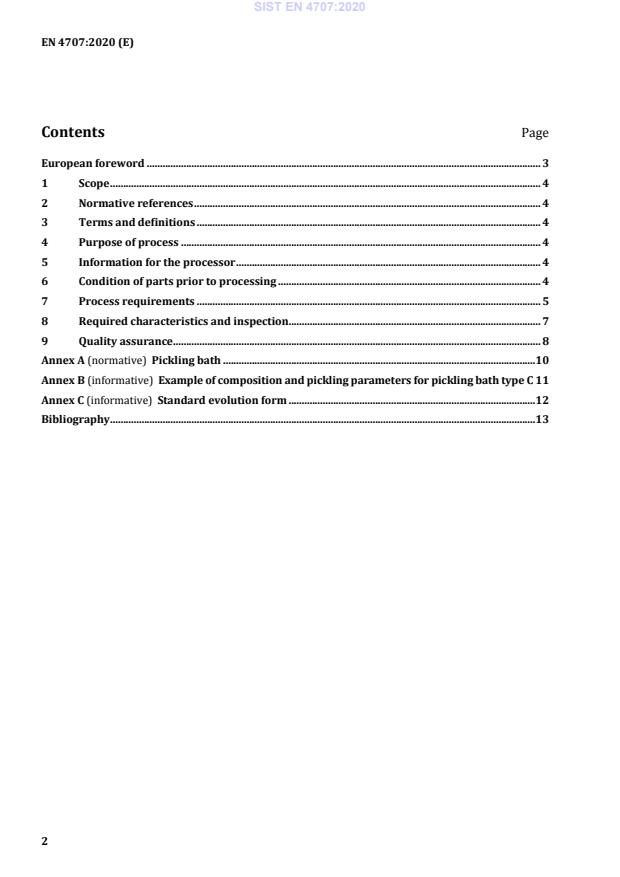
Contents Page
European foreword . 3
1 Scope . 4
2 Normative references . 4
3 Terms and definitions . 4
4 Purpose of process . 4
5 Information for the processor . 4
6 Condition of parts prior to processing . 4
7 Process requirements . 5
8 Required characteristics and inspection. 7
9 Quality assurance . 8
Annex A (normative) Pickling bath . 10
Annex B (informative) Example of composition and pickling parameters for pickling bath type C 11
Annex C (informative) Standard evolution form . 12
Bibliography . 13
European foreword
This document (EN 4707:2020) has been prepared by the Aerospace and Defence Industries Association
of Europe - Standardization (ASD-STAN).
After enquiries and votes carried out in accordance with the rules of this Association, this Standard has
received the approval of the National Associations and the Official Services of the member countries of
ASD, prior to its presentation to CEN.
This European Standard shall be given the status of a national standard, either by publication of an
identical text or by endorsement, at the latest by July 2020, and conflicting national standards shall be
withdrawn at the latest by July 2020.
Attention is drawn to the possibility that some of the elements of this document may be the subject of
patent rights. CEN shall not be held responsible for identifying any or all such patent rights.
This document supersedes EN 4707:2014.
According to the CEN-CENELEC Internal Regulations, the national standards organisations of the
following countries are bound to implement this European Standard: Austria, Belgium, Bulgaria, Croatia,
Cyprus, Czech Republic, Denmark, Estonia, Finland, France, Germany, Greece, Hungary, Iceland, Ireland,
Italy, Latvia, Lithuania, Luxembourg, Malta, Netherlands, Norway, Poland, Portugal, Republic of North
Macedonia, Romania, Serbia, Slovakia, Slovenia, Spain, Sweden, Switzerland, Turkey and the United
Kingdom.
1 Scope
This document specifies the acid pickling of aluminium and aluminium alloys free from hexavalent
chromium.
2 Normative references
There are no normative references in this document.
3 Terms and definitions
No terms and definitions are listed in this document.
ISO and IEC maintain terminological databases for use in standardization at the following addresses:
ISO Online browsing platform: available at http://www.iso.org/obp
IEC Electropedia: available at http://www.electropedia.org/
4 Purpose of process
4.1 Pre-treatment before penetrant testing/penetrant inspection.
4.2 Pre-treatment before anodizing.
4.3 Final treatment for parts prior to adhesive bonding application.
4.4 Final treatment before welding or brazing.
4.5 Pre-treatment before chemical milling.
4.6 Final treatment for parts prior to painting application.
4.7 Pre-treatment for parts prior to surface conversion coatings.
4.8 Desmutting, after alkaline etching or acid pickling.
5 Information for the processor
designation, see 9.5;
number of the material standard and metallurgical condition of the latter;
sequence of operations;
areas to be processed;
treatment.
6 Condition of parts prior to processing
Fabrication of the parts shall have been completed before pickling.
7 Process requirements
7.1 Process conditions
7.1.1 Toolings
Toolings, fixturings, and metal tooling masking must be protected from the corrosion and/or free from
corrosion or another deterioration detrimental to the treatment during their use.
Design of the toolings and racking must be achieved in order to:
avoid any retention of air or solution on the parts;
allow the neutralisation and the suppression of the solutions during rinsing operations;
avoid any accidental contact during treatment between parts and tank equipment, and between
various parts.
7.1.2 Tanks and racks
Materials used must be resistant to temperature and chemically compatible with the products involved
in the sequence of operations.
7.2 Process schedule
7.2.1 General
The pickling process shall be performed according to Table 1.
Table 1
Post Pickling processes
Preparation
Penetrant before Desmutting,
Welding Painting/ Surface
Process schedule
testing/ masking after
Anodizing Bonding or organic film conversion
penetrant for etching
brazing application coatings
inspection chemical or pickling
milling
Pre-treatments – Not
Applicable Applicable Applicable Applicable Applicable Applicable Applicable
Subclause 7.2.2 applicable
Pickling – Subclause 7.2.3 Applicable Applicable Applicable Applicable Applicable Applicable Applicable Applicable
Rinsing –
Subclause Applicable Applicable Applicable Applicable Applicable Applicable Applicable Applicable
7.2.4
Post-
treatments
Drying –
Not Not Not
Subclause Applicable Applicable Applicable Applicable Applicable
applicable applicable applicable
7.2.5
a
8 h
Post pickling maximum Immediately Immediately Immediately
or
a a a
8 h
16 h 8 h 16 h
lead-time in process in process in process
Immediately
in process
a
Recommended (in case of over lead time an appropriate storage and a visual inspection (according to 8.1.3) should be carried
out before and after the post pickling process).
E
...