

EN 13036-4:2011
(Main)Road and airfield surface characteristics - Test methods - Part 4: Method for measurement of slip/skid resistance of a surface: The pendulum test
General Information
- Abstract
This European Standard describes a method for determining the slip/skid resistance of a surface using a device which remains stationary at the test location. The slip/skid resistance is measured by means of a slider mounted at the end of a pendulum arm.
The method provides a measure of the slip/skid resistance properties of a surface either in the field or in the laboratory.
This method measures the slip/skid resistance of a small area of a surface (approximately 0,01 m2). This should be considered when deciding its applicability to a surface which may have non-homogeneous surface characteristics, e.g. containing ridges or grooves, or is rough textured (exceeding 1,2 mm patch test).
NOTE As the results from this test are taken at one small location, the results cannot be compared with results from devices e.g. mobile devices, that measure the slip/skid resistance over a long length of a surface.
- Status
- Published
- Publication Date
- 04-Oct-2011
- Withdrawal Date
- 29-Apr-2012
- Technical Committee
- CEN/TC 227 - Road materials
- Drafting Committee
- CEN/TC 227/WG 5 - Surface characteristics
- Current Stage
- 9092 - Decision on results of review/2YR ENQ - revise - Review Enquiry
- Start Date
- 04-Sep-2017
- Completion Date
- 30-Sep-2026



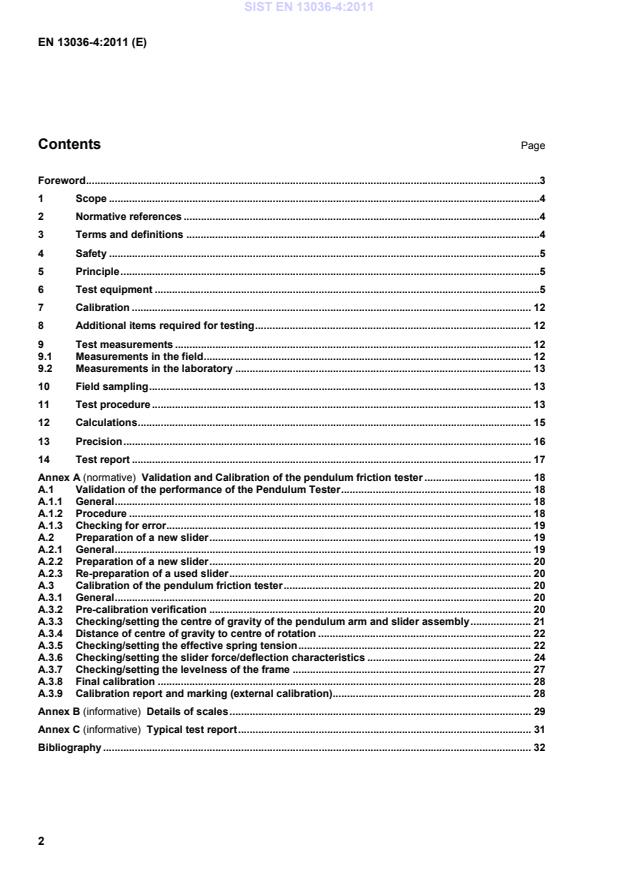
Overview - EN 13036-4:2011 (Pendulum test for slip/skid resistance)
EN 13036-4:2011 is the CEN European Standard that specifies the pendulum test method for measuring the slip/skid resistance of road and airfield surfaces. The method uses a stationary pendulum tester with a rubber slider mounted at the end of an arm. The measured loss of energy during the slider’s pass over the surface gives the Pendulum Test Value (PTV), a standardized indicator of surface friction. The test is suitable for field and laboratory use and measures a small surface area (≈ 0.01 m²), so care is needed when evaluating non‑homogeneous or heavily textured pavements.
Key topics and technical requirements
- Test principle: spring‑loaded pendulum arm with a rubber slider; energy loss during swing is recorded as a PTV.
- Equipment basics: pendulum arm mass and centre of gravity specifications; frame stability; levelling and release mechanisms; pointer and circular scales (unit Scale C for 126 mm sliding length and optional Scale F for 76 mm).
- Slider assemblies: wide slider (≈76.2 mm × 25.4 mm rubber pad) and narrow slider (≈31.75 mm × 25.4 mm), with specified thickness, mass and attachment method.
- Sliding length: nominally (126 ± 1) mm for typical field tests (76 mm used in some laboratory contexts).
- Calibration & validation: procedures and annex for performance validation, slider preparation and full calibration of the pendulum tester.
- Limitations: measures a small local area (~0.01 m²) - results are not directly comparable with mobile, long‑length friction devices; caution for surfaces with ridges/grooves or mean texture depth > 1.2 mm.
- Safety: operator and equipment form a stationary obstruction in field testing; appropriate traffic safety measures required.
Practical applications and users
Who uses EN 13036-4:2011:
- Road and airfield authorities for routine pavement friction assessment and maintenance planning
- Pavement engineers and consultants for safety audits and surface specification
- Airport operations for runway/Taxiway skid resistance monitoring
- Materials and construction laboratories for laboratory verification and product testing
- Contractors and project managers for acceptance testing and quality control
Typical uses:
- Routine field surveys and spot checks of wet/dry skid resistance
- Laboratory comparison of surfacing materials or slider/rubber formulations
- Forensic investigation of pavement‑related incidents
- Specification compliance and maintenance prioritisation
Related standards
- EN 13036 series (Parts 1, 2, 3, 6, 7, 8) - complementary surface measurement methods
- EN 1097‑8 and ISO standards referenced for rubber properties (e.g., ISO 48, ISO 7619)
Keywords: EN 13036-4:2011, pendulum test, Pendulum Test Value (PTV), slip resistance, skid resistance, pavement testing, airfield surface, pendulum tester, slider assembly, calibration.
Relations
- Effective Date
- 08-Oct-2011
- Effective Date
- 09-Feb-2026
- Effective Date
- 09-Feb-2026
- Effective Date
- 09-Feb-2026
- Effective Date
- 09-Feb-2026
- Effective Date
- 28-Jan-2026
- Referred By
EN 1436:2018 - Road marking materials - Road marking performance for road users and test methods - Effective Date
- 28-Jan-2026
- Referred By
EN 14904:2006 - Surfaces for sports areas - Indoor surfaces for multi-sports use - Specification - Effective Date
- 28-Jan-2026
- Effective Date
- 28-Jan-2026
- Effective Date
- 28-Jan-2026
- Effective Date
- 28-Jan-2026
- Effective Date
- 28-Jan-2026
- Effective Date
- 28-Jan-2026
- Effective Date
- 28-Jan-2026
- Effective Date
- 28-Jan-2023
Get Certified
Connect with accredited certification bodies for this standard

BSMI (Bureau of Standards, Metrology and Inspection)
Taiwan's standards and inspection authority.
Zavod za gradbeništvo Slovenije (ZAG) - Inšpekcija
ZAG inspection body for construction products, structures, and materials.
Sponsored listings
Frequently Asked Questions
EN 13036-4:2011 is a standard published by the European Committee for Standardization (CEN). Its full title is "Road and airfield surface characteristics - Test methods - Part 4: Method for measurement of slip/skid resistance of a surface: The pendulum test". This standard covers: This European Standard describes a method for determining the slip/skid resistance of a surface using a device which remains stationary at the test location. The slip/skid resistance is measured by means of a slider mounted at the end of a pendulum arm. The method provides a measure of the slip/skid resistance properties of a surface either in the field or in the laboratory. This method measures the slip/skid resistance of a small area of a surface (approximately 0,01 m2). This should be considered when deciding its applicability to a surface which may have non-homogeneous surface characteristics, e.g. containing ridges or grooves, or is rough textured (exceeding 1,2 mm patch test). NOTE As the results from this test are taken at one small location, the results cannot be compared with results from devices e.g. mobile devices, that measure the slip/skid resistance over a long length of a surface.
This European Standard describes a method for determining the slip/skid resistance of a surface using a device which remains stationary at the test location. The slip/skid resistance is measured by means of a slider mounted at the end of a pendulum arm. The method provides a measure of the slip/skid resistance properties of a surface either in the field or in the laboratory. This method measures the slip/skid resistance of a small area of a surface (approximately 0,01 m2). This should be considered when deciding its applicability to a surface which may have non-homogeneous surface characteristics, e.g. containing ridges or grooves, or is rough textured (exceeding 1,2 mm patch test). NOTE As the results from this test are taken at one small location, the results cannot be compared with results from devices e.g. mobile devices, that measure the slip/skid resistance over a long length of a surface.
EN 13036-4:2011 is classified under the following ICS (International Classification for Standards) categories: 17.040.20 - Properties of surfaces; 93.080.10 - Road construction; 93.080.20 - Road construction materials; 93.120 - Construction of airports. The ICS classification helps identify the subject area and facilitates finding related standards.
EN 13036-4:2011 has the following relationships with other standards: It is inter standard links to EN 13036-4:2003, ISO 7619-1:2010, ISO 48:2010, ISO 4662:2009, ISO 7619-2:2010, EN 1097-8:2020, EN 1436:2018, EN 14904:2006, CEN/TS 16786:2018, EN 1504-2:2004, EN 14877:2013, EN 14877:2006, EN 1504-3:2005, EN 124-1:2015, prEN 13036-4. Understanding these relationships helps ensure you are using the most current and applicable version of the standard.
EN 13036-4:2011 is available in PDF format for immediate download after purchase. The document can be added to your cart and obtained through the secure checkout process. Digital delivery ensures instant access to the complete standard document.
Standards Content (Sample)
2003-01.Slovenski inštitut za standardizacijo. Razmnoževanje celote ali delov tega standarda ni dovoljeno.ORPOberflächeneigenschaftenprüfverfahren - Teil 4: Methode zur Messung der Griffigkeit von Oberflächen: Der PendeltestCaractéristiques de surface - Methode d’essai - Partie 4 : Methode d’essai pour mesurer l’adherence d’une surface : L’essai au penduleRoad and airfield surface characteristics - Test methods - Part 4: Method for measurement of slip/skid resistance of a surface: The pendulum test93.120Construction of airports93.080.10Gradnja cestRoad construction17.040.20Lastnosti površinProperties of surfacesICS:Ta slovenski standard je istoveten z:EN 13036-4:2011SIST EN 13036-4:2011en,fr,de01-december-2011SIST EN 13036-4:2011SLOVENSKI
STANDARDSIST EN 13036-4:20041DGRPHãþD
EUROPEAN STANDARD NORME EUROPÉENNE EUROPÄISCHE NORM
EN 13036-4
October 2011 ICS 17.040.20; 93.080.10; 93.120 Supersedes EN 13036-4:2003English Version
Road and airfield surface characteristics - Test methods - Part 4: Method for measurement of slip/skid resistance of a surface: The pendulum test
Caractéristiques de surface des routes et aérodromes - Méthode d'essai - Partie 4: Méthode d'essai pour mesurer l'adhérence d'une surface: L'essai au pendule
Oberflächeneigenschaften von Straßen und Flugplätzen - Prüfverfahren - Teil 4: Verfahren zur Messung der Griffigkeit von Oberflächen: Der Pendeltest This European Standard was approved by CEN on 29 July 2011.
CEN members are bound to comply with the CEN/CENELEC Internal Regulations which stipulate the conditions for giving this European Standard the status of a national standard without any alteration. Up-to-date lists and bibliographical references concerning such national standards may be obtained on application to the CEN-CENELEC Management Centre or to any CEN member.
This European Standard exists in three official versions (English, French, German). A version in any other language made by translation under the responsibility of a CEN member into its own language and notified to the CEN-CENELEC Management Centre has the same status as the official versions.
CEN members are the national standards bodies of Austria, Belgium, Bulgaria, Croatia, Cyprus, Czech Republic, Denmark, Estonia, Finland, France, Germany, Greece, Hungary, Iceland, Ireland, Italy, Latvia, Lithuania, Luxembourg, Malta, Netherlands, Norway, Poland, Portugal, Romania, Slovakia, Slovenia, Spain, Sweden, Switzerland and United Kingdom.
EUROPEAN COMMITTEE FOR STANDARDIZATION
COMITÉ EUROPÉEN DE NORMALISATION EUROPÄISCHES KOMITEE FÜR NORMUNG
Management Centre:
Avenue Marnix 17,
B-1000 Brussels © 2011 CEN All rights of exploitation in any form and by any means reserved worldwide for CEN national Members. Ref. No. EN 13036-4:2011: ESIST EN 13036-4:2011
Validation and Calibration of the pendulum friction tester . 18A.1 Validation of the performance of the Pendulum Tester . 18A.1.1 General . 18A.1.2 Procedure . 18A.1.3 Checking for error. 19A.2 Preparation of a new slider . 19A.2.1 General . 19A.2.2 Preparation of a new slider . 20A.2.3 Re-preparation of a used slider . 20A.3 Calibration of the pendulum friction tester . 20A.3.1 General . 20A.3.2 Pre-calibration verification . 20A.3.3 Checking/setting the centre of gravity of the pendulum arm and slider assembly . 21A.3.4 Distance of centre of gravity to centre of rotation . 22A.3.5 Checking/setting the effective spring tension . 22A.3.6 Checking/setting the slider force/deflection characteristics . 24A.3.7 Checking/setting the levelness of the frame . 27A.3.8 Final calibration . 28A.3.9 Calibration report and marking (external calibration). 28Annex B (informative)
Details of scales . 29Annex C (informative)
Typical test report . 31Bibliography . 32 SIST EN 13036-4:2011
Key 1 pendulum arm 2 mark (in the centre of rotation) 3 release mechanism (knob) 4 frame 5 rear support foot 6 screw for rear support foot 7 spacer of rough adjustment of the sliding length (optional) 8 levelling screw 9 bottom plate (hinged, optional) 10 slider assembly 11 slider support rod 12 vertical screw (for vertical adjustment) 13 slider lifting handle 14 pendulum head 15 clamp for vertical adjustment 16 spirit level 17 gauge (see Figure 2) 18 pendulum foot 19 friction ring (including locking ring) 20 pointer 21 pointer counterbalance 22 unit scale 23 unit scale F 24 unit scale C 25 release catch 26 pointer cam (calibration purpose: pointer adjustment screw) 27 handle 28 lock nut Individual testers might have a slightly different configuration or appearance. Figure 1 — Pendulum Tester SIST EN 13036-4:2011
Figure 2a
Figure 2b Key 1 gauge 2 slider a measured sliding length b actual sliding length Figure 2 — Sliding length gauges 6.1.5 Means of holding and releasing the pendulum arm so that it falls freely from a horizontal position. 6.1.6 A pointer of nominal length 300 mm, balanced about the axis of suspension, indicating the position of the pendulum arm throughout its forward swing and moving over the circular scale (unit scale). The mass of the pointer shall be not more than 85 g. 6.1.7 The friction in the pointer mechanism shall be adjustable so that, with the pendulum arm swinging freely from a horizontal position, the outward tip of the pointer may be brought to rest on the forward swing of the arm at a point (10 ± 1) mm below the horizontal. This is the 0 reading. 6.1.8 A circular scale (unit scale C) as described in Table B.1, calibrated for a nominal sliding length of 126 mm on a flat surface marked from 0 to 150 at intervals of five. Tests in this mode of operation give the Pendulum Test Value directly. SIST EN 13036-4:2011
Key 1 rubber pad 2 aluminium backing 3 striking edge 4 worn edge width Figure 3 — Slider assembly (3D and profile), also illustrating the worn width of the striking edge 6.8 Two different types of slider rubber can be used regarding to the kind of testing. The sliders are named according to the hardness of rubber, slider 57 and slider 96. The initial resilience of the rubber pad shall be measured in accordance with ISO 4662 [using the Lüpke Rebound Hammer]; the hardness of the rubber SIST EN 13036-4:2011
Table 2 — Properties of the slider 96 Property Temperature °C 5 23 40 Resilience, % 19 to 23 21 to 26 26 to 30 Hardness, IRHD 94 to 98
NOTE 2 Sliders 57 are supplied by Federal Institute for Material Research and Testing (BAM), Unter den Eichen 87, 12205 Berlin, Germany, T: +49 30 8104 2358, F: +49 30 8104 2147, E: webshop@bam.de, I: www.webshop.bam.de and by Smithers Rapra Technology LTD, Shawbury, Shrewsbury, Shropshire SY4 4NR United Kingdom: T; +44 (0) 1939 250383, F: +44 (0) 1939 251118, E: info@rapra.net, I: www.rapra.net. This information is given for the convenience of users of this European Standard and does not constitute an endorsement by CEN of the product named. Equivalent products may be used if they can be shown to lead to the same results.
NOTE 3 Sliders 96 are supplied by Smithers Rapra Technology LTD, Shawbury, Shrewsbury, Shropshire SY4 4NR United Kingdom: T; +44 (0) 1939 250383, F: +44 (0) 1939 251118, E: info@rapra.net, I: www.rapra.net.This information is given for the convenience of users of this European Standard and does not constitute an endorsement by CEN of the product named. Equivalent products may be used if they can be shown to lead to the same results. 6.10 The slider shall have a certificate of conformity including the name of the manufacturer, date of manufacture and the measured results of resilience and hardness (IRHD and Shore A). 6.11 The edges of the slider rubber shall be square and clean-cut. The rubber shall be free from contamination by, for example, dust, abrasive or oil. 6.12 Before using a new slider rubber it shall be conditioned to achieve a minimum width of sliding edge as shown in Figure 3. After the conditioning procedure this is typically greater than 1 mm. 6.13 This can be achieved by setting up the tester and carrying out sufficient swings wet or dry as described in A.2. 6.14 When the width of the working edge of the rubber pad exceeds 2,5 mm for slider 57 and 3 mm for slider 96, or when it becomes excessively scored or burred, this edge shall no longer be used. The edge shall be suitably disfigured to prevent its further use, and the other long edge of the rubber pad shall be adopted as the working edge. When the width of this edge also exceeds 2,5 mm or 3 mm respectively or when it becomes excessively scored or burred, the rubber pad shall be discarded. 6.15 The slider assembly shall be stored in a dry watertight bag in the dark at a temperature of (10 ± 5) °C. The slider assembly shall be at ambient temperature when used. SIST EN 13036-4:2011
11.8
Set the sliding length of the slider (the distance between two points where the sliding edge of the rubber touches the test surface) by gently lowering the pendulum arm while using the vertical screw (Figure 1) after unclamp the head of the pendulum until the slider just touches the surface, first on one side of the vertical, and then on the other.The sliding length shall be between (126 ± 1) mm for the wide slider and (76 ± 1) mm for the narrow slider. This is normally accomplished as follows in a series of small steps, using one of the gauges shown in Figure 2 for 126 mm sliding length or a special scale for the narrow slider with a sliding length of 76mm.
11.8.1 Move the pendulum foot to the right and lower the head so that the slider starts to contact the test surface with its rear corner (aluminium backing) level with the right (outermost) mark on the gauge. Manually hold the gauge in that position. 11.8.2 Raise the slider with the slider lifting handle and move the pendulum foot to left hand side sufficiently to ensure the slider is clear of the surface when the slider is lowered. 11.8.3 Allow the pendulum foot to gently drop back so that the slider contacts the test surface. SIST EN 13036-4:2011
is the constant value achieved by the final three swings if the initial swings are too variable as described in 11.11. NOTE Some product test methods use a different number of swings and a different calculation of the PTV. 12.2 Report the PTV to the nearest whole number. 12.3 Where testing in the field, correct Pendulum Test Value for temperature using the nearest temperature from Table 3 below. 12.4 The measured slider temperature shall be the mean of the temperatures of the wetted slider before and after testing. 12.5 Report the temperature corrected PTV value as PTVCorr to the nearest whole number. The PTV for a location is the mean of three individual PTV determinations. NOTE 1 Where it was not possible to use the wide slider, the results for a narrow slider (see 6.4) on a flat surface/specimen over a 76 mm nominal swept length, shall be multiplied by a factor of 1,1 to obtain an estimated PTV within 10 %. Table 3 — Correction of PTV when the test is carried out at other than 20 °C using slider 57 Measured slider temperature °C Correction to measured value 36 to 40 +3 20 to 35 +2 23 to 29 +1 19 to 22 0 16 to 18 -1 11 to 15 -2 8 to 10 -3 5 to 7 -4 NOTE The temperature correction can be affected by the texture of the surface.
NOTE 2 The temperature correction for slider temperatures above 30 °C and below 10 °C are approximate and depend upon the roughness of the surface being tested. No temperature correction of Pendulum Test Value (PTV) is required when the test is carried out at other than 20 °C using slider 96. 13 Precision The reproducibility of the measuring method has been examined on the basis of a round-robin test in which eleven different European laboratories participated. This involved testing twelve different material surfaces, whereby each laboratory tested the relevant material surfaces under laboratory conditions, using a slider 57 as well as a slider 96. Testing was done in the “wet” condition. The materials were tested in two opposite directions and the average value was examined. The standard deviations found were as follows:
Slider 96: From 1.5 to 4.5 PTV units, depending on the nature and the surface characteristics of the material, with an average standard deviation of 2.4 PTV units. SIST EN 13036-4:2011
Validation and Calibration of the pendulum friction tester A.1 Validation of the performance of the Pendulum Tester A.1.1 General A.1.1.1 To ensure consistency of readings, the operation of the pendulum tester shall be validated daily, prior to and after use, using the method described below. It should also be used on return from calibration to check for damage in transit. A.1.1.2 The validation procedure comprises one set of readings in the wet condition on two standard surfaces, representing high and low PTV. A.1.1.3 The standard surfaces shall be wet float glass, free from contamination and scratches and a wet piece of verification film mounted on float glass. The verification film shall be used on one day only. A.1.1.4 The values obtained shall be used to monitor the performance of the operation of the pendulum tester until it is next calibrated. A.1.1.5 The acceptable verification limits are given in Table A.1. Table A.1 — Verification values for pendulum operation
PTV slider 57a PTV slider 96 Float Glass 3 to 8 5 to 10 Reference Tile
34 ± 3 34 ± 3 Verification Film 47 to 53a 58 to 64 a If the values with slider 57 are outside the range, the verification may be repeated with slider 96. If this is in tolerance, the operation of the pendulum has been verified.
A.1.1.6 When conducting the verification test a single virgin/untested area of the sheet of verification film shall be used for the set of eight swings required. NOTE The float glass measurement may be influenced by the moisture penetration in the rubber pore structure. It is necessary to recondition the rubber slider before verifying the float glass value. A.1.1.7 Should the value obtained from any daily check vary by more than 4 units from the value obtained in on return from calibration, the operation of the pendulum tester shall be investigated. A.1.1.8 Should the value obtained between start and finish checks on any one day by more than 2 units, the operation of the pendulum tester shall be investigated. NOTE The procedure may also be used to ensure that the operative is using the procedures in this standard correctly. A.1.2 Procedure A.1.2.1 Before carrying out the validation of performance of the Pendulum Tester, the pendulum shoud be adjusted in accordance with Clause 11. The laboratory shall maintain a piece of clean unscratched float SIST EN 13036-4:2011
...