

EN 4595:2013
(Main)Aerospace series - Paints and varnishes - Two component cold curing polyurethane finish - Subsonic erosion resistance
- Abstract
This standard specifies the requirements for a two component polyurethane, topcoat, with a medium degree of
resistance to erosion by the effects of rain, available in a range of colours and levels of gloss, to be applied
over a primer for aerospace applications on areas where rain erosion at subsonic speeds may be a problem
e.g. leading edges and air intakes.
The properties specified in this standard are obtained on defined aluminium alloy test pieces prepared in
accordance with EN 3837 Procedure A and EN 23270 and painted with primer to EN 2435. The ability of the
material to be used for a specific application (e.g. alternative substrate, alternative primer, specific drying
conditions etc.) shall be determined by supplementary tests to confirm that the requirements of this standard
are met.
- Status
- Published
- Publication Date
- 08-Jan-2013
- Withdrawal Date
- 30-Jul-2013
- Technical Committee
- ASD-STAN - Aerospace
- Drafting Committee
- ASD-STAN/D 5 - Non-Metallic
- Current Stage
- 9093 - Decision to confirm - Review Enquiry
- Start Date
- 21-Jan-2024
- Completion Date
- 21-Oct-2026

Overview
EN 4595:2013 is a European standard developed by CEN that specifies the requirements for a two component cold curing polyurethane finish designed for aerospace applications. This topcoat exhibits a medium degree of subsonic rain erosion resistance, making it suitable for protecting critical aircraft surfaces such as leading edges and air intakes where erosion due to rain at subsonic speeds is a significant concern. The standard covers a range of colors and gloss levels and applies to coatings used over primers meeting EN 2435 specifications.
The standard outlines methods for testing and qualification using defined aluminum alloy test pieces prepared according to EN 3837 Procedure A and EN 23270. Any variations in substrate or primer, or deviations in drying conditions, require supplementary tests to ensure compliance.
Key Topics
Two Component Polyurethane Coating
This cold curing system consists of a base with hydroxyl functional resin and an activator solution of polyisocyanate. A thinner may be included if required. Components must be mixed precisely according to manufacturer instructions.Resistance to Subsonic Rain Erosion
Designed to withstand the erosive effects of rain at subsonic velocities (e.g., 223 m/s), tested via whirling arm rigs simulating rain impact with artificial drops.Application and Performance Requirements
- Dry film thickness: 250 ± 50 µm
- Smooth, defect-free finish without runs, sags, or pinholes
- Gloss and color adherence as specified by EN 3840 and ISO 7724
- Drying time: maximum 16 hours under controlled conditions per EN 23270
- Pot life and viscosity within prescribed limits to ensure proper workability
Environmental and Mechanical Properties
- Minimum ultimate tensile elongation of 100% for durable, flexible film properties
- Resistance to fluids including tri-n-butyl phosphate without blistering or film defects
- Density of dried film not exceeding 1.3 g/ml to ensure coating integrity
Testing and Quality Assurance
Batch release tests focus on key parameters such as pot life, application conditions, and film properties. Full qualification includes extensive physical, chemical, mechanical, and environmental performance tests.
Applications
EN 4595:2013 is critical for ensuring longevity and durability of aerospace coatings subjected to harsh operational environments. Key applications include:
Leading Edges of Aircraft
Surfaces prone to rain erosion at subsonic speeds benefit from this polyurethane topcoat’s protective properties.Air Intakes and Engine Inlets
Protects surfaces exposed to frequent rain impingement, minimizing erosion damage and maintaining aerodynamic performance.Other High-Wear Aerospace Surfaces
Any aircraft area at risk of subsonic rain erosion requiring a medium resistance finish with customizable color and gloss.
By adhering to EN 4595, aerospace manufacturers and maintenance organizations can confidently specify and apply coatings that meet rigorous performance demands while ensuring compliance with European aerospace standards.
Related Standards
EN 4595 references and complements several other aerospace and coating standards, including:
- EN 2435 – Cold curing chromated two component primer for aerospace
- EN 3837 – Surface preparation methods for aluminum alloy test pieces
- EN 23270 – Standard conditions for temperature and humidity during coating testing
- EN 3840 – Technical specifications for aerospace paints and varnishes
- ISO 7724 series – Colorimetry applied to paint color assessment
- EN ISO 11890-1 – VOC content determination for paints and varnishes
- EN ISO 2813 – Gloss measurement of paint films
Together, these standards establish a comprehensive framework ensuring coatings meet safety, environmental, and performance criteria vital for aerospace applications.
Keywords: EN 4595, aerospace coating standard, two component polyurethane, cold curing finish, rain erosion resistance, subsonic erosion, aerospace paints and varnishes, aircraft leading edge protection, aviation surface coatings, aerospace primer topcoat
Relations
- Refers
ISO 7724-3:1984 - Paints and varnishes — Colorimetry — Part 3: Calculation of colour differences - Effective Date
- 25-Aug-2026
- Effective Date
- 25-Aug-2026
- Effective Date
- 25-Aug-2026
- Effective Date
- 09-Feb-2026
- Effective Date
- 09-Feb-2026
- Effective Date
- 28-Jan-2026
- Effective Date
- 28-Jan-2026
- Effective Date
- 28-Jan-2026
- Effective Date
- 28-Jan-2026
- Effective Date
- 28-Jan-2026
- Effective Date
- 28-Jan-2026
- Effective Date
- 28-Jan-2026
- Effective Date
- 28-Jan-2026
- Effective Date
- 28-Jan-2026
- Effective Date
- 28-Jan-2026
Get Certified
Connect with accredited certification bodies for this standard

BUREAU VERITAS Certification Germany
Bureau Veritas certification in Germany.

Element Materials Technology
Materials testing and product certification.

AQMS Ltd.
AQMS provides ISO certification to SMEs across the UK.
Sponsored listings
Frequently Asked Questions
EN 4595:2013 is a standard published by the European Committee for Standardization (CEN). Its full title is "Aerospace series - Paints and varnishes - Two component cold curing polyurethane finish - Subsonic erosion resistance". This standard covers: This standard specifies the requirements for a two component polyurethane, topcoat, with a medium degree of resistance to erosion by the effects of rain, available in a range of colours and levels of gloss, to be applied over a primer for aerospace applications on areas where rain erosion at subsonic speeds may be a problem e.g. leading edges and air intakes. The properties specified in this standard are obtained on defined aluminium alloy test pieces prepared in accordance with EN 3837 Procedure A and EN 23270 and painted with primer to EN 2435. The ability of the material to be used for a specific application (e.g. alternative substrate, alternative primer, specific drying conditions etc.) shall be determined by supplementary tests to confirm that the requirements of this standard are met.
This standard specifies the requirements for a two component polyurethane, topcoat, with a medium degree of resistance to erosion by the effects of rain, available in a range of colours and levels of gloss, to be applied over a primer for aerospace applications on areas where rain erosion at subsonic speeds may be a problem e.g. leading edges and air intakes. The properties specified in this standard are obtained on defined aluminium alloy test pieces prepared in accordance with EN 3837 Procedure A and EN 23270 and painted with primer to EN 2435. The ability of the material to be used for a specific application (e.g. alternative substrate, alternative primer, specific drying conditions etc.) shall be determined by supplementary tests to confirm that the requirements of this standard are met.
EN 4595:2013 is classified under the following ICS (International Classification for Standards) categories: 49.040 - Coatings and related processes used in aerospace industry. The ICS classification helps identify the subject area and facilitates finding related standards.
EN 4595:2013 has the following relationships with other standards: It is inter standard links to ISO 7724-3:1984, ISO 7724-2:1984, ISO 7724-1:1984, ISO 37:2011, ISO 2781:2008, EN ISO 9514:2019, EN ISO 9117-1:2009, EN ISO 2431:2019, EN ISO 11890-1:2024, EN ISO 1513:2010, EN ISO 3679:2022, EN ISO 2884-1:2024, EN ISO 2811-4:2011, EN ISO 3675:1998, EN ISO 2811-3:2023. Understanding these relationships helps ensure you are using the most current and applicable version of the standard.
EN 4595:2013 is available in PDF format for immediate download after purchase. The document can be added to your cart and obtained through the secure checkout process. Digital delivery ensures instant access to the complete standard document.
Standards Content (Sample)
2003-01.Slovenski inštitut za standardizacijo. Razmnoževanje celote ali delov tega standarda ni dovoljeno.LMLLuft- und Raumfahrt - Anstrichstoff - Zweikomponenten Polyurethan-Decklack, raumtemperaturhärtend - Unterschall-ErosionsbeständigkeitSérie aérospatiale - Peintures et vernis - Deux composants durcissement à froid, finition polyuréthane - Résistance à l’érosion subsoniqueAerospace series - Paints and varnishes - Two component cold curing polyurethane finish - Subsonic erosion resistance49.040Prevleke in z njimi povezani postopki, ki se uporabljajo v letalski in vesoljski industrijiCoatings and related processes used in aerospace industryICS:Ta slovenski standard je istoveten z:EN 4595:2013SIST EN 4595:2014en01-februar-2014SIST EN 4595:2014SLOVENSKI
STANDARD
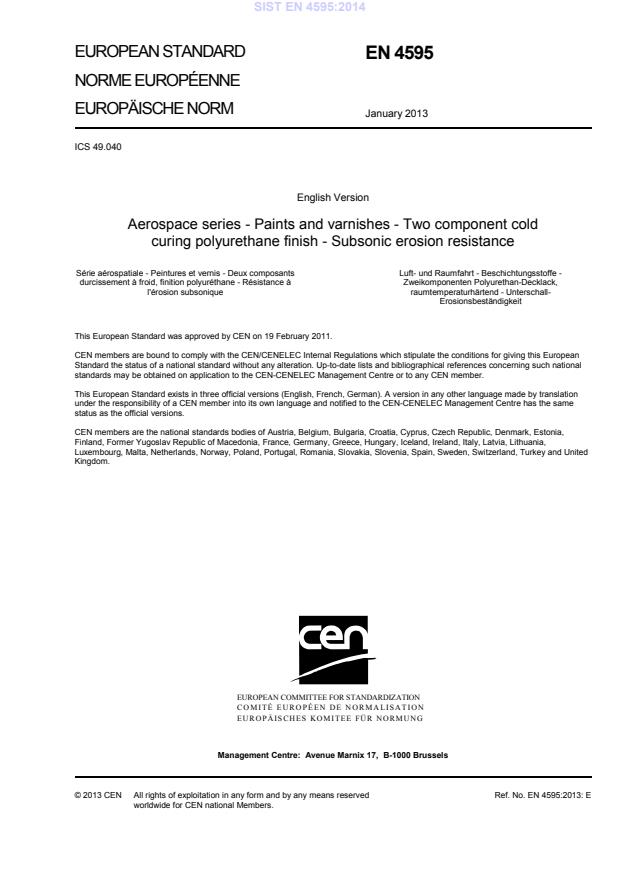
EUROPEAN STANDARD NORME EUROPÉENNE EUROPÄISCHE NORM
EN 4595
January 2013 ICS 49.040 English Version
Aerospace series - Paints and varnishes - Two component cold curing polyurethane finish - Subsonic erosion resistance
Série aérospatiale - Peintures et vernis - Deux composants durcissement à froid, finition polyuréthane - Résistance à l'érosion subsonique
Luft- und Raumfahrt - Beschichtungsstoffe - Zweikomponenten Polyurethan-Decklack, raumtemperaturhärtend - Unterschall-Erosionsbeständigkeit This European Standard was approved by CEN on 19 February 2011.
CEN members are bound to comply with the CEN/CENELEC Internal Regulations which stipulate the conditions for giving this European Standard the status of a national standard without any alteration. Up-to-date lists and bibliographical references concerning such national standards may be obtained on application to the CEN-CENELEC Management Centre or to any CEN member.
This European Standard exists in three official versions (English, French, German). A version in any other language made by translation under the responsibility of a CEN member into its own language and notified to the CEN-CENELEC Management Centre has the same status as the official versions.
CEN members are the national standards bodies of Austria, Belgium, Bulgaria, Croatia, Cyprus, Czech Republic, Denmark, Estonia, Finland, Former Yugoslav Republic of Macedonia, France, Germany, Greece, Hungary, Iceland, Ireland, Italy, Latvia, Lithuania, Luxembourg, Malta, Netherlands, Norway, Poland, Portugal, Romania, Slovakia, Slovenia, Spain, Sweden, Switzerland, Turkey and United Kingdom.
EUROPEAN COMMITTEE FOR STANDARDIZATION
COMITÉ EUROPÉEN DE NORMALISATION EUROPÄISCHES KOMITEE FÜR NORMUNG
Management Centre:
Avenue Marnix 17,
B-1000 Brussels © 2013 CEN All rights of exploitation in any form and by any means reserved worldwide for CEN national Members. Ref. No. EN 4595:2013: ESIST EN 4595:2014
...