

CEN/TR 17603-32-02:2022
(Main)Space engineering - Structural materials handbook - Part 2: Design calculation methods and general design aspects
- Abstract
The structural materials handbook, SMH, combines materials and design information on established polymer matrix composites with provisional information on the emerging groups of newer advanced materials and their composites. Design aspects are described, along with factors associated with joining and manufacturing. Where possible, these are illustrated by examples or case studies.
The Structural materials handbook contains 8 Parts.
A glossary of terms, definitions and abbreviated terms for these handbooks is contained in Part 8.
The parts are as follows:
Part 1 Overview and material properties and applications Clauses 1 ‐ 9
Part 2 Design calculation methods and general design aspects Clauses 10 ‐ 22
Part 3 Load transfer and design of joints and design of structures Clauses 23 ‐ 32
Part 4 Integrity control, verification guidelines and manufacturing Clauses 33 ‐ 45
Part 5 New advanced materials, advanced metallic materials, general design aspects and load transfer and design of joints Clauses 46 ‐ 63
Part 6 Fracture and material modelling, case studies and design and integrity control and inspection Clauses 64 ‐ 81
Part 7 Thermal and environmental integrity, manufacturing aspects, in‐orbit and health monitoring, soft materials, hybrid materials and nanotechnoligies Clauses 82 ‐ 107
Part 8 Glossary
NOTE: The 8 parts will be numbered TR17603-32-01 to TR 17603-32-08
- Status
- Published
- Publication Date
- 18-Jan-2022
- Technical Committee
- CEN/CLC/TC 5 - Space
- Drafting Committee
- CEN/CLC/TC 5/WG 6 - Upstream standards
- Current Stage
- 6060 - Definitive text made available (DAV) - Publishing
- Start Date
- 19-Jan-2022
- Due Date
- 29-Dec-2022
- Completion Date
- 19-Jan-2022


Overview
CEN/TR 17603-32-02:2022 - Space engineering: Structural materials handbook - Part 2: Design calculation methods and general design aspects - is a CEN Technical Report (approved 22 Nov 2021, published Jan 2022) that provides engineering calculation methods and general design guidance for structural materials used in space systems. Part 2 focuses on analytical notation, stress–strain relationships, strength prediction and failure criteria, thermal and moisture-related effects, and practical design considerations for polymer matrix composites and emerging advanced materials. The handbook complements manufacturing and joining information and, where available, illustrates methods with examples and case studies.
Key topics and technical content
- Stress–strain relationships for unidirectional (UD) plies and laminates, including elastic constant prediction methods, compliance and stiffness matrices, off‑axis stiffness and interlaminar stress calculations.
- Strength prediction and failure criteria, covering lamina failure models, comparison of failure theories, fatigue strength, and analytical notation for static and fatigue analyses.
- Thermal stress and displacement calculations, including coefficients of thermal expansion (CTE) for constituents, laminate CTE, residual curing stresses and microstress analysis.
- Moisture effects on composite properties, including moisture penetration, diffusion (Fick’s law), modulus and strength retention approximations, swelling coefficients, and coefficient of moisture expansion (CME).
- Practical computation methods: worked calculation approaches, flow charts and qualitative evaluation methods for interlaminar strength and laminate sequencing.
- Scope for advanced materials: combines established polymer matrix composite data with provisional guidance for newer advanced and hybrid materials.
Practical applications
This Part 2 document is intended to support:
- Structural design and analysis of spacecraft components (primary and secondary structures) using composite laminates.
- Material selection and qualification, by providing calculation methods for stiffness, strength, thermal and moisture behaviour.
- Design verification and trade studies, enabling engineers to compare failure criteria, predict fatigue life and assess environmental effects.
- Manufacturing and joining decisions, through insights on interlaminar stresses and residual curing loads that affect process choices.
Who should use this standard
- Aerospace and space systems structural engineers
- Composite materials engineers and analysts
- Design verification, testing and qualification teams
- Suppliers, manufacturers and integrators of space composite structures
- Research engineers working on advanced materials and laminate modelling
Related standards / handbook parts
Part 2 is one of eight parts (TR17603-32-01 to TR17603-32-08). Relevant companion parts include:
- Part 1: Overview, material properties and applications
- Part 3: Load transfer and joint design
- Part 4: Integrity control, verification and manufacturing
- Part 8: Glossary of terms and abbreviations
Keywords: space engineering, structural materials handbook, design calculation methods, composites, unidirectional ply, laminate analysis, failure criteria, thermal stress, moisture effects, CTE, CME.
Get Certified
Connect with accredited certification bodies for this standard

BUREAU VERITAS Certification Germany
Bureau Veritas certification in Germany.

Element Materials Technology
Materials testing and product certification.

AQMS Ltd.
AQMS provides ISO certification to SMEs across the UK.
Sponsored listings
Frequently Asked Questions
CEN/TR 17603-32-02:2022 is a technical report published by the European Committee for Standardization (CEN). Its full title is "Space engineering - Structural materials handbook - Part 2: Design calculation methods and general design aspects". This standard covers: The structural materials handbook, SMH, combines materials and design information on established polymer matrix composites with provisional information on the emerging groups of newer advanced materials and their composites. Design aspects are described, along with factors associated with joining and manufacturing. Where possible, these are illustrated by examples or case studies. The Structural materials handbook contains 8 Parts. A glossary of terms, definitions and abbreviated terms for these handbooks is contained in Part 8. The parts are as follows: Part 1 Overview and material properties and applications Clauses 1 ‐ 9 Part 2 Design calculation methods and general design aspects Clauses 10 ‐ 22 Part 3 Load transfer and design of joints and design of structures Clauses 23 ‐ 32 Part 4 Integrity control, verification guidelines and manufacturing Clauses 33 ‐ 45 Part 5 New advanced materials, advanced metallic materials, general design aspects and load transfer and design of joints Clauses 46 ‐ 63 Part 6 Fracture and material modelling, case studies and design and integrity control and inspection Clauses 64 ‐ 81 Part 7 Thermal and environmental integrity, manufacturing aspects, in‐orbit and health monitoring, soft materials, hybrid materials and nanotechnoligies Clauses 82 ‐ 107 Part 8 Glossary NOTE: The 8 parts will be numbered TR17603-32-01 to TR 17603-32-08
The structural materials handbook, SMH, combines materials and design information on established polymer matrix composites with provisional information on the emerging groups of newer advanced materials and their composites. Design aspects are described, along with factors associated with joining and manufacturing. Where possible, these are illustrated by examples or case studies. The Structural materials handbook contains 8 Parts. A glossary of terms, definitions and abbreviated terms for these handbooks is contained in Part 8. The parts are as follows: Part 1 Overview and material properties and applications Clauses 1 ‐ 9 Part 2 Design calculation methods and general design aspects Clauses 10 ‐ 22 Part 3 Load transfer and design of joints and design of structures Clauses 23 ‐ 32 Part 4 Integrity control, verification guidelines and manufacturing Clauses 33 ‐ 45 Part 5 New advanced materials, advanced metallic materials, general design aspects and load transfer and design of joints Clauses 46 ‐ 63 Part 6 Fracture and material modelling, case studies and design and integrity control and inspection Clauses 64 ‐ 81 Part 7 Thermal and environmental integrity, manufacturing aspects, in‐orbit and health monitoring, soft materials, hybrid materials and nanotechnoligies Clauses 82 ‐ 107 Part 8 Glossary NOTE: The 8 parts will be numbered TR17603-32-01 to TR 17603-32-08
CEN/TR 17603-32-02:2022 is classified under the following ICS (International Classification for Standards) categories: 49.140 - Space systems and operations. The ICS classification helps identify the subject area and facilitates finding related standards.
CEN/TR 17603-32-02:2022 is associated with the following European legislation: Standardization Mandates: M/496. When a standard is cited in the Official Journal of the European Union, products manufactured in conformity with it benefit from a presumption of conformity with the essential requirements of the corresponding EU directive or regulation.
CEN/TR 17603-32-02:2022 is available in PDF format for immediate download after purchase. The document can be added to your cart and obtained through the secure checkout process. Digital delivery ensures instant access to the complete standard document.
Standards Content (Sample)
SLOVENSKI STANDARD
01-marec-2022
Vesoljska tehnika - Priročnik o strukturnih materialih - 2. del: Metode za izračun
zasnove in splošni vidiki zasnove
Space engineering - Structural materials handbook - Part 2: Design calculation methods
and general design aspects
Raumfahrttechnik - Handbuch Konstruktionswerkstoffe - Teil 2:
Konstruktionsberechnungsverfahren und allgemeine Konstruktionsaspekte
Ingénierie spatiale - Manuel des matériaux structuraux - Partie 2 : Méthodes de calculs
de conception et aspects généraux de conception
Ta slovenski standard je istoveten z: CEN/TR 17603-32-02:2022
ICS:
49.140 Vesoljski sistemi in operacije Space systems and
operations
2003-01.Slovenski inštitut za standardizacijo. Razmnoževanje celote ali delov tega standarda ni dovoljeno.
TECHNICAL REPORT CEN/TR 17603-32-02
RAPPORT TECHNIQUE
TECHNISCHER BERICHT
January 2022
ICS 49.140
English version
Space engineering - Structural materials handbook - Part
2: Design calculation methods and general design aspects
Ingénierie spatiale - Manuel des matériaux structuraux Raumfahrttechnik - Handbuch
- Partie 2 : Méthodes de calculs de conception et Konstruktionswerkstoffe - Teil 2:
aspects généraux de conception Konstruktionsberechnungsverfahren und allgemeine
Konstruktionsaspekte
This Technical Report was approved by CEN on 22 November 2021. It has been drawn up by the Technical Committee
CEN/CLC/JTC 5.
CEN and CENELEC members are the national standards bodies and national electrotechnical committees of Austria, Belgium,
Bulgaria, Croatia, Cyprus, Czech Republic, Denmark, Estonia, Finland, France, Germany, Greece, Hungary, Iceland, Ireland, Italy,
Latvia, Lithuania, Luxembourg, Malta, Netherlands, Norway, Poland, Portugal, Republic of North Macedonia, Romania, Serbia,
Slovakia, Slovenia, Spain, Sweden, Switzerland, Turkey and United Kingdom.
CEN-CENELEC Management Centre:
Rue de la Science 23, B-1040 Brussels
© 2022 CEN/CENELEC All rights of exploitation in any form and by any means Ref. No. CEN/TR 17603-32-02:2022 E
reserved worldwide for CEN national Members and for
CENELEC Members.
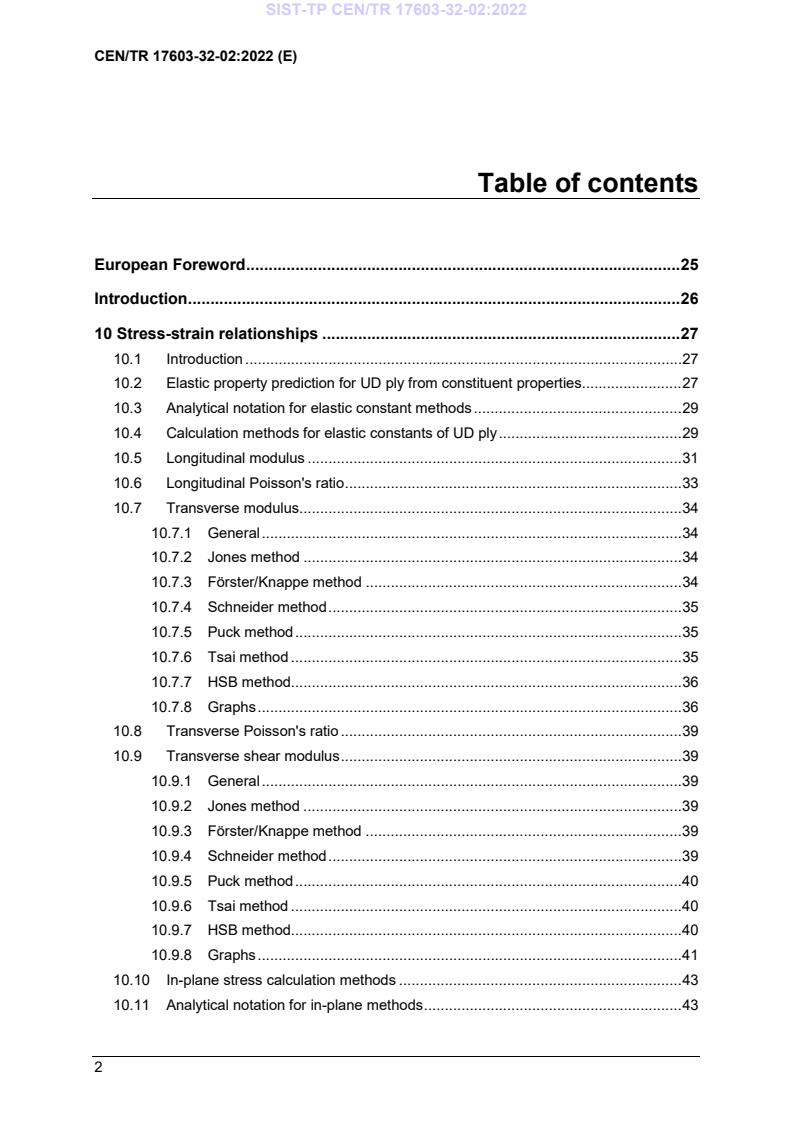
Table of contents
European Foreword . 25
Introduction . 26
10 Stress-strain relationships . 27
10.1 Introduction . 27
10.2 Elastic property prediction for UD ply from constituent properties. 27
10.3 Analytical notation for elastic constant methods . 29
10.4 Calculation methods for elastic constants of UD ply . 29
10.5 Longitudinal modulus . 31
10.6 Longitudinal Poisson's ratio . 33
10.7 Transverse modulus . 34
10.7.1 General . 34
10.7.2 Jones method . 34
10.7.3 Förster/Knappe method . 34
10.7.4 Schneider method . 35
10.7.5 Puck method . 35
10.7.6 Tsai method . 35
10.7.7 HSB method. 36
10.7.8 Graphs . 36
10.8 Transverse Poisson's ratio . 39
10.9 Transverse shear modulus . 39
10.9.1 General . 39
10.9.2 Jones method . 39
10.9.3 Förster/Knappe method . 39
10.9.4 Schneider method . 39
10.9.5 Puck method . 40
10.9.6 Tsai method . 40
10.9.7 HSB method. 40
10.9.8 Graphs . 41
10.10 In-plane stress calculation methods . 43
10.11 Analytical notation for in-plane methods . 43
10.12 Stress-strain relations for unidirectional plies . 45
10.12.1 Fibre-oriented co-ordinate system . 45
10.13 On axis stress strain relations . 45
10.13.1 General . 45
10.13.2 Compliance matrix . 46
10.13.3 Modulus matrix . 46
10.13.4 Symmetry of compliance and modulus matrices . 46
10.14 Stress-strain relations for a ply of arbitrary orientation . 46
10.14.1 General . 46
10.14.2 Off axis stiffness of a unidirectional ply. 48
10.15 Stiffness matrix for a laminate . 49
10.15.1 General laminates . 49
10.15.2 Symmetric laminates . 51
10.15.3 Flow chart . 52
10.16 Calculation methods with interlaminar stresses and strains . 53
10.16.1 Calculation with free-edge stresses . 53
10.17 Qualitative evaluation of interlaminar strength for design purposes . 55
10.17.1 General . 55
10.17.2 Variation of fibre direction within a [±φ°, 0°, ±φ°] laminate . 57
10.17.3 Variation of the thickness of the 0° layer within the [± 30°, 0n°, ± 30°]
laminate . 57
10.17.4 Variation of the sequence of layers . 58
10.18 References . 58
10.18.1 General . 58
11 Strength prediction and failure criteria . 60
11.1 Introduction . 60
11.1.1 Micro-mechanical strength models . 60
11.1.2 Lamina failure models . 60
11.1.3 Failure criteria studies . 61
11.1.4 Summary of World Wide Failure Exercise (WWFE) . 62
11.2 Tensile strength of UD composites in fibre direction . 64
11.2.1 General . 64
11.2.2 Weakest-link failure model . 64
11.2.3 Cumulative weakening failure model . 64
11.2.4 Fibre break propagation model . 66
11.2.5 Cumulative group mode failure model . 66
11.2.6 Status of models . 66
11.3 Compressive strength of UD composites in fibre direction. 66
11.3.1 General . 66
11.3.2 Extension mode buckling . 67
11.3.3 Shear mode buckling . 67
11.3.4 Analysis of compression failure . 68
11.4 Transverse tensile strength of UD composites . 70
11.4.1 General . 70
11.4.2 Prediction of transverse tensile strength . 71
11.4.3 Empirical analysis . 71
11.5 Static strength criteria for composites . 72
11.6 Analytical notation for static strength criteria for composites . 72
11.6.1 Co-ordinate system . 72
11.6.2 Formulae . 73
11.7 Different types of failure criteria . 74
11.7.1 General . 74
11.7.2 Evaluation studies . 75
11.8 Overview - Failure criteria . 75
11.8.1 Introduction . 75
11.8.2 Independent conditions . 76
11.8.3 Interactive conditions – Pure interpolative conditions . 77
11.8.4 Interactive conditions - Physical considerations . 78
11.9 Comparison between test data and various failure criteria . 87
11.9.1 Effects on failure mode . 87
11.10 Description of failure modes . 91
11.10.1 Laminates . 91
11.10.2 Failure . 91
11.11 Fatigue strength of composites . 96
11.11.1 Background . 96
11.11.2 Analytical notation . 97
11.11.3 Approximation of fatigue life . 97
11.12 References . 99
11.12.1 General . 99
12 Calculation of thermal stress and displacement . 103
12.1 Introduction . 103
12.1.1 General . 103
12.1.2 Longitudinal CTE . 103
12.1.3 Transverse CTE . 103
12.2 Analytical notation for thermal stress calculations . 104
12.3 Calculation of CTE from constituents . 105
12.3.1 CTE in fibre direction . 105
12.3.2 CTE perpendicular to fibre direction . 105
12.4 CTE for a laminate . 106
12.5 Thermal stresses within laminate layers . 108
12.5.1 General . 108
12.5.2 Residual curing stresses . 108
12.6 Stress strain temperature relation . 109
12.6.1 General . 109
12.6.2 Mechanical strains . 109
12.6.3 Incremental strain theory . 109
12.7 Microstress analysis . 111
12.7.1 General . 111
12.7.2 Microstresses on fibre axis . 111
12.7.3 Microstresses normal to fibre axis . 111
12.8 References . 111
12.8.1 General . 111
13 Moisture effects on composite properties . 113
13.1 Introduction . 113
13.1.1 General . 113
13.1.2 Moisture penetration . 113
13.1.3 Moisture effects . 113
13.2 Analytical notation for moisture effects . 114
13.3 Typical effects of moisture. 115
13.3.1 General . 115
13.3.2 Sample data: Effects of moisture . 115
13.4 Approximate method for calculation of strength and modulus retention of
[0°/90°] laminates . 120
13.4.1 General . 120
13.4.2 Modulus retention . 120
13.4.3 Strength retention . 122
13.5 Moisture content . 123
13.5.1 Fick's law . 123
13.5.2 Determination of moisture content . 124
13.5.3 Maximum moisture content . 125
13.5.4 Experimental determination of the diffusion coefficient . 126
13.6 Calculation of swelling coefficient from constituents . 128
13.6.1 General . 128
13.6.2 Swelling coefficient β in fibre direction. 128
13.6.3 Swelling coefficient β transverse to fibres . 128
13.6.4 Swelling coefficient for a laminate . 129
13.7 Coefficient of moisture expansion (CME) . 131
13.7.1 Resin behaviour . 131
13.7.2 Composite behaviour . 132
13.8 References . 133
13.8.1 General . 133
14 Stress concentrations and fracture . 135
14.1 Introduction . 135
14.1.1 General . 135
14.1.2 Fracture mechanics models . 135
14.2 Analytical notation for stress concentrations . 136
14.3 Summary of fracture models . 136
14.4 Evaluation of fracture models . 137
14.5 WEK fracture model . 138
14.5.1 General . 138
14.5.2 Circular holes . 138
14.5.3 Straight crack . 141
14.6 WN fracture model . 144
14.6.1 General . 144
14.6.2 Failure criteria . 144
14.6.3 Characteristics of WN fracture model . 146
14.6.4 Circular holes . 147
14.6.5 Straight cracks . 151
14.6.6 Point stress criteria . 152
14.6.7 Average stress criterion . 153
14.7 Finite plate models . 157
14.8 Finite width correction (FWC) . 157
14.8.1 General . 157
14.8.2 Circular holes . 159
14.8.3 Centre crack. 160
14.9 Calculated stress concentration factor at circular holes . 160
14.9.1 NASA results . 160
14.9.2 Finite width correction (FWC) . 162
14.9.3 MBB/ERNO study . 162
14.10 Stress distribution around circular holes . 167
14.10.1 General . 167
14.10.2 Stress concentration due to tensile load . 167
14.10.3 Stress concentration due to shear load . 168
14.11 Interlaminar fracture mechanics . 170
14.11.1 Nomenclature . 170
14.11.2 Delamination and fracture mechanics overview . 170
14.11.3 Standard test methods (static and fatigue) . 174
14.11.4 Calculation of strain energy release rate in structural analysis . 178
14.12 References . 184
14.12.1 General . 184
15 Prediction of dynamic characteristics . 188
15.1 Introduction . 188
15.2 Definition of damping terms . 188
15.2.1 General terms . 188
15.2.2 Complex modulus model . 190
15.3 Prediction methods for damping . 191
15.4 Determination of damping characteristics . 192
15.4.1 Unidirectional characteristics . 192
15.4.2 Off axis characteristics . 192
15.4.3 Laminate characteristics. 193
15.5 Approximate data on damping . 193
15.6 References . 194
15.6.1 General . 194
16 Computer analysis of composites . 195
16.1 Introduction . 195
16.2 Computer programs: Analysis of composites . 195
16.2.1 General . 195
16.2.2 Finite element programs. 197
16.2.3 Laminate analysis programs . 198
16.2.4 Special applications programs . 200
16.3 ESDU data for composite analysis . 202
16.3.1 General . 202
16.3.2 ESDU data items . 202
16.3.3 ESDUpac . 204
16.4 Buckling of orthotropic plates . 204
16.4.1 Title . 204
16.4.2 Usage and scope . 204
16.4.3 Analysis . 204
16.4.4 ESDUpac A7303 . 204
16.4.5 Notes . 205
16.5 Flexural stiffness of flat strips . 205
16.5.1 Title . 205
16.5.2 Usage and scope . 205
16.5.3 Analysis . 205
16.6 Metallic skin stiffeners reinforced by composite - local buckling . 206
16.6.1 Title . 206
16.6.2 Usage and scope . 206
16.6.3 Analysis and data . 206
16.7 Laminate stress analysis . 207
16.7.1 Title . 207
16.7.2 Usage and scope . 207
16.7.3 Analysis . 207
16.8 Plate stiffnesses (In-plane) . 208
16.8.1 Title . 208
16.8.2 Usage and scope . 208
16.8.3 Analysis and methods . 208
16.9 Bonded joints - 1 . 209
16.9.1 Title . 209
16.9.2 Usage and scope . 209
16.9.3 Analysis and data . 209
16.10 Bonded joints - 2 . 210
16.10.1 Title . 210
16.10.2 Usage and scope . 210
16.10.3 Analysis and data . 210
16.10.4 ESDUpac A7916 . 211
16.11 Bonded joints - 3 . 211
16.11.1 Title . 211
16.11.2 Usage and scope . 211
16.11.3 Analysis and data . 212
16.12 Buckling of rectangular specially orthotropic plates . 212
16.12.1 Title . 212
16.12.2 Usage and scope . 212
16.12.3 Analysis and data . 212
16.13 Bonded joints - 4 . 213
16.13.1 Title . 213
16.13.2 Usage and scope . 213
16.13.3 Analysis and data . 213
16.13.4 ESDUpac A8039 . 214
16.14 Bonded joints - 5 . 214
16.14.1 Title . 214
16.14.2 Usage and scope . 214
16.14.3 Information and guidance . 214
16.15 Buckling of orthotropic plates . 215
16.15.1 Title . 215
16.15.2 Usage and scope . 215
16.15.3 Analysis and data . 215
16.15.4 ESDUpac A8147 . 215
16.16 Lay-up arrangements for special orthotropy . 216
16.16.1 Title . 216
16.16.2 Usage and scope . 216
16.16.3 Analysis and data . 216
16.17 Failure modes of laminated composites . 217
16.17.1 Title . 217
16.17.2 Usage and scope . 217
16.17.3 Analysis and failure modes . 217
16.18 Failure criteria for layers of a laminated composite . 218
16.18.1 Title . 218
16.18.2 Usage and scope . 218
16.18.3 Analysis and data . 218
16.19 Plate stiffnesses and apparent elastic properties . 218
16.19.1 Title . 218
16.19.2 Usage and scope . 218
16.19.3 Analysis for stiffnesses and elastic properties . 219
16.19.4 ESDUpac A8335 . 219
16.20 Natural frequencies of laminated flat plates . 219
16.20.1 Title . 219
16.20.2 Usage and scope . 220
16.20.3 Calculation of natural frequencies . 220
16.20.4 ESDUpac A8336 . 220
16.21 Strain in skin panels under acoustic loading . 221
16.21.1 Title . 221
16.21.2 Usage and scope . 221
16.21.3 Calculation of surface strains . 221
16.21.4 ESDUpac A8408 . 221
16.22 Failure analysis . 222
16.22.1 Title . 222
16.22.2 Usage and scope . 222
16.22.3 Analysis . 222
16.22.4 ESDUpac A8418 . 223
16.23 Endurance under acoustic loading . 224
16.23.1 Title . 224
16.23.2 Usage and scope . 224
16.24 Stress and strain around circular holes . 224
16.24.1 Title . 224
16.24.2 Usage and scope . 225
16.24.3 Analysis . 225
16.24.4 ESDUpac A8501 . 225
16.25 Damping in composite plates . 226
16.25.1 Title . 226
16.25.2 Usage and scope . 226
16.25.3 Calculation of damping . 226
16.25.4 ESDUpac 8512 . 226
16.26 Sandwich panel natural frequencies . 227
16.26.1 Title . 227
16.26.2 Usage and scope . 227
16.26.3 Calculation of natural frequencies . 227
16.26.4 ESDUpac A8537 . 228
16.27 Selection of reinforcement around circular holes . 228
16.28 Buckling of unbalanced composite plates . 229
16.28.1 Title . 229
16.28.2 Usage and scope . 229
16.28.3 Analysis and data . 229
16.28.4 ESDUpac A8620 . 230
16.29 Sandwich panel response to acoustic loading . 230
16.29.1 Title . 230
16.29.2 Usage and scope . 230
16.29.3 Calculation of natural frequencies and surface strains . 231
16.29.4 ESDUpac A8624 . 231
16.30 Sandwich column and beam face plate wrinkling . 231
16.30.1 Title . 231
16.30.2 Usage and scope . 231
16.30.3 Analysis . 232
16.30.4 ESDUpac A8713 . 232
16.31 Buckling of curved composite panels . 233
16.31.1 Title . 233
16.31.2 Usage and scope . 233
16.31.3 Analysis and data . 233
16.31.4 ESDUpac A8725 . 233
16.32 Sandwich panel face plate wrinkling . 234
16.32.1 Title . 234
16.32.2 Usage and scope . 234
16.32.3 Analysis . 234
16.32.4 ESDUpac A8815 . 235
16.33 Vibration of singly-curved laminated plates . 235
16.33.1 Title . 235
16.33.2 Usage and scope . 235
16.33.3 Calculation of natural frequencies . 236
16.33.4 ESDUpac A8911 . 236
16.34 Plate through-the-thickness shear stiffnesses . 236
16.34.1 Title . 236
16.34.2 Usage and scope . 237
16.34.3 Analysis . 237
16.34.4 ESDUpac A8913 . 237
16.34.5 Notes . 237
16.35 Vibration of plates with in-plane loading . 238
16.35.1 Title . 238
16.35.2 Usage and scope . 238
16.35.3 Calculation of natural frequencies . 238
16.35.4 ESDUpac A9016 . 238
16.36 Delamination and free edge stresses
...