


EN 16931-1:2026
(Main)Electronic invoicing - Part 1: Semantic data model of the core elements of an electronic invoice
General Information
- Abstract
This European Standard establishes a semantic data model of the core elements of an electronic invoice. The semantic model includes only the essential information elements that an electronic invoice needs to ensure legal (including fiscal) compliance and to enable interoperability for cross-border, cross sector and for domestic trade. The semantic model may be used by organizations in the private and the public sector for public procurement invoicing. It may also be used for invoicing between private sector enterprises. It has not been specifically designed for invoicing consumers.
This European Standard complies at least with the following criteria:
- it is technologically neutral;
- it is compatible with relevant international standards on electronic invoicing;
- the application of this standard should comply with the requirements for the protection of personal data of Directive 95/46/EC, having due regard to the principles of privacy and data protection by-design, data minimization, purpose limitation, necessity and proportionality;
- it is consistent with the relevant provisions of Directive 2006/112/EC [2];
- it allows for the establishment of practical, user-friendly, flexible and cost-efficient electronic invoicing systems;
- it takes into account the special needs of small and medium-sized enterprises as well as of sub-central contracting authorities and contracting entities;
- it is suitable for use in commercial transactions between enterprises.
- Status
- Published
- Publication Date
- 17-Mar-2026
- Technical Committee
- CEN/TC 434 - Project Committee - Electronic Invoicing
- Drafting Committee
- CEN/TC 434/WG 1 - Definition
- Current Stage
- 6060 - Definitive text made available (DAV) - Publishing
- Start Date
- 18-Mar-2026
- Due Date
- 21-Jul-2026
- Completion Date
- 18-Mar-2026

Overview
EN 16931-1:2026 “Electronic invoicing - Part 1: Semantic data model of the core elements of an electronic invoice” is a European Standard developed by CEN to establish a common, technologically neutral semantic data model for the core elements of electronic invoices. Its main purpose is to define the essential information components required for creating, exchanging, and processing legally compliant and interoperable electronic invoices across cross-border, cross-sector, and domestic trade within the European Union.
This standard is designed for use by both public sector entities (such as those involved in public procurement) and private sector enterprises engaged in B2B transactions. It is not intended for consumer invoicing (B2C). EN 16931-1:2026 provides the foundation for building efficient, user-friendly, and cost-effective electronic invoicing systems, while supporting legal frameworks and ensuring compatibility with international e-invoicing standards.
Key Topics
- Semantic Data Model: Defines a structured and logically interrelated set of information elements for electronic invoices, ensuring shared meaning for all parties involved.
- Core Elements: Specifies only the essential data required for legal (including VAT and fiscal) compliance and business interoperability.
- Technological Neutrality: The standard does not prescribe specific technologies or transmission methods, enabling flexibility and future-proofing.
- Legal and Fiscal Compliance: Aligns with the requirements of Directive 2014/55/EU on electronic invoicing in public procurement and Directive 2006/112/EC (VAT directive).
- Interoperability: Ensures cross-border and cross-sector compatibility by using a minimal and common set of data, reducing the need for bilateral agreements.
- Personal Data Protection: Supports compliance with data protection principles such as privacy by design, data minimization, and purpose limitation, as required by Directive 95/46/EC.
- Support for Extensions: Allows the semantic model to be extended with additional, sector or country-specific elements through standardized methodologies, ensuring relevance for diverse business needs.
- Ease of Implementation: Facilitates adoption for small and medium-sized enterprises (SMEs), public bodies, and businesses of all sizes by emphasizing practical, flexible, and scalable invoicing systems.
Applications
EN 16931-1:2026 is widely applicable to organizations aiming to:
- Automate Invoice Processing: Streamline and automate the creation, sending, receiving, and processing of electronic invoices, minimizing manual intervention and errors.
- Achieve Cross-Border Trade Compliance: Meet the core invoice requirements for public procurement and commercial transactions throughout the EU, supporting seamless international business.
- Integrate with ERP and Accounting Systems: Provide a standardized data structure that software vendors can support for integration with enterprise resource planning (ERP), accounting, and financial management systems.
- Public Sector Procurement: Mandatory for receiving and processing e-invoices by EU public authorities and entities involved in procurement, following Directive 2014/55/EU.
- Private Sector B2B Invoicing: Adopt a common invoice standard for interoperability between trading partners, reducing integration costs and improving efficiency.
- Data Security and Legal Assurance: Ensure that invoices meet the necessary data protection, legal, and audit requirements for electronic transactions.
EN 16931-1:2026 enables organizations to transition from paper-based to digital invoicing, promoting savings, efficiency, and compliance across the European market.
Related Standards
- EN 16931-2: List of syntaxes that comply with EN 16931-1, ensuring compatibility with formats like UBL, UN/EDIFACT, and more.
- CEN/TS 16931-3-x: Syntax binding methodologies and guides for mapping the semantic model to various syntaxes.
- CEN/TS 16931-4: Guidelines for transmission-level interoperability of electronic invoices.
- CEN/TS 16931-5: Methodology for sector- or country-specific extensions to the core invoice model.
- ISO 20022, ISO 15000-5 (ebXML), ISO/IEC 6523: International standards referenced for identification, messaging, and data modeling.
- Directive 2014/55/EU: EU legal framework on electronic invoicing in public procurement.
- Directive 2006/112/EC: EU VAT directive, ensuring fiscal requirements are embedded in the standard.
By aligning with these related documents, EN 16931-1:2026 delivers a robust, future-oriented foundation for electronic invoicing throughout Europe and beyond.
Relations
- Effective Date
- 25-Mar-2026
- Effective Date
- 17-Apr-2024
- Effective Date
- 29-Apr-2026
- Effective Date
- 29-Apr-2026
- Effective Date
- 29-Apr-2026
- Effective Date
- 29-Apr-2026
- Effective Date
- 29-Apr-2026
- Effective Date
- 29-Apr-2026
- Effective Date
- 12-Aug-2026
- Effective Date
- 12-Aug-2026
- Effective Date
- 22-Jul-2026
- Effective Date
- 25-Mar-2026
- Effective Date
- 25-Mar-2026
- Referred By
CEN/TS 16931-3-4:2020 - Electronic invoicing - Part 3-4: Syntax binding for UN/EDIFACT INVOIC D16B - Effective Date
- 25-Mar-2026
- Effective Date
- 25-Mar-2026
Get Certified
Connect with accredited certification bodies for this standard

BSI Group
BSI (British Standards Institution) is the business standards company that helps organizations make excellence a habit.

NYCE
Mexican standards and certification body.
Sponsored listings
Frequently Asked Questions
EN 16931-1:2026 is a standard published by the European Committee for Standardization (CEN). Its full title is "Electronic invoicing - Part 1: Semantic data model of the core elements of an electronic invoice". This standard covers: This European Standard establishes a semantic data model of the core elements of an electronic invoice. The semantic model includes only the essential information elements that an electronic invoice needs to ensure legal (including fiscal) compliance and to enable interoperability for cross-border, cross sector and for domestic trade. The semantic model may be used by organizations in the private and the public sector for public procurement invoicing. It may also be used for invoicing between private sector enterprises. It has not been specifically designed for invoicing consumers. This European Standard complies at least with the following criteria: - it is technologically neutral; - it is compatible with relevant international standards on electronic invoicing; - the application of this standard should comply with the requirements for the protection of personal data of Directive 95/46/EC, having due regard to the principles of privacy and data protection by-design, data minimization, purpose limitation, necessity and proportionality; - it is consistent with the relevant provisions of Directive 2006/112/EC [2]; - it allows for the establishment of practical, user-friendly, flexible and cost-efficient electronic invoicing systems; - it takes into account the special needs of small and medium-sized enterprises as well as of sub-central contracting authorities and contracting entities; - it is suitable for use in commercial transactions between enterprises.
This European Standard establishes a semantic data model of the core elements of an electronic invoice. The semantic model includes only the essential information elements that an electronic invoice needs to ensure legal (including fiscal) compliance and to enable interoperability for cross-border, cross sector and for domestic trade. The semantic model may be used by organizations in the private and the public sector for public procurement invoicing. It may also be used for invoicing between private sector enterprises. It has not been specifically designed for invoicing consumers. This European Standard complies at least with the following criteria: - it is technologically neutral; - it is compatible with relevant international standards on electronic invoicing; - the application of this standard should comply with the requirements for the protection of personal data of Directive 95/46/EC, having due regard to the principles of privacy and data protection by-design, data minimization, purpose limitation, necessity and proportionality; - it is consistent with the relevant provisions of Directive 2006/112/EC [2]; - it allows for the establishment of practical, user-friendly, flexible and cost-efficient electronic invoicing systems; - it takes into account the special needs of small and medium-sized enterprises as well as of sub-central contracting authorities and contracting entities; - it is suitable for use in commercial transactions between enterprises.
EN 16931-1:2026 is classified under the following ICS (International Classification for Standards) categories: 35.240.20 - IT applications in office work; 35.240.63 - IT applications in trade. The ICS classification helps identify the subject area and facilitates finding related standards.
EN 16931-1:2026 has the following relationships with other standards: It is inter standard links to EN 16931-1:2017+A1:2019/AC:2020, EN 16931-1:2017+A1:2019, ISO 15000-5:2014, ISO 3166-1:2020, ISO/IEC 6523-2:2025, ISO 4217:2015, ISO 8601:2004, ISO/IEC 6523-1:2023, CEN/TS 16931-3-2:2026, CEN/TS 16931-3-3:2026, CEN/TS 16931-13:2026, CEN/TS 16931-3-2:2020, CEN/TR 16931-11-1:2026, CEN/TS 16931-3-4:2020, CEN/TS 16931-3-2:2017. Understanding these relationships helps ensure you are using the most current and applicable version of the standard.
EN 16931-1:2026 is associated with the following European legislation: EU Directives/Regulations: 2014/55/EU; Standardization Mandates: M/528, M/621. When a standard is cited in the Official Journal of the European Union, products manufactured in conformity with it benefit from a presumption of conformity with the essential requirements of the corresponding EU directive or regulation.
EN 16931-1:2026 is available in PDF format for immediate download after purchase. The document can be added to your cart and obtained through the secure checkout process. Digital delivery ensures instant access to the complete standard document.
Standards Content (Sample)
SLOVENSKI STANDARD
01-junij-2026
Nadomešča:
SIST EN 16931-1:2017+A1:2020
SIST EN 16931-1:2017+A1:2020/AC:2020
Elektronsko izdajanje računov - 1. del: Semantični podatkovni model osrednjih
elementov za elektronski račun
Electronic invoicing - Part 1: Semantic data model of the core elements of an electronic
invoice
Elektronische Rechnungsstellung - Teil 1: Semantisches Datenmodell der Kernelemente
einer elektronischen Rechnung
Facturation électronique - Partie 1 : Modèle sémantique de données des éléments
essentiels d'une facture électronique
Ta slovenski standard je istoveten z: EN 16931-1:2026
ICS:
03.100.20 Trgovina. Komercialna Trade. Commercial function.
dejavnost. Trženje Marketing
35.240.20 Uporabniške rešitve IT pri IT applications in office work
pisarniškem delu
35.240.63 Uporabniške rešitve IT v IT applications in trade
trgovini
2003-01.Slovenski inštitut za standardizacijo. Razmnoževanje celote ali delov tega standarda ni dovoljeno.
EN 16931-1
EUROPEAN STANDARD
NORME EUROPÉENNE
March 2026
EUROPÄISCHE NORM
ICS 35.240.63 Supersedes EN 16931-1:2017+A1:2019
English Version
Electronic invoicing - Part 1: Semantic data model of the
core elements of an electronic invoice
Facturation électronique - Partie 1 : Modèle Elektronische Rechnungsstellung - Teil 1:
sémantique de données des éléments essentiels d'une Semantisches Datenmodell der Kernelemente einer
facture électronique elektronischen Rechnung
This European Standard was approved by CEN on 13 March 2026.
CEN members are bound to comply with the CEN/CENELEC Internal Regulations which stipulate the conditions for giving this
European Standard the status of a national standard without any alteration. Up-to-date lists and bibliographical references
concerning such national standards may be obtained on application to the CEN-CENELEC Management Centre or to any CEN
member.
This European Standard exists in three official versions (English, French, German). A version in any other language made by
translation under the responsibility of a CEN member into its own language and notified to the CEN-CENELEC Management
Centre has the same status as the official versions.
CEN members are the national standards bodies of Austria, Belgium, Bulgaria, Croatia, Cyprus, Czech Republic, Denmark, Estonia,
Finland, France, Germany, Greece, Hungary, Iceland, Ireland, Italy, Latvia, Lithuania, Luxembourg, Malta, Netherlands, Norway,
Poland, Portugal, Republic of North Macedonia, Romania, Serbia, Slovakia, Slovenia, Spain, Sweden, Switzerland, Türkiye and
United Kingdom.
EUROPEAN COMMITTEE FOR STANDARDIZATION
COMITÉ EUROPÉEN DE NORMALISATION
EUROPÄISCHES KOMITEE FÜR NORMUNG
CEN-CENELEC Management Centre: Rue de la Science 23, B-1040 Brussels
© 2026 CEN All rights of exploitation in any form and by any means reserved Ref. No. EN 16931-1:2026 E
worldwide for CEN national Members.
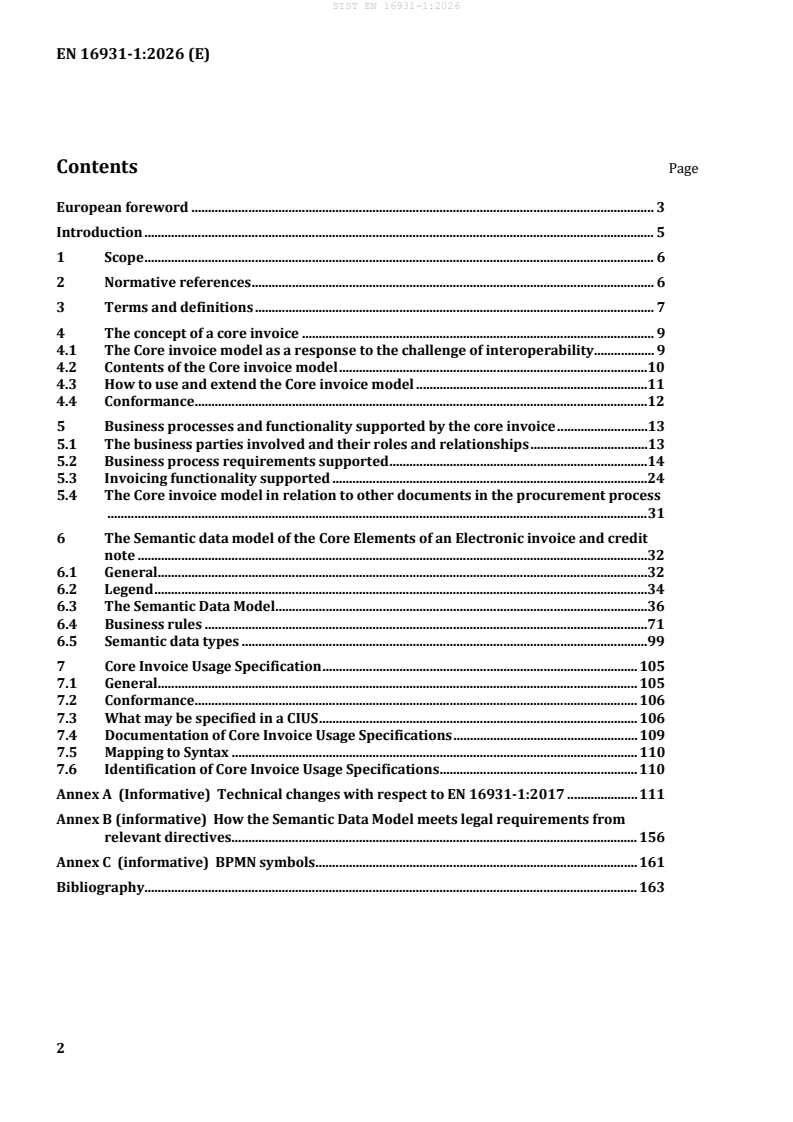
Contents Page
European foreword . 3
Introduction . 5
1 Scope . 6
2 Normative references . 6
3 Terms and definitions . 7
4 The concept of a core invoice . 9
4.1 The Core invoice model as a response to the challenge of interoperability . 9
4.2 Contents of the Core invoice model .10
4.3 How to use and extend the Core invoice model .11
4.4 Conformance .12
5 Business processes and functionality supported by the core invoice .13
5.1 The business parties involved and their roles and relationships .13
5.2 Business process requirements supported .14
5.3 Invoicing functionality supported .24
5.4 The Core invoice model in relation to other documents in the procurement process
.................................................................................................................................................................31
6 The Semantic data model of the Core Elements of an Electronic invoice and credit
note .32
6.1 General .32
6.2 Legend .34
6.3 The Semantic Data Model .36
6.4 Business rules .71
6.5 Semantic data types .99
7 Core Invoice Usage Specification . 105
7.1 General . 105
7.2 Conformance . 106
7.3 What may be specified in a CIUS . 106
7.4 Documentation of Core Invoice Usage Specifications . 109
7.5 Mapping to Syntax . 110
7.6 Identification of Core Invoice Usage Specifications . 110
Annex A (Informative) Technical changes with respect to EN 16931-1:2017 . 111
Annex B (informative) How the Semantic Data Model meets legal requirements from
relevant directives . 156
Annex C (informative) BPMN symbols . 161
Bibliography. 163
European foreword
This document (EN 16931-1:2026) has been prepared by Technical Committee CEN/TC 434 “Electronic
Invoicing”, the secretariat of which is held by NEN.
This European Standard shall be given the status of a national standard, either by publication of an
identical text or by endorsement, at the latest by September 2026, and conflicting national standards
shall be withdrawn at the latest by March 2029.
Attention is drawn to the possibility that some of the elements of this document may be the subject of
patent rights. CEN shall not be held responsible for identifying any or all such patent rights.
This document supersedes EN 16931-1:2017+A1:2019.
The main technical changes are listed in the informative Annex A. How the semantic data model meets
legal requirements from relevant directives is specified in the informative Annex B.
This document has been prepared under a standardization request addressed to CEN by the European
Commission. The Standing Committee of the EFTA States subsequently approves these requests for its
Member States.
This document is part of a set of documents, consisting of:
— EN 16931-1: Electronic invoicing - Part 1: Semantic data model of the Core Elements of an Electronic
Invoice
— CEN/TS 16931-2 Electronic invoicing - Part 2: List of syntaxes that comply with EN 16931-1
— CEN/TS 16931-3-1 Electronic invoicing - Part 3-1: Methodology for syntax bindings of the Core
Elements of an Electronic Invoice
— CEN/TS 16931-3-2Electronic invoicing - Part 3-2: Syntax binding for ISO/IEC 19845 (UBL 2.1)
invoice and credit note
— CEN/TS 16931-3-3 Electronic invoicing - Part 3-3: Syntax binding for UN/CEFACT XML Cross
Industry Invoice D16B
— CEN/TS 16931-3-4 Electronic invoicing - Part 3-4: Syntax binding for UN/EDIFACT INVOIC D16B
— CEN/TR 16931-4 Electronic invoicing - Part 4: Guidelines on interoperability of Electronic Invoices
at the transmission level
— prCEN/TS 16931-5 Electronic invoicing - Part 5: Guidelines on the use of sector or country
extensions in conjunction with EN 16931-1, methodology to be applied in the real environment
— CEN/TR 16931-6 Electronic invoicing - Part 6: Result of the test of EN 16931-1 with respect to its
practical application for an end user - Testing methodology
— CEN/TS 16931-7 Electronic invoicing - Part 7: Methodology for the development and use of EN
16931-1 compliant structured Core Invoice Usage Specifications
— CEN/TS 16931-8: Electronic invoicing - Part 8: Semantic data model of the elements of an e-receipt
or a simplified electronic invoice
— CEN/TR 16931-9 Electronic invoicing - Part 9: VAT reporting and gap analysis with current e-
invoicing standardization deliverables
— FprCEN/TR 16931-10 Electronic invoicing – Part 10: Additional requirements to extend to B2B
Any feedback and questions on this document should be directed to the users’ national standards body.
A complete listing of these bodies can be found on the CEN website.
According to the CEN-CENELEC Internal Regulations, the national standards organisations of the
following countries are bound to implement this European Standard: Austria, Belgium, Bulgaria, Croatia,
Cyprus, Czech Republic, Denmark, Estonia, Finland, France, Germany, Greece, Hungary, Iceland, Ireland,
Italy, Latvia, Lithuania, Luxembourg, Malta, Netherlands, Norway, Poland, Portugal, Republic of North
Macedonia, Romania, Serbia, Slovakia, Slovenia, Spain, Sweden, Switzerland, Türkiye and the United
Kingdom.
Introduction
The European Commission estimates that “The mass adoption of e-invoicing within the EU would lead
to significant economic benefits and it is estimated that moving from paper to Electronic invoices will
generate savings of around EUR 240 billion over a six-year period” . Based on this recognition “The
Commission wanted to see e-invoicing become the predominant method of invoicing by 2020 in
Europe.”
To achieve this goal, Directive 2014/55/EU [1] on electronic invoicing in public procurement aims at
facilitating the use of Electronic invoices by economic operators when supplying goods, works and
services to the public administration. The Directive sets out the legal framework for the establishment
and use of a European Standard (EN) for the Semantic data model of the Core Elements of an Electronic
invoice.
The Semantic data model of the Core Elements of an Electronic Invoice – the Core invoice model – as
described in this document is based on the proposition that a quite limited, but sufficient set of
information elements can be defined that supports generally applicable invoice-related functionalities.
These functionalities are described in Clause 5. The Core invoice model, as described in Clause 6,
contains information elements that are commonly used and accepted including those that are legally
required.
It is expected that in most situations, business partners would use the Core invoice model exclusively
and the invoices they send or receive would not contain any additional structured information elements.
However, in some sectors or situations where there are specific information requirements, the required
information may be conveyed in the form of unstructured text. Unstructured text has the drawback in
that it cannot be processed automatically and therefore requires human intervention. Alternatively, the
specific information requirements can be implemented using information elements that extend the Core
invoice model. Any such extension needs to respect the semantic descriptions in the Core invoice model.
Only business partners that are part of such a sector or supply chain would be expected to be able to
process the extensions. In these circumstances, it should be possible to define a number of required
additional information elements whilst still utilizing the Core invoice model concept.
In line with Directive 2014/55/EU [1] and after the publication of the reference to this document in the
Official Journal of the European Union, all contracting authorities and contracting entities in the EU will
be obliged to be able to receive and process an Electronic invoice as long as it contains all of the
(applicable) Core Elements of an invoice defined in this European Standard (and provided that it is
represented in any of the syntaxes identified in the related Technical Specification CEN/TS 16931-2
“List of syntaxes that comply with EN 16931-1” in accordance with the request referred to in paragraph
1 of article 3 of the Directive 2014/55/EU. The inclusion of any additional information which is not
contained in the core model will be at the sender’s discretion and contained in unstructured text or
based on an extension, by agreement with the contracting entity. The inclusion of any extension in an
Electronic invoice will be optional, and it will not form an integral part of the European Standard. See
Clause 4 below for further detail on extensions.
In 2025, the EC also proposes to amend Council Directive. 2006/112/EC [2] (the VAT directive) in order
to introduce a new method of VAT reporting for intra community trade. This method is based on
electronic invoicing, conformant to this European Norm.
By ensuring semantic interoperability of Electronic invoices, the European Standard and its ancillary
European standardization deliverables will serve to remove market barriers and obstacles to trade
deriving from the existence of various national rules and standards – and thus contribute to the goals
set by the European Commission.
http://eur-lex.europa.eu/LexUriServ/LexUriServ.do?uri=COM:2010:0712:FIN:en:PDF.
1 Scope
This document specifies a semantic data model of the core elements of an Electronic invoice. The
semantic data model includes only the essential information elements that an Electronic invoice needs
to ensure legal (including fiscal) compliance and to enable interoperability for cross-border, cross sector
and domestic trade. The semantic data model can be applied by organizations in the private and the
public sector for public procurement invoicing. It can also be used for invoicing between private sector
enterprises. It has not been specifically designed for invoicing consumers.
This document complies at least with the following criteria:
— it is technologically neutral;
— it is compatible with relevant international standards on electronic invoicing;
— the application of this standard should comply with the requirements for the protection of personal
data of Directive 95/46/EC, having due regard to the principles of privacy and data protection by-
design, data minimization, purpose limitation, necessity and proportionality;
— it is consistent with the relevant provisions of Directive 2006/112/EC [2];
— it allows for the establishment of practical, user-friendly, flexible and cost-efficient electronic
invoicing systems;
— it takes into account the special needs of small and medium-sized enterprises as well as of sub-
central contracting authorities and contracting entities;
— it is suitable for use in commercial transactions between enterprises.
2 Normative references
The following documents are referred to in the text in such a way that some or all of their content
constitutes requirements of this document. For dated references, only the edition cited applies. For
undated references, the latest edition of the referenced document (including any amendments) applies.
ISO 3166-1, Codes for the representation of names of countries and their subdivisions — Part 1: Country
codes (ISO 3166-1)
ISO 4217, Codes for the representation of currencies
ISO 8601, Data elements and interchange formats — Information interchange — Representation of dates
and times
ISO 15000-5, Electronic Business Extensible Markup Language (ebXML) — Part 5: Core Components
Specification (CCS)
ISO/IEC 6523 (all parts), Information technology — Structure for the identification of organizations and
organization parts
3 Terms and definitions
For the purposes of this document, the following terms and definitions apply.
ISO and IEC maintain terminology databases for use in standardization at the following addresses:
ISO Online browsing platform: available at https://www.iso.org/obp/
IEC Electropedia: available at https://www.electropedia.org/
NOTE Business Terms that are part of the Semantic Data Model are defined in the model itself.
3.1
Electronic invoice
invoice that has been issued, transmitted and received in a structured electronic format which allows
for its automatic and electronic processing
[SOURCE: Directive 2014/55/EU [1]]
3.2
Information Element
smallest unit of data that is used to represent an item of information within an Electronic invoice
Note 1 to entry: This document identifies these elements using Business Terms (BTs). In EN 16931-1 section 6.3
is a table of information elements contained in the Core invoice model.
3.3
Structured Information Element
information element that can be processed automatically
3.4
Business Term
label assigned to a given information element which is used as a primary reference
3.5
Business Terms Group
group of related Business Terms
Note 1 to entry: BTs can be aggregated within Business Terms Groups (BGs). For example, the BG Seller contains
all the information elements needed to describe the entity that is selling the good or service. BG Seller also contains
its own BGs such as address and contact i.e. BG Seller acts as a parent Group to child Groups for addresses and
contact details that are related to the Seller.
3.6
Semantic data model
structured set of logically interrelated information
3.7
Core invoice model
semantic data model of the core elements of an Electronic invoice
Note 1 to entry: The model contains the core elements of an Electronic invoice – see EN 16931-1 Clause 4 for a
more detailed explanation. The core invoice model is composed of mandatory information elements that every
invoice shall contain along with conditional elements that can be used when required.
3.8
Core elements of an Electronic invoice
set of information elements that most Electronic invoices contain in order to enable interoperability,
including the necessary information to ensure legal compliance
3.9
Extended Information Element
information element within the scope for extensions but outside the Core invoice model
Note 1 to entry: extended information elements are sometimes informally referred to as extensions in other
documents.
3.10
Core Invoice Usage Specification
CIUS
specification that provides detailed guidance, explanations, and examples, as well as rules (business
rules) related to the actual implementation and use of structured information elements present in the
Core invoice model in a specific trading situation
3.11
Core invoice instance document
instance of an Electronic invoice that is conformant with the Core invoice model
3.12
Extension specification
specification describing the use of extended information elements to the Core invoice model that may
reuse extension components
Note 1 to entry: An extension specification is intended to be published in the eInvoice registry. It is typically written
by a representative/representatives of a Sectoral Organisation for its members to describe an invoice that includes
the Core semantic model elements, extension components, and other elements needed for business.
Note 2 to entry: The resulting invoice model contains information elements that do not form a strict subset of the
Core invoice model. An extension specification can also provide additional explanations and examples.
3.13
Identifier
character string used to establish the identity of, and distinguish uniquely, one instance of an object
within an identification scheme from all other objects within the same scheme
Note 1 to entry: An identifier may be a word, number, letter, symbol, or any combination of those, depending on
the identification scheme used.
3.14
Identification Scheme
collection of identifiers applicable for a given type of object governed under a common set of rules
3.15
Compliant
meets all the legal requirements and follows all the legal rules of any Directive associated with the
standard, particularly the VAT Directive
3.16
Core conformant
respects all the normative rules of the Core invoice model
Note 1 to entry: A core conformant instance is not expected to throw any error when using CEN/TC434/WG3
validation artefacts for the Core invoice model.
3.17
Syntax
machine-readable format used to represent the information elements contained in an Electronic
invoice instance
Note 1 to entry: CEN/TS 16931-2 contains the list of syntaxes that comply with EN 16931-1 and that are
mandatory for public bodies in the European Union.
4 The concept of a core invoice
4.1 The Core invoice model as a response to the challenge of interoperability
The establishment of interoperability of business information systems with respect to the exchange of
electronic documents such as invoices is viewed by many as a major challenge for the following reasons:
a) the overall business environment is diverse and consequently so is the information that needs to be
exchanged between business partners;
b) invoices consist of many information elements; attempting to define and standardize all occurring
information elements would generate a very large and complex information model that no single
organization could implement entirely;
c) even if a complete implementation of such a large model were possible, its implementation across
the business environment would be very challenging and costly;
d) as experience shows, business partners in various industry sectors will agree on subsets of the
model that are supported by their business information systems. Such variety would work against
the principles of using common standards, jeopardize interoperability and result in expensive
implementation projects.
This document is based on a different approach. In contrast to collecting and meeting the requirements
of all businesses, a Semantic Data Model is defined that includes only the essential information elements
that an Electronic invoice needs to ensure legal (including fiscal) compliance and to enable
interoperability for cross-border, cross-sector and domestic trade. The Semantic Data Model may be
used by organizations in both the public and private sectors for electronic invoicing, supporting
transactions in public procurement as well as between private enterprises.
The result of this approach is a Semantic Data Model of core information elements for an Electronic
invoice. The following guiding principles form the basis of the Core invoice model:
1) it should be easier to prepare and send, as well as to receive and process Electronic invoices when
compared to paper invoices;
2) the use of standardized information elements should make Electronic invoice processing more
efficient than processing paper invoices;
3) conformance with the Core invoice model should mean that business partners are able to interpret
and understand the content of an Electronic invoice at the semantic level without prior consultation
or bilateral agreements;
4) invoices should be composed of structured information elements to enable efficient and automatic
processing;
5) invoice processing software should be able to present all information elements in the Core invoice
model, and automatically process all structured data;
6) the use of structured data should result in optimized business processes;
7) the Core invoice model makes no assumption about the method by which an invoice is created,
delivered and processed. It may be exchanged directly between business partners or exchanged
using an intermediary service provider;
8) the Core invoice model makes no assumption about the syntax or transmission technology used.
Senders and receivers of Electronic invoices shall ensure the authenticity and integrity of the
invoice according to relevant regulations. Mapping to several syntaxes is provided in
CEN/TS 16931-3 from subpart 2 onward.
4.2 Contents of the Core invoice model
The Core invoice model is based on the proposition that a quite limited, but nevertheless sufficient set
of information elements can be defined which supports generally applicable invoice-related
functionalities. These functionalities include invoice issuance and delivery, invoice validation,
accounting, VAT reporting, payment and auditing. The Core invoice model contains information
elements that are commonly used and accepted, including those that are legally required across Europe.
If all organisations in Europe were to implement the Core invoice model in their business information
systems using the specified information elements, it would be possible to send, receive, and process
Electronic invoices without human intervention. There would be no need for onerous pre-negotiated
bilateral agreements between organizations on the actual semantic content of the invoice and its
exchange. The only assumption is the existence of a normal business contract or trading agreement. The
Core invoice model supports a set of invoice functions, as specified in Clause 5 below.
The set of information elements that are contained in the Core invoice model is commonly considered
to consist of two parts: a legal part and a common part.
The legal part of the Core invoice model supports the observance of both tax and commercial legal and
regulatory requirements pertaining to electronic invoicing commonly in force throughout Europe.
The common part contains commonly used and accepted information elements that are not sector or
country specific.
A specific information element may be correctly allocated to one or both parts. Therefore, categorizing
elements with respect to these parts in the semantic data model is not considered to be meaningful.
To fulfil the requirements above, judgment has had to be made on the selection of the information
elements to be included in the Core invoice model. First, for the legal part requirements, the mandatory
elements are those that comply with the EU VAT Directives and most individual state laws, whether local
VAT regulations, or any other local legal provision (regulatory, contractual company law, laws on
business documents, etc.). In some cases, those information elements that are exclusively confined to a
single or very small number of countries and therefore fall outside the doctrine of ‘commonly in force
throughout the EU’ have not been included in the Core invoice model. Secondly, the elements selected
to satisfy the requirements of the common part form a justifiable selection of requirements required in
commercial practice.
An important criterion when to include an information element in the Core invoice model that is above
and beyond one that is legally required is whether it can be assumed that the Buyer’s information system
can process (or otherwise handle) such an element. If the business information systems of most Buyers
in Europe are incapable of processing such an information element, that element should not be part of
the Core invoice model. If such an element is nevertheless required in a specific context, it should be
contained within an extension to the Core invoice model, specific to either a sector or a country. The
methodology to create extensions is described in CEN/TS 16931-5. When experience shows that an
extension is frequently used, then such an extension could be added as information elements to the Core
invoice model in a later version rather than continuing to be handled in an extension.
4.3 How to use and extend the Core invoice model
As stated in the previous subclause, the Core invoice model is intended to be used for all generally
applicable invoicing processes. In many situations, business partners would use the Core invoice model
exclusively and the invoices they send or receive would contain only the structured information
elements as defined in the model. Where a dedicated field exists for a business term or piece of data, this
field shall be used for the information content instead of using a textual field.
There are however circumstances where the trading partners may wish to either: 1. restrict the
conditional information elements to be used in an Electronic invoice or 2. provide additional
information elements. The first requirement is satisfied using a Core Invoice Usage Specification (CIUS).
The second requirement is satisfied using an extension specified in an extension specification.
In many trading situations, it may be appropriate to restrict the use of conditional information elements
present in the Core invoice model in some way to support automated processing. The use of a CIUS to
specify these requirements is described in Clause 7 below. The CIUS is a specification that provides a
Seller with detailed guidance, explanations and examples, relating to the actual implementation and use
of the information elements in the Core invoice model in a specific trading situation.
Typically, a CIUS will be created by a contracting entity (Buyer) in relation to its own supply chain or by
a group of contracting entities wishing to achieve consistency in the way that the information elements
in the Core invoice model are to be used by Sellers trading with an identified sector or community of
Buyers. The requirements set out in such a CIUS will be communicated to Sellers or placed on a website
and may be included in the contractual documentation between the parties. Alternatively, a CIUS may
be created by a group of Sellers and agreed in turn by their Buyer or Buyers in the context of a specific
industry or supply chain.
A CIUS is a set of usage guidelines or restrictions made to the Core invoice model that will still produce
an invoice instance that is fully conformant with the Core invoice model set out in this document. This
means that a receiver of an invoice document instance that has been created in conformance with a CIUS
is still able to receive and process it in accordance with the rules defined for the Core invoice model.
In some sectors or situations where there are specific additional information requirements, the required
information may be conveyed in the form of unstructured text. Unstructured text, however, has the
drawback that it cannot be processed automatically and therefore requires human intervention.
Alternatively, the specific information requirements can be implemented using an extension containing
information elements that extend the Core invoice model (See CEN/TS 16931-5 for the methodology
applicable to the use of extensions). Any such extension should not infringe or contradict the semantic
descriptions in the Core invoice model and shall be conformant to CEN/TS 16931-5. Only business
partners that are part of such a sector or supply chain would be expected to be able to process the
extension. In these circumstances, it is possible to carefully define the required additional information
elements, whilst still utilizing the Core invoice model concept.
Some extensions are not specific to a single supply chain or industry sector but may be specific to
functions or business processes required by more than one sector. For example, the vendor managed
inventory (VMI) process has been implemented by several industries. The VMI business process may
require additional information elements, not present in the Core invoice model. Clearly, similar
functions and processes should consistently use the same information elements across Europe.
The development of sector-specific or cross-sector extensions shall be based on justified business
requirements. These can only be gathered by industry experts, (private and public) sector organizations
and their customers, who understand those requirements. The semantic data model of these additional
information elements will need to be defined and registered as an extension specification.
4.4 Conformance
4.4.1 General
Conformance to the Core invoice model, can be measured at three levels:
— at the level of specifications;
— the actual implementation by a given sender or receiver; and
— the individual invoice instance documents.
Each of these levels is discussed in 4.4.2 to 4.4.4.
4.4.2 Conformance of the Core Invoice Usage Specifications
The Core Invoice Usage Specifications that are used in conjunction with the Core invoice model shall
themselves conform to the methodology and rules described in this guideline and expressed in the
following criteria:
— the specification shall clearly state what business functions and/or legal requirements it is intended
to support;
— the specification shall clearly state its issuer and responsible 'governor';
— the specification shall clearly state in what way the requirements of the CIUS differ from the Core
invoice model, either by documenting the difference only or by specifically pointing out what the
differences are;
— the resulting invoice document instance shall be conformant to the Core invoice model.
— the specification and, when relevant, its version shall be uniquely identifiable both for referencing
and for identification in processing;
— the specification shall state its underlying specifications (the Core invoice model as well as other
specifications that it may build upon);
— the syntax binding of a specification shall follow the syntax binding methodology defined in
CEN/TS 16931-3-1.
4.4.3 Conformance of sending or receiving party
A receiving party may only claim conformance to the Core invoice model if they accept invoices that
conform with the Core invoice model in general, or with a CIUS, that is itself conformant with the Core
invoice model.
A sending party may claim conformance if they send invoices that conform to the Core invoice model,
including those issued in accordance with a conformant CIUS.
4.4.4 Conformance of a Core Invoice Instance Document
A core invoice instance document is conformant to the Core invoice model if it respects all rules defined
for the Core invoice model, which may include the specification contained in a conformant CIUS.
If a core invoice instance document supports requirements that can be considered as a use of a CIUS, the
core invoice instance document is still conformant to the Core invoice model. These core invoice
instance documents can still be received and processed by a party who is not supporting the CIUS
because it still conforms to the rules of the Core invoice model.
5 Business processes and functionality supported by the core invoice
5.1 The business parties involved and their roles and relationships
In the basic purchase-to-pay process there are two business parties, the Customer and the Supplier.
Each party may fulfil two or three roles in the process. The Customer party has the role of the Buyer (the
commercial role that contracts with a Seller and orders the goods and services) and the Receiver (the
operational role that receives the goods and services). The Supplier party has the role of the Seller (the
commercial role that is contracted by a Buyer) and the Payee (the role that receives the payment). Both
parties are considered to be Taxable persons (the role that declares and pays or reclaims VAT), except
for some public entities. The Supplier may delegate the operational aspects of that role to a Tax
representative, who declares and pays VAT on their behalf.
Figure 1 — Parties and roles
In the Core invoice model, it is assumed that the Supplier party combines, by default, the roles of Seller
and Payee. Roles may however be outsourced. The role of Payee may be fulfilled by another party, e.g. a
factoring service. The same applies to the roles of the Customer (Buyer and Receiver) that may be
fulfilled by different parties. It is assumed that the Seller issues the invoice. Note that in certain
transactions the Buyer may be liable to pay VAT instead of the Seller. See figure 1.
An invoice consists of a header and one or more line items. All information about the parties is defined
at header level.
Table 1 illustrates the different roles in an invoice:
Table 1 — Parties and roles
Context Role Explanation
Supplier:
Trade Seller (invoice issuer) Principal role
Additional role, may be a different
Payment Payee party from the Seller (e.g. a
factoring service)
Tax Taxable Person (may engage a Tax representative) Designation for tax purposes
Customer:
Trade Buyer (invoice receiver) Principal role
Additional role, may be a different
party from the Buyer (e.g. a
Delivery Receiver
subsidiary of the Buyer in another
location)
Tax Taxable Person Designation for tax purposes
Other parties may also play roles in the invoicing process, such as (e.g. transport) service providers and
(e.g. tax) authorities. They are however indirectly involved as an agent or counterpart and not included
in the table.
5.2 Business process requirements supported
5.2.1 General
The Core invoice model supports a basic purchase-to-pay process. Purchase-to-pay processes can be
complex due to logistics, legal, product and technical requirements. Examples of such complex processes
are: vendor managed inventory, invoicing on behalf of multiple parties in the same invoice, invoicing
complex products or project-related products, or ‘swap’ deals. These processes are out of scope of the
Core invoice model. However, the Core invoice model can be extended to support such processes. The
extension methodology is described in CEN/TS 16931-5.
This subclause 5.2 describes the processes that are supported by the Core Invoice Model. These
processes include buying, selling, delivering goods and services and payment between Customers and
Suppliers and their respective roles. How the invoice and other documents are electronically exchanged
is not described in the process models. Parties may handle document exchange with their own resources
or outsource (part of) it. See also CEN/TR 16931-4.
The process models focus on the external activities of the parties and do not describe internal activities.
Only the activities of the roles listed in Table 1 are modelled, not those of third parties.
The process model diagrams are presented in the Business Process Model and Notation (BPMN) of the
Object Management Group (OMG) [7]. A short legend of the symbols used can be found in Annex C.
The process models included in 5.2 are intended to indicate the business contexts that are supported by
the Core invoice model. The models do not give a full definition of those processes.
The Core invoice model shall include elements that allow the trading parties to represent any invoice
transaction according to the EU VAT directives and should support the following types of business
processes:
— P1: Invoicing of deliveries of goods and services against purchase orders, based on a contract;
— P2: Invoicing deliveries of goods and services based on a contract;
— P3: Invoicing the delivery of an incidental purchase order;
— P4: Pre-payment;
— P5: Spot payment;
— P6: Payment in advance of delivery;
— P7: Invoices with references to a despatch advice;
— P8: Invoices with references to a despatch advice and a receiving advice;
— P9: Credit notes or invoices with negative amounts, issued for a variety of reasons including the
return of empty packaging;
— P10: Corrective invoicing (cancellation/correction of an invoice);
— P11: Partial and final invoicing;
— P12: Self billing.
Other processes are not explicitly supported, but the Core invoice model may still be applicable. In more
complex or advanced processes, however, extensions to the information content of the Core invoice
model may be needed (see CEN/TR 16931-5).
5.2.2 Invoicing of deliveries against purchase orders, based on a contract (P1)
Figure 2 — Invoicing of deliveries against purchase orders, based on a contract
In this process the Buyer and the Seller conclude a formal contract (or there is an assumed contract by
legal definition) in which the terms and conditions are stated under which goods or services will be
delivered and are paid for. The Buyer orders the goods or services, stating the specifications for goods
and services, the quantities and the place and time of delivery. The Seller delivers the ordered goods or
services to the Receiver as specified on one or more purchase orders. This delivery or deliveries is/are
then invoiced by the Seller to the Buyer. Finally, the Buyer pays the Payee.
A purchase order is sent by the Buyer as a single document. Depending on the contract between the
Seller and the Buyer the purchase order may be confirmed by the Seller or even be the subject of
negotiation between Buyer and Seller (not shown in the diagram). The resulting purchase order then
may result in one or more deliveries (e.g. regular monthly or periodic supply with multiple deliveries
under one PO). Deliveries result in an invoice. An invoice may refer to multiple deliveries and multiple
purchase orders.
A delivery may include the pick-up and return of returnable packaging from previous deliveries and, for
which a payment (deposit) had previously been made by the Buyer and had been receive
...